

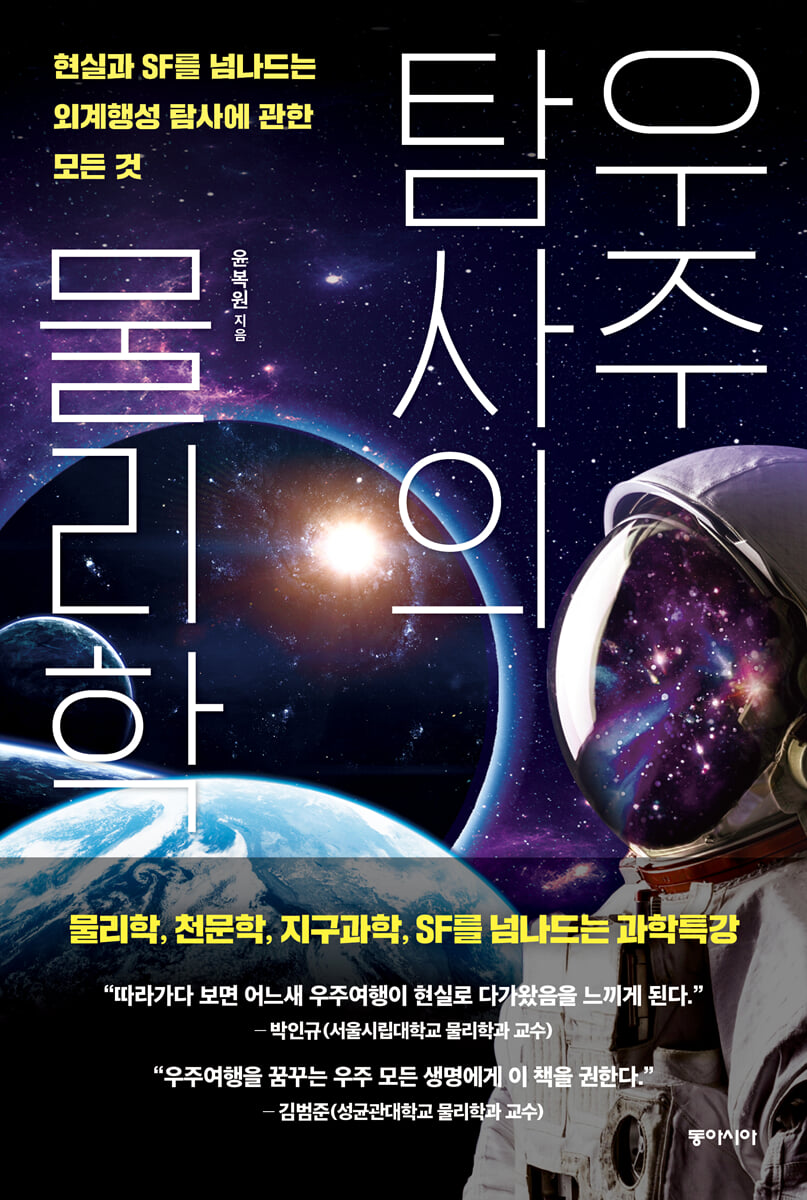
Physics of Space Exploration
 |
Description
Book Introduction
Physics, aerospace engineering, astronomy, earth science, science fiction…
Towards exoplanets and for space exploration
A friendly science lecture to satisfy all intellectual curiosity.
It contains scientific knowledge that should be considered during the long journey of space exploration that connects the past, present, near future, and very distant future.
It focuses particularly on scientific knowledge related to manned space exploration.
This book thoroughly explains, based on scientific knowledge, the fact that what we feel as gravity is not gravity, weightlessness created through free fall, the future weightlessness experience using Hyperloop, the initial speed and escape velocity of a spaceship, the effects of orbit and rotation on spaceship launch and flight, gravity-assist navigation that can increase spaceship speed without rocket propulsion, Earth's defense against asteroid or comet collisions, how to create artificial gravity necessary for long-term manned spaceflight, and special phenomena that occur in artificial gravity.
It explains the scientific knowledge related to finding exoplanets, mirages appearing on the ground and in space, and gravitational waves that occur when black holes merge, and explains what will happen in manned space exploration to exoplanets in the very distant future using the theory of special relativity.
It is full of information about why places that take light hundreds of years to travel can be reached in just a few decades, the twin paradox, the process of accelerating a spaceship to near the speed of light, and the energy required to do so.
Towards exoplanets and for space exploration
A friendly science lecture to satisfy all intellectual curiosity.
It contains scientific knowledge that should be considered during the long journey of space exploration that connects the past, present, near future, and very distant future.
It focuses particularly on scientific knowledge related to manned space exploration.
This book thoroughly explains, based on scientific knowledge, the fact that what we feel as gravity is not gravity, weightlessness created through free fall, the future weightlessness experience using Hyperloop, the initial speed and escape velocity of a spaceship, the effects of orbit and rotation on spaceship launch and flight, gravity-assist navigation that can increase spaceship speed without rocket propulsion, Earth's defense against asteroid or comet collisions, how to create artificial gravity necessary for long-term manned spaceflight, and special phenomena that occur in artificial gravity.
It explains the scientific knowledge related to finding exoplanets, mirages appearing on the ground and in space, and gravitational waves that occur when black holes merge, and explains what will happen in manned space exploration to exoplanets in the very distant future using the theory of special relativity.
It is full of information about why places that take light hundreds of years to travel can be reached in just a few decades, the twin paradox, the process of accelerating a spaceship to near the speed of light, and the energy required to do so.
- You can preview some of the book's contents.
Preview
index
prolog
Part 1: Zero Gravity and Satellites
Is it possible to achieve the dream of flying in the sky naked?
How to create zero gravity
The identity of zero gravity
Experience the future of weightlessness with Starship and Hyperloop
Experience weightlessness on an imaginary Earth
The Earth's rotation period is not 24 hours.
Why do satellites and missiles bend as they fly?
Part 2: Space Exploration of the Solar System
What is initial velocity?
Initial velocity to get to the moon and other planets
Gravity-assisted navigation is an invisible, free propulsion system.
Gravity-assisted navigation, also used for Mercury and solar exploration
What does the shape of a spacecraft's orbit mean?
Rockets, ion propulsion, and the photonic rocket of the future
Part 3: Asteroids, Comets, and the Earth's Orientation
Why are asteroids and comets bumpy?
Where did the energy from the asteroid impact that wiped out the dinosaurs come from?
What if a comet hits Earth?
Earth's defense against asteroid and comet impacts
Part 4: Artificial Gravity Required for Long-Term Manned Space Exploration
How did the Seattle train derailment happen?
Artificial gravity in sports
How to create artificial gravity in space
What if you juggle in artificial gravity?
The difference between flat and horizontal
The inertial force that explains weightlessness
The nature of artificial gravity and gravity as seen through inertial force
Part 5: Finding Extraterrestrial Objects
The first exoplanet observations and the Doppler effect
The Science of Shadows: Exoplanet Observations and X-ray Imaging
The Science of Mirages: What Would a Black Hole Look Like Up Close?
How do you measure distance?
Catching up on the first gravitational wave observation paper
Part 6: Manned Exploration of Exoplanets: Explained with Special Relativity
What happens when a spaceship approaches the speed of light?
The Twin Paradox: The Difference Between Knowing and Seeing
How fast can a manned spacecraft accelerate?
The energy required to accelerate to near the speed of light
Epilogue
main
Image source
Part 1: Zero Gravity and Satellites
Is it possible to achieve the dream of flying in the sky naked?
How to create zero gravity
The identity of zero gravity
Experience the future of weightlessness with Starship and Hyperloop
Experience weightlessness on an imaginary Earth
The Earth's rotation period is not 24 hours.
Why do satellites and missiles bend as they fly?
Part 2: Space Exploration of the Solar System
What is initial velocity?
Initial velocity to get to the moon and other planets
Gravity-assisted navigation is an invisible, free propulsion system.
Gravity-assisted navigation, also used for Mercury and solar exploration
What does the shape of a spacecraft's orbit mean?
Rockets, ion propulsion, and the photonic rocket of the future
Part 3: Asteroids, Comets, and the Earth's Orientation
Why are asteroids and comets bumpy?
Where did the energy from the asteroid impact that wiped out the dinosaurs come from?
What if a comet hits Earth?
Earth's defense against asteroid and comet impacts
Part 4: Artificial Gravity Required for Long-Term Manned Space Exploration
How did the Seattle train derailment happen?
Artificial gravity in sports
How to create artificial gravity in space
What if you juggle in artificial gravity?
The difference between flat and horizontal
The inertial force that explains weightlessness
The nature of artificial gravity and gravity as seen through inertial force
Part 5: Finding Extraterrestrial Objects
The first exoplanet observations and the Doppler effect
The Science of Shadows: Exoplanet Observations and X-ray Imaging
The Science of Mirages: What Would a Black Hole Look Like Up Close?
How do you measure distance?
Catching up on the first gravitational wave observation paper
Part 6: Manned Exploration of Exoplanets: Explained with Special Relativity
What happens when a spaceship approaches the speed of light?
The Twin Paradox: The Difference Between Knowing and Seeing
How fast can a manned spacecraft accelerate?
The energy required to accelerate to near the speed of light
Epilogue
main
Image source
Into the book
The Earth's rotation also affects missile launch speed.
Missiles launched from Earth gain the added speed of the Earth's rotation.
If a ball is thrown precisely upwards from a moving bus, the ball will go up if seen by a person inside the bus, but if seen by a person standing on the street outside the bus, the ball will also move in the direction the bus is moving.
When viewed from the ground, a missile launched from the ground moves at the speed and direction in which it was launched.
However, when viewed from far away in space, the speed at which the Earth rotates is added, so it appears to fly in the direction of rotation rather than the direction seen from the ground.
The speed at which the Earth rotates varies with latitude.
At the same sea level, the point located at the equator is the point farthest from the Earth's rotational axis.
Because of this, the speed of rotation is fastest at the equator, reaching 465 meters per second.
At latitude 30 degrees it is 402 meters per second, decreasing to 233 meters per second at latitude 60 degrees.
The North and South Poles are located on the Earth's axis of rotation, so they just rotate in place.
Therefore, the closer to the equator you launch, the more speed the missile gains as a bonus from the Earth's rotation.
---From "Part 1: Zero Gravity and Artificial Satellites / pp. 64-65"
The closest planet to the sun is Mercury.
The distance between Earth and Mercury ranges from 77 million kilometers at its shortest to 220 million kilometers at its farthest.
Meanwhile, the distance between Earth and Jupiter is 600 million kilometers at its shortest.
This suggests that Mercury may have been explored much earlier, as it is much closer to Earth than Jupiter.
However, the timing of the first Mercury exploration is similar to that of the first Jupiter exploration.
Pioneer 10 was launched on March 3, 1972, and made its first closest approach to Jupiter on December 4, 1973, while Mariner 10, the first Mercury probe, was launched on November 3, 1973, and made its closest approach to Mercury on March 29, 1974.
The Mercury probe must fly towards Mercury, which orbits further inside the planet than Earth.
But the problem is the spacecraft's high speed, which is given the bonus of Earth's orbital speed.
The inertia that pulls the spacecraft strongly in the direction of its orbit around the Earth makes it difficult to change direction.
This is because the faster the spaceship, the greater the change in speed required to change direction in the same way.
It is similar to the way a boat crosses a fast-flowing river, no matter how hard you row, to a person standing on the riverbank the boat appears to be being pushed by the fast current and moving in the same direction as the current.
---From "Part 2: Exploration of the Solar System / pp. 109-111"
If you add more water to the left side of a U-shaped glass tube containing water, the water level on the left side will rise higher at that moment.
As it gets higher, more water is being pressed down by gravity, so the pressure of the water on the left increases.
Water moves from the left side, where you press harder, to the right, where you press less, through the connected lower parts.
Over time, the water level at both ends becomes equal and the pressure becomes equal, so the water no longer moves.
The fact that the water levels on both sides are equal means that the distance from the center of the Earth to the water surfaces on both sides is equal.
Likewise, a celestial body made of fluids will have its internal matter shifted to become a spherical shape in which the distance from the center of the celestial body to its surface is the same.
The Sun and the Jovian planets are mostly filled with a fluid, either gas or liquid, inside.
This makes it easier for matter to move within a celestial body, which is advantageous for the celestial body to form a stable spherical shape.
However, there are many celestial bodies made of solid materials that are difficult to change shape.
In the case of Earth and Mars, most of the material that makes up their interior is very hard rock, but overall they are shaped like round balls.
Explaining these spherical rocky planets requires understanding the pressure within the body caused by the planet's own weight.
---From "Part 3: Asteroids, Comets, and the Orientation of the Earth/ pp. 156-157"
The movie The Martian (2015) features a spaceship called Hermes that travels between Earth and Mars.
The Hermes spacecraft, which travels between planets while accelerating with ion propulsion, accelerates very slowly, so without special equipment, it is virtually weightless inside the spacecraft.
In this film, astronauts also live in a living facility that creates artificial gravity through rotation.
The radius of the rotating habitable space on the Hermes spacecraft is about 15 meters.
In this case, it would take 7.77 seconds to complete one rotation to create an artificial gravity equal to that on the Earth's surface.
The speed at which the residential facility rotates is 12.1 meters per second.
If you run at 2 meters per second in the direction of rotation here, the rotation speed of the residential facility will be increased by 2 meters per second, making the runner's rotation speed 14.1 meters per second.
In this case, the magnitude of the artificial gravity felt by the runner is 1.35 times that of the Earth's surface gravity.
That's 35% more gravity than when you're standing still.
If the runner runs at 2 meters per second in the opposite direction of rotation, the runner will be spinning at 10.1 meters per second, and the magnitude of artificial gravity will be 0.69 times that of the Earth's surface gravity.
That's 31% less gravity than when you're standing still.
---From "Artificial Gravity Required for Long-Term Manned Space Exploration, Part 4 / pp. 229-230"
In 1995, Professor Mayor and his then-student Professor Kello observed the light of a star called '51 Pegasus' located in the constellation Pegasus.
We confirmed that blue and red shifts appear in the spectrum that separates starlight into light of various frequencies.
A blue shift in the star's spectrum means the star is moving toward Earth, and a red shift means the star is moving away from Earth.
By calculating how much more blueshift or redshift there is, we can calculate how fast the star is moving toward or away from us.
Calculations using the observed Doppler effect showed that 51 Pegasus repeatedly approached and moved away at a speed of about 50 meters per second.
By measuring the time it takes for the star to move closer and further away, we can determine how the star moves in detail, and from this movement, we can determine that there is a planet orbiting the star 51 Pegasus.
It was the first observation confirming a planet orbiting a star outside our solar system.
---From "Part 5: Finding Extraterrestrial Bodies / Page 288"
Research results on so-called "habitable planets", exoplanets located in the "habitable zone" of a star that is at an appropriate distance from the star and may have an environment suitable for life, are being published steadily.
The nearest star is a red dwarf called Proxima Centauri, 4.25 light-years from Earth.
A 2016 paper published in the scientific journal Nature revealed that there is a planet orbiting this star that may have an environment similar to Earth.
The story goes that even the nearest star has a planet that could be used as a destination.
Planets orbiting the red dwarf TRAPPIST-1 are a bit of a special case.
Three of the seven planets are known to have the potential to be habitable.
If, in the distant future, humanity is forced to migrate to a new planet outside the solar system due to environmental destruction on Earth or if humans are forced to directly visit an exoplanet for exploration purposes, the planets of TRAPPIST-1 are likely to become candidates for the destination.
Missiles launched from Earth gain the added speed of the Earth's rotation.
If a ball is thrown precisely upwards from a moving bus, the ball will go up if seen by a person inside the bus, but if seen by a person standing on the street outside the bus, the ball will also move in the direction the bus is moving.
When viewed from the ground, a missile launched from the ground moves at the speed and direction in which it was launched.
However, when viewed from far away in space, the speed at which the Earth rotates is added, so it appears to fly in the direction of rotation rather than the direction seen from the ground.
The speed at which the Earth rotates varies with latitude.
At the same sea level, the point located at the equator is the point farthest from the Earth's rotational axis.
Because of this, the speed of rotation is fastest at the equator, reaching 465 meters per second.
At latitude 30 degrees it is 402 meters per second, decreasing to 233 meters per second at latitude 60 degrees.
The North and South Poles are located on the Earth's axis of rotation, so they just rotate in place.
Therefore, the closer to the equator you launch, the more speed the missile gains as a bonus from the Earth's rotation.
---From "Part 1: Zero Gravity and Artificial Satellites / pp. 64-65"
The closest planet to the sun is Mercury.
The distance between Earth and Mercury ranges from 77 million kilometers at its shortest to 220 million kilometers at its farthest.
Meanwhile, the distance between Earth and Jupiter is 600 million kilometers at its shortest.
This suggests that Mercury may have been explored much earlier, as it is much closer to Earth than Jupiter.
However, the timing of the first Mercury exploration is similar to that of the first Jupiter exploration.
Pioneer 10 was launched on March 3, 1972, and made its first closest approach to Jupiter on December 4, 1973, while Mariner 10, the first Mercury probe, was launched on November 3, 1973, and made its closest approach to Mercury on March 29, 1974.
The Mercury probe must fly towards Mercury, which orbits further inside the planet than Earth.
But the problem is the spacecraft's high speed, which is given the bonus of Earth's orbital speed.
The inertia that pulls the spacecraft strongly in the direction of its orbit around the Earth makes it difficult to change direction.
This is because the faster the spaceship, the greater the change in speed required to change direction in the same way.
It is similar to the way a boat crosses a fast-flowing river, no matter how hard you row, to a person standing on the riverbank the boat appears to be being pushed by the fast current and moving in the same direction as the current.
---From "Part 2: Exploration of the Solar System / pp. 109-111"
If you add more water to the left side of a U-shaped glass tube containing water, the water level on the left side will rise higher at that moment.
As it gets higher, more water is being pressed down by gravity, so the pressure of the water on the left increases.
Water moves from the left side, where you press harder, to the right, where you press less, through the connected lower parts.
Over time, the water level at both ends becomes equal and the pressure becomes equal, so the water no longer moves.
The fact that the water levels on both sides are equal means that the distance from the center of the Earth to the water surfaces on both sides is equal.
Likewise, a celestial body made of fluids will have its internal matter shifted to become a spherical shape in which the distance from the center of the celestial body to its surface is the same.
The Sun and the Jovian planets are mostly filled with a fluid, either gas or liquid, inside.
This makes it easier for matter to move within a celestial body, which is advantageous for the celestial body to form a stable spherical shape.
However, there are many celestial bodies made of solid materials that are difficult to change shape.
In the case of Earth and Mars, most of the material that makes up their interior is very hard rock, but overall they are shaped like round balls.
Explaining these spherical rocky planets requires understanding the pressure within the body caused by the planet's own weight.
---From "Part 3: Asteroids, Comets, and the Orientation of the Earth/ pp. 156-157"
The movie The Martian (2015) features a spaceship called Hermes that travels between Earth and Mars.
The Hermes spacecraft, which travels between planets while accelerating with ion propulsion, accelerates very slowly, so without special equipment, it is virtually weightless inside the spacecraft.
In this film, astronauts also live in a living facility that creates artificial gravity through rotation.
The radius of the rotating habitable space on the Hermes spacecraft is about 15 meters.
In this case, it would take 7.77 seconds to complete one rotation to create an artificial gravity equal to that on the Earth's surface.
The speed at which the residential facility rotates is 12.1 meters per second.
If you run at 2 meters per second in the direction of rotation here, the rotation speed of the residential facility will be increased by 2 meters per second, making the runner's rotation speed 14.1 meters per second.
In this case, the magnitude of the artificial gravity felt by the runner is 1.35 times that of the Earth's surface gravity.
That's 35% more gravity than when you're standing still.
If the runner runs at 2 meters per second in the opposite direction of rotation, the runner will be spinning at 10.1 meters per second, and the magnitude of artificial gravity will be 0.69 times that of the Earth's surface gravity.
That's 31% less gravity than when you're standing still.
---From "Artificial Gravity Required for Long-Term Manned Space Exploration, Part 4 / pp. 229-230"
In 1995, Professor Mayor and his then-student Professor Kello observed the light of a star called '51 Pegasus' located in the constellation Pegasus.
We confirmed that blue and red shifts appear in the spectrum that separates starlight into light of various frequencies.
A blue shift in the star's spectrum means the star is moving toward Earth, and a red shift means the star is moving away from Earth.
By calculating how much more blueshift or redshift there is, we can calculate how fast the star is moving toward or away from us.
Calculations using the observed Doppler effect showed that 51 Pegasus repeatedly approached and moved away at a speed of about 50 meters per second.
By measuring the time it takes for the star to move closer and further away, we can determine how the star moves in detail, and from this movement, we can determine that there is a planet orbiting the star 51 Pegasus.
It was the first observation confirming a planet orbiting a star outside our solar system.
---From "Part 5: Finding Extraterrestrial Bodies / Page 288"
Research results on so-called "habitable planets", exoplanets located in the "habitable zone" of a star that is at an appropriate distance from the star and may have an environment suitable for life, are being published steadily.
The nearest star is a red dwarf called Proxima Centauri, 4.25 light-years from Earth.
A 2016 paper published in the scientific journal Nature revealed that there is a planet orbiting this star that may have an environment similar to Earth.
The story goes that even the nearest star has a planet that could be used as a destination.
Planets orbiting the red dwarf TRAPPIST-1 are a bit of a special case.
Three of the seven planets are known to have the potential to be habitable.
If, in the distant future, humanity is forced to migrate to a new planet outside the solar system due to environmental destruction on Earth or if humans are forced to directly visit an exoplanet for exploration purposes, the planets of TRAPPIST-1 are likely to become candidates for the destination.
---From "Part 6: Manned Exploration of Exoplanets Using Special Relativity / pp. 434-435"
Publisher's Review
Everything about exoplanet exploration, where reality and science fiction meet.
Satisfy all your intellectual curiosity about space exploration.
In Le Voyage dans la Lune (1902), known as the world's first science fiction film, a manned spaceship is launched to the moon using a cannon.
It's a somewhat odd-looking launch method, closer to a cannonball than a spaceship, but the speed of the spaceship as it leaves the cannon barrel does a good job of representing its initial velocity.
This is because it expresses a spacecraft that flies only with the inertia of its initial velocity without using additional propulsion after launch.
The film 2001: A Space Odyssey (1968) details how to create artificial gravity on a spaceship.
It is a method of creating artificial gravity by rotating.
In The Martian (2015), there is a spaceship called Hermes that travels between Earth and Mars. This spaceship accelerates very slowly, so without special equipment, the spaceship is practically weightless.
In this film, astronauts also live in a living facility that creates artificial gravity through rotation.
“Don't Look Up” (2021) depicts a hypothetical crisis in which a comet collides with Earth, while “Armageddon” (1998) tells the story of an asteroid heading towards Earth.
As expressed in numerous science fiction films, we have continuously dreamed of 'space exploration' from the 20th century to the present 21st century, and have been working to develop science and technology to make it come true.
On June 21, 2022, South Korea successfully launched an artificial satellite using Nuri, a propulsion system developed with its own technology, and on August 5, 2022, the country also developed a lunar orbiter, Danuri, and placed it into orbit around the moon using a ballistic lunar transfer method.
Space exploration or the search for extraterrestrial bodies is no longer confined to the realm of science fiction.
As science advances, we dream of leaving Earth and exploring the vast, unknown universe.
But when watching a movie that travels through the distant universe, there are times when you wonder if such a setting makes scientific sense.
If the story writer is not familiar with the basic scientific laws or theories related to space travel, the story may lack scientific validity.
Conversely, if the audience or readers are not familiar with scientific laws and theories, even a well-crafted story may be misunderstood as lacking scientific validity.
It cannot be ignored that with little direct experience and limited information about space travel, we have to rely to some extent on our imagination to create and enjoy stories.
If there is any part that lacks scientific validity or is questionable, it is a good idea to look into it at least once.
You can understand science better and sometimes even learn scientific facts you didn't know before.
Published with this purpose, the new book, "The Physics of Space Exploration," introduces the general story and basic knowledge of space, and examines the launch of spacecraft toward habitable exoplanets and the many scientific knowledge related to it.
That is, it provides the scientific knowledge that is essential for our hopes and adventures in space, especially the foundation for studying physics, which is considered difficult.
Although physics accounts for a relatively large portion of the book, astronomy, earth science, and aerospace engineering also occupy a significant portion.
Therefore, it can be said that it covers a wide range of scientific fields related to space exploration.
Each page is filled with a variety of rich photographic materials, and most of the illustrations explaining scientific content were drawn by the author himself, making the content easy to understand and helping readers fully understand.
Find a 'habitable planet' with an environment similar to Earth!
Physics, aerospace engineering, astronomy, and earth science all in one volume.
Space technology, which began to be implemented in earnest in the late 1950s, sent humans into outer space in 1961 and to the surface of the moon, a celestial body beyond Earth, in 1969.
Unmanned space exploration also continued, with probes sent to every planet in the solar system by the 1980s.
In the 21st century, we have been exploring various celestial bodies, including Pluto, which was demoted to a dwarf planet, Ceres, a dwarf planet in the asteroid belt, and Comet Churyumov-Gerasimenko.
Korea, which has consistently invested in aerospace science and technology, successfully launched an artificial satellite with Nuri and also developed a lunar orbiter, Danuri.
There were also advancements in astronomical observation.
Exoplanet observations, which began in the 1990s, have yielded results that have led to the discovery of over 5,000 exoplanets by 2022.
Research results on so-called "habitable planets" that are located at an appropriate distance from their stars and may have an environment suitable for life are steadily being published.
The nearest star is a red dwarf called Proxima Centauri, 4.25 light-years from Earth.
A 2016 paper published in the scientific journal Nature revealed that there is a planet orbiting this star that may have an environment similar to Earth.
The story goes that even the nearest star has a planet that could be used as a destination.
Although we have yet to send humans to any celestial body other than the Moon, news of exoplanet discoveries leads us to imagine setting foot on a habitable exoplanet and developing a colony there.
It is an imagination filled with hope that this will be possible in the distant future when science and technology have developed tremendously.
"The Physics of Space Exploration" contains scientific knowledge that should be considered during the long journey of space exploration that connects the past, present, near future, and the very distant future.
It focuses particularly on scientific knowledge related to manned space exploration.
This book thoroughly explains, based on scientific knowledge, the fact that what we feel as gravity is not gravity, weightlessness created through free fall, the future weightlessness experience using Hyperloop, the initial speed and escape velocity of a spaceship, the effects of orbit and rotation on spaceship launch and flight, gravity-assist navigation that can increase spaceship speed without rocket propulsion, Earth's defense against asteroid or comet collisions, how to create artificial gravity necessary for long-term manned spaceflight, and special phenomena that occur in artificial gravity.
The latter part of the book explains the science behind finding exoplanets, mirages on Earth and in space, and observing gravitational waves that occur when black holes merge.
Finally, the events and results of manned space exploration toward an exoplanet in the very distant future are explained using the special theory of relativity.
We explore why places that take light hundreds of years to travel can be reached in just a few decades, the twin paradox, the process of accelerating a spaceship to near the speed of light, and the energy required to do so.
The book explains things with care not only for the general public but also for science enthusiasts.
Parts that may not be easy to understand through text alone have been supplemented with various illustrations.
Unless absolutely necessary, formulas are avoided whenever possible.
It also explains how to apply the basic principles of related science and technology.
We scientifically examined not only current and future science and technology, but also content that exists only in the imagination.
The author, Dr. Bok-Won Yoon, stated that he wrote this book in the hope that many people, from elementary, middle, and high school students to college students and adults, would gain scientific information related to space travel and satisfy their intellectual curiosity.
These days, non-fiction texts, including science texts, are appearing in the Korean language section of the College Scholastic Ability Test. This will be very helpful in building basic science knowledge to prepare for the CSAT.
Moreover, this book will likely serve as a companion that provides detailed scientific knowledge that should be verified when writing about space travel, and thus, it will be of particular value to science fiction writers in many ways.
For scientists to communicate with the general public…
Bringing knowledge based on fundamental physics to the public
Communicating science between scientists and the general public is not easy.
The biggest problem is that the content itself is difficult.
To overcome this problem, it is important for scientists to make an effort to explain science in an easy-to-understand way.
Despite such efforts, if communication with the public remains difficult, the role of those who serve as intermediaries between scientists and the public is also important.
This includes science communicators, including science journalists and YouTubers.
Scientists need to provide them with accurate scientific information and provide feedback on their activities with the public.
There is also the problem of the 'terminology barrier'.
The terms that scientists use naturally and habitually can be difficult for the general public to understand, or even to grasp, what they mean.
Scientists may not even be aware that the public finds these terms difficult.
If possible, we should try to rewrite it in simple terms, and if that is difficult, we should try to provide easy explanations of the terms.
There is also the scientist's 'problem of consideration'.
When it comes to scientific topics that the public wants to know about, we should avoid responding with things like, "If you want to know, study it" or "If you're not a specialist, you won't know even if you study it."
Such comments can be hurtful to some members of the public, and may subsequently lead them to block all communication with scientists.
The author recognized these problems and became the first to write and contribute scientific articles to a general audience.
My first article of 2014 was about the 'twin paradox' of special relativity.
The theory of relativity was a basic physics knowledge that all physicists had to learn, and since then, most of the books have been based on basic physics knowledge, and the contents of the books have mainly dealt with topics that the author was personally interested in.
I paid attention to what was reported in the news and didn't forget to check it by doing my own calculations.
The author believed that writing a story without any verification was not the right attitude for a scientist.
In this way, Dr. Yoon Bok-won compiled scientific knowledge related to space and space travel into a book and presented it to the public.
The book is divided into six parts.
Parts 1 through 5 cover scientific knowledge related to existing space exploration, while the final part, Part 6, focuses on space exploration of exoplanets, which is likely to occur in the very distant future.
The author says that what happens after Part 6 is left to the reader's imagination and the advanced science and technology of the distant future.
Satisfy all your intellectual curiosity about space exploration.
In Le Voyage dans la Lune (1902), known as the world's first science fiction film, a manned spaceship is launched to the moon using a cannon.
It's a somewhat odd-looking launch method, closer to a cannonball than a spaceship, but the speed of the spaceship as it leaves the cannon barrel does a good job of representing its initial velocity.
This is because it expresses a spacecraft that flies only with the inertia of its initial velocity without using additional propulsion after launch.
The film 2001: A Space Odyssey (1968) details how to create artificial gravity on a spaceship.
It is a method of creating artificial gravity by rotating.
In The Martian (2015), there is a spaceship called Hermes that travels between Earth and Mars. This spaceship accelerates very slowly, so without special equipment, the spaceship is practically weightless.
In this film, astronauts also live in a living facility that creates artificial gravity through rotation.
“Don't Look Up” (2021) depicts a hypothetical crisis in which a comet collides with Earth, while “Armageddon” (1998) tells the story of an asteroid heading towards Earth.
As expressed in numerous science fiction films, we have continuously dreamed of 'space exploration' from the 20th century to the present 21st century, and have been working to develop science and technology to make it come true.
On June 21, 2022, South Korea successfully launched an artificial satellite using Nuri, a propulsion system developed with its own technology, and on August 5, 2022, the country also developed a lunar orbiter, Danuri, and placed it into orbit around the moon using a ballistic lunar transfer method.
Space exploration or the search for extraterrestrial bodies is no longer confined to the realm of science fiction.
As science advances, we dream of leaving Earth and exploring the vast, unknown universe.
But when watching a movie that travels through the distant universe, there are times when you wonder if such a setting makes scientific sense.
If the story writer is not familiar with the basic scientific laws or theories related to space travel, the story may lack scientific validity.
Conversely, if the audience or readers are not familiar with scientific laws and theories, even a well-crafted story may be misunderstood as lacking scientific validity.
It cannot be ignored that with little direct experience and limited information about space travel, we have to rely to some extent on our imagination to create and enjoy stories.
If there is any part that lacks scientific validity or is questionable, it is a good idea to look into it at least once.
You can understand science better and sometimes even learn scientific facts you didn't know before.
Published with this purpose, the new book, "The Physics of Space Exploration," introduces the general story and basic knowledge of space, and examines the launch of spacecraft toward habitable exoplanets and the many scientific knowledge related to it.
That is, it provides the scientific knowledge that is essential for our hopes and adventures in space, especially the foundation for studying physics, which is considered difficult.
Although physics accounts for a relatively large portion of the book, astronomy, earth science, and aerospace engineering also occupy a significant portion.
Therefore, it can be said that it covers a wide range of scientific fields related to space exploration.
Each page is filled with a variety of rich photographic materials, and most of the illustrations explaining scientific content were drawn by the author himself, making the content easy to understand and helping readers fully understand.
Find a 'habitable planet' with an environment similar to Earth!
Physics, aerospace engineering, astronomy, and earth science all in one volume.
Space technology, which began to be implemented in earnest in the late 1950s, sent humans into outer space in 1961 and to the surface of the moon, a celestial body beyond Earth, in 1969.
Unmanned space exploration also continued, with probes sent to every planet in the solar system by the 1980s.
In the 21st century, we have been exploring various celestial bodies, including Pluto, which was demoted to a dwarf planet, Ceres, a dwarf planet in the asteroid belt, and Comet Churyumov-Gerasimenko.
Korea, which has consistently invested in aerospace science and technology, successfully launched an artificial satellite with Nuri and also developed a lunar orbiter, Danuri.
There were also advancements in astronomical observation.
Exoplanet observations, which began in the 1990s, have yielded results that have led to the discovery of over 5,000 exoplanets by 2022.
Research results on so-called "habitable planets" that are located at an appropriate distance from their stars and may have an environment suitable for life are steadily being published.
The nearest star is a red dwarf called Proxima Centauri, 4.25 light-years from Earth.
A 2016 paper published in the scientific journal Nature revealed that there is a planet orbiting this star that may have an environment similar to Earth.
The story goes that even the nearest star has a planet that could be used as a destination.
Although we have yet to send humans to any celestial body other than the Moon, news of exoplanet discoveries leads us to imagine setting foot on a habitable exoplanet and developing a colony there.
It is an imagination filled with hope that this will be possible in the distant future when science and technology have developed tremendously.
"The Physics of Space Exploration" contains scientific knowledge that should be considered during the long journey of space exploration that connects the past, present, near future, and the very distant future.
It focuses particularly on scientific knowledge related to manned space exploration.
This book thoroughly explains, based on scientific knowledge, the fact that what we feel as gravity is not gravity, weightlessness created through free fall, the future weightlessness experience using Hyperloop, the initial speed and escape velocity of a spaceship, the effects of orbit and rotation on spaceship launch and flight, gravity-assist navigation that can increase spaceship speed without rocket propulsion, Earth's defense against asteroid or comet collisions, how to create artificial gravity necessary for long-term manned spaceflight, and special phenomena that occur in artificial gravity.
The latter part of the book explains the science behind finding exoplanets, mirages on Earth and in space, and observing gravitational waves that occur when black holes merge.
Finally, the events and results of manned space exploration toward an exoplanet in the very distant future are explained using the special theory of relativity.
We explore why places that take light hundreds of years to travel can be reached in just a few decades, the twin paradox, the process of accelerating a spaceship to near the speed of light, and the energy required to do so.
The book explains things with care not only for the general public but also for science enthusiasts.
Parts that may not be easy to understand through text alone have been supplemented with various illustrations.
Unless absolutely necessary, formulas are avoided whenever possible.
It also explains how to apply the basic principles of related science and technology.
We scientifically examined not only current and future science and technology, but also content that exists only in the imagination.
The author, Dr. Bok-Won Yoon, stated that he wrote this book in the hope that many people, from elementary, middle, and high school students to college students and adults, would gain scientific information related to space travel and satisfy their intellectual curiosity.
These days, non-fiction texts, including science texts, are appearing in the Korean language section of the College Scholastic Ability Test. This will be very helpful in building basic science knowledge to prepare for the CSAT.
Moreover, this book will likely serve as a companion that provides detailed scientific knowledge that should be verified when writing about space travel, and thus, it will be of particular value to science fiction writers in many ways.
For scientists to communicate with the general public…
Bringing knowledge based on fundamental physics to the public
Communicating science between scientists and the general public is not easy.
The biggest problem is that the content itself is difficult.
To overcome this problem, it is important for scientists to make an effort to explain science in an easy-to-understand way.
Despite such efforts, if communication with the public remains difficult, the role of those who serve as intermediaries between scientists and the public is also important.
This includes science communicators, including science journalists and YouTubers.
Scientists need to provide them with accurate scientific information and provide feedback on their activities with the public.
There is also the problem of the 'terminology barrier'.
The terms that scientists use naturally and habitually can be difficult for the general public to understand, or even to grasp, what they mean.
Scientists may not even be aware that the public finds these terms difficult.
If possible, we should try to rewrite it in simple terms, and if that is difficult, we should try to provide easy explanations of the terms.
There is also the scientist's 'problem of consideration'.
When it comes to scientific topics that the public wants to know about, we should avoid responding with things like, "If you want to know, study it" or "If you're not a specialist, you won't know even if you study it."
Such comments can be hurtful to some members of the public, and may subsequently lead them to block all communication with scientists.
The author recognized these problems and became the first to write and contribute scientific articles to a general audience.
My first article of 2014 was about the 'twin paradox' of special relativity.
The theory of relativity was a basic physics knowledge that all physicists had to learn, and since then, most of the books have been based on basic physics knowledge, and the contents of the books have mainly dealt with topics that the author was personally interested in.
I paid attention to what was reported in the news and didn't forget to check it by doing my own calculations.
The author believed that writing a story without any verification was not the right attitude for a scientist.
In this way, Dr. Yoon Bok-won compiled scientific knowledge related to space and space travel into a book and presented it to the public.
The book is divided into six parts.
Parts 1 through 5 cover scientific knowledge related to existing space exploration, while the final part, Part 6, focuses on space exploration of exoplanets, which is likely to occur in the very distant future.
The author says that what happens after Part 6 is left to the reader's imagination and the advanced science and technology of the distant future.
GOODS SPECIFICS
- Date of issue: March 28, 2023
- Page count, weight, size: 484 pages | 678g | 148*220*23mm
- ISBN13: 9788962624861
- ISBN10: 8962624869
You may also like
카테고리
korean


korean

![GQ KOREA Mark (Monthly): December [2025]](http://librairie.coreenne.fr/cdn/shop/files/8ef265dbbfbf186523ed75ba7319009d.jpg?v=1765340328&width=3840)


