

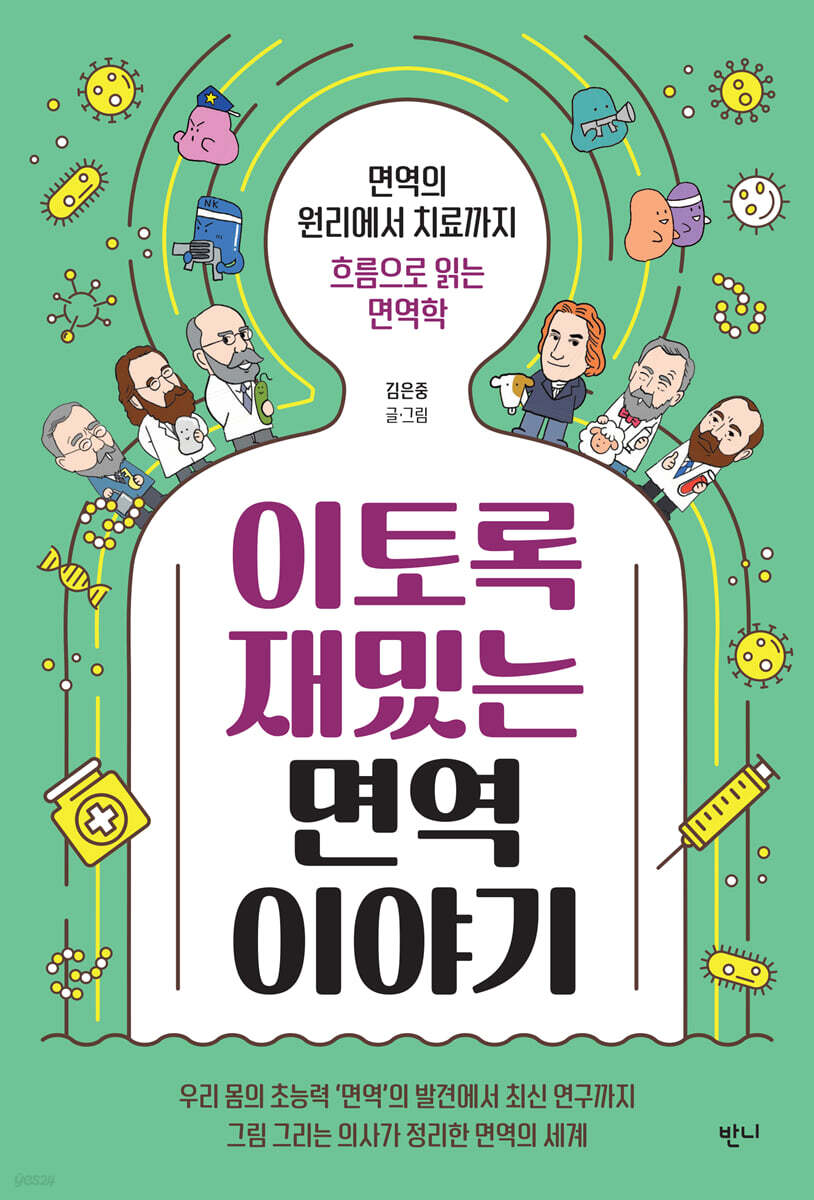
Such a fun immunity story
 |
Description
Book Introduction
How does immunity protect us?
And why do they attack our bodies?
From the discovery of our body's superpower, "immunity," to the latest research.
The World of Immunity Organized by a Drawing Doctor
The second book by author Kim Eun-joong, a doctor who draws pictures, has been published, "Such a Fun Story of Immunity."
While the previous work, "Such an Interesting Medical Story," illuminated the process from ancient times to the birth of modern medicine, this book explores the history of immunology, from the discovery of immunity to the latest research.
As with the previous work, the hand-drawn cartoon-like illustrations help understand the content and increase interest.
This time in particular, cute immune cell characters are introduced to easily explain the difficult principles of immunity, adding a unique fun element.
As a practicing ENT doctor, he provides expert information on various immune diseases, including allergic reactions, in an easy-to-understand and detailed manner.
How does the immune system protect us? And why does it sometimes attack us? The COVID-19 pandemic has heightened our interest in immunity.
PCR tests, known as genetic amplification tests, and mRNA vaccines, which were developed faster than ever before, have been humanity's key weapons against the coronavirus.
We have easily benefited from the knowledge of immunology, but behind it are hidden stories of doctors who have painstakingly explored the unknown world of immunity over a long period of time.
Just as in superhero movies, an ordinary person who didn't realize his own abilities becomes aware of his own inherent superpowers and then a truly interesting story unfolds, this book contains an exciting historical process in which medical scientists, awakened to the existence of germs and the human body's defense capabilities, use the immune system to launch a full-scale counterattack against microorganisms.
And it contains various knowledge about immunity that they have dedicated their lives to discovering.
This book will satisfy readers' intellectual curiosity about immunity and serve as an excellent guide to a healthy immune system.
And why do they attack our bodies?
From the discovery of our body's superpower, "immunity," to the latest research.
The World of Immunity Organized by a Drawing Doctor
The second book by author Kim Eun-joong, a doctor who draws pictures, has been published, "Such a Fun Story of Immunity."
While the previous work, "Such an Interesting Medical Story," illuminated the process from ancient times to the birth of modern medicine, this book explores the history of immunology, from the discovery of immunity to the latest research.
As with the previous work, the hand-drawn cartoon-like illustrations help understand the content and increase interest.
This time in particular, cute immune cell characters are introduced to easily explain the difficult principles of immunity, adding a unique fun element.
As a practicing ENT doctor, he provides expert information on various immune diseases, including allergic reactions, in an easy-to-understand and detailed manner.
How does the immune system protect us? And why does it sometimes attack us? The COVID-19 pandemic has heightened our interest in immunity.
PCR tests, known as genetic amplification tests, and mRNA vaccines, which were developed faster than ever before, have been humanity's key weapons against the coronavirus.
We have easily benefited from the knowledge of immunology, but behind it are hidden stories of doctors who have painstakingly explored the unknown world of immunity over a long period of time.
Just as in superhero movies, an ordinary person who didn't realize his own abilities becomes aware of his own inherent superpowers and then a truly interesting story unfolds, this book contains an exciting historical process in which medical scientists, awakened to the existence of germs and the human body's defense capabilities, use the immune system to launch a full-scale counterattack against microorganisms.
And it contains various knowledge about immunity that they have dedicated their lives to discovering.
This book will satisfy readers' intellectual curiosity about immunity and serve as an excellent guide to a healthy immune system.
- You can preview some of the book's contents.
Preview
index
Introduction
prolog
Let's start talking about immunology
Chapter 1: Fundamentals of Immunology
Antigens and Antibodies | Innate and Acquired | White Blood? The Discovery of Leukocytes | Various Immune Cells…
Chapter 2: The Birth and Development of Immunology
There's no second chance|Injecting cow secretions into humans?|Bacteria were the cause of disease?|Understanding the principles of vaccines…
Chapter 3: Innate Immunity
Even bacteria have a hard time | The sentinel of the border | The only scholar to receive the Nobel Prize after death | Natural Born Killers, natural killer cells…
Chapter 4: Acquired Immunity and Cellular Immunity
An experiment that brought white blood cells back into focus | A milestone on par with the discovery of DNA | Are lymph nodes swollen? They're actually lymph nodes | The hidden secrets of the thymus gland...
Chapter 5: Antibodies: The Heart of Humoral Immunity
Keys and Locks | Offering a Sacrifice | Antibodies Are No Longer Imaginary | Y Protects Us from Pathogens | Five Types of Antibodies …
Chapter 6: Immunity Created by Human Power, Vaccine Immunity
The development of vaccines after Pasteur | Typhoid Mary | Development of the tuberculosis vaccine BCG | The existence of viruses first revealed by tobacco...
Chapter 7: The Immune System: A Delicate Balance and Regulation
What Happens to the Immune System During Pregnancy | ABO Blood Types and Immune Responses | The Discovery of Anaphylaxis | Why Fatal Allergic Reactions Occur …
Chapter 8: Treating Diseases Using Immunology
The Birth of Monoclonal Antibodies | Interferon, a Cool Drug Name | Why We Get Fever and Interleukin | The Advent of Remicade, an Autoimmune Treatment...
Epilogue
Concluding the story of immunology
References
Photo source
Search
prolog
Let's start talking about immunology
Chapter 1: Fundamentals of Immunology
Antigens and Antibodies | Innate and Acquired | White Blood? The Discovery of Leukocytes | Various Immune Cells…
Chapter 2: The Birth and Development of Immunology
There's no second chance|Injecting cow secretions into humans?|Bacteria were the cause of disease?|Understanding the principles of vaccines…
Chapter 3: Innate Immunity
Even bacteria have a hard time | The sentinel of the border | The only scholar to receive the Nobel Prize after death | Natural Born Killers, natural killer cells…
Chapter 4: Acquired Immunity and Cellular Immunity
An experiment that brought white blood cells back into focus | A milestone on par with the discovery of DNA | Are lymph nodes swollen? They're actually lymph nodes | The hidden secrets of the thymus gland...
Chapter 5: Antibodies: The Heart of Humoral Immunity
Keys and Locks | Offering a Sacrifice | Antibodies Are No Longer Imaginary | Y Protects Us from Pathogens | Five Types of Antibodies …
Chapter 6: Immunity Created by Human Power, Vaccine Immunity
The development of vaccines after Pasteur | Typhoid Mary | Development of the tuberculosis vaccine BCG | The existence of viruses first revealed by tobacco...
Chapter 7: The Immune System: A Delicate Balance and Regulation
What Happens to the Immune System During Pregnancy | ABO Blood Types and Immune Responses | The Discovery of Anaphylaxis | Why Fatal Allergic Reactions Occur …
Chapter 8: Treating Diseases Using Immunology
The Birth of Monoclonal Antibodies | Interferon, a Cool Drug Name | Why We Get Fever and Interleukin | The Advent of Remicade, an Autoimmune Treatment...
Epilogue
Concluding the story of immunology
References
Photo source
Search
Detailed image

Into the book
In a world teeming with microbes, the ability to fight off attacks from surrounding pathogens is essential for survival.
Because various microorganisms did not wait patiently for living things to acquire defensive abilities and become somewhat prepared, only those born with basic immunity survived and were able to continue to produce descendants to this day.
Therefore, it can be said that all living things on Earth are born with basic immunity.
This innate immunity is called innate immunity or natural immunity.
---From "Chapter 1: Immunology Basics, p. 26"
Upon receiving a signal from a cytokine from a neutrophil, monocytes passing through a nearby blood vessel come out of the blood vessel and rush to the site of inflammation.
From the moment they leave the blood vessels, they are called 'macrophages'.
This is the cell that Metchnikoff discovered in 1883.
The name macrophage is reminiscent of a 'big eater' (a cell that seems to eat a lot), and in fact, it is a combination of the Greek words macros (large) and phagein (to eat).
Macrophages arrive after neutrophils when an infection signal is generated and engulf the pathogen.
Neutrophils and macrophages are called 'phagocytes', and the process by which they engulf pathogens is called 'phagocytosis'.
---From "Chapter 3 Innate Immunity, Congenital Immunity, p. 85"
On the other hand, Metchnikoff announced that immune cells called macrophages act to engulf pathogens, which is cellular immunity.
Ehrlich's humoral immunity and Metchnikoff's cellular immunity initially sharply criticized each other, but as further research progressed, both were proven to be true, and the Nobel Prize Committee awarded them the Nobel Prize in Physiology or Medicine simultaneously in 1908.
---From "Chapter 5: The Center of Humoral Immunity, Antibody Story, p. 165"
The placenta acts as a kind of filter, preventing the cells of the mother and baby from passing indiscriminately to each other.
However, necessary substances are allowed to pass through, and the baby's cute cells can cross over to the mother and repair her damaged tissues, and in return, the mother can pass on to the baby antibodies (IgG) that she has painstakingly developed throughout her life while enduring illness.
And these antibodies remain for more than six months after birth, protecting the baby.
So, mothers check for any antibody deficiency before pregnancy and get vaccinated in advance.
---From “Chapter 7: The Immune System: Delicate Balance and Control, p. 242”
Some deadly epidemics have not given our immune systems time to develop and have threatened the survival of humanity.
To combat this, doctors created vaccinations and antibiotics, and cleaned up the environment to prevent pathogens from taking hold.
As humanity achieved some degree of victory in the fight against infectious pathogens, our immune system, with less work to do, began to focus on non-infectious substances.
It caused an uncontrolled and excessive immune response to harmless dust, pollen, and food as if something serious had happened.
Because various microorganisms did not wait patiently for living things to acquire defensive abilities and become somewhat prepared, only those born with basic immunity survived and were able to continue to produce descendants to this day.
Therefore, it can be said that all living things on Earth are born with basic immunity.
This innate immunity is called innate immunity or natural immunity.
---From "Chapter 1: Immunology Basics, p. 26"
Upon receiving a signal from a cytokine from a neutrophil, monocytes passing through a nearby blood vessel come out of the blood vessel and rush to the site of inflammation.
From the moment they leave the blood vessels, they are called 'macrophages'.
This is the cell that Metchnikoff discovered in 1883.
The name macrophage is reminiscent of a 'big eater' (a cell that seems to eat a lot), and in fact, it is a combination of the Greek words macros (large) and phagein (to eat).
Macrophages arrive after neutrophils when an infection signal is generated and engulf the pathogen.
Neutrophils and macrophages are called 'phagocytes', and the process by which they engulf pathogens is called 'phagocytosis'.
---From "Chapter 3 Innate Immunity, Congenital Immunity, p. 85"
On the other hand, Metchnikoff announced that immune cells called macrophages act to engulf pathogens, which is cellular immunity.
Ehrlich's humoral immunity and Metchnikoff's cellular immunity initially sharply criticized each other, but as further research progressed, both were proven to be true, and the Nobel Prize Committee awarded them the Nobel Prize in Physiology or Medicine simultaneously in 1908.
---From "Chapter 5: The Center of Humoral Immunity, Antibody Story, p. 165"
The placenta acts as a kind of filter, preventing the cells of the mother and baby from passing indiscriminately to each other.
However, necessary substances are allowed to pass through, and the baby's cute cells can cross over to the mother and repair her damaged tissues, and in return, the mother can pass on to the baby antibodies (IgG) that she has painstakingly developed throughout her life while enduring illness.
And these antibodies remain for more than six months after birth, protecting the baby.
So, mothers check for any antibody deficiency before pregnancy and get vaccinated in advance.
---From “Chapter 7: The Immune System: Delicate Balance and Control, p. 242”
Some deadly epidemics have not given our immune systems time to develop and have threatened the survival of humanity.
To combat this, doctors created vaccinations and antibiotics, and cleaned up the environment to prevent pathogens from taking hold.
As humanity achieved some degree of victory in the fight against infectious pathogens, our immune system, with less work to do, began to focus on non-infectious substances.
It caused an uncontrolled and excessive immune response to harmless dust, pollen, and food as if something serious had happened.
---From "Epilogue, p. 305"
Publisher's Review
Understanding the principles of the immune system through pictures
The story of medical scientists who uncovered the secrets of immunity.
What happens when the immune system malfunctions? The 1976 film "The Boy in the Plastic Bubble" is based on the true story of David, a boy born with a congenital immune deficiency.
David was transferred into a sterile plastic bubble just 20 seconds after birth.
The boy, who had to wear a sterile spacesuit to go outside, received a bone marrow transplant from his sister, but it was contaminated with a virus, causing a severe infection and blood cancer.
Eventually, the medical team decides to take the boy out of the bubble.
David, who set foot on this world barefooted 12 years after birth, died before he could survive for two weeks.
"The Interesting Story of Immunity" provides insight into the principles of immunity by examining the flow of research on immunity, which is directly related to human life.
It covers everything from the discovery of immunity to the latest research, but it goes beyond simply listing medical knowledge about immunity.
It meticulously explains the development and birth of the core ideas of the immunologists who laid the foundation for modern immunology, and, like any engaging history book, appropriately reveals the unique aspects of the individuals involved.
The author's witty illustrations make it more approachable for medical professionals and the immune cells in our bodies.
It was in the mid-19th century that it was discovered that the pus flowing from the inflamed area was actually white blood cells.
Metchnikoff, who is well known to us for his research on lactic acid bacteria, took a hint from this discovery and proposed the theory that white blood cells protect the human body by consuming foreign substances and bacteria.
Metchnikoff named such white blood cells macrophages and received the Nobel Prize in Physiology or Medicine for his work.
It wasn't just lactic acid bacteria that won the Nobel Prize! Even white blood cells, now considered common knowledge, have fascinating stories hidden within them.
From the principles of immunity to treatment
Immunology through Flow
Looking at the structure of this book, Chapter 1 covers the fundamental concepts of immunology, such as antigens and antibodies, and Chapters 2 to 4 discuss innate and adaptive immunity.
Immunity is broadly divided into innate immunity and acquired immunity. Innate immunity mainly refers to immunity through the epithelial barrier (skin) and innate immune cells (white blood cells).
Acquired immunity is further divided into active immunity and passive immunity, and a representative example of active immunity is a vaccine.
Chapter 5 delves into antibodies, which bind to antigens, the triggers of immune responses, and defend the body.
It provides a glimpse into the intricate mechanisms of the immune system, showing how antibodies bind to antigens and induce immune cells such as macrophages.
The topic of Chapter 6 is vaccine immunity, which is both active immunity and a means of artificial immunity.
Covers the history of medicine related to vaccines since Pasteur created the rabies vaccine.
Chapter 7 examines the two faces of the immune system, where a delicate balance is key.
When the immune system overreacts, it can actually harm your health. Let's take a look at why.
Chapter 8 shows how immunology can be used to treat diseases, particularly cancer treatment.
Immunologists are now responding to a new immune system.
We have passed the era of unconditionally strengthening immunity and entered the stage of regulating immunity.
Immunologists, who had previously artificially stimulated immunity through vaccination, can now create drugs that can either boost or suppress immunity by making cytokines secreted by immune cells.
From the discovery of our body's superpower, "immunity," to the latest research, this book provides a clear overview.
For a healthy immune system
A request from a practicing doctor
In 1994, American neuroimmunologist Michael Irwin kept 23 healthy men awake from 3 a.m. to 7 a.m. and then checked their immune levels.
The results were significant.
Even just four hours of partial sleep deprivation was associated with a 72 percent decrease in the activity of natural killer cells in 18 of the 23 participants.
Natural killer cells are one of the representative innate immune cells, and if their activity decreases, they cannot suppress viruses and cancer cells in the early stages.
Fortunately, when the subjects were retested after a good night's sleep, their natural killer cell levels all returned to normal.
If getting enough sleep can help reduce colds and prevent cancer, what better treatment could there be? The author describes the immune system as a core brain in our body, requiring a delicate balance and delicate coordination, defending only when necessary and attacking only where necessary.
He also says we should be wary of various nutritional supplements and unverified medical claims that claim to boost immunity.
Excessive pressure to become stronger, as well as excessive overprotection, can damage the immune system.
Finally, the author offers the following words of advice from the perspective of a doctor caring for patients in the field.
“If we don’t forget our basic vaccinations, eat foods rich in fiber, use antibiotics correctly, and commit to getting enough sleep, our intelligent immune system will do its job.”
The story of medical scientists who uncovered the secrets of immunity.
What happens when the immune system malfunctions? The 1976 film "The Boy in the Plastic Bubble" is based on the true story of David, a boy born with a congenital immune deficiency.
David was transferred into a sterile plastic bubble just 20 seconds after birth.
The boy, who had to wear a sterile spacesuit to go outside, received a bone marrow transplant from his sister, but it was contaminated with a virus, causing a severe infection and blood cancer.
Eventually, the medical team decides to take the boy out of the bubble.
David, who set foot on this world barefooted 12 years after birth, died before he could survive for two weeks.
"The Interesting Story of Immunity" provides insight into the principles of immunity by examining the flow of research on immunity, which is directly related to human life.
It covers everything from the discovery of immunity to the latest research, but it goes beyond simply listing medical knowledge about immunity.
It meticulously explains the development and birth of the core ideas of the immunologists who laid the foundation for modern immunology, and, like any engaging history book, appropriately reveals the unique aspects of the individuals involved.
The author's witty illustrations make it more approachable for medical professionals and the immune cells in our bodies.
It was in the mid-19th century that it was discovered that the pus flowing from the inflamed area was actually white blood cells.
Metchnikoff, who is well known to us for his research on lactic acid bacteria, took a hint from this discovery and proposed the theory that white blood cells protect the human body by consuming foreign substances and bacteria.
Metchnikoff named such white blood cells macrophages and received the Nobel Prize in Physiology or Medicine for his work.
It wasn't just lactic acid bacteria that won the Nobel Prize! Even white blood cells, now considered common knowledge, have fascinating stories hidden within them.
From the principles of immunity to treatment
Immunology through Flow
Looking at the structure of this book, Chapter 1 covers the fundamental concepts of immunology, such as antigens and antibodies, and Chapters 2 to 4 discuss innate and adaptive immunity.
Immunity is broadly divided into innate immunity and acquired immunity. Innate immunity mainly refers to immunity through the epithelial barrier (skin) and innate immune cells (white blood cells).
Acquired immunity is further divided into active immunity and passive immunity, and a representative example of active immunity is a vaccine.
Chapter 5 delves into antibodies, which bind to antigens, the triggers of immune responses, and defend the body.
It provides a glimpse into the intricate mechanisms of the immune system, showing how antibodies bind to antigens and induce immune cells such as macrophages.
The topic of Chapter 6 is vaccine immunity, which is both active immunity and a means of artificial immunity.
Covers the history of medicine related to vaccines since Pasteur created the rabies vaccine.
Chapter 7 examines the two faces of the immune system, where a delicate balance is key.
When the immune system overreacts, it can actually harm your health. Let's take a look at why.
Chapter 8 shows how immunology can be used to treat diseases, particularly cancer treatment.
Immunologists are now responding to a new immune system.
We have passed the era of unconditionally strengthening immunity and entered the stage of regulating immunity.
Immunologists, who had previously artificially stimulated immunity through vaccination, can now create drugs that can either boost or suppress immunity by making cytokines secreted by immune cells.
From the discovery of our body's superpower, "immunity," to the latest research, this book provides a clear overview.
For a healthy immune system
A request from a practicing doctor
In 1994, American neuroimmunologist Michael Irwin kept 23 healthy men awake from 3 a.m. to 7 a.m. and then checked their immune levels.
The results were significant.
Even just four hours of partial sleep deprivation was associated with a 72 percent decrease in the activity of natural killer cells in 18 of the 23 participants.
Natural killer cells are one of the representative innate immune cells, and if their activity decreases, they cannot suppress viruses and cancer cells in the early stages.
Fortunately, when the subjects were retested after a good night's sleep, their natural killer cell levels all returned to normal.
If getting enough sleep can help reduce colds and prevent cancer, what better treatment could there be? The author describes the immune system as a core brain in our body, requiring a delicate balance and delicate coordination, defending only when necessary and attacking only where necessary.
He also says we should be wary of various nutritional supplements and unverified medical claims that claim to boost immunity.
Excessive pressure to become stronger, as well as excessive overprotection, can damage the immune system.
Finally, the author offers the following words of advice from the perspective of a doctor caring for patients in the field.
“If we don’t forget our basic vaccinations, eat foods rich in fiber, use antibiotics correctly, and commit to getting enough sleep, our intelligent immune system will do its job.”
GOODS SPECIFICS
- Date of issue: March 6, 2023
- Page count, weight, size: 320 pages | 456g | 148*218*20mm
- ISBN13: 9791167961129
- ISBN10: 1167961129
You may also like
카테고리
korean


korean

![GQ KOREA Mark (Monthly): December [2025]](http://librairie.coreenne.fr/cdn/shop/files/8ef265dbbfbf186523ed75ba7319009d.jpg?v=1765340328&width=3840)


