

Astronomy Stories
 |
Description
Book Introduction
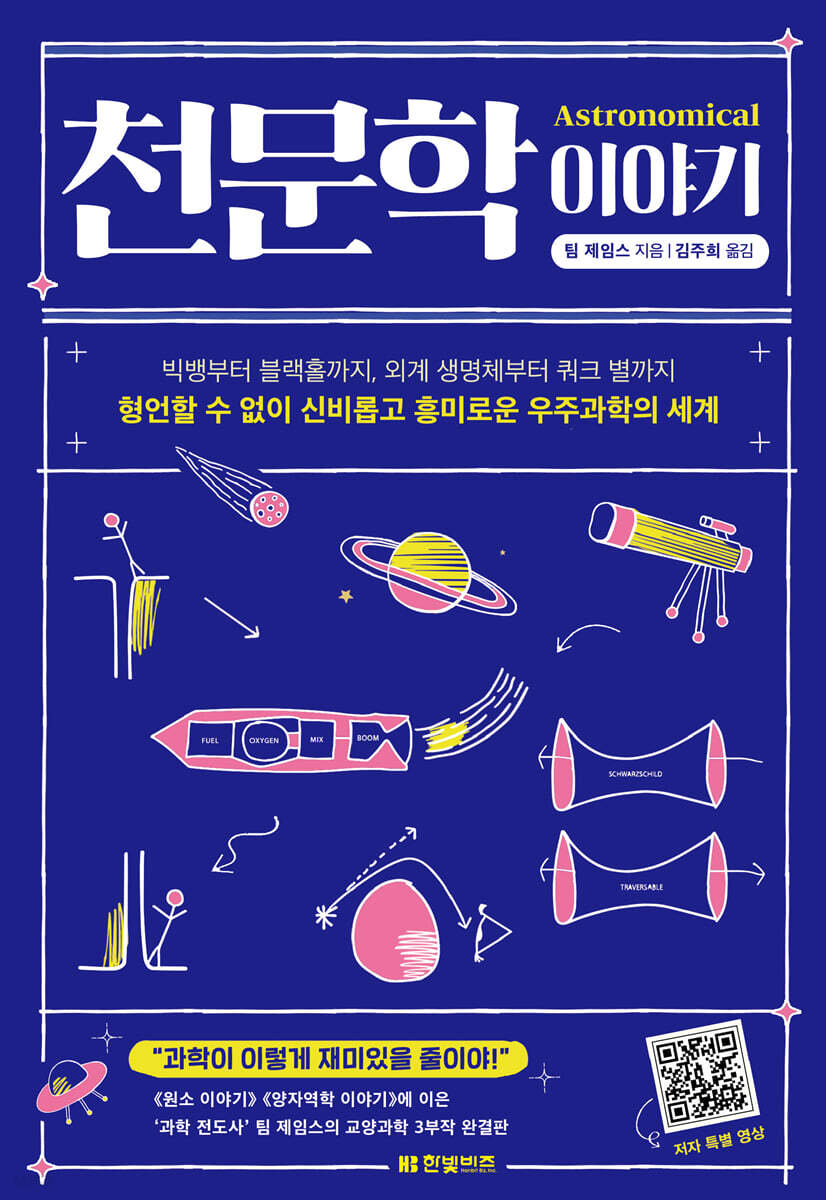
Guided by the oldest science, astronomy The wondrous world of space “This is the first photo of a black hole ever taken.” Applause erupted as the Event Horizon Telescope team unveiled the actual black hole image at a press conference in Brussels on April 10, 2019. Astronomers and millions of people around the world watched the live broadcast, and in just a few hours, the image was viewed by an estimated 4 billion people. The Event Horizon Telescope, a network of eight radio telescopes located around the Earth, focused on the galaxy M87, 5.2 trillion kilometers from Earth, and captured a picture of the black hole at its center. This shot yielded a photo of a ring of orange and yellow that appears like a glowing donut in space. The reason this photo excited scientists all over the world is because it neatly proved that black holes, which had been assumed to be virtual simulations until then, actually exist, and it also revealed that the shape of black holes predicted by the theory of general relativity matches reality. April 10, 2019 was one of the most monumental days in the history of human astronomy. It was a great achievement made 50 years after Stephen Hawking predicted 'Hawking radiation', and it was an achievement discovered 100 years after Einstein announced 'general theory of relativity'. Going back a bit further, it was an achievement that later generations of scholars responded to after 300 years of Isaac Newton's classical physics, and it was an advancement in the history of science that would have astonished Kepler and Galileo Galilei, who had advocated the heliocentric theory 400 years earlier. And that's not all. The history of human curiosity about the starry sky dates back to ancient Greek scholars such as Thales and Empedocles, who were active before Christ. Astronomy is one of the oldest sciences in human history, and it is a discipline that becomes more and more interesting the more we delve into it. Tim James, a science teacher renowned for making difficult science fun, guides us through the "indescribably mysterious space-time of the universe." Using Einstein's theory of relativity, quantum mechanics, astrophysics, and cosmology, it immerses you in the wondrous world of the universe. There is no need to worry about difficult terms like spectroscopy, gravitational waves, cosmic radiation, or string theory. Because he speaks so fluently with his unique wit, anyone can understand. Now, let's enter that mysterious and strange world. |
- You can preview some of the book's contents.
Preview
index
Preface: A Collection of the Strangest Things
Part 1: The more you know, the more bizarre the universe becomes.
Chapter 1: Huge, Old, and Strange
Chapter 2: Unraveling the Mysteries of the Solar System
Chapter 3: In Search of the Beginning of the Universe
Part 2: Everything We Don't Know About the Universe
Chapter 4: The Big Bang's Big Problem
Chapter 5 Einstein didn't make mistakes!?
Chapter 6: The Center of Darkness, the Black Hole
Chapter 7: Holograms, Loops, and Strings
Part 3: Life Surrounded by Stars
Chapter 8: Is anyone there?
Chapter 9: Goodbye, insignificant Earthlings!
Chapter 10: Moving Forward Boldly
supplement
Acknowledgements
main
Part 1: The more you know, the more bizarre the universe becomes.
Chapter 1: Huge, Old, and Strange
Chapter 2: Unraveling the Mysteries of the Solar System
Chapter 3: In Search of the Beginning of the Universe
Part 2: Everything We Don't Know About the Universe
Chapter 4: The Big Bang's Big Problem
Chapter 5 Einstein didn't make mistakes!?
Chapter 6: The Center of Darkness, the Black Hole
Chapter 7: Holograms, Loops, and Strings
Part 3: Life Surrounded by Stars
Chapter 8: Is anyone there?
Chapter 9: Goodbye, insignificant Earthlings!
Chapter 10: Moving Forward Boldly
supplement
Acknowledgements
main
Detailed image

Into the book
The most reasonable estimate of the age of the universe by humans is roughly 13.8 billion years, with a margin of error of a few thousand years. But there is a good way to express this enormous length of time in a way that makes it easy to understand at a glance.
The life of the universe can be summarized in a one-year calendar, according to a method proposed by astronomer Carl Sagan in 1977.
In this calendar, the universe was born at midnight on January 1st and has now reached midnight on December 31st.
The history of the human species occupies approximately four minutes on the calendar (200,000 years in real time).
In contrast, dinosaurs roamed the Earth for 170 million years, appearing at lunchtime on Christmas Day and lasting four days before going extinct on December 29th when the remaining party food ran out.
---From "Page 20, Chapter 1: Huge, Old, and Strange"
It is not known exactly why Copernicus waited until his death to publish his hypothesis, but it may have been because the biblical geocentric model, which states that the sun, not the Earth, revolves around the universe, conflicts with the heliocentric model, if taken literally.
Even if it were merely a question, denying the Bible in 16th-century Europe was a terribly foolish act.
Contrary to popular belief today, Copernicus' ideas were not taken seriously by anyone at the time, and so it is fair to say that they remained unopposed by the Church for a long time.
Copernicus's claim that the Earth revolves around the Sun was pure nonsense, and even the great Martin Luther ridiculed Copernicus's ideas, saying:
“It’s like this these days.
Anyone who wants to seem smart has to challenge other people's opinions.
Copernicus had to do something himself.
But it would be foolish to try to overturn the entire science of astronomy.”
---From "Pages 38-39, Chapter 2: Unraveling the Mysteries of the Solar System"
In 1964, physicists Robert Wilson and Arno Penzias were experimenting with a Holmdel horn antenna installed in New Jersey.
The device was a new, six-meter-tall instrument erected to search for radio waves and microwaves emitted by stars.
Initially, the two scientists used a horn antenna to spectroscopically study the radio waves emitted by our galaxy, but as they began their experiment, they noticed a constant hissing noise in the background of the signal.
Penzias went to the antenna to see what was causing the problem and discovered that two pigeons had built a nest inside the antenna.
Inside the antenna, there were piles of pigeon droppings, which Penzias wittily described as "white stuff."
… … At this point, one of the researchers resorted to the easiest method of killing the pigeon with a shotgun to settle the matter.
However, when the two scientists returned to the signal detector, they found that the microwaves were still being detected.
Not only that, the antenna was continuously picking up microwaves from all directions in the sky.
It was clear that the entire universe was filled with microwave energy, and at this point the two men began to become confused.
---From "Pages 73-74, Chapter 3: In Search of the Beginning of the Universe"
Suppose we launch a light-speed rocket toward a distant galaxy.
The space-time surrounding us continues to expand, and galaxies move further and further away.
The fastest we can catch up with a receding galaxy is the speed of light, but spacetime is stretching faster than the speed of light, so we will never catch up.
It's like riding an escalator that goes down faster than you can go up, but you can't get to the top floor.
The point where we cannot reach even if we try to approach it is called the cosmic event horizon, and this horizon is 16 billion light-years away from us.
---From "Pages 85-86, Chapter 4: The Big Problem of the Big Bang"
The discovery by astronomer Vera Rubin in 1976 changed the game.
The galaxy isn't just spinning fast, it's spinning really, really, really fast.
It also turns out that while planets and nebulae rotate at speeds that are not significantly different from those predicted by general relativity, most galaxies rotate six to eight times faster than we thought possible.
This was not a minor calculation error, but a major problem.
After Rubin's discovery, only two of the various explanations for the galaxy's excessively rapid rotation remained.
One explanation is that Einstein's equations are wrong, and the other is that the mysterious substance that truly fills the universe is hiding somewhere beyond the reach of human detection technology.
---From "Page 101, Chapter 5: Einstein Didn't Make Mistakes!?"
On April 10, 2019, the Event Horizon Telescope, a network of eight radio telescopes located around the Earth, turned the Earth into a giant antenna and focused on the galaxy M87, 5.2 trillion kilometers away, and captured a picture of the black hole at its center.
… … This shot yielded a picture of a ring of orange and yellow that looked like a glowing donut in space.
The reason black hole photos are so exciting is that they neatly prove that black holes really exist, and that their actual shape matches the shape predicted by general relativity.
---From "Page 125, Chapter 6, The Center of Darkness, the Black Hole"
Although energy is slowly being released (black holes are incredibly cold), it is slowly leaking out, causing the black hole to lose energy and contract.
After trillions of years, even supermassive black holes will shrink to nothingness.
We know that this black hole emission, which we call "Hawking radiation" in honor of Hawking, must occur, but we don't know what causes it to occur.
This is not the first time in the history of physics.
Isaac Newton didn't know what caused the planets to orbit, but he knew something was causing them to do so, so he left that part blank so that later scientists could figure out what that something was.
Hawking radiation is quite similar.
---From "Page 144, Chapter 7: Holograms, Loops, and Strings"
Consider our galaxy, which is currently estimated to contain 200 billion stars.
The radiation emitted near the galactic center is so strong that it can destroy complex biochemicals, so the area outside the galactic center, at least a quarter of the way out, is considered uninhabitable and is excluded.
That leaves 150 billion stars.
Next, if we consider that planets are created as byproducts of the star formation process, it is estimated that most stars have planets.
However, conservatively, we can assume that only 90 percent of stars have planets, with each star having one planet.
Then there are 135 billion habitable planets.
---From "Page 177, Chapter 8, Is There Anyone There?"
In 1855, something in the Tau Sagittarius region, about 1,000 trillion kilometers from Earth, generated radio waves.
After traveling at the speed of light through the cold, vast expanse of space for over a century, the radio wave finally entered Earth's atmosphere on August 15, 1977, and was picked up by the Big Ear radio telescope in Ohio.
The radio wave lay quietly in data storage for three days before astronomer Jerry Ehmann printed a week's worth of records to decipher what the telescope had captured.
On August 18th, Eman sat at the kitchen table reading the flow of numbers written on the record, and when he realized what the record meant, he jumped up in surprise.
---From "Pages 199-200, Chapter 9, Goodbye, Insignificant Earthlings!"
We all live in the present, regardless of our upbringing or intellectual ability, and we live in constant anxiety, underestimating our own worth.
Many people sometimes question whether humanity is worth preserving, and many others, realizing the grandeur of the universe, feel insignificant in comparison.
Space science is potentially depressing because it reminds us of our insignificance in the face of the universe.
… … If you look at each and every one of us, it is true that we are all small.
But everyone wants and thirsts to know where humanity fits in.
We embark on an adventure to discover what exists in the universe and marvel at science.
Scientific research isn't just the domain of 150-IQ, genius scientists in lab coats.
Science is for all of us, a burden we all share, an obstacle we all have to bear, a question we all ask ourselves.
The life of the universe can be summarized in a one-year calendar, according to a method proposed by astronomer Carl Sagan in 1977.
In this calendar, the universe was born at midnight on January 1st and has now reached midnight on December 31st.
The history of the human species occupies approximately four minutes on the calendar (200,000 years in real time).
In contrast, dinosaurs roamed the Earth for 170 million years, appearing at lunchtime on Christmas Day and lasting four days before going extinct on December 29th when the remaining party food ran out.
---From "Page 20, Chapter 1: Huge, Old, and Strange"
It is not known exactly why Copernicus waited until his death to publish his hypothesis, but it may have been because the biblical geocentric model, which states that the sun, not the Earth, revolves around the universe, conflicts with the heliocentric model, if taken literally.
Even if it were merely a question, denying the Bible in 16th-century Europe was a terribly foolish act.
Contrary to popular belief today, Copernicus' ideas were not taken seriously by anyone at the time, and so it is fair to say that they remained unopposed by the Church for a long time.
Copernicus's claim that the Earth revolves around the Sun was pure nonsense, and even the great Martin Luther ridiculed Copernicus's ideas, saying:
“It’s like this these days.
Anyone who wants to seem smart has to challenge other people's opinions.
Copernicus had to do something himself.
But it would be foolish to try to overturn the entire science of astronomy.”
---From "Pages 38-39, Chapter 2: Unraveling the Mysteries of the Solar System"
In 1964, physicists Robert Wilson and Arno Penzias were experimenting with a Holmdel horn antenna installed in New Jersey.
The device was a new, six-meter-tall instrument erected to search for radio waves and microwaves emitted by stars.
Initially, the two scientists used a horn antenna to spectroscopically study the radio waves emitted by our galaxy, but as they began their experiment, they noticed a constant hissing noise in the background of the signal.
Penzias went to the antenna to see what was causing the problem and discovered that two pigeons had built a nest inside the antenna.
Inside the antenna, there were piles of pigeon droppings, which Penzias wittily described as "white stuff."
… … At this point, one of the researchers resorted to the easiest method of killing the pigeon with a shotgun to settle the matter.
However, when the two scientists returned to the signal detector, they found that the microwaves were still being detected.
Not only that, the antenna was continuously picking up microwaves from all directions in the sky.
It was clear that the entire universe was filled with microwave energy, and at this point the two men began to become confused.
---From "Pages 73-74, Chapter 3: In Search of the Beginning of the Universe"
Suppose we launch a light-speed rocket toward a distant galaxy.
The space-time surrounding us continues to expand, and galaxies move further and further away.
The fastest we can catch up with a receding galaxy is the speed of light, but spacetime is stretching faster than the speed of light, so we will never catch up.
It's like riding an escalator that goes down faster than you can go up, but you can't get to the top floor.
The point where we cannot reach even if we try to approach it is called the cosmic event horizon, and this horizon is 16 billion light-years away from us.
---From "Pages 85-86, Chapter 4: The Big Problem of the Big Bang"
The discovery by astronomer Vera Rubin in 1976 changed the game.
The galaxy isn't just spinning fast, it's spinning really, really, really fast.
It also turns out that while planets and nebulae rotate at speeds that are not significantly different from those predicted by general relativity, most galaxies rotate six to eight times faster than we thought possible.
This was not a minor calculation error, but a major problem.
After Rubin's discovery, only two of the various explanations for the galaxy's excessively rapid rotation remained.
One explanation is that Einstein's equations are wrong, and the other is that the mysterious substance that truly fills the universe is hiding somewhere beyond the reach of human detection technology.
---From "Page 101, Chapter 5: Einstein Didn't Make Mistakes!?"
On April 10, 2019, the Event Horizon Telescope, a network of eight radio telescopes located around the Earth, turned the Earth into a giant antenna and focused on the galaxy M87, 5.2 trillion kilometers away, and captured a picture of the black hole at its center.
… … This shot yielded a picture of a ring of orange and yellow that looked like a glowing donut in space.
The reason black hole photos are so exciting is that they neatly prove that black holes really exist, and that their actual shape matches the shape predicted by general relativity.
---From "Page 125, Chapter 6, The Center of Darkness, the Black Hole"
Although energy is slowly being released (black holes are incredibly cold), it is slowly leaking out, causing the black hole to lose energy and contract.
After trillions of years, even supermassive black holes will shrink to nothingness.
We know that this black hole emission, which we call "Hawking radiation" in honor of Hawking, must occur, but we don't know what causes it to occur.
This is not the first time in the history of physics.
Isaac Newton didn't know what caused the planets to orbit, but he knew something was causing them to do so, so he left that part blank so that later scientists could figure out what that something was.
Hawking radiation is quite similar.
---From "Page 144, Chapter 7: Holograms, Loops, and Strings"
Consider our galaxy, which is currently estimated to contain 200 billion stars.
The radiation emitted near the galactic center is so strong that it can destroy complex biochemicals, so the area outside the galactic center, at least a quarter of the way out, is considered uninhabitable and is excluded.
That leaves 150 billion stars.
Next, if we consider that planets are created as byproducts of the star formation process, it is estimated that most stars have planets.
However, conservatively, we can assume that only 90 percent of stars have planets, with each star having one planet.
Then there are 135 billion habitable planets.
---From "Page 177, Chapter 8, Is There Anyone There?"
In 1855, something in the Tau Sagittarius region, about 1,000 trillion kilometers from Earth, generated radio waves.
After traveling at the speed of light through the cold, vast expanse of space for over a century, the radio wave finally entered Earth's atmosphere on August 15, 1977, and was picked up by the Big Ear radio telescope in Ohio.
The radio wave lay quietly in data storage for three days before astronomer Jerry Ehmann printed a week's worth of records to decipher what the telescope had captured.
On August 18th, Eman sat at the kitchen table reading the flow of numbers written on the record, and when he realized what the record meant, he jumped up in surprise.
---From "Pages 199-200, Chapter 9, Goodbye, Insignificant Earthlings!"
We all live in the present, regardless of our upbringing or intellectual ability, and we live in constant anxiety, underestimating our own worth.
Many people sometimes question whether humanity is worth preserving, and many others, realizing the grandeur of the universe, feel insignificant in comparison.
Space science is potentially depressing because it reminds us of our insignificance in the face of the universe.
… … If you look at each and every one of us, it is true that we are all small.
But everyone wants and thirsts to know where humanity fits in.
We embark on an adventure to discover what exists in the universe and marvel at science.
Scientific research isn't just the domain of 150-IQ, genius scientists in lab coats.
Science is for all of us, a burden we all share, an obstacle we all have to bear, a question we all ask ourselves.
---From "Pages 223-224, Chapter 10: Moving Forward Boldly"
Publisher's Review
It can never be expressed in human vocabulary,
A story of astronomical space and time
Before we go into space, let's learn about the Earth we are standing on now.
Did you know that we are currently 2.5 million kilometers away from where we were yesterday at the same time? This is because of the Earth's rotation.
The Earth orbits the Sun at 50 times faster than a bullet, enough to climb Mount Everest three times in one second.
But even at this tremendous speed, it takes one year to orbit the sun once.
Meanwhile, the Sun could hold a million Earths, and its massive mass would pull it with its powerful gravity to Neptune, the outermost planet of the solar system, a distance that would take a supersonic plane 150 years to reach.
As we go beyond our solar system and into our galaxy, we enter a realm that our brains cannot quantify for the time being.
Our galaxy has a mass of 1.5 trillion times that of the Sun and contains 200 billion stars.
This number of stars is equal to the number of water droplets present in a cloud.
We literally live in a starry sky.
It is said that in the universe, which is the area that would be covered if you picked up a grain of sand and held it up to the night sky, there are at least 10,000 galaxies filled with billions of stars.
What about time?
As Carl Sagan suggested, if we were to summarize the life of the universe in a one-year calendar, humans would appear just four minutes before midnight on December 31st.
Author Tim James says that the space and time of the universe are so 'astronomical' that we humans can never express them in language.
So how did humans, so insignificant compared to the astronomical universe, delve into that world?
From Thales to Galileo, Einstein and Hawking
The story of geniuses who unraveled the mysteries of the universe
Astronomy, which began with the astrology of the ancient Babylonians, was born as a science in the 6th century BC by Thales, a scholar from Miletus.
Thales, known as the first astronomer, predicted solar eclipses through meticulous records and even divided a month into 30 days and a year into 365 days.
Since then, ancient Greek scholars, including Plato and Aristotle, observed the phases and cycles of the stars and even gave names to the five planets in the solar system: Hermes (Mercury), Aphrodite (Venus), Ares (Mars), Zeus (Jupiter), and Cronus (Saturn).
Collectively, they were called 'planetes', meaning 'wanderers', and the idea of a planet also emerged during this period.
But as we all know, astronomy fell into the Dark Ages after that, and the names of the scientific geniuses we are familiar with did not appear until more than a thousand years later.
During the Renaissance, we meet the pioneers of heliocentrism, including Copernicus, Kepler, and Galileo, and author Tim James does more than simply introduce their achievements.
Copernicus, who published his book on the heliocentric theory just before his death; Tycho Brahe, the eccentric genius who killed his pet deer by throwing it down the stairs; Kepler, who stole Brahe's data to perfectly prove the Copernican model; Galileo, who metaphorically stood up to the church by writing a novel satirizing the Pope, etc. - this book tells the story of the hardships of the scholars of the time who struggled to uncover the truth about the universe and their wit in overcoming them through various episodes.
The theories of modern and contemporary scientists that appear next, such as Einstein's general theory of relativity, quantum mechanics, event horizons, gravitational lenses, the cosmological constant, Hawking radiation theory, string theory, etc., are physics and space science theories that were curious but difficult to understand, but can be easily understood through Tim James's easy and humorous explanations.
As you follow his chronological account, you will clearly see how remarkable Albert Einstein and Stephen Hawking were.
Especially when you realize that over the past 100 years since Einstein's general theory of relativity was published in 1915, subsequent scientists have actually proven the predictions of the theory of relativity, you will be amazed by the existence of a great genius.
Black holes, holographic universes, alien life, quark stars, UFOs, etc.
A journey of knowledge where the mysteries of the universe are slowly being unraveled.
Tim James, a science evangelist who works hard to popularize science through various media, including social media, broadcasting, and newspapers.
He explains the mysteries of the universe that we have always wondered about, such as the Big Bang, black holes and white holes, the holographic universe, extraterrestrial life, UFOs, etc., with his own witty storytelling.
Reading his casual humor makes you feel like you're attending a stand-up comedy show.
As you listen to Tim James's endless talk about why the universe keeps expanding, whether the Big Bang really proves the existence of God, whether there are planets beyond Earth with life, how Pluto lost its planetary status, and more, your curiosity will slowly turn into knowledge.
Edwin Hubble, an indispensable figure in the history of astronomy and the mastermind behind the Hubble Space Telescope, said, “Humans explore the universe around them using their five senses.
“We call this adventure science,” he said.
Use all your senses to look at the night sky.
The light of a star that was shot down from somewhere in space 1,000 years ago will enter your eyes.
If you've discovered that light, it's time to embark on a journey of knowledge into space.
With Tim James's Astronomy Stories!
A story of astronomical space and time
Before we go into space, let's learn about the Earth we are standing on now.
Did you know that we are currently 2.5 million kilometers away from where we were yesterday at the same time? This is because of the Earth's rotation.
The Earth orbits the Sun at 50 times faster than a bullet, enough to climb Mount Everest three times in one second.
But even at this tremendous speed, it takes one year to orbit the sun once.
Meanwhile, the Sun could hold a million Earths, and its massive mass would pull it with its powerful gravity to Neptune, the outermost planet of the solar system, a distance that would take a supersonic plane 150 years to reach.
As we go beyond our solar system and into our galaxy, we enter a realm that our brains cannot quantify for the time being.
Our galaxy has a mass of 1.5 trillion times that of the Sun and contains 200 billion stars.
This number of stars is equal to the number of water droplets present in a cloud.
We literally live in a starry sky.
It is said that in the universe, which is the area that would be covered if you picked up a grain of sand and held it up to the night sky, there are at least 10,000 galaxies filled with billions of stars.
What about time?
As Carl Sagan suggested, if we were to summarize the life of the universe in a one-year calendar, humans would appear just four minutes before midnight on December 31st.
Author Tim James says that the space and time of the universe are so 'astronomical' that we humans can never express them in language.
So how did humans, so insignificant compared to the astronomical universe, delve into that world?
From Thales to Galileo, Einstein and Hawking
The story of geniuses who unraveled the mysteries of the universe
Astronomy, which began with the astrology of the ancient Babylonians, was born as a science in the 6th century BC by Thales, a scholar from Miletus.
Thales, known as the first astronomer, predicted solar eclipses through meticulous records and even divided a month into 30 days and a year into 365 days.
Since then, ancient Greek scholars, including Plato and Aristotle, observed the phases and cycles of the stars and even gave names to the five planets in the solar system: Hermes (Mercury), Aphrodite (Venus), Ares (Mars), Zeus (Jupiter), and Cronus (Saturn).
Collectively, they were called 'planetes', meaning 'wanderers', and the idea of a planet also emerged during this period.
But as we all know, astronomy fell into the Dark Ages after that, and the names of the scientific geniuses we are familiar with did not appear until more than a thousand years later.
During the Renaissance, we meet the pioneers of heliocentrism, including Copernicus, Kepler, and Galileo, and author Tim James does more than simply introduce their achievements.
Copernicus, who published his book on the heliocentric theory just before his death; Tycho Brahe, the eccentric genius who killed his pet deer by throwing it down the stairs; Kepler, who stole Brahe's data to perfectly prove the Copernican model; Galileo, who metaphorically stood up to the church by writing a novel satirizing the Pope, etc. - this book tells the story of the hardships of the scholars of the time who struggled to uncover the truth about the universe and their wit in overcoming them through various episodes.
The theories of modern and contemporary scientists that appear next, such as Einstein's general theory of relativity, quantum mechanics, event horizons, gravitational lenses, the cosmological constant, Hawking radiation theory, string theory, etc., are physics and space science theories that were curious but difficult to understand, but can be easily understood through Tim James's easy and humorous explanations.
As you follow his chronological account, you will clearly see how remarkable Albert Einstein and Stephen Hawking were.
Especially when you realize that over the past 100 years since Einstein's general theory of relativity was published in 1915, subsequent scientists have actually proven the predictions of the theory of relativity, you will be amazed by the existence of a great genius.
Black holes, holographic universes, alien life, quark stars, UFOs, etc.
A journey of knowledge where the mysteries of the universe are slowly being unraveled.
Tim James, a science evangelist who works hard to popularize science through various media, including social media, broadcasting, and newspapers.
He explains the mysteries of the universe that we have always wondered about, such as the Big Bang, black holes and white holes, the holographic universe, extraterrestrial life, UFOs, etc., with his own witty storytelling.
Reading his casual humor makes you feel like you're attending a stand-up comedy show.
As you listen to Tim James's endless talk about why the universe keeps expanding, whether the Big Bang really proves the existence of God, whether there are planets beyond Earth with life, how Pluto lost its planetary status, and more, your curiosity will slowly turn into knowledge.
Edwin Hubble, an indispensable figure in the history of astronomy and the mastermind behind the Hubble Space Telescope, said, “Humans explore the universe around them using their five senses.
“We call this adventure science,” he said.
Use all your senses to look at the night sky.
The light of a star that was shot down from somewhere in space 1,000 years ago will enter your eyes.
If you've discovered that light, it's time to embark on a journey of knowledge into space.
With Tim James's Astronomy Stories!
GOODS SPECIFICS
- Date of issue: February 15, 2023
- Page count, weight, size: 264 pages | 410g | 148*215*17mm
- ISBN13: 9791157846467
- ISBN10: 1157846467
You may also like
카테고리
korean


korean

![GQ KOREA Mark (Monthly): December [2025]](http://librairie.coreenne.fr/cdn/shop/files/8ef265dbbfbf186523ed75ba7319009d.jpg?v=1765340328&width=3840)


