

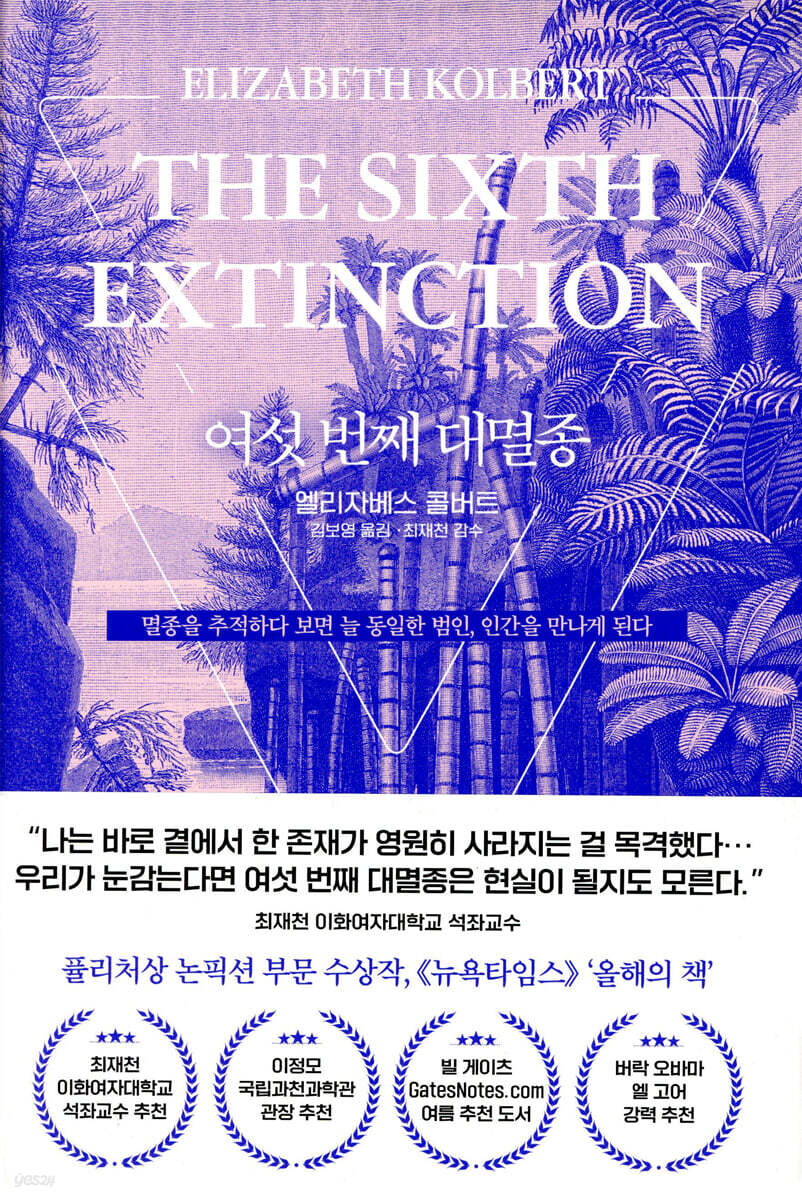
The sixth mass extinction
 |
Description
Book Introduction
We have only happened five times on Earth.
We are living in a moment where a mass extinction is happening again.
A problematic work that directly addresses the extinction crisis caused by humanity.
A classic of our time that everyone must read for a better tomorrow.
- Winner of the 2015 Pulitzer Prize in Nonfiction
- New translation, supervised by Professor Jae-Cheon Choi of Ewha Womans University
It is estimated that one-third of the world's freshwater mollusks, one-third of its sharks and rays, one-quarter of its mammals, one-fifth of its reptiles, and one-sixth of its birds are now permanently extinct.
Elizabeth Colbert makes clear the responsibility of humanity by saying, “There are different reasons why species disappear, but if you trace the process to the end, you always encounter the same culprit: ‘one weak species.’”
『The Sixth Mass Extinction』 is a representative work dealing with the 'Anthropocene' and is Elizabeth Kolbert's masterpiece that many readers in Korea have been hoping for its republication even after it went out of print.
Known for his powerful, immersive journalism, Colbert travels the globe from a New York cave to the Andes, the Amazon rainforest, the Great Barrier Reef, the Mediterranean Sea, and the Cincinnati Zoo to illuminate the current situation and warn of its impact.
Unlike the five previous mass extinctions on Earth, which were caused by natural disasters, this one confronts the Anthropocene and the Earth's ecosystem problems, which humans have brought upon themselves, and imprints on us the "sixth mass extinction."
We are living in a moment where a mass extinction is happening again.
A problematic work that directly addresses the extinction crisis caused by humanity.
A classic of our time that everyone must read for a better tomorrow.
- Winner of the 2015 Pulitzer Prize in Nonfiction
- New translation, supervised by Professor Jae-Cheon Choi of Ewha Womans University
It is estimated that one-third of the world's freshwater mollusks, one-third of its sharks and rays, one-quarter of its mammals, one-fifth of its reptiles, and one-sixth of its birds are now permanently extinct.
Elizabeth Colbert makes clear the responsibility of humanity by saying, “There are different reasons why species disappear, but if you trace the process to the end, you always encounter the same culprit: ‘one weak species.’”
『The Sixth Mass Extinction』 is a representative work dealing with the 'Anthropocene' and is Elizabeth Kolbert's masterpiece that many readers in Korea have been hoping for its republication even after it went out of print.
Known for his powerful, immersive journalism, Colbert travels the globe from a New York cave to the Andes, the Amazon rainforest, the Great Barrier Reef, the Mediterranean Sea, and the Cincinnati Zoo to illuminate the current situation and warn of its impact.
Unlike the five previous mass extinctions on Earth, which were caused by natural disasters, this one confronts the Anthropocene and the Earth's ecosystem problems, which humans have brought upon themselves, and imprints on us the "sixth mass extinction."
- You can preview some of the book's contents.
Preview
index
· Recommendation_ Professor Jae-Cheon Choi
· Recommendation_Director Lee Jeong-mo
· Praise for this book
prolog
CHAPTER 1 The Sixth Mass Extinction
CHAPTER 2 Mastodon's Molars
CHAPTER 3 The Original Penguin
CHAPTER 4 The Fate of the Ammonite
CHAPTER 5: WELCOME TO THE ANTHROPOCENE
CHAPTER 6 The Sea Surrounding Us
CHAPTER 7 The Addicted Sea
CHAPTER 8 Forest and Trees
CHAPTER 9 Islands on the Land
CHAPTER 10 New Pangea
CHAPTER 11 Ultrasound examination of a rhinoceros
CHAPTER 12 The Madness Gene
CHAPTER 13 In Search of Hope
Acknowledgements
main
References
Photo and illustration sources
· Recommendation_Director Lee Jeong-mo
· Praise for this book
prolog
CHAPTER 1 The Sixth Mass Extinction
CHAPTER 2 Mastodon's Molars
CHAPTER 3 The Original Penguin
CHAPTER 4 The Fate of the Ammonite
CHAPTER 5: WELCOME TO THE ANTHROPOCENE
CHAPTER 6 The Sea Surrounding Us
CHAPTER 7 The Addicted Sea
CHAPTER 8 Forest and Trees
CHAPTER 9 Islands on the Land
CHAPTER 10 New Pangea
CHAPTER 11 Ultrasound examination of a rhinoceros
CHAPTER 12 The Madness Gene
CHAPTER 13 In Search of Hope
Acknowledgements
main
References
Photo and illustration sources
Detailed image
Into the book
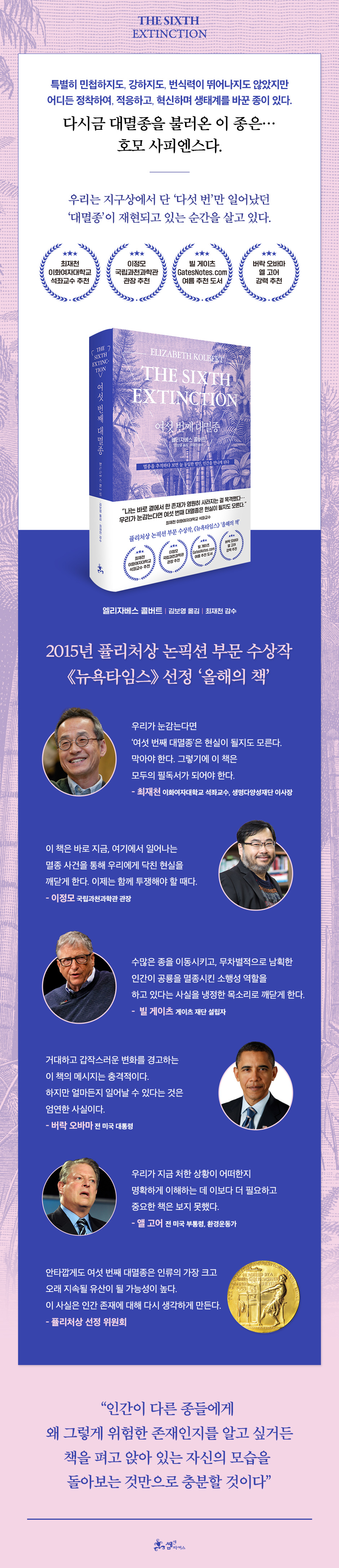
Most people hear about extinction from a few bridges, but this is how I witnessed the disappearance of something I knew forever.
Extinction is definitely happening.
And sometimes right next to me.
(…) I hope that Elizabeth Kolbert’s The Sixth Extinction will contribute to overcoming the climate crisis and bringing an early end to the Anthropocene.
As modern people living in the 21st century, we must be sensitive to environmental issues.
In that sense, this book should be a must-read for modern people.
---From “Recommendation_ Jae-Cheon Choi, Professor Emeritus, Ewha Womans University, Chairman of the Biodiversity Foundation”
It is time to fight for our own survival, not for the future of our descendants.
The last five mass extinctions were ultimately caused by rapid climate change.
It was all for natural reasons.
(…) The sixth mass extinction we are currently experiencing is also caused by rapid climate change.
But the good news is that the cause is us humans.
We just have to change.
(…) we must fight for a peaceful and just future.
We are not alone.
Fortunately, we are not alone.
---From “Recommendation_ Lee Jeong-mo, Director of the National Science Museum in Gwacheon”
As is often the case with new species, the status of this species is precarious.
The numbers are small and the area is limited to a very narrow area in eastern Africa.
The number has slowly increased, but some claim it has dwindled to a few thousand pairs and almost disappeared.
Members of this species are not particularly agile, strong, or prolific.
But there is a wisdom that other species do not have.
They gradually expand into areas with different climates, different predators, and different prey.
Neither the limits of their usual habitat nor geographical restrictions seem to be able to stop them.
They cross rivers, plateaus and mountain ranges.
They gather shellfish on the coast and hunt mammals deep inland.
They settle everywhere, adapt and innovate.
Upon reaching Europe, they encounter creatures that have inhabited this continent for a very long time.
They are very similar to them, but have a more robust and stocky build.
They interbreed with these creatures and then kill them, though the method is unknown.
This ending was a foreshadowing of what would happen later.
As their range of activity expands, they encounter animals twice, ten times, and twenty times their size, including giant cats, bears the size of houses, turtles as big as elephants, and sloths over 4 meters long.
These species are often stronger and more ferocious.
However, they are slow to reproduce and are eventually eliminated.
---From the "Prologue"
Today, amphibians have the unenviable title of being the most endangered class of animals on Earth.
It is estimated that the extinction rate of amphibians could be as much as 45,000 times the background extinction rate.
But the situation of other animals is also becoming closer to that of amphibians.
It is estimated that one-third of the world's reef-building corals, one-third of freshwater mollusks, one-third of sharks and rays, one-quarter of mammals, one-fifth of reptiles, and one-sixth of birds are disappearing.
Extinctions are occurring everywhere: in the South Pacific, the North Atlantic, the Arctic and the Sahel, on lakes and islands, on mountaintops and in valleys.
With a little background knowledge, you can spot signs of extinction happening right in your own backyard.
There are different reasons why species disappear, but if you trace the process to the end, you always encounter the same culprit: “a single weak species.”
---From "CHAPTER 1 The Sixth Mass Extinction"
If we accept Darwin's premise, one important prediction becomes possible.
If extinction were driven by natural selection, and could only be driven by natural selection, the two processes should proceed at similar rates.
If the speeds were different, extinction would have to be more gradual to make sense.
Darwin himself wrote:
“There is reason to believe that the process of species extinction is generally slower than the process of species creation.”
No one has ever witnessed the birth of a new species, and according to Darwin, such a thing is impossible.
Speciation is a process that takes place over such a long period of time that it is virtually impossible to observe.
Darwin declared, “I cannot see any change so slow in its course.”
If so, extinction should be much more difficult to witness.
But that wasn't the case.
In fact, during the years Darwin spent in seclusion at Down House developing his theory of evolution, the last of the great auk, one of Europe's most famous species, disappeared.
Moreover, this incident was meticulously documented by British ornithologists.
This direct clash between Darwin's theory and reality has profound implications.
---From "CHAPTER 3: The Original Penguin"
Twenty-five years ago, it was thought that all mass extinctions ultimately stemmed from the same cause, but now the opposite is true.
To borrow Tolstoy's phrase, every extinction event seems to have been unfortunate in its own way—and fatally unfortunate, at that.
In fact, the very fact that this extinction occurred so unexpectedly may have amplified its destructive power.
Organisms were suddenly confronted with an environment for which they were evolutionarily completely unprepared.
Walter Alvarez recalled:
“I had a naive expectation that after the evidence for the late Cretaceous asteroid impact became quite strong, researchers would soon find evidence for other extinction-causing impacts as well.
But the problem was much more complicated than expected.
We are witnessing right now that humans have the potential to cause mass extinction.
“At least it is clear that there is no general theory that covers all mass extinctions.”
---From "CHAPTER 5: Welcome to the Anthropocene"
The way coral reefs transform the world through multi-generational mega-construction projects is similar to how humans have done it, but with a crucial difference.
Humans drive out other creatures in the process, but coral helps other creatures.
Thousands—perhaps millions—of species have evolved to rely directly or indirectly on coral reefs, using them for shelter, food, or preying on them.
This coevolution took place over many generations.
However, researchers believe that this coevolution will not continue into the Anthropocene.
Three British scientists wrote in a joint book about coral reefs:
“Coral reefs are likely to be the first modern-day example of an entire ecosystem going extinct.” Some scholars claim that coral reefs will disappear by the end of this century, while others say they have even less time left.
In a paper published in Nature, Ove Hoeguldberg, former manager of the One Tree Island research station, predicted that if current trends continue, by 2050 visitors to the Great Barrier Reef will see nothing more than “a rapidly eroding pile of debris.”
---From "CHAPTER 7: The Addicted Sea"
Darwin's explanation was later confirmed by several physical traces.
For example, researchers studying ancient beetle shells have found that even very small insects migrated thousands of kilometers during the Ice Age, following favorable climates.
(For example, a small, dark brown beetle called Tachinus caillatus, which was common in Britain during the last ice age, now lives in the mountainous areas west of Ulaanbaatar.) Temperature changes in the next century are expected to be similar in magnitude to those of the Ice Ages.
(If current carbon emission trends continue, temperatures in the Andes will rise by nearly 5°C.) However, although the magnitude of the change will be similar, the speed will be completely different.
And again, the key is speed.
Today's warming is occurring at least ten times faster than at the end of any previous ice age, including the last.
To keep up with that pace, plants and animals would have to migrate and adapt ten times faster.
In Silman's study area, only the fastest—or perhaps "fast-rooting"—trees, such as those in the genus Scaplera, are keeping pace with rising temperatures.
It's unclear how many species could move that fast overall, but according to Silman, we'll know the answer within a few decades, whether we like it or not.
---From "CHAPTER 8 Forest and Trees"
“From a reproductive rate perspective, the lives of giant mammals are precarious.
For example, elephants have a gestation period of 22 months.
They don't give birth to twins and don't start breeding until they're over 10 years old.
So even if there are no problems, there is an absolute limit to the rate of reproduction.
However, they can survive because as long as they grow to a certain size, they can avoid being eaten.
It makes you less vulnerable to attacks.
From a reproductive standpoint, it's a terrible strategy, but from a predator avoidance standpoint, it's a huge advantage.
But when humans appear, this advantage completely disappears.
“Humans can eat any animal, no matter how large it is.” This is another example of how a peace treaty that has worked for millions of years can be broken in an instant.
There is nothing wrong with large animals like V-shaped stones, ammonites, and dinosaurs.
With the advent of humans, the 'rules of the survival game' simply changed.
---From "CHAPTER 11 Ultrasound Examination of Rhinoceroses"
Clearly, everyone has different levels of concern about the fate of our species.
But even if I risk being accused of being inhumane? If I may protest, many of my closest friends are human!? I can only say this.
The most important issue is not the survival of humanity.
Right now, in this incredible moment that we perceive as the present, we are unintentionally deciding which evolutionary paths will remain open and which will be permanently blocked.
This, which no living creature has ever done before, will unfortunately be our most enduring legacy.
The sixth mass extinction will determine the course of life long after everything humans have written, drawn, and built has crumbled to dust and the planet has been inherited by giant rats or some other creature.
Extinction is definitely happening.
And sometimes right next to me.
(…) I hope that Elizabeth Kolbert’s The Sixth Extinction will contribute to overcoming the climate crisis and bringing an early end to the Anthropocene.
As modern people living in the 21st century, we must be sensitive to environmental issues.
In that sense, this book should be a must-read for modern people.
---From “Recommendation_ Jae-Cheon Choi, Professor Emeritus, Ewha Womans University, Chairman of the Biodiversity Foundation”
It is time to fight for our own survival, not for the future of our descendants.
The last five mass extinctions were ultimately caused by rapid climate change.
It was all for natural reasons.
(…) The sixth mass extinction we are currently experiencing is also caused by rapid climate change.
But the good news is that the cause is us humans.
We just have to change.
(…) we must fight for a peaceful and just future.
We are not alone.
Fortunately, we are not alone.
---From “Recommendation_ Lee Jeong-mo, Director of the National Science Museum in Gwacheon”
As is often the case with new species, the status of this species is precarious.
The numbers are small and the area is limited to a very narrow area in eastern Africa.
The number has slowly increased, but some claim it has dwindled to a few thousand pairs and almost disappeared.
Members of this species are not particularly agile, strong, or prolific.
But there is a wisdom that other species do not have.
They gradually expand into areas with different climates, different predators, and different prey.
Neither the limits of their usual habitat nor geographical restrictions seem to be able to stop them.
They cross rivers, plateaus and mountain ranges.
They gather shellfish on the coast and hunt mammals deep inland.
They settle everywhere, adapt and innovate.
Upon reaching Europe, they encounter creatures that have inhabited this continent for a very long time.
They are very similar to them, but have a more robust and stocky build.
They interbreed with these creatures and then kill them, though the method is unknown.
This ending was a foreshadowing of what would happen later.
As their range of activity expands, they encounter animals twice, ten times, and twenty times their size, including giant cats, bears the size of houses, turtles as big as elephants, and sloths over 4 meters long.
These species are often stronger and more ferocious.
However, they are slow to reproduce and are eventually eliminated.
---From the "Prologue"
Today, amphibians have the unenviable title of being the most endangered class of animals on Earth.
It is estimated that the extinction rate of amphibians could be as much as 45,000 times the background extinction rate.
But the situation of other animals is also becoming closer to that of amphibians.
It is estimated that one-third of the world's reef-building corals, one-third of freshwater mollusks, one-third of sharks and rays, one-quarter of mammals, one-fifth of reptiles, and one-sixth of birds are disappearing.
Extinctions are occurring everywhere: in the South Pacific, the North Atlantic, the Arctic and the Sahel, on lakes and islands, on mountaintops and in valleys.
With a little background knowledge, you can spot signs of extinction happening right in your own backyard.
There are different reasons why species disappear, but if you trace the process to the end, you always encounter the same culprit: “a single weak species.”
---From "CHAPTER 1 The Sixth Mass Extinction"
If we accept Darwin's premise, one important prediction becomes possible.
If extinction were driven by natural selection, and could only be driven by natural selection, the two processes should proceed at similar rates.
If the speeds were different, extinction would have to be more gradual to make sense.
Darwin himself wrote:
“There is reason to believe that the process of species extinction is generally slower than the process of species creation.”
No one has ever witnessed the birth of a new species, and according to Darwin, such a thing is impossible.
Speciation is a process that takes place over such a long period of time that it is virtually impossible to observe.
Darwin declared, “I cannot see any change so slow in its course.”
If so, extinction should be much more difficult to witness.
But that wasn't the case.
In fact, during the years Darwin spent in seclusion at Down House developing his theory of evolution, the last of the great auk, one of Europe's most famous species, disappeared.
Moreover, this incident was meticulously documented by British ornithologists.
This direct clash between Darwin's theory and reality has profound implications.
---From "CHAPTER 3: The Original Penguin"
Twenty-five years ago, it was thought that all mass extinctions ultimately stemmed from the same cause, but now the opposite is true.
To borrow Tolstoy's phrase, every extinction event seems to have been unfortunate in its own way—and fatally unfortunate, at that.
In fact, the very fact that this extinction occurred so unexpectedly may have amplified its destructive power.
Organisms were suddenly confronted with an environment for which they were evolutionarily completely unprepared.
Walter Alvarez recalled:
“I had a naive expectation that after the evidence for the late Cretaceous asteroid impact became quite strong, researchers would soon find evidence for other extinction-causing impacts as well.
But the problem was much more complicated than expected.
We are witnessing right now that humans have the potential to cause mass extinction.
“At least it is clear that there is no general theory that covers all mass extinctions.”
---From "CHAPTER 5: Welcome to the Anthropocene"
The way coral reefs transform the world through multi-generational mega-construction projects is similar to how humans have done it, but with a crucial difference.
Humans drive out other creatures in the process, but coral helps other creatures.
Thousands—perhaps millions—of species have evolved to rely directly or indirectly on coral reefs, using them for shelter, food, or preying on them.
This coevolution took place over many generations.
However, researchers believe that this coevolution will not continue into the Anthropocene.
Three British scientists wrote in a joint book about coral reefs:
“Coral reefs are likely to be the first modern-day example of an entire ecosystem going extinct.” Some scholars claim that coral reefs will disappear by the end of this century, while others say they have even less time left.
In a paper published in Nature, Ove Hoeguldberg, former manager of the One Tree Island research station, predicted that if current trends continue, by 2050 visitors to the Great Barrier Reef will see nothing more than “a rapidly eroding pile of debris.”
---From "CHAPTER 7: The Addicted Sea"
Darwin's explanation was later confirmed by several physical traces.
For example, researchers studying ancient beetle shells have found that even very small insects migrated thousands of kilometers during the Ice Age, following favorable climates.
(For example, a small, dark brown beetle called Tachinus caillatus, which was common in Britain during the last ice age, now lives in the mountainous areas west of Ulaanbaatar.) Temperature changes in the next century are expected to be similar in magnitude to those of the Ice Ages.
(If current carbon emission trends continue, temperatures in the Andes will rise by nearly 5°C.) However, although the magnitude of the change will be similar, the speed will be completely different.
And again, the key is speed.
Today's warming is occurring at least ten times faster than at the end of any previous ice age, including the last.
To keep up with that pace, plants and animals would have to migrate and adapt ten times faster.
In Silman's study area, only the fastest—or perhaps "fast-rooting"—trees, such as those in the genus Scaplera, are keeping pace with rising temperatures.
It's unclear how many species could move that fast overall, but according to Silman, we'll know the answer within a few decades, whether we like it or not.
---From "CHAPTER 8 Forest and Trees"
“From a reproductive rate perspective, the lives of giant mammals are precarious.
For example, elephants have a gestation period of 22 months.
They don't give birth to twins and don't start breeding until they're over 10 years old.
So even if there are no problems, there is an absolute limit to the rate of reproduction.
However, they can survive because as long as they grow to a certain size, they can avoid being eaten.
It makes you less vulnerable to attacks.
From a reproductive standpoint, it's a terrible strategy, but from a predator avoidance standpoint, it's a huge advantage.
But when humans appear, this advantage completely disappears.
“Humans can eat any animal, no matter how large it is.” This is another example of how a peace treaty that has worked for millions of years can be broken in an instant.
There is nothing wrong with large animals like V-shaped stones, ammonites, and dinosaurs.
With the advent of humans, the 'rules of the survival game' simply changed.
---From "CHAPTER 11 Ultrasound Examination of Rhinoceroses"
Clearly, everyone has different levels of concern about the fate of our species.
But even if I risk being accused of being inhumane? If I may protest, many of my closest friends are human!? I can only say this.
The most important issue is not the survival of humanity.
Right now, in this incredible moment that we perceive as the present, we are unintentionally deciding which evolutionary paths will remain open and which will be permanently blocked.
This, which no living creature has ever done before, will unfortunately be our most enduring legacy.
The sixth mass extinction will determine the course of life long after everything humans have written, drawn, and built has crumbled to dust and the planet has been inherited by giant rats or some other creature.
---From "CHAPTER 13: In Search of Hope"
Publisher's Review
★★★ Winner of the 2015 Pulitzer Prize for Nonfiction
★★★ New translation, supervised by Ewha Womans University Professor Jae-Cheon Choi
★★★ Highly recommended by Choi Jae-cheon, Lee Jeong-mo, Bill Gates, Barack Obama, and Al Gore.
A species that was neither agile, strong, nor prolific
Settle, adapt, and innovate anywhere, establishing ourselves in every corner of the globe.
They have also intentionally cleared forests and reorganized the biosphere.
The species that brought about another mass extinction is none other than Homo sapiens.
On May 11, 2018, the Korean media simultaneously paid attention to the announcement made by Professor Bruce Waldman of Seoul National University, a world-renowned biologist.
This is because it was announced that the 'pot mold', which is called the 'black death of amphibians' with a shocking mortality rate of 90-100% and is driving amphibians around the world to the brink of extinction, originated from the Korean tree frog.
In 1998, 20 years before this announcement, the 'African origin theory', which has always been mentioned whenever it was difficult to determine the cause of the mass deaths of amphibians in Australia and Central America, was cited as the cause of the mass deaths of amphibians in the Proceedings of the National Academy of Sciences of the United States of America.
Leaving aside the origins of chytrid fungi, which are unusually mobile for a fungus, how did these tiny creatures manage to travel so far across continents in such a short period of time, and bring about such a massive extinction event?
Elizabeth Kolbert begins her seminal book on the Anthropocene, The Sixth Mass Extinction, with amphibians, “the most resilient animals on Earth” (p. 36).
Amphibians, which live on both land and water, are called the "canaries of the ecosystem" because they are sensitive to changes in the ecosystem and are considered an indicator of the health of the Earth.
There are several hypotheses regarding the spread of chytrid fungus, which led to the extinction of amphibians, but in all cases, the cause is narrowed down to humans.
Because if someone had not intentionally or unintentionally loaded it onto ships or aircraft, the chytrid fungus would not have been able to travel between continents.
This is something that cannot be found before, even if you look through the 3.5 billion years of history of life.
It is estimated that one-third of the world's freshwater mollusks, one-third of its sharks and rays, one-quarter of its mammals, one-fifth of its reptiles, and one-sixth of its birds are now permanently extinct.
Elizabeth Colbert clearly states that humanity is responsible for the disappearance of species, saying, “There are different reasons for the disappearance of species, but if you trace the process to the end, you always encounter the same culprit: ‘one weak species’” (p. 45).
《The Sixth Extinction》 is a representative work dealing with the 'Anthropocene' and is Elizabeth Kolbert's masterpiece that many readers in Korea have been hoping for its republication even after it went out of print.
Known for his powerful, immersive journalism, Colbert travels the globe from a New York cave to the Andes, the Amazon rainforest, the Great Barrier Reef, the Mediterranean Sea, and the Cincinnati Zoo to illuminate the current situation and warn of its impact.
Unlike the five previous mass extinctions on Earth, which were caused by natural disasters, this one confronts the Anthropocene and the Earth's ecosystem problems, which humans have brought upon themselves, and imprints on us the "sixth mass extinction."
We have only happened five times on Earth.
We are living in a moment where a mass extinction is happening again.
A problematic work that directly addresses the extinction crisis brought about by humanity.
A classic of our time that everyone must read for a better tomorrow.
The Anthropocene is a term coined by Dutch chemist Paul Kritzen, winner of the Nobel Prize in Chemistry in 1995, the same year Elizabeth Kolbert won the Pulitzer Prize.
As the name suggests, the Anthropocene refers to a period in which human activities have brought about significant (negative) changes to the Earth's environment.
Although the Anthropocene is not yet an official academic term for a geological epoch, and there is debate about its onset, no one can deny the impact of human decisions and their impact on the planet.
The Sixth Mass Extinction cites the American mastodon and the great auk as examples that conflict with Darwin's theory that "there is reason to believe that the process by which species become extinct is generally slower than the process by which they are created" (p. 95).
The American mastodon coincidentally became extinct “at the same time that modern humans began to spread” (p. 83), and the great auk, after humans discovered its habitat, became “a very tasty and nutritious meat” and was exploited “in every imaginable way” (p. 101) as “fishing bait, mattress stuffing, fuel”, and so on, until the last specimen was killed in the summer of 1821.
Elizabeth Colbert then takes us to the Great Barrier Reef, where coral, the "architects of ecosystems," are disappearing, and to the Amazon, where forests once teeming with biodiversity through their sheer complexity and interactions are being destroyed for economic reasons.
In his recommendation, Lee Jeong-mo, director of the National Science Museum in Gwacheon, says that the true value of Colbert as a journalist shines when he makes us realize “the reality that we face through extinction events that are happening right here and now, not in the past hundreds of millions of years ago.”
About 160km north of Rome is a small town called Gubbio.
The canyon here bears the scars of an asteroid impact 65 million years ago that wiped out three-quarters of all species on Earth, creating one of the worst days in Earth's history.
Unlike other strata, it is a thin layer in which no fossils have been discovered.
Whether the crisis facing humanity today is ever resolved or ultimately leads to extinction, the distant future will clearly demonstrate the existence of the Anthropocene as a distinct stratum, one that has irreversibly altered the Earth's environment.
In his letter of recommendation, Professor Jae-Cheon Choi of Ewha Womans University strongly emphasized, “Most people hear about extinction news from a few bridges away, but I witnessed the disappearance of a being I knew forever,” and “Extinction is definitely happening.”
Everyone who encounters "The Sixth Mass Extinction" will take Professor Choi's words, "If we close our eyes, we could easily lead to the sixth mass extinction, the largest in history," seriously as they turn the pages.
★★★ New translation, supervised by Ewha Womans University Professor Jae-Cheon Choi
★★★ Highly recommended by Choi Jae-cheon, Lee Jeong-mo, Bill Gates, Barack Obama, and Al Gore.
A species that was neither agile, strong, nor prolific
Settle, adapt, and innovate anywhere, establishing ourselves in every corner of the globe.
They have also intentionally cleared forests and reorganized the biosphere.
The species that brought about another mass extinction is none other than Homo sapiens.
On May 11, 2018, the Korean media simultaneously paid attention to the announcement made by Professor Bruce Waldman of Seoul National University, a world-renowned biologist.
This is because it was announced that the 'pot mold', which is called the 'black death of amphibians' with a shocking mortality rate of 90-100% and is driving amphibians around the world to the brink of extinction, originated from the Korean tree frog.
In 1998, 20 years before this announcement, the 'African origin theory', which has always been mentioned whenever it was difficult to determine the cause of the mass deaths of amphibians in Australia and Central America, was cited as the cause of the mass deaths of amphibians in the Proceedings of the National Academy of Sciences of the United States of America.
Leaving aside the origins of chytrid fungi, which are unusually mobile for a fungus, how did these tiny creatures manage to travel so far across continents in such a short period of time, and bring about such a massive extinction event?
Elizabeth Kolbert begins her seminal book on the Anthropocene, The Sixth Mass Extinction, with amphibians, “the most resilient animals on Earth” (p. 36).
Amphibians, which live on both land and water, are called the "canaries of the ecosystem" because they are sensitive to changes in the ecosystem and are considered an indicator of the health of the Earth.
There are several hypotheses regarding the spread of chytrid fungus, which led to the extinction of amphibians, but in all cases, the cause is narrowed down to humans.
Because if someone had not intentionally or unintentionally loaded it onto ships or aircraft, the chytrid fungus would not have been able to travel between continents.
This is something that cannot be found before, even if you look through the 3.5 billion years of history of life.
It is estimated that one-third of the world's freshwater mollusks, one-third of its sharks and rays, one-quarter of its mammals, one-fifth of its reptiles, and one-sixth of its birds are now permanently extinct.
Elizabeth Colbert clearly states that humanity is responsible for the disappearance of species, saying, “There are different reasons for the disappearance of species, but if you trace the process to the end, you always encounter the same culprit: ‘one weak species’” (p. 45).
《The Sixth Extinction》 is a representative work dealing with the 'Anthropocene' and is Elizabeth Kolbert's masterpiece that many readers in Korea have been hoping for its republication even after it went out of print.
Known for his powerful, immersive journalism, Colbert travels the globe from a New York cave to the Andes, the Amazon rainforest, the Great Barrier Reef, the Mediterranean Sea, and the Cincinnati Zoo to illuminate the current situation and warn of its impact.
Unlike the five previous mass extinctions on Earth, which were caused by natural disasters, this one confronts the Anthropocene and the Earth's ecosystem problems, which humans have brought upon themselves, and imprints on us the "sixth mass extinction."
We have only happened five times on Earth.
We are living in a moment where a mass extinction is happening again.
A problematic work that directly addresses the extinction crisis brought about by humanity.
A classic of our time that everyone must read for a better tomorrow.
The Anthropocene is a term coined by Dutch chemist Paul Kritzen, winner of the Nobel Prize in Chemistry in 1995, the same year Elizabeth Kolbert won the Pulitzer Prize.
As the name suggests, the Anthropocene refers to a period in which human activities have brought about significant (negative) changes to the Earth's environment.
Although the Anthropocene is not yet an official academic term for a geological epoch, and there is debate about its onset, no one can deny the impact of human decisions and their impact on the planet.
The Sixth Mass Extinction cites the American mastodon and the great auk as examples that conflict with Darwin's theory that "there is reason to believe that the process by which species become extinct is generally slower than the process by which they are created" (p. 95).
The American mastodon coincidentally became extinct “at the same time that modern humans began to spread” (p. 83), and the great auk, after humans discovered its habitat, became “a very tasty and nutritious meat” and was exploited “in every imaginable way” (p. 101) as “fishing bait, mattress stuffing, fuel”, and so on, until the last specimen was killed in the summer of 1821.
Elizabeth Colbert then takes us to the Great Barrier Reef, where coral, the "architects of ecosystems," are disappearing, and to the Amazon, where forests once teeming with biodiversity through their sheer complexity and interactions are being destroyed for economic reasons.
In his recommendation, Lee Jeong-mo, director of the National Science Museum in Gwacheon, says that the true value of Colbert as a journalist shines when he makes us realize “the reality that we face through extinction events that are happening right here and now, not in the past hundreds of millions of years ago.”
About 160km north of Rome is a small town called Gubbio.
The canyon here bears the scars of an asteroid impact 65 million years ago that wiped out three-quarters of all species on Earth, creating one of the worst days in Earth's history.
Unlike other strata, it is a thin layer in which no fossils have been discovered.
Whether the crisis facing humanity today is ever resolved or ultimately leads to extinction, the distant future will clearly demonstrate the existence of the Anthropocene as a distinct stratum, one that has irreversibly altered the Earth's environment.
In his letter of recommendation, Professor Jae-Cheon Choi of Ewha Womans University strongly emphasized, “Most people hear about extinction news from a few bridges away, but I witnessed the disappearance of a being I knew forever,” and “Extinction is definitely happening.”
Everyone who encounters "The Sixth Mass Extinction" will take Professor Choi's words, "If we close our eyes, we could easily lead to the sixth mass extinction, the largest in history," seriously as they turn the pages.
GOODS SPECIFICS
- Publication date: November 19, 2022
- Format: Hardcover book binding method guide
- Page count, weight, size: 416 pages | 782g | 155*225*28mm
- ISBN13: 9791165346003
- ISBN10: 1165346001
You may also like
카테고리
korean


korean

![GQ KOREA Mark (Monthly): December [2025]](http://librairie.coreenne.fr/cdn/shop/files/8ef265dbbfbf186523ed75ba7319009d.jpg?v=1765340328&width=3840)


