

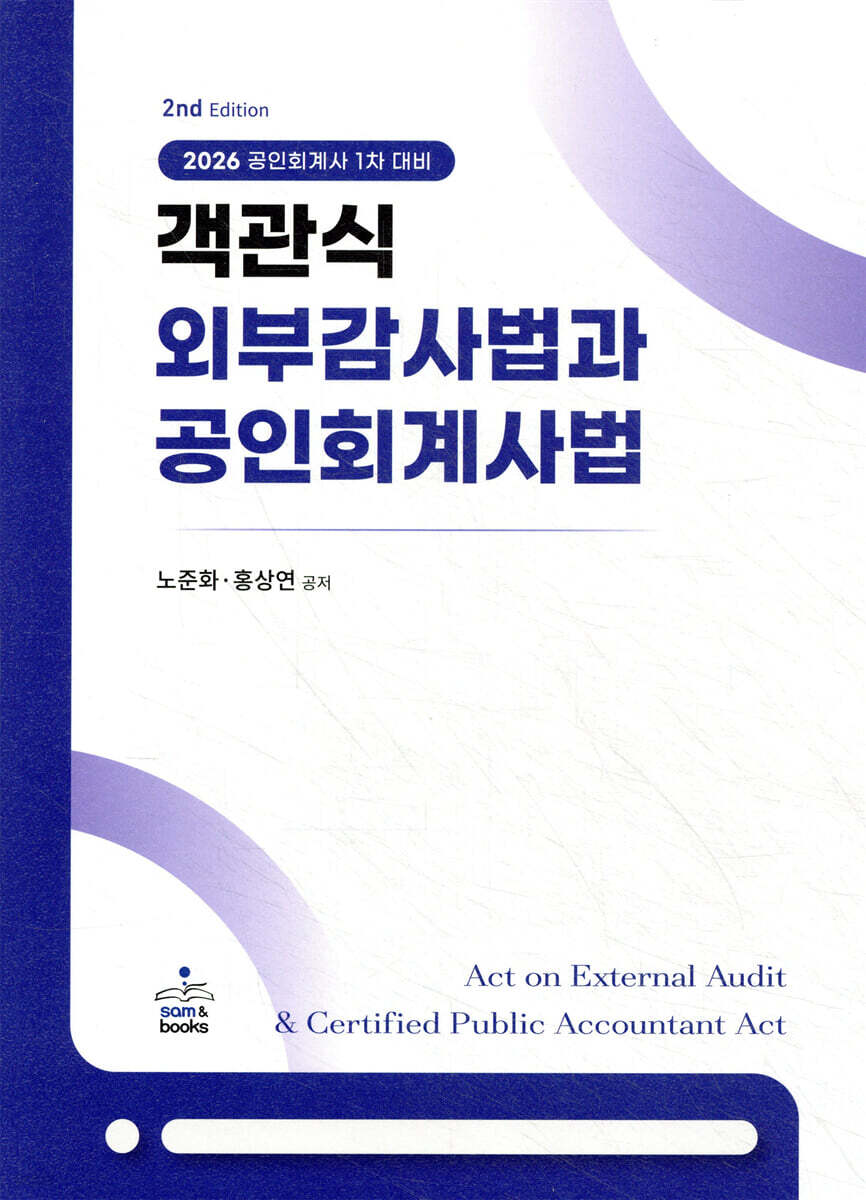
Objective External Audit Act and Certified Public Accountant Act
 |
Description
Book Introduction
1.
We prepared a minimum number of questions for each article.
I believe that increasing the number of questions only takes away the test takers' time and concentration and is not very helpful.
Instead, minority problems required the same level of integrated thinking as complex problems.
2.
The number in question matches the article number.
This is the first year that the External Audit Act and the Certified Public Accountants Act are included in the exam, so questions may be supplemented and added in the future.
Convenience for test takers has been improved by matching the question number with the question text.
3.
The correct answer and explanation have been added at the bottom of the question.
In particular, the commentary has organized the content well, gathering and organizing scattered knowledge.
The explanation is final, and the test takers' own efforts to correct their mistakes will make them stronger.
4.
Each time a clause is changed, it contains the clause and some of its revised contents.
This prepared test takers for new questions by reminding them of basic knowledge before new content began.
5.
As it was the first year, the questions presented in 2025 were very basic.
Past exam questions are included with the corresponding articles along with explanations.
We prepared a minimum number of questions for each article.
I believe that increasing the number of questions only takes away the test takers' time and concentration and is not very helpful.
Instead, minority problems required the same level of integrated thinking as complex problems.
2.
The number in question matches the article number.
This is the first year that the External Audit Act and the Certified Public Accountants Act are included in the exam, so questions may be supplemented and added in the future.
Convenience for test takers has been improved by matching the question number with the question text.
3.
The correct answer and explanation have been added at the bottom of the question.
In particular, the commentary has organized the content well, gathering and organizing scattered knowledge.
The explanation is final, and the test takers' own efforts to correct their mistakes will make them stronger.
4.
Each time a clause is changed, it contains the clause and some of its revised contents.
This prepared test takers for new questions by reminding them of basic knowledge before new content began.
5.
As it was the first year, the questions presented in 2025 were very basic.
Past exam questions are included with the corresponding articles along with explanations.
index
PART Ⅰ Act on External Audit of Corporations, etc.
CHAPTER 01 GENERAL PROVISIONS 3
1.
Purpose of the External Audit Act 3
2.
Definition of Terms 5
3.
Relationship with other laws 11
CHAPTER 02 Company and Auditor 13
4.
Object of external audit 13
5.
Accounting Standard 21
6.
Responsibilities for Preparation and Submission of Financial Statements 25
7.
Authority of the controlling company 32
8.
Operation of the Internal Accounting Management System 33
9.
Auditor Qualifications Restriction 48
9-2.
Registration and Cancellation of Auditors of Listed Corporations (Listed Corporation Auditor Registration System) 55
10.
Appointment of auditors 61
11.
68 Appointment of auditors by the Securities and Futures Commission
12.
Report on Appointment of Auditor 77
13.
Dismissal of the auditor 81
14.
Electrical auditor's right to express opinion 87
15.
Termination of Audit Contract by Auditor 90
16.
Accounting Auditing Standard 97
16-2.
Standard audit time 100
17.
Quality Control Standard 102
18.
Preparation of the Audit Report 107
19.
Audit Report 109
20.
Confidentiality 112
21.
Auditor's authority, etc. 115
22.
Report misconduct, etc. 119
23.
123 Submission of audit reports, etc.
24.
Attendance at general shareholders' meetings, etc. 128
25.
Submission, storage, and disclosure of accounting firm business reports, etc. 131
CHAPTER 03 Supervision and Disposition 135
26.
Securities and Futures Commission Supervision Work 135
27.
137 Request for submission of materials, etc.
28.
Protection of whistleblowers of misconduct, etc. 139
29.
Actions against companies and auditors, etc. 141
30.
Publication of violations, etc. 146
31.
Liability for damages 149
32.
Accumulation of a joint compensation fund, etc. 157
33.
Payment and limits of joint funds, etc. 163
34.
Management of common funds, etc. 167
35.
Fine 169
36.
Imposition and Collection of Surcharges 173
CHAPTER 04 Supplementary Rules 177
38.
Delegation of Work 177
PART Ⅱ Certified Public Accountants Act
CHAPTER 01 GENERAL PROVISIONS 181
1.
Objective 181
2.
Scope of duties 183
3.
Qualification 185
4.
Disqualification Reason 187
CHAPTER 02 EXAMINATION 189
5.
Certified Public Accountant Exam 189
5-2.
Sanctions against misconduct 191
6.
Partial exemption from exam 193
CHAPTER 03 Registration and Opening 197
7.
Registration 197
11.
Prohibition on the use of similar names 198
CHAPTER 04 Rights and Obligations 203
12.
Office opening 203
13.
Office worker 203
15.
Duty of Fairness and Honesty, etc. 204
16.
Compliance with the Rules 204
18.
Jangbu Beach 205
20.
Confidentiality 205
19.
Guarantee of Liability for Damages 209
21.
Job Restrictions 212
22.
Prohibition of lending of names, etc. 218
CHAPTER 05 Accounting Firm 220
23.
Established 220
24.
Accounting Firm Registration 222
26.
Director, etc. 224
27.
Capital, etc. 229
28.
Damage Compensation Reserve Fund 231
29.
Restrictions on investment by other corporations, etc. 233
30.
Accounting Processing, etc. 233
31.
Name 234
32.
Office 234
33.
Job Restrictions 238
34.
Method of Executing Business 248
35.
Prohibition of Competition 251
36.
Withdrawal 253
37.
Disbandment 255
05-2 Foreign Certified Public Accountants and Foreign Accounting Firms 257
40-2.
Definition 257
40-3.
Scope of Duties of Foreign Certified Public Accountants and Foreign Accounting Firms 258
40-4.
Registration of Foreign Certified Public Accountants 261
40-7.
Registration of Foreign Accounting Firms 263
40-8.
Cancellation of registration of foreign accounting firms, etc. 264
40-9.
Foreign Certified Public Accountants' Practice Methods 266
40-11.
268 Indication of qualifications, etc.
40-12.
271 Investment in Accounting Firms
CHAPTER 06 Korean Institute of Certified Public Accountants 273
41.
Purpose and Establishment 273
42.
Obligation to attend 275
43.
Code of Ethics 275
44.
Delegation of work, etc. 276
45.
Dispute Resolution 276
46.
Member training, etc. 277
47.
Director 277
CHAPTER 07 Discipline 279
48.
Discipline 279
CHAPTER 08 Supplementary Rules 283
50.
Work Restrictions 283
51.
Inspection of ledgers, etc. 283
52.
Delegation of Work 284
CHAPTER 08-2 Imposition and Collection of Surcharges 286
52-2.
Imposition of fines 286
CHAPTER 09 PENALTY 290
53.
Penalty 290
54.
Penalty 292
CHAPTER 01 GENERAL PROVISIONS 3
1.
Purpose of the External Audit Act 3
2.
Definition of Terms 5
3.
Relationship with other laws 11
CHAPTER 02 Company and Auditor 13
4.
Object of external audit 13
5.
Accounting Standard 21
6.
Responsibilities for Preparation and Submission of Financial Statements 25
7.
Authority of the controlling company 32
8.
Operation of the Internal Accounting Management System 33
9.
Auditor Qualifications Restriction 48
9-2.
Registration and Cancellation of Auditors of Listed Corporations (Listed Corporation Auditor Registration System) 55
10.
Appointment of auditors 61
11.
68 Appointment of auditors by the Securities and Futures Commission
12.
Report on Appointment of Auditor 77
13.
Dismissal of the auditor 81
14.
Electrical auditor's right to express opinion 87
15.
Termination of Audit Contract by Auditor 90
16.
Accounting Auditing Standard 97
16-2.
Standard audit time 100
17.
Quality Control Standard 102
18.
Preparation of the Audit Report 107
19.
Audit Report 109
20.
Confidentiality 112
21.
Auditor's authority, etc. 115
22.
Report misconduct, etc. 119
23.
123 Submission of audit reports, etc.
24.
Attendance at general shareholders' meetings, etc. 128
25.
Submission, storage, and disclosure of accounting firm business reports, etc. 131
CHAPTER 03 Supervision and Disposition 135
26.
Securities and Futures Commission Supervision Work 135
27.
137 Request for submission of materials, etc.
28.
Protection of whistleblowers of misconduct, etc. 139
29.
Actions against companies and auditors, etc. 141
30.
Publication of violations, etc. 146
31.
Liability for damages 149
32.
Accumulation of a joint compensation fund, etc. 157
33.
Payment and limits of joint funds, etc. 163
34.
Management of common funds, etc. 167
35.
Fine 169
36.
Imposition and Collection of Surcharges 173
CHAPTER 04 Supplementary Rules 177
38.
Delegation of Work 177
PART Ⅱ Certified Public Accountants Act
CHAPTER 01 GENERAL PROVISIONS 181
1.
Objective 181
2.
Scope of duties 183
3.
Qualification 185
4.
Disqualification Reason 187
CHAPTER 02 EXAMINATION 189
5.
Certified Public Accountant Exam 189
5-2.
Sanctions against misconduct 191
6.
Partial exemption from exam 193
CHAPTER 03 Registration and Opening 197
7.
Registration 197
11.
Prohibition on the use of similar names 198
CHAPTER 04 Rights and Obligations 203
12.
Office opening 203
13.
Office worker 203
15.
Duty of Fairness and Honesty, etc. 204
16.
Compliance with the Rules 204
18.
Jangbu Beach 205
20.
Confidentiality 205
19.
Guarantee of Liability for Damages 209
21.
Job Restrictions 212
22.
Prohibition of lending of names, etc. 218
CHAPTER 05 Accounting Firm 220
23.
Established 220
24.
Accounting Firm Registration 222
26.
Director, etc. 224
27.
Capital, etc. 229
28.
Damage Compensation Reserve Fund 231
29.
Restrictions on investment by other corporations, etc. 233
30.
Accounting Processing, etc. 233
31.
Name 234
32.
Office 234
33.
Job Restrictions 238
34.
Method of Executing Business 248
35.
Prohibition of Competition 251
36.
Withdrawal 253
37.
Disbandment 255
05-2 Foreign Certified Public Accountants and Foreign Accounting Firms 257
40-2.
Definition 257
40-3.
Scope of Duties of Foreign Certified Public Accountants and Foreign Accounting Firms 258
40-4.
Registration of Foreign Certified Public Accountants 261
40-7.
Registration of Foreign Accounting Firms 263
40-8.
Cancellation of registration of foreign accounting firms, etc. 264
40-9.
Foreign Certified Public Accountants' Practice Methods 266
40-11.
268 Indication of qualifications, etc.
40-12.
271 Investment in Accounting Firms
CHAPTER 06 Korean Institute of Certified Public Accountants 273
41.
Purpose and Establishment 273
42.
Obligation to attend 275
43.
Code of Ethics 275
44.
Delegation of work, etc. 276
45.
Dispute Resolution 276
46.
Member training, etc. 277
47.
Director 277
CHAPTER 07 Discipline 279
48.
Discipline 279
CHAPTER 08 Supplementary Rules 283
50.
Work Restrictions 283
51.
Inspection of ledgers, etc. 283
52.
Delegation of Work 284
CHAPTER 08-2 Imposition and Collection of Surcharges 286
52-2.
Imposition of fines 286
CHAPTER 09 PENALTY 290
53.
Penalty 290
54.
Penalty 292
Publisher's Review
Following the recent publication of the basic textbooks on the External Audit Act and the Certified Public Accountant Act, we have now published a collection of multiple-choice questions.
When creating multiple-choice questions, I focused on establishing the underlying philosophy of the textbook as a problem.
Its origins go back to my memories of when I was a third-year university student, ambitiously trying to pass the first CPA exam.
It was a time when commercial law was a subject on the first exam and a so-called high-scoring subject, just like now.
The author was very fond of law subjects.
Naturally, I had invested a lot of time into commercial law, and I took the first exam with full confidence that I could solve any problem, but I remember being very flustered in the examination room due to the unusually high level of difficulty.
The questions were too long and none of them had clear answers.
That year, English and commercial law were the most difficult subjects the author had ever encountered.
As a result, while there were approximately 500 successful applicants in the first round in previous years, only 167 were successful that year.
Excluding those who failed the commercial law and English subjects, there were only a few applicants who scored over 60 points on average for all subjects that were required to pass.
In the end, the number of people who passed the first exam was less than the number of certified public accountants required that year.
The author, who failed the first exam, had serious concerns about whether he could achieve the desired results if he studied for another year.
However, as I focused on studying accounting during the summer, it suddenly became fall and the weather became cooler. I was anxious about having to go to the test center when it got colder, so I started to focus on the first test again.
There was pressure to enlist if I didn't pass next year.
At the time, military service was very strict and taking a leave of absence outside of military service was not allowed, so in effect, the author was given one last chance.
Since I absolutely had to pass the exam the following year, I had to pass the commercial law section no matter what questions were asked.
I don't think there were any particular problems with the textbook.
The multiple-choice workbook was written by the same author as the textbook, so I was able to answer the questions right away by reading the textbook chapters and solving the problems.
Since the problem was created according to the so-called article, if you understood the article, you could easily solve the problem.
The fingerprints are either copied as is or with some modifications.
Some modified sentences are the correct answer.
Meanwhile, a friend of mine who was attending law school said that he had a multiple-choice commercial law problem book written by a professor at Y University, but he couldn't solve it at all.
I immediately bought the workbook and solved the problems, but the correct answer rate was only about 30%.
It was a problem at the level of the Commercial Act of the previous year.
Even though I opened the textbook and tried to solve the problems I got wrong, I ended up not being able to solve about 30% of them.
For a moment, the author began to doubt whether the problem was a mistake.
However, I knew that such thoughts were very dangerous for a test taker, so I kept them in my head for several days.
As time went on, all the problems were solved, and as a result, the problem was with the depth of the author's knowledge.
The author's understanding and application of commercial law improved thanks to the multiple-choice question book written by a professor at Y University.
Thanks to this, the author was able to gain wings in commercial law and was able to prepare for the second exam right away, confident of passing the first exam the following year without even being graded.
Of course, the author passed the second exam that year, graduated in February of the following year, and began his military service. After continuing his studies, he mainly spent his time researching accounting auditing and corporate accounting transparency.
Around the age of fifty, which is considered late in life, he passed the CPA exam in Washington State, USA, and is currently registered as a CPA in two countries.
The author believes that a multiple-choice workbook should be able to fill in the gaps in the superficial knowledge gained from basic textbooks and make it more thorough.
This book, based on the author's unique experience, aims to provide test takers with a thorough knowledge of the External Audit Act and the Certified Public Accountant Act.
I believe that test takers who analyze the multiple-choice questions and build a defensive wall will be confident in any test.
The author's message to test takers, based on his experience as a test taker, is that if you practice multiple-choice questions that are literally like the passage and easily solve them every time, and then evaluate yourself as good, you may face unexpected difficulties in passing the first stage of the test, which is evaluated by prospective experts.
The author's basic philosophy in writing this book was that multiple-choice questions that simply ask the questions in question are not very helpful to test takers.
Rather than creating a large number of problems, we tried to combine only the necessary content to deepen understanding of the relevant article with the minimum number of problems.
A good problem is one that exploits the examinee's vulnerabilities, like a white hat hacker, and allows the examinee to improve upon those vulnerabilities, thereby building a more impenetrable defense wall.
However, the problems created by the author cannot be tested on the first exam. However, if you prepare for the commercial law subject that the author experienced, I believe that the chances of passing the exam will greatly increase.
This book is structured as follows.
1.
We prepared a minimum number of questions for each article.
I believe that increasing the number of questions only takes up the test takers' time and concentration and is not very helpful.
Instead, minority problems required the same level of integrated thinking as multiple problems combined.
2.
The number in question matches the article number.
This is the first year that the External Audit Act and the Certified Public Accountants Act are included in the exam, so questions may be supplemented and added in the future.
Convenience for test takers has been improved by matching the question number with the question text.
3.
The correct answer and explanation have been added at the bottom of the question.
In particular, the commentary has organized the content well, gathering and organizing scattered knowledge.
The explanation is final, and the test takers' own efforts to correct their mistakes will make them stronger.
4.
Each time a clause is changed, it contains the clause and some of its revised contents.
This prepared test takers for new questions by reminding them of basic knowledge before new content began.
5.
As it was the first year, the questions presented in 2025 were very basic.
Past exam questions are included with the corresponding articles along with explanations.
The difficulty level is expected to increase further in the future.
The number of questions allocated to the External Audit Act and the Certified Public Accountants Act in the first exam is not that large.
This book has been written to be of great help in solving problems of given ratios in a short period of time.
As I create complex problems, I am concerned that there may be some errors.
If any errors are discovered in the future, we will actively inform readers through the publisher.
I hope that the test takers' defenses will become stronger so that they can share the joy of passing the exam with me next year.
2025.
8
Written by Noh Jun-hwa
When creating multiple-choice questions, I focused on establishing the underlying philosophy of the textbook as a problem.
Its origins go back to my memories of when I was a third-year university student, ambitiously trying to pass the first CPA exam.
It was a time when commercial law was a subject on the first exam and a so-called high-scoring subject, just like now.
The author was very fond of law subjects.
Naturally, I had invested a lot of time into commercial law, and I took the first exam with full confidence that I could solve any problem, but I remember being very flustered in the examination room due to the unusually high level of difficulty.
The questions were too long and none of them had clear answers.
That year, English and commercial law were the most difficult subjects the author had ever encountered.
As a result, while there were approximately 500 successful applicants in the first round in previous years, only 167 were successful that year.
Excluding those who failed the commercial law and English subjects, there were only a few applicants who scored over 60 points on average for all subjects that were required to pass.
In the end, the number of people who passed the first exam was less than the number of certified public accountants required that year.
The author, who failed the first exam, had serious concerns about whether he could achieve the desired results if he studied for another year.
However, as I focused on studying accounting during the summer, it suddenly became fall and the weather became cooler. I was anxious about having to go to the test center when it got colder, so I started to focus on the first test again.
There was pressure to enlist if I didn't pass next year.
At the time, military service was very strict and taking a leave of absence outside of military service was not allowed, so in effect, the author was given one last chance.
Since I absolutely had to pass the exam the following year, I had to pass the commercial law section no matter what questions were asked.
I don't think there were any particular problems with the textbook.
The multiple-choice workbook was written by the same author as the textbook, so I was able to answer the questions right away by reading the textbook chapters and solving the problems.
Since the problem was created according to the so-called article, if you understood the article, you could easily solve the problem.
The fingerprints are either copied as is or with some modifications.
Some modified sentences are the correct answer.
Meanwhile, a friend of mine who was attending law school said that he had a multiple-choice commercial law problem book written by a professor at Y University, but he couldn't solve it at all.
I immediately bought the workbook and solved the problems, but the correct answer rate was only about 30%.
It was a problem at the level of the Commercial Act of the previous year.
Even though I opened the textbook and tried to solve the problems I got wrong, I ended up not being able to solve about 30% of them.
For a moment, the author began to doubt whether the problem was a mistake.
However, I knew that such thoughts were very dangerous for a test taker, so I kept them in my head for several days.
As time went on, all the problems were solved, and as a result, the problem was with the depth of the author's knowledge.
The author's understanding and application of commercial law improved thanks to the multiple-choice question book written by a professor at Y University.
Thanks to this, the author was able to gain wings in commercial law and was able to prepare for the second exam right away, confident of passing the first exam the following year without even being graded.
Of course, the author passed the second exam that year, graduated in February of the following year, and began his military service. After continuing his studies, he mainly spent his time researching accounting auditing and corporate accounting transparency.
Around the age of fifty, which is considered late in life, he passed the CPA exam in Washington State, USA, and is currently registered as a CPA in two countries.
The author believes that a multiple-choice workbook should be able to fill in the gaps in the superficial knowledge gained from basic textbooks and make it more thorough.
This book, based on the author's unique experience, aims to provide test takers with a thorough knowledge of the External Audit Act and the Certified Public Accountant Act.
I believe that test takers who analyze the multiple-choice questions and build a defensive wall will be confident in any test.
The author's message to test takers, based on his experience as a test taker, is that if you practice multiple-choice questions that are literally like the passage and easily solve them every time, and then evaluate yourself as good, you may face unexpected difficulties in passing the first stage of the test, which is evaluated by prospective experts.
The author's basic philosophy in writing this book was that multiple-choice questions that simply ask the questions in question are not very helpful to test takers.
Rather than creating a large number of problems, we tried to combine only the necessary content to deepen understanding of the relevant article with the minimum number of problems.
A good problem is one that exploits the examinee's vulnerabilities, like a white hat hacker, and allows the examinee to improve upon those vulnerabilities, thereby building a more impenetrable defense wall.
However, the problems created by the author cannot be tested on the first exam. However, if you prepare for the commercial law subject that the author experienced, I believe that the chances of passing the exam will greatly increase.
This book is structured as follows.
1.
We prepared a minimum number of questions for each article.
I believe that increasing the number of questions only takes up the test takers' time and concentration and is not very helpful.
Instead, minority problems required the same level of integrated thinking as multiple problems combined.
2.
The number in question matches the article number.
This is the first year that the External Audit Act and the Certified Public Accountants Act are included in the exam, so questions may be supplemented and added in the future.
Convenience for test takers has been improved by matching the question number with the question text.
3.
The correct answer and explanation have been added at the bottom of the question.
In particular, the commentary has organized the content well, gathering and organizing scattered knowledge.
The explanation is final, and the test takers' own efforts to correct their mistakes will make them stronger.
4.
Each time a clause is changed, it contains the clause and some of its revised contents.
This prepared test takers for new questions by reminding them of basic knowledge before new content began.
5.
As it was the first year, the questions presented in 2025 were very basic.
Past exam questions are included with the corresponding articles along with explanations.
The difficulty level is expected to increase further in the future.
The number of questions allocated to the External Audit Act and the Certified Public Accountants Act in the first exam is not that large.
This book has been written to be of great help in solving problems of given ratios in a short period of time.
As I create complex problems, I am concerned that there may be some errors.
If any errors are discovered in the future, we will actively inform readers through the publisher.
I hope that the test takers' defenses will become stronger so that they can share the joy of passing the exam with me next year.
2025.
8
Written by Noh Jun-hwa
GOODS SPECIFICS
- Date of issue: September 1, 2025
- Page count, weight, size: 312 pages | 188*258*30mm
- ISBN13: 9791156265726
You may also like
카테고리
korean


korean

![GQ KOREA Mark (Monthly): December [2025]](http://librairie.coreenne.fr/cdn/shop/files/8ef265dbbfbf186523ed75ba7319009d.jpg?v=1765340328&width=3840)


