

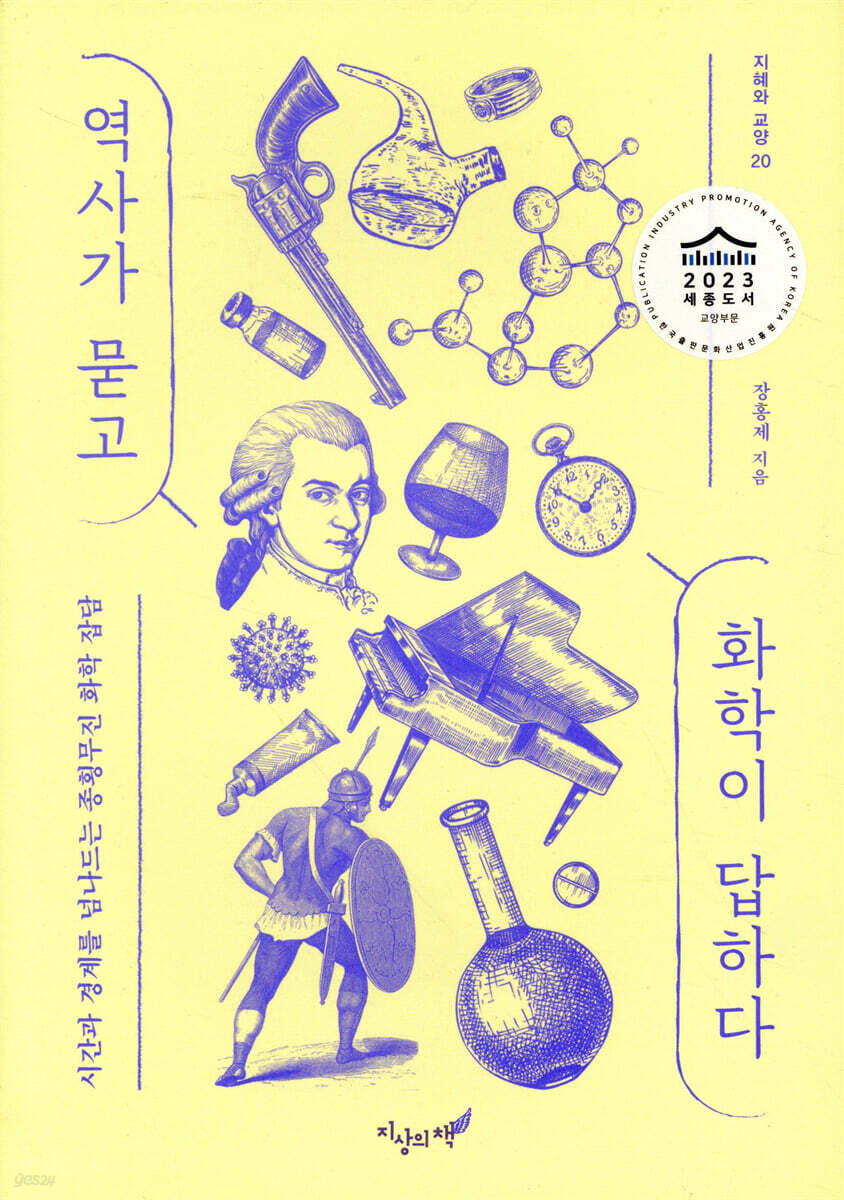
History asks, chemistry answers
 |
Description
Book Introduction
How did chemistry change the world?
How should humans use chemistry?
If you dig into the secrets of materials hidden in the backstory of history,
Meet the moment when chemistry becomes as good as history!
- How were the sketches hidden in Rembrandt's paintings discovered?
- Did Hannibal's army really use vinegar to break down rocks?
- What element is associated with the deaths of Mozart and Beethoven?
- Metal nanoparticles determine the color of stained glass?
- How will Alice's body change when she enters the upside-down world through the looking glass?
- Why is alchemy so prominent in various contents, including literary works and games?
Chemistry is close to us.
There are many products of chemical development that we find all around us, no matter how hard we try to avoid or reduce them, such as chemical products that have already become deeply ingrained in our daily lives, such as medicines, cosmetics, and detergents, as well as foods and plastic products containing chemical additives.
Every moment we eat, apply, wash, use, or throw away something, chemicals are already diligently working around us or inside our bodies.
"History Asks, Chemistry Answers" is a book in which a chemist who discovers traces of chemistry in every corner of the world talks about the moments when history and chemistry intersect.
The author, a professor of chemistry at Kwangwoon University who has been actively conducting research and writing, has completed a unique "hybrid science book" with a humanistic perspective that matches the title, "History Asks, Chemistry Answers."
It describes the tactics of Hannibal of ancient Carthage, explains common sense about acid and vinegar, and delves into the deaths of Mozart and Beethoven along with the toxins of lead and mercury.
By discussing the development of alchemy, the properties of stained glass and glass in cathedrals, and the history of chemical weapons development, we are encouraged to look into the world of chemistry and chemistry in the world.
By engaging in the fascinating chatter of a chemist who freely crosses the boundaries between the humanities and chemistry, readers will likely find traces of chemistry more readily everywhere, whether watching historical dramas on television, appreciating famous paintings, listening to music, or reading books or movies.
So, both chemistry and history will become a little easier and more interesting.
How should humans use chemistry?
If you dig into the secrets of materials hidden in the backstory of history,
Meet the moment when chemistry becomes as good as history!
- How were the sketches hidden in Rembrandt's paintings discovered?
- Did Hannibal's army really use vinegar to break down rocks?
- What element is associated with the deaths of Mozart and Beethoven?
- Metal nanoparticles determine the color of stained glass?
- How will Alice's body change when she enters the upside-down world through the looking glass?
- Why is alchemy so prominent in various contents, including literary works and games?
Chemistry is close to us.
There are many products of chemical development that we find all around us, no matter how hard we try to avoid or reduce them, such as chemical products that have already become deeply ingrained in our daily lives, such as medicines, cosmetics, and detergents, as well as foods and plastic products containing chemical additives.
Every moment we eat, apply, wash, use, or throw away something, chemicals are already diligently working around us or inside our bodies.
"History Asks, Chemistry Answers" is a book in which a chemist who discovers traces of chemistry in every corner of the world talks about the moments when history and chemistry intersect.
The author, a professor of chemistry at Kwangwoon University who has been actively conducting research and writing, has completed a unique "hybrid science book" with a humanistic perspective that matches the title, "History Asks, Chemistry Answers."
It describes the tactics of Hannibal of ancient Carthage, explains common sense about acid and vinegar, and delves into the deaths of Mozart and Beethoven along with the toxins of lead and mercury.
By discussing the development of alchemy, the properties of stained glass and glass in cathedrals, and the history of chemical weapons development, we are encouraged to look into the world of chemistry and chemistry in the world.
By engaging in the fascinating chatter of a chemist who freely crosses the boundaries between the humanities and chemistry, readers will likely find traces of chemistry more readily everywhere, whether watching historical dramas on television, appreciating famous paintings, listening to music, or reading books or movies.
So, both chemistry and history will become a little easier and more interesting.
- You can preview some of the book's contents.
Preview
index
To begin with
A story about the moment when history and chemistry intersect
Part 1.
There was chemistry in history
Why We Can't Explain Exactly What Poison Is - The Identity of the Drug That Causes Death
·Execute with drugs
·The poison of history and tradition, emergency
·If you put too much in, it's poisonous
Similar traits, similar to "Chemical Chat"
Can Chemistry Unlock the Secrets of Music? From Mozart's Death to the Pitch of Elements
Who Killed Mozart?
·Toxins accumulated in Beethoven's body
·Music to chemistry, chemistry to music
〈Chemical Chat〉 How are elements classified?
Can a mountain be crossed? - Hannibal and the Second Punic War
·Chemical reactions as a cross-sectional strategy
Vinegar in Livy's History of Rome
·For acetic acid to dissolve rocks,
·Thermochemical analysis
〈Chemical Chat〉Why don't electrons and nuclei stick together?
Part 2.
How Chemistry Changed the World
All that glitters isn't gold - Anti-Proliferation Laws and the Advancement of Chemistry
·Can we make gold too?
A dream that cannot be easily achieved
·The magic of making gold
〈Chemical Chat〉 Is there something special about the elements in Group 11?
When Color and Chemistry Meet - The Secrets of X-Rays and Paint
·What was in that picture?
·What is paint made of?
·Things that determine the color of paint
Measuring Age in Tens of Thousands of Years
How Gunpowder Shifted the World's Paradigm: From the Siege of Constantinople to the Present
·The cannon that destroyed the walls of Constantinople
·When and how was gunpowder made?
·Manufacturing black powder for actual combat
·A very modern gunpowder manufacturing method
〈Chemical Chatter〉 What is the standard for soluble substances?
How to Color Glass: Chemistry Discovered in Stained Glass
·Cathedral with rose windows
·For transparent glass to be colored
·Stained glass has a new look
〈Chemical Chatter〉 To melt glass
Part 3.
How should humans use chemistry?
Can using fire as a weapon be ethically just? From the Siege of Plataea to napalm.
·Fire in War
A fire that doesn't go out even when water is poured on it
·Can't we make better use of combustion?
〈Extensive Chemistry Chat〉 Oxidation and Reduction: A Pair
Why do dangerous and deadly chemical weapons exist? From Euphorbia resinifera to DDT.
·I'll make you shed tears
·The beginning of tear gas chemical weapons
·If poison gas enters our body
·The problem is how to use it.
〈Chemical Chatter〉 How can we experience that taste?
A Tale with a Twist - About Mirror Isomers and Symmetry
·If I meet someone who looks just like me
·How will Alice's body change in the mirror world?
·Looking in the mirror at the boundary between good and evil
〈Chemical Chat〉 What is the difference between inorganic and organic compounds?
References and Notes
A story about the moment when history and chemistry intersect
Part 1.
There was chemistry in history
Why We Can't Explain Exactly What Poison Is - The Identity of the Drug That Causes Death
·Execute with drugs
·The poison of history and tradition, emergency
·If you put too much in, it's poisonous
Similar traits, similar to "Chemical Chat"
Can Chemistry Unlock the Secrets of Music? From Mozart's Death to the Pitch of Elements
Who Killed Mozart?
·Toxins accumulated in Beethoven's body
·Music to chemistry, chemistry to music
〈Chemical Chat〉 How are elements classified?
Can a mountain be crossed? - Hannibal and the Second Punic War
·Chemical reactions as a cross-sectional strategy
Vinegar in Livy's History of Rome
·For acetic acid to dissolve rocks,
·Thermochemical analysis
〈Chemical Chat〉Why don't electrons and nuclei stick together?
Part 2.
How Chemistry Changed the World
All that glitters isn't gold - Anti-Proliferation Laws and the Advancement of Chemistry
·Can we make gold too?
A dream that cannot be easily achieved
·The magic of making gold
〈Chemical Chat〉 Is there something special about the elements in Group 11?
When Color and Chemistry Meet - The Secrets of X-Rays and Paint
·What was in that picture?
·What is paint made of?
·Things that determine the color of paint
Measuring Age in Tens of Thousands of Years
How Gunpowder Shifted the World's Paradigm: From the Siege of Constantinople to the Present
·The cannon that destroyed the walls of Constantinople
·When and how was gunpowder made?
·Manufacturing black powder for actual combat
·A very modern gunpowder manufacturing method
〈Chemical Chatter〉 What is the standard for soluble substances?
How to Color Glass: Chemistry Discovered in Stained Glass
·Cathedral with rose windows
·For transparent glass to be colored
·Stained glass has a new look
〈Chemical Chatter〉 To melt glass
Part 3.
How should humans use chemistry?
Can using fire as a weapon be ethically just? From the Siege of Plataea to napalm.
·Fire in War
A fire that doesn't go out even when water is poured on it
·Can't we make better use of combustion?
〈Extensive Chemistry Chat〉 Oxidation and Reduction: A Pair
Why do dangerous and deadly chemical weapons exist? From Euphorbia resinifera to DDT.
·I'll make you shed tears
·The beginning of tear gas chemical weapons
·If poison gas enters our body
·The problem is how to use it.
〈Chemical Chatter〉 How can we experience that taste?
A Tale with a Twist - About Mirror Isomers and Symmetry
·If I meet someone who looks just like me
·How will Alice's body change in the mirror world?
·Looking in the mirror at the boundary between good and evil
〈Chemical Chat〉 What is the difference between inorganic and organic compounds?
References and Notes
Detailed image

Into the book
Inheritance Powder
Human history and poison are inseparable.
Long ago, when people lacked the strength to fight against nature, they hunted using both weapons and poison. Even after civilization developed and classes and societies were formed, poison continued to be used as a means to achieve goals with insufficient strength.
In the case of poison, the ingredients and manufacturing methods were kept secret and were used for official state affairs such as executing criminals, and then were lost, but in the West, it was used in a slightly more open manner.
The name "inheritance powders" hints at their use and popularity.
Although arsenic and arsenic may seem similar, to scientists they are completely different substances.
Emergency is a combination of various elements such as oxygen, sulfur, and arsenic, and arsenic can be seen as a pure element and a core component of emergency.
(Omitted) When separated arsenic is oxidized by methods such as heating in the air, it changes into highly toxic arsenic oxide (As2O3). Its biggest characteristic is that it has no taste or smell and is completely undetectable when mixed into food or drinks in the form of a white powder.
--- p.30
How was Beethoven's cause of death discovered?
In 1994, a hair sample purchased at auction by the Beethoven Society was subjected to a precise compositional analysis using a synchrotron particle accelerator.
As a result, the concentration of mercury in Beethoven's hair was found to be within the normal range, proving that he had never suffered from syphilis (at that time, the only treatment for syphilis was mercury).
And it was discovered that he was suffering from severe lead poisoning, with lead levels hundreds of times higher than normal.
All of the symptoms Beethoven suffered from, including emotional reactions due to nerve damage, hearing loss, and abdominal pain, are consistent with lead poisoning.
The discovery of elemental toxicity and the advancement of scientific analysis techniques have unlocked secrets that had remained hidden for hundreds of years.
--- p.47
If Hannibal's army used vinegar
If we think of it only in terms of chemical reactions, it seems entirely possible that Hannibal's army, armed with vinegar, could dissolve limestone rocks and open a path.
But if you do a little math, you'll realize that there are serious errors left.
Table vinegar that is safe for humans to drink has an acetic acid content of only 3 to 5%.
Highly concentrated acetic acid used for industrial purposes typically has a concentration of 45 to 75 percent, which is a dangerously high acidity that can cause serious and irreversible damage to the mouth, esophagus, and internal organs when ingested.
--- p.74
The Dawn of the Age of Chemistry, Not the Extinction of Alchemy
As alchemy, which had been evolving, was restricted by the prohibition of multiplication, later alchemists and early chemists became interested in the chemistry of medicines and the reactions of substances, rather than gold.
The freedom to practice alchemy, which had been banned in 1404, was abolished in 1689 through the efforts of Robert Boyle, a great chemist and alchemist who is praised as one of the fathers of chemistry.
However, the dawn of the chemical age did not mean the demise of alchemy.
From Isaac Newton and Goethe to psychologist Carl Jung, luminaries from various fields have continued to explore the value of alchemy.
And now, with the advancement of chemistry and science, we can look rationally into the eternity of gold, the principles of its sparkle, and the meaning of its surface.
We have moved beyond the material obsession with gold and precious metals for their beauty and nobility, and into an era where we view the elements for more practical and useful purposes.
--- p.108~109
Can glass be replaced by other materials?
Colored glass and special glasses with special functions are still being invented today.
Beyond the ordinary metallic elements, a green glass containing praseodymium (Pr) and neodymium, found at the very bottom of the periodic table, is used to make safety glasses.
Glass containing uranium (U), an element used in nuclear power generation, is being used for a new purpose because of its characteristic of producing bright green fluorescence when exposed to ultraviolet light.
Now, objects as transparent, flat, and strong as glass can be made using polymers such as polycarbonate.
However, it is not easy to obtain a surface as smooth and flawless as glass.
Because glass is extremely resistant to acids, bases, and chemicals except hydrofluoric acid (HF), replacing existing glass with new materials seems like a distant dream.
--- p.185~186
What was Greek fire made of?
The Greek fire used against the invading Arab fleet in 678 is thought to have been a mixture of sulfur, petroleum, and bitumen, along with some novel combinations.
In particular, as the separation of crude oil became possible, the use of less refined gasoline called naphtha became more effective.
Quicklime, a solid substance produced by the combustion of calcium sulfate contained in desert roses, also plays a key role in creating the ever-burning Greek fire.
--- p.201
The Relationship Between War and Chemistry
The strategies, weapons, troops, and logistics used in the World Wars are extensive.
Chemistry also showed its presence most fully after the World Wars.
To overcome the shortage of natural rubber due to the war, synthetic rubber was created to replace tires and other items, and the Ghost Army of the 23rd Special Forces Division was able to use rubber balloon tanks to guide air strikes and use deception tactics to confuse the enemy.
They even made parachutes out of nylon, a synthetic polymer fiber, and successfully carried out the Normandy landings.
--- p.228
What changes will occur inside Alice's body?
Alice, who was imagining the world on the other side of the mirror, touches the mirror hanging above the fireplace and is transported to the world inside the mirror.
Just as a mirror reflects reality in reverse, the mirror world Alice entered was a world where logic was reversed, where running would stop her in place and stepping back would make her move forward.
(syncopation)
Now, let's make the problem a little more serious from a chemical perspective.
Alice is not an individual person existing separately inside and outside the mirror, but enters a world where everything is upside down through the mirror.
Since Alice entered a world where all logic was reversed and not reversed, the DNA that makes up her genes would still be twisted counterclockwise, and the amino acids would also be the exact opposite of those of the humans in the mirror world.
Other than the left-right inversion, each molecule is made up of the same type and number of atoms anyway, so you might not think there will be a big problem, but in the end, a serious problem occurs in Alice's body.
Human history and poison are inseparable.
Long ago, when people lacked the strength to fight against nature, they hunted using both weapons and poison. Even after civilization developed and classes and societies were formed, poison continued to be used as a means to achieve goals with insufficient strength.
In the case of poison, the ingredients and manufacturing methods were kept secret and were used for official state affairs such as executing criminals, and then were lost, but in the West, it was used in a slightly more open manner.
The name "inheritance powders" hints at their use and popularity.
Although arsenic and arsenic may seem similar, to scientists they are completely different substances.
Emergency is a combination of various elements such as oxygen, sulfur, and arsenic, and arsenic can be seen as a pure element and a core component of emergency.
(Omitted) When separated arsenic is oxidized by methods such as heating in the air, it changes into highly toxic arsenic oxide (As2O3). Its biggest characteristic is that it has no taste or smell and is completely undetectable when mixed into food or drinks in the form of a white powder.
--- p.30
How was Beethoven's cause of death discovered?
In 1994, a hair sample purchased at auction by the Beethoven Society was subjected to a precise compositional analysis using a synchrotron particle accelerator.
As a result, the concentration of mercury in Beethoven's hair was found to be within the normal range, proving that he had never suffered from syphilis (at that time, the only treatment for syphilis was mercury).
And it was discovered that he was suffering from severe lead poisoning, with lead levels hundreds of times higher than normal.
All of the symptoms Beethoven suffered from, including emotional reactions due to nerve damage, hearing loss, and abdominal pain, are consistent with lead poisoning.
The discovery of elemental toxicity and the advancement of scientific analysis techniques have unlocked secrets that had remained hidden for hundreds of years.
--- p.47
If Hannibal's army used vinegar
If we think of it only in terms of chemical reactions, it seems entirely possible that Hannibal's army, armed with vinegar, could dissolve limestone rocks and open a path.
But if you do a little math, you'll realize that there are serious errors left.
Table vinegar that is safe for humans to drink has an acetic acid content of only 3 to 5%.
Highly concentrated acetic acid used for industrial purposes typically has a concentration of 45 to 75 percent, which is a dangerously high acidity that can cause serious and irreversible damage to the mouth, esophagus, and internal organs when ingested.
--- p.74
The Dawn of the Age of Chemistry, Not the Extinction of Alchemy
As alchemy, which had been evolving, was restricted by the prohibition of multiplication, later alchemists and early chemists became interested in the chemistry of medicines and the reactions of substances, rather than gold.
The freedom to practice alchemy, which had been banned in 1404, was abolished in 1689 through the efforts of Robert Boyle, a great chemist and alchemist who is praised as one of the fathers of chemistry.
However, the dawn of the chemical age did not mean the demise of alchemy.
From Isaac Newton and Goethe to psychologist Carl Jung, luminaries from various fields have continued to explore the value of alchemy.
And now, with the advancement of chemistry and science, we can look rationally into the eternity of gold, the principles of its sparkle, and the meaning of its surface.
We have moved beyond the material obsession with gold and precious metals for their beauty and nobility, and into an era where we view the elements for more practical and useful purposes.
--- p.108~109
Can glass be replaced by other materials?
Colored glass and special glasses with special functions are still being invented today.
Beyond the ordinary metallic elements, a green glass containing praseodymium (Pr) and neodymium, found at the very bottom of the periodic table, is used to make safety glasses.
Glass containing uranium (U), an element used in nuclear power generation, is being used for a new purpose because of its characteristic of producing bright green fluorescence when exposed to ultraviolet light.
Now, objects as transparent, flat, and strong as glass can be made using polymers such as polycarbonate.
However, it is not easy to obtain a surface as smooth and flawless as glass.
Because glass is extremely resistant to acids, bases, and chemicals except hydrofluoric acid (HF), replacing existing glass with new materials seems like a distant dream.
--- p.185~186
What was Greek fire made of?
The Greek fire used against the invading Arab fleet in 678 is thought to have been a mixture of sulfur, petroleum, and bitumen, along with some novel combinations.
In particular, as the separation of crude oil became possible, the use of less refined gasoline called naphtha became more effective.
Quicklime, a solid substance produced by the combustion of calcium sulfate contained in desert roses, also plays a key role in creating the ever-burning Greek fire.
--- p.201
The Relationship Between War and Chemistry
The strategies, weapons, troops, and logistics used in the World Wars are extensive.
Chemistry also showed its presence most fully after the World Wars.
To overcome the shortage of natural rubber due to the war, synthetic rubber was created to replace tires and other items, and the Ghost Army of the 23rd Special Forces Division was able to use rubber balloon tanks to guide air strikes and use deception tactics to confuse the enemy.
They even made parachutes out of nylon, a synthetic polymer fiber, and successfully carried out the Normandy landings.
--- p.228
What changes will occur inside Alice's body?
Alice, who was imagining the world on the other side of the mirror, touches the mirror hanging above the fireplace and is transported to the world inside the mirror.
Just as a mirror reflects reality in reverse, the mirror world Alice entered was a world where logic was reversed, where running would stop her in place and stepping back would make her move forward.
(syncopation)
Now, let's make the problem a little more serious from a chemical perspective.
Alice is not an individual person existing separately inside and outside the mirror, but enters a world where everything is upside down through the mirror.
Since Alice entered a world where all logic was reversed and not reversed, the DNA that makes up her genes would still be twisted counterclockwise, and the amino acids would also be the exact opposite of those of the humans in the mirror world.
Other than the left-right inversion, each molecule is made up of the same type and number of atoms anyway, so you might not think there will be a big problem, but in the end, a serious problem occurs in Alice's body.
--- p.250~251
Publisher's Review
How we understand chemistry from a humanistic perspective
- A wide range of chemistry chatter, spanning various fields including art, music, literature, and architecture.
Among the many works by Rembrandt, an artist who cannot be left out in the history of Western art, “The Night Watch” is famous for its special anecdote.
When X-ray fluorescence analysis was attempted on this work, it was revealed that the underdrawing had been densely drawn in a space that had previously appeared dark.
Rembrandt often used bone charcoal when sketching. Bone charcoal, made by carbonizing animal bones by heating them at high temperatures in the absence of oxygen, contains calcium phosphate (CaPO4).
So, when X-ray fluorescence analysis was performed on Rembrandt's "Night Watch" for calcium (Ca) and phosphorus (P), the hidden underpainting could finally be revealed.
This book begins with Rembrandt's work to explain how removing a specific electron with high-energy X-rays creates a void, which other electrons then occupy, producing light in the form of fluorescence.
Not everyone has had the experience of thinking about chemistry in conjunction with music, but chemists find traces of chemistry even in the history of music.
The author points out that heavy metal poisoning was a common cause of death for both Mozart and Beethoven, and informs us about the toxic substances commonly used as medicine at the time.
It provides interesting examples of how chemistry has played a significant role in unraveling the mysteries of history, such as the reason why Mozart was suspected to have died from antimony poisoning, and the discovery of Beethoven's lead poisoning through analysis at a synchrotron particle accelerator.
There is no law that says chemistry cannot meet literature or architecture.
In a chapter that covers the struggle to create gold and the process leading up to the legal prohibition of alchemy, the author also presents numerous examples of interest in and affection for alchemy expressed in literary works and games.
Sometimes, while looking at the beautiful colors and patterns of stained glass and architecture, we naturally move on to explanations of optical phenomena, crystallinity of solids, cooling, and glassmaking technology.
The stained glass decorating the rose window looks quite different when viewed from the outside of the building.
It only appears as a dark gray or dark achromatic color overall, and no color is visible from the inside.
The difference is in the optical phenomena that appear due to the absorption, reflection, and transmission of white light pouring down from the sun.
This feature is more clearly observed in red and yellow glasses in a manner called dichroism.
─ 179p.
From 'For Transparent Glass to Be Colored'
The chemist's deeply humanistic yet scientific writing style, which crosses the boundaries of various fields, appeals refreshingly even to those who have previously found chemistry difficult.
This book provides a new experience where you can learn about history and become interested in chemistry.
Discovering chemistry in the changing world and understanding the world through the history of chemistry.
-A new perspective on war, weapons, executions, assassinations, and alchemy.
Of course, the 'chemical chatter' that the author unfolds in the book is not that simple.
This is because these are words that encourage us to discover chemistry in the changing world and to read the world through the history of chemistry, rather than just glancing at the back story of history and the development of chemistry here and there.
《History Asks, Chemistry Answers》 contains a wealth of articles related to not only the history of art and culture, but also the history of war.
In particular, the author's perspective, which examines changes in tactics and weaponry alongside the development of chemistry, provides an opportunity to think more deeply about the relationship between science and society, and science and ethics.
Gunpowder has great potential in industrial fields.
However, as with Nobel's dynamite, we cannot overlook its negative aspects, such as its use in war, violence, and terrorism.
(Omitted) Countless inventions have changed civilization and history, but gunpowder has been and will continue to be a major turning point in history.
Gunpowder, which destroys villages and takes human lives in war, is used to open blocked roads, light the sky with fireworks, and destroy for the sake of new creation.
Gunpowder is one of the most powerful forms of energy that humans can manipulate, and it is used as a propellant, fuel, explosive, and tool, moving into the depths of the ocean, under the Earth, and into space.
─ 161p.
Among the 'very modern gunpowder manufacturing methods'
The author even confesses in the preface that he wanted to show how to make homemade explosives by opening a channel called 'Bombmaster Jang Hong-je', but instead of breaking the law, he wrote about explosives, tear gas, and gunpowder.
Thanks to this, readers can safely access the book on black powder manufacturing, which is, in a way, 'unnecessarily high quality,' and even have the opportunity to consider the use of gunpowder today.
Articles dealing with poisons used in executions and assassinations also stimulate curiosity about other times and societies.
Readers who have ever wondered what the poisons often appearing in historical dramas are made of will find special satisfaction in the author's analytical yet humorous writing that details the toxicity of the rich and the unlucky.
Meanwhile, arsenic, a key component of emergency medicine, is used in the manufacture of semiconductors in modern society. In Europe, it was used in the 17th century by women who wanted to kill their husbands, and in the 19th century by those seeking to inherit insurance money.
As we follow the author's gaze as he examines the use of toxic substances throughout history, we also gain insight into how toxic substances were used in different times and societies.
The author also devotes considerable space to describing the Act Against Multipliers and the decline of alchemy.
The Anti-Proliferation Act, passed by the English Parliament in 1404, was a law prohibiting alchemists from creating gold or silver.
At that time, the value of gold increased further due to the Black Death and several wars, and the atmosphere of trying to prevent the proliferation of gold and silver by using the law became stronger.
Through oppression and restrictions, alchemists and early chemists became interested in the chemistry of medicines and the reactions of substances, rather than gold, and their interest led to the dawn of the chemical age.
The author's writing, which seamlessly connects the decline of alchemy and the rise of chemistry, concisely conveys another process by which humans began to rationally examine matter and principles.
It's a little difficult, but actually interesting
All-round chemistry story
- A structure that satisfies readers who want to learn more about chemistry
"History Asks, Chemistry Answers" will pique the interest of those who claim to be liberal arts students to the core, but it is not a book only for readers who find science difficult.
The author, who is well-versed in history, literature, music, and games, also faithfully reveals the characteristics of his 'main character' as a chemist in the book.
So, while talking about Rembrandt, Renoir, and Gauguin, he soon finds himself rambling about the composition of pigments in his paints, and in a chapter on Beethoven's autograph, he even goes into detail about the scientific explanation of the pitches of the line spectrum of the hydrogen atom.
The principle is the same for paints.
Each pigment will have a unique wavelength of light that it absorbs, and the complementary light that is not absorbed and reflected is perceived as color by us.
While the fundamental physical laws of visible light reflection and propagation create the appearance of shapes and colors, the different colors of each pigment are determined by the properties of the chemicals that make up the pigment.
Everything about pigment color is explained by chemical theories called conjugated systems and crystal field theory.
Conjugated pigments are related to the color principles of natural pigments extracted from plants and animals or synthetic pigments made from petroleum.
They all have in common that they are organic compounds made by linking carbon atoms.
─ 128p.
Among the 'Things that determine the color of paint'
Readers who are more curious about chemistry than history will be able to access more in-depth chemical knowledge through the special section titled "Extensive Chemistry Chat" at the end of each chapter.
In the chapter on alchemy, the author suggests thinking about transmuting metals in the same group as gold on the periodic table into gold, mentioning gold, silver, and copper in group 11.
And then, in the 'Chemical Chat' corner, we will recall these elements and go into more detail about the colors, conductivity, etc. of the Group 11 metal elements.
Also, in the main text that deals with the possibility that vinegar was used in Hannibal's march through the Alps, the components of acetic acid and the octet rule are discussed, and then the author goes back to 'Chemical Chat' to take an in-depth look at the outermost electrons and the creation of cations and anions.
This book diligently tells the story of how science has changed the world, how humans have used science, and how they should continue to use science.
Therefore, it can serve as a useful guide for both young readers who want to develop a scientific perspective and logical thinking skills, and adult readers who want to understand the world of chemistry in a slightly new way.
Of course, you can open this book without any specific purpose.
Those who don't just enjoy the spicy flavor but also want to know why capsaicin feels like it's burning when it enters the mouth, and those who are simply curious about what changes occur in Alice's body in the world of Lewis Carroll's Alice series, may be the readers who will find the chemical and humanistic ramblings filled with "History Asks, Chemistry Answers" more interesting.
- A wide range of chemistry chatter, spanning various fields including art, music, literature, and architecture.
Among the many works by Rembrandt, an artist who cannot be left out in the history of Western art, “The Night Watch” is famous for its special anecdote.
When X-ray fluorescence analysis was attempted on this work, it was revealed that the underdrawing had been densely drawn in a space that had previously appeared dark.
Rembrandt often used bone charcoal when sketching. Bone charcoal, made by carbonizing animal bones by heating them at high temperatures in the absence of oxygen, contains calcium phosphate (CaPO4).
So, when X-ray fluorescence analysis was performed on Rembrandt's "Night Watch" for calcium (Ca) and phosphorus (P), the hidden underpainting could finally be revealed.
This book begins with Rembrandt's work to explain how removing a specific electron with high-energy X-rays creates a void, which other electrons then occupy, producing light in the form of fluorescence.
Not everyone has had the experience of thinking about chemistry in conjunction with music, but chemists find traces of chemistry even in the history of music.
The author points out that heavy metal poisoning was a common cause of death for both Mozart and Beethoven, and informs us about the toxic substances commonly used as medicine at the time.
It provides interesting examples of how chemistry has played a significant role in unraveling the mysteries of history, such as the reason why Mozart was suspected to have died from antimony poisoning, and the discovery of Beethoven's lead poisoning through analysis at a synchrotron particle accelerator.
There is no law that says chemistry cannot meet literature or architecture.
In a chapter that covers the struggle to create gold and the process leading up to the legal prohibition of alchemy, the author also presents numerous examples of interest in and affection for alchemy expressed in literary works and games.
Sometimes, while looking at the beautiful colors and patterns of stained glass and architecture, we naturally move on to explanations of optical phenomena, crystallinity of solids, cooling, and glassmaking technology.
The stained glass decorating the rose window looks quite different when viewed from the outside of the building.
It only appears as a dark gray or dark achromatic color overall, and no color is visible from the inside.
The difference is in the optical phenomena that appear due to the absorption, reflection, and transmission of white light pouring down from the sun.
This feature is more clearly observed in red and yellow glasses in a manner called dichroism.
─ 179p.
From 'For Transparent Glass to Be Colored'
The chemist's deeply humanistic yet scientific writing style, which crosses the boundaries of various fields, appeals refreshingly even to those who have previously found chemistry difficult.
This book provides a new experience where you can learn about history and become interested in chemistry.
Discovering chemistry in the changing world and understanding the world through the history of chemistry.
-A new perspective on war, weapons, executions, assassinations, and alchemy.
Of course, the 'chemical chatter' that the author unfolds in the book is not that simple.
This is because these are words that encourage us to discover chemistry in the changing world and to read the world through the history of chemistry, rather than just glancing at the back story of history and the development of chemistry here and there.
《History Asks, Chemistry Answers》 contains a wealth of articles related to not only the history of art and culture, but also the history of war.
In particular, the author's perspective, which examines changes in tactics and weaponry alongside the development of chemistry, provides an opportunity to think more deeply about the relationship between science and society, and science and ethics.
Gunpowder has great potential in industrial fields.
However, as with Nobel's dynamite, we cannot overlook its negative aspects, such as its use in war, violence, and terrorism.
(Omitted) Countless inventions have changed civilization and history, but gunpowder has been and will continue to be a major turning point in history.
Gunpowder, which destroys villages and takes human lives in war, is used to open blocked roads, light the sky with fireworks, and destroy for the sake of new creation.
Gunpowder is one of the most powerful forms of energy that humans can manipulate, and it is used as a propellant, fuel, explosive, and tool, moving into the depths of the ocean, under the Earth, and into space.
─ 161p.
Among the 'very modern gunpowder manufacturing methods'
The author even confesses in the preface that he wanted to show how to make homemade explosives by opening a channel called 'Bombmaster Jang Hong-je', but instead of breaking the law, he wrote about explosives, tear gas, and gunpowder.
Thanks to this, readers can safely access the book on black powder manufacturing, which is, in a way, 'unnecessarily high quality,' and even have the opportunity to consider the use of gunpowder today.
Articles dealing with poisons used in executions and assassinations also stimulate curiosity about other times and societies.
Readers who have ever wondered what the poisons often appearing in historical dramas are made of will find special satisfaction in the author's analytical yet humorous writing that details the toxicity of the rich and the unlucky.
Meanwhile, arsenic, a key component of emergency medicine, is used in the manufacture of semiconductors in modern society. In Europe, it was used in the 17th century by women who wanted to kill their husbands, and in the 19th century by those seeking to inherit insurance money.
As we follow the author's gaze as he examines the use of toxic substances throughout history, we also gain insight into how toxic substances were used in different times and societies.
The author also devotes considerable space to describing the Act Against Multipliers and the decline of alchemy.
The Anti-Proliferation Act, passed by the English Parliament in 1404, was a law prohibiting alchemists from creating gold or silver.
At that time, the value of gold increased further due to the Black Death and several wars, and the atmosphere of trying to prevent the proliferation of gold and silver by using the law became stronger.
Through oppression and restrictions, alchemists and early chemists became interested in the chemistry of medicines and the reactions of substances, rather than gold, and their interest led to the dawn of the chemical age.
The author's writing, which seamlessly connects the decline of alchemy and the rise of chemistry, concisely conveys another process by which humans began to rationally examine matter and principles.
It's a little difficult, but actually interesting
All-round chemistry story
- A structure that satisfies readers who want to learn more about chemistry
"History Asks, Chemistry Answers" will pique the interest of those who claim to be liberal arts students to the core, but it is not a book only for readers who find science difficult.
The author, who is well-versed in history, literature, music, and games, also faithfully reveals the characteristics of his 'main character' as a chemist in the book.
So, while talking about Rembrandt, Renoir, and Gauguin, he soon finds himself rambling about the composition of pigments in his paints, and in a chapter on Beethoven's autograph, he even goes into detail about the scientific explanation of the pitches of the line spectrum of the hydrogen atom.
The principle is the same for paints.
Each pigment will have a unique wavelength of light that it absorbs, and the complementary light that is not absorbed and reflected is perceived as color by us.
While the fundamental physical laws of visible light reflection and propagation create the appearance of shapes and colors, the different colors of each pigment are determined by the properties of the chemicals that make up the pigment.
Everything about pigment color is explained by chemical theories called conjugated systems and crystal field theory.
Conjugated pigments are related to the color principles of natural pigments extracted from plants and animals or synthetic pigments made from petroleum.
They all have in common that they are organic compounds made by linking carbon atoms.
─ 128p.
Among the 'Things that determine the color of paint'
Readers who are more curious about chemistry than history will be able to access more in-depth chemical knowledge through the special section titled "Extensive Chemistry Chat" at the end of each chapter.
In the chapter on alchemy, the author suggests thinking about transmuting metals in the same group as gold on the periodic table into gold, mentioning gold, silver, and copper in group 11.
And then, in the 'Chemical Chat' corner, we will recall these elements and go into more detail about the colors, conductivity, etc. of the Group 11 metal elements.
Also, in the main text that deals with the possibility that vinegar was used in Hannibal's march through the Alps, the components of acetic acid and the octet rule are discussed, and then the author goes back to 'Chemical Chat' to take an in-depth look at the outermost electrons and the creation of cations and anions.
This book diligently tells the story of how science has changed the world, how humans have used science, and how they should continue to use science.
Therefore, it can serve as a useful guide for both young readers who want to develop a scientific perspective and logical thinking skills, and adult readers who want to understand the world of chemistry in a slightly new way.
Of course, you can open this book without any specific purpose.
Those who don't just enjoy the spicy flavor but also want to know why capsaicin feels like it's burning when it enters the mouth, and those who are simply curious about what changes occur in Alice's body in the world of Lewis Carroll's Alice series, may be the readers who will find the chemical and humanistic ramblings filled with "History Asks, Chemistry Answers" more interesting.
GOODS SPECIFICS
- Publication date: May 25, 2022
- Page count, weight, size: 280 pages | 406g | 148*210*20mm
- ISBN13: 9791197637940
- ISBN10: 119763794X
You may also like
카테고리
korean


korean

![GQ KOREA Mark (Monthly): December [2025]](http://librairie.coreenne.fr/cdn/shop/files/8ef265dbbfbf186523ed75ba7319009d.jpg?v=1765340328&width=3840)


