

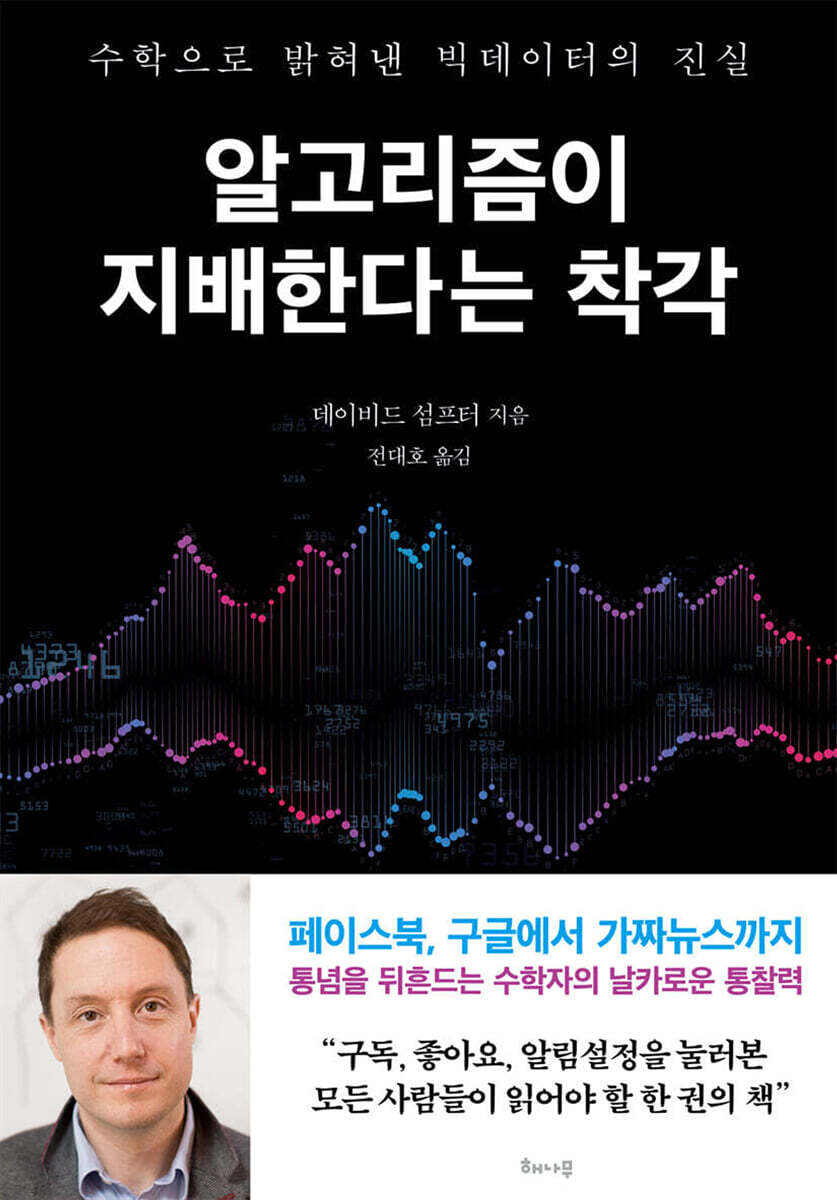
The illusion that algorithms rule
 |
Description
Book Introduction
A masterpiece by a world-renowned applied mathematician that raises powerful questions by mathematically dissecting the common belief that algorithms dominate humans.
This book argues that the controversy surrounding big data algorithms, especially the recent widespread fear of social media and artificial intelligence, has been exaggerated by the media and some experts, providing a balanced perspective that we, who live surrounded by algorithms, must possess.
This book mathematically analyzes algorithms, from Facebook and Google to fake news and artificial intelligence, and boldly challenges our common sense.
He points out that claims that Facebook knows us perfectly are nothing more than hype, allays concerns that social media is trapping us in biased views, and argues that there is no need to be overly fearful of fake news.
Elon Musk's claim that artificial intelligence will soon replace humans is also clearly revealed to be a baseless speculative fallacy when considering the current state of research.
Algorithms that analyze us, influence us, and are believed to one day become like us.
David Sumpter dismantles the mathematical principles of algorithms that work in secret, revealing that the greatest danger lies in our inability to rationally assess their impact and in our sway over science fiction scenarios.
This book argues that the controversy surrounding big data algorithms, especially the recent widespread fear of social media and artificial intelligence, has been exaggerated by the media and some experts, providing a balanced perspective that we, who live surrounded by algorithms, must possess.
This book mathematically analyzes algorithms, from Facebook and Google to fake news and artificial intelligence, and boldly challenges our common sense.
He points out that claims that Facebook knows us perfectly are nothing more than hype, allays concerns that social media is trapping us in biased views, and argues that there is no need to be overly fearful of fake news.
Elon Musk's claim that artificial intelligence will soon replace humans is also clearly revealed to be a baseless speculative fallacy when considering the current state of research.
Algorithms that analyze us, influence us, and are believed to one day become like us.
David Sumpter dismantles the mathematical principles of algorithms that work in secret, revealing that the greatest danger lies in our inability to rationally assess their impact and in our sway over science fiction scenarios.
- You can preview some of the book's contents.
Preview
index
Recommendation | 60 Percent Truth _ Park Sang-hyun (columnist)
Part 1 | The Algorithm That Analyzes Us
Chapter 1 | Finding Banksy
Chapter 2 | Make Noise
Chapter 3 | The Ingredients of Friendship
Chapter 4 | The 100-Dimensional You
Chapter 5 | Cambridge Analytica's Hype
Chapter 6 | Bias-Freedom Is Impossible
Chapter 7 | Data Alchemists
Part 2 | Algorithms That Affect Us
Chapter 8 | Nate Silver and Us
Chapter 9 | Recommendation Algorithms and the "Like" Model
Chapter 10 | Popularity Race
Chapter 11 | Filter Bubble
Chapter 12 | Football Matters
Chapter 13 | Who Reads Fake News?
Part 3 | Algorithms That Become Like Us
Chapter 14 | Learning About Sexism
Chapter 15 | The Only Thought in Numbers
Chapter 16 | I'll definitely step on you in Space Invaders
Chapter 17 | The Bacterial Brain
Chapter 18 | Back to Reality
main
Acknowledgements
Translator's Note
Search
Part 1 | The Algorithm That Analyzes Us
Chapter 1 | Finding Banksy
Chapter 2 | Make Noise
Chapter 3 | The Ingredients of Friendship
Chapter 4 | The 100-Dimensional You
Chapter 5 | Cambridge Analytica's Hype
Chapter 6 | Bias-Freedom Is Impossible
Chapter 7 | Data Alchemists
Part 2 | Algorithms That Affect Us
Chapter 8 | Nate Silver and Us
Chapter 9 | Recommendation Algorithms and the "Like" Model
Chapter 10 | Popularity Race
Chapter 11 | Filter Bubble
Chapter 12 | Football Matters
Chapter 13 | Who Reads Fake News?
Part 3 | Algorithms That Become Like Us
Chapter 14 | Learning About Sexism
Chapter 15 | The Only Thought in Numbers
Chapter 16 | I'll definitely step on you in Space Invaders
Chapter 17 | The Bacterial Brain
Chapter 18 | Back to Reality
main
Acknowledgements
Translator's Note
Search
Detailed image

Into the book
“Mathematics is destroying our personal authenticity, giving legitimacy to cheap rumors, charging Birmingham citizens with terrorism charges, collecting vast amounts of data from inside irresponsible corporations, and creating superintelligences that monitor our actions.
How serious are these issues, and how realistic are these scenarios? I decided to find out the answer the only way I knew how.
The way to do that is to look at the data, calculate statistics, and do math.” --- p.
24
“If you use Facebook, Instagram, Snapchat, Twitter, or any other social media site on a daily basis, you’re probably overwhelmed by the numbers.
You are allowing your personality to be a point in a space of hundreds of dimensions, allowing your emotions to be quantified and your future behavior to be modeled and predicted.
“All of this is done not only efficiently, but automatically, in a way that is almost incomprehensible to most of us.” --- p.61
“It's important to distinguish between scientific discovery—that a particular set of Facebook 'likes' correlates with personality test results—and implementing a reliable algorithm based on that discovery—that develops a formula that accurately predicts what type you are.
Scientific discoveries can be true and interesting.
However, unless the correlations found are very strong, it is impossible to reliably predict individual behavior based on scientific findings.”
--- p.
80
“With companies from Facebook and Spotify to travel agencies and sports consulting firms claiming to offer algorithms that categorize us and explain our behavior, I need to learn more about the accuracy of those algorithms.
"How well do these algorithms know us? Could they be making other, more dangerous errors?"
--- p., 86
“The work of analyzing personality analysis algorithms has changed my perspective in unexpected ways.
“While my concerns about the algorithms predicting us with dangerous accuracy have diminished, my concerns about how they are advertised have increased.”
--- p.87
“Only when black defendants in Broward, Florida, have the same recidivism rate as white defendants, or when there are as many women as men majoring in computer programming, can we hope to create algorithms that are completely free of bias.
“If the world we live in isn’t equal in every way possible, we can’t expect algorithms to be perfectly fair.”
--- p.100
“Based on experience, algorithms’ predictions of our behavior are nowhere near as accurate as others’ predictions.
“Algorithms perform best when used by someone who understands their limitations.”
--- p.117
“When I look at models that I've explored in some detail—models that predict the probability of a goal being scored in soccer, musical taste, crime rate, and political personality—I've come to the same conclusion:
“The accuracy of the algorithm is at best comparable to that of a human.”
--- p.121
“When it comes to our ability to analyze our behavior, the algorithms we’ve seen so far are at best on par with humans.
Mechanical Tucker's team, working with Julia Dressel's research, was able to predict recidivism with similar accuracy to state-of-the-art algorithms, but using much less data.
Personality models based on 'likes' still fall far short of 'knowing us' as individuals.
Spotify is trying to figure out how to recommend music to us as well as our friends.”
--- p.
135
“In my model, consumers don’t care how good a book is.
They buy books based on links provided by algorithms.
So, two equally excellent authors may end up with drastically different sales figures, one of whom may become a best-selling author while the other sells far fewer copies.
Even if all books are of exactly the same quality, some will become bestsellers, while others will falter and become flops.”
--- p.159
“Reading the articles, it seemed as if we were letting algorithms decide what we think and what we do.
There was a real risk that some of the news we were being fed was being distorted or fabricated by political villains.
However, I didn't like the way math was used in those articles.
I also found the implications about people's media consumption unsettling.
…are people really that strongly influenced by what they see on Facebook? Many of my colleagues seemed to think so, too.
But I wasn't sure.”
--- p.
196~197
“The effect of filtering was negligible.
Both Democrats and Republicans were only slightly less exposed to opposing views.
We're more likely to see posts from our close friends in our news feeds, but the political views they express are no more extreme than those of our entire group of friends.
Much of what we see on Facebook doesn't align with our own views.
Furthermore, the study found that Republicans, often criticized as a closed group, were exposed to slightly more opposing views than Democrats.
--- p.217
“There’s a lot of hype about Facebook and its impact on our lives.
However, after carefully reviewing large-scale studies and talking to the researchers involved, I realized that research results are almost always reported in the media in a distorted or exaggerated form.
The fuss clashed with my own scientific knowledge.
Of course, this is not an absurd fuss.
Facebook could create a small bubble on Election Day to slightly increase the number of voters.
It can also slightly dent our emotional bubble by showing us depressing posts.
It's certainly true that the news Facebook provides us doesn't fully represent the diverse views expressed around the world.
But these are not life-changing influences.
“The impact Facebook has on our lives is very small compared to the impact our everyday human relationships have on our real lives.”
--- p.221~222
“Although they have a slight progressive bias, these social media sites contribute to the spread and sharing of diverse information.
Overall, we are exposed to a multitude of views.
Some of them we like, some of them we hate.
But all of these views provide information about the world we live in.
“Our extensive social connections keep us from being trapped in a filter bubble.”
--- p.234~235
“There is no concrete evidence that the spread of fake news changes the course of elections or that the rise of bots has a negative impact on people’s political discussions.
We do not live in a 'post-truth' world.
Our hobbies and interests allow other people's political views to infiltrate our bubble.
At least for now, the bots' only conversation partners are other bots and a small number of alt-right Americans.
…and also, no one remembers fake news properly anyway.
“The news that Republicans get on Facebook, through what their friends share and what the Facebook algorithm curates, tends to be slightly more conservative than news that is selected completely at random.”
--- p.
254
“I found out that word inference algorithms are still under our control.
Even though these algorithms learned autonomously by looking only at our data, it turns out that we can figure out what's going on inside them and change the results they produce.
Unlike the connections in my brain—where my implicit reactions to words are intertwined with my childhood, upbringing, and professional experiences—the connections that drive algorithmic sexism can be unraveled and modified.
Therefore, it is inappropriate to say that the algorithm is sexist.
In fact, analyzing algorithms can help us better understand our own implicit sexism.
The work reveals how deeply stereotyping operates within our culture.”
--- p.283
“Despite the conviction of the panelists (Elon Musk, Ray Kurzweil, Demis Hassabis, and Nick Bostrom) that general artificial intelligence is on the way, my skepticism grew stronger as I watched the debate.
For the past year, I've been dissecting the algorithms of the companies those guys run.
Based on my observations, I simply cannot understand where they think general artificial intelligence is coming from.
In the algorithms they are developing, I find little evidence to suggest that human-like intelligence is on the horizon.
As far as I could tell, the panelists, who were big names in the tech industry, weren't taking the topic of their discussion seriously.
They were enjoying speculation, but speculation is not science.
“The discussion was purely entertainment.”
--- p.334~335
“The truth behind today’s algorithms is not only more mundane but also much simpler than the term ‘artificial intelligence’ suggests.
As I looked at the algorithms that try to classify us, I discovered that they are nothing more than statistical representations of what we already know about ourselves.
When I looked at the algorithms that try to influence us, I found that they exploit some very simple aspects of our behavior to determine what search information and ads to show us.
…when Alex and I built our own language bot, it surprised us by saying a few convincing sentences, but then it quickly revealed itself to be a complete fraud.”
--- p.350~351
“The possibilities for developing amazing products and services using the algorithms we explore in this book are open.
While these algorithms will continue to transform our homes, workplaces, and the way we travel, we are still a long way from general artificial intelligence.
Technology is giving our toasters, home audio equipment, offices, and cars a kind of bacterial intelligence.
“These algorithms have the potential to reduce the menial tasks we have to do, but they will not be able to perform human-like behavior.” --- p.
353
“Let’s go back to the real world.
Humans will remain the sole possessor of human-like intelligence for a long time to come.
The real question is whether we will use the algorithms already developed for the needs and convenience of a few, or for the broader society.
“I know which of these two options I prefer.”
How serious are these issues, and how realistic are these scenarios? I decided to find out the answer the only way I knew how.
The way to do that is to look at the data, calculate statistics, and do math.” --- p.
24
“If you use Facebook, Instagram, Snapchat, Twitter, or any other social media site on a daily basis, you’re probably overwhelmed by the numbers.
You are allowing your personality to be a point in a space of hundreds of dimensions, allowing your emotions to be quantified and your future behavior to be modeled and predicted.
“All of this is done not only efficiently, but automatically, in a way that is almost incomprehensible to most of us.” --- p.61
“It's important to distinguish between scientific discovery—that a particular set of Facebook 'likes' correlates with personality test results—and implementing a reliable algorithm based on that discovery—that develops a formula that accurately predicts what type you are.
Scientific discoveries can be true and interesting.
However, unless the correlations found are very strong, it is impossible to reliably predict individual behavior based on scientific findings.”
--- p.
80
“With companies from Facebook and Spotify to travel agencies and sports consulting firms claiming to offer algorithms that categorize us and explain our behavior, I need to learn more about the accuracy of those algorithms.
"How well do these algorithms know us? Could they be making other, more dangerous errors?"
--- p., 86
“The work of analyzing personality analysis algorithms has changed my perspective in unexpected ways.
“While my concerns about the algorithms predicting us with dangerous accuracy have diminished, my concerns about how they are advertised have increased.”
--- p.87
“Only when black defendants in Broward, Florida, have the same recidivism rate as white defendants, or when there are as many women as men majoring in computer programming, can we hope to create algorithms that are completely free of bias.
“If the world we live in isn’t equal in every way possible, we can’t expect algorithms to be perfectly fair.”
--- p.100
“Based on experience, algorithms’ predictions of our behavior are nowhere near as accurate as others’ predictions.
“Algorithms perform best when used by someone who understands their limitations.”
--- p.117
“When I look at models that I've explored in some detail—models that predict the probability of a goal being scored in soccer, musical taste, crime rate, and political personality—I've come to the same conclusion:
“The accuracy of the algorithm is at best comparable to that of a human.”
--- p.121
“When it comes to our ability to analyze our behavior, the algorithms we’ve seen so far are at best on par with humans.
Mechanical Tucker's team, working with Julia Dressel's research, was able to predict recidivism with similar accuracy to state-of-the-art algorithms, but using much less data.
Personality models based on 'likes' still fall far short of 'knowing us' as individuals.
Spotify is trying to figure out how to recommend music to us as well as our friends.”
--- p.
135
“In my model, consumers don’t care how good a book is.
They buy books based on links provided by algorithms.
So, two equally excellent authors may end up with drastically different sales figures, one of whom may become a best-selling author while the other sells far fewer copies.
Even if all books are of exactly the same quality, some will become bestsellers, while others will falter and become flops.”
--- p.159
“Reading the articles, it seemed as if we were letting algorithms decide what we think and what we do.
There was a real risk that some of the news we were being fed was being distorted or fabricated by political villains.
However, I didn't like the way math was used in those articles.
I also found the implications about people's media consumption unsettling.
…are people really that strongly influenced by what they see on Facebook? Many of my colleagues seemed to think so, too.
But I wasn't sure.”
--- p.
196~197
“The effect of filtering was negligible.
Both Democrats and Republicans were only slightly less exposed to opposing views.
We're more likely to see posts from our close friends in our news feeds, but the political views they express are no more extreme than those of our entire group of friends.
Much of what we see on Facebook doesn't align with our own views.
Furthermore, the study found that Republicans, often criticized as a closed group, were exposed to slightly more opposing views than Democrats.
--- p.217
“There’s a lot of hype about Facebook and its impact on our lives.
However, after carefully reviewing large-scale studies and talking to the researchers involved, I realized that research results are almost always reported in the media in a distorted or exaggerated form.
The fuss clashed with my own scientific knowledge.
Of course, this is not an absurd fuss.
Facebook could create a small bubble on Election Day to slightly increase the number of voters.
It can also slightly dent our emotional bubble by showing us depressing posts.
It's certainly true that the news Facebook provides us doesn't fully represent the diverse views expressed around the world.
But these are not life-changing influences.
“The impact Facebook has on our lives is very small compared to the impact our everyday human relationships have on our real lives.”
--- p.221~222
“Although they have a slight progressive bias, these social media sites contribute to the spread and sharing of diverse information.
Overall, we are exposed to a multitude of views.
Some of them we like, some of them we hate.
But all of these views provide information about the world we live in.
“Our extensive social connections keep us from being trapped in a filter bubble.”
--- p.234~235
“There is no concrete evidence that the spread of fake news changes the course of elections or that the rise of bots has a negative impact on people’s political discussions.
We do not live in a 'post-truth' world.
Our hobbies and interests allow other people's political views to infiltrate our bubble.
At least for now, the bots' only conversation partners are other bots and a small number of alt-right Americans.
…and also, no one remembers fake news properly anyway.
“The news that Republicans get on Facebook, through what their friends share and what the Facebook algorithm curates, tends to be slightly more conservative than news that is selected completely at random.”
--- p.
254
“I found out that word inference algorithms are still under our control.
Even though these algorithms learned autonomously by looking only at our data, it turns out that we can figure out what's going on inside them and change the results they produce.
Unlike the connections in my brain—where my implicit reactions to words are intertwined with my childhood, upbringing, and professional experiences—the connections that drive algorithmic sexism can be unraveled and modified.
Therefore, it is inappropriate to say that the algorithm is sexist.
In fact, analyzing algorithms can help us better understand our own implicit sexism.
The work reveals how deeply stereotyping operates within our culture.”
--- p.283
“Despite the conviction of the panelists (Elon Musk, Ray Kurzweil, Demis Hassabis, and Nick Bostrom) that general artificial intelligence is on the way, my skepticism grew stronger as I watched the debate.
For the past year, I've been dissecting the algorithms of the companies those guys run.
Based on my observations, I simply cannot understand where they think general artificial intelligence is coming from.
In the algorithms they are developing, I find little evidence to suggest that human-like intelligence is on the horizon.
As far as I could tell, the panelists, who were big names in the tech industry, weren't taking the topic of their discussion seriously.
They were enjoying speculation, but speculation is not science.
“The discussion was purely entertainment.”
--- p.334~335
“The truth behind today’s algorithms is not only more mundane but also much simpler than the term ‘artificial intelligence’ suggests.
As I looked at the algorithms that try to classify us, I discovered that they are nothing more than statistical representations of what we already know about ourselves.
When I looked at the algorithms that try to influence us, I found that they exploit some very simple aspects of our behavior to determine what search information and ads to show us.
…when Alex and I built our own language bot, it surprised us by saying a few convincing sentences, but then it quickly revealed itself to be a complete fraud.”
--- p.350~351
“The possibilities for developing amazing products and services using the algorithms we explore in this book are open.
While these algorithms will continue to transform our homes, workplaces, and the way we travel, we are still a long way from general artificial intelligence.
Technology is giving our toasters, home audio equipment, offices, and cars a kind of bacterial intelligence.
“These algorithms have the potential to reduce the menial tasks we have to do, but they will not be able to perform human-like behavior.” --- p.
353
“Let’s go back to the real world.
Humans will remain the sole possessor of human-like intelligence for a long time to come.
The real question is whether we will use the algorithms already developed for the needs and convenience of a few, or for the broader society.
“I know which of these two options I prefer.”
--- p.
354
354
Publisher's Review
The many myths and misconceptions surrounding Big Tech.
Beyond the fictional scenario, a world-renowned mathematician poses
The most urgent topic in the big data era
The author of the best mathematics paper received the Catherine Richards Award.
Highly recommended by columnist Park Sang-hyun!
"The Power of Mathematical Thinking" by Kit Yates is highly recommended!
“I clicked on Subscribe, Like, and Notification Settings
“A book everyone should read”
'Facebook is controlling us', 'Social media is forcing us into certain views and splitting society in two', 'Trump's election was manipulated by fake news', 'Artificial intelligence that perfectly mimics human intelligence will emerge and replace humans'... In the age of big data algorithms, humans have become mere commodities.
The prophecies about the dark future of humanity brought about by algorithms are echoing.
Are these prophecies actually true? How realistic are the algorithmic dystopian scenarios currently floating around?
Here, a mathematician questions the validity of concerns about algorithmic dominance.
World-renowned applied mathematician David Sumpter uses what he does best—mathematics—to examine data, compute statistics, and test scenarios one by one.
While not ignoring the reality that data is being used against us, Sumpter is not overly optimistic about the capabilities of algorithms, offering a balanced perspective that we, who live surrounded by algorithms, must possess.
Algorithms that analyze us, influence us, and are believed to one day become like us.
By dissecting the mathematical principles of algorithms that operate in secret, the author reveals that the greatest danger lies in our inability to rationally assess their impact and in our sway over science fiction scenarios.
From Facebook to Google, fake news
A mathematician's sharp insights that challenge conventional wisdom
“Before I read this book, I had
“A lot of my thoughts have changed.” _Park Sang-hyun (digital columnist)
From Facebook and Google to fake news and artificial intelligence, David Sumpter navigates the world of algorithms, challenging our assumptions.
One of them is a scientific rebuttal to the common belief that Facebook knows us perfectly and uses that information to manipulate us.
For example, in 2012, the media made headlines by reporting research showing that Facebook could manipulate our emotions.
But the research these articles were based on only found that users tended to use one more negative word per month, no matter how much negative news they consumed.
The media overestimated the risks of algorithms, ignoring the fact that, although statistically significant, their impact on real-life outcomes was minimal.
While many people are fussing over the impact of social media, including Facebook, on our lives, Sumpter's findings show that most of these concerns are exaggerated by indiscriminate media reporting.
While we tend to receive posts with similar views (a filter bubble) by forming friendships with people who share our political leanings on social media, research shows that people are also significantly exposed to views that differ from their own.
Few people use social media solely for political purposes; most share a variety of hobbies and interests, and it is this tendency that allows others' views to infiltrate our bubble.
There is also no concrete evidence that the spread of fake news changes the course of elections or that the rise of social media bots has a negative impact on people's political discussions.
“The truth behind the current algorithm is
More than what the term 'artificial intelligence' implies
“It’s not only more ordinary, but also much simpler.”
The theory that a general artificial intelligence that replicates human cognitive abilities will soon appear and replace humans is also revealed to be a groundless speculative fallacy when considering the current state of research.
Sumpter, who has thoroughly dissected the algorithms of companies run by Big Tech pioneers such as Tesla CEO Elon Musk, Google futurist Ray Kurzweil, and DeepMind founder Demis Hassabis, says he has found no clue that human-like intelligence is on the horizon.
Artificial neural networks, algorithms that mimic the neural network structure of the brain, have shown impressive technical achievements in some games such as Go, but humans are still far superior in their ability to learn the fundamentals of a game from the ground up.
Language algorithms that mimic human language have produced surprising results by producing some plausible sentences, but even the best language algorithms can't properly figure out what the word "it" in a sentence refers to.
The part that compares the current state of artificial intelligence to 'bacteria' is also novel and insightful.
Sumpter, realizing that AI is still a long way from achieving human-level tasks, raises the intriguing question of whether AI could possibly compete with other living organisms.
Comparing the cognitive abilities of various living organisms, such as dogs, bees, C. elegans, and microorganisms, with those of artificial intelligence, the somewhat shocking conclusion is that even at its highest performance, artificial intelligence is only at the level of bacteria like E. coli.
Just as bacteria take actions appropriate to their surroundings for purposes such as resource acquisition and reproduction, artificial intelligence also has the ability to adapt to situations by responding to various input signals.
But the capabilities of artificial intelligence end there.
AI can't understand and respond to human context like a dog, play soccer like a bee (seriously!), or interact socially like a C. elegans worm.
After a cool-headed analysis of the state of artificial intelligence development, Sumpter reached this conclusion:
“The truth behind today’s algorithms is not only more mundane, but also much simpler than the term ‘artificial intelligence’ suggests.”
“Now I know that the algorithm is not as I thought it was in the past.
“I know it’s not scary.”
What we arrive at from this revelation by a world-renowned applied mathematician lies somewhere between the constant chanting of Big Tech and the often-present, pessimistic conspiracy theories that suffocate us with fear.
According to Sumpter, the discussion about big tech should begin with that middle ground: a nuanced, rational examination of complex arguments without squashing them.
Now we have several choices before us.
Do you freely celebrate the hype-filled Big Tech utopia, or are you simply pessimistic about the algorithmic dystopia overblown by the media? Or do you cultivate a perspective that allows you to better understand future scenarios by calmly and coolly observing the gap between the optimistic and pessimistic dominance of algorithms?
The choice is entirely up to us.
GOODS SPECIFICS
- Publication date: February 28, 2022
- Page count, weight, size: 400 pages | 522g | 145*210*30mm
- ISBN13: 9791164051557
- ISBN10: 1164051555
You may also like
카테고리
korean


korean

![GQ KOREA Mark (Monthly): December [2025]](http://librairie.coreenne.fr/cdn/shop/files/8ef265dbbfbf186523ed75ba7319009d.jpg?v=1765340328&width=3840)


