

Thousand Character Classic Completion Workbook Training Book
 |
Description
Book Introduction
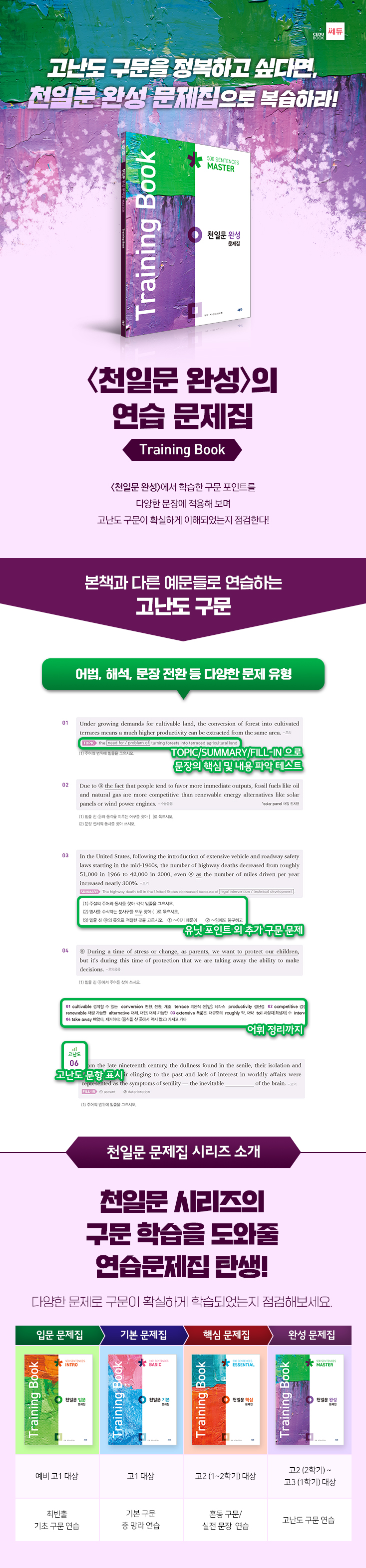
A practice book that allows you to practice difficult sentence structures with various problems.
Check if the syntax has been learned properly
The Thousand Character Classic series, which first appeared in 2004, became the number one bestseller in Korean literature, with cumulative sales exceeding 4.3 million copies.
The Thousand-Yil Classic, which has established itself as the best English textbook in Korea, has been reborn in a new way to fit learning trends.
The Thousand-Yil Classic is characterized by learning English structure by reading representative phrases in detail, and it allows for quick direct reading and accurate sentence interpretation.
The "Thousand Character Classic Completion Workbook (Training Book)" is a practice book for "Thousand Character Classic Completion." It contains sentences different from those in the main book, allowing you to encounter a wider variety of high-difficulty sentences and check whether you have thoroughly learned the structure of the sentences.
It consists of various types of questions such as sentence core confirmation questions (TOPIC/SUMMARY/FILL-IN), grammar, interpretation, and sentence transitions.
You can develop the ability to accurately interpret long sentences or sentences containing two or more phrases.
If you want to conquer all the difficult sentences on the CSAT, I recommend reviewing them with a training book!
Check if the syntax has been learned properly
The Thousand Character Classic series, which first appeared in 2004, became the number one bestseller in Korean literature, with cumulative sales exceeding 4.3 million copies.
The Thousand-Yil Classic, which has established itself as the best English textbook in Korea, has been reborn in a new way to fit learning trends.
The Thousand-Yil Classic is characterized by learning English structure by reading representative phrases in detail, and it allows for quick direct reading and accurate sentence interpretation.
The "Thousand Character Classic Completion Workbook (Training Book)" is a practice book for "Thousand Character Classic Completion." It contains sentences different from those in the main book, allowing you to encounter a wider variety of high-difficulty sentences and check whether you have thoroughly learned the structure of the sentences.
It consists of various types of questions such as sentence core confirmation questions (TOPIC/SUMMARY/FILL-IN), grammar, interpretation, and sentence transitions.
You can develop the ability to accurately interpret long sentences or sentences containing two or more phrases.
If you want to conquer all the difficult sentences on the CSAT, I recommend reviewing them with a training book!
- You can preview some of the book's contents.
Preview
index
Structure and Syntax | Look at the Tree
CHAPTER 01 Finding Subjects and Verbs
Unit 01 Review the Basics with Longer Sentences Subject Form
Unit 02 Distinction between adverbial phrases and subjects at the beginning of a sentence
Unit 03 Semantic Scope of Noun Phrase Subjects
Unit 04 Semantic Scope of Noun Clause Subjects
CHAPTER 02 Finding the Verb After a Modifier Phrase
Unit 05 Review the Basics with Longer Sentences Various Forms of Modifier Phrases Following Subjects
Unit 06 Finding the Verb After 〈Subject + Long Modifier Phrase〉
Unit 07 Finding the Verb After 〈Subject + Modifiers〉
Unit 08 Verb Position, Semi-Verb Position
CHAPTER 03 Problems Caused by Modifiers After Nouns
Unit 09 Review the Basics with Longer Sentences Noun Modifier Position
Unit 10 Finding the Object Complement after the Object
Unit 11 Various modifiers after nouns
Unit 12 Scope of Modifier Phrases
CHAPTER 04 Things that make it difficult to understand sentence structure
Unit 13 Relative clauses containing parentheses
Unit 14 The Role of Words That Are Easily Mistaken
Unit 15 Free Position of Adverbs
Unit 16: Unusual forms of participle phrases
CHAPTER 05 Understanding Sentence Structures with Omissions
Unit 17 Review the Basics with Longer Sentences Omissions and Common Sentences
Unit 18 Omitted Sentences
Unit 19 Omission of Conjunctions and Relatives
Unit 20 Conditional sentences with omitted if or if clauses
CHAPTER 06 Phrases that require careful word order
Unit 21 Review the Basics with Longer Sentences Word Order Changes
Unit 22 Move forward in sentences
Unit 23 Go back to the sentence
Unit 24 Information You Already Know + New Information
CHAPTER 07 Why Parallel Structures Are Difficult to Understand
Unit 25 Review the Basics with longer sentences Parallel structure
Unit 26 Sentences with two or more candidates for connecting phrases
Unit 27 Sentences with multiple coordinating conjunctions
Unit 28 Be careful with parentheses after coordinating conjunctions.
CHAPTER 08 Things to Understand in Comparative Sentences
Unit 29 Review the Basics with longer sentences
Unit 30 Omitting repetitive phrases such as ~, than ~, and below
Unit 31 Omission of Comparison Objects
Unit 32 Comparative Phrases to Watch Out For
CHAPTER 09 Phrases you seem to know but need to think about again
Unit 33 Pronouns it, they, this, that
Unit 34 Hidden Subjunctive
Unit 35 Negative Sentences
Unit 36 Passive expressions indicating cause and effect/order
Structure and Syntax | Dealing with Long and Complex Sentences
CHAPTER 10: Skip Boldly and Anticipate Actively
Unit 37 Review the Basics with Longer Sentences Skip the Explanations
Unit 38 Examples, Appositives
Unit 39 Adding Information vs.
stress
Unit 40: Connecting words that express comparison and contrast
CHAPTER 11 Find the matching phrases
Unit 41 it ~ to-v[that]
Unit 42 Paired Conjunctions
Unit 43 Paired Pronouns and Adverbs
Unit 44 Verbs with Specific Prepositions
CHAPTER 12 Solving Long and Complex Sentences
Unit 45 Complex sentences with multiple relative clauses
Unit 46 Complex clauses combined with comparative phrases
Unit 47 Complex clauses combined with special constructs
Unit 48 Long sentences of about 50 words
[Book within a Book] Answers and Explanations
CHAPTER 01 Finding Subjects and Verbs
Unit 01 Review the Basics with Longer Sentences Subject Form
Unit 02 Distinction between adverbial phrases and subjects at the beginning of a sentence
Unit 03 Semantic Scope of Noun Phrase Subjects
Unit 04 Semantic Scope of Noun Clause Subjects
CHAPTER 02 Finding the Verb After a Modifier Phrase
Unit 05 Review the Basics with Longer Sentences Various Forms of Modifier Phrases Following Subjects
Unit 06 Finding the Verb After 〈Subject + Long Modifier Phrase〉
Unit 07 Finding the Verb After 〈Subject + Modifiers〉
Unit 08 Verb Position, Semi-Verb Position
CHAPTER 03 Problems Caused by Modifiers After Nouns
Unit 09 Review the Basics with Longer Sentences Noun Modifier Position
Unit 10 Finding the Object Complement after the Object
Unit 11 Various modifiers after nouns
Unit 12 Scope of Modifier Phrases
CHAPTER 04 Things that make it difficult to understand sentence structure
Unit 13 Relative clauses containing parentheses
Unit 14 The Role of Words That Are Easily Mistaken
Unit 15 Free Position of Adverbs
Unit 16: Unusual forms of participle phrases
CHAPTER 05 Understanding Sentence Structures with Omissions
Unit 17 Review the Basics with Longer Sentences Omissions and Common Sentences
Unit 18 Omitted Sentences
Unit 19 Omission of Conjunctions and Relatives
Unit 20 Conditional sentences with omitted if or if clauses
CHAPTER 06 Phrases that require careful word order
Unit 21 Review the Basics with Longer Sentences Word Order Changes
Unit 22 Move forward in sentences
Unit 23 Go back to the sentence
Unit 24 Information You Already Know + New Information
CHAPTER 07 Why Parallel Structures Are Difficult to Understand
Unit 25 Review the Basics with longer sentences Parallel structure
Unit 26 Sentences with two or more candidates for connecting phrases
Unit 27 Sentences with multiple coordinating conjunctions
Unit 28 Be careful with parentheses after coordinating conjunctions.
CHAPTER 08 Things to Understand in Comparative Sentences
Unit 29 Review the Basics with longer sentences
Unit 30 Omitting repetitive phrases such as ~, than ~, and below
Unit 31 Omission of Comparison Objects
Unit 32 Comparative Phrases to Watch Out For
CHAPTER 09 Phrases you seem to know but need to think about again
Unit 33 Pronouns it, they, this, that
Unit 34 Hidden Subjunctive
Unit 35 Negative Sentences
Unit 36 Passive expressions indicating cause and effect/order
Structure and Syntax | Dealing with Long and Complex Sentences
CHAPTER 10: Skip Boldly and Anticipate Actively
Unit 37 Review the Basics with Longer Sentences Skip the Explanations
Unit 38 Examples, Appositives
Unit 39 Adding Information vs.
stress
Unit 40: Connecting words that express comparison and contrast
CHAPTER 11 Find the matching phrases
Unit 41 it ~ to-v[that]
Unit 42 Paired Conjunctions
Unit 43 Paired Pronouns and Adverbs
Unit 44 Verbs with Specific Prepositions
CHAPTER 12 Solving Long and Complex Sentences
Unit 45 Complex sentences with multiple relative clauses
Unit 46 Complex clauses combined with comparative phrases
Unit 47 Complex clauses combined with special constructs
Unit 48 Long sentences of about 50 words
[Book within a Book] Answers and Explanations
Detailed image
GOODS SPECIFICS
- Publication date: October 18, 2021
- Page count, weight, size: 224 pages | 426g | 210*280*20mm
- ISBN13: 9788968062353
- ISBN10: 8968062358
- Reference book for grades: 3rd year of high school
- Reference book usage semester: Common semester
- Reference book difficulty: Medium Reference book difficulty guide
You may also like
카테고리
korean


korean

![GQ KOREA Mark (Monthly): December [2025]](http://librairie.coreenne.fr/cdn/shop/files/8ef265dbbfbf186523ed75ba7319009d.jpg?v=1765340328&width=3840)


