

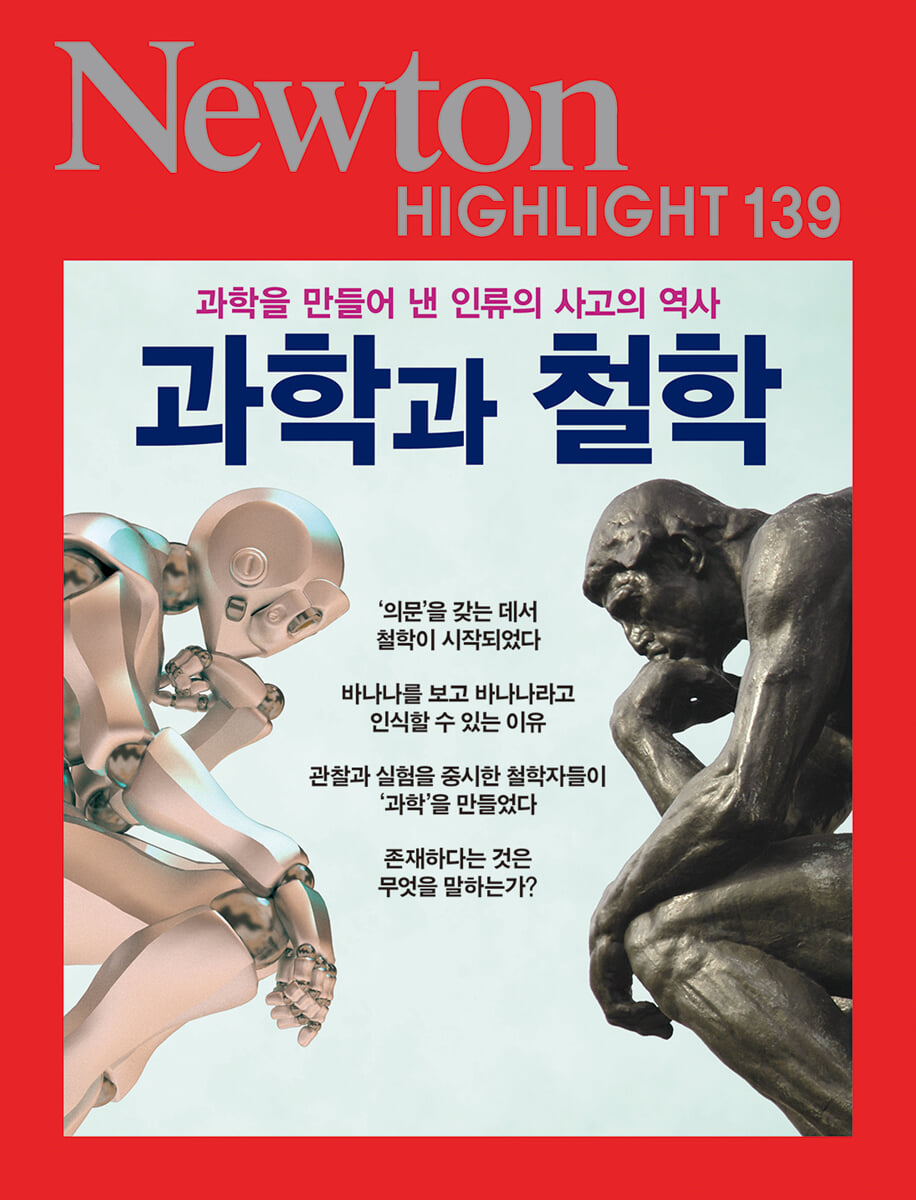
NEWTON HIGHLIGHTS 139 Science and Philosophy
 |
Description
Book Introduction
Explore the thinking and history that created science.
The discipline we call 'science' was once included in philosophy.
And from the 17th to the 19th century, it branched off from philosophy and developed as a science.
In other words, even Galileo and Newton, who are now called scientists, were both philosophers.
Since the distant days of ancient Greece, philosophers have observed various phenomena, asked the question, "Why is that so?", and have consistently sought answers.
It can be said that the advancements in science and technology and the abundance of our lives today are also based on the intellectual activities of such philosophers.
『NEWTON HIGHLIGHT 139 Science and Philosophy』 introduces the history of thinking of philosophers from ancient times to the present in an easy-to-understand manner, focusing on their relationship with science.
Chapter 1 deals with Greek philosophy, which is the origin of the discipline of science.
Chapter 2 then introduces the process through which science branched off from philosophy and developed.
Chapter 3 covers early modern philosophy, which developed alongside science, starting from empiricism, a progressive idea at the time.
Chapter 4, “Modern Philosophy,” introduces science and philosophy, which evolved independently while strongly influencing each other.
Chapter 5, the final chapter, deals with 'thought experiments', which philosophers of all ages have used as tools to verify and strengthen their ideas.
The discipline we call 'science' was once included in philosophy.
And from the 17th to the 19th century, it branched off from philosophy and developed as a science.
In other words, even Galileo and Newton, who are now called scientists, were both philosophers.
Since the distant days of ancient Greece, philosophers have observed various phenomena, asked the question, "Why is that so?", and have consistently sought answers.
It can be said that the advancements in science and technology and the abundance of our lives today are also based on the intellectual activities of such philosophers.
『NEWTON HIGHLIGHT 139 Science and Philosophy』 introduces the history of thinking of philosophers from ancient times to the present in an easy-to-understand manner, focusing on their relationship with science.
Chapter 1 deals with Greek philosophy, which is the origin of the discipline of science.
Chapter 2 then introduces the process through which science branched off from philosophy and developed.
Chapter 3 covers early modern philosophy, which developed alongside science, starting from empiricism, a progressive idea at the time.
Chapter 4, “Modern Philosophy,” introduces science and philosophy, which evolved independently while strongly influencing each other.
Chapter 5, the final chapter, deals with 'thought experiments', which philosophers of all ages have used as tools to verify and strengthen their ideas.
- You can preview some of the book's contents.
Preview
index
Chapter 1: The Origins of Science: Greek Philosophy
The Origins of Philosophy/The First Philosopher/Pythagoras/Atomism/The Ancestor of All Learning/Column 1: "Form is Emptiness" is One Answer to the Question, "What is Existence?"/Column 2: Does "Vacuum" Really Exist? The Great Debate of Ancient Greece/Column 3: The Ethics of Eastern Philosophy as Seen in "Confucius and Lao-tzu"
Chapter 2: Medieval and Modern Philosophy: The Cultivation of Science
Occam's Razor / The Formation of Modern Science / Self-Consciousness / Physics and Determinism / Empiricism ① / The Birth of Science / Column 4: Aristotle's Philosophy Reintroduced to Europe After Being Transmitted to Islam / Column 5: Is God's Expected Value Infinite? 'Pascal's Wager'
Chapter 3: Early Modern and Contemporary Philosophy Developing Alongside Science
Chance causation/empiricism ②~③/Copernican shift/Laplace's demon/Progressive thought and evolution theory/Aether wind/Mach's principle/Neutral monism/Scientific realism/Unconsciousness/Contradiction of set theory/Logical positivism/Confirmation theory/Falsifiability/Paradigm shift/Bayes theorem/Bayesism/Column 6 Living itself is the 'will to power'/Column 7 Japanese philosophers who developed their own philosophy and received worldwide attention/Column 8 Giants of psychology - Freud, Jung, Adler
Chapter 4: Modern Philosophy Walking with Science
Philosophy of Individual Science/Philosophy of Time/Law of Increasing Entropy/Philosophy of Quantum Theory/Interpretation of the Many Worlds/Animal Ethics/Bioethics/Philosophy of the Mind ①~②/Theory of the Mind/Ethics of Artificial Intelligence/Public Health Ethics/Column 9: Husserl and Heidegger/Column 10: Acquire Philosophical Thinking through Critical Thinking
Chapter 5: Ten Thought Experiments to Get to Know Philosophy
The Devil's Hypothesis/The Chinese Room/The Experience Machine/The Bug in the Box/Still Light/The Fake Cabin/The Martian Transmitter/Galileo's Sailboat/Gavagae/The Ship of Theseus/The Philosophical Map
The Origins of Philosophy/The First Philosopher/Pythagoras/Atomism/The Ancestor of All Learning/Column 1: "Form is Emptiness" is One Answer to the Question, "What is Existence?"/Column 2: Does "Vacuum" Really Exist? The Great Debate of Ancient Greece/Column 3: The Ethics of Eastern Philosophy as Seen in "Confucius and Lao-tzu"
Chapter 2: Medieval and Modern Philosophy: The Cultivation of Science
Occam's Razor / The Formation of Modern Science / Self-Consciousness / Physics and Determinism / Empiricism ① / The Birth of Science / Column 4: Aristotle's Philosophy Reintroduced to Europe After Being Transmitted to Islam / Column 5: Is God's Expected Value Infinite? 'Pascal's Wager'
Chapter 3: Early Modern and Contemporary Philosophy Developing Alongside Science
Chance causation/empiricism ②~③/Copernican shift/Laplace's demon/Progressive thought and evolution theory/Aether wind/Mach's principle/Neutral monism/Scientific realism/Unconsciousness/Contradiction of set theory/Logical positivism/Confirmation theory/Falsifiability/Paradigm shift/Bayes theorem/Bayesism/Column 6 Living itself is the 'will to power'/Column 7 Japanese philosophers who developed their own philosophy and received worldwide attention/Column 8 Giants of psychology - Freud, Jung, Adler
Chapter 4: Modern Philosophy Walking with Science
Philosophy of Individual Science/Philosophy of Time/Law of Increasing Entropy/Philosophy of Quantum Theory/Interpretation of the Many Worlds/Animal Ethics/Bioethics/Philosophy of the Mind ①~②/Theory of the Mind/Ethics of Artificial Intelligence/Public Health Ethics/Column 9: Husserl and Heidegger/Column 10: Acquire Philosophical Thinking through Critical Thinking
Chapter 5: Ten Thought Experiments to Get to Know Philosophy
The Devil's Hypothesis/The Chinese Room/The Experience Machine/The Bug in the Box/Still Light/The Fake Cabin/The Martian Transmitter/Galileo's Sailboat/Gavagae/The Ship of Theseus/The Philosophical Map
Detailed image
.jpg)
Publisher's Review
The 'crystal of knowledge' that humanity has created over more than 2,500 years - that is 'philosophy'.
The discipline we call 'science' was once included in philosophy.
And from the 17th to the 19th century, it branched off from philosophy and developed as a science.
In other words, even Galileo and Newton, who are now called scientists, were both philosophers.
Since the distant days of ancient Greece, philosophers have observed various phenomena, asked the question, "Why is that so?", and have consistently sought answers.
It can be said that the advancements in science and technology and the abundance of our lives today are also based on the intellectual activities of such philosophers.
This book introduces the history of thinking of philosophers from ancient times to the present in an easy-to-understand manner, focusing on their relationship with science.
Chapter 1 deals with Greek philosophy, which is the origin of the discipline of science.
Chapter 2 then introduces the process through which science branched off from philosophy and developed.
Chapter 3 covers early modern philosophy, which developed alongside science, starting from empiricism, a progressive idea at the time.
Chapter 4, “Modern Philosophy,” introduces science and philosophy, which evolved independently while strongly influencing each other.
Chapter 5, the final chapter, deals with 'thought experiments', which philosophers of all ages have used as tools to verify and strengthen their ideas.
Thought experiments can help you train yourself to think logically.
I think this book will be a good guide to understanding what scientific thinking is.
● Introducing ancient Greek philosophy, which formed the basis of modern science.
It is said that philosophy began in ancient Greece more than 2,500 years ago.
The origin of 'science', which supports our lives, can also be said to be the intellectual activities of ancient Greek philosophers.
The insights of the philosophers of the time were very sharp, and some concepts emerged that seemed to surpass modern scientific knowledge.
Chapter 1 introduces ancient Greek philosophy, focusing on its connection with modern science.
● Examining the trajectory of 'medieval and modern philosophy' that fostered science
Philosophy, which originated in ancient Greece, made great strides in Europe after the 13th century.
The various thoughts and experiments of philosophers who explored 'true knowledge' became the foundation of 'science' that began to emerge around the 17th century.
Chapter 2 deals with ‘Medieval and Modern Philosophy.’
In this era, philosophy and science had not yet developed separately.
We trace the trajectory of 'medieval and modern philosophy' until it gave rise to science.
● We examine the science and philosophy of the early and modern eras that influenced and developed together.
Science and philosophy have developed together, influencing each other from the early modern period to the modern era.
And in the process, we encountered several problems.
The biggest problem among them was how far the scope of research as a science should be expanded.
Chapter 3 examines how early modern philosophy confronted this problem and how the academic discipline of "philosophy of science" developed.
● Introduces modern philosophy in various fields, including the philosophy of individual sciences.
As science and technology developed, the philosophy that governs science also developed.
In fact, there are cases where scientists who continue to conduct specialized research in each field become the ones who create new philosophies.
This chapter introduces modern philosophy, focusing on the 'philosophy of individual science' in which scientists in the field talk about philosophy.
● Learn how to think logically through thought experiments.
A thought experiment is a method in which philosophers or scientists experiment with phenomena derived from theories through thought alone (only in their heads).
There are many subjects for thought experiments.
There are also things about ethics and things that prove the existence of an invisible mind.
It is also known as the method that created grand physical laws such as the theory of relativity.
Let's learn how to think logically through thought experiments.
Supervision, collaboration, and writing
Kanayama Yasuhira / Former Professor, Graduate School of Humanities, Nagoya University, Japan, Doctor of Literature
Mariko Kanayama / Former Professor, Osaka University of Medicine and Pharmaceutical Sciences, Japan
Masaki Ichinose / Professor at Musashino University, Professor Emeritus at the University of Tokyo, Doctor of Literature
Tetsuji Iseda / Associate Professor, Graduate School of Letters, Kyoto University, Japan, Ph.D.
(philosophy)
The discipline we call 'science' was once included in philosophy.
And from the 17th to the 19th century, it branched off from philosophy and developed as a science.
In other words, even Galileo and Newton, who are now called scientists, were both philosophers.
Since the distant days of ancient Greece, philosophers have observed various phenomena, asked the question, "Why is that so?", and have consistently sought answers.
It can be said that the advancements in science and technology and the abundance of our lives today are also based on the intellectual activities of such philosophers.
This book introduces the history of thinking of philosophers from ancient times to the present in an easy-to-understand manner, focusing on their relationship with science.
Chapter 1 deals with Greek philosophy, which is the origin of the discipline of science.
Chapter 2 then introduces the process through which science branched off from philosophy and developed.
Chapter 3 covers early modern philosophy, which developed alongside science, starting from empiricism, a progressive idea at the time.
Chapter 4, “Modern Philosophy,” introduces science and philosophy, which evolved independently while strongly influencing each other.
Chapter 5, the final chapter, deals with 'thought experiments', which philosophers of all ages have used as tools to verify and strengthen their ideas.
Thought experiments can help you train yourself to think logically.
I think this book will be a good guide to understanding what scientific thinking is.
● Introducing ancient Greek philosophy, which formed the basis of modern science.
It is said that philosophy began in ancient Greece more than 2,500 years ago.
The origin of 'science', which supports our lives, can also be said to be the intellectual activities of ancient Greek philosophers.
The insights of the philosophers of the time were very sharp, and some concepts emerged that seemed to surpass modern scientific knowledge.
Chapter 1 introduces ancient Greek philosophy, focusing on its connection with modern science.
● Examining the trajectory of 'medieval and modern philosophy' that fostered science
Philosophy, which originated in ancient Greece, made great strides in Europe after the 13th century.
The various thoughts and experiments of philosophers who explored 'true knowledge' became the foundation of 'science' that began to emerge around the 17th century.
Chapter 2 deals with ‘Medieval and Modern Philosophy.’
In this era, philosophy and science had not yet developed separately.
We trace the trajectory of 'medieval and modern philosophy' until it gave rise to science.
● We examine the science and philosophy of the early and modern eras that influenced and developed together.
Science and philosophy have developed together, influencing each other from the early modern period to the modern era.
And in the process, we encountered several problems.
The biggest problem among them was how far the scope of research as a science should be expanded.
Chapter 3 examines how early modern philosophy confronted this problem and how the academic discipline of "philosophy of science" developed.
● Introduces modern philosophy in various fields, including the philosophy of individual sciences.
As science and technology developed, the philosophy that governs science also developed.
In fact, there are cases where scientists who continue to conduct specialized research in each field become the ones who create new philosophies.
This chapter introduces modern philosophy, focusing on the 'philosophy of individual science' in which scientists in the field talk about philosophy.
● Learn how to think logically through thought experiments.
A thought experiment is a method in which philosophers or scientists experiment with phenomena derived from theories through thought alone (only in their heads).
There are many subjects for thought experiments.
There are also things about ethics and things that prove the existence of an invisible mind.
It is also known as the method that created grand physical laws such as the theory of relativity.
Let's learn how to think logically through thought experiments.
Supervision, collaboration, and writing
Kanayama Yasuhira / Former Professor, Graduate School of Humanities, Nagoya University, Japan, Doctor of Literature
Mariko Kanayama / Former Professor, Osaka University of Medicine and Pharmaceutical Sciences, Japan
Masaki Ichinose / Professor at Musashino University, Professor Emeritus at the University of Tokyo, Doctor of Literature
Tetsuji Iseda / Associate Professor, Graduate School of Letters, Kyoto University, Japan, Ph.D.
(philosophy)
GOODS SPECIFICS
- Publication date: October 15, 2021
- Page count, weight, size: 144 pages | 210*275*20mm
- ISBN13: 9791161961125
- ISBN10: 1161961127
You may also like
카테고리
korean


korean

![GQ KOREA Mark (Monthly): December [2025]](http://librairie.coreenne.fr/cdn/shop/files/8ef265dbbfbf186523ed75ba7319009d.jpg?v=1765340328&width=3840)


