

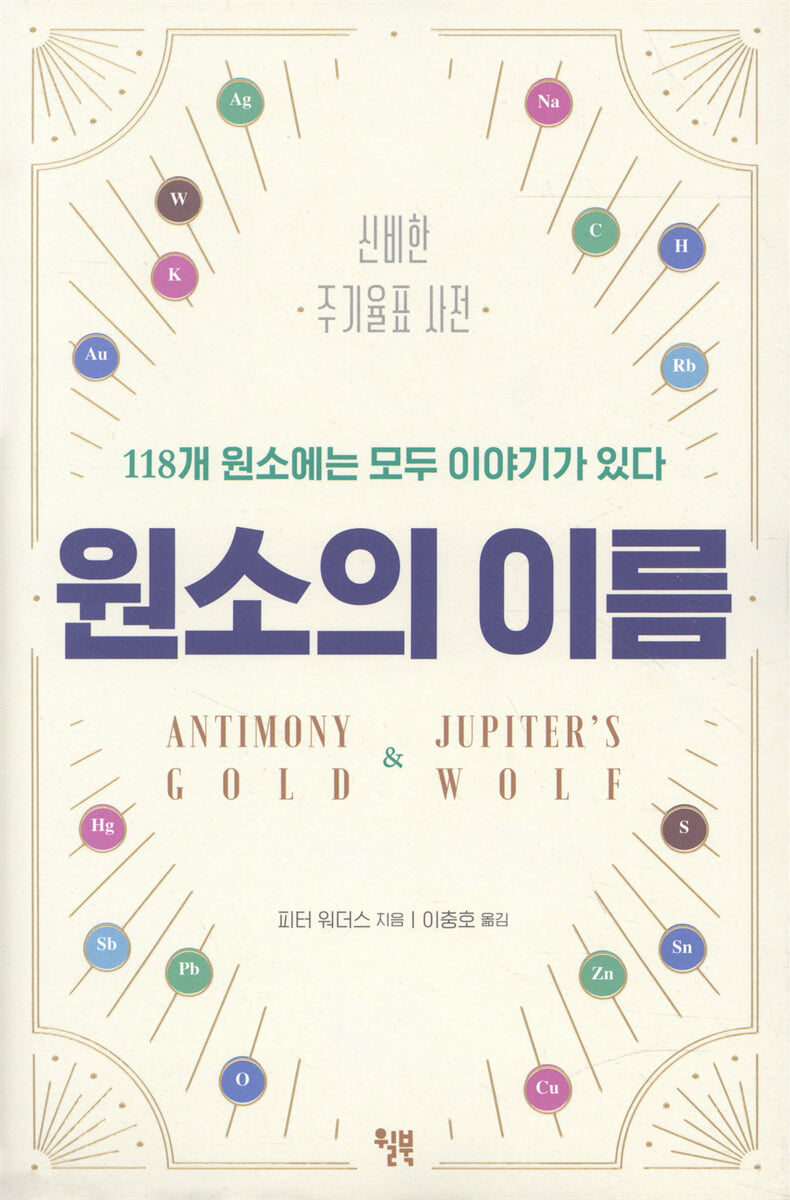
Name of the element
 |
Description
Book Introduction
Discover the mysterious stories hidden in the names and etymologies of elements in the periodic table.
Antimony, the wolf of metal; cobalt, the origin of the word goblin; a tale of elements that go hand in hand.
Covering mythology, religion, semiotics, history, ancient astronomy and mineralogy,
An amazing book that brings together diverse knowledge to create chemical reactions.
The elements in the periodic table, which completely fill the seven horizontal rows in a beautiful and elegant form.
How did the names of the 118 elements in the periodic table come about? While the periodic table was "completed" in its current form in November 2016, the stories behind each element's discovery and its current name are as diverse as the number of elements.
The origins of element names are found in Greek mythology, in passages from the Bible, in 17th-century literature, and in alchemical books.
Peter Wadders, an author who teaches chemistry at Cambridge University, calls chemists “modern-day alchemists.”
Chemistry is not only older than any other branch of science, but it is also a discipline that has been on the border between superstition and science.
In "The Names of the Elements," we delve into ancient and medieval records about metals and persistently search for the origins of element names.
Antimony, which was called the "wolf of metals" because it sucked up other metals like a wolf; cobalt, which is the origin of the German word "goblin" because it was a fearsome creature like a goblin to 17th century miners; aluminum, a metal that Charles Dickens praised with the line, "Good children will be born with an aluminum spoon in their mouths"; and even oxygen, which was named after a scientific error because its chemical properties were not fully understood.
The names of metals and elements, which originated in pre-scientific times, were finally freed from their mystery and given modern scientific names starting with Lavoisier's reform of French chemical nomenclature.
The task of uncovering the etymology of the name of an element, and thus going back to the era in which that element was discovered, is like a 'time travel' that reveals what characteristics of the metal people of that time paid attention to, what kind of work people did with the metal, and how the metal was used.
On the surface, it is a science book covering the history of chemistry, but if you look closely, it is also a humanities book that encompasses a wide range of knowledge, including mythology, religion, semiotics, history, ancient astronomy, and mineralogy, all of which contribute to chemical reactions.
Jae-sik Kwak, a doctor of engineering and author, wrote a recommendation saying, "The names of elements are like stepping stones that connect the world of myths and legends with the real world of science."
Antimony, the wolf of metal; cobalt, the origin of the word goblin; a tale of elements that go hand in hand.
Covering mythology, religion, semiotics, history, ancient astronomy and mineralogy,
An amazing book that brings together diverse knowledge to create chemical reactions.
The elements in the periodic table, which completely fill the seven horizontal rows in a beautiful and elegant form.
How did the names of the 118 elements in the periodic table come about? While the periodic table was "completed" in its current form in November 2016, the stories behind each element's discovery and its current name are as diverse as the number of elements.
The origins of element names are found in Greek mythology, in passages from the Bible, in 17th-century literature, and in alchemical books.
Peter Wadders, an author who teaches chemistry at Cambridge University, calls chemists “modern-day alchemists.”
Chemistry is not only older than any other branch of science, but it is also a discipline that has been on the border between superstition and science.
In "The Names of the Elements," we delve into ancient and medieval records about metals and persistently search for the origins of element names.
Antimony, which was called the "wolf of metals" because it sucked up other metals like a wolf; cobalt, which is the origin of the German word "goblin" because it was a fearsome creature like a goblin to 17th century miners; aluminum, a metal that Charles Dickens praised with the line, "Good children will be born with an aluminum spoon in their mouths"; and even oxygen, which was named after a scientific error because its chemical properties were not fully understood.
The names of metals and elements, which originated in pre-scientific times, were finally freed from their mystery and given modern scientific names starting with Lavoisier's reform of French chemical nomenclature.
The task of uncovering the etymology of the name of an element, and thus going back to the era in which that element was discovered, is like a 'time travel' that reveals what characteristics of the metal people of that time paid attention to, what kind of work people did with the metal, and how the metal was used.
On the surface, it is a science book covering the history of chemistry, but if you look closely, it is also a humanities book that encompasses a wide range of knowledge, including mythology, religion, semiotics, history, ancient astronomy, and mineralogy, all of which contribute to chemical reactions.
Jae-sik Kwak, a doctor of engineering and author, wrote a recommendation saying, "The names of elements are like stepping stones that connect the world of myths and legends with the real world of science."
- You can preview some of the book's contents.
Preview
index
Recommendation
preface
1.
orb
2.
Goblins and Demons
3.
fire and brimstone
4.
H2O or O2H?
5.
Ash and alkali
6.
Magnetite and earth
7.
Making salt
8.
The elements right under our noses
9.
Unstable area
Acknowledgements
References
Search
preface
1.
orb
2.
Goblins and Demons
3.
fire and brimstone
4.
H2O or O2H?
5.
Ash and alkali
6.
Magnetite and earth
7.
Making salt
8.
The elements right under our noses
9.
Unstable area
Acknowledgements
References
Search
Detailed image

Into the book
The reason sodium hydroxide is called lye is because before sodium hydroxide appeared, a substance with similar properties was called “lye.”
And the reason why lye, which was often used as a bleaching agent in laundry, was named lye is because the substance was created by mixing the ashes of burnt plants with water and extracting them.
--- p.4, "Recommendation (Kwak Jae-sik)"
The periodic table was finally 'completed' when every column from hydrogen (1) to oganesson (118) had an element with a formal name, and the seven horizontal rows were completely filled.
There is still a possibility that new elements will be synthesized in the future (research is still ongoing).
However, it is highly unlikely that such a neatly arranged periodic table will ever appear again, as 54 new elements would have to be created to fill the next column.
--- p.8, "Preface"
The origins of the names of the oldest known elements are unknown, but the oldest metals were considered to be associated with celestial bodies from very early times.
Without knowing the connection between alchemy and astronomy, it may not be immediately clear how this image represents the seven metals.
--- p.17, Chapter 1.
orb"
The number '7' has long been considered a number with mystical meaning.
The week was established as seven days in the Bible to reflect the seven days it took to create heaven and earth.
Over time, the seven celestial bodies came to be associated with the days of the week and with gods from ancient mythology.
It is also difficult to see as a coincidence that only seven metals (gold, silver, copper, iron, tin, lead, and mercury) were known in ancient times.
These metals were each associated with specific celestial bodies in the sky.
--- pp.20~21, 「Chapter 1.
orb"
Alchemists teach that seven planets rule specific parts of our body.
And because the metals represent the planets, it is taught that each metal has a special effect in treating abnormalities in certain areas and maintaining health.
So they assign the heart to gold, the head to silver, the liver to iron, the lungs to stone, the kidneys to copper, and the spleen to lead.
--- p.24, Chapter 1.
orb"
The link between the moon and brain disorders persists today in the English word "lunatic," meaning "madman" or "mentally ill," which refers to mental disorders that recur with the phases of the moon.
--- p.30, Chapter 1.
orb"
Miners often sang songs to boost their morale as they descended into 'hell'.
Mathesius included in his sermons a number of hymns used for this purpose.
The story of Snow White and the Seven Dwarfs may have been inspired by these images of singing miners and the little fairies they met.
The authors, the Grimm brothers, were renowned linguists and philologists of the 19th century, and they knew the 'kobold demon' well because they had collected many such folktales.
--- p.98, Chapter 2.
"Goblin and the Devil"
To be fair, Lavoisier also knew that oxygen did not always form acids when it reacted with other substances, but he believed that oxygen was an essential ingredient common to all acids.
Unfortunately, this idea was proven incorrect as hydrochloric acid was found to be composed solely of chlorine and hydrogen.
By the 19th century, the key component of acids (at least in aqueous solution) was discovered to be hydrogen ions, and the pH scale was developed to measure hydrogen ion concentration.
Therefore, given that hydrogen is the core component of all acids, it would have been more appropriate to name hydrogen oxygen.
And since oxygen's unique property is to combine with hydrogen to form water, the name hydrogen would have been more appropriate for oxygen.
It would be more logical to interchange the names hydrogen and oxygen, in which case we would be writing the molecular formula for water as O2H instead of H2O.
--- p.214, Chapter 4.
H2O or O2H?
The most important goal was to make the new symbols easy to understand.
They wrote:
“Our chemical symbol reform will not adopt the same design used by ancient chemists.
They used every means possible to shroud their science in a veil of mystery to keep it from the public's view.
On the contrary, we must do our best to communicate our knowledge as widely as possible.”
And the reason why lye, which was often used as a bleaching agent in laundry, was named lye is because the substance was created by mixing the ashes of burnt plants with water and extracting them.
--- p.4, "Recommendation (Kwak Jae-sik)"
The periodic table was finally 'completed' when every column from hydrogen (1) to oganesson (118) had an element with a formal name, and the seven horizontal rows were completely filled.
There is still a possibility that new elements will be synthesized in the future (research is still ongoing).
However, it is highly unlikely that such a neatly arranged periodic table will ever appear again, as 54 new elements would have to be created to fill the next column.
--- p.8, "Preface"
The origins of the names of the oldest known elements are unknown, but the oldest metals were considered to be associated with celestial bodies from very early times.
Without knowing the connection between alchemy and astronomy, it may not be immediately clear how this image represents the seven metals.
--- p.17, Chapter 1.
orb"
The number '7' has long been considered a number with mystical meaning.
The week was established as seven days in the Bible to reflect the seven days it took to create heaven and earth.
Over time, the seven celestial bodies came to be associated with the days of the week and with gods from ancient mythology.
It is also difficult to see as a coincidence that only seven metals (gold, silver, copper, iron, tin, lead, and mercury) were known in ancient times.
These metals were each associated with specific celestial bodies in the sky.
--- pp.20~21, 「Chapter 1.
orb"
Alchemists teach that seven planets rule specific parts of our body.
And because the metals represent the planets, it is taught that each metal has a special effect in treating abnormalities in certain areas and maintaining health.
So they assign the heart to gold, the head to silver, the liver to iron, the lungs to stone, the kidneys to copper, and the spleen to lead.
--- p.24, Chapter 1.
orb"
The link between the moon and brain disorders persists today in the English word "lunatic," meaning "madman" or "mentally ill," which refers to mental disorders that recur with the phases of the moon.
--- p.30, Chapter 1.
orb"
Miners often sang songs to boost their morale as they descended into 'hell'.
Mathesius included in his sermons a number of hymns used for this purpose.
The story of Snow White and the Seven Dwarfs may have been inspired by these images of singing miners and the little fairies they met.
The authors, the Grimm brothers, were renowned linguists and philologists of the 19th century, and they knew the 'kobold demon' well because they had collected many such folktales.
--- p.98, Chapter 2.
"Goblin and the Devil"
To be fair, Lavoisier also knew that oxygen did not always form acids when it reacted with other substances, but he believed that oxygen was an essential ingredient common to all acids.
Unfortunately, this idea was proven incorrect as hydrochloric acid was found to be composed solely of chlorine and hydrogen.
By the 19th century, the key component of acids (at least in aqueous solution) was discovered to be hydrogen ions, and the pH scale was developed to measure hydrogen ion concentration.
Therefore, given that hydrogen is the core component of all acids, it would have been more appropriate to name hydrogen oxygen.
And since oxygen's unique property is to combine with hydrogen to form water, the name hydrogen would have been more appropriate for oxygen.
It would be more logical to interchange the names hydrogen and oxygen, in which case we would be writing the molecular formula for water as O2H instead of H2O.
--- p.214, Chapter 4.
H2O or O2H?
The most important goal was to make the new symbols easy to understand.
They wrote:
“Our chemical symbol reform will not adopt the same design used by ancient chemists.
They used every means possible to shroud their science in a veil of mystery to keep it from the public's view.
On the contrary, we must do our best to communicate our knowledge as widely as possible.”
--- pp.270, Chapter 5.
Ash and alkali"
Ash and alkali"
Publisher's Review
The Hidden History of Chemistry Revealed by Element Names, and the World Until Yesterday
For a very long time, people thought there were seven elements.
This belief reflects the era's perception that seven was a perfect number, and was also associated with the seven celestial bodies.
Gold, silver, copper, iron, and tin, the oldest metals, are deeply connected to the names of celestial bodies.
The crescent-shaped alchemical symbol representing silver illustrates this.
In the past, the names of metals were written as 'alchemical symbols', which shows that at that time, metals were discovered and named in the process of making 'gold'.
Early metals were associated with astrology and astronomy, and had a place somewhere in the world of myth and superstition.
The names of elements date back to such unscientific times.
It was with the reform of chemical nomenclature in France in the late 18th century that we began to get closer to the modern names of elements.
Many 'chemists' were dissatisfied with the way substances were named, and Lavoisier and other young chemists led the way in reforming this.
This reform included requiring that new element names be in Greek and Latin and be applicable to different modern languages.
And at this time, the goal was also set that the symbol representing the compound should be made up of a combination of element symbols.
In particular, this reform sought to use a design different from that used by previous chemists, which marked a significant turning point in the shift away from myth and superstition in element symbols.
They abandoned the traditional alchemical symbols that had been used to shroud science in mystery, and sought to communicate the scientists' knowledge to the public as widely as possible.
To learn how the names of the elements were created is to read the process by which the realm of myth, superstition, and mystery transformed into science.
The stories in this book tell the history of chemistry, but also show the fascinating evolution of chemistry into a science of reason and rationality.
Interesting Stories Behind Metal Names
The people who most frequently encountered metal in life were undoubtedly miners.
For pre-modern miners, mines were hell, full of toxic minerals and poisonous gases, and lacking ventilation and proper lighting.
In 17th-century works, descriptions of 'demons' encountered in mines are frequently found.
The Brothers Grimm, 19th-century linguists and philologists, popularized the theory that the etymology of "nickel" is related to the devil through their collection of folk tales.
Miners called this mineral "copper nickel," meaning "devil's copper," because it "resembled copper" but from which copper could not be extracted.
The author also speculates that the element cobalt comes from the German word 'kobold', meaning devil.
Initially, miners discarded cobalt as a waste product, but it must have seemed like a demonic goblin to 17th-century miners, as it wasted their labor and demoralized them as much as a ghost.
Meanwhile, we can also get a glimpse into the perception of the people of the time when the new metal was discovered.
Charles Dickens said of aluminum, “All babies born in good homes will be born with an aluminum spoon in their mouth.”
Aluminum was a rare and expensive metal when it was first discovered, so the French emperor Napoleon III made knives and forks out of this surprisingly light metal and used them at state banquets.
A metal that is as white as silver, as uncorruptible as gold, as easily melted as copper, and as hard as iron.
And aluminum, which has excellent ductility and strength and is lighter than glass, was an innovative metal at the time.
Shouldn't it have been O2H, not H2O? Names forged within the limitations of science.
Elements were also named within the limitations of scientific knowledge of the time.
'Oxygen' is like that.
Lavoisier, the father of modern chemistry, called oxygen oxygene, which is a combination of the word oxy and the Greek word meaning 'to give birth'.
That is, it means ‘making a mountain.’
However, this name has since been criticized because of the error that oxygen does not necessarily form acids when combined with other substances.
As science progressed, it was discovered that the core component of acids was hydrogen ions, and therefore hydrogen was the core component of all acids.
In that case, it would be more theoretically correct to name ‘hydrogen’ ‘oxygen’ (which creates acids).
Moreover, since oxygen's unique property is to combine with hydrogen to form water, the name hydrogen (which forms water) would have been more appropriate for oxygen.
If that were the case, we might be writing the molecular formula for water as O2H instead of H2O.
In this way, the names of elements also reveal the reality of scientific knowledge at the time the elements were named.
The names of elements provide an insight into the time period in which they were created, the way people viewed matter, and the development of scientific theories.
Research into the etymology of elemental names is a direct demonstration of the progress of science.
A relentless search for the names of elements, rich in illustrations and original texts.
Peter Wadders, a scientist who teaches chemistry at Cambridge University and also works to communicate science to the public.
In "The Names of the Elements," he persistently explores how the names of the elements in the periodic table were created.
The way he goes about finding the names of the elements is like a scene from an archaeology movie.
I will be rummaging through very old medieval manuscripts, studying old books such as Agracola's On Metals, and bringing in woodcuts of metalworking to show you.
The book is filled with old chemical texts, various 17th-century prints depicting metals, a table of elements drawn by Lavoisier himself, and allegorical drawings of metals appearing in mythology.
The author begins the story of very old chemistry by searching for old original texts.
The history of the chemical elements unfolds before your eyes like a beautifully woven tapestry of astrology and astronomy, literature and art, mythology and the human imagination.
Let us delve into the amazing story of how the countless streams of human knowledge flow into a single river called chemical elements.
A fascinating and bizarre book… wickedly entertaining.
Spectator
In this remarkable chronicle of chemistry, Peter Wothers finally unravels the tangled etymology of the elements.
Nature
For a very long time, people thought there were seven elements.
This belief reflects the era's perception that seven was a perfect number, and was also associated with the seven celestial bodies.
Gold, silver, copper, iron, and tin, the oldest metals, are deeply connected to the names of celestial bodies.
The crescent-shaped alchemical symbol representing silver illustrates this.
In the past, the names of metals were written as 'alchemical symbols', which shows that at that time, metals were discovered and named in the process of making 'gold'.
Early metals were associated with astrology and astronomy, and had a place somewhere in the world of myth and superstition.
The names of elements date back to such unscientific times.
It was with the reform of chemical nomenclature in France in the late 18th century that we began to get closer to the modern names of elements.
Many 'chemists' were dissatisfied with the way substances were named, and Lavoisier and other young chemists led the way in reforming this.
This reform included requiring that new element names be in Greek and Latin and be applicable to different modern languages.
And at this time, the goal was also set that the symbol representing the compound should be made up of a combination of element symbols.
In particular, this reform sought to use a design different from that used by previous chemists, which marked a significant turning point in the shift away from myth and superstition in element symbols.
They abandoned the traditional alchemical symbols that had been used to shroud science in mystery, and sought to communicate the scientists' knowledge to the public as widely as possible.
To learn how the names of the elements were created is to read the process by which the realm of myth, superstition, and mystery transformed into science.
The stories in this book tell the history of chemistry, but also show the fascinating evolution of chemistry into a science of reason and rationality.
Interesting Stories Behind Metal Names
The people who most frequently encountered metal in life were undoubtedly miners.
For pre-modern miners, mines were hell, full of toxic minerals and poisonous gases, and lacking ventilation and proper lighting.
In 17th-century works, descriptions of 'demons' encountered in mines are frequently found.
The Brothers Grimm, 19th-century linguists and philologists, popularized the theory that the etymology of "nickel" is related to the devil through their collection of folk tales.
Miners called this mineral "copper nickel," meaning "devil's copper," because it "resembled copper" but from which copper could not be extracted.
The author also speculates that the element cobalt comes from the German word 'kobold', meaning devil.
Initially, miners discarded cobalt as a waste product, but it must have seemed like a demonic goblin to 17th-century miners, as it wasted their labor and demoralized them as much as a ghost.
Meanwhile, we can also get a glimpse into the perception of the people of the time when the new metal was discovered.
Charles Dickens said of aluminum, “All babies born in good homes will be born with an aluminum spoon in their mouth.”
Aluminum was a rare and expensive metal when it was first discovered, so the French emperor Napoleon III made knives and forks out of this surprisingly light metal and used them at state banquets.
A metal that is as white as silver, as uncorruptible as gold, as easily melted as copper, and as hard as iron.
And aluminum, which has excellent ductility and strength and is lighter than glass, was an innovative metal at the time.
Shouldn't it have been O2H, not H2O? Names forged within the limitations of science.
Elements were also named within the limitations of scientific knowledge of the time.
'Oxygen' is like that.
Lavoisier, the father of modern chemistry, called oxygen oxygene, which is a combination of the word oxy and the Greek word meaning 'to give birth'.
That is, it means ‘making a mountain.’
However, this name has since been criticized because of the error that oxygen does not necessarily form acids when combined with other substances.
As science progressed, it was discovered that the core component of acids was hydrogen ions, and therefore hydrogen was the core component of all acids.
In that case, it would be more theoretically correct to name ‘hydrogen’ ‘oxygen’ (which creates acids).
Moreover, since oxygen's unique property is to combine with hydrogen to form water, the name hydrogen (which forms water) would have been more appropriate for oxygen.
If that were the case, we might be writing the molecular formula for water as O2H instead of H2O.
In this way, the names of elements also reveal the reality of scientific knowledge at the time the elements were named.
The names of elements provide an insight into the time period in which they were created, the way people viewed matter, and the development of scientific theories.
Research into the etymology of elemental names is a direct demonstration of the progress of science.
A relentless search for the names of elements, rich in illustrations and original texts.
Peter Wadders, a scientist who teaches chemistry at Cambridge University and also works to communicate science to the public.
In "The Names of the Elements," he persistently explores how the names of the elements in the periodic table were created.
The way he goes about finding the names of the elements is like a scene from an archaeology movie.
I will be rummaging through very old medieval manuscripts, studying old books such as Agracola's On Metals, and bringing in woodcuts of metalworking to show you.
The book is filled with old chemical texts, various 17th-century prints depicting metals, a table of elements drawn by Lavoisier himself, and allegorical drawings of metals appearing in mythology.
The author begins the story of very old chemistry by searching for old original texts.
The history of the chemical elements unfolds before your eyes like a beautifully woven tapestry of astrology and astronomy, literature and art, mythology and the human imagination.
Let us delve into the amazing story of how the countless streams of human knowledge flow into a single river called chemical elements.
A fascinating and bizarre book… wickedly entertaining.
Spectator
In this remarkable chronicle of chemistry, Peter Wothers finally unravels the tangled etymology of the elements.
Nature
GOODS SPECIFICS
- Publication date: June 10, 2021
- Page count, weight, size: 463 pages | 650g | 146*220*29mm
- ISBN13: 9791155813744
- ISBN10: 115581374X
You may also like
카테고리
korean


korean

![GQ KOREA Mark (Monthly): December [2025]](http://librairie.coreenne.fr/cdn/shop/files/8ef265dbbfbf186523ed75ba7319009d.jpg?v=1765340328&width=3840)


