

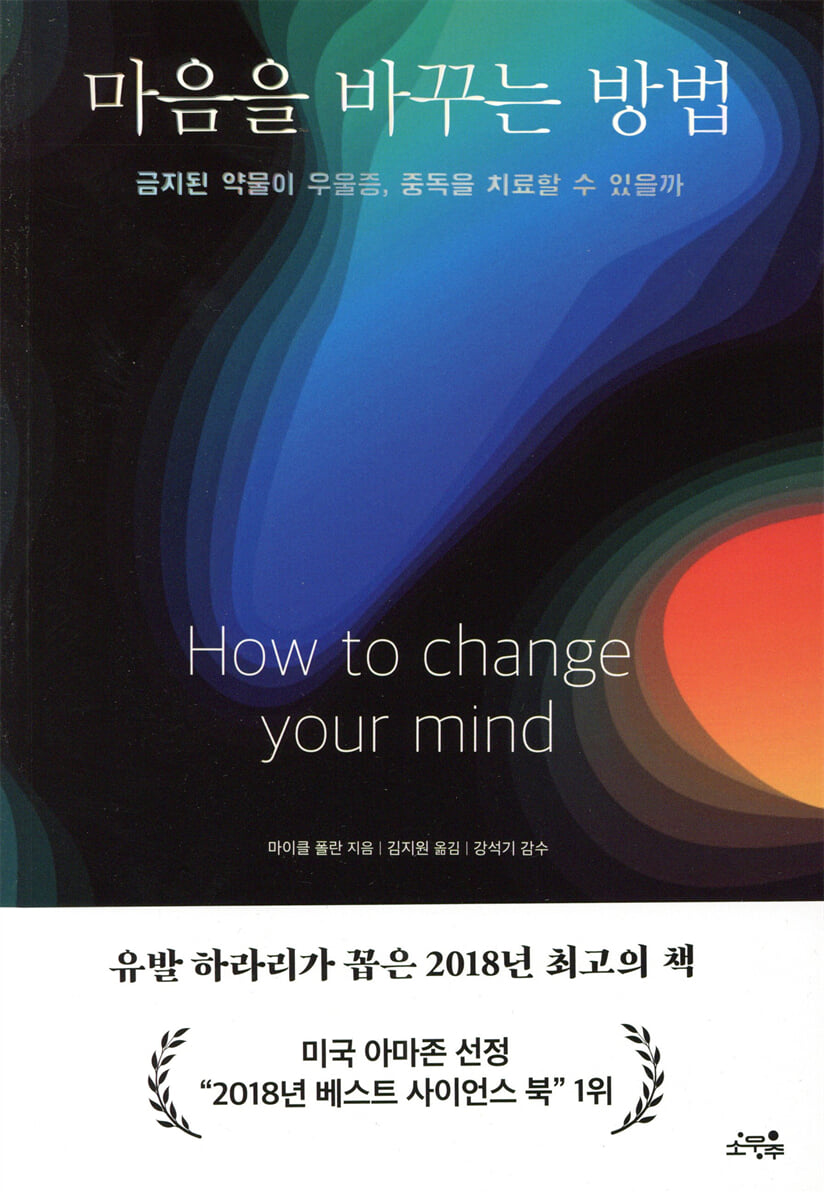
How to change your mind
 |
Description
Book Introduction
A drug that has been taboo and confined by the shackles of 'narcotics' for the past half century.
LSD and psilocybin, branded as hippie drugs that symbolize excess and debauchery.
Once used as miracle cures to tens of thousands of patients, why were psychedelics suddenly classified as drugs, and how did they find renewed hope? In this book, Michael Pollan, a leading American nonfiction author, clearly explains the misconceptions and scientific facts surrounding LSD and psilocybin, and offers a captivating account of how these psychedelics, after modern medical validation, were once again recognized as drugs that heal the human mind.
LSD and psilocybin, branded as hippie drugs that symbolize excess and debauchery.
Once used as miracle cures to tens of thousands of patients, why were psychedelics suddenly classified as drugs, and how did they find renewed hope? In this book, Michael Pollan, a leading American nonfiction author, clearly explains the misconceptions and scientific facts surrounding LSD and psilocybin, and offers a captivating account of how these psychedelics, after modern medical validation, were once again recognized as drugs that heal the human mind.
- You can preview some of the book's contents.
Preview
index
Prologue: A New Door
Chapter 1: Renaissance
Chapter 2: Natural History: Eating Hallucinogenic Mushrooms
Conclusion
Chapter 3 History: The First Wave
Part 1: Possibilities
Part 2: Bankruptcy
Conclusion
Chapter 4: Travels: Journey to the Underworld
Trip 1: LSD
Trip 2: Psilocybin
Trip 3: 5-Methoxydimethyltryptamine (or Toad Venom)
Chapter 5 Neuroscience: The Psychedelic Brain
Chapter 6 Travel Therapy: Psychedelics in Psychotherapy
1: Death
2: Addiction
3: Depression
Conclusion: Meet My Default Mode Network
Epilogue: A Tribute to Neurodiversity
Glossary
Acknowledgements
main
References
Search
Chapter 1: Renaissance
Chapter 2: Natural History: Eating Hallucinogenic Mushrooms
Conclusion
Chapter 3 History: The First Wave
Part 1: Possibilities
Part 2: Bankruptcy
Conclusion
Chapter 4: Travels: Journey to the Underworld
Trip 1: LSD
Trip 2: Psilocybin
Trip 3: 5-Methoxydimethyltryptamine (or Toad Venom)
Chapter 5 Neuroscience: The Psychedelic Brain
Chapter 6 Travel Therapy: Psychedelics in Psychotherapy
1: Death
2: Addiction
3: Depression
Conclusion: Meet My Default Mode Network
Epilogue: A Tribute to Neurodiversity
Glossary
Acknowledgements
main
References
Search
Detailed image
.jpg)
Into the book
Stanislav Grof believes that psychedelics had to be repelled in 1960s America because they unleashed a “crazy element” that threatened the country’s puritanical values (he told me the same thing could happen again).
Roland Griffiths points out that we are not the first culture to feel threatened by psychedelics.
The reason R. Gordon Watson had to rediscover magic mushrooms in Mexico was also because Spain considered them a dangerous tool of paganism and suppressed them so effectively.
“It really speaks volumes about how reluctant the culture is to accept the changes that this kind of stuff can bring about,” he told me when we first met.
“Because so much authority comes from early mystical experiences, it poses a threat to the current hierarchical system.”
--- pp.70~71
Today, Roland Griffiths, who has taken up the research that was halted at Spring Grove, is appalled that the first wave of psychedelic research, so promising as it was, ended for reasons that had nothing to do with science.
“We ended up demonizing these compounds.
Is there another scientific field so dangerous and taboo that all research should be blocked for decades? This is unprecedented in modern science." The sheer volume of scientific knowledge that has been literally erased is also unprecedented.
--- p.72
Indeed, the seed Hubbard planted in Silicon Valley continues to bear interesting fruit in the form of a persistent curiosity about psychedelics as tools for creativity and innovation (as of this writing, microdosing—the regular, “imperceptible” microdosing of LSD as a kind of mental tonic—is all the rage in the tech community).
Steve Jobs often told people that his LSD experiments were among the two or three most important experiences of his life.
He used to tease Bill Gates (Gates actually said he had tried LSD) by saying, "If he had tried drugs or been to an ashram when he was younger, his mind would have been much broader."
--- pp.191~192
In fact, brain scans have shown increased activity (via increased blood flow and oxygen consumption) in several different areas of the brain, including the limbic region, under the influence of psychedelics.
This disinhibition effect may explain why material that would otherwise be unavailable in normal conscious states—such as emotions, memories, and sometimes even long-buried childhood traumas—now floats to the surface of our consciousness.
For this reason, some scientists and psychotherapists believe that psychedelics can be useful in bringing to the surface and exploring the contents of the unconscious mind.
--- p.331
I've been thinking about this so-called perspective effect ever since I spoke with volunteers for psilocybin trials, especially those who have overcome addiction after a psychedelic journey into inner space.
Several volunteers said they had gained a new sense of distance from their lives, and that things that were once overwhelming, including addiction, now felt smaller and more manageable.
Psychedelic experiences seem to give many people a perspective on their own lives, shifting their worldview and priorities, allowing them to let go of old habits, sometimes with surprising ease.
A lifelong smoker explained it to me in an incredibly simple way.
“Smoking has become unimportant.
So I quit.”
--- pp.386~387
In early 2017, when Roland Griffiths and Stephen Ross submitted their clinical trial results to the FDA seeking approval for a Phase 3 psilocybin trial in cancer patients, something unexpected happened. FDA officials were impressed by their data and largely ignored the inherent challenges of psychedelic research, such as blinding, the need for combining treatments and drugs, and the fact that the drugs in question were still illegal. The FDA surprised the researchers by urging them to expand their scope and pursue their research with greater ambition.
The idea was to test whether psilocybin could also be used to treat depression, a larger and more serious problem in the general public.
Regulators saw their data as a strong “signal” that psilocybin could also alleviate depression.
Given the enormous demand and the limitations of currently available treatments, it would be a shame not to explore this direction.
--- p.403
In early results published in The Lancet Psychiatry in 2016, researchers gave psilocybin to six men and six women with “treatment-resistant depression” (meaning they had already tried at least two treatments without improvement).
There was no control group, so everyone knew they were receiving psilocybin.
After a week, all volunteers showed improvement in their symptoms, and two-thirds were free of depression.
For some of them, it was the first time in years that they had recovered from depression.
Seven of the 12 volunteers still showed significant improvement after three months.
--- p.404
But even a little thought reveals that attributing the psychedelic experience to “drugs” explains virtually nothing.
Images, narratives, and insights don't fall from thin air, nor do they emerge from chemicals.
It comes from our minds, and at least tells us something about our minds.
If dreams, visions, and free associations are worthy of interpretation, then the far more vivid and detailed information that psychedelic travel reveals to us is certainly worthy of interpretation.
This opens new doors to the human mind.
Roland Griffiths points out that we are not the first culture to feel threatened by psychedelics.
The reason R. Gordon Watson had to rediscover magic mushrooms in Mexico was also because Spain considered them a dangerous tool of paganism and suppressed them so effectively.
“It really speaks volumes about how reluctant the culture is to accept the changes that this kind of stuff can bring about,” he told me when we first met.
“Because so much authority comes from early mystical experiences, it poses a threat to the current hierarchical system.”
--- pp.70~71
Today, Roland Griffiths, who has taken up the research that was halted at Spring Grove, is appalled that the first wave of psychedelic research, so promising as it was, ended for reasons that had nothing to do with science.
“We ended up demonizing these compounds.
Is there another scientific field so dangerous and taboo that all research should be blocked for decades? This is unprecedented in modern science." The sheer volume of scientific knowledge that has been literally erased is also unprecedented.
--- p.72
Indeed, the seed Hubbard planted in Silicon Valley continues to bear interesting fruit in the form of a persistent curiosity about psychedelics as tools for creativity and innovation (as of this writing, microdosing—the regular, “imperceptible” microdosing of LSD as a kind of mental tonic—is all the rage in the tech community).
Steve Jobs often told people that his LSD experiments were among the two or three most important experiences of his life.
He used to tease Bill Gates (Gates actually said he had tried LSD) by saying, "If he had tried drugs or been to an ashram when he was younger, his mind would have been much broader."
--- pp.191~192
In fact, brain scans have shown increased activity (via increased blood flow and oxygen consumption) in several different areas of the brain, including the limbic region, under the influence of psychedelics.
This disinhibition effect may explain why material that would otherwise be unavailable in normal conscious states—such as emotions, memories, and sometimes even long-buried childhood traumas—now floats to the surface of our consciousness.
For this reason, some scientists and psychotherapists believe that psychedelics can be useful in bringing to the surface and exploring the contents of the unconscious mind.
--- p.331
I've been thinking about this so-called perspective effect ever since I spoke with volunteers for psilocybin trials, especially those who have overcome addiction after a psychedelic journey into inner space.
Several volunteers said they had gained a new sense of distance from their lives, and that things that were once overwhelming, including addiction, now felt smaller and more manageable.
Psychedelic experiences seem to give many people a perspective on their own lives, shifting their worldview and priorities, allowing them to let go of old habits, sometimes with surprising ease.
A lifelong smoker explained it to me in an incredibly simple way.
“Smoking has become unimportant.
So I quit.”
--- pp.386~387
In early 2017, when Roland Griffiths and Stephen Ross submitted their clinical trial results to the FDA seeking approval for a Phase 3 psilocybin trial in cancer patients, something unexpected happened. FDA officials were impressed by their data and largely ignored the inherent challenges of psychedelic research, such as blinding, the need for combining treatments and drugs, and the fact that the drugs in question were still illegal. The FDA surprised the researchers by urging them to expand their scope and pursue their research with greater ambition.
The idea was to test whether psilocybin could also be used to treat depression, a larger and more serious problem in the general public.
Regulators saw their data as a strong “signal” that psilocybin could also alleviate depression.
Given the enormous demand and the limitations of currently available treatments, it would be a shame not to explore this direction.
--- p.403
In early results published in The Lancet Psychiatry in 2016, researchers gave psilocybin to six men and six women with “treatment-resistant depression” (meaning they had already tried at least two treatments without improvement).
There was no control group, so everyone knew they were receiving psilocybin.
After a week, all volunteers showed improvement in their symptoms, and two-thirds were free of depression.
For some of them, it was the first time in years that they had recovered from depression.
Seven of the 12 volunteers still showed significant improvement after three months.
--- p.404
But even a little thought reveals that attributing the psychedelic experience to “drugs” explains virtually nothing.
Images, narratives, and insights don't fall from thin air, nor do they emerge from chemicals.
It comes from our minds, and at least tells us something about our minds.
If dreams, visions, and free associations are worthy of interpretation, then the far more vivid and detailed information that psychedelic travel reveals to us is certainly worthy of interpretation.
This opens new doors to the human mind.
--- p.435
Publisher's Review
Yuval Harari's Best Books of 2018
#1 "Best Science Book" by Amazon in the US in 2018
In April 2021, an interesting paper was published in the New England Journal of Medicine (NEJM), a leading medical journal.
In this paper, titled "Clinical trials of psilocybin and escitalopram in the treatment of depression," psilocybin, considered a representative psychedelic along with LSD, proved to be as effective as existing antidepressants.
Are LSD and psilocybin, drugs so feared to be spoken of, truly so terrifying? Why did psychedelics, once hailed as miracle cures, suddenly fall to the underworld? And how, after decades of regulation and oppression, did they dream of a revival?
"How to Change Your Mind" is the story of the renaissance of LSD and psilocybin.
The Birth of Psychedelics
In the mid-20th century, two similar substances exploded across the West, changing not only the course of social, political, and cultural history, but also the course of many people's lives.
These are LSD and psilocybin.
In 1938, Swiss chemist Albert Hoffmann synthesized LSD while searching for a drug that would improve blood circulation.
However, since it did not have the expected effect, he left it alone until one day, when he accidentally consumed a small amount, he realized that he had created something powerful.
The second substance produced by the small brown mushrooms was later called psilocybin, and has long been used in ceremonies by indigenous peoples of Central America.
These mushrooms, which the Aztecs called "the flesh of the gods," were relegated to the underworld after the Spanish conquest and were banned by the Roman Catholic Church, but they resurfaced when Manhattan banker Gordon Watson tasted them in Mexico and described his experience in Life magazine.
Psychedelics, such as LSD and psilocybin, have been shown to cause symptoms similar to psychosis, leading neuroscientists to seek the neurological causes of mental disorders.
At the same time, psychedelics have been a pillar of psychotherapy and have been used to treat conditions such as alcoholism, anxiety disorders, and depression.
By the 1950s and mid-1960s, psychedelics were no longer street drugs but miracle drugs embraced by mainstream psychiatry, promulgated through more than a thousand scientific papers, dozens of books, and cover stories in Time and Life magazines.
Becoming a banned drug due to cultural abuse and political repression.
But as recreational use of psychedelics spread, led by counterculture icons like Timothy Leary and Ken Kesey, people experiencing "bad trips" ended up in emergency rooms, and notorious criminals like Charles Manson became linked to LSD, the darker side of psychedelics began to be exaggerated in the media.
Moreover, the Central Intelligence Agency (CIA) funded a program called "MK-Ultra" to utilize psychedelics as interrogation tools.
The cultural and scientific communities turned their backs on drugs just as quickly as they embraced psychedelics.
By the late 1960s, psychedelics, which had been legal in most places, were outlawed and pushed underground.
When young Americans influenced by the counterculture refused to fight in the Vietnam War, President Richard Nixon attempted to crush the counterculture by declaring Timothy Leary "the most dangerous man in America," and the federal government classified psychedelics as Schedule 1 controlled substances (substances with a high potential for abuse and no approved medical use).
For the next several decades, research and clinical trials on psychedelics virtually ceased.
Psychedelics, making a comeback.
In the 1990s, a small group of scientists and psychotherapists began working to reclaim what they believed was a precious loss in both science and culture.
As controlled substances like marijuana and ketamine have gained acceptance as therapeutic agents, interest in psychedelics has grown, and clinical trials have begun in earnest at institutions including Johns Hopkins. Psychedelics, which had endured decades of suppression and neglect, are experiencing a renaissance today.
A new generation of scientists, inspired by firsthand experience with this substance, are exploring its potential to treat mental illnesses like depression, anxiety, and addiction.
The concept proposed by researchers is as follows:
Our brain has a structure called the default mode network (DMN), which acts as the conductor of the symphony of brain activity.
In other words, the DMN exerts an inhibitory influence on other parts of the brain, particularly those involved in emotions and memory, and helps maintain self-identity. The DMN's dominance gradually increases as a person grows, and its extremes manifest as depression, addiction, and obsessive-compulsive disorder.
However, because psychedelics suppress the activity of the DMN, the activity of other parts of the brain increases, causing past memories to be recalled, emotions from the unconscious to be expressed, a feeling of self-disintegration, and extremely heightened sensitivity to external stimuli, leading to so-called mystical experiences, including hallucinations.
Depression is the area where clinical trials of psychedelics are most active.
Depression affects 40 million people in the United States alone, and 8 million of them, or 20%, do not respond to existing antidepressants.
Psychedelics have been shown to be effective in alleviating symptoms in patients with treatment-resistant depression.
Addiction is also a promising area, as alcoholics and smokers can overcome addiction by losing interest in alcohol and cigarettes through a single dose of medication, as their horizons of perception broaden and their existing value system collapses.
Existential distress, such as the fear of death felt by terminally ill cancer patients, is an emotion experienced when confronted with one's own death. It has been found that administering psychedelics alleviates existential distress by allowing one to experience the dissolution of the ego and feel like one is a part of nature.
Can a banned drug change the human mind?
Michael Pollan, the author who demonstrated the essence of participatory journalism through his previous works, including “The Omnivore’s Dilemma,” was not so much a member of the psychedelic generation of the 1960s as a victim of the moral panic induced by psychedelics.
Pollan, who had a stable life as a university professor and bestselling author, had never had a single “spiritually intense” experience in his life.
But at a dinner party, he overhears a prominent psychologist talking about his LSD experience and becomes intrigued by the claim that LSD "gives insight into how young children perceive the world."
Then I remembered an email I received years ago.
It was a paper about a psilocybin study conducted at Johns Hopkins, and I was deeply impressed by the results of the paper, which showed that the participants considered the psilocybin experience to be one of the most meaningful events in their lives, comparable to "the birth of a first child or the death of a parent."
He found all this talk incredibly interesting, while at the same time wondering if it might be a drug-induced hallucination.
Could a psychedelic experience, triggered by the act of swallowing a single pill or a single sheet of blotting paper, profoundly alter one's worldview? Could it not only alter one's perception of human mortality, but actually alter the human mind and sustain that state for a long time? Captivated by these thoughts, he ultimately decides to explore the world of the mind himself.
Then, you'll experience LSD, psilocybin, and other substances firsthand, entering into various altered states of consciousness, and delving deep into the underworld of cutting-edge brain science and psychedelic therapists.
Pollan's "mental journey" is an exploration not only of psychedelics but also of the eternal puzzle of human consciousness.
The Future of Psychedelics
Pollan says he wants psychedelics to be brought back into the system, but he doesn't argue that they should be classified as drugs.
In reality, psychedelics are less addictive than alcohol or cigarettes, and the extent of their harm to the body and mind is exaggerated. However, even so, they should not be legalized across the board so that anyone can use them.
However, it is clear that banning it for political reasons and thus depriving it of the opportunity to be used as a useful treatment is an excessively harsh measure.
There are dozens of ongoing clinical trials of psychedelics, and leading institutions such as Imperial College London, Johns Hopkins, UC Berkeley, and the Icahn School of Medicine at Mount Sinai have dedicated psychedelic research centers.
If psychedelics are administered to selected individuals under the guidance of a guide in a controlled environment after undergoing rigorous clinical trials, wouldn't they be able to break free from their long-held shackles and establish themselves as a refreshing drug for modern people suffering from mental illness?
Michael Pollan, who explored the world of psychoactive drugs in his previous book, The Plant of Desire, delves deeper into it in this bold and engaging book.
He shakes the 'snowball' by experimenting on himself, following the ideas of William James, who, more than a century ago, thought the boundaries of consciousness might be much wider.” - Nature
"Michael Pollan, who made a name for himself with books on plants and food, has awakened our curiosity and critical perspective on a whole new topic.
"How to Change Your Mind" beautifully unfolds the latest insights in psychedelic science, drawing on firsthand experience." - Science
"It's intense and sometimes thrilling.
(Omitted) Pollan is a top science writer, yet he is willing to abandon the stereotype that a materialist view of science is the only path to understanding.
“The most important message of this book is that the therapeutic benefits of psychedelics for the dying and seriously ill cannot be separated from the mystical experiences they induce.” - The Guardian
#1 "Best Science Book" by Amazon in the US in 2018
In April 2021, an interesting paper was published in the New England Journal of Medicine (NEJM), a leading medical journal.
In this paper, titled "Clinical trials of psilocybin and escitalopram in the treatment of depression," psilocybin, considered a representative psychedelic along with LSD, proved to be as effective as existing antidepressants.
Are LSD and psilocybin, drugs so feared to be spoken of, truly so terrifying? Why did psychedelics, once hailed as miracle cures, suddenly fall to the underworld? And how, after decades of regulation and oppression, did they dream of a revival?
"How to Change Your Mind" is the story of the renaissance of LSD and psilocybin.
The Birth of Psychedelics
In the mid-20th century, two similar substances exploded across the West, changing not only the course of social, political, and cultural history, but also the course of many people's lives.
These are LSD and psilocybin.
In 1938, Swiss chemist Albert Hoffmann synthesized LSD while searching for a drug that would improve blood circulation.
However, since it did not have the expected effect, he left it alone until one day, when he accidentally consumed a small amount, he realized that he had created something powerful.
The second substance produced by the small brown mushrooms was later called psilocybin, and has long been used in ceremonies by indigenous peoples of Central America.
These mushrooms, which the Aztecs called "the flesh of the gods," were relegated to the underworld after the Spanish conquest and were banned by the Roman Catholic Church, but they resurfaced when Manhattan banker Gordon Watson tasted them in Mexico and described his experience in Life magazine.
Psychedelics, such as LSD and psilocybin, have been shown to cause symptoms similar to psychosis, leading neuroscientists to seek the neurological causes of mental disorders.
At the same time, psychedelics have been a pillar of psychotherapy and have been used to treat conditions such as alcoholism, anxiety disorders, and depression.
By the 1950s and mid-1960s, psychedelics were no longer street drugs but miracle drugs embraced by mainstream psychiatry, promulgated through more than a thousand scientific papers, dozens of books, and cover stories in Time and Life magazines.
Becoming a banned drug due to cultural abuse and political repression.
But as recreational use of psychedelics spread, led by counterculture icons like Timothy Leary and Ken Kesey, people experiencing "bad trips" ended up in emergency rooms, and notorious criminals like Charles Manson became linked to LSD, the darker side of psychedelics began to be exaggerated in the media.
Moreover, the Central Intelligence Agency (CIA) funded a program called "MK-Ultra" to utilize psychedelics as interrogation tools.
The cultural and scientific communities turned their backs on drugs just as quickly as they embraced psychedelics.
By the late 1960s, psychedelics, which had been legal in most places, were outlawed and pushed underground.
When young Americans influenced by the counterculture refused to fight in the Vietnam War, President Richard Nixon attempted to crush the counterculture by declaring Timothy Leary "the most dangerous man in America," and the federal government classified psychedelics as Schedule 1 controlled substances (substances with a high potential for abuse and no approved medical use).
For the next several decades, research and clinical trials on psychedelics virtually ceased.
Psychedelics, making a comeback.
In the 1990s, a small group of scientists and psychotherapists began working to reclaim what they believed was a precious loss in both science and culture.
As controlled substances like marijuana and ketamine have gained acceptance as therapeutic agents, interest in psychedelics has grown, and clinical trials have begun in earnest at institutions including Johns Hopkins. Psychedelics, which had endured decades of suppression and neglect, are experiencing a renaissance today.
A new generation of scientists, inspired by firsthand experience with this substance, are exploring its potential to treat mental illnesses like depression, anxiety, and addiction.
The concept proposed by researchers is as follows:
Our brain has a structure called the default mode network (DMN), which acts as the conductor of the symphony of brain activity.
In other words, the DMN exerts an inhibitory influence on other parts of the brain, particularly those involved in emotions and memory, and helps maintain self-identity. The DMN's dominance gradually increases as a person grows, and its extremes manifest as depression, addiction, and obsessive-compulsive disorder.
However, because psychedelics suppress the activity of the DMN, the activity of other parts of the brain increases, causing past memories to be recalled, emotions from the unconscious to be expressed, a feeling of self-disintegration, and extremely heightened sensitivity to external stimuli, leading to so-called mystical experiences, including hallucinations.
Depression is the area where clinical trials of psychedelics are most active.
Depression affects 40 million people in the United States alone, and 8 million of them, or 20%, do not respond to existing antidepressants.
Psychedelics have been shown to be effective in alleviating symptoms in patients with treatment-resistant depression.
Addiction is also a promising area, as alcoholics and smokers can overcome addiction by losing interest in alcohol and cigarettes through a single dose of medication, as their horizons of perception broaden and their existing value system collapses.
Existential distress, such as the fear of death felt by terminally ill cancer patients, is an emotion experienced when confronted with one's own death. It has been found that administering psychedelics alleviates existential distress by allowing one to experience the dissolution of the ego and feel like one is a part of nature.
Can a banned drug change the human mind?
Michael Pollan, the author who demonstrated the essence of participatory journalism through his previous works, including “The Omnivore’s Dilemma,” was not so much a member of the psychedelic generation of the 1960s as a victim of the moral panic induced by psychedelics.
Pollan, who had a stable life as a university professor and bestselling author, had never had a single “spiritually intense” experience in his life.
But at a dinner party, he overhears a prominent psychologist talking about his LSD experience and becomes intrigued by the claim that LSD "gives insight into how young children perceive the world."
Then I remembered an email I received years ago.
It was a paper about a psilocybin study conducted at Johns Hopkins, and I was deeply impressed by the results of the paper, which showed that the participants considered the psilocybin experience to be one of the most meaningful events in their lives, comparable to "the birth of a first child or the death of a parent."
He found all this talk incredibly interesting, while at the same time wondering if it might be a drug-induced hallucination.
Could a psychedelic experience, triggered by the act of swallowing a single pill or a single sheet of blotting paper, profoundly alter one's worldview? Could it not only alter one's perception of human mortality, but actually alter the human mind and sustain that state for a long time? Captivated by these thoughts, he ultimately decides to explore the world of the mind himself.
Then, you'll experience LSD, psilocybin, and other substances firsthand, entering into various altered states of consciousness, and delving deep into the underworld of cutting-edge brain science and psychedelic therapists.
Pollan's "mental journey" is an exploration not only of psychedelics but also of the eternal puzzle of human consciousness.
The Future of Psychedelics
Pollan says he wants psychedelics to be brought back into the system, but he doesn't argue that they should be classified as drugs.
In reality, psychedelics are less addictive than alcohol or cigarettes, and the extent of their harm to the body and mind is exaggerated. However, even so, they should not be legalized across the board so that anyone can use them.
However, it is clear that banning it for political reasons and thus depriving it of the opportunity to be used as a useful treatment is an excessively harsh measure.
There are dozens of ongoing clinical trials of psychedelics, and leading institutions such as Imperial College London, Johns Hopkins, UC Berkeley, and the Icahn School of Medicine at Mount Sinai have dedicated psychedelic research centers.
If psychedelics are administered to selected individuals under the guidance of a guide in a controlled environment after undergoing rigorous clinical trials, wouldn't they be able to break free from their long-held shackles and establish themselves as a refreshing drug for modern people suffering from mental illness?
Michael Pollan, who explored the world of psychoactive drugs in his previous book, The Plant of Desire, delves deeper into it in this bold and engaging book.
He shakes the 'snowball' by experimenting on himself, following the ideas of William James, who, more than a century ago, thought the boundaries of consciousness might be much wider.” - Nature
"Michael Pollan, who made a name for himself with books on plants and food, has awakened our curiosity and critical perspective on a whole new topic.
"How to Change Your Mind" beautifully unfolds the latest insights in psychedelic science, drawing on firsthand experience." - Science
"It's intense and sometimes thrilling.
(Omitted) Pollan is a top science writer, yet he is willing to abandon the stereotype that a materialist view of science is the only path to understanding.
“The most important message of this book is that the therapeutic benefits of psychedelics for the dying and seriously ill cannot be separated from the mystical experiences they induce.” - The Guardian
GOODS SPECIFICS
- Date of issue: May 8, 2021
- Page count, weight, size: 488 pages | 632g | 152*225*26mm
- ISBN13: 9791189895037
- ISBN10: 118989503X
You may also like
카테고리
korean


korean

![GQ KOREA Mark (Monthly): December [2025]](http://librairie.coreenne.fr/cdn/shop/files/8ef265dbbfbf186523ed75ba7319009d.jpg?v=1765340328&width=3840)


