

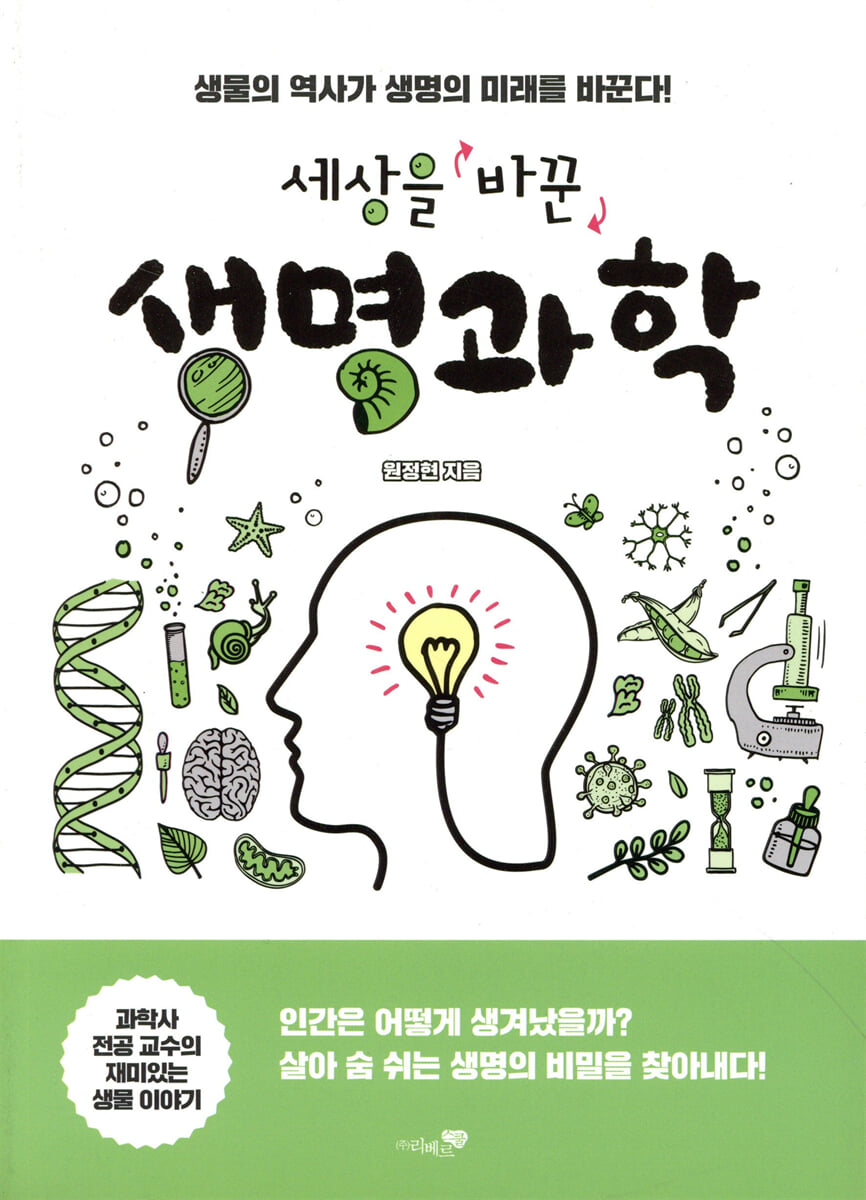
Life science that changed the world
 |
Description
Book Introduction
To understand current biological theories, you must know the history of biology!
From ancient Greece to the present, meet scientists exploring the mysteries of life!
The field of 'science' is thought to contain absolute and unchanging truths.
However, scholarship has changed as various theories have emerged.
Natural science is no exception.
The scientific concepts we learn in science class are the result of many scientists debating and verifying each other's ways of understanding the world.
In "Life Science That Changed the World," the author naturally blends modern biological theories with the history of biology, making it easy and fun to learn.
Additionally, the cute illustrations and various visual aids included in the book help readers understand living things in various ways.
The third book in the [Science that Changed the World] series, 『Life Science that Changed the World』, begins with the ancient Greek physician Hippocrates.
The doctors' struggle to understand how the human body moves and why it becomes ill has been passed down through generations, giving rise to the theory of blood circulation and vaccines.
As the Age of Exploration began and new creatures entered Europe, further changes and advancements occurred in biology.
Linnaeus struggled to find a proper way to classify these creatures, and Darwin presented the theory of evolution, which states that creatures of different appearances all descend from the same ancestor.
Advances in other scientific fields, such as physics, chemistry, and earth science, have also had a significant impact on biological research and have been used in DNA research.
In this way, biology has developed in close relationship with human life and society.
Let's take a look at the history of scientists critiquing and accepting existing biological theories, conducting new experiments, and exploring the mysteries of life!
From ancient Greece to the present, meet scientists exploring the mysteries of life!
The field of 'science' is thought to contain absolute and unchanging truths.
However, scholarship has changed as various theories have emerged.
Natural science is no exception.
The scientific concepts we learn in science class are the result of many scientists debating and verifying each other's ways of understanding the world.
In "Life Science That Changed the World," the author naturally blends modern biological theories with the history of biology, making it easy and fun to learn.
Additionally, the cute illustrations and various visual aids included in the book help readers understand living things in various ways.
The third book in the [Science that Changed the World] series, 『Life Science that Changed the World』, begins with the ancient Greek physician Hippocrates.
The doctors' struggle to understand how the human body moves and why it becomes ill has been passed down through generations, giving rise to the theory of blood circulation and vaccines.
As the Age of Exploration began and new creatures entered Europe, further changes and advancements occurred in biology.
Linnaeus struggled to find a proper way to classify these creatures, and Darwin presented the theory of evolution, which states that creatures of different appearances all descend from the same ancestor.
Advances in other scientific fields, such as physics, chemistry, and earth science, have also had a significant impact on biological research and have been used in DNA research.
In this way, biology has developed in close relationship with human life and society.
Let's take a look at the history of scientists critiquing and accepting existing biological theories, conducting new experiments, and exploring the mysteries of life!
- You can preview some of the book's contents.
Preview
index
Author's Note
Introduction
Chapter 1: Why Does Blood Flow in the Body? | Blood Circulation Theory and Physiology
Galen divides the physiological system into veins, arteries, and nerves.
As anatomy developed, Galen's theory was shaken.
Harvey proves blood circulation through experiments
Theories that influenced blood circulation theory
Bernard, who developed 19th-century physiology by elucidating the functions of the human body.
Chapter 2: Linnaeus Creates Rules for Classifying Organisms | Linnaeus's Classification System and Taxonomy
Aristotle classifies living things into soul and form.
Europeans explore the world and encounter countless creatures.
ㆍCharacteristics, subgroups, and nomenclature of the Linnaean classification system
Linnaeus criticized for its limited classification criteria
A classification system that reflects only evolution emerges.
Chapter 3: Plants Create Nutrients and Oxygen for Life | Plants and Photosynthesis
ㆍWhat roles do the leaves, stems, and roots of plants each play?
Plants need light, water, and carbon dioxide.
Photosynthesis, the process of converting light energy into chemical energy
ㆍAnalyzing the two stages of photosynthesis: light reactions and dark reactions.
Plants, the foundation of life on Earth
Chapter 4: Living Things Have Continuously Changed? | Darwin's Theory of Evolution
God created life according to the ladder of nature.
As the Earth ages, the concept of evolution emerges.
ㆍWhy do the shells of Galapagos tortoises differ from island to island?
ㆍDarwin summarizes his research and publishes "The Origin of Species."
ㆍControversy arises over Darwin's theory of evolution.
Chapter 5: The Never-ending Battle Against Disease | Germs and Vaccines
ㆍThe cause of disease, from God to nature
ㆍAncient and medieval belief: 'Bad air causes illness'
Pasteur identifies microorganisms as the cause of decay.
Koch discovered the relationship between rod-shaped bacteria and anthrax.
Pasteur develops a vaccine to prevent infectious diseases.
The war against microorganisms will continue in the future.
Chapter 6: How Do Offspring Resemble Their Parents? | Mendel and the Development of Classical Genetics
ㆍWhich of the parents carries the seed of life?
Austrian monk grows peas for genetic research.
ㆍRediscovering Mendel's laws of heredity
Mendel, through hard work and insight, became the "Father of Genetics."
Chapter 7: Uncovering the Identity of Genetic Material! | Discovering the Role and Structure of DNA
ㆍWhich is the genetic material, nucleic acids or proteins?
Biology and chemistry work together to uncover the identity of genetic material.
Watson and Crick discover the structure of DNA
ㆍExchanges among scientists create new scientific knowledge.
References
Photo source
Introduction
Chapter 1: Why Does Blood Flow in the Body? | Blood Circulation Theory and Physiology
Galen divides the physiological system into veins, arteries, and nerves.
As anatomy developed, Galen's theory was shaken.
Harvey proves blood circulation through experiments
Theories that influenced blood circulation theory
Bernard, who developed 19th-century physiology by elucidating the functions of the human body.
Chapter 2: Linnaeus Creates Rules for Classifying Organisms | Linnaeus's Classification System and Taxonomy
Aristotle classifies living things into soul and form.
Europeans explore the world and encounter countless creatures.
ㆍCharacteristics, subgroups, and nomenclature of the Linnaean classification system
Linnaeus criticized for its limited classification criteria
A classification system that reflects only evolution emerges.
Chapter 3: Plants Create Nutrients and Oxygen for Life | Plants and Photosynthesis
ㆍWhat roles do the leaves, stems, and roots of plants each play?
Plants need light, water, and carbon dioxide.
Photosynthesis, the process of converting light energy into chemical energy
ㆍAnalyzing the two stages of photosynthesis: light reactions and dark reactions.
Plants, the foundation of life on Earth
Chapter 4: Living Things Have Continuously Changed? | Darwin's Theory of Evolution
God created life according to the ladder of nature.
As the Earth ages, the concept of evolution emerges.
ㆍWhy do the shells of Galapagos tortoises differ from island to island?
ㆍDarwin summarizes his research and publishes "The Origin of Species."
ㆍControversy arises over Darwin's theory of evolution.
Chapter 5: The Never-ending Battle Against Disease | Germs and Vaccines
ㆍThe cause of disease, from God to nature
ㆍAncient and medieval belief: 'Bad air causes illness'
Pasteur identifies microorganisms as the cause of decay.
Koch discovered the relationship between rod-shaped bacteria and anthrax.
Pasteur develops a vaccine to prevent infectious diseases.
The war against microorganisms will continue in the future.
Chapter 6: How Do Offspring Resemble Their Parents? | Mendel and the Development of Classical Genetics
ㆍWhich of the parents carries the seed of life?
Austrian monk grows peas for genetic research.
ㆍRediscovering Mendel's laws of heredity
Mendel, through hard work and insight, became the "Father of Genetics."
Chapter 7: Uncovering the Identity of Genetic Material! | Discovering the Role and Structure of DNA
ㆍWhich is the genetic material, nucleic acids or proteins?
Biology and chemistry work together to uncover the identity of genetic material.
Watson and Crick discover the structure of DNA
ㆍExchanges among scientists create new scientific knowledge.
References
Photo source
Detailed image
.jpg)
Into the book
It is often said that in order to understand the present and predict the future, we must first know the past.
We study history from Gojoseon to the present to analyze the past and understand the present.
The same goes for the history of science.
We need to know the history of science to properly understand current scientific theories.
There are no right answers in the history of science.
The history of science is an academic discipline that uses various sources to find the historical meaning of various scientific events, and there are various perspectives on historical interpretation.
When studying the history of science, the importance of historical events and their interpretations can vary depending on one's perspective.
--- p.8~9, from the author's note
Before the 17th century, Europeans knew of only about 6,000 species of living things.
This is a very small number compared to the fact that there are about 2 million species of living things that we currently know of.
However, during the Age of Exploration, as Europeans began to explore various parts of the Earth using their advanced navigational technology, information about new creatures began to pour into Europe.
In the 18th century, Europeans knew more than twice as many species as previous generations.
As naturalists who study plants, animals, and minerals encounter a large number of new species, they have been struggling with how to record and classify information about living things.
Naturalists felt the need for a new method of recording life realistically.
They sought to create a system that could classify organisms quickly, accurately, and systematically.
These concerns of naturalists led to the birth of modern natural history research.
--- p.52, from “Chapter 2 Linnaeus, Creating Rules for Classifying Living Things”
Although many people enthusiastically accepted Darwin's theory, there was also considerable opposition.
It is often assumed that religion was at the center of opposition, and that all religious people would oppose evolution.
But this is a misunderstanding.
Rather, many religious people believed that Darwin's theory of evolution was evidence that God was continually creating living things.
Conversely, not all scientists welcomed the theory of evolution.
Many scientists failed to accept Darwin's core concept of natural selection.
In fact, this was a very natural phenomenon at the time.
To understand natural selection, one must understand the concepts of mutation and heredity, but genetics was not yet developed at the time.
--- p.138, from “Chapter 4 Living Things Have Been Changing?”
The following year, at the age of 58, Pasteur attempted to develop a vaccine against anthrax and succeeded.
Pasteur boasted about his invention of a vaccine against anthrax, and a displeased veterinarian suggested a large-scale public experiment.
The open trial was conducted at Pouilly-le-Fort, where the veterinarian's farm is located.
On May 5, 1881, Pasteur injected anthrax vaccine into 24 sheep, 6 cows, and 1 lamb.
And then two weeks later, I had another vaccine shot.
On May 31, both vaccinated and unvaccinated animals were injected with anthrax.
The experiment, which was conducted in front of a crowd of over 150 people, ended in victory for Pasteur.
All the animals that received the vaccine survived, but all the animals that did not receive the vaccine died.
--- p.174~175, from “Chapter 5: The Never-ending Battle with Disease”
Mendel presented his findings at the Natural History Society in Brno in 1865.
It is said that at the time of his announcement, no one raised any objections to Mendel's announcement because no one understood the results of his experiments.
Mendel summarized his research results in a 44-page paper titled “Experiments on Plant Hybridization,” which he published in the Brno Journal of Natural Sciences.
Mendel also made 40 copies of his paper and sent them to various biologists in Europe.
But Mendel's paper remained largely unread.
There are several reasons why Mendel's work was ignored.
First, Mendel was completely unknown to the scientific community at the time.
Scientists thought of Mendel only as a monk and did not recognize him as a scientist.
Second, at that time, scientists' main focus was on the theory of evolution.
Because it was not long after Darwin published On the Origin of Species in 1859, scientists' attention was focused on the theory of evolution, and Mendel's genetic research seemed relatively trivial.
--- p.200, from “Chapter 6 How do children resemble their parents?”
The process by which Watson and Crick discovered the structure of DNA is a good example of how the exchange of information among researchers plays a crucial role in the creation of new scientific knowledge.
Compare this to Linus Pauling, who many expected to discover the structure of DNA.
Pauling, who was unable to see the latest X-ray diffraction images of DNA for political reasons, was experiencing repeated failures.
During this time, Watson and Crick were able to obtain the latest information by interacting with the research team at University College London who were studying the same subject and attending conferences, and based on this, they were able to interpret the structure of DNA.
We study history from Gojoseon to the present to analyze the past and understand the present.
The same goes for the history of science.
We need to know the history of science to properly understand current scientific theories.
There are no right answers in the history of science.
The history of science is an academic discipline that uses various sources to find the historical meaning of various scientific events, and there are various perspectives on historical interpretation.
When studying the history of science, the importance of historical events and their interpretations can vary depending on one's perspective.
--- p.8~9, from the author's note
Before the 17th century, Europeans knew of only about 6,000 species of living things.
This is a very small number compared to the fact that there are about 2 million species of living things that we currently know of.
However, during the Age of Exploration, as Europeans began to explore various parts of the Earth using their advanced navigational technology, information about new creatures began to pour into Europe.
In the 18th century, Europeans knew more than twice as many species as previous generations.
As naturalists who study plants, animals, and minerals encounter a large number of new species, they have been struggling with how to record and classify information about living things.
Naturalists felt the need for a new method of recording life realistically.
They sought to create a system that could classify organisms quickly, accurately, and systematically.
These concerns of naturalists led to the birth of modern natural history research.
--- p.52, from “Chapter 2 Linnaeus, Creating Rules for Classifying Living Things”
Although many people enthusiastically accepted Darwin's theory, there was also considerable opposition.
It is often assumed that religion was at the center of opposition, and that all religious people would oppose evolution.
But this is a misunderstanding.
Rather, many religious people believed that Darwin's theory of evolution was evidence that God was continually creating living things.
Conversely, not all scientists welcomed the theory of evolution.
Many scientists failed to accept Darwin's core concept of natural selection.
In fact, this was a very natural phenomenon at the time.
To understand natural selection, one must understand the concepts of mutation and heredity, but genetics was not yet developed at the time.
--- p.138, from “Chapter 4 Living Things Have Been Changing?”
The following year, at the age of 58, Pasteur attempted to develop a vaccine against anthrax and succeeded.
Pasteur boasted about his invention of a vaccine against anthrax, and a displeased veterinarian suggested a large-scale public experiment.
The open trial was conducted at Pouilly-le-Fort, where the veterinarian's farm is located.
On May 5, 1881, Pasteur injected anthrax vaccine into 24 sheep, 6 cows, and 1 lamb.
And then two weeks later, I had another vaccine shot.
On May 31, both vaccinated and unvaccinated animals were injected with anthrax.
The experiment, which was conducted in front of a crowd of over 150 people, ended in victory for Pasteur.
All the animals that received the vaccine survived, but all the animals that did not receive the vaccine died.
--- p.174~175, from “Chapter 5: The Never-ending Battle with Disease”
Mendel presented his findings at the Natural History Society in Brno in 1865.
It is said that at the time of his announcement, no one raised any objections to Mendel's announcement because no one understood the results of his experiments.
Mendel summarized his research results in a 44-page paper titled “Experiments on Plant Hybridization,” which he published in the Brno Journal of Natural Sciences.
Mendel also made 40 copies of his paper and sent them to various biologists in Europe.
But Mendel's paper remained largely unread.
There are several reasons why Mendel's work was ignored.
First, Mendel was completely unknown to the scientific community at the time.
Scientists thought of Mendel only as a monk and did not recognize him as a scientist.
Second, at that time, scientists' main focus was on the theory of evolution.
Because it was not long after Darwin published On the Origin of Species in 1859, scientists' attention was focused on the theory of evolution, and Mendel's genetic research seemed relatively trivial.
--- p.200, from “Chapter 6 How do children resemble their parents?”
The process by which Watson and Crick discovered the structure of DNA is a good example of how the exchange of information among researchers plays a crucial role in the creation of new scientific knowledge.
Compare this to Linus Pauling, who many expected to discover the structure of DNA.
Pauling, who was unable to see the latest X-ray diffraction images of DNA for political reasons, was experiencing repeated failures.
During this time, Watson and Crick were able to obtain the latest information by interacting with the research team at University College London who were studying the same subject and attending conferences, and based on this, they were able to interpret the structure of DNA.
--- p.240, from “Chapter 7 Uncover the Identity of Genetic Material!”
Publisher's Review
The history of biology, told by a professor of science and gifted education specialist!
Connecting history and theory, transcending the limitations of existing science history books!
There is probably no one who does not know the anecdote that Newton was inspired by a falling apple to come up with the idea of gravity.
But Newton did not come up with gravity solely through his genius, as is commonly believed.
Newton said that he was able to accomplish his great achievements because he "stood on the shoulders of giants."
He was influenced by previous scientists to form his own theories, and he himself had a great influence on the theories of later scientists.
In this way, the scientific theories we learn in science class were formed through the mutual influence of numerous scientists in the past.
Therefore, examining the process of change in scientific theories is the best way to understand scientific concepts.
However, most existing books on the history of science do not comprehensively present these influences, but rather contain only interesting anecdotes and fragmentary stories centered on great figures.
In this way, we separate current scientific theories from history.
Professor Won Jeong-Hyeon, the author, found a balance between the two so that readers can learn scientific concepts through the history of science.
As a historian of science and a teacher in charge of science education for gifted students, the author has long been contemplating ways to incorporate the history of science into science education in a fun way.
The result of that deliberation is the series “Science that Changed the World.”
In this series, you will realize that the history of science and scientific concepts are organically linked and complement each other.
Understanding the development of biological theory reveals the mystery of life!
Natural science began by asking questions about why and how natural phenomena occur.
The "Science That Changed the World" series divides science into the fields of physics, chemistry, biology, and earth science, and then traces the evolution of key concepts in each field.
The core scientific concepts covered in this book were selected with reference to science textbooks.
These are fundamental and important theories for understanding science.
If we follow the process of how ancient people understood the world, we naturally arrive at today's science.
The third book in the [Science that Changed the World] series, Life Science that Changed the World, explains how important discoveries in biology, such as evolution, genetics, photosynthesis, and vaccines, were made.
How did ancient people believe the human body and plants lived and reproduced? We examine the hypotheses and experiments that led to the replacement of vague speculations with theories grounded in actual natural phenomena.
You can also learn how society and other fields of study have influenced biology, and how advances in biology have affected our lives.
By reading this book, you will not only understand biological theory while examining the changes in the history of biology, but also learn how to think and reason scientifically.
Understand science easily and enjoyably with various materials!
《Life Science that Changed the World》 actively utilized various devices to help readers understand.
Images such as photographs of historical sites allow us to vividly experience scientific discoveries.
Diagrams and illustrations inserted in the middle of the text visually organize content that may seem difficult.
Additionally, notes summarizing key points were included in the middle to ensure that key scientific concepts and historical background were not missed.
At the end of each chapter, I've included short, interesting stories that weren't covered in the main text.
You can gain interesting knowledge related to the text, such as the criteria for blood type classification, what happened when the theory of evolution was applied to society and eugenics was born, and what kind of research is being conducted in genetic engineering.
There is also a corner that summarizes the content covered in each chapter, allowing you to review the content.
If you gain an integrated understanding of the history of science and scientific theory through this book, your ability to think scientifically and critically will also grow.
Connecting history and theory, transcending the limitations of existing science history books!
There is probably no one who does not know the anecdote that Newton was inspired by a falling apple to come up with the idea of gravity.
But Newton did not come up with gravity solely through his genius, as is commonly believed.
Newton said that he was able to accomplish his great achievements because he "stood on the shoulders of giants."
He was influenced by previous scientists to form his own theories, and he himself had a great influence on the theories of later scientists.
In this way, the scientific theories we learn in science class were formed through the mutual influence of numerous scientists in the past.
Therefore, examining the process of change in scientific theories is the best way to understand scientific concepts.
However, most existing books on the history of science do not comprehensively present these influences, but rather contain only interesting anecdotes and fragmentary stories centered on great figures.
In this way, we separate current scientific theories from history.
Professor Won Jeong-Hyeon, the author, found a balance between the two so that readers can learn scientific concepts through the history of science.
As a historian of science and a teacher in charge of science education for gifted students, the author has long been contemplating ways to incorporate the history of science into science education in a fun way.
The result of that deliberation is the series “Science that Changed the World.”
In this series, you will realize that the history of science and scientific concepts are organically linked and complement each other.
Understanding the development of biological theory reveals the mystery of life!
Natural science began by asking questions about why and how natural phenomena occur.
The "Science That Changed the World" series divides science into the fields of physics, chemistry, biology, and earth science, and then traces the evolution of key concepts in each field.
The core scientific concepts covered in this book were selected with reference to science textbooks.
These are fundamental and important theories for understanding science.
If we follow the process of how ancient people understood the world, we naturally arrive at today's science.
The third book in the [Science that Changed the World] series, Life Science that Changed the World, explains how important discoveries in biology, such as evolution, genetics, photosynthesis, and vaccines, were made.
How did ancient people believe the human body and plants lived and reproduced? We examine the hypotheses and experiments that led to the replacement of vague speculations with theories grounded in actual natural phenomena.
You can also learn how society and other fields of study have influenced biology, and how advances in biology have affected our lives.
By reading this book, you will not only understand biological theory while examining the changes in the history of biology, but also learn how to think and reason scientifically.
Understand science easily and enjoyably with various materials!
《Life Science that Changed the World》 actively utilized various devices to help readers understand.
Images such as photographs of historical sites allow us to vividly experience scientific discoveries.
Diagrams and illustrations inserted in the middle of the text visually organize content that may seem difficult.
Additionally, notes summarizing key points were included in the middle to ensure that key scientific concepts and historical background were not missed.
At the end of each chapter, I've included short, interesting stories that weren't covered in the main text.
You can gain interesting knowledge related to the text, such as the criteria for blood type classification, what happened when the theory of evolution was applied to society and eugenics was born, and what kind of research is being conducted in genetic engineering.
There is also a corner that summarizes the content covered in each chapter, allowing you to review the content.
If you gain an integrated understanding of the history of science and scientific theory through this book, your ability to think scientifically and critically will also grow.
GOODS SPECIFICS
- Date of issue: March 4, 2021
- Page count, weight, size: 248 pages | 153*210*20mm
- ISBN13: 9788965822905
- ISBN10: 8965822904
You may also like
카테고리
korean


korean

![GQ KOREA Mark (Monthly): December [2025]](http://librairie.coreenne.fr/cdn/shop/files/8ef265dbbfbf186523ed75ba7319009d.jpg?v=1765340328&width=3840)


