

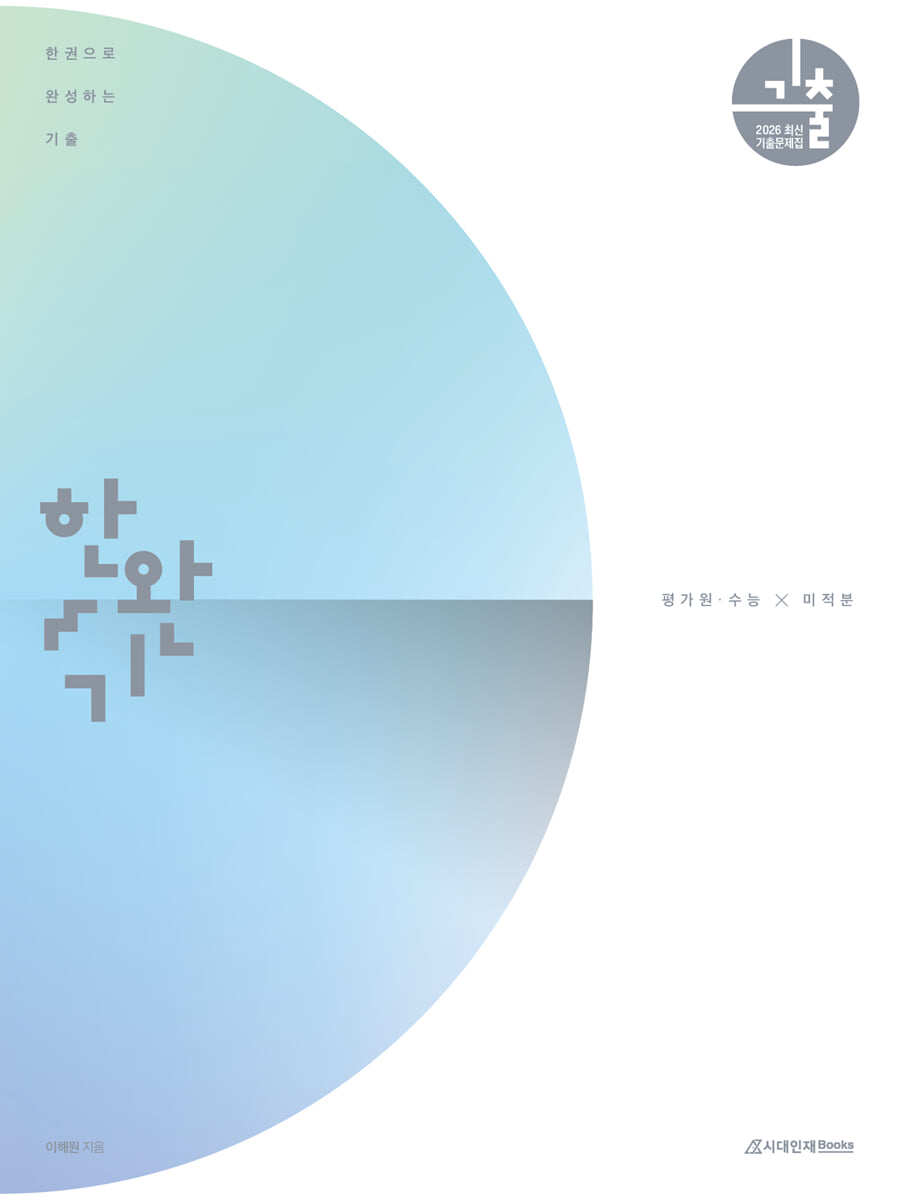
2026 Han Wan-ki: Complete the Calculus Exams for the National Institute of Education and the College Scholastic Ability Test (2025) in One Volume
 |
Description
Book Introduction
This is a must-read book for preparing for the college entrance exam and school grades.
It contains all the questions from the 1994-2025 school years of the College Scholastic Ability Test (CSAT) and the Evaluation Institute's previous exams that must be solved when preparing for the CSAT.
Additionally, since there are no questions as well-polished as the previous exam questions from the College Scholastic Ability Test and the Evaluation Institute, studying the previous exam questions while preparing for the internal exam will be of great help in studying math.
It contains all the questions from the 1994-2025 school years of the College Scholastic Ability Test (CSAT) and the Evaluation Institute's previous exams that must be solved when preparing for the CSAT.
Additionally, since there are no questions as well-polished as the previous exam questions from the College Scholastic Ability Test and the Evaluation Institute, studying the previous exam questions while preparing for the internal exam will be of great help in studying math.
- You can preview some of the book's contents.
Preview
index
Part 0 2005~2025 College Scholastic Ability Test and Evaluation Institute Basics
1.
Limit of a sequence
Limit of 1-1 sequence
Type 1: Limit calculation of the form (polynomial function)/(polynomial function)
1-2 grade
Type 2: Properties of series
2.
Differential calculus
2-1 Differentiation of various functions
Type 3: Limits and Differentiation of Exponential and Logarithmic Functions
Type 4: Addition theorem of trigonometric functions
Type 5: Limits and Differentiation of Trigonometric Functions
2-2 Various Differentiation Methods
Type 6: Various Differential Calculations
Type 7: Differentiation of parametric functions and implicit functions
3.
Integration method
3-1 Various integration methods
Type 8: Calculating various definite integrals
3-2 Application of definite integrals
Type 9: Definite integrals and sums of series
Part 1 2005~2025 College Scholastic Ability Test/Evaluation Institute Essentials
1.
Limit of a sequence
Limit of 1-1 sequence
Pattern 01 Find the limit by expressing it as a convergent sequence!
1-2 grade
Pattern 02 Familiarize yourself with the properties of series and two types of convergent series!
Pattern 03 Find the common ratio using the surrounding shapes!
2.
Differential calculus
2-1 Differentiation of various functions
Pattern 04: Learn the limits of exponential and logarithmic functions and limits related to e!
Pattern 05 Memorize the trigonometric relationship formulas and apply the addition rule!
2-2 Various Differentiation Methods
Pattern 06 Learn the 5 concepts needed for geometric limits!
Pattern 07 Master the differentiation of composite functions and the differentiation of quotients!
Pattern 08 Master the differentiation of parametric functions and implicit functions!
Pattern 09 Memorize all the methods for calculating the differentiation of inverse functions!
Application of 2-3 derivatives
Pattern 10 Tangent line problem starts with writing y=f′(t)(xt)+f(t)!
Complete the graph using graphs ①~⑥ of Pattern 11 function!
Pattern 12: Limits of composite functions, arithmetic operations, and continuity of composite functions
Pattern 13 Differentiability of Arithmetic Operations and Composite Functions, Maxima and Minima
Pattern 14 Know the speed, magnitude of speed, acceleration, and magnitude of acceleration!
3.
Integration method
3-1 Various integration methods
Pattern 15: Substitution integrals are multiplied by derivatives, partial integrals are ladders!
Pattern 16: The key to functions expressed as definite integrals is substitution and differentiation!
3-2 Application of definite integrals
Pattern 17 The relationship between the sum and definite integral of a series can be established by setting xk!
Pattern 18 Understand the geometric meaning of definite integrals, but find the area without a graph!
Pattern 19 The key is to express the kth shape, whether it is area or volume!
Pattern 20 Memorize the two curve length formulas perfectly!
Part 2 2005~2025 College Scholastic Ability Test and Evaluation Institute Core
1.
Limit of a sequence
2.
Differential calculus
3.
Integration method
Part 3 2005~2025 College Scholastic Ability Test and Evaluation Institute
1.
Limit of a sequence
2.
Differential calculus
3.
Integration method
Part 4 1994~2004 College Scholastic Ability Test and Evaluation Institute
1.
Limit of a sequence
2.
Differential calculus
3.
Integration method
Thema Calculus
0.
Math 2 Summary
Thema 01~23 Su2 Thema Summary
1.
Limit of a sequence
Theme 24: How to Solve Problems with the 'Convergence Assumption'
Theme 25: Convergence of fractional series
Thema 26 Approximation of the Square Root Limit
2.
Differential calculus
Theme 27: Approximation of the speed of going to zero and the limit of transcendental functions
Thema 28 Limits without substitution
Theme 29: Extreme values of composite functions (N-axis)
Theme 30: Maxima and Minima of Composite Functions (N-axis)
Theme 31: The properties of downward convexity and upward convexity and the positional relationship between straight lines and curves
The number of tangents in Thema 32 is the key to dividing convex intervals, inflection tangents, and asymptotes.
3.
Integration method
Theme 33 Definite Integral Identity
Theme 34: The Core of Substitution Integrals, Quick Calculation of Definite Integrals
Theme 35: Fast calculation of partial integration
Thema 36 Basic Width
1.
Limit of a sequence
Limit of 1-1 sequence
Type 1: Limit calculation of the form (polynomial function)/(polynomial function)
1-2 grade
Type 2: Properties of series
2.
Differential calculus
2-1 Differentiation of various functions
Type 3: Limits and Differentiation of Exponential and Logarithmic Functions
Type 4: Addition theorem of trigonometric functions
Type 5: Limits and Differentiation of Trigonometric Functions
2-2 Various Differentiation Methods
Type 6: Various Differential Calculations
Type 7: Differentiation of parametric functions and implicit functions
3.
Integration method
3-1 Various integration methods
Type 8: Calculating various definite integrals
3-2 Application of definite integrals
Type 9: Definite integrals and sums of series
Part 1 2005~2025 College Scholastic Ability Test/Evaluation Institute Essentials
1.
Limit of a sequence
Limit of 1-1 sequence
Pattern 01 Find the limit by expressing it as a convergent sequence!
1-2 grade
Pattern 02 Familiarize yourself with the properties of series and two types of convergent series!
Pattern 03 Find the common ratio using the surrounding shapes!
2.
Differential calculus
2-1 Differentiation of various functions
Pattern 04: Learn the limits of exponential and logarithmic functions and limits related to e!
Pattern 05 Memorize the trigonometric relationship formulas and apply the addition rule!
2-2 Various Differentiation Methods
Pattern 06 Learn the 5 concepts needed for geometric limits!
Pattern 07 Master the differentiation of composite functions and the differentiation of quotients!
Pattern 08 Master the differentiation of parametric functions and implicit functions!
Pattern 09 Memorize all the methods for calculating the differentiation of inverse functions!
Application of 2-3 derivatives
Pattern 10 Tangent line problem starts with writing y=f′(t)(xt)+f(t)!
Complete the graph using graphs ①~⑥ of Pattern 11 function!
Pattern 12: Limits of composite functions, arithmetic operations, and continuity of composite functions
Pattern 13 Differentiability of Arithmetic Operations and Composite Functions, Maxima and Minima
Pattern 14 Know the speed, magnitude of speed, acceleration, and magnitude of acceleration!
3.
Integration method
3-1 Various integration methods
Pattern 15: Substitution integrals are multiplied by derivatives, partial integrals are ladders!
Pattern 16: The key to functions expressed as definite integrals is substitution and differentiation!
3-2 Application of definite integrals
Pattern 17 The relationship between the sum and definite integral of a series can be established by setting xk!
Pattern 18 Understand the geometric meaning of definite integrals, but find the area without a graph!
Pattern 19 The key is to express the kth shape, whether it is area or volume!
Pattern 20 Memorize the two curve length formulas perfectly!
Part 2 2005~2025 College Scholastic Ability Test and Evaluation Institute Core
1.
Limit of a sequence
2.
Differential calculus
3.
Integration method
Part 3 2005~2025 College Scholastic Ability Test and Evaluation Institute
1.
Limit of a sequence
2.
Differential calculus
3.
Integration method
Part 4 1994~2004 College Scholastic Ability Test and Evaluation Institute
1.
Limit of a sequence
2.
Differential calculus
3.
Integration method
Thema Calculus
0.
Math 2 Summary
Thema 01~23 Su2 Thema Summary
1.
Limit of a sequence
Theme 24: How to Solve Problems with the 'Convergence Assumption'
Theme 25: Convergence of fractional series
Thema 26 Approximation of the Square Root Limit
2.
Differential calculus
Theme 27: Approximation of the speed of going to zero and the limit of transcendental functions
Thema 28 Limits without substitution
Theme 29: Extreme values of composite functions (N-axis)
Theme 30: Maxima and Minima of Composite Functions (N-axis)
Theme 31: The properties of downward convexity and upward convexity and the positional relationship between straight lines and curves
The number of tangents in Thema 32 is the key to dividing convex intervals, inflection tangents, and asymptotes.
3.
Integration method
Theme 33 Definite Integral Identity
Theme 34: The Core of Substitution Integrals, Quick Calculation of Definite Integrals
Theme 35: Fast calculation of partial integration
Thema 36 Basic Width
Publisher's Review
1.
This is a must-read book for preparing for the college entrance exam and school grades.
It includes all the questions from the 1994-2025 CSAT and Evaluation Institute Past Exams that you must solve when preparing for the CSAT.
Additionally, since there are no questions as well-polished as the previous exam questions from the College Scholastic Ability Test and the Evaluation Institute, studying the previous exam questions while preparing for the internal exam will be of great help in studying math.
2.
You can study past exam questions most efficiently.
In 'Han Wan-ki', the previous questions from the College Scholastic Ability Test and the Evaluation Institute are divided into parts according to difficulty and importance, and arranged in order so that you can study most efficiently.
Additionally, you can freely use the book by selecting and studying only the necessary parts depending on the situation.
3.
The previous exam questions from the College Scholastic Ability Test (CSAT) and the Evaluation Institute are arranged by pattern.
'Han Wan-gi' defined a pattern optimized for CSAT preparation and classified and arranged CSAT/Evaluation Institute past questions accordingly.
4.
You can learn the basic concepts of Pattern and practical concepts of Thema.
Problems are classified by pattern, and the ‘basic pattern concept’ is explained before each pattern.
‘Pattern Basic Concepts’ is structured so that you can learn ‘problem-solving textbook concepts’ rather than simply listing concepts.
In addition, we provide 'Thema (subject-specific) practical concepts' as a 'separate book' so that you can complete 'practical concepts' while solving past exam questions.
The questions that utilize the 'Thema Practical Concepts' are marked on the questions, so you can study the 'Thema Practical Concepts' at the same time while studying the relevant questions.
In other words, if you study Part 1 of 'Han Wan-ki', both 'problem-solving textbook concepts' and 'practical concepts' will be automatically completed.
5.
You can study in line with the intention of the exam with explanations based on the textbook.
Books on the market explain without distinguishing between ‘concepts within the curriculum’ and ‘concepts outside the curriculum.’
However, 'Han Wan-ki' thoroughly distinguishes between these and explains them in two ways.
It also includes ‘quick solutions’ that utilize concepts beyond the textbook, and at this time, it is structured so that additional study of the ‘non-textbook concepts’ can be done in the ‘Thema Separate Book’.
6.
While based on textbooks, the explanations are centered around practical explanations.
There are cases where the ‘logical solution based on the textbook’ is difficult to use in an actual exam.
Of course, studying such logical solutions is important, but in the exam field, there are many cases where you have to finish with a ‘practical solution.’
For such problems, we first explain the 'practical solution' that test takers can actually solve in the field, and then explain the 'logical solution' for studying.
7. QR codes have been added to make learning more convenient.
‘Quick Answers’ and ‘Find Questions by Year’ are in the bookmarks at the end of the text, and ‘Find Questions by Theme’ is also at the end of the theme textbook.
This is a must-read book for preparing for the college entrance exam and school grades.
It includes all the questions from the 1994-2025 CSAT and Evaluation Institute Past Exams that you must solve when preparing for the CSAT.
Additionally, since there are no questions as well-polished as the previous exam questions from the College Scholastic Ability Test and the Evaluation Institute, studying the previous exam questions while preparing for the internal exam will be of great help in studying math.
2.
You can study past exam questions most efficiently.
In 'Han Wan-ki', the previous questions from the College Scholastic Ability Test and the Evaluation Institute are divided into parts according to difficulty and importance, and arranged in order so that you can study most efficiently.
Additionally, you can freely use the book by selecting and studying only the necessary parts depending on the situation.
3.
The previous exam questions from the College Scholastic Ability Test (CSAT) and the Evaluation Institute are arranged by pattern.
'Han Wan-gi' defined a pattern optimized for CSAT preparation and classified and arranged CSAT/Evaluation Institute past questions accordingly.
4.
You can learn the basic concepts of Pattern and practical concepts of Thema.
Problems are classified by pattern, and the ‘basic pattern concept’ is explained before each pattern.
‘Pattern Basic Concepts’ is structured so that you can learn ‘problem-solving textbook concepts’ rather than simply listing concepts.
In addition, we provide 'Thema (subject-specific) practical concepts' as a 'separate book' so that you can complete 'practical concepts' while solving past exam questions.
The questions that utilize the 'Thema Practical Concepts' are marked on the questions, so you can study the 'Thema Practical Concepts' at the same time while studying the relevant questions.
In other words, if you study Part 1 of 'Han Wan-ki', both 'problem-solving textbook concepts' and 'practical concepts' will be automatically completed.
5.
You can study in line with the intention of the exam with explanations based on the textbook.
Books on the market explain without distinguishing between ‘concepts within the curriculum’ and ‘concepts outside the curriculum.’
However, 'Han Wan-ki' thoroughly distinguishes between these and explains them in two ways.
It also includes ‘quick solutions’ that utilize concepts beyond the textbook, and at this time, it is structured so that additional study of the ‘non-textbook concepts’ can be done in the ‘Thema Separate Book’.
6.
While based on textbooks, the explanations are centered around practical explanations.
There are cases where the ‘logical solution based on the textbook’ is difficult to use in an actual exam.
Of course, studying such logical solutions is important, but in the exam field, there are many cases where you have to finish with a ‘practical solution.’
For such problems, we first explain the 'practical solution' that test takers can actually solve in the field, and then explain the 'logical solution' for studying.
7. QR codes have been added to make learning more convenient.
‘Quick Answers’ and ‘Find Questions by Year’ are in the bookmarks at the end of the text, and ‘Find Questions by Theme’ is also at the end of the theme textbook.
GOODS SPECIFICS
- Date of issue: December 16, 2024
- Page count, weight, size: 642 pages | 225*300*35mm
- ISBN13: 9791166767289
- ISBN10: 1166767280
You may also like
카테고리
korean


korean

![ELLE 엘르 스페셜 에디션 A형 : 12월 [2025]](http://librairie.coreenne.fr/cdn/shop/files/b8e27a3de6c9538896439686c6b0e8fb.jpg?v=1766436872&width=3840)


