

botany class
 |
Description
Book Introduction
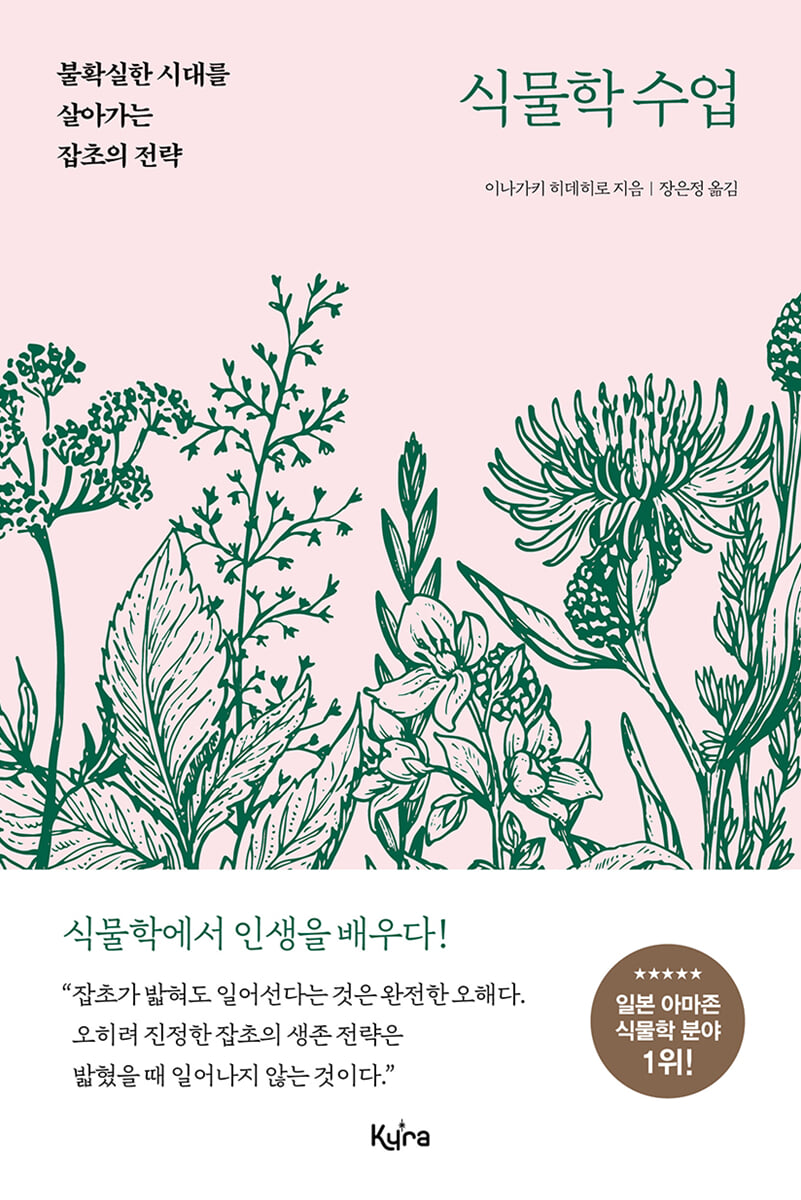
Learning about life from botany!
Plant Survival Guidelines Analyzed Through Business Strategy
#1 in the Japanese Amazon Botany category!
Why Botany Matters Now: Plant Life is Hard, Too
When you think of plants, you might think of them living their entire lives quietly in one place.
But just because it seems like you're not moving doesn't mean you're living peacefully.
Plants are also struggling with all their might to survive in the vast natural world.
They must survive against herbivores, endure natural disasters like floods, droughts, and earthquakes, and deal with all the problems brought about by humans.
There is also fierce competition among plants.
It is a fight to secure a good environment with light, water, and fertile soil.
In that respect, humans and plants are not very different.
Everyone is doing their best to survive in an uncertain future.
Especially in the natural world where the law of survival of the fittest is strictly applied, plants use all means possible to survive.
Moreover, weak and small 'grass' requires various strategies.
Small grasses, commonly called 'weeds', are less competitive than trees with strong roots and lush leaves.
If you live in the shade of a tree, you won't be able to photosynthesize properly because you won't get enough sunlight, and your roots will be too thin and weak to absorb nutrients from the soil.
However, weeds have survived for millions of years and are still commonly found around us today.
How did weeds survive for so long? What survival strategies do these fragile plants employ?
Botanist Hidehiro Inagaki examines the tenacity of small grasses and seeks to find clues to surviving in uncertain times that change every day.
Plant Survival Guidelines Analyzed Through Business Strategy
#1 in the Japanese Amazon Botany category!
Why Botany Matters Now: Plant Life is Hard, Too
When you think of plants, you might think of them living their entire lives quietly in one place.
But just because it seems like you're not moving doesn't mean you're living peacefully.
Plants are also struggling with all their might to survive in the vast natural world.
They must survive against herbivores, endure natural disasters like floods, droughts, and earthquakes, and deal with all the problems brought about by humans.
There is also fierce competition among plants.
It is a fight to secure a good environment with light, water, and fertile soil.
In that respect, humans and plants are not very different.
Everyone is doing their best to survive in an uncertain future.
Especially in the natural world where the law of survival of the fittest is strictly applied, plants use all means possible to survive.
Moreover, weak and small 'grass' requires various strategies.
Small grasses, commonly called 'weeds', are less competitive than trees with strong roots and lush leaves.
If you live in the shade of a tree, you won't be able to photosynthesize properly because you won't get enough sunlight, and your roots will be too thin and weak to absorb nutrients from the soil.
However, weeds have survived for millions of years and are still commonly found around us today.
How did weeds survive for so long? What survival strategies do these fragile plants employ?
Botanist Hidehiro Inagaki examines the tenacity of small grasses and seeks to find clues to surviving in uncertain times that change every day.
- You can preview some of the book's contents.
Preview
index
Introduction
Part 1: The Birth of Weeds
Lecture 1: Revolution in the Plant World
1.
The small conquers the big
2.
Even in a rapidly changing world, you must not become a loser.
Chapter 2: A Battle for Survival
1.
Fight a fight you can win
2.
There are many types of strength.
Lesson 3: Adapting to Change
1.
Strength is knowing weakness
2.
Being strong doesn't come in one form.
Part 2: The Laws of Success Learned from Plants
Lesson 4: Turn Adversity to Your Side
1.
Crisis is opportunity
2.
Softness overcomes strength
3.
Lower the growth point
4.
Opportunity comes only to those who are prepared.
Lesson 5: There are many ways to get to your destination.
1.
If you can't change it, accept it. If you can change it, change it.
2.
Not bound by rules
3.
Because it doesn't change, it can change.
Lesson 6: Opportunity Hidden in Change
1.
improvisation
2.
Change is the key to survival
Lesson 7: Ride the Wave
1.
If you can't change it, accept it quickly.
2.
Change your methods to suit your environment
Lesson 8: The Power of Diversity
1.
Endless challenges
2.
Narrow the fighting space, but don't reduce the weapons.
3.
There is no unnecessary individuality.
Lesson 9: Weeds that transcend common sense
1.
Conditions for plants to survive change
2.
Ideal weed
Part 3: The Philosophy of Plants
Lesson 10: Six Plant Survival Strategies
Strategy 1: Dominant Strategy
Strategy 2: Cosmopolitan Strategy
Strategy 3: Rosette Strategy
Strategy 4: Allelopathic Strategy
Strategy 5 Parasitic Strategy
Strategy 6 Vine Strategy
Lesson 11: What Plants Taught Us
1.
Everything has two sides
2.
Embrace ambiguity
3.
Big doesn't mean strong
Outgoing post
Appendix: Professor Hidehiro Inagaki's "Weeds and Life"
Part 1: The Birth of Weeds
Lecture 1: Revolution in the Plant World
1.
The small conquers the big
2.
Even in a rapidly changing world, you must not become a loser.
Chapter 2: A Battle for Survival
1.
Fight a fight you can win
2.
There are many types of strength.
Lesson 3: Adapting to Change
1.
Strength is knowing weakness
2.
Being strong doesn't come in one form.
Part 2: The Laws of Success Learned from Plants
Lesson 4: Turn Adversity to Your Side
1.
Crisis is opportunity
2.
Softness overcomes strength
3.
Lower the growth point
4.
Opportunity comes only to those who are prepared.
Lesson 5: There are many ways to get to your destination.
1.
If you can't change it, accept it. If you can change it, change it.
2.
Not bound by rules
3.
Because it doesn't change, it can change.
Lesson 6: Opportunity Hidden in Change
1.
improvisation
2.
Change is the key to survival
Lesson 7: Ride the Wave
1.
If you can't change it, accept it quickly.
2.
Change your methods to suit your environment
Lesson 8: The Power of Diversity
1.
Endless challenges
2.
Narrow the fighting space, but don't reduce the weapons.
3.
There is no unnecessary individuality.
Lesson 9: Weeds that transcend common sense
1.
Conditions for plants to survive change
2.
Ideal weed
Part 3: The Philosophy of Plants
Lesson 10: Six Plant Survival Strategies
Strategy 1: Dominant Strategy
Strategy 2: Cosmopolitan Strategy
Strategy 3: Rosette Strategy
Strategy 4: Allelopathic Strategy
Strategy 5 Parasitic Strategy
Strategy 6 Vine Strategy
Lesson 11: What Plants Taught Us
1.
Everything has two sides
2.
Embrace ambiguity
3.
Big doesn't mean strong
Outgoing post
Appendix: Professor Hidehiro Inagaki's "Weeds and Life"
Detailed image
Into the book
The larger the plant, the better.
Because they need sunlight to photosynthesize, they need to be taller than the surrounding plants to receive more light from a higher position.
Being big means being competitive.
They cannot photosynthesize sufficiently under the shade of other plants.
So the plants competed to grow taller.
They competed with each other and rose higher and higher.
--- p.17
Then the era of competition based on size came to an end.
As the dinosaurs' in-laws were dying out, an incredible and unimaginable transformation took place in the plant world.
That's where 'pool' comes in.
The grass did not grow tall, but bloomed close to the ground.
The innovative entity called Pool completely overturned the previous value of bigger being better.
A new era has begun.
--- p.
19
We generally think of weeds as tough and strong, but in fact, weeds can be classified as 'weak plants'.
Weak here means weak in competition.
Weeds are weak plants.
There is no chance of survival in a head-on confrontation.
So, we chose a place where unpredictable changes occur and there is no need for competitiveness.
Choosing a place where there is no competition because the weeds are weak means, in other words, choosing a method that competes based on the ability to respond to change.
--- p.55
It is not true that weeds grow anywhere.
There are few creatures that choose their habitats according to their own strengths as much as weeds.
Of course, plants cannot move, so it is misleading to say that they choose their own location.
Plants spread as many seeds as possible to produce many sprouts.
Only those individuals who are fortunate enough to grow up in a place where they can utilize their strengths can grow properly.
--- p.75
Even if weeds are trampled and trampled, they rise again.
Don't you have this impression of weeds? Unfortunately, this is a misconception.
If you get stepped on once or twice, you might get up.
But if stepped on several times, even weeds cannot rise again.
Rather, the key strategy for weeds is to ‘not rise even when stepped on.’
Even though it was hard, I gritted my teeth and worked hard like a weed, so I might be disappointed by these unexpected words.
But is it really something to be disappointed about? From a botanist's perspective, the "weed's strategy of not rising" is truly a magnificent aspect.
If you think about it objectively, there is no reason for the weeds to rise again.
What is important for plants is to bloom and leave seeds.
There's no need to waste energy on getting back up even if you get stepped on.
--- p.101
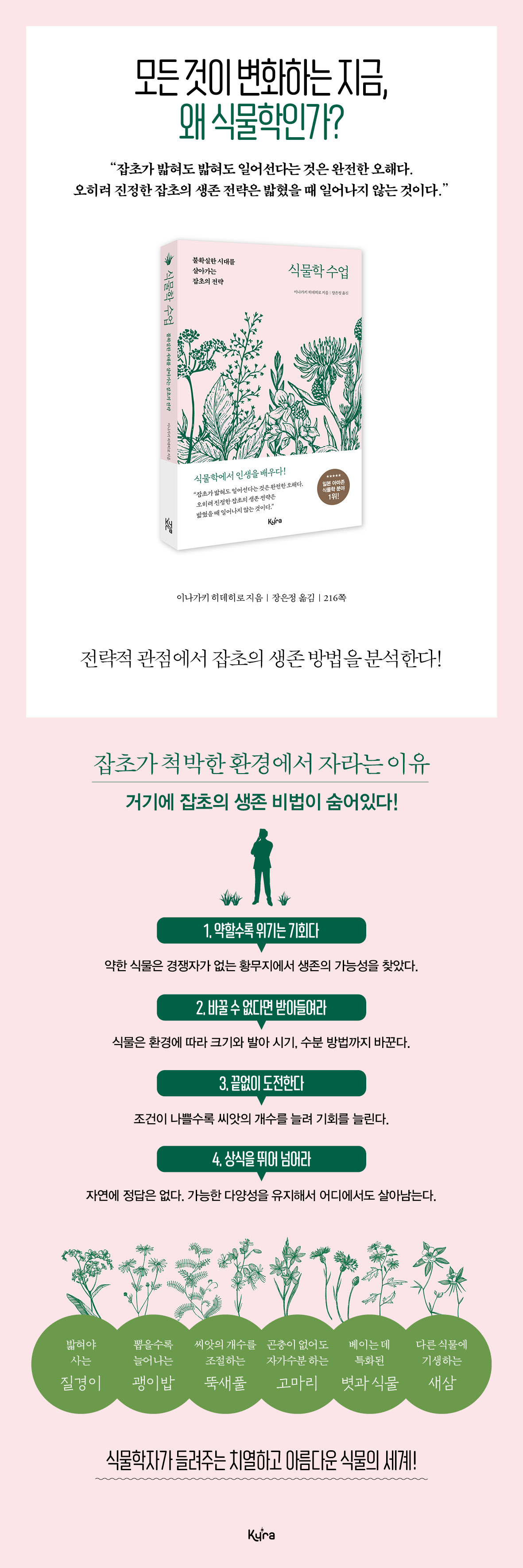
The basic strategy of weeds is 'number of seeds'.
However, because the environment in which each weed lives is different, even within the same type of weed, some produce relatively large seeds while others produce smaller seeds.
This means that the size of the seeds changes depending on the conditions.
A representative example is the Korean knotweed.
The Korean dandelion is divided into the 'field type' that grows in fields and the 'rice paddy type' that grows in rice paddies.
Even though it is the same plant, the size of the seeds varies depending on the habitat.
The field type chose a strategy that produces many small seeds.
The conditions for cultivation are the same for both rice paddies and dry fields, but the cultivation period for rice paddies is set to spring every year.
On the other hand, the cultivation period for fields varies depending on the vegetables or crops grown.
It may be done several times a year.
In other words, compared to rice paddies, fields are environments with greater disturbance.
So, in the field, it is advantageous to produce many small seeds.
--- p.141
Weeds may seem small and insignificant compared to large, sturdy trees that live for hundreds of years.
But in nature, the strong do not always win.
Sometimes, rather than competing with force, a strategy of receiving force is needed.
It is about using adversity and change as opportunities to survive with your own strengths.
Because they need sunlight to photosynthesize, they need to be taller than the surrounding plants to receive more light from a higher position.
Being big means being competitive.
They cannot photosynthesize sufficiently under the shade of other plants.
So the plants competed to grow taller.
They competed with each other and rose higher and higher.
--- p.17
Then the era of competition based on size came to an end.
As the dinosaurs' in-laws were dying out, an incredible and unimaginable transformation took place in the plant world.
That's where 'pool' comes in.
The grass did not grow tall, but bloomed close to the ground.
The innovative entity called Pool completely overturned the previous value of bigger being better.
A new era has begun.
--- p.
19
We generally think of weeds as tough and strong, but in fact, weeds can be classified as 'weak plants'.
Weak here means weak in competition.
Weeds are weak plants.
There is no chance of survival in a head-on confrontation.
So, we chose a place where unpredictable changes occur and there is no need for competitiveness.
Choosing a place where there is no competition because the weeds are weak means, in other words, choosing a method that competes based on the ability to respond to change.
--- p.55
It is not true that weeds grow anywhere.
There are few creatures that choose their habitats according to their own strengths as much as weeds.
Of course, plants cannot move, so it is misleading to say that they choose their own location.
Plants spread as many seeds as possible to produce many sprouts.
Only those individuals who are fortunate enough to grow up in a place where they can utilize their strengths can grow properly.
--- p.75
Even if weeds are trampled and trampled, they rise again.
Don't you have this impression of weeds? Unfortunately, this is a misconception.
If you get stepped on once or twice, you might get up.
But if stepped on several times, even weeds cannot rise again.
Rather, the key strategy for weeds is to ‘not rise even when stepped on.’
Even though it was hard, I gritted my teeth and worked hard like a weed, so I might be disappointed by these unexpected words.
But is it really something to be disappointed about? From a botanist's perspective, the "weed's strategy of not rising" is truly a magnificent aspect.
If you think about it objectively, there is no reason for the weeds to rise again.
What is important for plants is to bloom and leave seeds.
There's no need to waste energy on getting back up even if you get stepped on.
--- p.101
The basic strategy of weeds is 'number of seeds'.
However, because the environment in which each weed lives is different, even within the same type of weed, some produce relatively large seeds while others produce smaller seeds.
This means that the size of the seeds changes depending on the conditions.
A representative example is the Korean knotweed.
The Korean dandelion is divided into the 'field type' that grows in fields and the 'rice paddy type' that grows in rice paddies.
Even though it is the same plant, the size of the seeds varies depending on the habitat.
The field type chose a strategy that produces many small seeds.
The conditions for cultivation are the same for both rice paddies and dry fields, but the cultivation period for rice paddies is set to spring every year.
On the other hand, the cultivation period for fields varies depending on the vegetables or crops grown.
It may be done several times a year.
In other words, compared to rice paddies, fields are environments with greater disturbance.
So, in the field, it is advantageous to produce many small seeds.
--- p.141
Weeds may seem small and insignificant compared to large, sturdy trees that live for hundreds of years.
But in nature, the strong do not always win.
Sometimes, rather than competing with force, a strategy of receiving force is needed.
It is about using adversity and change as opportunities to survive with your own strengths.
--- p.205
Publisher's Review
Weed Survival Strategy: If You Can't Change It, Accept It
Think of a place where weeds grow.
These include vacant lots, roadsides, cultivated land such as rice paddies and fields, and wastelands with poor soil.
It is a constantly changing environment where you can always be trampled by people and cars or cut down or cut down at any time.
There's a reason weeds grow in places like this.
Weeds, plants that are less competitive than trees or larger plants, have found a chance to survive in places where there is little competition among plants and where they have to focus their energy solely on surviving.
It's like when the weakest soccer team beats a strong team in a pouring rain and wins the championship.
In an environment with a lot of change, unexpected results can occur.
Especially if you have the right skills.
The fragile weed has developed the ability to adapt to change.
Known as the "treading expert," the plantain spreads its seeds by sticking to shoes or car wheels.
For a snail, it is not a problem to be stepped on, but rather it is difficult not to be stepped on.
Also, when the roots of dandelion or sedge are pulled out, the seeds are ejected due to the stimulus.
And they use the adhesive substance in the seeds to stick to people's clothes.
As people move, seeds move with them, expanding their distribution area in an amazing way.
The newpoa grass, which is often seen on golf courses, produces ears almost touching the ground.
No matter how closely the grass is mowed, the ears of grain are not cut off and can produce seeds properly.
What's interesting is that the location of the spikes varies depending on the golf course.
Compared to the rough where the grass is left long, the new grass on the fairway where it is mowed short has a much lower head position.
What the weeds taught me: Never lose sight of your purpose, no matter what.
Weeds are often known as tenacious plants that rise again and again even if they are stepped on.
But that is a complete misunderstanding.
Rather, weeds are the plants that best accept and adapt to environmental changes.
Don't waste your energy trying to get up from a place that is often stepped on.
The most important goal of a plant is to leave as many seeds as possible.
So rather than putting effort into getting up after being stepped on, focus on spreading the seeds.
A true weed's survival strategy is to not get up when stepped on.
To achieve their goal of survival in any situation, weeds have evolved into forms optimized for rapidly changing environments.
Depending on habitat conditions, the size, color, number of seeds, germination time, and pollination method (self-pollination and cross-pollination) are controlled.
This is how small, weak plants survive adversity.
In that sense, our lives, living in an unpredictable era where we cannot see even an inch ahead, are not much different.
In this age of change, reading the fascinating stories of plants that have turned crises into opportunities and overcome them will provide small insights for living in the modern world.
Think of a place where weeds grow.
These include vacant lots, roadsides, cultivated land such as rice paddies and fields, and wastelands with poor soil.
It is a constantly changing environment where you can always be trampled by people and cars or cut down or cut down at any time.
There's a reason weeds grow in places like this.
Weeds, plants that are less competitive than trees or larger plants, have found a chance to survive in places where there is little competition among plants and where they have to focus their energy solely on surviving.
It's like when the weakest soccer team beats a strong team in a pouring rain and wins the championship.
In an environment with a lot of change, unexpected results can occur.
Especially if you have the right skills.
The fragile weed has developed the ability to adapt to change.
Known as the "treading expert," the plantain spreads its seeds by sticking to shoes or car wheels.
For a snail, it is not a problem to be stepped on, but rather it is difficult not to be stepped on.
Also, when the roots of dandelion or sedge are pulled out, the seeds are ejected due to the stimulus.
And they use the adhesive substance in the seeds to stick to people's clothes.
As people move, seeds move with them, expanding their distribution area in an amazing way.
The newpoa grass, which is often seen on golf courses, produces ears almost touching the ground.
No matter how closely the grass is mowed, the ears of grain are not cut off and can produce seeds properly.
What's interesting is that the location of the spikes varies depending on the golf course.
Compared to the rough where the grass is left long, the new grass on the fairway where it is mowed short has a much lower head position.
What the weeds taught me: Never lose sight of your purpose, no matter what.
Weeds are often known as tenacious plants that rise again and again even if they are stepped on.
But that is a complete misunderstanding.
Rather, weeds are the plants that best accept and adapt to environmental changes.
Don't waste your energy trying to get up from a place that is often stepped on.
The most important goal of a plant is to leave as many seeds as possible.
So rather than putting effort into getting up after being stepped on, focus on spreading the seeds.
A true weed's survival strategy is to not get up when stepped on.
To achieve their goal of survival in any situation, weeds have evolved into forms optimized for rapidly changing environments.
Depending on habitat conditions, the size, color, number of seeds, germination time, and pollination method (self-pollination and cross-pollination) are controlled.
This is how small, weak plants survive adversity.
In that sense, our lives, living in an unpredictable era where we cannot see even an inch ahead, are not much different.
In this age of change, reading the fascinating stories of plants that have turned crises into opportunities and overcome them will provide small insights for living in the modern world.
GOODS SPECIFICS
- Publication date: February 20, 2021
- Page count, weight, size: 216 pages | 294g | 140*210*20mm
- ISBN13: 9791190783026
- ISBN10: 1190783029
You may also like
카테고리
korean


korean

![GQ KOREA Mark (Monthly): December [2025]](http://librairie.coreenne.fr/cdn/shop/files/8ef265dbbfbf186523ed75ba7319009d.jpg?v=1765340328&width=3840)


