

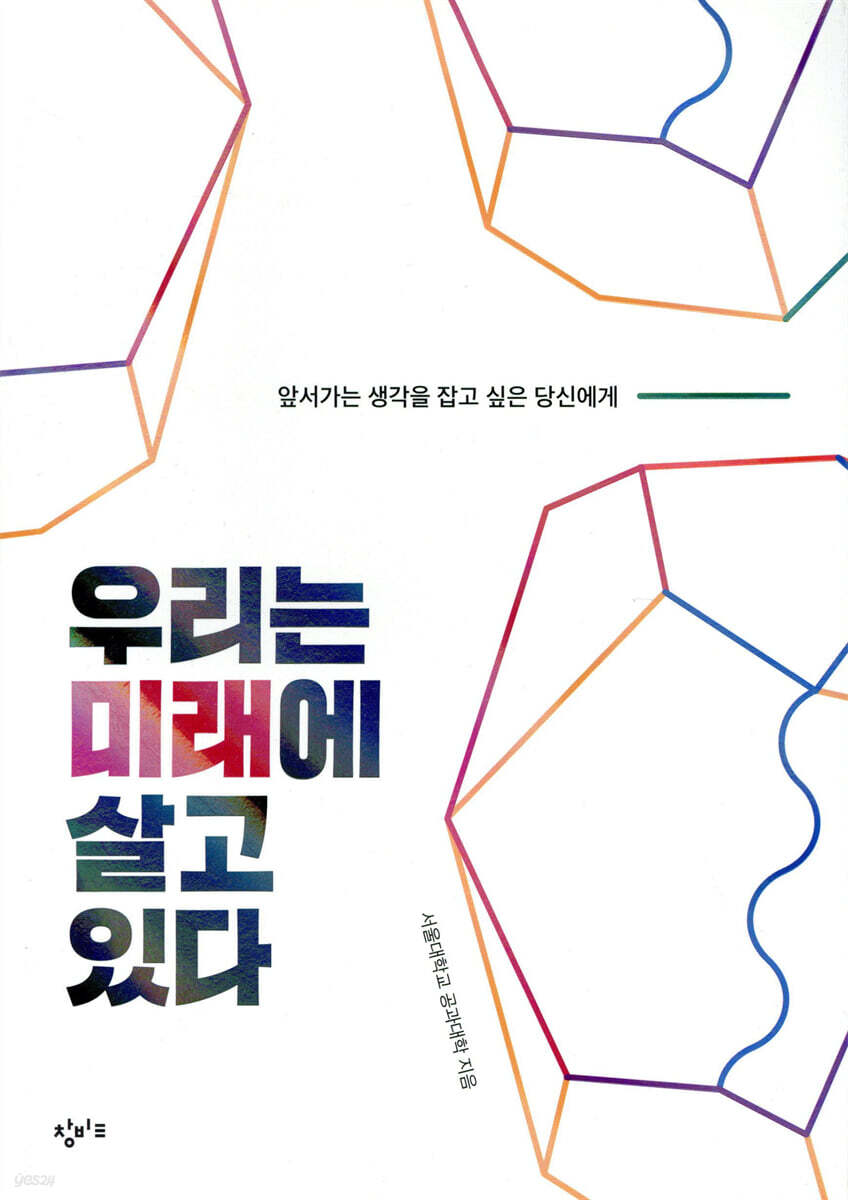
We live in the future
 |
Description
Book Introduction
Countless dreams become reality through engineering! For you, the future protagonist Heart-pounding engineering lectures from Seoul National University professors "We Live in the Future" is a book introducing the present and future of engineering, where professors from Seoul National University's College of Engineering, who are at the forefront of cutting-edge technology research in Korea, are making countless dreams come true. Twenty-one professors participate as authors and introduce emerging engineering technologies and cutting-edge materials, such as deep learning, VR, and quantum dots, and explain how they are being applied to our lives, what research is being conducted in this area, and what future challenges lie ahead. They also include their own perspectives on how the technology or material will change the world we live in, making readers anticipate the future of engineering. Engineering has played a major role in improving human life. But for the public, engineering is still a discipline too distant to approach. Those who have been feeling regretful about this have come together to create “We Live in the Future.” We have eliminated as much unfamiliar technical terms and complex specialized knowledge as possible, and explained engineering techniques using simple language, familiar examples, and cute illustrations, so that anyone can approach engineering with a light heart. If you want to adapt well to a society that changes every day and face the future with forward-thinking, wouldn't it be necessary to make an effort to get closer to engineering even now? In that sense, this book will serve as a helpful guide for both those who dream of a career in engineering and those who wish to change their paradigm of thinking through engineering. |
- You can preview some of the book's contents.
Preview
index
Foreword by Cha Guk-heon
Part 1: Humans and Computers: The Evolutionary War Continues
Can computers help you stop going crazy? Lee Kwang-geun
The emergence of computers that see and think like humans. Kim Geon-hee
Big data that penetrates the human mind
Part 2: Exploring Communication Methods in the Hyperconnected Era
Algorithm Moonbyungro, a means of transportation for traveling through virtual space
Can we create a machine that thinks like a human? Yoon Seong-ro
How did Pokémon get into my room? Lee Byung-ho
Jeong Deok-gyun, the magic stone that powers all the world's electronic devices
Part 3: Dreaming of Innovation in Transportation that Leads to the Future
How did rockets get into space? Yoon Young-bin
Why do helicopters need rotor blades on their tails? Shin Sang-jun
Song Han-ho in search of the Infinity Stones in the car
Why don't tall buildings and large bridges collapse? Kim Seong-ryeol
Kim Yong-hwan dreams of building an underwater city
Part 4: Exploring Infinite Possibilities in the Invisible World
The emergence of a device that can be crumpled like paper without breaking, Hyun Taek-hwan
Min Dong-ju searches for treasures hidden underground
How far will the transformation of solar energy go? Heo Eun-nyeong
If the sun rises in the laboratory, Hwang Yong-seok
Part 5: Creating a Smart Living Space Embracing Human Emotions
Han Ji-sook: Creating Something Never Before with Microorganisms
A cleaner lives in the dirt. Nam Gyeong-pil
The Information Revolution: Creating New Architectural Spaces by Hong Seong-geol
The Birth of a Gravity-Defying Building: Kang Hyun-gu
The secret of Baek Jin's champon architecture, a harmonious blend of new and old.
Part 1: Humans and Computers: The Evolutionary War Continues
Can computers help you stop going crazy? Lee Kwang-geun
The emergence of computers that see and think like humans. Kim Geon-hee
Big data that penetrates the human mind
Part 2: Exploring Communication Methods in the Hyperconnected Era
Algorithm Moonbyungro, a means of transportation for traveling through virtual space
Can we create a machine that thinks like a human? Yoon Seong-ro
How did Pokémon get into my room? Lee Byung-ho
Jeong Deok-gyun, the magic stone that powers all the world's electronic devices
Part 3: Dreaming of Innovation in Transportation that Leads to the Future
How did rockets get into space? Yoon Young-bin
Why do helicopters need rotor blades on their tails? Shin Sang-jun
Song Han-ho in search of the Infinity Stones in the car
Why don't tall buildings and large bridges collapse? Kim Seong-ryeol
Kim Yong-hwan dreams of building an underwater city
Part 4: Exploring Infinite Possibilities in the Invisible World
The emergence of a device that can be crumpled like paper without breaking, Hyun Taek-hwan
Min Dong-ju searches for treasures hidden underground
How far will the transformation of solar energy go? Heo Eun-nyeong
If the sun rises in the laboratory, Hwang Yong-seok
Part 5: Creating a Smart Living Space Embracing Human Emotions
Han Ji-sook: Creating Something Never Before with Microorganisms
A cleaner lives in the dirt. Nam Gyeong-pil
The Information Revolution: Creating New Architectural Spaces by Hong Seong-geol
The Birth of a Gravity-Defying Building: Kang Hyun-gu
The secret of Baek Jin's champon architecture, a harmonious blend of new and old.
Detailed image

Into the book
"We Live in the Future" is the result of a project organized by Seoul National University's College of Engineering with the aim of "introducing engineering to more people in an easier way."
Twenty-one researchers who have been at the forefront of shaping the future of society through engineering have attempted to explain their fields of research in an easy-to-understand and accessible way.
I hope that through this book, you will be able to overcome your unfamiliarity and fear of engineering and feel firsthand that engineering is always close to us.
I would be most delighted if, after reading this book, even one of you became interested in the research being conducted at the College of Engineering or in related fields, and if that interest led to your dream of becoming an engineer in the future.
(Cha Kook-heon, Dean of Seoul National University College of Engineering)
--- From the preface
Big data can be leveraged across diverse and complexly interconnected fields.
By predicting a person's future risk of developing a disease based on data about their favorite foods and preferred activities, we could suggest behavioral changes to prevent the disease.
Optimized decision-making based on big data like this will bring about innovation across all areas of society, ultimately contributing significantly to improving the quality of human life.
--- p.38~39
Sometimes, the algorithm knows better than you what you like.
Many of you may have already experienced Netflix's movie recommendations and Melon's music recommendations.
Even in the gaming industry, user data is overflowing.
We use this to research which games to recommend and what suggestions we can make to users who are playing the game to make the game most enjoyable.
Algorithm is a term that you will encounter frequently in the future along with artificial intelligence.
You will encounter it like licorice in a wide variety of fields and environments.
--- p.51
Nanoparticles can also be used to create wearable electronics that can be worn freely.
If we could bend and roll up the hard materials we carry around in our smartphones, we could wear them on our wrists or attach them to our skin.
Do you think this is a distant future? Before nanotechnology, bendable devices like this were considered science fiction.
But now, using a new type of transparent electrode containing nanomaterials, they are creating devices that can bend, roll, and even crumple like paper.
--- p.143
Drone taxis and landing pads are new, but the dining table has been with us since the days of Confucius and Mencius, Plato and Aristotle.
How about blending the ever-changing and the unchanging, the new and the old, like a delicious jjambbong? That's the way to design outstanding architecture in the 21st century.
Twenty-one researchers who have been at the forefront of shaping the future of society through engineering have attempted to explain their fields of research in an easy-to-understand and accessible way.
I hope that through this book, you will be able to overcome your unfamiliarity and fear of engineering and feel firsthand that engineering is always close to us.
I would be most delighted if, after reading this book, even one of you became interested in the research being conducted at the College of Engineering or in related fields, and if that interest led to your dream of becoming an engineer in the future.
(Cha Kook-heon, Dean of Seoul National University College of Engineering)
--- From the preface
Big data can be leveraged across diverse and complexly interconnected fields.
By predicting a person's future risk of developing a disease based on data about their favorite foods and preferred activities, we could suggest behavioral changes to prevent the disease.
Optimized decision-making based on big data like this will bring about innovation across all areas of society, ultimately contributing significantly to improving the quality of human life.
--- p.38~39
Sometimes, the algorithm knows better than you what you like.
Many of you may have already experienced Netflix's movie recommendations and Melon's music recommendations.
Even in the gaming industry, user data is overflowing.
We use this to research which games to recommend and what suggestions we can make to users who are playing the game to make the game most enjoyable.
Algorithm is a term that you will encounter frequently in the future along with artificial intelligence.
You will encounter it like licorice in a wide variety of fields and environments.
--- p.51
Nanoparticles can also be used to create wearable electronics that can be worn freely.
If we could bend and roll up the hard materials we carry around in our smartphones, we could wear them on our wrists or attach them to our skin.
Do you think this is a distant future? Before nanotechnology, bendable devices like this were considered science fiction.
But now, using a new type of transparent electrode containing nanomaterials, they are creating devices that can bend, roll, and even crumple like paper.
--- p.143
Drone taxis and landing pads are new, but the dining table has been with us since the days of Confucius and Mencius, Plato and Aristotle.
How about blending the ever-changing and the unchanging, the new and the old, like a delicious jjambbong? That's the way to design outstanding architecture in the 21st century.
--- p.221
Publisher's Review
Clearing away the fog of uncertainty
For those of you who want to get one step closer to the future
Seoul National University College of Engineering professors have united!
Recently, we have been experiencing life like never before due to the COVID-19 pandemic.
As the spread of contactless culture changes people's lifestyles, the influence of engineering is growing in countless fields, including healthcare, education, and logistics.
Moreover, as the new winds of the Fourth Industrial Revolution rapidly blow in, in a situation where it is difficult to predict even an inch ahead of how our lives will unfold in the future, people's anxiety due to uncertainty is increasing.
In times like these, we must cultivate an eye for the future through engineering and design our lives based on the wisdom we gain.
Because engineering brings our imaginations into reality and takes us one step further than we are now.
"We Live in the Future" is a book introducing the present and future of engineering, where professors from Seoul National University's College of Engineering, who are at the forefront of cutting-edge technology research in Korea, are making countless dreams come true.
In addition to the commonly introduced computer engineering, electrical and information engineering, and mechanical engineering, twenty-one professors from ten fields participated as authors, including energy resources engineering, chemical and biological engineering, nuclear engineering, aerospace engineering, shipbuilding and marine engineering, construction and environmental engineering, and architecture.
The authors introduce emerging engineering technologies and cutting-edge materials, such as deep learning, VR, and quantum dots, and explain how they are being applied to our lives, what research is being conducted in this area, and what future challenges lie ahead.
They also include their own perspectives on how the technology or material will change the world we live in, making readers anticipate the future of engineering.
From artificial intelligence and big data, which are the core technologies of the 4th industrial revolution,
Even the nanotechnology of Professor Hyun Taek-hwan, a candidate for the Nobel Prize in Chemistry…
Discover everything about cutting-edge technologies that will lead the future in one book.
This book is divided into five parts.
Part 1, "Humans and Computers: The Evolutionary War," covers technologies that have become a familiar part of our lives, such as artificial intelligence and big data.
If you still only think of AlphaGo when you think of artificial intelligence, the knowledge contained here will broaden your perspective.
We can glimpse the possibility of artificial intelligence that goes beyond simply understanding human speech and following commands to thinking and learning on its own like humans.
Part 2, "Exploring Communication Methods in the Hyper-Connected Era," introduces algorithms, virtual reality (VR), augmented reality (AR), and electronic circuits.
You'll find answers to questions like, "When will we see a virtual reality device that's not dizzying?" and "What's the secret to smartphones and computers continuing to shrink in size?"
Part 3, "Dreaming of Innovation in Transportation that Leads to the Future," offers a fresh perspective on things we've always taken for granted, such as tall buildings, bridges, cars, and helicopters.
It interestingly unravels the hidden principles behind things like 'hydrogen-powered cars' and 'Lotte World Tower, which doesn't fall over even at a height of 550 meters', and contains the process of efforts to meet the demands of the times.
Part 4, “Exploring Infinite Possibilities in the Invisible World,” introduces nanotechnology, resource exploration, and nuclear fusion power generation.
This section is particularly meaningful because it provides a glimpse into the various aspects of nanotechnology, which has been in the spotlight since Professor Hyun Taek-hwan of the Department of Chemical and Biological Engineering was mentioned as a strong candidate for the 2020 Nobel Prize in Chemistry.
Finally, Part 5, "Creating a Smart Living Space with Human Emotions," explores the role of microorganisms as an alternative to solving global environmental problems and envisions the future of environmental technology.
It also introduces smart construction methods that were born by blending existing architectural engineering with Fourth Industrial Revolution technologies, and leads us to reflect on what remains constant in our lives despite the revolutionary changes in technology, and to think about what kind of space we will live in in the future should be.
“Let’s introduce engineering to more people, more easily!”
A soft engineering lecture where you can grasp forward-thinking ideas in one hand.
Engineering is called an 'enabler discipline' because it plays a supporting role in helping us live more convenient and comfortable lives.
Engineering has played a huge role in improving human life.
But for the public, engineering is still a discipline too distant to approach.
In a situation where there is already a shortage of introductory engineering books for the general public, it is even more difficult to find books that explain engineering in an easy-to-understand and interesting way at a level that appeals to the general public.
The authors have always felt regretful about this point, and that is how this book was born.
"We Live in the Future" is the result of a project organized by Seoul National University's College of Engineering with the aim of "introducing engineering to more people in an easier way."
We have tried to avoid unfamiliar technical terms and complex specialized knowledge as much as possible and explain engineering techniques using easy words, familiar examples, and cute illustrations, so that even those without much background knowledge in engineering can approach engineering with a light heart.
Cars that drive themselves without human intervention, electronic devices that can bend and roll—things once seen only in science fiction movies are becoming increasingly real.
And the pace of these changes is happening faster than we perceive.
Engineering is so deeply ingrained in our lives that it's difficult to dismiss it as something we can live without knowing about. Even at this very moment, it's changing our world and our future.
If you want to adapt to a society that changes every day and embrace the future with forward-thinking, shouldn't you make an effort to get closer to engineering now?
In that sense, this book will serve as a warm and friendly guide for both those who dream of a career in engineering and those who wish to change their paradigm of thinking through engineering.
For those of you who want to get one step closer to the future
Seoul National University College of Engineering professors have united!
Recently, we have been experiencing life like never before due to the COVID-19 pandemic.
As the spread of contactless culture changes people's lifestyles, the influence of engineering is growing in countless fields, including healthcare, education, and logistics.
Moreover, as the new winds of the Fourth Industrial Revolution rapidly blow in, in a situation where it is difficult to predict even an inch ahead of how our lives will unfold in the future, people's anxiety due to uncertainty is increasing.
In times like these, we must cultivate an eye for the future through engineering and design our lives based on the wisdom we gain.
Because engineering brings our imaginations into reality and takes us one step further than we are now.
"We Live in the Future" is a book introducing the present and future of engineering, where professors from Seoul National University's College of Engineering, who are at the forefront of cutting-edge technology research in Korea, are making countless dreams come true.
In addition to the commonly introduced computer engineering, electrical and information engineering, and mechanical engineering, twenty-one professors from ten fields participated as authors, including energy resources engineering, chemical and biological engineering, nuclear engineering, aerospace engineering, shipbuilding and marine engineering, construction and environmental engineering, and architecture.
The authors introduce emerging engineering technologies and cutting-edge materials, such as deep learning, VR, and quantum dots, and explain how they are being applied to our lives, what research is being conducted in this area, and what future challenges lie ahead.
They also include their own perspectives on how the technology or material will change the world we live in, making readers anticipate the future of engineering.
From artificial intelligence and big data, which are the core technologies of the 4th industrial revolution,
Even the nanotechnology of Professor Hyun Taek-hwan, a candidate for the Nobel Prize in Chemistry…
Discover everything about cutting-edge technologies that will lead the future in one book.
This book is divided into five parts.
Part 1, "Humans and Computers: The Evolutionary War," covers technologies that have become a familiar part of our lives, such as artificial intelligence and big data.
If you still only think of AlphaGo when you think of artificial intelligence, the knowledge contained here will broaden your perspective.
We can glimpse the possibility of artificial intelligence that goes beyond simply understanding human speech and following commands to thinking and learning on its own like humans.
Part 2, "Exploring Communication Methods in the Hyper-Connected Era," introduces algorithms, virtual reality (VR), augmented reality (AR), and electronic circuits.
You'll find answers to questions like, "When will we see a virtual reality device that's not dizzying?" and "What's the secret to smartphones and computers continuing to shrink in size?"
Part 3, "Dreaming of Innovation in Transportation that Leads to the Future," offers a fresh perspective on things we've always taken for granted, such as tall buildings, bridges, cars, and helicopters.
It interestingly unravels the hidden principles behind things like 'hydrogen-powered cars' and 'Lotte World Tower, which doesn't fall over even at a height of 550 meters', and contains the process of efforts to meet the demands of the times.
Part 4, “Exploring Infinite Possibilities in the Invisible World,” introduces nanotechnology, resource exploration, and nuclear fusion power generation.
This section is particularly meaningful because it provides a glimpse into the various aspects of nanotechnology, which has been in the spotlight since Professor Hyun Taek-hwan of the Department of Chemical and Biological Engineering was mentioned as a strong candidate for the 2020 Nobel Prize in Chemistry.
Finally, Part 5, "Creating a Smart Living Space with Human Emotions," explores the role of microorganisms as an alternative to solving global environmental problems and envisions the future of environmental technology.
It also introduces smart construction methods that were born by blending existing architectural engineering with Fourth Industrial Revolution technologies, and leads us to reflect on what remains constant in our lives despite the revolutionary changes in technology, and to think about what kind of space we will live in in the future should be.
“Let’s introduce engineering to more people, more easily!”
A soft engineering lecture where you can grasp forward-thinking ideas in one hand.
Engineering is called an 'enabler discipline' because it plays a supporting role in helping us live more convenient and comfortable lives.
Engineering has played a huge role in improving human life.
But for the public, engineering is still a discipline too distant to approach.
In a situation where there is already a shortage of introductory engineering books for the general public, it is even more difficult to find books that explain engineering in an easy-to-understand and interesting way at a level that appeals to the general public.
The authors have always felt regretful about this point, and that is how this book was born.
"We Live in the Future" is the result of a project organized by Seoul National University's College of Engineering with the aim of "introducing engineering to more people in an easier way."
We have tried to avoid unfamiliar technical terms and complex specialized knowledge as much as possible and explain engineering techniques using easy words, familiar examples, and cute illustrations, so that even those without much background knowledge in engineering can approach engineering with a light heart.
Cars that drive themselves without human intervention, electronic devices that can bend and roll—things once seen only in science fiction movies are becoming increasingly real.
And the pace of these changes is happening faster than we perceive.
Engineering is so deeply ingrained in our lives that it's difficult to dismiss it as something we can live without knowing about. Even at this very moment, it's changing our world and our future.
If you want to adapt to a society that changes every day and embrace the future with forward-thinking, shouldn't you make an effort to get closer to engineering now?
In that sense, this book will serve as a warm and friendly guide for both those who dream of a career in engineering and those who wish to change their paradigm of thinking through engineering.
GOODS SPECIFICS
- Publication date: December 23, 2020
- Page count, weight, size: 224 pages | 358g | 148*210*20mm
- ISBN13: 9791165700423
- ISBN10: 1165700425
You may also like
카테고리
korean


korean

![GQ KOREA Mark (Monthly): December [2025]](http://librairie.coreenne.fr/cdn/shop/files/8ef265dbbfbf186523ed75ba7319009d.jpg?v=1765340328&width=3840)


