

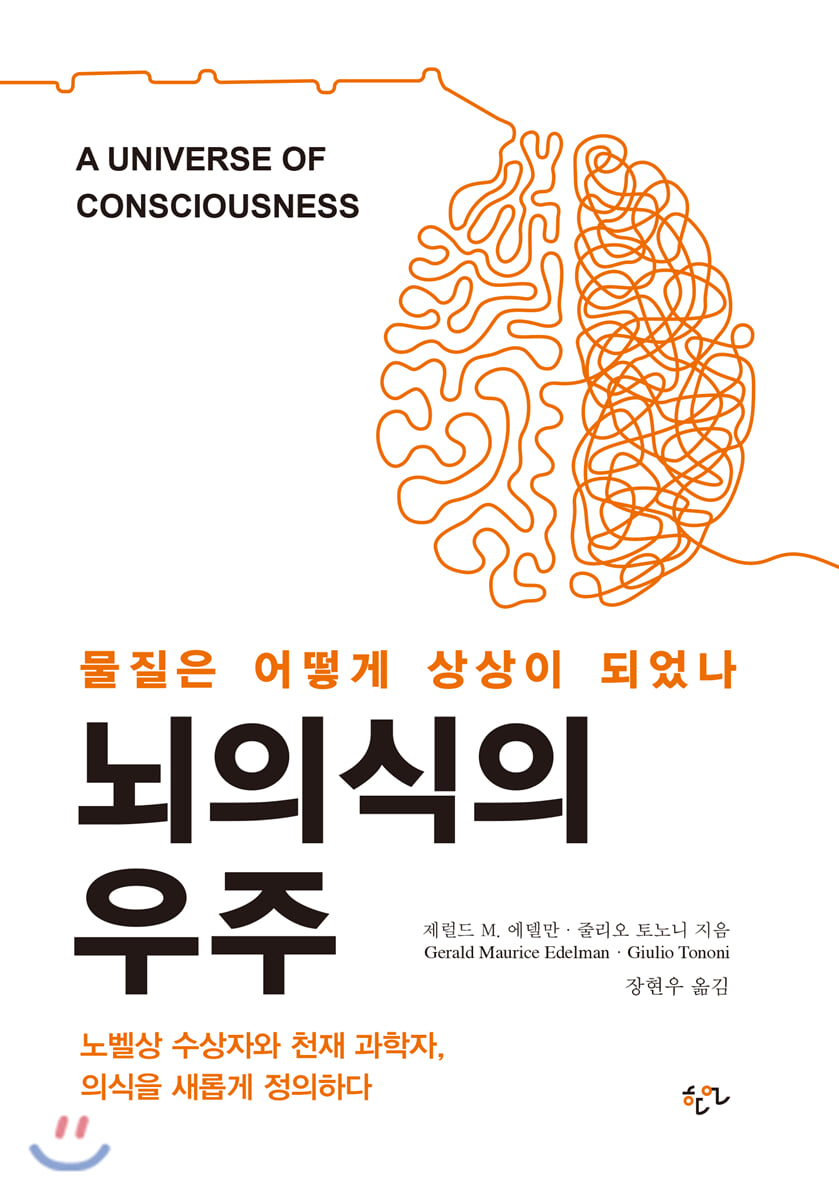
The Universe of Brain Consciousness
 |
Description
Book Introduction
Breaking new ground in the scientific exploration of consciousness
Edelman marked a Copernican shift in the direction of consciousness research toward the exploration of the underlying neural processes that enable the universal properties of consciousness.
"The Universe of Brain Consciousness" boldly unfolds neuroscientific insights into many humanities topics, including the self, language, literature, and art.
It will be of great help to those seeking a rational and objective theory of consciousness.
Edelman marked a Copernican shift in the direction of consciousness research toward the exploration of the underlying neural processes that enable the universal properties of consciousness.
"The Universe of Brain Consciousness" boldly unfolds neuroscientific insights into many humanities topics, including the self, language, literature, and art.
It will be of great help to those seeking a rational and objective theory of consciousness.
- You can preview some of the book's contents.
Preview
index
Translator's Note _ i
Acknowledgements _ 7
Preface _ 9
Part 1: The World's Knots _ 15
Chapter 1: Consciousness: Philosophical Paradox or Object of Scientific Study? _ 18
Chapter 2: The Singularity of the Problem of Consciousness _ 29
Chapter 3: Everyone's Own Theater: Unceasing Unity, Endless Diversity _ 43
Part 2: Consciousness and the Brain _ 65
Chapter 4: Exploring the Brain _ 68
Chapter 5: Consciousness and Distributed Neural Activity _ 88
Chapter 6 Neural Activity: Integrated and Differentiated _ 104
Part 3: The Mechanism of Consciousness: A Darwinian Perspective _ 125
Chapter 7: Natural Selection _ 127
Chapter 8: The Non-Representationality of Memory _ 147
Chapter 9 From Perception to Memory: The Remembered Present _ 159
Part 4: Coping with Diversity: The Dynamic Core Hypothesis _ 171
Chapter 10: Integration and Reintroduction _ 173
Chapter 11: Consciousness and Complexity _ 189
Chapter 12: Where the Knots Are Tied: The Dynamic Core Hypothesis _ 208
Part 5: Untying the Knot _ 231
Chapter 13: Qualia and Distinction _ 233
Chapter 14: Consciousness and the Unconscious _ 259
Part 6: The Observer's Time _ 281
Chapter 15: Language and the Self _ 283
Chapter 16 Thoughts _ 294
Chapter 17: Prisoners of Narrative _ 305
Note _ 329
References _ 376
Illustration source _ 398
List of illustrations _ 400
Index _ 402
Acknowledgements _ 7
Preface _ 9
Part 1: The World's Knots _ 15
Chapter 1: Consciousness: Philosophical Paradox or Object of Scientific Study? _ 18
Chapter 2: The Singularity of the Problem of Consciousness _ 29
Chapter 3: Everyone's Own Theater: Unceasing Unity, Endless Diversity _ 43
Part 2: Consciousness and the Brain _ 65
Chapter 4: Exploring the Brain _ 68
Chapter 5: Consciousness and Distributed Neural Activity _ 88
Chapter 6 Neural Activity: Integrated and Differentiated _ 104
Part 3: The Mechanism of Consciousness: A Darwinian Perspective _ 125
Chapter 7: Natural Selection _ 127
Chapter 8: The Non-Representationality of Memory _ 147
Chapter 9 From Perception to Memory: The Remembered Present _ 159
Part 4: Coping with Diversity: The Dynamic Core Hypothesis _ 171
Chapter 10: Integration and Reintroduction _ 173
Chapter 11: Consciousness and Complexity _ 189
Chapter 12: Where the Knots Are Tied: The Dynamic Core Hypothesis _ 208
Part 5: Untying the Knot _ 231
Chapter 13: Qualia and Distinction _ 233
Chapter 14: Consciousness and the Unconscious _ 259
Part 6: The Observer's Time _ 281
Chapter 15: Language and the Self _ 283
Chapter 16 Thoughts _ 294
Chapter 17: Prisoners of Narrative _ 305
Note _ 329
References _ 376
Illustration source _ 398
List of illustrations _ 400
Index _ 402
Into the book
The subject of consciousness has never left humanity's attention.
In the past, only philosophers explored consciousness, but recently psychologists and neuroscientists have also begun to tackle the so-called mind-body problem, or what Schopenhauer called the "knot of the world."
This chapter provides an overview of both traditional approaches and modern methodologies in the study of consciousness.
We will compare various claims made by philosophers, psychologists, and neuroscientists, and filter out those that are clearly wrong, such as dualism or extreme reductionism.
Through this, we aim to show that consciousness is not the exclusive domain of philosophers, but a subject open to scientific inquiry.
--- p.18
The human brain is a very unique thing and system.
The brain's connectivity, dynamics, functional patterns, and relationships with the body and the outside world are unlike anything else.
In these circumstances, drawing a blueprint of the brain is truly a tremendous challenge.
Our current knowledge of the brain represents only a tiny fraction of the overall picture.
But wouldn't even a half-finished sketch be better than rushing in empty-handed? Especially if it's sufficient to construct a proper theory of consciousness.
--- p.69
Once higher consciousness emerges, social and emotional relationships constitute the self.
The ego creates the 'subject', an agent with self-consciousness.
The individuality of the self is qualitatively different from the biological individuality of animals with primary consciousness.
The ego further refines phenomenological experience, linking sensory impressions to thoughts, culture, and beliefs.
The ego frees the imagination and opens up a vast horizon called 'metaphor'.
Through the ego, we can briefly escape the shackles of the remembered present while remaining conscious.
By connecting the blueprints of primary and higher consciousness, we can solve three mysteries of human intelligence: the persistence of awareness, the self, and the construction of stories, plans, and novels.
--- p.283~284
If you doubt the utility of consciousness, compare the creations of poets, composers, mathematicians, and scientists with the behavior of eusocial insects.
Of course, without life, the delicate behavior of bees or the complex colony structures of termites would not have emerged spontaneously.
But these are nothing compared to the dazzling achievements of humanity's higher consciousness.
Every human being has his or her own grand perspective on the universe.
Through science, humanity seeks to understand our place in the universe, and through art, it comforts one another and reminds us of our own greatness.
Both human freedom and a sense of belonging are products of consciousness.
In the past, only philosophers explored consciousness, but recently psychologists and neuroscientists have also begun to tackle the so-called mind-body problem, or what Schopenhauer called the "knot of the world."
This chapter provides an overview of both traditional approaches and modern methodologies in the study of consciousness.
We will compare various claims made by philosophers, psychologists, and neuroscientists, and filter out those that are clearly wrong, such as dualism or extreme reductionism.
Through this, we aim to show that consciousness is not the exclusive domain of philosophers, but a subject open to scientific inquiry.
--- p.18
The human brain is a very unique thing and system.
The brain's connectivity, dynamics, functional patterns, and relationships with the body and the outside world are unlike anything else.
In these circumstances, drawing a blueprint of the brain is truly a tremendous challenge.
Our current knowledge of the brain represents only a tiny fraction of the overall picture.
But wouldn't even a half-finished sketch be better than rushing in empty-handed? Especially if it's sufficient to construct a proper theory of consciousness.
--- p.69
Once higher consciousness emerges, social and emotional relationships constitute the self.
The ego creates the 'subject', an agent with self-consciousness.
The individuality of the self is qualitatively different from the biological individuality of animals with primary consciousness.
The ego further refines phenomenological experience, linking sensory impressions to thoughts, culture, and beliefs.
The ego frees the imagination and opens up a vast horizon called 'metaphor'.
Through the ego, we can briefly escape the shackles of the remembered present while remaining conscious.
By connecting the blueprints of primary and higher consciousness, we can solve three mysteries of human intelligence: the persistence of awareness, the self, and the construction of stories, plans, and novels.
--- p.283~284
If you doubt the utility of consciousness, compare the creations of poets, composers, mathematicians, and scientists with the behavior of eusocial insects.
Of course, without life, the delicate behavior of bees or the complex colony structures of termites would not have emerged spontaneously.
But these are nothing compared to the dazzling achievements of humanity's higher consciousness.
Every human being has his or her own grand perspective on the universe.
Through science, humanity seeks to understand our place in the universe, and through art, it comforts one another and reminds us of our own greatness.
Both human freedom and a sense of belonging are products of consciousness.
--- p.322~323
Publisher's Review
A Nobel Prize winner and a genius scientist
Revolutionary insights into the brain and consciousness
Gerald Edelman won the 1972 Nobel Prize in Physiology or Medicine for his work elucidating the structure of antibody proteins and elucidating the mechanisms of immune responses in living organisms.
He later applied immunological thinking to neuroscience and established neural Darwinism, or the theory of neural group selection.
He did not stop there, but attempted to solve the problem of consciousness by introducing a new method that had never existed before.
The goal was to first define the universal properties of consciousness and then find the underlying neural processes that make those properties possible.
This was a great shift in thinking that no one before Edelman had ever achieved.
Edelman's theory of consciousness, which viewed 'competition and integration of information' as the main function of consciousness, has inspired many neurophysicists, and research is still actively being conducted on how the flow of information changes in various states of consciousness.
Furthermore, recent research using optogenetics continues to demonstrate that bidirectional connections between neural populations, which Edelman has collectively termed “re-entrainment,” are essential for higher-order brain functions.
In this book, Gerald Edelman completes his theory of consciousness by weaving experimental evidence into the groundbreaking concepts introduced in his trilogy: Neural Darwinism, Topological Biology, and The Remembered Present.
In this book, Edelman and his colleague Tononi cover the structure and function of the brain, various existing theories of consciousness, and even higher-order human consciousness, for scholars from various fields who are exploring the nature of the human mind.
The first half of this book introduces the philosophical, psychological, and biological foundations essential to understanding the authors' theories.
Next, we redefine various frequently misused terms and concepts, such as “complexity,” and use them to establish a robust and testable theory of the neural basis of consciousness.
In the latter part, various elements of the human mind, such as language and thought, are reinterpreted based on the authors' theories.
This bold attempt is expected to generate various experimental and theoretical repercussions.
In this book, readers will find answers to major questions in science, philosophy, and even literature.
What happens in our heads when we think? How do the physical events that occur in our brain, a soft, palm-sized organ, create the incredible world of conscious experience, encompassing our senses, knowledge, and existence? Scientists and philosophers have pondered these questions for ages, but no one has come up with a theory based on observable scientific experiments.
In this book, Gerald Edelman completes his theory of consciousness by weaving experimental evidence into the groundbreaking concepts introduced in his trilogy, Neural Darwinism, Topological Biology, and The Remembered Present.
Edelman and Tononi present a cutting-edge experimental technique that measures subtle brain electrical currents to detect brain waves associated with specific conscious experiences.
This book will likely cause quite a stir among current consciousness researchers.
The authors argue that Freud's unconscious accounts for a much larger proportion of total brain activity than previously believed.
Consciousness is not a unified entity, and each individual has a unique “consciousness footprint.”
This is why we must pay attention to the individuality of human beings.
- Science Magazine
This is the best introductory book to understand Edelman's theory of consciousness.
…Consciousness is the holy grail of modern neuroscience, so it is premature to argue over which theory is correct.
However, it is true that Edelman and Tononi's claim is a bolder hypothesis than any other theory, and it is a valid hypothesis.
- Nature Magazine
[Edelman and Tononi] vividly demonstrate that the explosive progress of modern science will completely overturn the landscape of brain research, which has been gradually pursued by philosophers for thousands of years.
Therefore, the message this book delivers to the scientific and philosophical communities is by no means small.
- Boston Book Review
Revolutionary insights into the brain and consciousness
Gerald Edelman won the 1972 Nobel Prize in Physiology or Medicine for his work elucidating the structure of antibody proteins and elucidating the mechanisms of immune responses in living organisms.
He later applied immunological thinking to neuroscience and established neural Darwinism, or the theory of neural group selection.
He did not stop there, but attempted to solve the problem of consciousness by introducing a new method that had never existed before.
The goal was to first define the universal properties of consciousness and then find the underlying neural processes that make those properties possible.
This was a great shift in thinking that no one before Edelman had ever achieved.
Edelman's theory of consciousness, which viewed 'competition and integration of information' as the main function of consciousness, has inspired many neurophysicists, and research is still actively being conducted on how the flow of information changes in various states of consciousness.
Furthermore, recent research using optogenetics continues to demonstrate that bidirectional connections between neural populations, which Edelman has collectively termed “re-entrainment,” are essential for higher-order brain functions.
In this book, Gerald Edelman completes his theory of consciousness by weaving experimental evidence into the groundbreaking concepts introduced in his trilogy: Neural Darwinism, Topological Biology, and The Remembered Present.
In this book, Edelman and his colleague Tononi cover the structure and function of the brain, various existing theories of consciousness, and even higher-order human consciousness, for scholars from various fields who are exploring the nature of the human mind.
The first half of this book introduces the philosophical, psychological, and biological foundations essential to understanding the authors' theories.
Next, we redefine various frequently misused terms and concepts, such as “complexity,” and use them to establish a robust and testable theory of the neural basis of consciousness.
In the latter part, various elements of the human mind, such as language and thought, are reinterpreted based on the authors' theories.
This bold attempt is expected to generate various experimental and theoretical repercussions.
In this book, readers will find answers to major questions in science, philosophy, and even literature.
What happens in our heads when we think? How do the physical events that occur in our brain, a soft, palm-sized organ, create the incredible world of conscious experience, encompassing our senses, knowledge, and existence? Scientists and philosophers have pondered these questions for ages, but no one has come up with a theory based on observable scientific experiments.
In this book, Gerald Edelman completes his theory of consciousness by weaving experimental evidence into the groundbreaking concepts introduced in his trilogy, Neural Darwinism, Topological Biology, and The Remembered Present.
Edelman and Tononi present a cutting-edge experimental technique that measures subtle brain electrical currents to detect brain waves associated with specific conscious experiences.
This book will likely cause quite a stir among current consciousness researchers.
The authors argue that Freud's unconscious accounts for a much larger proportion of total brain activity than previously believed.
Consciousness is not a unified entity, and each individual has a unique “consciousness footprint.”
This is why we must pay attention to the individuality of human beings.
- Science Magazine
This is the best introductory book to understand Edelman's theory of consciousness.
…Consciousness is the holy grail of modern neuroscience, so it is premature to argue over which theory is correct.
However, it is true that Edelman and Tononi's claim is a bolder hypothesis than any other theory, and it is a valid hypothesis.
- Nature Magazine
[Edelman and Tononi] vividly demonstrate that the explosive progress of modern science will completely overturn the landscape of brain research, which has been gradually pursued by philosophers for thousands of years.
Therefore, the message this book delivers to the scientific and philosophical communities is by no means small.
- Boston Book Review
GOODS SPECIFICS
- Date of issue: August 1, 2020
- Page count, weight, size: 420 pages | 128*188*30mm
- ISBN13: 9788955968972
- ISBN10: 8955968973
You may also like
카테고리
korean


korean

![GQ KOREA Mark (Monthly): December [2025]](http://librairie.coreenne.fr/cdn/shop/files/8ef265dbbfbf186523ed75ba7319009d.jpg?v=1765340328&width=3840)


