

Mr. Confucius's Bakery
 |
Description
Book Introduction
A basic humanities textbook for children, taught by the saints of old!
"The First Humanities Fairy Tale That Lays the Foundation of Character" is a new concept fairy tale and self-development book in which representative figures from the humanities fields such as philosophy, literature, art, and religion appear as children's neighbors, share their concerns with them, awaken life wisdom, and cultivate good character.
The first book in the series, "Uncle Confucius's Bakery," features Uncle Confucius transformed into a bakery owner.
When the main character Hwan-hee is worried about his grades at school, the story helps him think positively and develop a good personality through the saying, "Isn't it fun to learn and practice sometimes?" and when he is worried about a fight with a friend, the story helps him think positively and develop a good personality through the lesson, "Humanity means loving people."
Through conversations with Uncle Confucius, Huanxi naturally cultivates humanistic virtues in his heart, and Huanxi's inner thoughts will be conveyed to the children who read the book.
"The First Humanities Fairy Tale That Lays the Foundation of Character" is a new concept fairy tale and self-development book in which representative figures from the humanities fields such as philosophy, literature, art, and religion appear as children's neighbors, share their concerns with them, awaken life wisdom, and cultivate good character.
The first book in the series, "Uncle Confucius's Bakery," features Uncle Confucius transformed into a bakery owner.
When the main character Hwan-hee is worried about his grades at school, the story helps him think positively and develop a good personality through the saying, "Isn't it fun to learn and practice sometimes?" and when he is worried about a fight with a friend, the story helps him think positively and develop a good personality through the lesson, "Humanity means loving people."
Through conversations with Uncle Confucius, Huanxi naturally cultivates humanistic virtues in his heart, and Huanxi's inner thoughts will be conveyed to the children who read the book.
- You can preview some of the book's contents.
Preview
index
Meeting the Bakery Man
[The virtuous are not lonely]
Studying is fun?
[Isn't it fun to learn and practice from time to time?]
The day I fought with my brother
[In is loving people]
You're not my friend anymore
[Aren't you happy when a friend comes from far away?]
Sunday hike
[A person's true worth is revealed in difficult situations]
First boiled porridge
[Hyo-ran has respect for her parents]
Get a girlfriend
[Don't make others do what you don't want them to do to you]
-supplement
Who is Confucius, the great teacher of Eastern philosophy?
[The virtuous are not lonely]
Studying is fun?
[Isn't it fun to learn and practice from time to time?]
The day I fought with my brother
[In is loving people]
You're not my friend anymore
[Aren't you happy when a friend comes from far away?]
Sunday hike
[A person's true worth is revealed in difficult situations]
First boiled porridge
[Hyo-ran has respect for her parents]
Get a girlfriend
[Don't make others do what you don't want them to do to you]
-supplement
Who is Confucius, the great teacher of Eastern philosophy?
Detailed image
Into the book
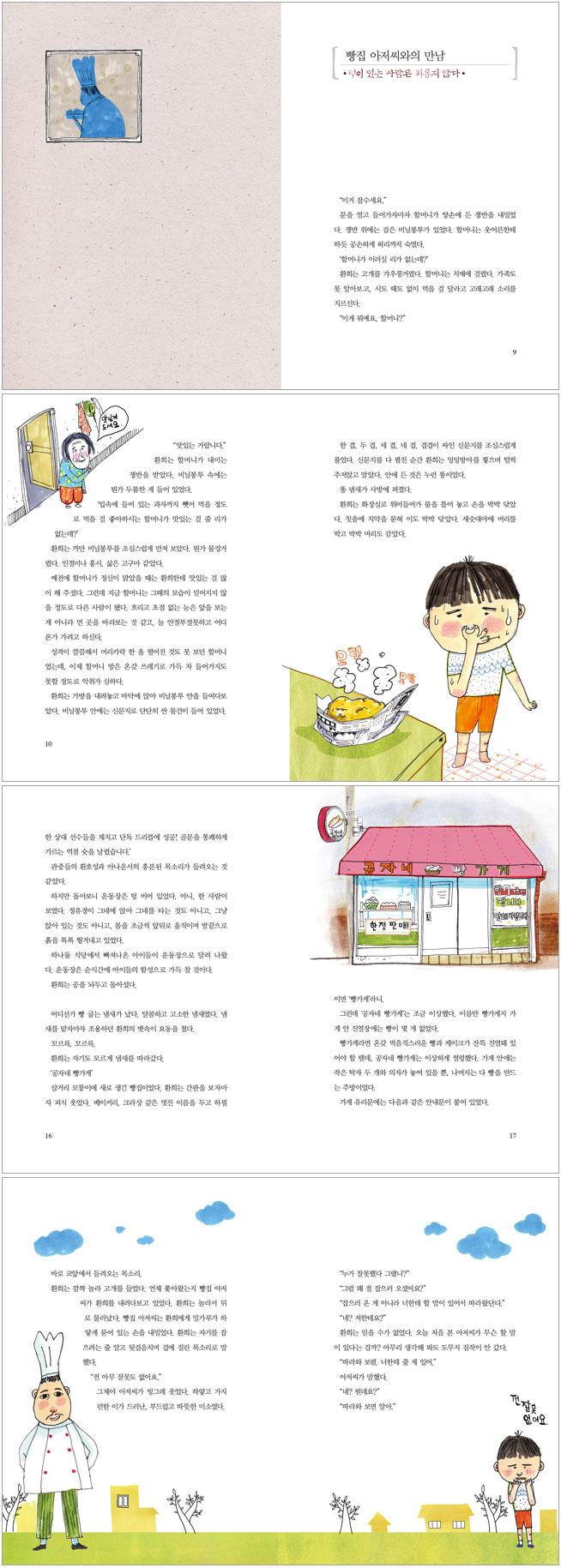
The smell of baking bread came from somewhere.
It smelled sweet and savory.
As soon as I smelled it, my stomach churned with joy.
It was a newly opened bakery at the corner of the intersection called ‘Gongja’s Bakery.’
Hwanhee chuckled as soon as he saw the sign.
There are many cool names like bakery and croissant, but why ‘bakery’?
--- pp.16-17
“You don’t need bread anymore.
You won't be hungry anymore even if you don't eat the bread I baked.
I'm off to find another 'joy' somewhere else.
“I plan to open a bakery there and share freshly baked, delicious bread with my hungry and weary friends.” --- p.141
“Scientific civilization has advanced beyond imagination over the past 2,500 years, but people’s thinking seems to be the same now as it was then.
Whenever his disciples asked him how they should live, Confucius gave a clear answer, as if he were a problem solver.
The answer applies equally to those of that era as well as to us living in the present day.”
It smelled sweet and savory.
As soon as I smelled it, my stomach churned with joy.
It was a newly opened bakery at the corner of the intersection called ‘Gongja’s Bakery.’
Hwanhee chuckled as soon as he saw the sign.
There are many cool names like bakery and croissant, but why ‘bakery’?
--- pp.16-17
“You don’t need bread anymore.
You won't be hungry anymore even if you don't eat the bread I baked.
I'm off to find another 'joy' somewhere else.
“I plan to open a bakery there and share freshly baked, delicious bread with my hungry and weary friends.” --- p.141
“Scientific civilization has advanced beyond imagination over the past 2,500 years, but people’s thinking seems to be the same now as it was then.
Whenever his disciples asked him how they should live, Confucius gave a clear answer, as if he were a problem solver.
The answer applies equally to those of that era as well as to us living in the present day.”
--- From the author's note
Publisher's Review
-Humanities, now in crisis, are gaining attention again. Why?
If the humanities are the study of how people live like human beings, then the humanities are the most necessary discipline for children whose personalities are just beginning to form.
These days, interest in humanities is growing in the field of children, to the point that the term “children’s humanities” is commonly used.
Bullying and school violence, issues we often see in the news, are no longer limited to teenagers.
The age of school violence among elementary school students has been decreasing, with the number of school violence cases quadrupling in the past five years.
These problems also arise because children lack the ability to empathize with the pain of others and the moral capacity to reflect on their own actions.
If you receive a proper humanities education from childhood, you will not cause pain or harm to others.
The foundation of humanities lies in developing a heart that understands and cares for others, that is, a ‘good character.’
It is important to foster the power of thinking based on the humanities to help children make their own judgments and effectively resolve the numerous problems they will face in life.
The best humanities mentor for children, "The First Humanities Fairy Tale That Lays the Foundation for Character"
Most children's humanities books currently published deal with the humanities themselves, and for the sake of easy access at a level suitable for children, they simply introduce famous anecdotes about adults.
In contrast, the series “First Humanities Fairy Tales that Lay the Foundation of Character” features great people reincarnated as bakery owners, animal hospital directors, and stationery store owners in creative fairy tales, listening to children’s concerns and teaching them how to live righteously.
The virtues of life advocated by each character are naturally incorporated into the fairy tale, and these virtues are once again emphasized through the chapter titles and colored fonts within the text.
It is a structure that allows you to gradually build up humanistic virtues just by reading fairy tales in an enjoyable way.
In addition, the knowledge that is lacking in fairy tales alone is supplemented with appendices containing the lives and thoughts of adults.
Also, rather than covering the entire humanities in one book, each volume introduces a person, such as Confucius, Mother Teresa, Tolstoy, and Socrates, and conveys the lessons they teach, so it can also be read as an information book about that person.
Of course, through an easier approach with fairy tales.
For children, studying is learning, playing is learning, and meeting different people is also learning.
For children, for whom life itself is a learning experience, it is really important to have a mentor by their side.
〈The First Humanities Fairy Tale that Lays the Foundation of Character〉 will become the best mentor children want to have next to their parents.
If the humanities are the study of how people live like human beings, then the humanities are the most necessary discipline for children whose personalities are just beginning to form.
These days, interest in humanities is growing in the field of children, to the point that the term “children’s humanities” is commonly used.
Bullying and school violence, issues we often see in the news, are no longer limited to teenagers.
The age of school violence among elementary school students has been decreasing, with the number of school violence cases quadrupling in the past five years.
These problems also arise because children lack the ability to empathize with the pain of others and the moral capacity to reflect on their own actions.
If you receive a proper humanities education from childhood, you will not cause pain or harm to others.
The foundation of humanities lies in developing a heart that understands and cares for others, that is, a ‘good character.’
It is important to foster the power of thinking based on the humanities to help children make their own judgments and effectively resolve the numerous problems they will face in life.
The best humanities mentor for children, "The First Humanities Fairy Tale That Lays the Foundation for Character"
Most children's humanities books currently published deal with the humanities themselves, and for the sake of easy access at a level suitable for children, they simply introduce famous anecdotes about adults.
In contrast, the series “First Humanities Fairy Tales that Lay the Foundation of Character” features great people reincarnated as bakery owners, animal hospital directors, and stationery store owners in creative fairy tales, listening to children’s concerns and teaching them how to live righteously.
The virtues of life advocated by each character are naturally incorporated into the fairy tale, and these virtues are once again emphasized through the chapter titles and colored fonts within the text.
It is a structure that allows you to gradually build up humanistic virtues just by reading fairy tales in an enjoyable way.
In addition, the knowledge that is lacking in fairy tales alone is supplemented with appendices containing the lives and thoughts of adults.
Also, rather than covering the entire humanities in one book, each volume introduces a person, such as Confucius, Mother Teresa, Tolstoy, and Socrates, and conveys the lessons they teach, so it can also be read as an information book about that person.
Of course, through an easier approach with fairy tales.
For children, studying is learning, playing is learning, and meeting different people is also learning.
For children, for whom life itself is a learning experience, it is really important to have a mentor by their side.
〈The First Humanities Fairy Tale that Lays the Foundation of Character〉 will become the best mentor children want to have next to their parents.
GOODS SPECIFICS
- Date of issue: January 27, 2012
- Page count, weight, size: 160 pages | 357g | 168*234*20mm
- ISBN13: 9788934956082
- ISBN10: 8934956089
You may also like
카테고리
korean


korean

![GQ KOREA Mark (Monthly): December [2025]](http://librairie.coreenne.fr/cdn/shop/files/8ef265dbbfbf186523ed75ba7319009d.jpg?v=1765340328&width=3840)


