

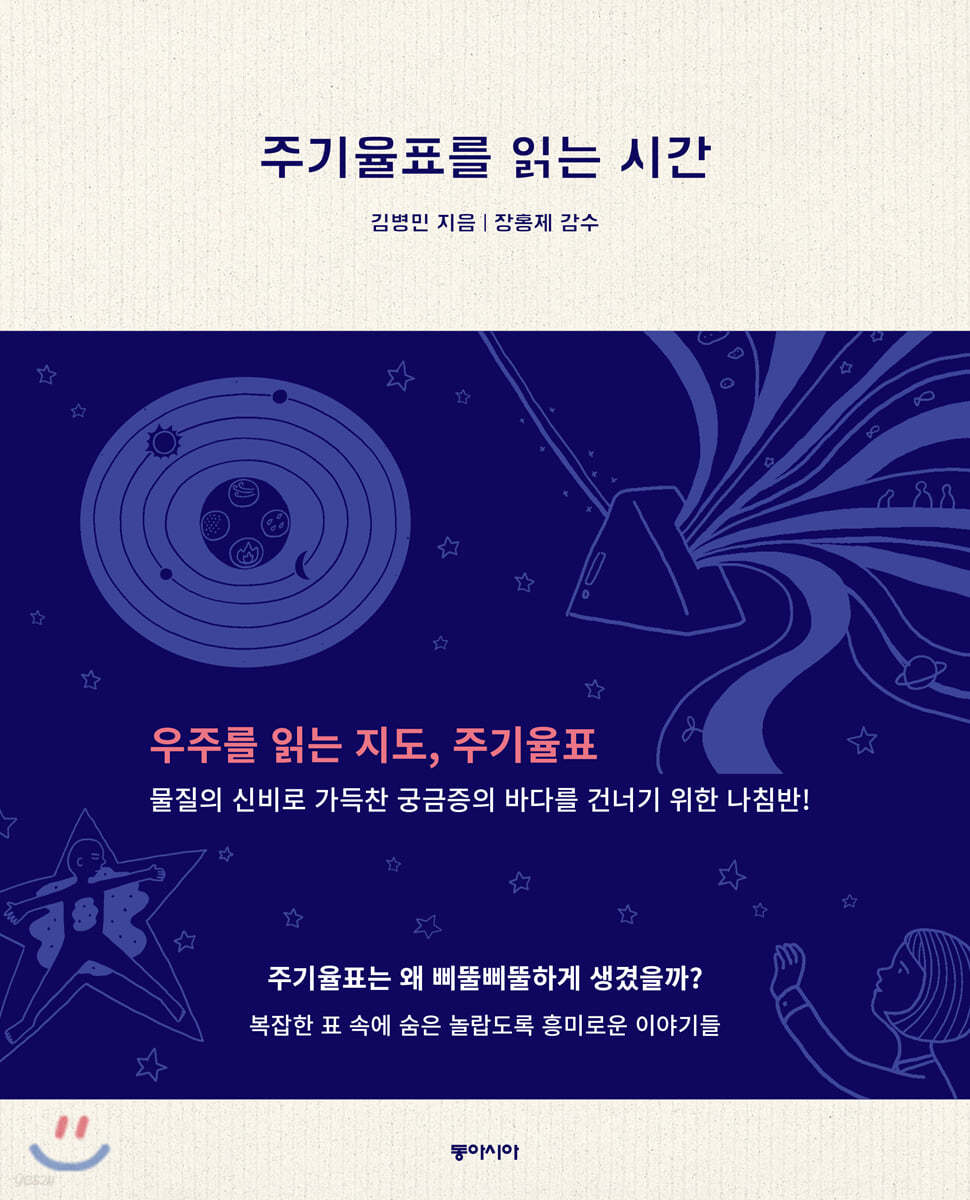
Time to read the periodic table
 |
Description
Book Introduction
Presented by Kim Byeong-min, author of 『Science Village』 A New Perspective on Reading the Periodic Table Suhelibebun carbonate fluorine alkaloid sulfur salt alkaloid. This method of memorizing only the first letters of the periodic table from 1 to 20 has not changed in the past several decades. It would be impossible to find the charm of chemistry in this environment. The periodic table is a map that guides us to understand this complex world and universe. It is not something that was given to us for free, but is the culmination of human effort accumulated over hundreds of years. Each square on the periodic table contains the diverse stories of countless people. "Time to Read the Periodic Table" fully reflects the author's desire to convey to people the beauty of the principles that make up the periodic table and the countless trials and errors and efforts that went into creating it. Part 1, "Time to Read the Periodic Table," provides time to slowly "read" the subject called the "periodic table" together with the reader. The author's story, which begins with the object of admiration called the star and moves on to the secrets of matter and the relationship between elements that the star reveals, slowly traces the process of discovering the concepts of atoms and elements and gradually creating the periodic table. Part 2, "Dictionary of Mysterious Elements," introduces the general characteristics of each of the 118 elements, as well as various historical episodes or uses related to each element. With these intuitive and eye-catching images, it's easy to understand that the elements that make up the periodic table exist not only in laboratories or textbooks, but are scattered all around us. |
- You can preview some of the book's contents.
Preview
index
004 Entering
Part 1: Reading the Periodic Table
Chapter 1: The Periodic Table of the Universe
010 The world is made of atoms
014 Everything Comes from the Stars
018 The Origin of the Elements, the Big Bang, and the Birth of Stars
023 What did matter mean to humanity?
028 The Science of Desire, Alchemy
034 The Birth of the Periodic Table
040 Why Mendeleev became the 'Father of the Periodic Table'
047 Beginning to Understand the Identity of the Atom
057 Chemistry that resembles human desire
Chapter 2: Architectural Aesthetics of the Periodic Table
064 Why atoms are distinguished as elements
076 The rules of electron configuration that come to mind whenever I see an onion
085 Periodic Table Mechanism of Electronic Configuration
093 The properties of an element are determined by the remaining electrons.
098 Why are there fewer elements at the top of the periodic table?
Why is the atomic weight of 103 so ambiguous?
110 Periodic Table Across and Down
Chapter 3: The Residents of the Periodic Table Mansion
116 Reactive alkali metals
120 Halogen elements that make salt
124 Noble Nobility, Inert Gas
129 Links in the periodic table, transition metals
136 Metalloids and Nonmetals
142 Lanthanides and Rare Earth Elements
149 Actinide and Transuranium Elements
154 Alkaline Earth Metals and Ionization Tendencies
Chapter 4: The Properties of Elements and the Future of the Periodic Table
162 The physical properties of elements also have periodicity.
169 Why do atoms hate being alone?
174 Chemical Bonding I
178 Chemical Bonding II
184 Are all metals hard?
189 Metals are shiny and stretchy
Conducts electricity and heat well
197 The periodic table is not one.
207 Coming from a star and returning to a star again
213 elements, is that the end of 118?
220 Recommended Articles
Part 2: Dictionary of Mysterious Elements
Part 1: Reading the Periodic Table
Chapter 1: The Periodic Table of the Universe
010 The world is made of atoms
014 Everything Comes from the Stars
018 The Origin of the Elements, the Big Bang, and the Birth of Stars
023 What did matter mean to humanity?
028 The Science of Desire, Alchemy
034 The Birth of the Periodic Table
040 Why Mendeleev became the 'Father of the Periodic Table'
047 Beginning to Understand the Identity of the Atom
057 Chemistry that resembles human desire
Chapter 2: Architectural Aesthetics of the Periodic Table
064 Why atoms are distinguished as elements
076 The rules of electron configuration that come to mind whenever I see an onion
085 Periodic Table Mechanism of Electronic Configuration
093 The properties of an element are determined by the remaining electrons.
098 Why are there fewer elements at the top of the periodic table?
Why is the atomic weight of 103 so ambiguous?
110 Periodic Table Across and Down
Chapter 3: The Residents of the Periodic Table Mansion
116 Reactive alkali metals
120 Halogen elements that make salt
124 Noble Nobility, Inert Gas
129 Links in the periodic table, transition metals
136 Metalloids and Nonmetals
142 Lanthanides and Rare Earth Elements
149 Actinide and Transuranium Elements
154 Alkaline Earth Metals and Ionization Tendencies
Chapter 4: The Properties of Elements and the Future of the Periodic Table
162 The physical properties of elements also have periodicity.
169 Why do atoms hate being alone?
174 Chemical Bonding I
178 Chemical Bonding II
184 Are all metals hard?
189 Metals are shiny and stretchy
Conducts electricity and heat well
197 The periodic table is not one.
207 Coming from a star and returning to a star again
213 elements, is that the end of 118?
220 Recommended Articles
Part 2: Dictionary of Mysterious Elements
Detailed image
Into the book
The field of chemistry is indeed vast, but if we were to specify its geographical location, it would be somewhere between physics and biology or earth science.
Physics isn't really interested in anything other than particles.
Instead, it is revealing the identity and movement of the microscopic world.
And biology and earth science deal with complex ecosystems and help us understand how the world works.
Chemistry bridges the gap between the microscopic world and its mechanisms.
So it tells us how the world was created and why the world has to work the way it does.
At the center of it are 118 elements, and at the center of the world that these elements create is the electron.
So, the periodic table is a table that organizes information about the 118 materials and electrons that made up the world.
--- p.4 From “Introduction”
The elements created by the death of stars are scattered throughout the universe and gather together somewhere to form stars, or to create planets and life forms like Earth.
Even though we don't know these scientific facts, we look at the stars in the night sky and yearn for the world beyond.
Perhaps we have unconsciously known, as if we longed for our homeland, that we came from the stars.
Likewise, the future we will face in the future may also lie within the starlight.
--- p.22 From “The Origin of Elements, the Big Bang and the Birth of Stars”
The reason why I compare the periodic table to a building here is because the location of the elements on the periodic table ultimately tells us about the special characteristics and properties of the elements.
It is impossible to memorize all of these properties by atomic number.
The periodic table has elements arranged in a well-organized manner based on these properties.
That's why the geographic location of an element on the periodic table is important.
I think that if you apply it to architecture, the structure of the periodic table will come to mind easily and the periodic table will become more familiar.
In addition to metals, nonmetals, typical elements, and transition elements, the periodic table also contains several classification names that distinguish elements.
The name is determined by the properties of the element.
Since the names mainly change along the vertical lines, it is clear that it has to do with the outer electrons due to the electron configuration.
Because the properties of an atom are determined by the valence electrons that exist on the outside.
--- p.113 From "Periodic Table"
In fact, no one knows what significance the discovery of a new element will have for humanity.
We don't know what profound impact an element that exists only for a fleeting moment might have on the future of humanity, and such research could simply be driven by national competition or the curiosity of scientists.
But this has been humanity's journey so far.
Humanity has constantly explored the unknown to understand the nature of things, ultimately revealing our past and defining our present.
What we can be sure of is that new materials may be milestones that will lead us into a future we don't yet know about.
Physics isn't really interested in anything other than particles.
Instead, it is revealing the identity and movement of the microscopic world.
And biology and earth science deal with complex ecosystems and help us understand how the world works.
Chemistry bridges the gap between the microscopic world and its mechanisms.
So it tells us how the world was created and why the world has to work the way it does.
At the center of it are 118 elements, and at the center of the world that these elements create is the electron.
So, the periodic table is a table that organizes information about the 118 materials and electrons that made up the world.
--- p.4 From “Introduction”
The elements created by the death of stars are scattered throughout the universe and gather together somewhere to form stars, or to create planets and life forms like Earth.
Even though we don't know these scientific facts, we look at the stars in the night sky and yearn for the world beyond.
Perhaps we have unconsciously known, as if we longed for our homeland, that we came from the stars.
Likewise, the future we will face in the future may also lie within the starlight.
--- p.22 From “The Origin of Elements, the Big Bang and the Birth of Stars”
The reason why I compare the periodic table to a building here is because the location of the elements on the periodic table ultimately tells us about the special characteristics and properties of the elements.
It is impossible to memorize all of these properties by atomic number.
The periodic table has elements arranged in a well-organized manner based on these properties.
That's why the geographic location of an element on the periodic table is important.
I think that if you apply it to architecture, the structure of the periodic table will come to mind easily and the periodic table will become more familiar.
In addition to metals, nonmetals, typical elements, and transition elements, the periodic table also contains several classification names that distinguish elements.
The name is determined by the properties of the element.
Since the names mainly change along the vertical lines, it is clear that it has to do with the outer electrons due to the electron configuration.
Because the properties of an atom are determined by the valence electrons that exist on the outside.
--- p.113 From "Periodic Table"
In fact, no one knows what significance the discovery of a new element will have for humanity.
We don't know what profound impact an element that exists only for a fleeting moment might have on the future of humanity, and such research could simply be driven by national competition or the curiosity of scientists.
But this has been humanity's journey so far.
Humanity has constantly explored the unknown to understand the nature of things, ultimately revealing our past and defining our present.
What we can be sure of is that new materials may be milestones that will lead us into a future we don't yet know about.
--- p.218~219 From "Is there only 118 elements?"
Publisher's Review
The periodic table, a map to reading the universe
Suhelibebun carbonate fluorine alkaloid sulfur salt alkaloid.
This method of memorizing only the first letters of the periodic table from 1 to 20 has not changed in the past several decades.
It would be impossible to find the charm of chemistry in this environment.
The author of this book, Kim Byeong-min, majored in chemical engineering and is fascinated by chemistry. He has always felt regretful that people do not know the beauty of the periodic table.
This is because when I first encountered the periodic table, I did not approach it in the right way.
In a curriculum where there is a lot to study but time is limited, you have no choice but to prioritize memorization in order to study the periodic table and chemistry.
As a science writer who has spent many years trying to convey the usefulness and beauty of chemistry to people, this is a truly deplorable situation.
In fact, chemistry is a fascinating discipline that contains the composition of all substances in the world and the secrets of the universe.
The periodic table is a map that guides us to understand this complex world and universe.
It is not something that was given to us for free, but is the culmination of human effort accumulated over hundreds of years.
Each square on the periodic table contains the diverse stories of countless people.
By telling that story, this book fully reflects the author's desire to convey to people the beauty of the principles that make up the periodic table and the countless trials and errors and efforts that went into creating it.
The author infinitely affirms the 'different perspective' on things and the 'act of asking questions with curiosity' itself.
The very composition of this book is the result of his free thinking and unique perspective.
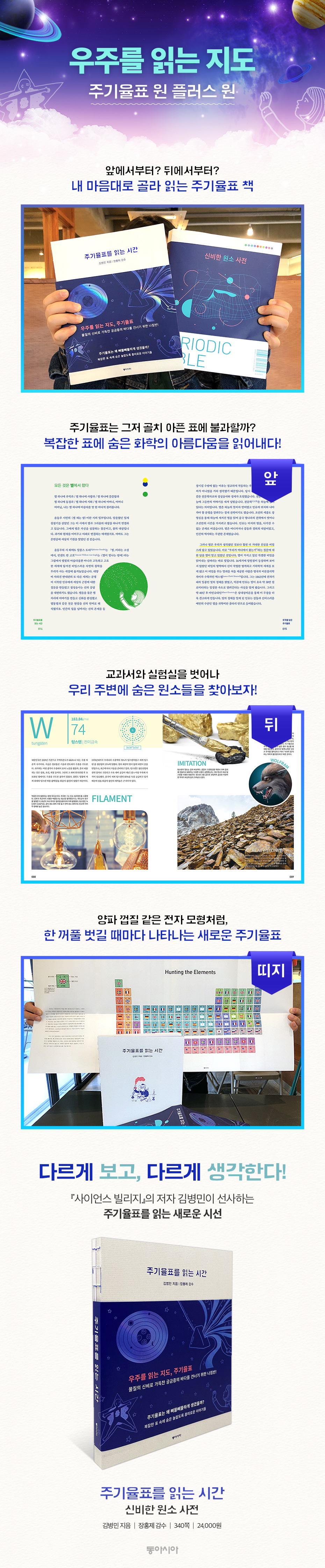
You don't necessarily have to read a book from front to back.
This book, which is like two books glued together, can be read from either the front or the back without any problem.
In Part 1, "Time to Read the Periodic Table," we provide time to slowly "read" the subject called the "periodic table" together with the reader.
The author's story, which begins with the object of admiration called the star and moves on to the secrets of matter and the relationship between elements that the star reveals, slowly traces the process of discovering the concepts of atoms and elements and gradually creating the periodic table.
Part 2, "Encyclopedia of Mysterious Elements," introduces the general characteristics of each of the 118 elements, as well as various historical episodes or uses related to each element.
With these intuitive and eye-catching images, it's easy to understand that the elements that make up the periodic table exist not only in laboratories or textbooks, but are scattered all around us.
Why is the periodic table so strangely shaped?
Architectural Engineering of the Periodic Table
If you look at the standard periodic table in use today without knowing much about the periodic table, you might wonder what it is.
The 118 squares are not arranged in a square shape, but rather stick out here and there, and there are even parts where teeth are missing in the middle and stick out.
If you try to memorize this arrangement blindly, you will naturally get goosebumps.
Even though it is called the standard periodic table, the content it contains varies greatly, from the simplest periodic table that only lists atomic numbers and element symbols to tables that contain various information about each element, including atomic weight.
But you don't need to memorize all this complex information.
What we need is not to memorize the periodic table and the elements, but to understand the architectural engineering that created the magnificent structure that is the periodic table.
What do the rows and columns of the periodic table each hold? Why are the two rows at the bottom of the table so far apart? Why is the number of elements constantly increasing, rather than fixed? The author helpfully answers various questions that arise when looking at the periodic table.
This leisurely, unfamiliar attempt to understand the periodic table is actually not entirely new or unusual.
It is simply a natural process of following in the footsteps of the senior scientists who created the periodic table.
However, in a reality where this obvious thing is not achieved naturally, this attempt will provide a new perspective on reading the periodic table.
Another face of the periodic table
Is the standard periodic table we commonly know the entire periodic table? Absolutely not.
The author consistently emphasizes a free perspective that is not bound by conventions throughout the book.
The same goes for the periodic table.
The International Union of Pure and Applied Chemistry (IUPAC) and the Korean Chemical Society have established the periodic table, which is based on Mendeleev's periodic table, as the standard.
However, this ‘standard’ is not unchanging either.
This is because the periodic table, which originally started with about 60 elements, has continued to change and evolve.
This is the result of the curiosity and effort of people surrounding the elements.
This effort bore fruit in a variety of ways, and we can find results everywhere, beyond the standard periodic table, of people organizing the elements and trying to understand the world in their own unique ways.
There are various types of periodic tables, such as one that reflects the composition of elements in the earth's crust, one that does not separate group 1 and group 18 elements but rather arranges them so that they meet in a circle like a globe.
The author is a periodic table nerd who loves the principles of the periodic table and the beauty it embodies.
Of course, we cannot help but love the unique charms of periodic tables other than the standard periodic table.
This book also introduces several alternative periodic tables.
In chemistry, too, it is important not to be caught up in stereotypes.
The various aspects of the periodic table he introduces expand the horizons of those who look at chemistry.
In particular, the colorful and diverse periodic table that appears when you open the book's cover has a charm that immediately captures the hearts of not only chemistry students but also those who are not familiar with chemistry.
People who follow the elements
We will find the answer
Humans have been using various materials since before the Common Era.
However, only a handful of substances in their pure elemental state were available, and their true nature was not well known.
The existence of 'hydrogen' was discovered in 1766, and it was not until the 18th century that the existence of elements and substances began to be explored in earnest.
That passion gradually gained momentum, and most of the 118 elements were discovered or created within nearly 400 years.
Temple novels, the theory of the five elements, ether, phlogiston.
Although there were countless misunderstandings and errors that hindered our understanding of matter, humanity is gradually coming to understand matter through these dark ages.
More today than yesterday, and even more deeply tomorrow than today.
The current standard periodic table, which has artificially created elements to fill positions up to 118, clearly demonstrates this fact.
Behind the scenes, countless people, in addition to those who have made their mark as the first discoverers of each element, have made efforts, and those who have inherited their legacy are still working tirelessly day and night to hunt for the 119th element.
Human civilization made a breakthrough when it came to understand the elements.
Chemistry supports our lives everywhere, from the microscopic world to the macroscopic world, including various chemical products and pharmaceuticals around us.
Of course, advances in chemistry have not only brought benefits.
As if to rebuke humanity's arrogance, side effects are also appearing.
However, this too can be overcome through a proper understanding and approach to chemistry.
As the famous quote from the movie Interstellar says, we will find the answer.
As always.
Stars, humans, and elements
Where did humanity's fascination with space and the stars begin? In "Counting Stars at Night," the genius Korean poet Yun Dong-ju sang of the delicate emotions of contemplating the longing felt while counting the stars in the night sky. Dutch Impressionist painter Vincent van Gogh, in his masterpiece "The Starry Night," depicted the brilliant stars that adorned the night sky.
They are not the only ones who have used stars as a subject in their artistic activities.
Going back further, since the ancient Greek times, stars have served as a metaphor or a point of orientation for natural objects and human history.
In a time when space exploration had no practical benefit, would it have been possible to launch rockets and send humans into space, writing hundreds of thousands of calculations by hand, without a yearning for space and the stars? It must have been an expression of a yearning bordering on longing.
Kim Byung-min, author of "Time to Read the Periodic Table," majored in science and currently works with scientists, but unlike others, he starts off with a somewhat sentimental story.
The story is that, at the root of human longing for the stars, there may be a desire and curiosity to explore one's own existence, as well as an unconscious conviction that the secrets of the universe will lead to the answer.
An interesting fact is that in the past, in Eastern thought, centered around China, the human body was described as a microcosm, and was regarded as a world that contained the laws of nature.
This idea cannot be accepted as is because it leads to somewhat magical concepts such as qi (氣) and the five elements of yin and yang (陰陽五行), but it still holds some interesting points even when interpreted from a modern perspective.
From the perspective of modern chemistry, there is no difference between the elements that make up the universe and the elements that make up the human body.
In fact, it is not a level that is no different, but the same element itself.
According to the Big Bang theory (which is currently the most credible hypothesis about the beginning of the universe), after the Big Bang, stars were created, and heavier elements were created. These elements cycled and eventually created the Earth and life.
That's right, humans.
The material from which humans were created is exactly the same as the material from which the universe was created.
In a sense, understanding the universe means understanding the elements, and this is ultimately the process of understanding humanity.
Over the course of half a millennium of Chinese history, Eastern philosophy meets modern chemistry.
Suhelibebun carbonate fluorine alkaloid sulfur salt alkaloid.
This method of memorizing only the first letters of the periodic table from 1 to 20 has not changed in the past several decades.
It would be impossible to find the charm of chemistry in this environment.
The author of this book, Kim Byeong-min, majored in chemical engineering and is fascinated by chemistry. He has always felt regretful that people do not know the beauty of the periodic table.
This is because when I first encountered the periodic table, I did not approach it in the right way.
In a curriculum where there is a lot to study but time is limited, you have no choice but to prioritize memorization in order to study the periodic table and chemistry.
As a science writer who has spent many years trying to convey the usefulness and beauty of chemistry to people, this is a truly deplorable situation.
In fact, chemistry is a fascinating discipline that contains the composition of all substances in the world and the secrets of the universe.
The periodic table is a map that guides us to understand this complex world and universe.
It is not something that was given to us for free, but is the culmination of human effort accumulated over hundreds of years.
Each square on the periodic table contains the diverse stories of countless people.
By telling that story, this book fully reflects the author's desire to convey to people the beauty of the principles that make up the periodic table and the countless trials and errors and efforts that went into creating it.
The author infinitely affirms the 'different perspective' on things and the 'act of asking questions with curiosity' itself.
The very composition of this book is the result of his free thinking and unique perspective.
You don't necessarily have to read a book from front to back.
This book, which is like two books glued together, can be read from either the front or the back without any problem.
In Part 1, "Time to Read the Periodic Table," we provide time to slowly "read" the subject called the "periodic table" together with the reader.
The author's story, which begins with the object of admiration called the star and moves on to the secrets of matter and the relationship between elements that the star reveals, slowly traces the process of discovering the concepts of atoms and elements and gradually creating the periodic table.
Part 2, "Encyclopedia of Mysterious Elements," introduces the general characteristics of each of the 118 elements, as well as various historical episodes or uses related to each element.
With these intuitive and eye-catching images, it's easy to understand that the elements that make up the periodic table exist not only in laboratories or textbooks, but are scattered all around us.
Why is the periodic table so strangely shaped?
Architectural Engineering of the Periodic Table
If you look at the standard periodic table in use today without knowing much about the periodic table, you might wonder what it is.
The 118 squares are not arranged in a square shape, but rather stick out here and there, and there are even parts where teeth are missing in the middle and stick out.
If you try to memorize this arrangement blindly, you will naturally get goosebumps.
Even though it is called the standard periodic table, the content it contains varies greatly, from the simplest periodic table that only lists atomic numbers and element symbols to tables that contain various information about each element, including atomic weight.
But you don't need to memorize all this complex information.
What we need is not to memorize the periodic table and the elements, but to understand the architectural engineering that created the magnificent structure that is the periodic table.
What do the rows and columns of the periodic table each hold? Why are the two rows at the bottom of the table so far apart? Why is the number of elements constantly increasing, rather than fixed? The author helpfully answers various questions that arise when looking at the periodic table.
This leisurely, unfamiliar attempt to understand the periodic table is actually not entirely new or unusual.
It is simply a natural process of following in the footsteps of the senior scientists who created the periodic table.
However, in a reality where this obvious thing is not achieved naturally, this attempt will provide a new perspective on reading the periodic table.
Another face of the periodic table
Is the standard periodic table we commonly know the entire periodic table? Absolutely not.
The author consistently emphasizes a free perspective that is not bound by conventions throughout the book.
The same goes for the periodic table.
The International Union of Pure and Applied Chemistry (IUPAC) and the Korean Chemical Society have established the periodic table, which is based on Mendeleev's periodic table, as the standard.
However, this ‘standard’ is not unchanging either.
This is because the periodic table, which originally started with about 60 elements, has continued to change and evolve.
This is the result of the curiosity and effort of people surrounding the elements.
This effort bore fruit in a variety of ways, and we can find results everywhere, beyond the standard periodic table, of people organizing the elements and trying to understand the world in their own unique ways.
There are various types of periodic tables, such as one that reflects the composition of elements in the earth's crust, one that does not separate group 1 and group 18 elements but rather arranges them so that they meet in a circle like a globe.
The author is a periodic table nerd who loves the principles of the periodic table and the beauty it embodies.
Of course, we cannot help but love the unique charms of periodic tables other than the standard periodic table.
This book also introduces several alternative periodic tables.
In chemistry, too, it is important not to be caught up in stereotypes.
The various aspects of the periodic table he introduces expand the horizons of those who look at chemistry.
In particular, the colorful and diverse periodic table that appears when you open the book's cover has a charm that immediately captures the hearts of not only chemistry students but also those who are not familiar with chemistry.
People who follow the elements
We will find the answer
Humans have been using various materials since before the Common Era.
However, only a handful of substances in their pure elemental state were available, and their true nature was not well known.
The existence of 'hydrogen' was discovered in 1766, and it was not until the 18th century that the existence of elements and substances began to be explored in earnest.
That passion gradually gained momentum, and most of the 118 elements were discovered or created within nearly 400 years.
Temple novels, the theory of the five elements, ether, phlogiston.
Although there were countless misunderstandings and errors that hindered our understanding of matter, humanity is gradually coming to understand matter through these dark ages.
More today than yesterday, and even more deeply tomorrow than today.
The current standard periodic table, which has artificially created elements to fill positions up to 118, clearly demonstrates this fact.
Behind the scenes, countless people, in addition to those who have made their mark as the first discoverers of each element, have made efforts, and those who have inherited their legacy are still working tirelessly day and night to hunt for the 119th element.
Human civilization made a breakthrough when it came to understand the elements.
Chemistry supports our lives everywhere, from the microscopic world to the macroscopic world, including various chemical products and pharmaceuticals around us.
Of course, advances in chemistry have not only brought benefits.
As if to rebuke humanity's arrogance, side effects are also appearing.
However, this too can be overcome through a proper understanding and approach to chemistry.
As the famous quote from the movie Interstellar says, we will find the answer.
As always.
Stars, humans, and elements
Where did humanity's fascination with space and the stars begin? In "Counting Stars at Night," the genius Korean poet Yun Dong-ju sang of the delicate emotions of contemplating the longing felt while counting the stars in the night sky. Dutch Impressionist painter Vincent van Gogh, in his masterpiece "The Starry Night," depicted the brilliant stars that adorned the night sky.
They are not the only ones who have used stars as a subject in their artistic activities.
Going back further, since the ancient Greek times, stars have served as a metaphor or a point of orientation for natural objects and human history.
In a time when space exploration had no practical benefit, would it have been possible to launch rockets and send humans into space, writing hundreds of thousands of calculations by hand, without a yearning for space and the stars? It must have been an expression of a yearning bordering on longing.
Kim Byung-min, author of "Time to Read the Periodic Table," majored in science and currently works with scientists, but unlike others, he starts off with a somewhat sentimental story.
The story is that, at the root of human longing for the stars, there may be a desire and curiosity to explore one's own existence, as well as an unconscious conviction that the secrets of the universe will lead to the answer.
An interesting fact is that in the past, in Eastern thought, centered around China, the human body was described as a microcosm, and was regarded as a world that contained the laws of nature.
This idea cannot be accepted as is because it leads to somewhat magical concepts such as qi (氣) and the five elements of yin and yang (陰陽五行), but it still holds some interesting points even when interpreted from a modern perspective.
From the perspective of modern chemistry, there is no difference between the elements that make up the universe and the elements that make up the human body.
In fact, it is not a level that is no different, but the same element itself.
According to the Big Bang theory (which is currently the most credible hypothesis about the beginning of the universe), after the Big Bang, stars were created, and heavier elements were created. These elements cycled and eventually created the Earth and life.
That's right, humans.
The material from which humans were created is exactly the same as the material from which the universe was created.
In a sense, understanding the universe means understanding the elements, and this is ultimately the process of understanding humanity.
Over the course of half a millennium of Chinese history, Eastern philosophy meets modern chemistry.
GOODS SPECIFICS
- Date of issue: April 30, 2020
- Format: Guide to book binding methods for four-sided binding
- Page count, weight, size: 340 pages | 742g | 190*235*21mm
- ISBN13: 9788962623321
- ISBN10: 8962623323
You may also like
카테고리
korean


korean

![GQ KOREA Mark (Monthly): December [2025]](http://librairie.coreenne.fr/cdn/shop/files/8ef265dbbfbf186523ed75ba7319009d.jpg?v=1765340328&width=3840)


