

Nature's Counterattack, Infectious Diseases
 |
Description
Book Introduction
The plague that devastated medieval Europe,
The Spanish flu killed more people than World War II.
The pandemic COVID-19 that has thrown the world into chaos
What we need to know about infectious diseases
The year 2020, when COVID-19 swept the globe, is likely to be remembered as a pivotal turning point in human history.
There are even those who say that future history will be divided into BC (Before Corona) and AC (After Corona). The shockwaves brought about by the invisible virus have shaken countries around the world, and we all feel the power of infectious diseases every day.
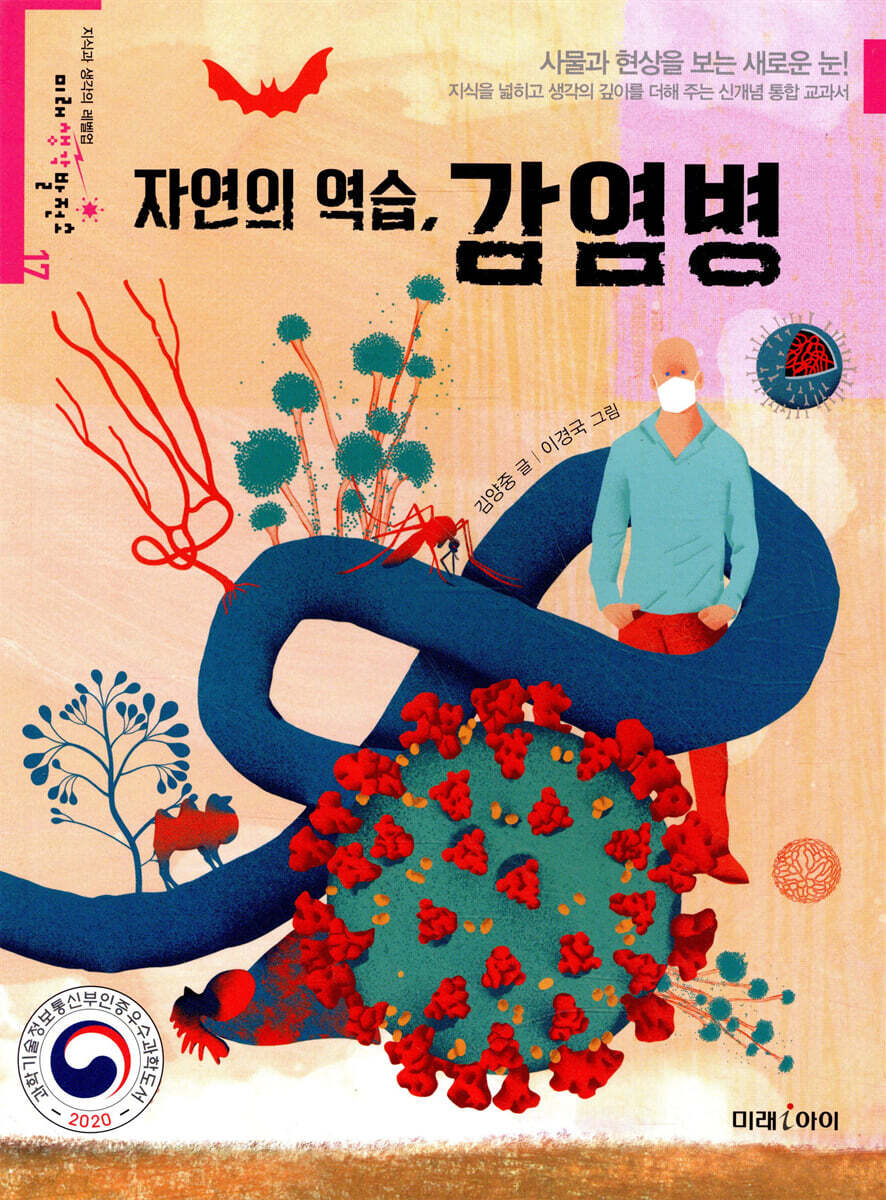
The 17th volume of the Future Thinking Power Plant series, "Nature's Revenge, Infectious Diseases," is a book that provides children with easy-to-understand information about infectious diseases that have accompanied human history, including COVID-19, the disease we are currently experiencing, as well as the plague, leprosy, and influenza.
The Spanish flu killed more people than World War II.
The pandemic COVID-19 that has thrown the world into chaos
What we need to know about infectious diseases
The year 2020, when COVID-19 swept the globe, is likely to be remembered as a pivotal turning point in human history.
There are even those who say that future history will be divided into BC (Before Corona) and AC (After Corona). The shockwaves brought about by the invisible virus have shaken countries around the world, and we all feel the power of infectious diseases every day.
The 17th volume of the Future Thinking Power Plant series, "Nature's Revenge, Infectious Diseases," is a book that provides children with easy-to-understand information about infectious diseases that have accompanied human history, including COVID-19, the disease we are currently experiencing, as well as the plague, leprosy, and influenza.
- You can preview some of the book's contents.
Preview
index
Chapter 1 Infectious Diseases and Humans
-What is an infectious disease?
-When did infectious diseases first appear?
-Punishment from God
-Witches persecuted for infectious diseases
[Thought Power Plant] Infectious Diseases Instead of Contagious Diseases
Chapter 2: Infectious Diseases Shake the World
-Jesus and leprosy
-God's curse, the plague
-Smallpox, which destroyed the Aztec and Inca empires
-The typhus epidemic that frustrated Napoleon
-The greatest disaster of all time, the Spanish flu
Tuberculosis, Called "Writers' Occupational Disease"
Chapter 3: Advances in medicine reveal the causes of infectious diseases.
-The invention of the microscope, which made us aware of the existence of microorganisms
Bacteria that live in our bodies
Viruses smaller than bacteria
[Thought Power Plant] The Difference Between Bacteria and Viruses
A fungus that likes dark, damp places
Why do parasites get cursed?
-Jenner and the smallpox vaccine, the beginning of vaccination
-Water supply and norovirus
[Thought Power Plant] Penicillin, the World's First Antibiotic
Chapter 4 Modern Diseases That Changed Our Daily Lives
-Human immunodeficiency virus (HIV) and AIDS
Ebola, a still terrifying and lethal virus
-People confined to Hong Kong hospitals due to SARS
Avian influenza, an infectious disease transmitted by chickens
-New flu outbreak
-Camel flu, MERS
Zika virus and microcephaly in babies
-COVID-19, declared a pandemic by the World Health Organization
- Are there viruses that cause cancer?
-Biological weapons and germs
[Thought Power Plant] Treating cancer with viruses?
Chapter 5: Infectious Diseases in Film
-Is there a pathogen that controls people like in "Love Poem"?
- Could a virus that spreads as quickly as the zombies in "Train to Busan" exist?
-Who will be the winner of the "War of the Worlds"?
"The Flu," a film that shows what quarantine is all about.
"World War Z," which showed how bacteria and viruses survive.
People who exploit bacteria and viruses, "Inferno" and "Rampant"
The Birth of "Monster" and "Contagion"
[Thought Power Plant] What if you didn't get sick or die as you got older?
Chapter 6: Infectious Diseases and the Future of Humanity
Antibiotics become useless? Antibiotic resistance.
-Will infectious diseases disappear in the future?
-Bacteria that live with us
The first step in preventing infectious diseases is washing your hands.
Hepatitis A, an infectious disease that is actually harmful in a clean environment
Environmental destruction leads to new infectious diseases.
[Thought Power Plant] Could genetic engineering be the future cure for disease?
-What is an infectious disease?
-When did infectious diseases first appear?
-Punishment from God
-Witches persecuted for infectious diseases
[Thought Power Plant] Infectious Diseases Instead of Contagious Diseases
Chapter 2: Infectious Diseases Shake the World
-Jesus and leprosy
-God's curse, the plague
-Smallpox, which destroyed the Aztec and Inca empires
-The typhus epidemic that frustrated Napoleon
-The greatest disaster of all time, the Spanish flu
Tuberculosis, Called "Writers' Occupational Disease"
Chapter 3: Advances in medicine reveal the causes of infectious diseases.
-The invention of the microscope, which made us aware of the existence of microorganisms
Bacteria that live in our bodies
Viruses smaller than bacteria
[Thought Power Plant] The Difference Between Bacteria and Viruses
A fungus that likes dark, damp places
Why do parasites get cursed?
-Jenner and the smallpox vaccine, the beginning of vaccination
-Water supply and norovirus
[Thought Power Plant] Penicillin, the World's First Antibiotic
Chapter 4 Modern Diseases That Changed Our Daily Lives
-Human immunodeficiency virus (HIV) and AIDS
Ebola, a still terrifying and lethal virus
-People confined to Hong Kong hospitals due to SARS
Avian influenza, an infectious disease transmitted by chickens
-New flu outbreak
-Camel flu, MERS
Zika virus and microcephaly in babies
-COVID-19, declared a pandemic by the World Health Organization
- Are there viruses that cause cancer?
-Biological weapons and germs
[Thought Power Plant] Treating cancer with viruses?
Chapter 5: Infectious Diseases in Film
-Is there a pathogen that controls people like in "Love Poem"?
- Could a virus that spreads as quickly as the zombies in "Train to Busan" exist?
-Who will be the winner of the "War of the Worlds"?
"The Flu," a film that shows what quarantine is all about.
"World War Z," which showed how bacteria and viruses survive.
People who exploit bacteria and viruses, "Inferno" and "Rampant"
The Birth of "Monster" and "Contagion"
[Thought Power Plant] What if you didn't get sick or die as you got older?
Chapter 6: Infectious Diseases and the Future of Humanity
Antibiotics become useless? Antibiotic resistance.
-Will infectious diseases disappear in the future?
-Bacteria that live with us
The first step in preventing infectious diseases is washing your hands.
Hepatitis A, an infectious disease that is actually harmful in a clean environment
Environmental destruction leads to new infectious diseases.
[Thought Power Plant] Could genetic engineering be the future cure for disease?
Detailed image
Into the book
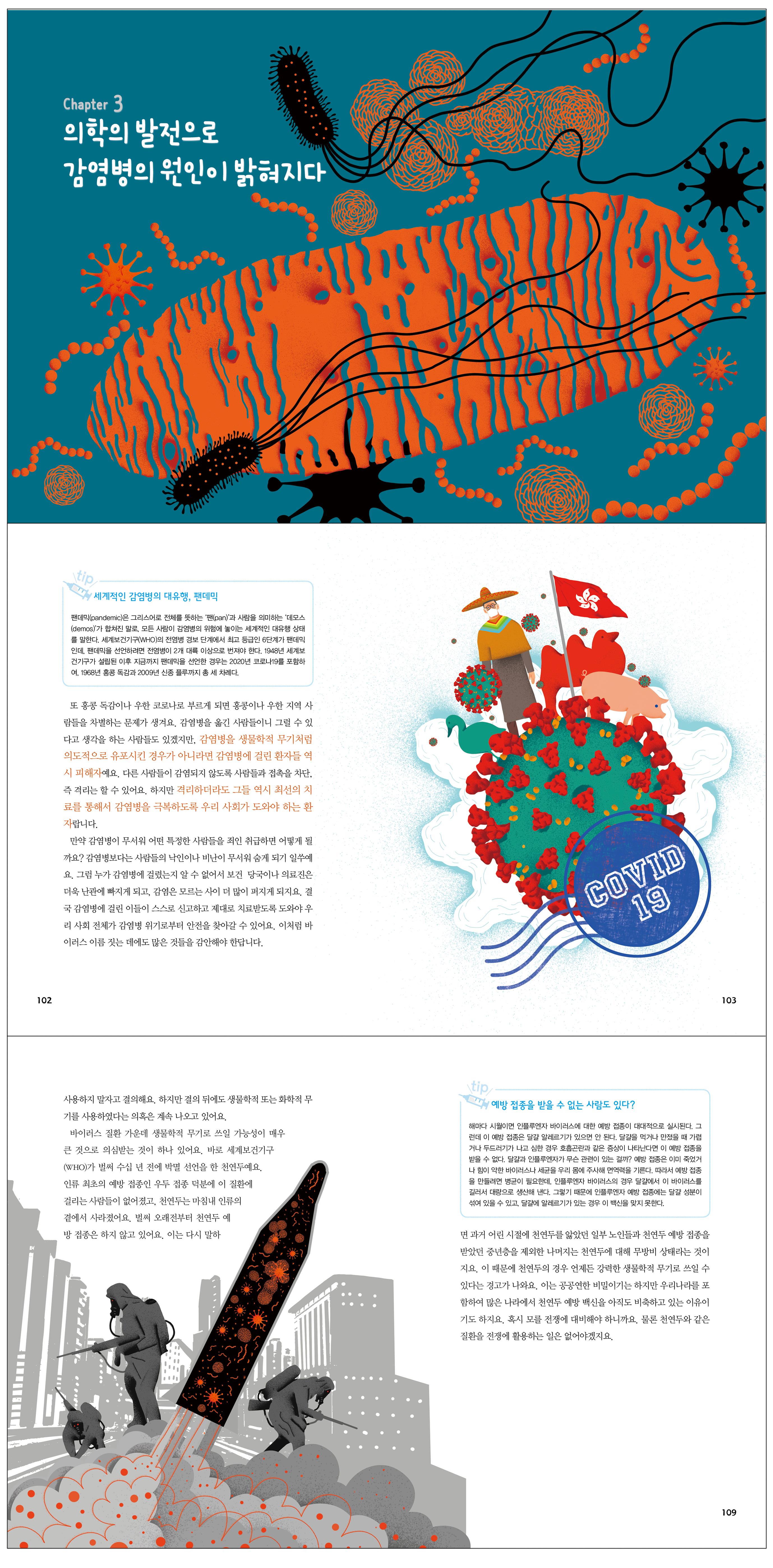
Also, calling it the Hong Kong flu or the Wuhan coronavirus creates the problem of hatred or discrimination against those who live in or have passed through Hong Kong or Wuhan.
Some people might think that it is natural for them to do so since they are the ones who spread the infectious disease, but unless the infectious disease was intentionally spread as a biological weapon, patients who contract the infectious disease are also victims.
You can isolate yourself, i.e., limit contact with people, to prevent them from becoming infected.
But even if they are isolated, they are also patients whom our society must help overcome the infectious disease through the best possible treatment.
What if we treat certain people as criminals out of fear of infectious diseases? People often hide out of fear of stigmatization and criticism, rather than the infectious disease itself.
This makes it even more difficult for health authorities and medical staff to know who has the disease, and the infection spreads further without anyone knowing.
Ultimately, only when we help those who contract infectious diseases report themselves and receive proper treatment can our entire society find safety from the infectious disease crisis.
As such, there are many things to consider when naming a virus.
--- p.
102
Among viral diseases, there is one that is highly suspected of having the potential to be used as a biological weapon.
It is smallpox, which the World Health Organization (WHO) declared eradicated decades ago.
Thanks to the cowpox vaccination, the first vaccination in human history, this disease was eliminated, and smallpox was finally eradicated from humankind.
We haven't been vaccinated against smallpox for a long time.
In other words, except for some elderly people who had smallpox in their childhood and middle-aged people who had been vaccinated against smallpox, the rest of the population is defenseless against smallpox.
This is why there are warnings that smallpox could be used as a powerful biological weapon at any time.
This is an open secret, but it is also the reason why many countries, including ours, still stockpile smallpox vaccines.
Because we have to prepare for an unexpected war.
Of course, diseases like smallpox should not be used in warfare.
--- pp.
108-109
When a place is untouched by human hands, it is often easy to think of it as undeveloped.
But this is only from the people's perspective.
The fact that some people call some countries in Africa or Southeast Asia uncivilized also comes from a perspective that does not recognize other societies and cultures.
However, this society, with its jungle-like nature and culture different from that of the West, already has order.
The untouched jungle means that countless animals, plants, and microorganisms such as bacteria and viruses are maintained in balance.
If a virus multiplies too much, many of the virus's hosts die, disrupting the balance.
Then, the virus and the host disappear together, and the place is filled by other animals and viruses, and this phenomenon continues to repeat itself.
But what if those trying to develop the jungle encounter these viruses and bacteria? Our immune systems aren't trained to defend against unfamiliar bacteria or viruses.
The principle of vaccination is to inject bacteria or viruses that are dead or have already died, so that our body's immune system learns how to fight them.
When we encounter a virus or bacteria we've never encountered before, our immune system becomes confused and has a hard time blocking their attacks.
Some people might think that it is natural for them to do so since they are the ones who spread the infectious disease, but unless the infectious disease was intentionally spread as a biological weapon, patients who contract the infectious disease are also victims.
You can isolate yourself, i.e., limit contact with people, to prevent them from becoming infected.
But even if they are isolated, they are also patients whom our society must help overcome the infectious disease through the best possible treatment.
What if we treat certain people as criminals out of fear of infectious diseases? People often hide out of fear of stigmatization and criticism, rather than the infectious disease itself.
This makes it even more difficult for health authorities and medical staff to know who has the disease, and the infection spreads further without anyone knowing.
Ultimately, only when we help those who contract infectious diseases report themselves and receive proper treatment can our entire society find safety from the infectious disease crisis.
As such, there are many things to consider when naming a virus.
--- p.
102
Among viral diseases, there is one that is highly suspected of having the potential to be used as a biological weapon.
It is smallpox, which the World Health Organization (WHO) declared eradicated decades ago.
Thanks to the cowpox vaccination, the first vaccination in human history, this disease was eliminated, and smallpox was finally eradicated from humankind.
We haven't been vaccinated against smallpox for a long time.
In other words, except for some elderly people who had smallpox in their childhood and middle-aged people who had been vaccinated against smallpox, the rest of the population is defenseless against smallpox.
This is why there are warnings that smallpox could be used as a powerful biological weapon at any time.
This is an open secret, but it is also the reason why many countries, including ours, still stockpile smallpox vaccines.
Because we have to prepare for an unexpected war.
Of course, diseases like smallpox should not be used in warfare.
--- pp.
108-109
When a place is untouched by human hands, it is often easy to think of it as undeveloped.
But this is only from the people's perspective.
The fact that some people call some countries in Africa or Southeast Asia uncivilized also comes from a perspective that does not recognize other societies and cultures.
However, this society, with its jungle-like nature and culture different from that of the West, already has order.
The untouched jungle means that countless animals, plants, and microorganisms such as bacteria and viruses are maintained in balance.
If a virus multiplies too much, many of the virus's hosts die, disrupting the balance.
Then, the virus and the host disappear together, and the place is filled by other animals and viruses, and this phenomenon continues to repeat itself.
But what if those trying to develop the jungle encounter these viruses and bacteria? Our immune systems aren't trained to defend against unfamiliar bacteria or viruses.
The principle of vaccination is to inject bacteria or viruses that are dead or have already died, so that our body's immune system learns how to fight them.
When we encounter a virus or bacteria we've never encountered before, our immune system becomes confused and has a hard time blocking their attacks.
--- pp.
153-156
153-156
Publisher's Review
Infectious disease refers to any disease that is transmitted through various routes.
An infectious disease is a disease that spreads when a specific pathogen is transferred from person to person or between people and animals through some medium such as air, physical contact, genetic material, water, blood transfusion, or food.
Microorganisms, such as bacteria, viruses, and fungi, which are the main causes of infectious diseases, existed on Earth before humans, and their population is so large that it cannot even be compared to that of humans.
Although they are invisible to the naked eye and only became known to mankind after the invention of the microscope, infectious diseases have actually been with us from the beginning.
In the past, when the cause was unknown, infectious diseases such as leprosy were believed to be divine punishment for human wrongdoing, and those who contracted infectious diseases were often condemned as sinners.
The plague that devastated medieval Europe spread further and claimed more victims as people gathered in churches to pray for forgiveness for their sins.
Later, people who did not believe in God appeared, and the plague brought an end to the church-centered Middle Ages and opened an era in which people realized the importance of medicine and science over religion.
The development of smallpox vaccination by the British physician Jenner in the late 18th century opened the way to preventing smallpox, and the discovery of penicillin, the first antibiotic, in the 20th century completely changed our perspective on infectious diseases.
With the advancement of science, infectious diseases are no longer considered a punishment from God, but now humanity is falling into a new delusion that the era of infectious diseases is over.
However, it is impossible to completely eliminate microorganisms such as bacteria and viruses with any antibiotic or antiviral drug developed to date.
Rather, advances in transportation have allowed infectious diseases to spread farther and faster, and to attack those without immunity.
The Spanish flu of 1918, which infected more than 50 million people, killed more people than World War I or World War II.
Even with the COVID-19 pandemic currently plaguing the world, we cannot completely eradicate the virus that causes it, and we cannot guarantee that another global pandemic like this will not occur.
So, what should we do to prevent infectious diseases? The author says coexistence with nature is the key.
This is because indiscriminate development of forests and destruction of the environment disrupts the balance of nature and may invite new pathogens, such as viruses, that we do not know about.
Ultimately, infectious diseases can only be prevented if humans find a way to coexist in balance with microorganisms such as bacteria and viruses.
He also says that only when patients with infectious diseases are properly treated and helped to overcome the disease, rather than discriminated against or blamed, can our entire society overcome the infectious disease crisis.
In today's world, where infectious diseases have completely changed our daily lives, no one is safe from them or exempt from them.
This book will serve as a new guide for children to correctly understand and follow infectious diseases, which are often vaguely feared.
An infectious disease is a disease that spreads when a specific pathogen is transferred from person to person or between people and animals through some medium such as air, physical contact, genetic material, water, blood transfusion, or food.
Microorganisms, such as bacteria, viruses, and fungi, which are the main causes of infectious diseases, existed on Earth before humans, and their population is so large that it cannot even be compared to that of humans.
Although they are invisible to the naked eye and only became known to mankind after the invention of the microscope, infectious diseases have actually been with us from the beginning.
In the past, when the cause was unknown, infectious diseases such as leprosy were believed to be divine punishment for human wrongdoing, and those who contracted infectious diseases were often condemned as sinners.
The plague that devastated medieval Europe spread further and claimed more victims as people gathered in churches to pray for forgiveness for their sins.
Later, people who did not believe in God appeared, and the plague brought an end to the church-centered Middle Ages and opened an era in which people realized the importance of medicine and science over religion.
The development of smallpox vaccination by the British physician Jenner in the late 18th century opened the way to preventing smallpox, and the discovery of penicillin, the first antibiotic, in the 20th century completely changed our perspective on infectious diseases.
With the advancement of science, infectious diseases are no longer considered a punishment from God, but now humanity is falling into a new delusion that the era of infectious diseases is over.
However, it is impossible to completely eliminate microorganisms such as bacteria and viruses with any antibiotic or antiviral drug developed to date.
Rather, advances in transportation have allowed infectious diseases to spread farther and faster, and to attack those without immunity.
The Spanish flu of 1918, which infected more than 50 million people, killed more people than World War I or World War II.
Even with the COVID-19 pandemic currently plaguing the world, we cannot completely eradicate the virus that causes it, and we cannot guarantee that another global pandemic like this will not occur.
So, what should we do to prevent infectious diseases? The author says coexistence with nature is the key.
This is because indiscriminate development of forests and destruction of the environment disrupts the balance of nature and may invite new pathogens, such as viruses, that we do not know about.
Ultimately, infectious diseases can only be prevented if humans find a way to coexist in balance with microorganisms such as bacteria and viruses.
He also says that only when patients with infectious diseases are properly treated and helped to overcome the disease, rather than discriminated against or blamed, can our entire society overcome the infectious disease crisis.
In today's world, where infectious diseases have completely changed our daily lives, no one is safe from them or exempt from them.
This book will serve as a new guide for children to correctly understand and follow infectious diseases, which are often vaguely feared.
GOODS SPECIFICS
- Date of issue: May 25, 2020
- Page count, weight, size: 160 pages | 170*230*20mm
- ISBN13: 9788983948854
- ISBN10: 898394885X
- KC Certification: Certification Type: Conformity Confirmation
You may also like
카테고리
korean


korean

![ELLE 엘르 스페셜 에디션 A형 : 12월 [2025]](http://librairie.coreenne.fr/cdn/shop/files/b8e27a3de6c9538896439686c6b0e8fb.jpg?v=1766436872&width=3840)


