

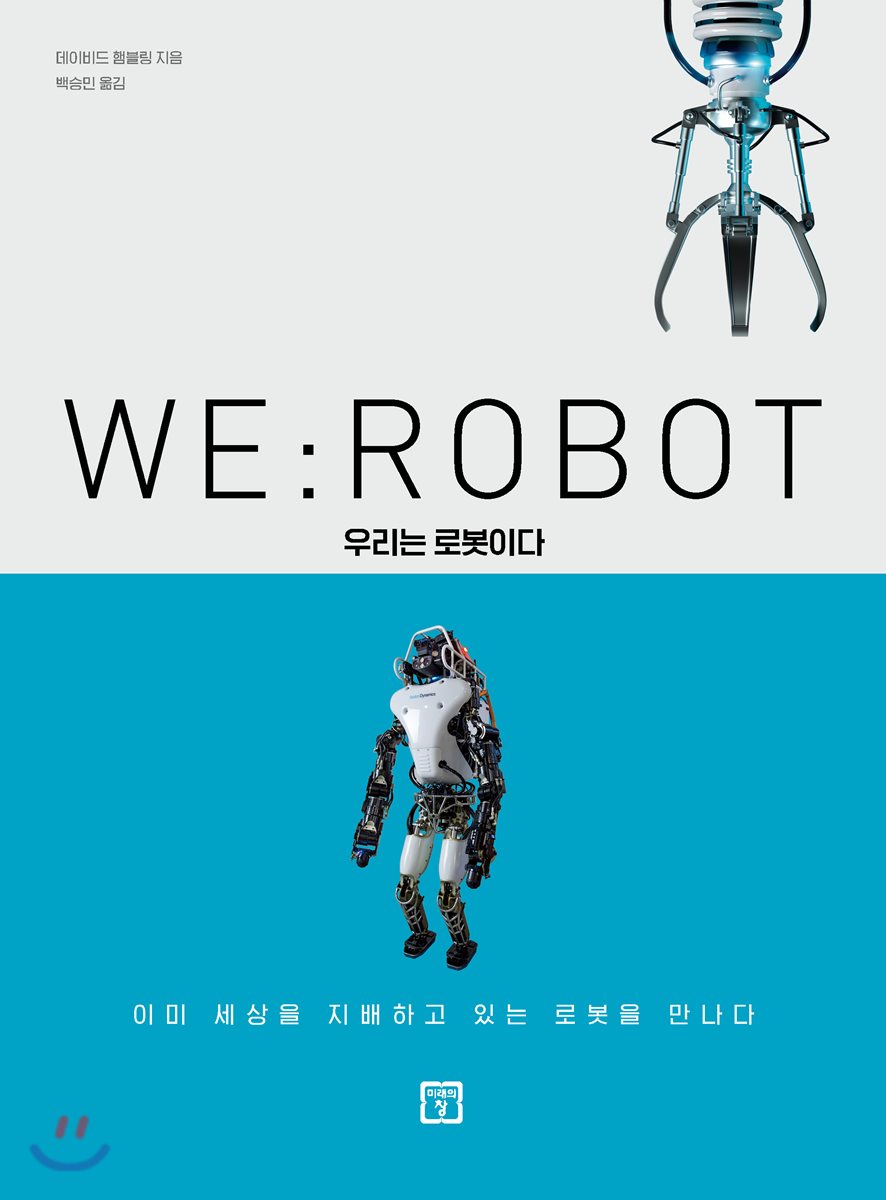
WE: ROBOT We are robots
 |
Description
Book Introduction
Books recommended by the National Science Teachers Association
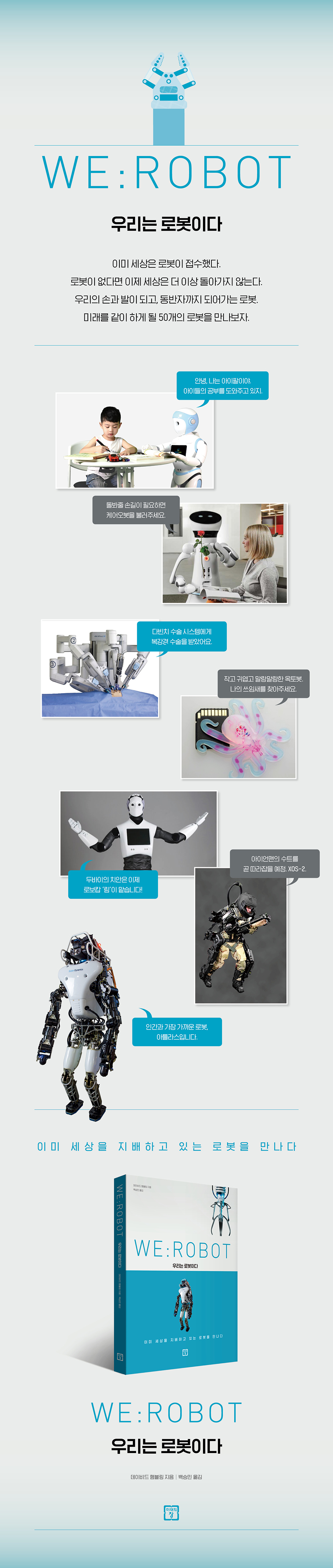
Our surroundings are already filled with robots.
From strawberry-picking robots to dolphin robots, life-saving robots, and even burger-making robots.
Meet the 50 robots that will change our future.
Robots are no longer just science fiction.
Swagbot, Agbot, Astronaut, etc. are unfamiliar names of robots, but if you think of them as cow herding robots, strawberry picking robots, and cow milking robots, you can see how close robots are to our lives.
Today, robots work diligently in factories, assist surgeons, and even perform military operations alongside soldiers.
Indeed, a wide variety of robots are already doing a lot of work around us.
It's just somewhere you can't see it.
This book provides specific examples of how robots have made our lives more convenient and how deeply they have penetrated our lives.
The author doesn't just introduce various robots; he says they will completely change the world we live in.
The robots introduced in this book will give us a glimpse into how much influence robots will have on our future.
Our surroundings are already filled with robots.
From strawberry-picking robots to dolphin robots, life-saving robots, and even burger-making robots.
Meet the 50 robots that will change our future.
Robots are no longer just science fiction.
Swagbot, Agbot, Astronaut, etc. are unfamiliar names of robots, but if you think of them as cow herding robots, strawberry picking robots, and cow milking robots, you can see how close robots are to our lives.
Today, robots work diligently in factories, assist surgeons, and even perform military operations alongside soldiers.
Indeed, a wide variety of robots are already doing a lot of work around us.
It's just somewhere you can't see it.
This book provides specific examples of how robots have made our lives more convenient and how deeply they have penetrated our lives.
The author doesn't just introduce various robots; he says they will completely change the world we live in.
The robots introduced in this book will give us a glimpse into how much influence robots will have on our future.
- You can preview some of the book's contents.
Preview
index
introduction
ROBOTS AT WORK
Collaborative Robot CR-35iA | Agrobot SW 6010 | Gekko Facade Robot | Lely Astronaut A4 | Kiva | Swagbot | Universal Robots UR10 | Pibot | Robotic Pipeline Inspection System | Pit Viper-275CA | Optimus | Alpha Burgerbot
ROBOTS IN YOUR LIFE
Roomba 966 | da Vinci Surgical System | Automower® 450X | IPAL | Waymo | Care-O-BOT 4 | Flex Robotic System | Amazon Prime Air | Bebionic Hand | Mavic Pro | Soft Robotic Exosuit | Starsmart Tissue Autonomous Robot | Vahana
ROBOTS AT WAR
PACKBOT | XOS-2 EXOSKELETON | MQ-9 REAPER | SGR-A1 SENTRY | ECHO VOYAGER | WINGMAN | GHOST MINITAUR | SEA HUNTER | COMRADE IN ARMS | SWITCHBLADE | COVERT ROBOT | Grumman X-47B
ROBOTS BEYOND
ROBONAUT 2 | DOLPHIN | EMILY | ATLAS | CURIOSITY | OCTOBOT | SOPHIA | FLYING SEA GLIDER | KILOBOT | SAFFIR | VISHWA EXTENSOR | GEMINOID HI-4 | REEM DUBAI POLICE
ROBOTS AT WORK
Collaborative Robot CR-35iA | Agrobot SW 6010 | Gekko Facade Robot | Lely Astronaut A4 | Kiva | Swagbot | Universal Robots UR10 | Pibot | Robotic Pipeline Inspection System | Pit Viper-275CA | Optimus | Alpha Burgerbot
ROBOTS IN YOUR LIFE
Roomba 966 | da Vinci Surgical System | Automower® 450X | IPAL | Waymo | Care-O-BOT 4 | Flex Robotic System | Amazon Prime Air | Bebionic Hand | Mavic Pro | Soft Robotic Exosuit | Starsmart Tissue Autonomous Robot | Vahana
ROBOTS AT WAR
PACKBOT | XOS-2 EXOSKELETON | MQ-9 REAPER | SGR-A1 SENTRY | ECHO VOYAGER | WINGMAN | GHOST MINITAUR | SEA HUNTER | COMRADE IN ARMS | SWITCHBLADE | COVERT ROBOT | Grumman X-47B
ROBOTS BEYOND
ROBONAUT 2 | DOLPHIN | EMILY | ATLAS | CURIOSITY | OCTOBOT | SOPHIA | FLYING SEA GLIDER | KILOBOT | SAFFIR | VISHWA EXTENSOR | GEMINOID HI-4 | REEM DUBAI POLICE
Detailed image
Into the book
The claim that machines are taking away human jobs has always generated a lot of controversy.
In the 18th century, Luddites, who opposed new technology, attempted to stop the mechanization of weaving by destroying spinning machines.
Today, this view has been proven wrong.
Mechanization has created as many jobs as it has taken away, and even though 200 years have passed since industry became automated, there are still plenty of jobs left for humans.
Lamplighters, office messengers, and broom makers will probably no longer exist, but their descendants will be website developers, digital content managers, and life coaches.
It is estimated that one-third of children currently attending school will end up working in jobs that don't even exist yet.
While there may be fears that robots could take over our jobs, we must remember that work is not as romantic as we think and is often harsh and dangerous.
Robots show us a future where we don't have to do rough and dangerous work.
Of course, some people might choose jobs that could easily be done by machines, such as making hamburgers or picking fruit by hand.
But it may not be for the sake of making a living, but because it is enjoyable.
--- p.11
Cleaning windows in high-rise buildings is very dangerous.
Even if there is no wind on the ground, it can blow at speeds of up to 48 km/h on the 100th floor.
Therefore, a high-rise building about 305 meters high is exposed to strong winds, and to prevent excessive swaying, a large additional damper called tuned mass dampers is required inside the building.
People inside the building may not notice the wind blowing outside, but window cleaners are exposed to the full force of the wind, so accidents can occur.
Even in situations where the wind is so strong that it is difficult for a person to work, the gecko robot with suction cups can operate.
--- p.22
Since Amazon acquired Kiva Robotics in 2012, Kiva robots have been supplied exclusively to Amazon.
Amazon had about 5,000 robots in 2012, but by 2017, it had introduced over 45,000 robots.
Amazon's acquisition of Kiva Robotics shook up the logistics robotics market.
Existing Kiva Robotics customers, including office supply chains Staples and Office Depot, and clothing retailer Gap, were forced to look for new suppliers after they were no longer receiving Kiva robots.
Kiva robots work tirelessly and diligently like ants, never complaining, and don't even need to be paid wages.
According to research, Kiva robots can efficiently perform tasks such as picking, packing, and transporting items in Amazon fulfillment centers, improving order fulfillment rates by two to six times while reducing errors.
--- p.30
Alpha produces 360 burgers per hour, minimizing waiting times and providing the freshest burgers possible.
The creator's goal was not to simply produce a standardized product like McDonald's, but to customize every burger to the customer's needs.
This allows you to create patties with a variety of meat blends, such as patties containing 20% pork or lamb, and you can make burgers as large or small as you like.
You can also choose different types of toppings or cheese and the machine will place them on your burger.
The company has a patented feedback system to improve its services.
Customers rate their burgers and record their requests, such as "more cheese" or "less pickles."
This allows Alpha to know what to offer them next.
--- p.58
Some argue that care robots could increase social isolation among older people.
Caregivers are not just a helping hand; they are also people who provide human contact, including empathy, warmth, and conversation.
It would be problematic if robots were seen only as a cheap and convenient way to care for the elderly, leaving them isolated without human contact.
But ideally, robots like Care-O-Bot could free up caregivers to focus on caring for the elderly by handling mundane household chores like cooking and cleaning.
It will also improve the quality of life for older adults by providing them with a means to connect to the Internet and the world.
--- p.86
In 2011, Lockheed Martin's Advanced Research Laboratory in Cherry Hill, New Jersey, unveiled details of a covert robot capable of evading human sentries.
The robot moves quietly on four rubber wheels and can construct a 3D model of its surroundings, creating a map and instantly reading its crosshairs.
But the Covert robot's real secret weapon is its ability to figure out where it can be exposed, making it essentially a well-functioning spy.
The Covert robot has four ways to evade enemy detection.
The simplest method is to stay away from lighted areas at night and look for shadows.
Additionally, in areas where the sentries' locations are known, it moves to avoid the sentries' sight, and uses the four microphones it is equipped with to recognize the sound of approaching footsteps, determine the direction of approach, and then deviate from the original path to move unnoticed.
Also, check multiple escape routes to avoid getting stuck in a dead end.
--- p.161
Nature is far ahead of us.
Fish move effortlessly and lightly in the water, and dolphins can leap at high speeds and swim as if they are leaping through the water.
In 1936, biologist James Gray calculated that underwater drag would be so great that it would be impossible for dolphins to swim faster than 30 km/h.
But in reality, dolphins can reach speeds of over 60 km/h.
The mystery remained unsolved until 2008, when biologist Frank Fish discovered that dolphin tails were more efficient at generating propulsion than ever before.
Robotics engineers have been drawing inspiration from nature since Leonardo da Vinci, and a team led by Professor Junzhi Yu of the Chinese Academy of Sciences in Beijing has developed a robot inspired by the spotted dolphin.
The robot is a scaled-down model measuring 72cm in length and weighing less than 5kg, with a streamlined shape that allows its electric motor-powered tail to generate maximum thrust.
The dolphin robot's tail and wing fins were designed as three-dimensional aerofoils (wing-shaped cross-sections - translator's note).
--- p.177
Atlas has a unique gait, taking short, quick steps at regular intervals.
It has no way of standing still, and even when it is not moving anywhere, it appears to be walking in place, adjusting its footing.
Jumping, running, and high jumping all rely on dynamic stability, just like dancers and gymnasts.
Although not perfect, Atlas has an excellent sense of balance and can maintain its balance and upright position even when slipping or being pushed.
Atlas, like humans, can adjust its center of gravity to cope with unstable or uneven ground, and can get back up without outside help if it falls.
They can also perform tasks that require a sense of balance, such as lifting heavy boxes and placing them on high shelves.
--- p.186
If robots are suited to the 3D jobs of 'dirty, dangerous, and dull', then Mars exploration is the perfect fit for their mission.
It's dirty because it involves constant exposure to harmful radiation, it's dangerous because space travel has failed 26 times, and it's boring because space travel usually takes about seven months.
While it costs astronauts a fortune and adds absurd complexity to their missions, robots don't have to return to Earth.
For this reason, Mars exploration has always been a robotic endeavor.
Curiosity, which landed on Mars in August 2012 and is still active, is the most advanced planetary exploration robot among the various scientific instruments developed to search for signs of Martian life.
It follows NASA's Sojourner in 1997 and the twin rovers Spirit and Opportunity in 2003.
Sojourner weighs 11kg, Spirit and Opportunity 180kg, while Curiosity, which is about the size of a small car, is 3m long and weighs 900kg.
Not only in size, but also in functionality, it is far superior to previous exploration robots.
--- p.189
One of the motivations for developing soft robots is their adaptability.
They can pass through narrow passageways and transform their shape to suit the space. DARPA has been researching soft robots that can slip under mailboxes and doors, or move through ventilation ducts.
Very small soft robots could also find medical applications, as they can move through the body more safely and easily than rigid hard robots.
While a fully soft robot with all soft parts may not be practical, soft manipulators can be an alternative to hard robot joints.
Soft robotic arms would be safer for working around humans than strong, rigid ones, and could be useful in care robots for the elderly.
In a future where robots are likely to frequently bump shoulders with humans, the softer their shoulders, the better.
In the 18th century, Luddites, who opposed new technology, attempted to stop the mechanization of weaving by destroying spinning machines.
Today, this view has been proven wrong.
Mechanization has created as many jobs as it has taken away, and even though 200 years have passed since industry became automated, there are still plenty of jobs left for humans.
Lamplighters, office messengers, and broom makers will probably no longer exist, but their descendants will be website developers, digital content managers, and life coaches.
It is estimated that one-third of children currently attending school will end up working in jobs that don't even exist yet.
While there may be fears that robots could take over our jobs, we must remember that work is not as romantic as we think and is often harsh and dangerous.
Robots show us a future where we don't have to do rough and dangerous work.
Of course, some people might choose jobs that could easily be done by machines, such as making hamburgers or picking fruit by hand.
But it may not be for the sake of making a living, but because it is enjoyable.
--- p.11
Cleaning windows in high-rise buildings is very dangerous.
Even if there is no wind on the ground, it can blow at speeds of up to 48 km/h on the 100th floor.
Therefore, a high-rise building about 305 meters high is exposed to strong winds, and to prevent excessive swaying, a large additional damper called tuned mass dampers is required inside the building.
People inside the building may not notice the wind blowing outside, but window cleaners are exposed to the full force of the wind, so accidents can occur.
Even in situations where the wind is so strong that it is difficult for a person to work, the gecko robot with suction cups can operate.
--- p.22
Since Amazon acquired Kiva Robotics in 2012, Kiva robots have been supplied exclusively to Amazon.
Amazon had about 5,000 robots in 2012, but by 2017, it had introduced over 45,000 robots.
Amazon's acquisition of Kiva Robotics shook up the logistics robotics market.
Existing Kiva Robotics customers, including office supply chains Staples and Office Depot, and clothing retailer Gap, were forced to look for new suppliers after they were no longer receiving Kiva robots.
Kiva robots work tirelessly and diligently like ants, never complaining, and don't even need to be paid wages.
According to research, Kiva robots can efficiently perform tasks such as picking, packing, and transporting items in Amazon fulfillment centers, improving order fulfillment rates by two to six times while reducing errors.
--- p.30
Alpha produces 360 burgers per hour, minimizing waiting times and providing the freshest burgers possible.
The creator's goal was not to simply produce a standardized product like McDonald's, but to customize every burger to the customer's needs.
This allows you to create patties with a variety of meat blends, such as patties containing 20% pork or lamb, and you can make burgers as large or small as you like.
You can also choose different types of toppings or cheese and the machine will place them on your burger.
The company has a patented feedback system to improve its services.
Customers rate their burgers and record their requests, such as "more cheese" or "less pickles."
This allows Alpha to know what to offer them next.
--- p.58
Some argue that care robots could increase social isolation among older people.
Caregivers are not just a helping hand; they are also people who provide human contact, including empathy, warmth, and conversation.
It would be problematic if robots were seen only as a cheap and convenient way to care for the elderly, leaving them isolated without human contact.
But ideally, robots like Care-O-Bot could free up caregivers to focus on caring for the elderly by handling mundane household chores like cooking and cleaning.
It will also improve the quality of life for older adults by providing them with a means to connect to the Internet and the world.
--- p.86
In 2011, Lockheed Martin's Advanced Research Laboratory in Cherry Hill, New Jersey, unveiled details of a covert robot capable of evading human sentries.
The robot moves quietly on four rubber wheels and can construct a 3D model of its surroundings, creating a map and instantly reading its crosshairs.
But the Covert robot's real secret weapon is its ability to figure out where it can be exposed, making it essentially a well-functioning spy.
The Covert robot has four ways to evade enemy detection.
The simplest method is to stay away from lighted areas at night and look for shadows.
Additionally, in areas where the sentries' locations are known, it moves to avoid the sentries' sight, and uses the four microphones it is equipped with to recognize the sound of approaching footsteps, determine the direction of approach, and then deviate from the original path to move unnoticed.
Also, check multiple escape routes to avoid getting stuck in a dead end.
--- p.161
Nature is far ahead of us.
Fish move effortlessly and lightly in the water, and dolphins can leap at high speeds and swim as if they are leaping through the water.
In 1936, biologist James Gray calculated that underwater drag would be so great that it would be impossible for dolphins to swim faster than 30 km/h.
But in reality, dolphins can reach speeds of over 60 km/h.
The mystery remained unsolved until 2008, when biologist Frank Fish discovered that dolphin tails were more efficient at generating propulsion than ever before.
Robotics engineers have been drawing inspiration from nature since Leonardo da Vinci, and a team led by Professor Junzhi Yu of the Chinese Academy of Sciences in Beijing has developed a robot inspired by the spotted dolphin.
The robot is a scaled-down model measuring 72cm in length and weighing less than 5kg, with a streamlined shape that allows its electric motor-powered tail to generate maximum thrust.
The dolphin robot's tail and wing fins were designed as three-dimensional aerofoils (wing-shaped cross-sections - translator's note).
--- p.177
Atlas has a unique gait, taking short, quick steps at regular intervals.
It has no way of standing still, and even when it is not moving anywhere, it appears to be walking in place, adjusting its footing.
Jumping, running, and high jumping all rely on dynamic stability, just like dancers and gymnasts.
Although not perfect, Atlas has an excellent sense of balance and can maintain its balance and upright position even when slipping or being pushed.
Atlas, like humans, can adjust its center of gravity to cope with unstable or uneven ground, and can get back up without outside help if it falls.
They can also perform tasks that require a sense of balance, such as lifting heavy boxes and placing them on high shelves.
--- p.186
If robots are suited to the 3D jobs of 'dirty, dangerous, and dull', then Mars exploration is the perfect fit for their mission.
It's dirty because it involves constant exposure to harmful radiation, it's dangerous because space travel has failed 26 times, and it's boring because space travel usually takes about seven months.
While it costs astronauts a fortune and adds absurd complexity to their missions, robots don't have to return to Earth.
For this reason, Mars exploration has always been a robotic endeavor.
Curiosity, which landed on Mars in August 2012 and is still active, is the most advanced planetary exploration robot among the various scientific instruments developed to search for signs of Martian life.
It follows NASA's Sojourner in 1997 and the twin rovers Spirit and Opportunity in 2003.
Sojourner weighs 11kg, Spirit and Opportunity 180kg, while Curiosity, which is about the size of a small car, is 3m long and weighs 900kg.
Not only in size, but also in functionality, it is far superior to previous exploration robots.
--- p.189
One of the motivations for developing soft robots is their adaptability.
They can pass through narrow passageways and transform their shape to suit the space. DARPA has been researching soft robots that can slip under mailboxes and doors, or move through ventilation ducts.
Very small soft robots could also find medical applications, as they can move through the body more safely and easily than rigid hard robots.
While a fully soft robot with all soft parts may not be practical, soft manipulators can be an alternative to hard robot joints.
Soft robotic arms would be safer for working around humans than strong, rigid ones, and could be useful in care robots for the elderly.
In a future where robots are likely to frequently bump shoulders with humans, the softer their shoulders, the better.
--- p.194
Publisher's Review
Meet the robots that are already ruling the world.
When we think of robots, we usually think of humanoid robots.
However, the scope of robots is very broad.
According to the dictionary, a robot is 'a machine that can automatically perform a complex series of actions.'
According to this definition, common household appliances such as dishwashers and washing machines also fall under the category of robots.
Okay, now let's look around and find the robot.
Robots are already all around us, dominating the world, and will continue to change it.
The human desire for robots, which began with Leonardo da Vinci's mechanical engineering drawings in 1495, continues to this day and will continue into the future.
Robots are becoming more and more prevalent and are becoming a close part of our lives.
Robots are used in a wide range of fields, from the most common robot vacuum cleaners to the industrial robots of which there are over 400,000, to reconnaissance robots that sneak around like spies to spy on enemy lines, to robot surgeries using motion capture technology, and more are being developed to use robots in more places.
Soon we may see flying robot taxis or Robocops catching criminals.
Robots are changing the world now, but this is just the beginning.
This book provides various visions of what robots can do now and what they will be able to do in the near future, based on robots that have already been put into practical use and robots that will be put into practical use in the future.
Government research labs and giant corporations like Google may already have more advanced machines.
There is no set plan for how robots will develop.
We can only imagine through the robots introduced in this book.
Not all of these robots will succeed in the real world.
Not to mention flying taxis, delivery drones and driverless cars will inevitably require changes to existing laws.
It may take longer to change the relevant laws than to develop the technology.
Also, just because something is technically possible doesn't mean it's desirable.
We need to consider very carefully whether we should entrust robots with raising our children, caring for the elderly, and how much responsibility we should place on robots when using them in the operating room.
Let's imagine the future that robots will create.
Individual technologies applied to the robots mentioned in this book, such as manipulators, mobility, swarm control, and social interaction software, will be combined to create more effective robots.
We can also expect to see dolphin-shaped machines equipped with robotic hands like the Vishwa Extensor, or multiple Roombas with swarm control software to efficiently clean large mansions.
A static humanoid robot like Sophia could become a true android robot when combined with a mobile body like Atlas.
Additionally, on the battlefield, robot soldiers could take over the fighting, eliminating the need for human bloodshed.
Moreover, if artificial intelligence programs like AlphaGo are developed in a more advanced form and applied to robots, it is not impossible to converse with and work together with robots that surpass human intelligence.
The author, a tech journalist, selected robots that are closely related to our lives from among the robots around us and introduced them in four categories: industry, real life, military, and future.
Beyond the macroscopic story of robots, the book focuses on the robots themselves, explaining in detail how practical robots are built, operate, and can be applied, and forecasting the impact each robot will have on human life.
It consists of four chapters: working robots, robots in everyday life, military robots, and robots of the future. 12 to 13 robots are selected for each field, introducing a total of 51 robots.
In addition, the origins, operating principles, applicable tasks, advantages and disadvantages, and development potential of each robot are explained in detail, and photographs and graphic images are inserted to help readers understand.
When we think of robots, we usually think of humanoid robots.
However, the scope of robots is very broad.
According to the dictionary, a robot is 'a machine that can automatically perform a complex series of actions.'
According to this definition, common household appliances such as dishwashers and washing machines also fall under the category of robots.
Okay, now let's look around and find the robot.
Robots are already all around us, dominating the world, and will continue to change it.
The human desire for robots, which began with Leonardo da Vinci's mechanical engineering drawings in 1495, continues to this day and will continue into the future.
Robots are becoming more and more prevalent and are becoming a close part of our lives.
Robots are used in a wide range of fields, from the most common robot vacuum cleaners to the industrial robots of which there are over 400,000, to reconnaissance robots that sneak around like spies to spy on enemy lines, to robot surgeries using motion capture technology, and more are being developed to use robots in more places.
Soon we may see flying robot taxis or Robocops catching criminals.
Robots are changing the world now, but this is just the beginning.
This book provides various visions of what robots can do now and what they will be able to do in the near future, based on robots that have already been put into practical use and robots that will be put into practical use in the future.
Government research labs and giant corporations like Google may already have more advanced machines.
There is no set plan for how robots will develop.
We can only imagine through the robots introduced in this book.
Not all of these robots will succeed in the real world.
Not to mention flying taxis, delivery drones and driverless cars will inevitably require changes to existing laws.
It may take longer to change the relevant laws than to develop the technology.
Also, just because something is technically possible doesn't mean it's desirable.
We need to consider very carefully whether we should entrust robots with raising our children, caring for the elderly, and how much responsibility we should place on robots when using them in the operating room.
Let's imagine the future that robots will create.
Individual technologies applied to the robots mentioned in this book, such as manipulators, mobility, swarm control, and social interaction software, will be combined to create more effective robots.
We can also expect to see dolphin-shaped machines equipped with robotic hands like the Vishwa Extensor, or multiple Roombas with swarm control software to efficiently clean large mansions.
A static humanoid robot like Sophia could become a true android robot when combined with a mobile body like Atlas.
Additionally, on the battlefield, robot soldiers could take over the fighting, eliminating the need for human bloodshed.
Moreover, if artificial intelligence programs like AlphaGo are developed in a more advanced form and applied to robots, it is not impossible to converse with and work together with robots that surpass human intelligence.
The author, a tech journalist, selected robots that are closely related to our lives from among the robots around us and introduced them in four categories: industry, real life, military, and future.
Beyond the macroscopic story of robots, the book focuses on the robots themselves, explaining in detail how practical robots are built, operate, and can be applied, and forecasting the impact each robot will have on human life.
It consists of four chapters: working robots, robots in everyday life, military robots, and robots of the future. 12 to 13 robots are selected for each field, introducing a total of 51 robots.
In addition, the origins, operating principles, applicable tasks, advantages and disadvantages, and development potential of each robot are explained in detail, and photographs and graphic images are inserted to help readers understand.
GOODS SPECIFICS
- Date of issue: June 5, 2019
- Page count, weight, size: 224 pages | 740g | 170*230*20mm
- ISBN13: 9788959895854
- ISBN10: 8959895857
You may also like
카테고리
korean


korean

![GQ KOREA Mark (Monthly): December [2025]](http://librairie.coreenne.fr/cdn/shop/files/8ef265dbbfbf186523ed75ba7319009d.jpg?v=1765340328&width=3840)


