

Professor Choi Moo-young's physics lecture
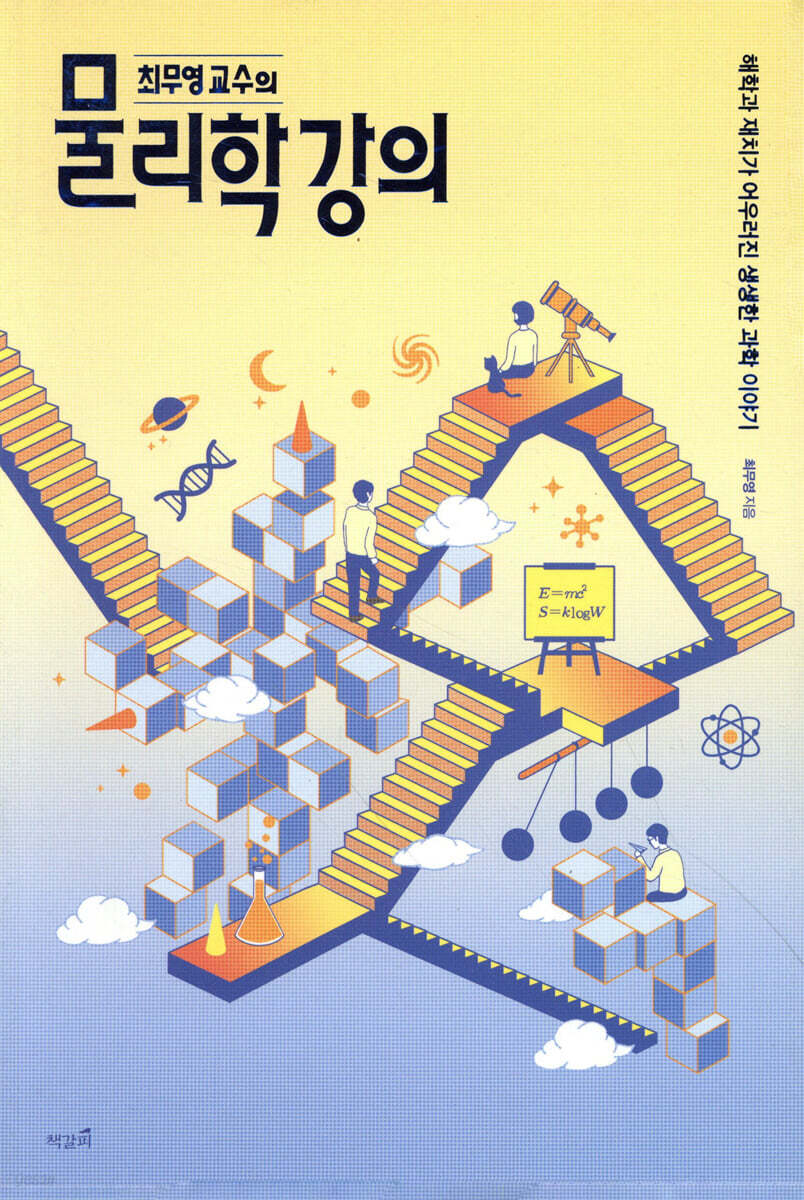 |
Description
Book Introduction
This book is based on lectures given by Professor Mooyoung Choi of the Department of Physics and Astronomy at Seoul National University to students who are not majoring in natural sciences.
This is an introductory book on physics written so that anyone can easily understand the true meaning of science, but it also covers all topics in physics, including classical mechanics, quantum mechanics, and relativity, as well as the latest topics of the 21st century, such as chaos, complex systems, entropy, the birth and evolution of the universe, and life phenomena.
It was serialized in the Pressian magazine in 2008 and received a warm response, and as soon as the first edition was published, it rose to the top of the bestseller list in the natural sciences category.
It swept various awards, including the Outstanding Science Book from the Korea Foundation for the Advancement of Science and Creativity, the Youth Book of the Year from the Korean Publishers Association, and the Outstanding Academic Book from the National Academy of Sciences of the Republic of Korea.
This comprehensively revised edition, intended to be a worthy textbook, captures the core concepts and meaning of physics from beginning to end, while also introducing new findings from recent research.
It is structured in a lecture-style format with students asking questions and the professor answering, so you can read it as if you were listening to a lecture directly.
It explains the principles of physics across various fields, including philosophy, literature, humanities, and art, and translates difficult foreign language terms into our native language to make them easier and more familiar.
This is an introductory book on physics written so that anyone can easily understand the true meaning of science, but it also covers all topics in physics, including classical mechanics, quantum mechanics, and relativity, as well as the latest topics of the 21st century, such as chaos, complex systems, entropy, the birth and evolution of the universe, and life phenomena.
It was serialized in the Pressian magazine in 2008 and received a warm response, and as soon as the first edition was published, it rose to the top of the bestseller list in the natural sciences category.
It swept various awards, including the Outstanding Science Book from the Korea Foundation for the Advancement of Science and Creativity, the Youth Book of the Year from the Korean Publishers Association, and the Outstanding Academic Book from the National Academy of Sciences of the Republic of Korea.
This comprehensively revised edition, intended to be a worthy textbook, captures the core concepts and meaning of physics from beginning to end, while also introducing new findings from recent research.
It is structured in a lecture-style format with students asking questions and the professor answering, so you can read it as if you were listening to a lecture directly.
It explains the principles of physics across various fields, including philosophy, literature, humanities, and art, and translates difficult foreign language terms into our native language to make them easier and more familiar.
- You can preview some of the book's contents.
Preview
index
Recommendation
In publishing a revised edition
Opening remarks
Part 1 Science and Physics
Lecture 1: What is Science?
What Science Means to Us | The Beauty of Science | Scientific Thinking
Lecture 2: Scientific Knowledge
Specific and Universal Knowledge | Theory Structure | Good Theories | Examples of Universal Theory Systems: Symmetry Breaking | The Nature of Scientific Activity
Lecture 3: The Advancement of Science and the Spirit of the Times
Classical Physics: Motion and Light | Modern Physics: Relativity and Quantum Mechanics | Statistical Mechanics: Information and Entropy | Chaos and Order | Cooperation and Emergence | Complex Systems
4th Division of Physics
What is Physics? | Fields of Physics | Scope of Physics
Part 2: Components of Matter
Lecture 5: Matter and Atoms
The Evolution of the Concept of Matter | Atomism | Atomic Particles | Light: Electromagnetic Waves and Light Beads
Lecture 6: Elementary Particles and Quark Theory
Particles and Antiparticles | Mesons and Neutrinos | Classification of Particles | Quark Theory | Fundamental Interactions | Theory of Everything
Lecture 7: Symmetry of the Laws of Physics
Symmetry of the Laws of Physics | Time Asymmetry
Part 3: Mechanical Description of Natural Phenomena
Classical Mechanics, Lecture 8
Dynamics | Newtonian Mechanics | Energy | Hamiltonian Mechanics
Lecture 9: Electromagnetic Theory
Yard | Maxwell's Equations and Electromagnetic Waves
Lesson 10: Space and Time
The Principle of Relativity | Constant Speed of Light | Basic Principles and Consequences of Relativity
Lecture 11: Special Relativity
The Lorentz Transformation | Shortening of Length | Determining Units | Time Dilation and the Twin Paradox | Four-Dimensional Spacetime | Mass Expansion | Some Questions
Lecture 12: General Relativity
General Relativity | The Equivalence Principle | Curved Space and Non-Euclidean Geometry | Field Equations | General Relativity Phenomena | Relativity and Art | Some Questions
Lecture 13: Quantum Mechanics
Background of Quantum Mechanics | Basic Concepts of Quantum Mechanics | Forms of Quantum Mechanics | Contents of Quantum Mechanics
Lesson 14: Measurement and Interpretation
Measurement and Eigenstates | Examples of Measurement | The Ipiar Thought Experiment and Nonlocality | Schrödinger's Cat | Interpretation of Quantum Mechanics | Some Questions
Part 4: Chaos and Order
Lecture 15: Nonlinear Dynamics
Chaos and Order: Historical Illumination | Logistics Pattern | Deterministic Chaos | Lyapunov Index
Round of 16: Chaos and Order
The Movement of Celestial Bodies | Order in Chaos | Chaos in Nature and Society | The Meaning of Chaos
Part 5: Macroscopic Phenomena and Entropy
Lecture 17: Macroscopic Perspectives and Statistical Mechanics
Multiparticulate Systems and Macroscopic Technology | Backtracking and Unbacktracking | Entropy | Heat and Temperature | Statistical Mechanics
Lesson 18 Entropy
The Meaning and Information of Entropy | Maxwell's Demon | Perpetual Motion | The Nature of Entropy | Entropy and Ecosystems
Lesson 19: Probability and Information
Probability | Baseline Inference | Information | Objective and Subjective Perspectives | Quantum Information | Information and Dynamics
Part 6: The Structure and Evolution of the Universe
20th Lecture: The Observable Universe
Understanding the Universe | Evolution of Cosmology | Solar System | Stars and Galaxies | Observation of Celestial Objects
Lesson 21: Stars and Interstellar Matter
Measuring Celestial Distances | The Birth of Stars | The Life Cycle of Stars | Black Holes and Gravitational Waves
Lecture 22: The Origin and Evolution of the Universe
The Origins of Modern Cosmology | The Expanding Universe | The Open and Closed Universe | The Composition of Matter and Energy | The History of the Universe | An Artist's Perspective on the Universe
Lecture 23: The Universe and Humans
Time and Space | What Science Shows About the Universe
Part 7 Complex Systems and Integrative Thinking
24 Complexity and High Cost
Complexity | Spatial Heterogeneousness: Distance | Time Heterogeneousness: The 1/f Signal | Mechanisms of Complexity
Lecture 25: Physics of Complex Systems
What is a Complex System? | Examples of Complex Systems | Information Exchange Dynamics
Lecture 26: Understanding Life Phenomena
Physics and Biology | Research Topics in Biophysics | What is Life? | The Core Elements of Life | The Units of Life
Lecture 27: Complex Systems and Integrated Science
Physics and Social Sciences | Theoretical Understanding of Social Phenomena | Complex Systems and Integrative Thinking
Reading material
Search
In publishing a revised edition
Opening remarks
Part 1 Science and Physics
Lecture 1: What is Science?
What Science Means to Us | The Beauty of Science | Scientific Thinking
Lecture 2: Scientific Knowledge
Specific and Universal Knowledge | Theory Structure | Good Theories | Examples of Universal Theory Systems: Symmetry Breaking | The Nature of Scientific Activity
Lecture 3: The Advancement of Science and the Spirit of the Times
Classical Physics: Motion and Light | Modern Physics: Relativity and Quantum Mechanics | Statistical Mechanics: Information and Entropy | Chaos and Order | Cooperation and Emergence | Complex Systems
4th Division of Physics
What is Physics? | Fields of Physics | Scope of Physics
Part 2: Components of Matter
Lecture 5: Matter and Atoms
The Evolution of the Concept of Matter | Atomism | Atomic Particles | Light: Electromagnetic Waves and Light Beads
Lecture 6: Elementary Particles and Quark Theory
Particles and Antiparticles | Mesons and Neutrinos | Classification of Particles | Quark Theory | Fundamental Interactions | Theory of Everything
Lecture 7: Symmetry of the Laws of Physics
Symmetry of the Laws of Physics | Time Asymmetry
Part 3: Mechanical Description of Natural Phenomena
Classical Mechanics, Lecture 8
Dynamics | Newtonian Mechanics | Energy | Hamiltonian Mechanics
Lecture 9: Electromagnetic Theory
Yard | Maxwell's Equations and Electromagnetic Waves
Lesson 10: Space and Time
The Principle of Relativity | Constant Speed of Light | Basic Principles and Consequences of Relativity
Lecture 11: Special Relativity
The Lorentz Transformation | Shortening of Length | Determining Units | Time Dilation and the Twin Paradox | Four-Dimensional Spacetime | Mass Expansion | Some Questions
Lecture 12: General Relativity
General Relativity | The Equivalence Principle | Curved Space and Non-Euclidean Geometry | Field Equations | General Relativity Phenomena | Relativity and Art | Some Questions
Lecture 13: Quantum Mechanics
Background of Quantum Mechanics | Basic Concepts of Quantum Mechanics | Forms of Quantum Mechanics | Contents of Quantum Mechanics
Lesson 14: Measurement and Interpretation
Measurement and Eigenstates | Examples of Measurement | The Ipiar Thought Experiment and Nonlocality | Schrödinger's Cat | Interpretation of Quantum Mechanics | Some Questions
Part 4: Chaos and Order
Lecture 15: Nonlinear Dynamics
Chaos and Order: Historical Illumination | Logistics Pattern | Deterministic Chaos | Lyapunov Index
Round of 16: Chaos and Order
The Movement of Celestial Bodies | Order in Chaos | Chaos in Nature and Society | The Meaning of Chaos
Part 5: Macroscopic Phenomena and Entropy
Lecture 17: Macroscopic Perspectives and Statistical Mechanics
Multiparticulate Systems and Macroscopic Technology | Backtracking and Unbacktracking | Entropy | Heat and Temperature | Statistical Mechanics
Lesson 18 Entropy
The Meaning and Information of Entropy | Maxwell's Demon | Perpetual Motion | The Nature of Entropy | Entropy and Ecosystems
Lesson 19: Probability and Information
Probability | Baseline Inference | Information | Objective and Subjective Perspectives | Quantum Information | Information and Dynamics
Part 6: The Structure and Evolution of the Universe
20th Lecture: The Observable Universe
Understanding the Universe | Evolution of Cosmology | Solar System | Stars and Galaxies | Observation of Celestial Objects
Lesson 21: Stars and Interstellar Matter
Measuring Celestial Distances | The Birth of Stars | The Life Cycle of Stars | Black Holes and Gravitational Waves
Lecture 22: The Origin and Evolution of the Universe
The Origins of Modern Cosmology | The Expanding Universe | The Open and Closed Universe | The Composition of Matter and Energy | The History of the Universe | An Artist's Perspective on the Universe
Lecture 23: The Universe and Humans
Time and Space | What Science Shows About the Universe
Part 7 Complex Systems and Integrative Thinking
24 Complexity and High Cost
Complexity | Spatial Heterogeneousness: Distance | Time Heterogeneousness: The 1/f Signal | Mechanisms of Complexity
Lecture 25: Physics of Complex Systems
What is a Complex System? | Examples of Complex Systems | Information Exchange Dynamics
Lecture 26: Understanding Life Phenomena
Physics and Biology | Research Topics in Biophysics | What is Life? | The Core Elements of Life | The Units of Life
Lecture 27: Complex Systems and Integrated Science
Physics and Social Sciences | Theoretical Understanding of Social Phenomena | Complex Systems and Integrative Thinking
Reading material
Search
Into the book
What science means
Science should be studied by scientists who specialize in it, so why should we, who don't specialize in science, study it? To find the answer, we need to consider what science means to us living in modern society.
The first meaning of science is scientific thinking.
Scientific thinking refers to critical and rational thinking, and the scientific way of thinking can be called the scientific spirit.
When we talk about the power of science, it's easy to think of scientific knowledge or its special application as technology.
Nowadays, we think of its power and strength narrowly as material civilization, and even more narrowly as something like weapons.
Years later, the United States invaded Iraq and occupied it in an instant.
At this time, the real difference between the two countries was which side had stronger military power, and the weapons that determined this came from the application of technology.
Seeing things like that, it's easy to think that the power of natural science depends on how well it is applied to technology.
However, the power of real natural science lies not in the application of technology, but in scientific thinking.
…
The second meaning that science gives us is that through science we can pursue new meaning in life.
Natural science is the study of natural phenomena, that is, the entire universe, including ourselves.
In other words, natural science is an attempt to fundamentally understand the entire universe, including ourselves. As we explore natural science, we come to a better understanding of humanity and the universe, and our worldview itself changes.
You will be able to think with a new scientific worldview, and this is the 'new meaning that science gives to our lives.'
…
Thirdly, we can talk about the practical meaning of science.
We live as members of modern society.
It's not like living alone like Robinson Crusoe in Defoe's novel.
In this modern society, natural science has a very significant influence.
For better or worse.
Natural science is the most basic knowledge that we must have to live in modern society.
The reason why scientific civilization is particularly important in modern society can be thought of in relation to the use of scientific knowledge.
If we use scientific knowledge in the right way, science will enrich our lives.
But if we misuse science, it can be a truly catastrophic disaster.
Something like a nuclear bomb is a prime example of a scientific civilization that has its cart before its horse, and could destroy all of humanity.
Finally, the significance of science is that it is an important foundation of culture.
What comes to mind when you think of cultural heritage? A few years ago, a book called "My Cultural Heritage Tour" was quite popular.
When we talk about cultural heritage, we usually think of the works of art covered in books like this, and we don't seem to think of science as cultural heritage.
But in fact, science is humanity's most precious cultural heritage.
When it comes to representative cultural heritage sites in our country, we can think of Jongmyo Shrine in Seoul, which was designated as a World Heritage Site by UNESCO.
What other UNESCO-designated cultural heritage sites are there? Suwon Hwaseong Fortress, the Tripitaka Koreana, and Seokguram Grotto are also designated.
What these cultural heritages have in common is that they are products of human activity.
Humans are the object of scientific inquiry.
Scientific activity seeks to understand and interpret nature, and since humans are included in nature, they are naturally the subject of scientific activity.
But at the same time, humans are also the subjects of scientific activity.
Natural science can be said to be very special in that respect.
From the perspective that humans are the main actors in scientific activities, science, like other human activities, can be considered a cultural heritage.
Among the cultural heritages listed by UNESCO, there is Jongmyo Shrine and Jongmyo Jeryeak.
When it comes to cultural assets, it's easy to only think of what's visible, but there are also intangible cultural assets.
Science, a creation of humankind, can also be considered a valuable, invisible cultural heritage, like music.
Good theory
Typically, when trying to explain a phenomenon, there may be several theories.
So which theory should we choose? What should be the criteria for selection? In the example above, why did we choose heliocentrism over geocentrism? Both theories are equally realistic.
Our country's national treasure number one is Sungnyemun.
Heunginjimun is Treasure No. 1.
… Generally, it is said that national treasures are of higher rank than treasures, but if that is the case, is Sungnyemun more superior than Heunginjimun? (I am not sure if Sungnyemun has any significance as ‘National Treasure No. 1’ since it was restored after the absurd incident of burning down.) When looking at works of art, some are very good, and some are relatively inferior.
Of course, there may be controversy depending on what the criteria for these evaluations are.
Even in theory, we use the expression 'good theory'.
Since theories are not all the same, there are a few criteria to consider when deciding which one is better.
What does it mean to say, "This work is better than that one" in art? In high school, if all the students in an art class drew the same landscape, and the art teacher judged one student's painting to be better and another's worse, what criteria would that teacher use? He would likely praise the work he felt was more beautiful.
The same goes for good theories.
You could say it's a question of which one is more beautiful.
So what are those criteria? Factors like accuracy, universality, and fecundity are considered, but I'll just explain two key ones.
First of all, there is a random element in the theory, but it should not be too much.
If there are too many random elements, the theory becomes meaningless.
You should start with just a few random elements, but when you connect them to experience, you should be able to explain the widest possible range of observations.
This is the first important condition of a good theory.
Connecting sensory experience to observation is the so-called empirical verification process, and in this case, it must be able to explain as wide a range of observations as possible, meaning that the greater the universality, the better.
Another condition is that the observation results must be clearly predictable.
In other words, for a theory to be good, it must be able to explain well what has happened and predict what has not yet happened.
The key to this is the falsifiability we talked about earlier.
If you clearly predicted the result, but the actual observation is different from your prediction, then it is considered refutation.
However, if a theory does not clearly predict the observed results and only says, “It could be this or that,” it cannot be falsified.
That can't be a good theory because it's not falsifiable.
Let's say you go to people who claim to have the ability to predict the future and ask them what will happen in the future.
People like that usually don't speak clearly.
You talk nonsense for a long time and make vague statements about what could be this or that, but if you say things like that, you can't refute them.
Later, they say it was right because it happened this way, but even if it had been done differently, it could have been said to have been right.
This is because it is not a clear prediction, and therefore makes it unfalsifiable.
This cannot be called a scientific theory.
So-called 'pseudoscience', or more accurately 'pseudoscience', ultimately lacks at least one of these two conditions.
There is no empirical verification or clear prediction.
If you think about it carefully, you will be able to easily determine whether it is pseudoscience or not.
Interestingly, these days, we live in an age of science, so we add the word "science" to the end of things everywhere.
What kind of science is this?
Well, they say that beds are also science.
It's difficult to give a representative example, but many years ago there was a somewhat vague thing called "new science," and recently there's also something called "creation science," which is particularly absurd and almost comical. Whether or not these fall into the category of pseudoscience can be determined by a cool-headed judgment of just these two things.
A good theory must be able to explain a wide range of observations.
In other words, there must be universality, so the development of science can be said to be a process of constructing a more universal theoretical system.
Looking at the history of classical mechanics, it can be said that Newton's classical mechanics system was born from Galileo's laws of falling objects and the problem of inertia, and expanded these into a more universal theoretical system.
However, there is an extension of this into a more universal theoretical system.
This is Einstein's theory of relativity, which many of you have probably heard of.
So, going from Galileo to Newton and then to Einstein can be said to be a process of finding a more universal theoretical system.
Einstein's theory of relativity
He pointed out two elements of classical physics: classical mechanics, which deals with motion, and electromagnetism, which deals with electricity, magnetism, and light.
So what about electromagnetic phenomena? It would be nice if the laws describing them were consistent across observers.
In other words, we hope that Galileo's principle of relativity will apply not only to the laws of mechanics but also to the laws of electromagnetism.
Then physicists who pursue more universal theoretical systems feel happy.
Let's take a look at what it actually looks like.
Let's consider a simple electromagnetic phenomenon.
When there is a stationary charge, that is, an electrically charged particle, an electric field is created.
If you place different charges here, they will either attract or repel depending on the sign of the electricity.
It explains that a stationary charge creates an electric field in the space around it, and other charges are placed in that electric field and thus experience an electric force.
On the other hand, when charges move, that is, when there is a current, a magnetic field is created.
This can be seen by looking at an electromagnet created by passing current through an electrical wire.
An electromagnet creates a magnetic field, which exerts a magnetic force on other magnets or current-carrying conductors placed in the field.
Just because charges move here doesn't mean an electric field doesn't exist.
The electric field is created anyway, but when you move, a magnetic field is created in addition to it, so the strength ends up being different.
This reasoning leads to a very important conclusion.
If you were to tell this eraser to transmit, it would only create an electric field around it, since it is stationary when you look at it.
But when I move it, I see that the eraser is moving backwards, so electricity is flowing.
Then you have your own yard.
So, when you look at me, there is only an electric field, but when I move and look at myself, not only an electric field but also a magnetic field appears.
Surprisingly, in the description of electromagnetic phenomena, two observers moving at constant speed are different.
(For example, the electromagnetic force, or Lorentz force, experienced by a moving charge in an electromagnetic field appears differently to two observers.) Accordingly, we cannot help but conclude that Galileo's principle of relativity applies to the laws of mechanics but not to the laws of electromagnetism.
You might say, “I guess so,” but physicists are not happy in this situation.
The result that this and that are different without universality makes us reflect on whether we are interpreting natural phenomena incorrectly.
So, it was Einstein who essentially started out with a misunderstanding of basic concepts like time and space.
The reason Einstein is said to be brilliant is because he thought boldly to the point of recklessness.
If you have a good understanding of the classical physics system, it is difficult to think that you have strong preconceptions about it and that it is fundamentally wrong to start from the beginning.
Because classical mechanics so perfectly explains everyday events, like Kepler's laws, how can we doubt it? It's a truly difficult task.
It was as difficult as Galileo's doubting the then-accepted law of falling objects—that heavier objects fall before lighter ones.
Einstein believed that our existing understanding of time and space was fundamentally flawed, and that if we understood time and space correctly, not only the laws of mechanics but also the laws of electromagnetism would be the same regardless of the observer.
So, we assumed that “not only the laws of mechanics but also the laws of electromagnetism are the same for observers moving at a constant speed relative to each other,” which ultimately means that everything in classical physics must be the same.
So, in summary, we can say that “observers moving with uniform velocity are equal.”
This is an extension of Galileo's principle of relativity and is called Einstein's principle of relativity, or more precisely, the special principle of relativity.
Equivalence means that the interpretation of all natural phenomena must be the same, and that all laws of physics are the same.
Nowadays, when we talk about the principle of relativity, we usually refer to this.
Twin paradox
Have you heard that space travel makes you younger? Time passes slowly when you're traveling fast in a spaceship. So, while ten years seem to have passed on Earth, only one year has passed on board.
But this is not such a simple problem.
That's because in the theory of relativity, motion is literally relative.
When we look from the ground, the train is moving, but when we look from the train, we on the ground are moving.
Likewise, when we look from Earth, the spaceship is moving, but when we look from the spaceship, we are the ones moving.
So, for a person on a spaceship, time seems to pass quickly inside the spaceship, while time seems to pass slowly on Earth.
After all, after a ten-year space journey, it may only have been one year on Earth.
But anyway, if you actually come back and look, one of you will be younger.
So who is younger and who is older?
There are twins, Gapsoon and Eulsoon. Gapsoon stays on Earth, while Eulsoon goes far away on a spaceship and returns.
Which of the two do you think is older? From Gapsoon's perspective, Eulsoon has been far away, but from Eulsoon's perspective, Gapsoon has been far away.
Ultimately, it's all relative. Who is younger and who is older? This is a famous problem known as the "twin paradox."
There are many paradoxes like this in the theory of relativity.
Relativity and Art
How do children usually draw desks? They have four legs, but the inner legs are often hard to see.
Adults draw what they see, so they don't draw the inner legs that can't be seen, but children draw them sticking out to the side to make it clear that they are there.
This is not a drawing that is seen from one point, but rather a drawing that is a synthesis of what is seen from multiple points.
The picture above is also drawn from various perspectives, just like children draw.
This means that the viewpoint was not fixed to one point and drawn.
Picasso didn't start out like this.
When he was young, his so-called blue period included many realistic paintings, but as he went on, he began to paint abstract paintings.
When asked why he draws like a child, Picasso is said to have replied, “It took me 50 years to learn to draw like a child.”
It is said that only after studying for 50 years can one finally understand the nature of things.
Until then, the mainstream of Western art used perspective to draw objects.
Things that are far away are drawn small and things that are close are drawn large, but things that are far away are not actually small, so this can actually be considered an optical illusion.
Therefore, Picasso believed that perspective could not express the true nature of objects.
I thought that the true nature of things could be expressed by looking at them from multiple perspectives rather than fixing the viewpoint on one point.
I feel like I'm getting a sense of the concept of relativity.
Accordingly, the picture above is a work that was observed from various points and reconstructed to express it.
The West only began to consider this meaning in the 20th century. What about the East? You know the Joseon Dynasty painter Gyeomjae Jeong Seon? Figures 12-15 are Gyeomjae's Geumgangjeondo.
As you can see, the painting was not done with a single point as the starting point, but rather with multiple points.
This Korean painting technique is called Samwon (三遠), and it is said that it is drawn by selecting at least three different points of interest: high (plateau), deep (simwon), and flat (plain).
I believed that this was the only way to express it closer to its true nature.
This painting was painted by Jeong Seon in the early 18th century, so it is about 200 years before Picasso.
Quantum mechanics perspective
To actually verify this, Davidson and Germer performed an electron diffraction experiment and obtained the same results as for light.
It was confirmed that electrons, like light, also oscillate.
In the previously discussed Young's double-slit experiment, using electrons instead of light also produces an interference pattern.
The so-called wave-particle duality, which states that even particles like electrons have wave properties, has been confirmed.
Wave-grain duality does not always mean that something has both wave and grain properties, or is somewhere in between.
Depending on the situation, in some cases it behaves like a wave and in other cases it behaves like a grain.
For example, if you send an electron through a double-stranded gap, which one will it go through? If you send about 10,000 electrons, roughly 5,000 will go one way and 5,000 will go the other way.
Now, let's see where each electron goes.
If you look closely and see which of the two slits the electron passed through, you will be surprised to see that the interference pattern disappears.
When we measure the position in this way, the electrons no longer have wave properties and behave entirely like particles.
But if you don't measure its position, that is, if you don't look at where the electron went, it behaves like a wave.
When we measure, each electron goes one way or the other.
But if you don't look at it, you might think it behaves like a wave, going this way and that.
Let me emphasize again that this is not to say, 'We don't know because we didn't measure it, but it actually went one way or the other.'
This is analogized as follows:
As shown in Figure 13-3, there are marks left by someone skiing down a winter ski slope.
Since I was riding on two feet, there were two pairs of ski marks parallel to each other in the snow.
As I was coming down, I saw a tall old tree.
But there are ski marks on both sides of the tree.
Which side of the tree did this person pass by? If I saw him as he passed, I'm sure he passed by on one side or the other.
But if you don't see it, it's like they've passed each other and come back together.
This is the quantum mechanical perspective we will now discuss.
Base inference
As an example to demonstrate base inference, let's introduce the Yabawi problem - originally the Monty Hall problem introduced on an American television program.
The swindler has placed three bowls of rice on the table, and one of them contains a dice.
I suggest you bet money on which bowl the dice will land on.
For example, if you bet 1,000 won and get it wrong, you lose that money, but if you get it right, you get 5,000 won.
If you don't know anything, you would think the probability of it being in any of the three bowls is 1/3.
Since there is no information, the base inference is to assume that the probability distribution is uniform.
But let's say we bet money and choose bowl number 1.
Then, the dummy does not show number 1, but instead flips number 2 to show that there is no dice, and then gives the player a chance to change it.
I chose option 1, but they said they would give me the chance to change it to option 3 if I wanted.
What would be the best course of action in this situation? Sticking with option 1 or switching to option 3? (Of course, this discussion assumes the swindler isn't cheating.)
At first, there was no information, so 1, 2, and 3 all had the same probability, 1/3 each.
However, since number 2 has new information that the probability is 0, the entire probability distribution changes.
If you think about it quickly, the remaining 1 and 3 are equal, so the probability would be 1/2 for each.
So, whether you stick with option 1 or switch to option 3, the odds will be the same.
But that's not the case.
If the dice were in the bowl numbered 1, the thief would have shown either 2 or 3.
The probability in this case is 1/3.
If the dice had landed on number 2 (with a 1/3 probability), the swindler would have inevitably flipped over and shown number 3. Conversely, if the dice had landed on number 3 (also with a 1/3 probability), the swindler would have inevitably shown number 2, and in these cases, there is no other choice.
Therefore, after flipping number 2, the probability of it being in number 3 is the original probability of it being in number 3 plus the probability of it being in number 2, which becomes 2/3.
On the other hand, the probability of being at number 1 does not change, so it is 1/3 as before.
In the end, if we obtain information that there is no probability in number 2, the correct base inference is to increase the probability to 2/3 by giving it to number 3 instead of splitting the remaining 1/3 probability that number 2 had in half between number 1 and number 3.
Therefore, we can conclude that it is statistically more advantageous to change to a 3-bowl rice bowl.
The expanding universe
It was pointed out that general relativity is the basis of theoretical cosmology.
By assuming these cosmological principles and solving the field equations of general relativity, we can obtain a model of the universe.
It is generally thought that the universe itself is stationary and not moving, but this stationary universe is in fact unstable.
In the universe, matter, including galaxies, is distributed, and such matter attracts each other because gravity acts on it.
Then the universe cannot stand still.
Since they are attracted to each other, they will eventually gather in one place.
Common sense tells us that the universe cannot remain still.
Even in the general theory of relativity, a stationary universe is unstable, so Einstein introduced a cosmological constant to make the universe stationary.
Here, the cosmological constant acts as a repulsive force in response to the gravitational pull.
But I think the universe is not standing still, but expanding.
The basis for this expanding universe is the observation of redshift, which we discussed in the last lecture.
When analyzing the light bands coming from distant celestial bodies, we observed that the wavelengths were longer than normal, that is, they were shifted toward red.
If we interpret this as the Doppler effect, it means that celestial bodies are moving away from us, which ultimately means that the universe is expanding.
The so-called expanding universe was established.
In fact, before Hubble observed redshift, Friedmann and Lemaître (who was a Catholic priest) had already shown that the universe could be expanding using the field equations of general relativity, and discussed the possibilities of how it might unfold in the future.
So, theoretically, general relativity supports the expanding universe, and observations also show that the redshift shows the expanding universe.
It is easy to confuse what is meant by the universe expanding here.
For example, you might think that the universe is currently spherical and its radius is constantly increasing.
But if the inside of the ball is the universe, then we can ask the question: what is outside of it?
Is it nothing and empty? Is it just empty space, devoid of matter? No.
Outside, there is not only no matter, but no space itself.
The expansion of the universe means that space is expanding.
It's not that there's empty space outside and the universe is expanding into it, but rather that space itself is being created anew.
When comparing the expansion of a balloon by blowing it up to the expansion of the universe, it is easy to think that the expansion of the balloon corresponds to the expansion of the universe, but in this analogy, the universe is not the inside of the balloon, but the outside of the balloon.
It is a two-dimensional representation of the universe.
When you blow up a balloon, how does its outer surface expand? Instead of the outer surface taking up empty space, a new surface appears where it wasn't before.
Soon the space itself will expand.
The same goes for the expansion of the universe.
It's not that there's an empty space outside of the universe that the universe is gradually filling up. Space is all there is to it, and space itself is constantly being created anew.
Artificial intelligence from a complex systems perspective
Since AlphaGo, which brought great shock to our society, artificial intelligence has brought about extremely conflicting predictions about the future of humanity.
It generated enormous interest by presenting both the rosy hopes of paradise and the bleak, gray concerns of the future.
To properly understand and deal with this, we must first understand the true nature of intelligence.
What is intelligence? It's difficult to define, but it's a complex phenomenon.
It is dangerous to treat brains with such intelligence as reductionist machines.
This also holds true for machines with artificial intelligence.
So I don't think we need to be afraid of machines becoming more like humans.
Conversely, the concern is that people who should be perceived from a holistic perspective of complex systems are perceived from a reductionist perspective as machines.
This is because it makes deep thinking impossible and runs the risk of alienating existence, ultimately lowering the quality of human life and leading to the destruction of humanity.
We live in an unprecedented time in human history.
Humanity can either ascend to a higher level of world through scientific advancement and technological industrialization, or it can head down the path of destruction.
In this context, modern people have a significant mission for their time, and their awareness of science is crucial.
In particular, for the proper use of science, science must become a shared asset for all of society, and all members of society must have a deep interest in and understanding of science.
This means scientific thinking as true rationalism that goes beyond narrow positivism, not simply scientific knowledge.
Furthermore, the intersection of science, society, and the humanities is crucial to giving new meaning to science and life and to reaching a level of wisdom that allows for self-reflection on humanity and the world—the so-called "whole consciousness."
This should not be about creating another boundary from a reductionist perspective, but rather moving from crossing boundaries to breaking them down.
From this perspective, we expect that the complexity perspective will be suitable as a universal approach to integrated science and, furthermore, integrated studies.
Science should be studied by scientists who specialize in it, so why should we, who don't specialize in science, study it? To find the answer, we need to consider what science means to us living in modern society.
The first meaning of science is scientific thinking.
Scientific thinking refers to critical and rational thinking, and the scientific way of thinking can be called the scientific spirit.
When we talk about the power of science, it's easy to think of scientific knowledge or its special application as technology.
Nowadays, we think of its power and strength narrowly as material civilization, and even more narrowly as something like weapons.
Years later, the United States invaded Iraq and occupied it in an instant.
At this time, the real difference between the two countries was which side had stronger military power, and the weapons that determined this came from the application of technology.
Seeing things like that, it's easy to think that the power of natural science depends on how well it is applied to technology.
However, the power of real natural science lies not in the application of technology, but in scientific thinking.
…
The second meaning that science gives us is that through science we can pursue new meaning in life.
Natural science is the study of natural phenomena, that is, the entire universe, including ourselves.
In other words, natural science is an attempt to fundamentally understand the entire universe, including ourselves. As we explore natural science, we come to a better understanding of humanity and the universe, and our worldview itself changes.
You will be able to think with a new scientific worldview, and this is the 'new meaning that science gives to our lives.'
…
Thirdly, we can talk about the practical meaning of science.
We live as members of modern society.
It's not like living alone like Robinson Crusoe in Defoe's novel.
In this modern society, natural science has a very significant influence.
For better or worse.
Natural science is the most basic knowledge that we must have to live in modern society.
The reason why scientific civilization is particularly important in modern society can be thought of in relation to the use of scientific knowledge.
If we use scientific knowledge in the right way, science will enrich our lives.
But if we misuse science, it can be a truly catastrophic disaster.
Something like a nuclear bomb is a prime example of a scientific civilization that has its cart before its horse, and could destroy all of humanity.
Finally, the significance of science is that it is an important foundation of culture.
What comes to mind when you think of cultural heritage? A few years ago, a book called "My Cultural Heritage Tour" was quite popular.
When we talk about cultural heritage, we usually think of the works of art covered in books like this, and we don't seem to think of science as cultural heritage.
But in fact, science is humanity's most precious cultural heritage.
When it comes to representative cultural heritage sites in our country, we can think of Jongmyo Shrine in Seoul, which was designated as a World Heritage Site by UNESCO.
What other UNESCO-designated cultural heritage sites are there? Suwon Hwaseong Fortress, the Tripitaka Koreana, and Seokguram Grotto are also designated.
What these cultural heritages have in common is that they are products of human activity.
Humans are the object of scientific inquiry.
Scientific activity seeks to understand and interpret nature, and since humans are included in nature, they are naturally the subject of scientific activity.
But at the same time, humans are also the subjects of scientific activity.
Natural science can be said to be very special in that respect.
From the perspective that humans are the main actors in scientific activities, science, like other human activities, can be considered a cultural heritage.
Among the cultural heritages listed by UNESCO, there is Jongmyo Shrine and Jongmyo Jeryeak.
When it comes to cultural assets, it's easy to only think of what's visible, but there are also intangible cultural assets.
Science, a creation of humankind, can also be considered a valuable, invisible cultural heritage, like music.
Good theory
Typically, when trying to explain a phenomenon, there may be several theories.
So which theory should we choose? What should be the criteria for selection? In the example above, why did we choose heliocentrism over geocentrism? Both theories are equally realistic.
Our country's national treasure number one is Sungnyemun.
Heunginjimun is Treasure No. 1.
… Generally, it is said that national treasures are of higher rank than treasures, but if that is the case, is Sungnyemun more superior than Heunginjimun? (I am not sure if Sungnyemun has any significance as ‘National Treasure No. 1’ since it was restored after the absurd incident of burning down.) When looking at works of art, some are very good, and some are relatively inferior.
Of course, there may be controversy depending on what the criteria for these evaluations are.
Even in theory, we use the expression 'good theory'.
Since theories are not all the same, there are a few criteria to consider when deciding which one is better.
What does it mean to say, "This work is better than that one" in art? In high school, if all the students in an art class drew the same landscape, and the art teacher judged one student's painting to be better and another's worse, what criteria would that teacher use? He would likely praise the work he felt was more beautiful.
The same goes for good theories.
You could say it's a question of which one is more beautiful.
So what are those criteria? Factors like accuracy, universality, and fecundity are considered, but I'll just explain two key ones.
First of all, there is a random element in the theory, but it should not be too much.
If there are too many random elements, the theory becomes meaningless.
You should start with just a few random elements, but when you connect them to experience, you should be able to explain the widest possible range of observations.
This is the first important condition of a good theory.
Connecting sensory experience to observation is the so-called empirical verification process, and in this case, it must be able to explain as wide a range of observations as possible, meaning that the greater the universality, the better.
Another condition is that the observation results must be clearly predictable.
In other words, for a theory to be good, it must be able to explain well what has happened and predict what has not yet happened.
The key to this is the falsifiability we talked about earlier.
If you clearly predicted the result, but the actual observation is different from your prediction, then it is considered refutation.
However, if a theory does not clearly predict the observed results and only says, “It could be this or that,” it cannot be falsified.
That can't be a good theory because it's not falsifiable.
Let's say you go to people who claim to have the ability to predict the future and ask them what will happen in the future.
People like that usually don't speak clearly.
You talk nonsense for a long time and make vague statements about what could be this or that, but if you say things like that, you can't refute them.
Later, they say it was right because it happened this way, but even if it had been done differently, it could have been said to have been right.
This is because it is not a clear prediction, and therefore makes it unfalsifiable.
This cannot be called a scientific theory.
So-called 'pseudoscience', or more accurately 'pseudoscience', ultimately lacks at least one of these two conditions.
There is no empirical verification or clear prediction.
If you think about it carefully, you will be able to easily determine whether it is pseudoscience or not.
Interestingly, these days, we live in an age of science, so we add the word "science" to the end of things everywhere.
What kind of science is this?
Well, they say that beds are also science.
It's difficult to give a representative example, but many years ago there was a somewhat vague thing called "new science," and recently there's also something called "creation science," which is particularly absurd and almost comical. Whether or not these fall into the category of pseudoscience can be determined by a cool-headed judgment of just these two things.
A good theory must be able to explain a wide range of observations.
In other words, there must be universality, so the development of science can be said to be a process of constructing a more universal theoretical system.
Looking at the history of classical mechanics, it can be said that Newton's classical mechanics system was born from Galileo's laws of falling objects and the problem of inertia, and expanded these into a more universal theoretical system.
However, there is an extension of this into a more universal theoretical system.
This is Einstein's theory of relativity, which many of you have probably heard of.
So, going from Galileo to Newton and then to Einstein can be said to be a process of finding a more universal theoretical system.
Einstein's theory of relativity
He pointed out two elements of classical physics: classical mechanics, which deals with motion, and electromagnetism, which deals with electricity, magnetism, and light.
So what about electromagnetic phenomena? It would be nice if the laws describing them were consistent across observers.
In other words, we hope that Galileo's principle of relativity will apply not only to the laws of mechanics but also to the laws of electromagnetism.
Then physicists who pursue more universal theoretical systems feel happy.
Let's take a look at what it actually looks like.
Let's consider a simple electromagnetic phenomenon.
When there is a stationary charge, that is, an electrically charged particle, an electric field is created.
If you place different charges here, they will either attract or repel depending on the sign of the electricity.
It explains that a stationary charge creates an electric field in the space around it, and other charges are placed in that electric field and thus experience an electric force.
On the other hand, when charges move, that is, when there is a current, a magnetic field is created.
This can be seen by looking at an electromagnet created by passing current through an electrical wire.
An electromagnet creates a magnetic field, which exerts a magnetic force on other magnets or current-carrying conductors placed in the field.
Just because charges move here doesn't mean an electric field doesn't exist.
The electric field is created anyway, but when you move, a magnetic field is created in addition to it, so the strength ends up being different.
This reasoning leads to a very important conclusion.
If you were to tell this eraser to transmit, it would only create an electric field around it, since it is stationary when you look at it.
But when I move it, I see that the eraser is moving backwards, so electricity is flowing.
Then you have your own yard.
So, when you look at me, there is only an electric field, but when I move and look at myself, not only an electric field but also a magnetic field appears.
Surprisingly, in the description of electromagnetic phenomena, two observers moving at constant speed are different.
(For example, the electromagnetic force, or Lorentz force, experienced by a moving charge in an electromagnetic field appears differently to two observers.) Accordingly, we cannot help but conclude that Galileo's principle of relativity applies to the laws of mechanics but not to the laws of electromagnetism.
You might say, “I guess so,” but physicists are not happy in this situation.
The result that this and that are different without universality makes us reflect on whether we are interpreting natural phenomena incorrectly.
So, it was Einstein who essentially started out with a misunderstanding of basic concepts like time and space.
The reason Einstein is said to be brilliant is because he thought boldly to the point of recklessness.
If you have a good understanding of the classical physics system, it is difficult to think that you have strong preconceptions about it and that it is fundamentally wrong to start from the beginning.
Because classical mechanics so perfectly explains everyday events, like Kepler's laws, how can we doubt it? It's a truly difficult task.
It was as difficult as Galileo's doubting the then-accepted law of falling objects—that heavier objects fall before lighter ones.
Einstein believed that our existing understanding of time and space was fundamentally flawed, and that if we understood time and space correctly, not only the laws of mechanics but also the laws of electromagnetism would be the same regardless of the observer.
So, we assumed that “not only the laws of mechanics but also the laws of electromagnetism are the same for observers moving at a constant speed relative to each other,” which ultimately means that everything in classical physics must be the same.
So, in summary, we can say that “observers moving with uniform velocity are equal.”
This is an extension of Galileo's principle of relativity and is called Einstein's principle of relativity, or more precisely, the special principle of relativity.
Equivalence means that the interpretation of all natural phenomena must be the same, and that all laws of physics are the same.
Nowadays, when we talk about the principle of relativity, we usually refer to this.
Twin paradox
Have you heard that space travel makes you younger? Time passes slowly when you're traveling fast in a spaceship. So, while ten years seem to have passed on Earth, only one year has passed on board.
But this is not such a simple problem.
That's because in the theory of relativity, motion is literally relative.
When we look from the ground, the train is moving, but when we look from the train, we on the ground are moving.
Likewise, when we look from Earth, the spaceship is moving, but when we look from the spaceship, we are the ones moving.
So, for a person on a spaceship, time seems to pass quickly inside the spaceship, while time seems to pass slowly on Earth.
After all, after a ten-year space journey, it may only have been one year on Earth.
But anyway, if you actually come back and look, one of you will be younger.
So who is younger and who is older?
There are twins, Gapsoon and Eulsoon. Gapsoon stays on Earth, while Eulsoon goes far away on a spaceship and returns.
Which of the two do you think is older? From Gapsoon's perspective, Eulsoon has been far away, but from Eulsoon's perspective, Gapsoon has been far away.
Ultimately, it's all relative. Who is younger and who is older? This is a famous problem known as the "twin paradox."
There are many paradoxes like this in the theory of relativity.
Relativity and Art
How do children usually draw desks? They have four legs, but the inner legs are often hard to see.
Adults draw what they see, so they don't draw the inner legs that can't be seen, but children draw them sticking out to the side to make it clear that they are there.
This is not a drawing that is seen from one point, but rather a drawing that is a synthesis of what is seen from multiple points.
The picture above is also drawn from various perspectives, just like children draw.
This means that the viewpoint was not fixed to one point and drawn.
Picasso didn't start out like this.
When he was young, his so-called blue period included many realistic paintings, but as he went on, he began to paint abstract paintings.
When asked why he draws like a child, Picasso is said to have replied, “It took me 50 years to learn to draw like a child.”
It is said that only after studying for 50 years can one finally understand the nature of things.
Until then, the mainstream of Western art used perspective to draw objects.
Things that are far away are drawn small and things that are close are drawn large, but things that are far away are not actually small, so this can actually be considered an optical illusion.
Therefore, Picasso believed that perspective could not express the true nature of objects.
I thought that the true nature of things could be expressed by looking at them from multiple perspectives rather than fixing the viewpoint on one point.
I feel like I'm getting a sense of the concept of relativity.
Accordingly, the picture above is a work that was observed from various points and reconstructed to express it.
The West only began to consider this meaning in the 20th century. What about the East? You know the Joseon Dynasty painter Gyeomjae Jeong Seon? Figures 12-15 are Gyeomjae's Geumgangjeondo.
As you can see, the painting was not done with a single point as the starting point, but rather with multiple points.
This Korean painting technique is called Samwon (三遠), and it is said that it is drawn by selecting at least three different points of interest: high (plateau), deep (simwon), and flat (plain).
I believed that this was the only way to express it closer to its true nature.
This painting was painted by Jeong Seon in the early 18th century, so it is about 200 years before Picasso.
Quantum mechanics perspective
To actually verify this, Davidson and Germer performed an electron diffraction experiment and obtained the same results as for light.
It was confirmed that electrons, like light, also oscillate.
In the previously discussed Young's double-slit experiment, using electrons instead of light also produces an interference pattern.
The so-called wave-particle duality, which states that even particles like electrons have wave properties, has been confirmed.
Wave-grain duality does not always mean that something has both wave and grain properties, or is somewhere in between.
Depending on the situation, in some cases it behaves like a wave and in other cases it behaves like a grain.
For example, if you send an electron through a double-stranded gap, which one will it go through? If you send about 10,000 electrons, roughly 5,000 will go one way and 5,000 will go the other way.
Now, let's see where each electron goes.
If you look closely and see which of the two slits the electron passed through, you will be surprised to see that the interference pattern disappears.
When we measure the position in this way, the electrons no longer have wave properties and behave entirely like particles.
But if you don't measure its position, that is, if you don't look at where the electron went, it behaves like a wave.
When we measure, each electron goes one way or the other.
But if you don't look at it, you might think it behaves like a wave, going this way and that.
Let me emphasize again that this is not to say, 'We don't know because we didn't measure it, but it actually went one way or the other.'
This is analogized as follows:
As shown in Figure 13-3, there are marks left by someone skiing down a winter ski slope.
Since I was riding on two feet, there were two pairs of ski marks parallel to each other in the snow.
As I was coming down, I saw a tall old tree.
But there are ski marks on both sides of the tree.
Which side of the tree did this person pass by? If I saw him as he passed, I'm sure he passed by on one side or the other.
But if you don't see it, it's like they've passed each other and come back together.
This is the quantum mechanical perspective we will now discuss.
Base inference
As an example to demonstrate base inference, let's introduce the Yabawi problem - originally the Monty Hall problem introduced on an American television program.
The swindler has placed three bowls of rice on the table, and one of them contains a dice.
I suggest you bet money on which bowl the dice will land on.
For example, if you bet 1,000 won and get it wrong, you lose that money, but if you get it right, you get 5,000 won.
If you don't know anything, you would think the probability of it being in any of the three bowls is 1/3.
Since there is no information, the base inference is to assume that the probability distribution is uniform.
But let's say we bet money and choose bowl number 1.
Then, the dummy does not show number 1, but instead flips number 2 to show that there is no dice, and then gives the player a chance to change it.
I chose option 1, but they said they would give me the chance to change it to option 3 if I wanted.
What would be the best course of action in this situation? Sticking with option 1 or switching to option 3? (Of course, this discussion assumes the swindler isn't cheating.)
At first, there was no information, so 1, 2, and 3 all had the same probability, 1/3 each.
However, since number 2 has new information that the probability is 0, the entire probability distribution changes.
If you think about it quickly, the remaining 1 and 3 are equal, so the probability would be 1/2 for each.
So, whether you stick with option 1 or switch to option 3, the odds will be the same.
But that's not the case.
If the dice were in the bowl numbered 1, the thief would have shown either 2 or 3.
The probability in this case is 1/3.
If the dice had landed on number 2 (with a 1/3 probability), the swindler would have inevitably flipped over and shown number 3. Conversely, if the dice had landed on number 3 (also with a 1/3 probability), the swindler would have inevitably shown number 2, and in these cases, there is no other choice.
Therefore, after flipping number 2, the probability of it being in number 3 is the original probability of it being in number 3 plus the probability of it being in number 2, which becomes 2/3.
On the other hand, the probability of being at number 1 does not change, so it is 1/3 as before.
In the end, if we obtain information that there is no probability in number 2, the correct base inference is to increase the probability to 2/3 by giving it to number 3 instead of splitting the remaining 1/3 probability that number 2 had in half between number 1 and number 3.
Therefore, we can conclude that it is statistically more advantageous to change to a 3-bowl rice bowl.
The expanding universe
It was pointed out that general relativity is the basis of theoretical cosmology.
By assuming these cosmological principles and solving the field equations of general relativity, we can obtain a model of the universe.
It is generally thought that the universe itself is stationary and not moving, but this stationary universe is in fact unstable.
In the universe, matter, including galaxies, is distributed, and such matter attracts each other because gravity acts on it.
Then the universe cannot stand still.
Since they are attracted to each other, they will eventually gather in one place.
Common sense tells us that the universe cannot remain still.
Even in the general theory of relativity, a stationary universe is unstable, so Einstein introduced a cosmological constant to make the universe stationary.
Here, the cosmological constant acts as a repulsive force in response to the gravitational pull.
But I think the universe is not standing still, but expanding.
The basis for this expanding universe is the observation of redshift, which we discussed in the last lecture.
When analyzing the light bands coming from distant celestial bodies, we observed that the wavelengths were longer than normal, that is, they were shifted toward red.
If we interpret this as the Doppler effect, it means that celestial bodies are moving away from us, which ultimately means that the universe is expanding.
The so-called expanding universe was established.
In fact, before Hubble observed redshift, Friedmann and Lemaître (who was a Catholic priest) had already shown that the universe could be expanding using the field equations of general relativity, and discussed the possibilities of how it might unfold in the future.
So, theoretically, general relativity supports the expanding universe, and observations also show that the redshift shows the expanding universe.
It is easy to confuse what is meant by the universe expanding here.
For example, you might think that the universe is currently spherical and its radius is constantly increasing.
But if the inside of the ball is the universe, then we can ask the question: what is outside of it?
Is it nothing and empty? Is it just empty space, devoid of matter? No.
Outside, there is not only no matter, but no space itself.
The expansion of the universe means that space is expanding.
It's not that there's empty space outside and the universe is expanding into it, but rather that space itself is being created anew.
When comparing the expansion of a balloon by blowing it up to the expansion of the universe, it is easy to think that the expansion of the balloon corresponds to the expansion of the universe, but in this analogy, the universe is not the inside of the balloon, but the outside of the balloon.
It is a two-dimensional representation of the universe.
When you blow up a balloon, how does its outer surface expand? Instead of the outer surface taking up empty space, a new surface appears where it wasn't before.
Soon the space itself will expand.
The same goes for the expansion of the universe.
It's not that there's an empty space outside of the universe that the universe is gradually filling up. Space is all there is to it, and space itself is constantly being created anew.
Artificial intelligence from a complex systems perspective
Since AlphaGo, which brought great shock to our society, artificial intelligence has brought about extremely conflicting predictions about the future of humanity.
It generated enormous interest by presenting both the rosy hopes of paradise and the bleak, gray concerns of the future.
To properly understand and deal with this, we must first understand the true nature of intelligence.
What is intelligence? It's difficult to define, but it's a complex phenomenon.
It is dangerous to treat brains with such intelligence as reductionist machines.
This also holds true for machines with artificial intelligence.
So I don't think we need to be afraid of machines becoming more like humans.
Conversely, the concern is that people who should be perceived from a holistic perspective of complex systems are perceived from a reductionist perspective as machines.
This is because it makes deep thinking impossible and runs the risk of alienating existence, ultimately lowering the quality of human life and leading to the destruction of humanity.
We live in an unprecedented time in human history.
Humanity can either ascend to a higher level of world through scientific advancement and technological industrialization, or it can head down the path of destruction.
In this context, modern people have a significant mission for their time, and their awareness of science is crucial.
In particular, for the proper use of science, science must become a shared asset for all of society, and all members of society must have a deep interest in and understanding of science.
This means scientific thinking as true rationalism that goes beyond narrow positivism, not simply scientific knowledge.
Furthermore, the intersection of science, society, and the humanities is crucial to giving new meaning to science and life and to reaching a level of wisdom that allows for self-reflection on humanity and the world—the so-called "whole consciousness."
This should not be about creating another boundary from a reductionist perspective, but rather moving from crossing boundaries to breaking them down.
From this perspective, we expect that the complexity perspective will be suitable as a universal approach to integrated science and, furthermore, integrated studies.
--- From the text
Publisher's Review
Recently, many science books have been published to help young scientists understand science more easily.
However, it is not common for a top Korean scientist to publish a general physics book for the general public.
Because it is a task that requires a lot of effort and time, but does not come with a great reward in the academic world.
The author of this book, Professor Moo-Young Choi of the Department of Physics and Astronomy at Seoul National University, is a world-class physicist who has won the Korea Science Award, known as the Korean Nobel Prize, and has published over 230 papers in international academic journals. However, he invested a lot of time and effort to accomplish this difficult task.
This book is based on lectures given by Professor Mooyoung Choi to students not majoring in natural sciences between 2002 and 2005.
This is an introductory book on physics written so that anyone can easily understand the true meaning of science, but it does not fall into the trap of superficiality or narrowly covering a topic.
This book covers all topics in physics, including classical mechanics, quantum mechanics, and relativity, as well as the latest topics of the 21st century: chaos, complex systems, entropy, the birth and evolution of the universe, and life phenomena.
It also examines issues such as what science is and how it influences society, what scientific thinking and activity are, and the relationship between science and technology, leading us to ponder the true meaning of science for humanity.
It is amazing that such a vast amount of content has been distilled down to its essence and put into a single book.
It was serialized in the Pressian magazine in 2008 and received a warm response, and as soon as the first edition was published, it rose to the top of the bestseller list in the natural sciences category.
It swept various awards, including the Korea Foundation for the Advancement of Science and Creativity's Outstanding Science Book, the Asia-Pacific Center for Theoretical Physics' Science Book of the Year, Science Dong-A's Science Book of the Year, the Korean Publishers Association's Youth Book of the Year, the Korean Publication Ethics Committee's Recommended Book for Youth, and the National Academy of Sciences of the Republic of Korea's Outstanding Academic Book.
This comprehensively revised edition, intended to be a worthy textbook, captures the core concepts and meaning of physics from beginning to end, while also introducing new findings from recent research.
As the author himself states, “It contains insights I’ve only recently discovered after teaching physics for over 30 years, so I hope it will offer a fresh perspective even to those who have majored in physics.”
It is structured in a lecture-style format with students asking questions and the professor answering, so you can read it as if you were listening to a lecture directly.
The author explains the principles of physics by crossing over various fields such as philosophy, literature, humanities, and art, in line with his usual view that “free imagination is an important element in physics along with logical thinking.”
We also changed difficult foreign language terms into our native language to make them easier and more familiar.
As you follow the lectures, which are full of humor and wit, you will soon find yourself becoming familiar with science.
However, it is not common for a top Korean scientist to publish a general physics book for the general public.
Because it is a task that requires a lot of effort and time, but does not come with a great reward in the academic world.
The author of this book, Professor Moo-Young Choi of the Department of Physics and Astronomy at Seoul National University, is a world-class physicist who has won the Korea Science Award, known as the Korean Nobel Prize, and has published over 230 papers in international academic journals. However, he invested a lot of time and effort to accomplish this difficult task.
This book is based on lectures given by Professor Mooyoung Choi to students not majoring in natural sciences between 2002 and 2005.
This is an introductory book on physics written so that anyone can easily understand the true meaning of science, but it does not fall into the trap of superficiality or narrowly covering a topic.
This book covers all topics in physics, including classical mechanics, quantum mechanics, and relativity, as well as the latest topics of the 21st century: chaos, complex systems, entropy, the birth and evolution of the universe, and life phenomena.
It also examines issues such as what science is and how it influences society, what scientific thinking and activity are, and the relationship between science and technology, leading us to ponder the true meaning of science for humanity.
It is amazing that such a vast amount of content has been distilled down to its essence and put into a single book.
It was serialized in the Pressian magazine in 2008 and received a warm response, and as soon as the first edition was published, it rose to the top of the bestseller list in the natural sciences category.
It swept various awards, including the Korea Foundation for the Advancement of Science and Creativity's Outstanding Science Book, the Asia-Pacific Center for Theoretical Physics' Science Book of the Year, Science Dong-A's Science Book of the Year, the Korean Publishers Association's Youth Book of the Year, the Korean Publication Ethics Committee's Recommended Book for Youth, and the National Academy of Sciences of the Republic of Korea's Outstanding Academic Book.
This comprehensively revised edition, intended to be a worthy textbook, captures the core concepts and meaning of physics from beginning to end, while also introducing new findings from recent research.
As the author himself states, “It contains insights I’ve only recently discovered after teaching physics for over 30 years, so I hope it will offer a fresh perspective even to those who have majored in physics.”
It is structured in a lecture-style format with students asking questions and the professor answering, so you can read it as if you were listening to a lecture directly.
The author explains the principles of physics by crossing over various fields such as philosophy, literature, humanities, and art, in line with his usual view that “free imagination is an important element in physics along with logical thinking.”
We also changed difficult foreign language terms into our native language to make them easier and more familiar.
As you follow the lectures, which are full of humor and wit, you will soon find yourself becoming familiar with science.
GOODS SPECIFICS
- Date of issue: January 29, 2019
- Page count, weight, size: 720 pages | 1,040g | 152*225*40mm
- ISBN13: 9788979661583
- ISBN10: 8979661584
You may also like
카테고리
korean


korean

![GQ KOREA Mark (Monthly): December [2025]](http://librairie.coreenne.fr/cdn/shop/files/8ef265dbbfbf186523ed75ba7319009d.jpg?v=1765340328&width=3840)


