

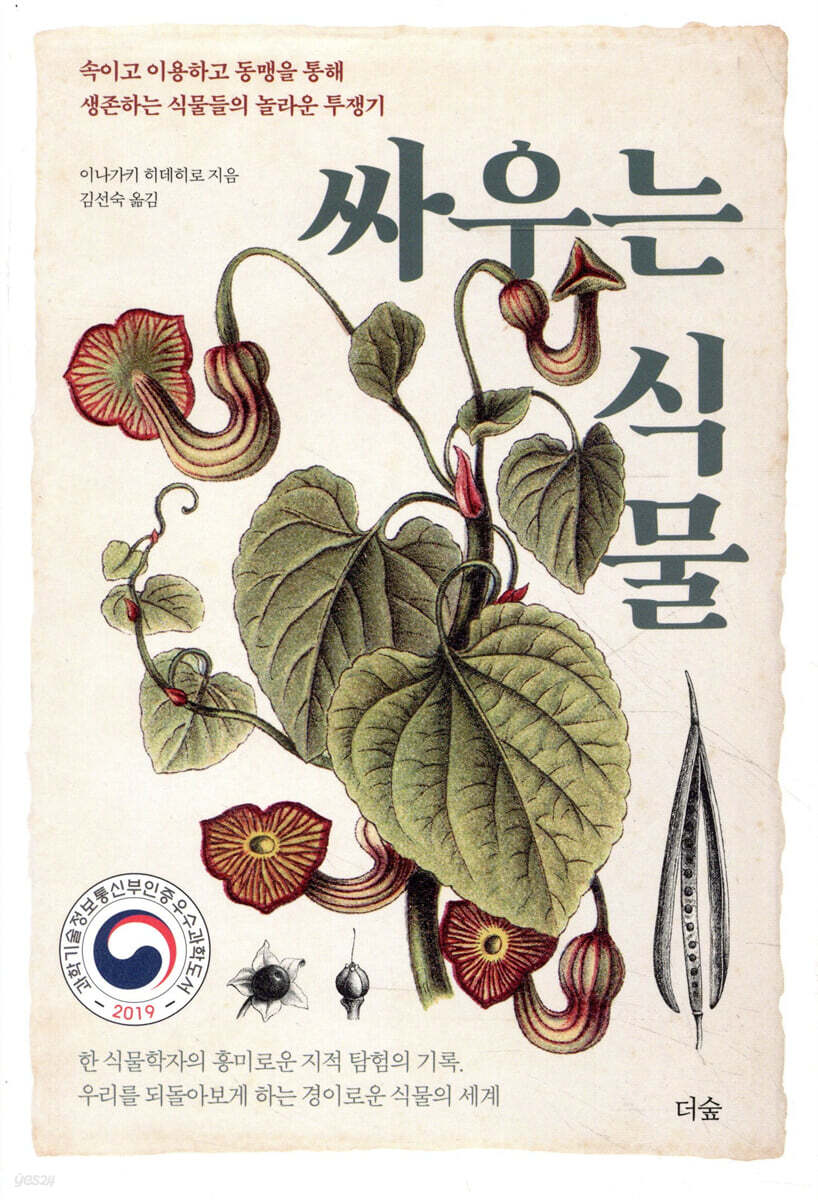
fighting plants
 |
Description
Book Introduction
“Even plants that appear peaceful actually live in fierce battles.”
A guide to the wondrous world of plants we never knew existed.
A record of a botanist's fascinating intellectual explorations
Unlike animals, the seemingly static and passive world of plants—is it truly as peaceful as it appears? The author, a leading Japanese botanist and doctor of agricultural science, begins this book by revealing, through his extensive research and profound insight into plants, that "even seemingly peaceful plants actually live in fierce struggle, and that this is the truth of the natural world."
When it was published in Japan, "Fighting Plants" received attention with reviews such as "a book that changed our indifferent view of plants" and "a book that allows us to discover aspects of the lives of plants that we had previously overlooked."
This fascinating botany book, like a drama or documentary, shows the surprising strategies and tactics that plants employ in their struggles with everything around them, from the environment and pathogens to insects, animals, and humans, in the natural world, an arena for survival.
It vividly depicts the struggles of plants, often considered the 'weak', against various opponents for survival.
Plants employ a variety of survival strategies, including deceiving, exploiting, betraying, and ultimately forming alliances with their enemies.
Some plants, such as pine and walnut trees, engage in an invisible chemical warfare that inhibits the growth of surrounding plants with substances released from their roots for their own growth. Other plants employ ants as bodyguards to protect themselves from pest attacks, and plant cells even resort to self-destruction as a last resort to prevent the spread of pathogens.
As the review suggests, "I would recommend this to my children to learn how difficult life is," the lives of plants are dynamic, much like a glimpse into human history.
You will be amazed and fascinated by the fact that immobile plants can survive and thrive in their own place, achieving success and balance.
A guide to the wondrous world of plants we never knew existed.
A record of a botanist's fascinating intellectual explorations
Unlike animals, the seemingly static and passive world of plants—is it truly as peaceful as it appears? The author, a leading Japanese botanist and doctor of agricultural science, begins this book by revealing, through his extensive research and profound insight into plants, that "even seemingly peaceful plants actually live in fierce struggle, and that this is the truth of the natural world."
When it was published in Japan, "Fighting Plants" received attention with reviews such as "a book that changed our indifferent view of plants" and "a book that allows us to discover aspects of the lives of plants that we had previously overlooked."
This fascinating botany book, like a drama or documentary, shows the surprising strategies and tactics that plants employ in their struggles with everything around them, from the environment and pathogens to insects, animals, and humans, in the natural world, an arena for survival.
It vividly depicts the struggles of plants, often considered the 'weak', against various opponents for survival.
Plants employ a variety of survival strategies, including deceiving, exploiting, betraying, and ultimately forming alliances with their enemies.
Some plants, such as pine and walnut trees, engage in an invisible chemical warfare that inhibits the growth of surrounding plants with substances released from their roots for their own growth. Other plants employ ants as bodyguards to protect themselves from pest attacks, and plant cells even resort to self-destruction as a last resort to prevent the spread of pathogens.
As the review suggests, "I would recommend this to my children to learn how difficult life is," the lives of plants are dynamic, much like a glimpse into human history.
You will be amazed and fascinated by the fact that immobile plants can survive and thrive in their own place, achieving success and balance.
- You can preview some of the book's contents.
Preview
index
Round 1 Plant vs. Plant
Plants fighting against the peaceful plant world
A fiercely competitive society | The fiercest competition for sunlight | The key to victory is growth speed - Morning glory observation diary | Why vines grow thin and long | There are many ways to wind them | Rose thorns are weapons for defense and attack | A terrifying killer who doesn't care about the means and methods | Can you grow quickly without suffering by relying on others? 25 | Parasites without stems or leaves | The identity of the world's largest flower | A devil without roots or leaves 32 | Invisible chemical warfare | No solo victory allowed | How is the balance of power maintained in the plant kingdom?
Round 2: Plants vs. Environment
The art of fighting to overcome hardship
Fighting is not easy even for the strong|Winning without fighting = CSR strategy|Survival method of the weak that turns adverse conditions into opportunities|Why do cacti have thorns|Power up with a turbo engine|Prevents moisture evaporation|The emergence of the high-performance twin cam engine|The roots grow when there is less water|They grow when dry|Weeds are weak|Opportunities lie in adversity and trials_The fate of weeds|Adversity is a favorable environment
Round 3: Plants vs. Pathogens
Plant defense mechanisms against pathogens
Antibacterial substances in plants are the main characters of health products|Plants produce only what they need to survive|An emergency situation unfolds on a leaf one day|A battle over derivatives|The beginning of a fight|Oxygen was waste|The evolution of living things brought about by oxygen|The emergence of active oxygen, a weapon and defense system of plants|A desperate operation, 'Destruct yourself with the enemy!'|After the fight|Substances in plants with various effects|Plant kidnapped by the devil|A contract with the devil|Which side is in control?|The plant also strengthens itself|The history of fungi and plants that fought and coexisted|The symbiotic relationship between legumes and rhizobacteria|Symbiosis requires painstaking effort|The attitude of legumes toward rhizobacteria|Friendship for show|Symbiosis
Plants were born with | New symbiosis | An ecosystem called you
Round 4: Plants vs. Insects
Head-on collisions don't work
The only way to defeat a powerful enemy, poisoning|Chemical weapons made by plants|Why do people decorate windowsills with flowers in Europe|Why are there so many picky insects|Bad guys who use poison|Use it thoroughly|Even the stench is ineffective|Use weak poison_Pretend to be eaten and chase them away|Tactic to suppress appetite|You have to eat to survive_Insects counterattack|Humans who have caught the fisherman|Deceive with eggs|Send an SOS signal to the natural enemy|The appearance of an unexpected hero|Plant that hires bodyguards|Hire a bodyguard to live in|How pests persuade plant bodyguards|Even enemies take advantage of it|Is it profitable to deceive each other?
Round 5: Plants vs. Animals
How plants survive in a 'eat-and-be-eaten' relationship
The emergence of giant enemies, animals | How did plants fight against dinosaurs? | The expansion of angiosperms and the end of the dinosaur era | Dinosaurs that ate angiosperms | Poisonous plants drove out dinosaurs | How to protect yourself from new enemies | Evolve with your enemies rather than wishing them dead | The evolution of herbivores that overcame poison | Why not all plants are poisonous | Protect yourself with thorns | The mystery of thorns that drive away evil spirits | Plants with both poison and thorns | The evolution of plants that live in grasslands | The counterattack of herbivores | The defense strategy of grass plants that protect themselves by lowering their posture | The secret of grass plants that use adversity | Exploit by being eaten | The emergence of gymnosperms | The arrival of a new era | Green stays still, red goes away | Carefully select your colleagues | There is a reason why lemons are sour | Prevent monopolization with poisonous ingredients | The ovary is, after all, inedible | The differentiation strategy of apples | Animals can also take advantage
Round 6: Plants vs. Humans
An endless battle of exploitation and being exploited
What were apes like to plants? | The dramatic development of mankind | Grass plants are allies of mankind | Using toxic substances as plant protectors | Why children dislike bitter vegetables | Regaining vitality with weak toxic substances | We cannot live without toxic substances | Why do toxic substances make humans happy | The conspiracy of crops that fool humans so perfectly | The emergence of a persistent rebel | Overcoming weeding by changing similarly | Do weeds increase when weeds are pulled out? | Living by clinging to humans | Weeds, plants created by humans | Putting an end to the battle between humans and weeds - Development of herbicides | Emergence of super weeds that do not respond to herbicides | Fighting as good competitors
In the end, in the midst of the fight
Plants fighting against the peaceful plant world
A fiercely competitive society | The fiercest competition for sunlight | The key to victory is growth speed - Morning glory observation diary | Why vines grow thin and long | There are many ways to wind them | Rose thorns are weapons for defense and attack | A terrifying killer who doesn't care about the means and methods | Can you grow quickly without suffering by relying on others? 25 | Parasites without stems or leaves | The identity of the world's largest flower | A devil without roots or leaves 32 | Invisible chemical warfare | No solo victory allowed | How is the balance of power maintained in the plant kingdom?
Round 2: Plants vs. Environment
The art of fighting to overcome hardship
Fighting is not easy even for the strong|Winning without fighting = CSR strategy|Survival method of the weak that turns adverse conditions into opportunities|Why do cacti have thorns|Power up with a turbo engine|Prevents moisture evaporation|The emergence of the high-performance twin cam engine|The roots grow when there is less water|They grow when dry|Weeds are weak|Opportunities lie in adversity and trials_The fate of weeds|Adversity is a favorable environment
Round 3: Plants vs. Pathogens
Plant defense mechanisms against pathogens
Antibacterial substances in plants are the main characters of health products|Plants produce only what they need to survive|An emergency situation unfolds on a leaf one day|A battle over derivatives|The beginning of a fight|Oxygen was waste|The evolution of living things brought about by oxygen|The emergence of active oxygen, a weapon and defense system of plants|A desperate operation, 'Destruct yourself with the enemy!'|After the fight|Substances in plants with various effects|Plant kidnapped by the devil|A contract with the devil|Which side is in control?|The plant also strengthens itself|The history of fungi and plants that fought and coexisted|The symbiotic relationship between legumes and rhizobacteria|Symbiosis requires painstaking effort|The attitude of legumes toward rhizobacteria|Friendship for show|Symbiosis
Plants were born with | New symbiosis | An ecosystem called you
Round 4: Plants vs. Insects
Head-on collisions don't work
The only way to defeat a powerful enemy, poisoning|Chemical weapons made by plants|Why do people decorate windowsills with flowers in Europe|Why are there so many picky insects|Bad guys who use poison|Use it thoroughly|Even the stench is ineffective|Use weak poison_Pretend to be eaten and chase them away|Tactic to suppress appetite|You have to eat to survive_Insects counterattack|Humans who have caught the fisherman|Deceive with eggs|Send an SOS signal to the natural enemy|The appearance of an unexpected hero|Plant that hires bodyguards|Hire a bodyguard to live in|How pests persuade plant bodyguards|Even enemies take advantage of it|Is it profitable to deceive each other?
Round 5: Plants vs. Animals
How plants survive in a 'eat-and-be-eaten' relationship
The emergence of giant enemies, animals | How did plants fight against dinosaurs? | The expansion of angiosperms and the end of the dinosaur era | Dinosaurs that ate angiosperms | Poisonous plants drove out dinosaurs | How to protect yourself from new enemies | Evolve with your enemies rather than wishing them dead | The evolution of herbivores that overcame poison | Why not all plants are poisonous | Protect yourself with thorns | The mystery of thorns that drive away evil spirits | Plants with both poison and thorns | The evolution of plants that live in grasslands | The counterattack of herbivores | The defense strategy of grass plants that protect themselves by lowering their posture | The secret of grass plants that use adversity | Exploit by being eaten | The emergence of gymnosperms | The arrival of a new era | Green stays still, red goes away | Carefully select your colleagues | There is a reason why lemons are sour | Prevent monopolization with poisonous ingredients | The ovary is, after all, inedible | The differentiation strategy of apples | Animals can also take advantage
Round 6: Plants vs. Humans
An endless battle of exploitation and being exploited
What were apes like to plants? | The dramatic development of mankind | Grass plants are allies of mankind | Using toxic substances as plant protectors | Why children dislike bitter vegetables | Regaining vitality with weak toxic substances | We cannot live without toxic substances | Why do toxic substances make humans happy | The conspiracy of crops that fool humans so perfectly | The emergence of a persistent rebel | Overcoming weeding by changing similarly | Do weeds increase when weeds are pulled out? | Living by clinging to humans | Weeds, plants created by humans | Putting an end to the battle between humans and weeds - Development of herbicides | Emergence of super weeds that do not respond to herbicides | Fighting as good competitors
In the end, in the midst of the fight
Detailed image
Into the book
Plants that cannot survive without sunlight compete with each other by spreading their leaves to receive sunlight.
Since all plants spread their leaves to receive sunlight, they must occupy a higher position than other plants to get more sunlight.
In this way, plants grow upwards while competing with each other.
Even if a plant tries to grow faster than other plants, it is difficult for it to grow exceptionally because its competitors are also growing at the same rate.
Since any plant is trying to grow as quickly as possible, it appears that all plants grow the same, like measuring the height of an acorn.
This is the phenomenon of 'just enough height'.
Even though the newly sprouted leaves spread their blades upwards, if the leaves grow thickly, the lower part becomes shaded and cannot receive sunlight.
Then the leaves at the bottom lose their function and fall off.
The situation is that only the leaves on top are spreading out.
When you enter the forest, the leaves are gathered only at the top, as if covered by a roof.
The leaves at the bottom fell off because they didn't get enough sunlight.
This appearance of leaves gathered only at the top is called a tree crown or grass crown.
If you look up from beneath the forest, you can see that the various leaves are intertwined to form a crown, like a jigsaw puzzle.
In this way, plants form a forest by competing for space and surrounding sunlight.
---From "The Fierce Competition Surrounding Sunlight"
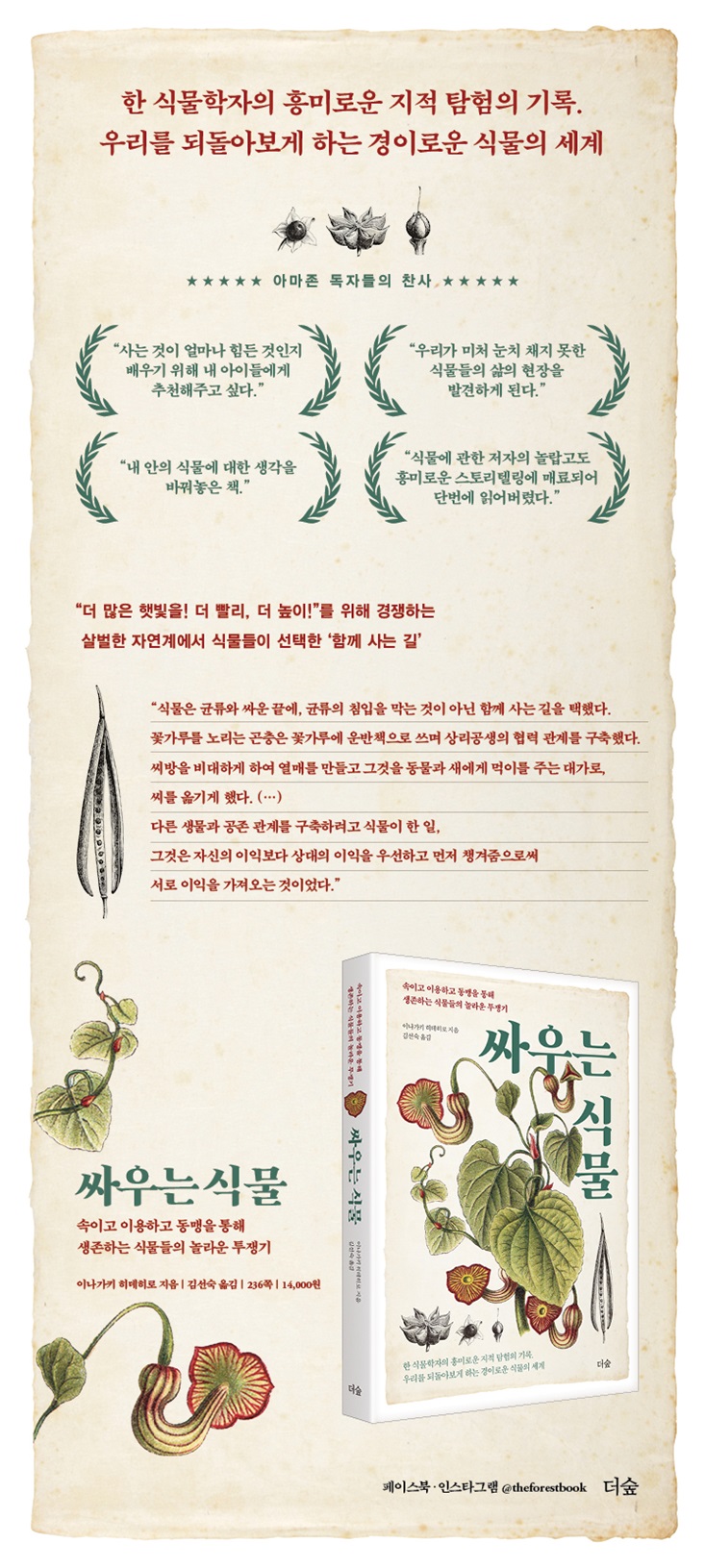
Some plants are more hospitable and accept ants, trying to win them over.
Surprisingly, the plant attracts ants by providing not only food but also a home for the ant family to live in.
These plants, called 'ant plants', create spaces within their branches and allow ants to live there.
Of course, the food to feed the ants is also luxurious.
It provides ants with all nutrients, including sugars such as honey, as well as proteins and lipids.
Thanks to this, ants can live on this plant.
Instead, ants protect the plants from insects such as caterpillars that try to eat the leaves.
Unfortunately, in areas with cold winters, ants cannot remain in trees year-round, as they must nest underground to overwinter.
It is unlikely that any plants will appear that provide habitat for ants.
In tropical regions where there is no need to worry about overwintering, plants belonging to various families, such as the Pepper family, the Nettle family, the Leguminosae family, the Euphorbiaceae family, the Passionaceae family, the Clematis family, the Rubus chinensis family, and the Palm family, have evolved to coexist with ants in a similar system.
The tropical ants that I hired while begging for the plants to come to me are relieved to finally get the home they longed for.
Even when humans approach the plant, the ants show hostility and attack.
What a dependable bodyguard!
---From "Hiring a Security Guard"
When the fruit ripens, it turns red.
For example, fruits that ripen on trees, such as apples, peaches, persimmons, tangerines, and grapes, often have a reddish color, such as red, yellow, pink, or purple.
Fruits dyed red like this stand out.
The 'stop' signal was set to 'red' so that it could be seen from a distance.
Red light, which has a long wavelength, has the property of traveling farther than other colors of light.
That is why the fruit is chosen to be red so that it can be easily recognized from a distance.
Also, since plants are green, red, the opposite color of green, is especially noticeable.
The unripe fruits are green like the leaves and are not easily visible.
Also, it tastes bitter rather than sweet.
This is to protect the fruit by accumulating bitter substances, as it would be difficult if the seeds were eaten while they were still unripe.
For example, tannins contained in bitter persimmons and momordicin and charantin contained in unripe green persimmons are substances used to preserve the fruit.
These fruits eventually become sweet as the seeds ripen, removing bitter substances and accumulating sugars.
Only after it has become this delicious do the berries change color from green to red, signaling that they are in season.
'Don't eat the green one.' 'Eat the red one.' These are the signals of the fruit.
---From "Green Stops, Red Goes"
Plants prepare toxic substances, whether large or small, to protect themselves.
But humans love the toxic components of this plant.
For example, beverages that humans enjoy, such as green tea, black tea, coffee, cocoa, and herbal tea, have both stimulating and calming effects.
All of these are weakly toxic components of plants that function.
The scents of plants, such as incense and potpourri, also heal and restore people.
In forests, various plants produce substances that keep pests and pathogens away.
People take forest baths in forests like this.
Why does forest air, saturated with plant toxins and other toxic substances, have such beneficial effects on humans? One factor is the hormesis effect.
Hormesis is a Greek word meaning 'stimulus'.
The poisons found in drinks, spices, and plants abundant in forests are not strong enough to harm humans.
It only acts to the extent that it acts as a stimulant to humans.
That is, the human body enters a defense system to protect life when stimulated by a weak poison.
That tension activates our ability to live and energizes us.
There's a fine line between poison and medicine.
If you consume a small amount of poison, it can be a good stimulus to the human body and act as medicine.
In fact, humans use most of the toxins that plants accumulate to kill microorganisms and insects as medicinal ingredients in herbal medicines.
Since all plants spread their leaves to receive sunlight, they must occupy a higher position than other plants to get more sunlight.
In this way, plants grow upwards while competing with each other.
Even if a plant tries to grow faster than other plants, it is difficult for it to grow exceptionally because its competitors are also growing at the same rate.
Since any plant is trying to grow as quickly as possible, it appears that all plants grow the same, like measuring the height of an acorn.
This is the phenomenon of 'just enough height'.
Even though the newly sprouted leaves spread their blades upwards, if the leaves grow thickly, the lower part becomes shaded and cannot receive sunlight.
Then the leaves at the bottom lose their function and fall off.
The situation is that only the leaves on top are spreading out.
When you enter the forest, the leaves are gathered only at the top, as if covered by a roof.
The leaves at the bottom fell off because they didn't get enough sunlight.
This appearance of leaves gathered only at the top is called a tree crown or grass crown.
If you look up from beneath the forest, you can see that the various leaves are intertwined to form a crown, like a jigsaw puzzle.
In this way, plants form a forest by competing for space and surrounding sunlight.
---From "The Fierce Competition Surrounding Sunlight"
Some plants are more hospitable and accept ants, trying to win them over.
Surprisingly, the plant attracts ants by providing not only food but also a home for the ant family to live in.
These plants, called 'ant plants', create spaces within their branches and allow ants to live there.
Of course, the food to feed the ants is also luxurious.
It provides ants with all nutrients, including sugars such as honey, as well as proteins and lipids.
Thanks to this, ants can live on this plant.
Instead, ants protect the plants from insects such as caterpillars that try to eat the leaves.
Unfortunately, in areas with cold winters, ants cannot remain in trees year-round, as they must nest underground to overwinter.
It is unlikely that any plants will appear that provide habitat for ants.
In tropical regions where there is no need to worry about overwintering, plants belonging to various families, such as the Pepper family, the Nettle family, the Leguminosae family, the Euphorbiaceae family, the Passionaceae family, the Clematis family, the Rubus chinensis family, and the Palm family, have evolved to coexist with ants in a similar system.
The tropical ants that I hired while begging for the plants to come to me are relieved to finally get the home they longed for.
Even when humans approach the plant, the ants show hostility and attack.
What a dependable bodyguard!
---From "Hiring a Security Guard"
When the fruit ripens, it turns red.
For example, fruits that ripen on trees, such as apples, peaches, persimmons, tangerines, and grapes, often have a reddish color, such as red, yellow, pink, or purple.
Fruits dyed red like this stand out.
The 'stop' signal was set to 'red' so that it could be seen from a distance.
Red light, which has a long wavelength, has the property of traveling farther than other colors of light.
That is why the fruit is chosen to be red so that it can be easily recognized from a distance.
Also, since plants are green, red, the opposite color of green, is especially noticeable.
The unripe fruits are green like the leaves and are not easily visible.
Also, it tastes bitter rather than sweet.
This is to protect the fruit by accumulating bitter substances, as it would be difficult if the seeds were eaten while they were still unripe.
For example, tannins contained in bitter persimmons and momordicin and charantin contained in unripe green persimmons are substances used to preserve the fruit.
These fruits eventually become sweet as the seeds ripen, removing bitter substances and accumulating sugars.
Only after it has become this delicious do the berries change color from green to red, signaling that they are in season.
'Don't eat the green one.' 'Eat the red one.' These are the signals of the fruit.
---From "Green Stops, Red Goes"
Plants prepare toxic substances, whether large or small, to protect themselves.
But humans love the toxic components of this plant.
For example, beverages that humans enjoy, such as green tea, black tea, coffee, cocoa, and herbal tea, have both stimulating and calming effects.
All of these are weakly toxic components of plants that function.
The scents of plants, such as incense and potpourri, also heal and restore people.
In forests, various plants produce substances that keep pests and pathogens away.
People take forest baths in forests like this.
Why does forest air, saturated with plant toxins and other toxic substances, have such beneficial effects on humans? One factor is the hormesis effect.
Hormesis is a Greek word meaning 'stimulus'.
The poisons found in drinks, spices, and plants abundant in forests are not strong enough to harm humans.
It only acts to the extent that it acts as a stimulant to humans.
That is, the human body enters a defense system to protect life when stimulated by a weak poison.
That tension activates our ability to live and energizes us.
There's a fine line between poison and medicine.
If you consume a small amount of poison, it can be a good stimulus to the human body and act as medicine.
In fact, humans use most of the toxins that plants accumulate to kill microorganisms and insects as medicinal ingredients in herbal medicines.
---From "Reviving Vitality with Weak Ingredients"
Publisher's Review
“More sunlight! Faster, higher!”
After a battle with the environment, pathogens, insects, animals and humans,
The 'way to live together' chosen by plants
As the author says, “To survive in a competitive society, you must possess considerable competitiveness.” This book is a fascinating scientific essay that tells the story of plants that have developed diverse and wise survival strategies despite being in a weak position.
Plants engage in a constant battle with all living things around them, but in a natural world without morals or rules, there are no creatures that help each other.
So, what path did plants choose after their long struggle? Ironically, the author answers, "Plants have achieved a state of mutual benefit by prioritizing the interests of others over their own, fostering a relationship of coexistence with other living things."
In short, after fighting with fungi, plants chose to live with them rather than prevent their invasion.
Insects that target pollen serve as pollen transporters and form a mutualistic cooperative relationship.
They enlarged their ovaries to produce fruits, which they fed to animals and birds in return for transporting the seeds.
In the harsh world of nature, plants fight only for their own safety, but the fact that they end up coexisting with their enemies is very suggestive.
Winning together, not through individual victory, but through alliance and solidarity, can provide a profound awakening to the world we live in.
The author concludes by warning, “Whether it is right for plants to choose to ‘coexist’ with other creatures, or whether it is right for humans to drive other creatures to extinction instead of allowing them to survive, the answer will soon be revealed,” thereby providing an opportunity for humanity to fundamentally reflect on how we should live in the future.
Are plants victims of human selfish desires?
A Plant Rebellion That Overturns Stereotypes
Plants have toxic substances in their bodies to protect themselves from attacks by mammals, but there are creatures that even use these poisons.
That is humanity.
Humans not only enjoy eating bitter-tasting herbs like mugwort and burdock, and spicy horseradish and mustard because of their toxic substances, but they also become addicted to and dependent on caffeine from coffee and nicotine from cigarettes.
In this way, from the perspective of plants, humans are difficult to understand beings who even use the weapons they have painstakingly prepared against them.
It almost seems as if humans have the upper hand and can control the plants at will.
However, the author says, “Humans think they are using plants, but it may be that plants are actually using humans by fooling them.” This shows that humans and plants have a complementary relationship in which they ‘use and are used.’
Although humans have been modifying plants to suit their needs, we can glimpse the plants' ingenious strategies in that we actually play a significant role in transporting plant seeds around the world.
Although they may seem quiet and passive, plants have developed and evolved more intelligent survival skills than any other living organism.
This book overturns the stereotype of plants as victims of human selfishness and sheds new light on them, thereby portraying the structure of plants and the natural world in a three-dimensional way.
It also allows us to look at the world from the perspective of others and reflect on the meaning of life.
After a battle with the environment, pathogens, insects, animals and humans,
The 'way to live together' chosen by plants
As the author says, “To survive in a competitive society, you must possess considerable competitiveness.” This book is a fascinating scientific essay that tells the story of plants that have developed diverse and wise survival strategies despite being in a weak position.
Plants engage in a constant battle with all living things around them, but in a natural world without morals or rules, there are no creatures that help each other.
So, what path did plants choose after their long struggle? Ironically, the author answers, "Plants have achieved a state of mutual benefit by prioritizing the interests of others over their own, fostering a relationship of coexistence with other living things."
In short, after fighting with fungi, plants chose to live with them rather than prevent their invasion.
Insects that target pollen serve as pollen transporters and form a mutualistic cooperative relationship.
They enlarged their ovaries to produce fruits, which they fed to animals and birds in return for transporting the seeds.
In the harsh world of nature, plants fight only for their own safety, but the fact that they end up coexisting with their enemies is very suggestive.
Winning together, not through individual victory, but through alliance and solidarity, can provide a profound awakening to the world we live in.
The author concludes by warning, “Whether it is right for plants to choose to ‘coexist’ with other creatures, or whether it is right for humans to drive other creatures to extinction instead of allowing them to survive, the answer will soon be revealed,” thereby providing an opportunity for humanity to fundamentally reflect on how we should live in the future.
Are plants victims of human selfish desires?
A Plant Rebellion That Overturns Stereotypes
Plants have toxic substances in their bodies to protect themselves from attacks by mammals, but there are creatures that even use these poisons.
That is humanity.
Humans not only enjoy eating bitter-tasting herbs like mugwort and burdock, and spicy horseradish and mustard because of their toxic substances, but they also become addicted to and dependent on caffeine from coffee and nicotine from cigarettes.
In this way, from the perspective of plants, humans are difficult to understand beings who even use the weapons they have painstakingly prepared against them.
It almost seems as if humans have the upper hand and can control the plants at will.
However, the author says, “Humans think they are using plants, but it may be that plants are actually using humans by fooling them.” This shows that humans and plants have a complementary relationship in which they ‘use and are used.’
Although humans have been modifying plants to suit their needs, we can glimpse the plants' ingenious strategies in that we actually play a significant role in transporting plant seeds around the world.
Although they may seem quiet and passive, plants have developed and evolved more intelligent survival skills than any other living organism.
This book overturns the stereotype of plants as victims of human selfishness and sheds new light on them, thereby portraying the structure of plants and the natural world in a three-dimensional way.
It also allows us to look at the world from the perspective of others and reflect on the meaning of life.
GOODS SPECIFICS
- Date of issue: November 2, 2018
- Page count, weight, size: 236 pages | 330g | 130*190*20mm
- ISBN13: 9791186900710
- ISBN10: 1186900717
You may also like
카테고리
korean


korean

![GQ KOREA Mark (Monthly): December [2025]](http://librairie.coreenne.fr/cdn/shop/files/8ef265dbbfbf186523ed75ba7319009d.jpg?v=1765340328&width=3840)


