

NEWTON HIGHLIGHT 122 High School Chemistry
 |
Description
Book Introduction
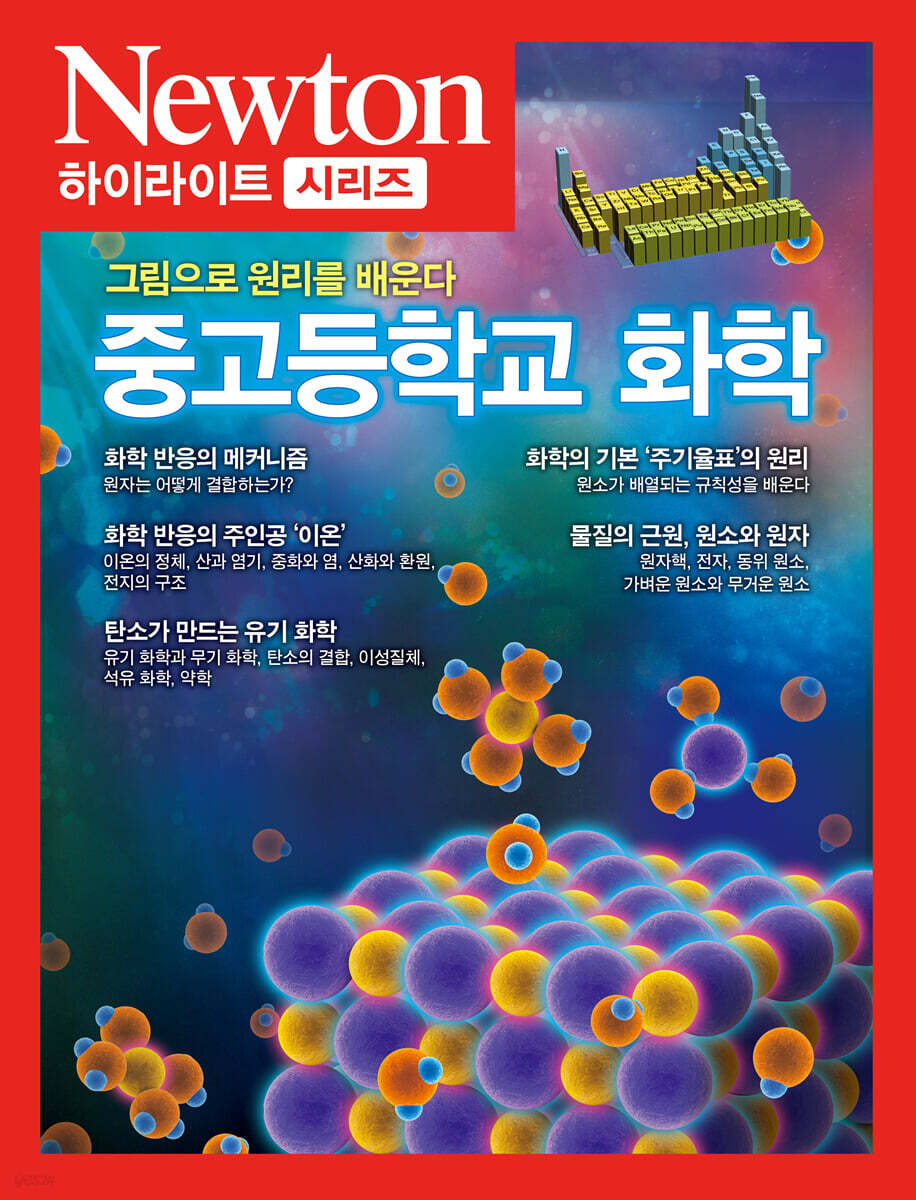
See the principles of chemistry with your own eyes
Anything in this world is easy if you know the principle.
The amount and depth of chemistry learned in middle and high school increases significantly as you advance in grade.
So, if you don't lay a solid foundation, it will be difficult to understand the various contents that unfold afterwards.
Chemistry, in particular, is a subject that deals with changes in invisible phenomena.
Although it may seem difficult, chemistry is actually based on surprisingly simple principles.
This book begins with the story of atoms that create matter, and then goes on to introduce the periodic table, a 'guide' to chemistry, the characteristics of elements, chemical bonds and chemical reactions, and organic chemistry, in which carbon plays a leading role, from the basics to applications.
Chapter 1 analyzes atoms, the source of matter.
Organize the concepts of the nucleus and electrons, the role of electrons, elements, and atoms.
In Chapter 2, we will learn about the principles of the periodic table, the foundation and pillar of chemistry.
You can fully understand the periodic table through the principles of electron configuration, ions, metals, transition elements, noble gases, rare earth elements, and flame reactions.
In Chapter 3, we learn about chemical bonding.
We learn about the bonding of atoms and molecules, changes in the state of matter, the properties of gases and the structure of solids, the concept of moles, semiconductors, etc.
The topic of Chapter 4 is ions and chemical reactions.
It covers the basic principles of ionic identity and combination, osmosis, acids and bases, neutralization and salts, oxidation and reduction, etc.
Finally, Chapter 5 describes the organic chemistry produced by carbon.
We will also delve into the scientific background of how carbon can be 'active' in organic chemistry, as well as the 'skeleton and decoration' of organic substances, isomers, artificial organic substances, and the relationship between petrochemistry and pharmacology.
I have no doubt that this book, with its over 400 world-class illustrations and photographs, and detailed yet accessible explanations, will be of great help to both students studying chemistry and those seeking a fresh understanding of the subject.
Anything in this world is easy if you know the principle.
The amount and depth of chemistry learned in middle and high school increases significantly as you advance in grade.
So, if you don't lay a solid foundation, it will be difficult to understand the various contents that unfold afterwards.
Chemistry, in particular, is a subject that deals with changes in invisible phenomena.
Although it may seem difficult, chemistry is actually based on surprisingly simple principles.
This book begins with the story of atoms that create matter, and then goes on to introduce the periodic table, a 'guide' to chemistry, the characteristics of elements, chemical bonds and chemical reactions, and organic chemistry, in which carbon plays a leading role, from the basics to applications.
Chapter 1 analyzes atoms, the source of matter.
Organize the concepts of the nucleus and electrons, the role of electrons, elements, and atoms.
In Chapter 2, we will learn about the principles of the periodic table, the foundation and pillar of chemistry.
You can fully understand the periodic table through the principles of electron configuration, ions, metals, transition elements, noble gases, rare earth elements, and flame reactions.
In Chapter 3, we learn about chemical bonding.
We learn about the bonding of atoms and molecules, changes in the state of matter, the properties of gases and the structure of solids, the concept of moles, semiconductors, etc.
The topic of Chapter 4 is ions and chemical reactions.
It covers the basic principles of ionic identity and combination, osmosis, acids and bases, neutralization and salts, oxidation and reduction, etc.
Finally, Chapter 5 describes the organic chemistry produced by carbon.
We will also delve into the scientific background of how carbon can be 'active' in organic chemistry, as well as the 'skeleton and decoration' of organic substances, isomers, artificial organic substances, and the relationship between petrochemistry and pharmacology.
I have no doubt that this book, with its over 400 world-class illustrations and photographs, and detailed yet accessible explanations, will be of great help to both students studying chemistry and those seeking a fresh understanding of the subject.
index
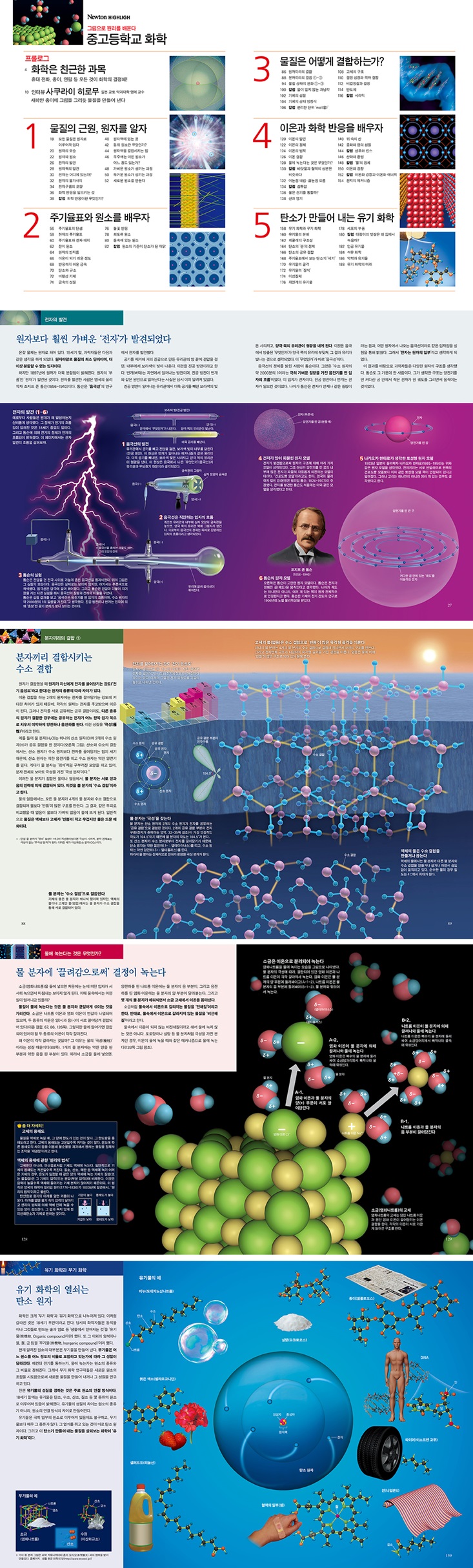
prolog
Science is a friendly subject
Everything from cell phones to paper and pencils is a crystallization of chemistry!
Interview with Hiromu Sakurai, Professor Emeritus, Kyoto University of Pharmaceutical Sciences, Japan
Create material as if drawing on a blank sheet of paper
Chapter 1: Understanding Atoms, the Origin of Matter
All matter is made of atoms / The shape of atoms / Atoms and elements / The discovery of electrons / The discovery of the atomic nucleus / Where are electrons? / The mystery of electrons / The shape of the electron cloud / What causes chemical reactions / What is in the atomic nucleus / What are isotopes? / The force that binds atomic nuclei / How many elements are there in the universe? / The process of forming light elements / The process of forming heavy elements / Creating new elements
* What is a column chemical reaction?
Chapter 2: Let's Learn About the Periodic Table and Elements
The birth of the periodic table / The current periodic table / The periodic table and electron configuration / Transition elements / Atomic radius / Ease of becoming ions / Reactive metals / Carbon and silicon / Noble gases / Properties of metals / Flame reaction / Rare earth elements / Elements in the body
* Why carbon became the standard for column elements
Chapter 3 How do substances combine?
Bonding between atoms / Bonding between molecules ①~③ / Changes in the state of matter ①~③ / Properties of gases / Equations of state of gases / Structure of solids / Crystal growth and lattice defects / Amorphous and crystals / Semiconductors
* Supercooling where the column water does not freeze
Column Convenient Unit 'mol'
Column Ceramic
Chapter 4: Let's Learn About Ions and Chemical Reactions
Discovery of ions / Identity of ions / Laws of ions / Ionic bonding / What does it mean to dissolve in water? / Depression of freezing point and elevation of boiling point / Does water conduct electricity? / Acids and bases / Acids in the stomach / Properties of neutralization and salts / Oxidation and reduction / Identity of column 'fire' / Tendency of ionization / Mechanism of batteries
* Column: Components of seawater and blood
Column osmotic pressure
Column shampoo and rinse
Column ionization trend and ionization energy
Chapter 5 Organic Chemistry Produced by Carbon
Organic and inorganic chemistry / decomposition of organic substances / Kekulé's structural theory / identity of the 'hand' of carbon / covalent bonds of carbon / the 'strength' of carbon as seen in the periodic table / skeleton of organic substances / 'decoration' of organic substances / isomers / organic substances in nature / parts of cells / artificial organic substances / petrochemistry / pharmacology and organic substances / the future of organic chemistry
* Why does the belly of a trout just melt in your mouth?
Science is a friendly subject
Everything from cell phones to paper and pencils is a crystallization of chemistry!
Interview with Hiromu Sakurai, Professor Emeritus, Kyoto University of Pharmaceutical Sciences, Japan
Create material as if drawing on a blank sheet of paper
Chapter 1: Understanding Atoms, the Origin of Matter
All matter is made of atoms / The shape of atoms / Atoms and elements / The discovery of electrons / The discovery of the atomic nucleus / Where are electrons? / The mystery of electrons / The shape of the electron cloud / What causes chemical reactions / What is in the atomic nucleus / What are isotopes? / The force that binds atomic nuclei / How many elements are there in the universe? / The process of forming light elements / The process of forming heavy elements / Creating new elements
* What is a column chemical reaction?
Chapter 2: Let's Learn About the Periodic Table and Elements
The birth of the periodic table / The current periodic table / The periodic table and electron configuration / Transition elements / Atomic radius / Ease of becoming ions / Reactive metals / Carbon and silicon / Noble gases / Properties of metals / Flame reaction / Rare earth elements / Elements in the body
* Why carbon became the standard for column elements
Chapter 3 How do substances combine?
Bonding between atoms / Bonding between molecules ①~③ / Changes in the state of matter ①~③ / Properties of gases / Equations of state of gases / Structure of solids / Crystal growth and lattice defects / Amorphous and crystals / Semiconductors
* Supercooling where the column water does not freeze
Column Convenient Unit 'mol'
Column Ceramic
Chapter 4: Let's Learn About Ions and Chemical Reactions
Discovery of ions / Identity of ions / Laws of ions / Ionic bonding / What does it mean to dissolve in water? / Depression of freezing point and elevation of boiling point / Does water conduct electricity? / Acids and bases / Acids in the stomach / Properties of neutralization and salts / Oxidation and reduction / Identity of column 'fire' / Tendency of ionization / Mechanism of batteries
* Column: Components of seawater and blood
Column osmotic pressure
Column shampoo and rinse
Column ionization trend and ionization energy
Chapter 5 Organic Chemistry Produced by Carbon
Organic and inorganic chemistry / decomposition of organic substances / Kekulé's structural theory / identity of the 'hand' of carbon / covalent bonds of carbon / the 'strength' of carbon as seen in the periodic table / skeleton of organic substances / 'decoration' of organic substances / isomers / organic substances in nature / parts of cells / artificial organic substances / petrochemistry / pharmacology and organic substances / the future of organic chemistry
* Why does the belly of a trout just melt in your mouth?
Detailed image
Publisher's Review
The principles of the periodic table, the starting point of chemistry, and the laws of chemistry are explained with over 400 illustrations and photographs.
The starting point of chemistry is the periodic table.
The basis of chemistry is elements, and the periodic table clearly organizes the properties and principles of elements, such as the arrangement of electrons.
Again, elements combine and react according to clear principles.
Therefore, if you make these basic principles your own, you will be fully prepared for any subsequent application.
This book, "Middle and High School Chemistry," explains all the content covered in middle and high school courses using over 400 illustrations and photographs.
You can make all the chemistry principles you learn in school your own by seeing them with your own eyes.
It is composed of unique graphics that help you understand the characteristics of elements at a glance, such as a three-dimensional periodic table.
The content of chemistry is made up of numerous elements, principles, and laws, such as elements, atoms, electrons, combinations of atoms, ions, and molecules, gases, liquids, and solids, acids, bases, and neutralization, oxidation, and reduction.
Visual aids play a crucial role in organizing and understanding these complex contents.
In "Middle and High School Chemistry," numerous principles of chemistry are visually presented using unique graphics developed through Newton's long-standing expertise, such as the three-dimensional periodic table.
Understand the invisible chemical changes with world-class illustrations and expert explanations.
It is not easy to understand what is invisible.
The more such a subject is, the more the importance of graphics is emphasized.
Newton Science Magazine is a science magazine known for conveying all fields of science with world-class graphics.
Newton's "Middle and High School Chemistry" also shows the process of chemical change with detailed drawings and photographs, as well as easy-to-understand explanations by experts.
A detailed explanation of the fundamentals and applications of organic chemistry, including the atoms, the source of matter, the combination of substances, and the ions, the main characters of chemical reactions.
『Middle and High School Chemistry』 is divided into a total of 5 chapters.
That is, atoms, the periodic table and elements, chemical bonds, ions and chemical reactions, and organic chemistry made of carbon.
Each of these contents is structured to start from the basics and gradually progress to the applied level.
As you visually understand each content through pictures, the overall structure of chemistry will be organized in your head.
The 122nd science book in the Newton Highlights series
The science magazine is publishing a new type of science book called the 'Newton Highlight Series' by reorganizing only the articles that received particularly high reader response by topic.
『Middle and High School Chemistry』 is the 122nd book, and is selling well along with 『Theory of Relativity』, 『Quantum Theory』, 『Brain and Neurons』, 『Differentiation and Integration』, and 『The Amazing World of Mathematics』.
The starting point of chemistry is the periodic table.
The basis of chemistry is elements, and the periodic table clearly organizes the properties and principles of elements, such as the arrangement of electrons.
Again, elements combine and react according to clear principles.
Therefore, if you make these basic principles your own, you will be fully prepared for any subsequent application.
This book, "Middle and High School Chemistry," explains all the content covered in middle and high school courses using over 400 illustrations and photographs.
You can make all the chemistry principles you learn in school your own by seeing them with your own eyes.
It is composed of unique graphics that help you understand the characteristics of elements at a glance, such as a three-dimensional periodic table.
The content of chemistry is made up of numerous elements, principles, and laws, such as elements, atoms, electrons, combinations of atoms, ions, and molecules, gases, liquids, and solids, acids, bases, and neutralization, oxidation, and reduction.
Visual aids play a crucial role in organizing and understanding these complex contents.
In "Middle and High School Chemistry," numerous principles of chemistry are visually presented using unique graphics developed through Newton's long-standing expertise, such as the three-dimensional periodic table.
Understand the invisible chemical changes with world-class illustrations and expert explanations.
It is not easy to understand what is invisible.
The more such a subject is, the more the importance of graphics is emphasized.
Newton Science Magazine is a science magazine known for conveying all fields of science with world-class graphics.
Newton's "Middle and High School Chemistry" also shows the process of chemical change with detailed drawings and photographs, as well as easy-to-understand explanations by experts.
A detailed explanation of the fundamentals and applications of organic chemistry, including the atoms, the source of matter, the combination of substances, and the ions, the main characters of chemical reactions.
『Middle and High School Chemistry』 is divided into a total of 5 chapters.
That is, atoms, the periodic table and elements, chemical bonds, ions and chemical reactions, and organic chemistry made of carbon.
Each of these contents is structured to start from the basics and gradually progress to the applied level.
As you visually understand each content through pictures, the overall structure of chemistry will be organized in your head.
The 122nd science book in the Newton Highlights series
The science magazine is publishing a new type of science book called the 'Newton Highlight Series' by reorganizing only the articles that received particularly high reader response by topic.
『Middle and High School Chemistry』 is the 122nd book, and is selling well along with 『Theory of Relativity』, 『Quantum Theory』, 『Brain and Neurons』, 『Differentiation and Integration』, and 『The Amazing World of Mathematics』.
GOODS SPECIFICS
- Date of issue: September 12, 2018
- Page count, weight, size: 144 pages | 620g | 210*275*20mm
- ISBN13: 9791161960395
You may also like
카테고리
korean


korean

![GQ KOREA Mark (Monthly): December [2025]](http://librairie.coreenne.fr/cdn/shop/files/8ef265dbbfbf186523ed75ba7319009d.jpg?v=1765340328&width=3840)


