

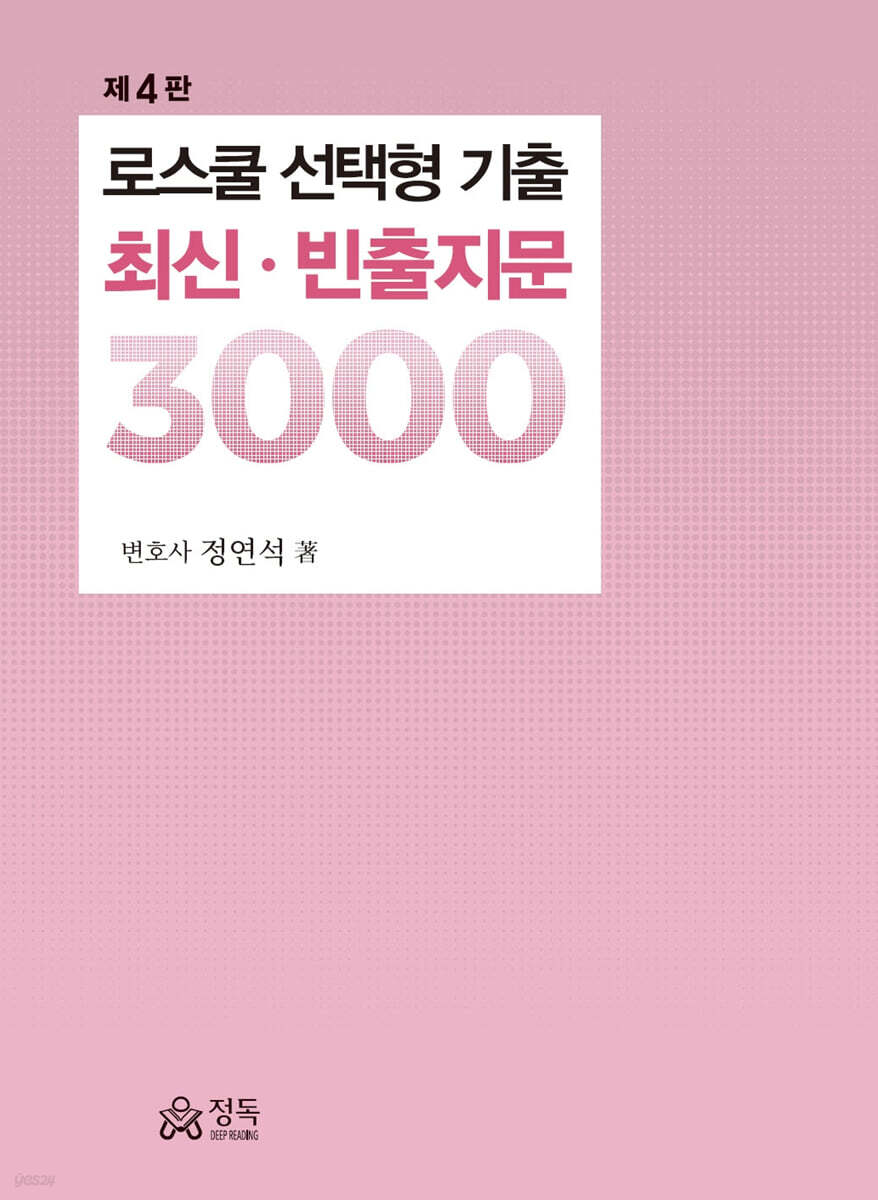
3000 Latest and Frequently Asked Questions from Law School Elective Exams
 |
Description
Book Introduction
preface
We sincerely thank our readers for their warm support of this book, first published in 2022.
Please be sure to read the "Preface to the First Edition" below to learn about the reasons for publishing a book like this one, its strengths, writing and editing methods, and specific ways to use it.
This year, you can fully experience the full use of this book in the lecture “2025 [FINAL] Civil Law Elective Latest Textbook 3000.”
In this course, which is less than 30 hours long, we will read, explain, and organize expected passages from “almost all of the text in this book” without exception.
If test takers can organize ① “all” passages that have appeared “more than 3 times” in the bar exam and the Law Society mock exams for the past 14-15 years with that amount of time invested in this book, and ② “all” passages that have appeared in the bar exam and the Law Society mock exams for the “last 3 years” (2023, 2024, 2025), I am confident that a significant portion of the major concerns about the civil law multiple-choice section at the end of the exam will be resolved.
Meanwhile, this year's 4th edition has added one edit: among the passages that appeared "for the first time" in the mock exam of the Korean Bar Association in 2025, ① very important recent precedents, ② cases where the passage is not recent but has a high level of application and is important, and ③ cases where case-based or record-based questions are likely to be asked, the passage itself has been marked in "bold".
As a result, test takers will be able to prioritize the “essential repetition passages” that are important to them, such as “① red asterisks, ② bold, ③ supplementary but with asterisks,” and it is essential to have your own priority markings like this.
I would like to express my deepest gratitude to MegaMD, MegaRoyals, and Jeongdok Publishing for their hard work in bringing this book to fruition. I believe that all readers who study with this book will achieve the highest scores ever achieved on the multiple-choice section of the bar exam.
thank you
2025.
11.
Attorney Jeong Yeon-seok
We sincerely thank our readers for their warm support of this book, first published in 2022.
Please be sure to read the "Preface to the First Edition" below to learn about the reasons for publishing a book like this one, its strengths, writing and editing methods, and specific ways to use it.
This year, you can fully experience the full use of this book in the lecture “2025 [FINAL] Civil Law Elective Latest Textbook 3000.”
In this course, which is less than 30 hours long, we will read, explain, and organize expected passages from “almost all of the text in this book” without exception.
If test takers can organize ① “all” passages that have appeared “more than 3 times” in the bar exam and the Law Society mock exams for the past 14-15 years with that amount of time invested in this book, and ② “all” passages that have appeared in the bar exam and the Law Society mock exams for the “last 3 years” (2023, 2024, 2025), I am confident that a significant portion of the major concerns about the civil law multiple-choice section at the end of the exam will be resolved.
Meanwhile, this year's 4th edition has added one edit: among the passages that appeared "for the first time" in the mock exam of the Korean Bar Association in 2025, ① very important recent precedents, ② cases where the passage is not recent but has a high level of application and is important, and ③ cases where case-based or record-based questions are likely to be asked, the passage itself has been marked in "bold".
As a result, test takers will be able to prioritize the “essential repetition passages” that are important to them, such as “① red asterisks, ② bold, ③ supplementary but with asterisks,” and it is essential to have your own priority markings like this.
I would like to express my deepest gratitude to MegaMD, MegaRoyals, and Jeongdok Publishing for their hard work in bringing this book to fruition. I believe that all readers who study with this book will achieve the highest scores ever achieved on the multiple-choice section of the bar exam.
thank you
2025.
11.
Attorney Jeong Yeon-seok
index
Part 1 Civil Law
Part 1 General Bonds
Chapter 2 Purpose of Bonds
Chapter 3 Effect of Bonds
Chapter 4 Assignment of Claims and Assumption of Debts
Chapter 5 Extinction of Bonds
Chapter 6: Creditors and Debtors
Part 2 Bond Theory
Chapter 7 Individual Creditor Relationships
Part 3 General Provisions of Civil Law
Chapter 1 General Civil Law
Chapter 3 Subjects of Rights
Chapter 4 Objects of Rights
Chapter 5 Changes in Rights
Part 4 Property Law
Chapter 2 General Provisions of Property Law
Chapter 3: Provisions of Property Law
Part 2 Civil Procedure Act
Part 5 General Provisions, Subjects of Litigation
Part 1 General Theory
Part 2 Subjects of the Litigation
Chapter 1 Court
Chapter 2 Parties
Part 6 First-instance litigation procedures
Part 3 First Trial Procedure
Chapter 2 Argument
Chapter 3 Evidence
Part 7 Termination of Litigation
Part 4: Termination of Litigation
Chapter 1 Reasons for Termination of Litigation
Chapter 2 Termination by Acts of the Parties
Chapter 3 Termination by Final Judgment
Part 8 Consolidated Litigation
Part 5 Consolidated Litigation
Chapter 1 Consolidation Claims
Chapter 2 Multi-Party Litigation
Part 9 Appeals and Retrials
Part 6 Appeal Procedure
Part 7 Retrial Procedures
Part 10 Civil Execution Act, General Issues, etc.
Part 1 General Bonds
Chapter 2 Purpose of Bonds
Chapter 3 Effect of Bonds
Chapter 4 Assignment of Claims and Assumption of Debts
Chapter 5 Extinction of Bonds
Chapter 6: Creditors and Debtors
Part 2 Bond Theory
Chapter 7 Individual Creditor Relationships
Part 3 General Provisions of Civil Law
Chapter 1 General Civil Law
Chapter 3 Subjects of Rights
Chapter 4 Objects of Rights
Chapter 5 Changes in Rights
Part 4 Property Law
Chapter 2 General Provisions of Property Law
Chapter 3: Provisions of Property Law
Part 2 Civil Procedure Act
Part 5 General Provisions, Subjects of Litigation
Part 1 General Theory
Part 2 Subjects of the Litigation
Chapter 1 Court
Chapter 2 Parties
Part 6 First-instance litigation procedures
Part 3 First Trial Procedure
Chapter 2 Argument
Chapter 3 Evidence
Part 7 Termination of Litigation
Part 4: Termination of Litigation
Chapter 1 Reasons for Termination of Litigation
Chapter 2 Termination by Acts of the Parties
Chapter 3 Termination by Final Judgment
Part 8 Consolidated Litigation
Part 5 Consolidated Litigation
Chapter 1 Consolidation Claims
Chapter 2 Multi-Party Litigation
Part 9 Appeals and Retrials
Part 6 Appeal Procedure
Part 7 Retrial Procedures
Part 10 Civil Execution Act, General Issues, etc.
Publisher's Review
Preface to the First Edition
In March of this year, we published "Complete Analysis of Classic Past Exam Questions for Law School Electives (hereinafter referred to as "Law School Electives")" on Civil Law and Civil Procedure Law.
This textbook, while containing all of the multiple-choice questions from the 11-year bar exam and the Law Society mock exam, has pursued the utmost efficiency by deleting overlapping passages (however, if there were elements that should not have been deleted, they were retained; for detailed criteria, see the introduction to “Selection of Laws”), and marking frequently appearing passages with asterisks according to frequency, and indicating supplementary information for minor passages.
In addition, the expression of the commentary is consistent with my basic textbook, “Law School Civil Law/Civil Procedure Law Essentials,” to ensure consistency of data, and I have supplemented the original text of legal provisions that are not in the basic textbook by highlighting them (especially the Civil Procedure Act), and have also included detailed commentary on difficult case problems.
While taking advantage of this "selection of the text," I thought it would be good to have a textbook that would be useful for test takers who want to quickly study only the most frequently appearing and the latest texts in the period leading up to the exam, so I published this book, "The Classics of Civil Law Law School Elective Texts: 3000 Latest and Frequently Appearing Texts (hereinafter referred to as "this book")."
This book is also the textbook for the “2022 [FINAL] Civil Law Elective Latest Textbook 3000,” which will begin in mid-November.
I am planning to take the above lecture, and for the sake of readers who have "Roseonjeong," I have kept the question numbers in this book the same as "Roseonjeong."
If the questions added this year are provided to students as a supplementary material during class, it would be possible to take the course without purchasing the book.
However, the two textbooks have completely different pages, and as you can see below, older duplicate passages may be deleted, existing commentaries may be shortened, improved, or deleted altogether, so if you take the course with only the "Roseonjeong" textbook, you can expect some inconvenience.
This book is based on the mock exam of the Law Society in October 2022, and contains only ① passages that have appeared at least twice in the bar exam and mock exams over the past 12 years, and ② passages from the latest three-year bar exam and mock exams from 2020 to 2022.
Therefore, by looking at this book, you can see all the passages that appeared more than twice in the previous versions and mock exams, as well as all the passages for the 12 most recent exams over the past three years.
By the way, the origin of the signature '3000' in this book does not mean that there are exactly 3000 fingerprints, but that there are 51 questions on the Civil Code and Civil Procedure Act, and since there are an average of 5 fingerprints, it is a number multiplied by 12 times over 3 years (50 x 5 x 12 = 3000). All of the deleted fingerprints from the 3-year questions exist as duplicate fingerprints from 12 years, so if you add the duplicate fingerprints older than 3 years to this, you can think of it as having data of fingerprints that are actually far more than 3000, and from which duplicate fingerprints were deleted.
Even for this work, more detailed standards for fingerprint deletion were needed. Similar to the existing "Roseonjeong" organizing principles, ① the bar exam fingerprints were left rather than mock exam fingerprints, ② the most recent fingerprints were left rather than past fingerprints, and ③ even in the above cases, if the mock exam or past fingerprints had a better learning effect, those fingerprints were left.
Of course, I maintained the principle of leaving both duplicated fingerprints if they ask different questions or if the textbook parts are different, but since this is a final textbook, I deleted more than the "Roseonjeong" ones.
Meanwhile, considering that this is a final review textbook, the commentary has been simplified a bit, and in particular, in the case of very basic case law or well-known legal provisions, commentary that is merely repetitive has been deleted.
However, for incorrect passages, I have provided explanations whenever possible, and even for correct passages, if there is a possibility that the passage will be included in the case or record-based exam next year, I have left it as is because I thought it would be good to look at the passage at least once more.
This is because, especially in the case of ‘reasons’ established by case law, they are often omitted in multiple choice texts.
During the process of working on this book, the number of passages that appeared more than twice was greater than expected, so the book may be somewhat burdensome for a final review textbook. However, considering the structure of this book, such as the somewhat larger font size and margins compared to other textbooks, it will not be on the same level of page length as the 'OX passage collection' that is usually published.
However, if the volume is still burdensome, it can be sufficiently adjusted through taking the lectures mentioned above or through the reader's own choice.
In other words, the lecture above will be re-selecting and teaching more important passages for next year's bar exam, so you will be able to get enough help. Even if you are studying alone, you will be able to study according to your own needs through the color-coded indication of passages that have appeared 2-3 times and passages that have appeared 3-4 times or more, as well as the indication of the year of examination.
In this book, the same notation as in “Roseonjeong” has been left as is, but regarding the text to be supplemented to the basic book, the extracted materials and audio lecture files from throughout the 12 years will be uploaded separately to the notice section of the professor’s homepage in December, so there is no need to be too concerned about the supplementary notation when using this book.
However, it would be a good idea to take a close look at the passages that first appeared in the mock exam this year, 2022.
This book assigned the item number "SS" to the three new mock exams added this year to distinguish them from other questions. When adding SS questions, ① if the added questions overlapped with questions from past mock exams, the past questions were deleted and the SS questions were marked with an asterisk. ② If the questions overlapped with questions from the bar exam, the SS questions were deleted.
The revised edition of "Roseonjeong" will also be published next year with the same revisions (however, there may be changes in the process of reflecting the new questions from the 2023 bar exam).
I would like to express my deepest gratitude to the staff at MegaMD and MegaRoyers for their hard work in bringing this book to fruition. I believe that all readers of this book will find the "multiple-choice" section to be a driving force in their success on the bar exam.
thank you
2022.
11.
Attorney Jeong Yeon-seok
In March of this year, we published "Complete Analysis of Classic Past Exam Questions for Law School Electives (hereinafter referred to as "Law School Electives")" on Civil Law and Civil Procedure Law.
This textbook, while containing all of the multiple-choice questions from the 11-year bar exam and the Law Society mock exam, has pursued the utmost efficiency by deleting overlapping passages (however, if there were elements that should not have been deleted, they were retained; for detailed criteria, see the introduction to “Selection of Laws”), and marking frequently appearing passages with asterisks according to frequency, and indicating supplementary information for minor passages.
In addition, the expression of the commentary is consistent with my basic textbook, “Law School Civil Law/Civil Procedure Law Essentials,” to ensure consistency of data, and I have supplemented the original text of legal provisions that are not in the basic textbook by highlighting them (especially the Civil Procedure Act), and have also included detailed commentary on difficult case problems.
While taking advantage of this "selection of the text," I thought it would be good to have a textbook that would be useful for test takers who want to quickly study only the most frequently appearing and the latest texts in the period leading up to the exam, so I published this book, "The Classics of Civil Law Law School Elective Texts: 3000 Latest and Frequently Appearing Texts (hereinafter referred to as "this book")."
This book is also the textbook for the “2022 [FINAL] Civil Law Elective Latest Textbook 3000,” which will begin in mid-November.
I am planning to take the above lecture, and for the sake of readers who have "Roseonjeong," I have kept the question numbers in this book the same as "Roseonjeong."
If the questions added this year are provided to students as a supplementary material during class, it would be possible to take the course without purchasing the book.
However, the two textbooks have completely different pages, and as you can see below, older duplicate passages may be deleted, existing commentaries may be shortened, improved, or deleted altogether, so if you take the course with only the "Roseonjeong" textbook, you can expect some inconvenience.
This book is based on the mock exam of the Law Society in October 2022, and contains only ① passages that have appeared at least twice in the bar exam and mock exams over the past 12 years, and ② passages from the latest three-year bar exam and mock exams from 2020 to 2022.
Therefore, by looking at this book, you can see all the passages that appeared more than twice in the previous versions and mock exams, as well as all the passages for the 12 most recent exams over the past three years.
By the way, the origin of the signature '3000' in this book does not mean that there are exactly 3000 fingerprints, but that there are 51 questions on the Civil Code and Civil Procedure Act, and since there are an average of 5 fingerprints, it is a number multiplied by 12 times over 3 years (50 x 5 x 12 = 3000). All of the deleted fingerprints from the 3-year questions exist as duplicate fingerprints from 12 years, so if you add the duplicate fingerprints older than 3 years to this, you can think of it as having data of fingerprints that are actually far more than 3000, and from which duplicate fingerprints were deleted.
Even for this work, more detailed standards for fingerprint deletion were needed. Similar to the existing "Roseonjeong" organizing principles, ① the bar exam fingerprints were left rather than mock exam fingerprints, ② the most recent fingerprints were left rather than past fingerprints, and ③ even in the above cases, if the mock exam or past fingerprints had a better learning effect, those fingerprints were left.
Of course, I maintained the principle of leaving both duplicated fingerprints if they ask different questions or if the textbook parts are different, but since this is a final textbook, I deleted more than the "Roseonjeong" ones.
Meanwhile, considering that this is a final review textbook, the commentary has been simplified a bit, and in particular, in the case of very basic case law or well-known legal provisions, commentary that is merely repetitive has been deleted.
However, for incorrect passages, I have provided explanations whenever possible, and even for correct passages, if there is a possibility that the passage will be included in the case or record-based exam next year, I have left it as is because I thought it would be good to look at the passage at least once more.
This is because, especially in the case of ‘reasons’ established by case law, they are often omitted in multiple choice texts.
During the process of working on this book, the number of passages that appeared more than twice was greater than expected, so the book may be somewhat burdensome for a final review textbook. However, considering the structure of this book, such as the somewhat larger font size and margins compared to other textbooks, it will not be on the same level of page length as the 'OX passage collection' that is usually published.
However, if the volume is still burdensome, it can be sufficiently adjusted through taking the lectures mentioned above or through the reader's own choice.
In other words, the lecture above will be re-selecting and teaching more important passages for next year's bar exam, so you will be able to get enough help. Even if you are studying alone, you will be able to study according to your own needs through the color-coded indication of passages that have appeared 2-3 times and passages that have appeared 3-4 times or more, as well as the indication of the year of examination.
In this book, the same notation as in “Roseonjeong” has been left as is, but regarding the text to be supplemented to the basic book, the extracted materials and audio lecture files from throughout the 12 years will be uploaded separately to the notice section of the professor’s homepage in December, so there is no need to be too concerned about the supplementary notation when using this book.
However, it would be a good idea to take a close look at the passages that first appeared in the mock exam this year, 2022.
This book assigned the item number "SS" to the three new mock exams added this year to distinguish them from other questions. When adding SS questions, ① if the added questions overlapped with questions from past mock exams, the past questions were deleted and the SS questions were marked with an asterisk. ② If the questions overlapped with questions from the bar exam, the SS questions were deleted.
The revised edition of "Roseonjeong" will also be published next year with the same revisions (however, there may be changes in the process of reflecting the new questions from the 2023 bar exam).
I would like to express my deepest gratitude to the staff at MegaMD and MegaRoyers for their hard work in bringing this book to fruition. I believe that all readers of this book will find the "multiple-choice" section to be a driving force in their success on the bar exam.
thank you
2022.
11.
Attorney Jeong Yeon-seok
GOODS SPECIFICS
- Date of issue: November 20, 2025
- Page count, weight, size: 608 pages | 188*257*35mm
- ISBN13: 9791168584112
- ISBN10: 1168584116
You may also like
카테고리
korean


korean

![GQ KOREA Mark (Monthly): December [2025]](http://librairie.coreenne.fr/cdn/shop/files/8ef265dbbfbf186523ed75ba7319009d.jpg?v=1765340328&width=3840)


