

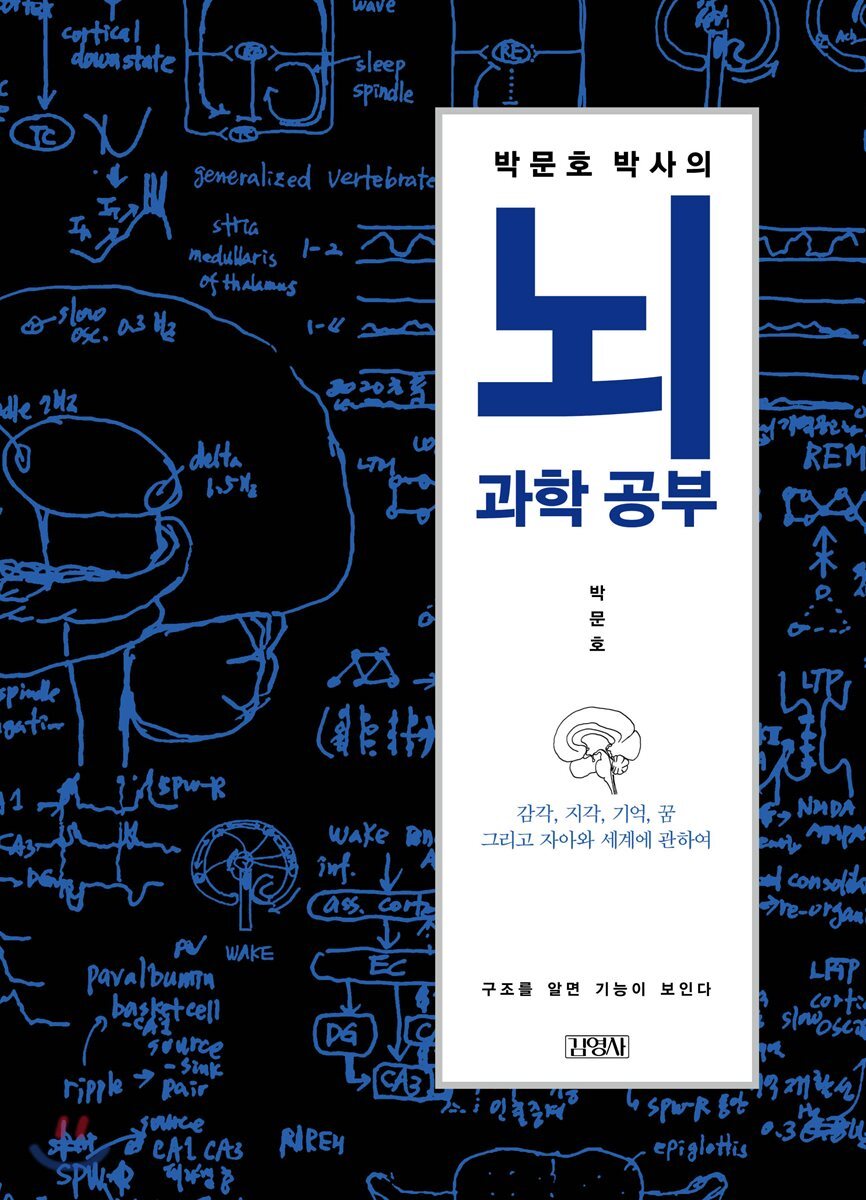
Dr. Park Moon-ho's study of brain science
 |
Description
Book Introduction
“If you know the structure, you can see the function.”
The culmination of 10 years of brain science research by Dr. Park Moon-ho, who sparked a brain science craze in Korea!
Contains 240 illustrations showing the brain's working mechanisms.
Understanding the structure and function of the brain!
Park Moon-ho, who has sparked a brain science craze in Korea through his regular classes on "Park Moon-ho's World of Natural Science," as well as lectures and writings at Seoul National University, KAIST, Buddhist TV, YTN Science, and other institutions, presents the culmination of his brain science research! Based on four years of lectures, this book presents a deeper understanding of the brain's structure and function.
Not only does it provide a detailed explanation of the anatomical mechanisms of brain function and guides you on how to draw and master them, it also densely covers everything about brain studies, from neuroscience study methodology to philosophical discussions on consciousness and memory.
He explained the brain's functions centered on sensation, perception, memory, and dreams, presenting 240 illustrations that were painstakingly created by modifying colors, shades, and even individual guidelines.
The culmination of 10 years of brain science research by Dr. Park Moon-ho, who sparked a brain science craze in Korea!
Contains 240 illustrations showing the brain's working mechanisms.
Understanding the structure and function of the brain!
Park Moon-ho, who has sparked a brain science craze in Korea through his regular classes on "Park Moon-ho's World of Natural Science," as well as lectures and writings at Seoul National University, KAIST, Buddhist TV, YTN Science, and other institutions, presents the culmination of his brain science research! Based on four years of lectures, this book presents a deeper understanding of the brain's structure and function.
Not only does it provide a detailed explanation of the anatomical mechanisms of brain function and guides you on how to draw and master them, it also densely covers everything about brain studies, from neuroscience study methodology to philosophical discussions on consciousness and memory.
He explained the brain's functions centered on sensation, perception, memory, and dreams, presenting 240 illustrations that were painstakingly created by modifying colors, shades, and even individual guidelines.
- You can preview some of the book's contents.
Preview
index
preface
1.
Symmetrical structure of the brain
When you find symmetry, nature reveals its true form | The basic pattern of the vertebrate brain is bilateral symmetry | There is symmetry, modularity, and order in the expression of nature | The shortcut to studying brain science is the discovery of symmetrical structures | All disciplines are linguistics | When you become familiar with the terminology of axon bundles, brain connections become concrete | Myelinated cells are different in the central and peripheral nervous systems | Brain development is the beginning of symmetrical structures | Brain development is the process of creating various symmetrical structures | Animals produce movement from senses, and humans produce behavior from memory | Brain-based learning method centered on core concepts | The limbic system's neural connections are beautifully symmetrical | It is easier to change behavior than emotions | Brain work, brain movement | Don't solve problems, classify problems
2.
sense and perception
General senses include temperature, pain, visceral sensation, touch, and proprioception | Voluntary movement requires continuous proprioceptive information | Consistency of behavior arises in response to categorized features of objects | Early stages of vision proceed through dedicated channels to form maps | The pupils make continuous saccadic eye movements toward objects | Positional information of the hand generated by proprioception is combined with object perception to grasp objects with the hand | Frequency-specific maps of hearing | General sensory maps are located in the gray matter of the spinal cord | Perception is a creative process unique to each person
3.
Core structures of the brain
10 Core Frameworks of Brain Structure | The Cerebral Cortex is Interconnected by Long-Range Nerve Fibers | The Sensorimotor Pathway: The Internal Capsule | The Cerebral Cortex-Brodmann Area | The Functions of the Human Cerebral Cortex are Represented in the Karl Kleist Brain Atlas | Diagrammatically Conceptualizing the Ascending Sensory and Descending Motor Tracts | The Anterolateral System is a Set of Sensory Tracts that Convey Pain and Temperature Sensations | The Posterior Fissure-Mediated Band and the Corticospinal Tract are the Core Tracts for Sensory and Motor Functions | The Descending Motor Tract is Divided into the Pyramidal and Extrapyramidal Tracts
4.
Structure of the spinal cord and brainstem
Mastering the Study of Brain Structure | The general senses of the spinal cord include pain, touch, temperature, and proprioception | The nerve tracts of the spinal cord | The sensory and motor information processing process of the spinal cord is the beginning of studying the brain | Get familiar with the locations of the brain nuclei in the brainstem | The brainstem reticular formation controls consciousness and movement | The cranial nerves of the brainstem | The cross-sectional structure of the brainstem is a key area for studying brain structure | The 12 cranial nerves detect and respond to the general senses of the body and the special senses of the face | Get familiar with the nerve nuclei and nerve tracts of the brainstem | The nucleus tractus solitarius and the nucleus intermedius originate from the senses and movements that control fish gills | The trigeminal nerve is a general sensory nerve that ascends to the face | The cerebellum is divided into the vestibulocerebellum, spinocerebellum, and neocerebellum | The pontine cross-section of the middle and inferior cerebellar peduncles
5.
Limbic-cerebral structure
The three-dimensional structure of the brain is shown in the coronal, sagittal, and horizontal cross-sections | Brain structure | The hindbrain of the cerebral cortex processes sensory and the forebrain processes motor neural information | The reticular formation controls descending motor and ascending consciousness | The limbic system is the emotional brain that creates emotions and memories | The hypothalamus contains neural nuclei that control body temperature, blood pressure, appetite, libido, and sleep | Connection between the brainstem and the limbic system | Ascending sensory and descending motor axon bundles form the internal capsule.
6.
Memory and the hippocampus
Memory can be divided into passive automatic memory and active maturing memory | Hippocampal dentate gyrus granule cells can be newly generated in the adult brain | Adult neoneurons of the hippocampal dentate gyrus granule cells | The starting point of memory creation is the synapse formation of mossy fiber terminals and CA3 pyramidal cells | Newly generated granule cells add new memories to the neural circuit | Hippocampal pyramidal cells | Memory-generating neuronal connections in the hippocampus | Animal behavior comes from senses, and human behavior comes from meaning | Episodic memory is the immediate automatic memory of new information.
7.
Semantic memory and episodic memory
Autobiographical episodic memories are creating our selves at every moment | Each memory has a different creation process and role | Memory is the process by which the brain creates a picture of the world using sensory input from the external world | Dreams, animals, and amnesiacs may be eternally present beings | Semantic memory forms a categorized network | Emotions do not arise if memories do not exist | Visceral and sensory information are input into the amygdala | The amygdala processes emotional memories | The essence of memory is a sequence of patterns | The creation of new memories inevitably accompanies the retrieval of previous memories | The existence of the world is an internal representation created by our nervous system | The world we participate in is a beautiful trick created by the nervous system
8.
hippocampal memory circuit
The hippocampus is a primitive cortex rolled inward | The sequence of repeated behavioral patterns becomes our reality | Event memories are encoded in gamma waves carried by theta waves | Specific places trigger specific behaviors | Actions tied to places are the building blocks of events | The hippocampus represents spatial distances through the firing sequence of neurons | The brain creates an internal sense of direction and distance of movement in space | The separation of the motor planning stage and the motor output stage allows for more computation in human behavior | Human memory is a content-addressed memory, where the content is the address.
9.
Memories and Dreams
The brain opens and closes its own state-regulating doors | In REM sleep dreams, vivid visual projections of emotions unfold seamlessly | REM sleep dreams are a repetitive learning of lived experiences | Sleep spindles and delta waves emerge in slow-wave sleep | Memories temporarily stored in the hippocampus are transferred to the cerebral cortex during slow-wave sleep | Electrical fields within and between neurons | In REM sleep, serotonin- and norepinephrine-producing neurons cease firing | Dreams are an exceptionally vivid state of consciousness, and reality is a terrible dream | Dreams are a state of amnesia where past memories cannot be accessed | REM sleep is a brain state in which REM cells fire and REM-OFF cells stop firing | Dreams are not a realization of experience, but an abstraction of meaning | Burst-mode waves in the reticular nucleus act as an autonomic pacemaker | I can't remember what I was thinking just a moment ago | During REM sleep, the interconnection between the frontal lobe and the hippocampus weakens
10.
Brain and Language
Language is the symbolic use of vocalization | The vocal organs are fast and precisely controlled motor organs | Language is a phenomenon in which the temporal arrangement of voltage pulses in the neocortex is categorized into phonemes, words, and sentences | Animals transform the external world into value-memories evaluated in the brain | Dreams are like movies projected by the emotional brain | Daytime thoughts are a linguistic representation of categorized perceptions |
11.
The Brain and Goal Orientation
The main functions of the prefrontal cortex are working memory, sense of order, and impulse inhibition. Human movement is goal-directed, accompanied by intention and motivation. The reticular nucleus inhibits the relay action of the thalamic sensory nuclei. When proprioception is lost, the body feels like it has disappeared. A characteristic of mammals is the ability to move and find food. The emergence of goal-oriented humans.
There are three types of learning: supervised learning, reinforcement learning, and unsupervised learning. | The Power of Iteration | The Power of Procedures | The Power of Concepts
Picture source
Search
1.
Symmetrical structure of the brain
When you find symmetry, nature reveals its true form | The basic pattern of the vertebrate brain is bilateral symmetry | There is symmetry, modularity, and order in the expression of nature | The shortcut to studying brain science is the discovery of symmetrical structures | All disciplines are linguistics | When you become familiar with the terminology of axon bundles, brain connections become concrete | Myelinated cells are different in the central and peripheral nervous systems | Brain development is the beginning of symmetrical structures | Brain development is the process of creating various symmetrical structures | Animals produce movement from senses, and humans produce behavior from memory | Brain-based learning method centered on core concepts | The limbic system's neural connections are beautifully symmetrical | It is easier to change behavior than emotions | Brain work, brain movement | Don't solve problems, classify problems
2.
sense and perception
General senses include temperature, pain, visceral sensation, touch, and proprioception | Voluntary movement requires continuous proprioceptive information | Consistency of behavior arises in response to categorized features of objects | Early stages of vision proceed through dedicated channels to form maps | The pupils make continuous saccadic eye movements toward objects | Positional information of the hand generated by proprioception is combined with object perception to grasp objects with the hand | Frequency-specific maps of hearing | General sensory maps are located in the gray matter of the spinal cord | Perception is a creative process unique to each person
3.
Core structures of the brain
10 Core Frameworks of Brain Structure | The Cerebral Cortex is Interconnected by Long-Range Nerve Fibers | The Sensorimotor Pathway: The Internal Capsule | The Cerebral Cortex-Brodmann Area | The Functions of the Human Cerebral Cortex are Represented in the Karl Kleist Brain Atlas | Diagrammatically Conceptualizing the Ascending Sensory and Descending Motor Tracts | The Anterolateral System is a Set of Sensory Tracts that Convey Pain and Temperature Sensations | The Posterior Fissure-Mediated Band and the Corticospinal Tract are the Core Tracts for Sensory and Motor Functions | The Descending Motor Tract is Divided into the Pyramidal and Extrapyramidal Tracts
4.
Structure of the spinal cord and brainstem
Mastering the Study of Brain Structure | The general senses of the spinal cord include pain, touch, temperature, and proprioception | The nerve tracts of the spinal cord | The sensory and motor information processing process of the spinal cord is the beginning of studying the brain | Get familiar with the locations of the brain nuclei in the brainstem | The brainstem reticular formation controls consciousness and movement | The cranial nerves of the brainstem | The cross-sectional structure of the brainstem is a key area for studying brain structure | The 12 cranial nerves detect and respond to the general senses of the body and the special senses of the face | Get familiar with the nerve nuclei and nerve tracts of the brainstem | The nucleus tractus solitarius and the nucleus intermedius originate from the senses and movements that control fish gills | The trigeminal nerve is a general sensory nerve that ascends to the face | The cerebellum is divided into the vestibulocerebellum, spinocerebellum, and neocerebellum | The pontine cross-section of the middle and inferior cerebellar peduncles
5.
Limbic-cerebral structure
The three-dimensional structure of the brain is shown in the coronal, sagittal, and horizontal cross-sections | Brain structure | The hindbrain of the cerebral cortex processes sensory and the forebrain processes motor neural information | The reticular formation controls descending motor and ascending consciousness | The limbic system is the emotional brain that creates emotions and memories | The hypothalamus contains neural nuclei that control body temperature, blood pressure, appetite, libido, and sleep | Connection between the brainstem and the limbic system | Ascending sensory and descending motor axon bundles form the internal capsule.
6.
Memory and the hippocampus
Memory can be divided into passive automatic memory and active maturing memory | Hippocampal dentate gyrus granule cells can be newly generated in the adult brain | Adult neoneurons of the hippocampal dentate gyrus granule cells | The starting point of memory creation is the synapse formation of mossy fiber terminals and CA3 pyramidal cells | Newly generated granule cells add new memories to the neural circuit | Hippocampal pyramidal cells | Memory-generating neuronal connections in the hippocampus | Animal behavior comes from senses, and human behavior comes from meaning | Episodic memory is the immediate automatic memory of new information.
7.
Semantic memory and episodic memory
Autobiographical episodic memories are creating our selves at every moment | Each memory has a different creation process and role | Memory is the process by which the brain creates a picture of the world using sensory input from the external world | Dreams, animals, and amnesiacs may be eternally present beings | Semantic memory forms a categorized network | Emotions do not arise if memories do not exist | Visceral and sensory information are input into the amygdala | The amygdala processes emotional memories | The essence of memory is a sequence of patterns | The creation of new memories inevitably accompanies the retrieval of previous memories | The existence of the world is an internal representation created by our nervous system | The world we participate in is a beautiful trick created by the nervous system
8.
hippocampal memory circuit
The hippocampus is a primitive cortex rolled inward | The sequence of repeated behavioral patterns becomes our reality | Event memories are encoded in gamma waves carried by theta waves | Specific places trigger specific behaviors | Actions tied to places are the building blocks of events | The hippocampus represents spatial distances through the firing sequence of neurons | The brain creates an internal sense of direction and distance of movement in space | The separation of the motor planning stage and the motor output stage allows for more computation in human behavior | Human memory is a content-addressed memory, where the content is the address.
9.
Memories and Dreams
The brain opens and closes its own state-regulating doors | In REM sleep dreams, vivid visual projections of emotions unfold seamlessly | REM sleep dreams are a repetitive learning of lived experiences | Sleep spindles and delta waves emerge in slow-wave sleep | Memories temporarily stored in the hippocampus are transferred to the cerebral cortex during slow-wave sleep | Electrical fields within and between neurons | In REM sleep, serotonin- and norepinephrine-producing neurons cease firing | Dreams are an exceptionally vivid state of consciousness, and reality is a terrible dream | Dreams are a state of amnesia where past memories cannot be accessed | REM sleep is a brain state in which REM cells fire and REM-OFF cells stop firing | Dreams are not a realization of experience, but an abstraction of meaning | Burst-mode waves in the reticular nucleus act as an autonomic pacemaker | I can't remember what I was thinking just a moment ago | During REM sleep, the interconnection between the frontal lobe and the hippocampus weakens
10.
Brain and Language
Language is the symbolic use of vocalization | The vocal organs are fast and precisely controlled motor organs | Language is a phenomenon in which the temporal arrangement of voltage pulses in the neocortex is categorized into phonemes, words, and sentences | Animals transform the external world into value-memories evaluated in the brain | Dreams are like movies projected by the emotional brain | Daytime thoughts are a linguistic representation of categorized perceptions |
11.
The Brain and Goal Orientation
The main functions of the prefrontal cortex are working memory, sense of order, and impulse inhibition. Human movement is goal-directed, accompanied by intention and motivation. The reticular nucleus inhibits the relay action of the thalamic sensory nuclei. When proprioception is lost, the body feels like it has disappeared. A characteristic of mammals is the ability to move and find food. The emergence of goal-oriented humans.
There are three types of learning: supervised learning, reinforcement learning, and unsupervised learning. | The Power of Iteration | The Power of Procedures | The Power of Concepts
Picture source
Search
Detailed image
.jpg)
Into the book
Brain function is human itself.
When your brain changes, you change.
Memories arise, a sense of time extending from the past to the present emerges, and the individual self and human culture begin.
Language and meaning emerge as we classify objects and events based on our experienced memories.
Studying the brain is the starting point for understanding humans and all human-created phenomena.
The process by which a child learns to walk and speak is training, not learning.
Learning is all about feeling like you know something, but training is all about being able to do something.
The child stumbles countless times as he walks, but he keeps getting up and trying to walk.
A shortcut to becoming familiar with brain structures is to simply draw them repeatedly in a notebook, like a child learning to walk.
_Page 4
Knowing your brain structure can change your thoughts and actions.
Understanding how the brain works can help you understand your emotions, freeing you from them and helping you understand yourself and others.
The reason we draw the brain is because it is the most efficient way to study to understand how the brain works.
While you are remembering the brain structure, the connections in your brain are already changing, and so you are changing.
Page 27
Dogs and cats have little memory of events.
Because their memory for events is weak, it is meaningless to ask your pet about what happened yesterday.
For animals, only the brief moment of present stimulated by the senses exists.
The reason the tiger's eyes burn is because of its prominent presence.
The eyes of wild animals, bound by their senses, see only fragments of time in which the present exists.
The ambiguous and complex function of memory arises in the human brain, and consciousness of time emerges.
As the cerebral cortex evolved, the association cortex, which associates senses, expanded near the primary sensory cortex, which directly processes sensory input.
Thus, approximately 2 million years ago, the area of the cerebral cortex doubled.
When neural stimulation flows into specific brain regions that connect vision, hearing, and somatosensation, a phenomenon occurs in which the excited traces of sensory input do not disappear over time.
I started to remember the events I experienced.
For primitive people who moved every day, remembering dangerous places was an ability directly related to survival.
_Page 310
Long-term memory requires the production of proteins.
Protein channels inserted into the terminals of nerve cells are the starting point of memory.
Genes are involved in the creation of protein channels, and synapses are the concrete entities where memories are created.
We must understand the transmission process of neurotransmitters, the electrical activity of neurons, and the phenomenon of collective excitation of neurons.
Because memory is a phenomenon of excitement in a group of nerve cells.
Page 311
There are many opinions about creative thinking, but expanding the capacity of working memory may be an effective way to enhance creative thinking.
An expert is someone who uses long-term memory like working memory.
To use an analogy, long-term memory is all your savings in the bank, and working memory is the cash in your wallet.
A person who can immediately retrieve long-term memories learned over a long period of time and reflect them in his thoughts is an expert.
Creativity arises from the process of combining long-term memories in diverse and novel ways, and the diversity of memory combinations is proportional to the amount of information stored.
People who use various long-term memories as working memory are experts.
Page 317
As I became more aware of the future, I began to feel a sense of awe at the infinite duration of natural time.
So, ever since humans became conscious of time, they conceptualized time as a repeating unit in order to endure the flow of time that continues forever.
That is, by changing the infinite linear time into the form of a repeatable circle, we combined life patterns with the repeating time cycle.
By establishing a seasonal festival day, we can adjust the overwhelming feeling of time's infinite duration into the finiteness of our lives.
The feeling of being overwhelmed by the infinitely wide space was overcome by setting the coordinates of the world within one's mind by setting the directions of east, west, south, and north.
Humans adapted to nature by converting their fear of infinite time and space into a repetitive and directional inner world created by the brain.
What repeats becomes reality, and because it repeats, reality becomes predictable.
Page 326
When your brain changes, you change.
Memories arise, a sense of time extending from the past to the present emerges, and the individual self and human culture begin.
Language and meaning emerge as we classify objects and events based on our experienced memories.
Studying the brain is the starting point for understanding humans and all human-created phenomena.
The process by which a child learns to walk and speak is training, not learning.
Learning is all about feeling like you know something, but training is all about being able to do something.
The child stumbles countless times as he walks, but he keeps getting up and trying to walk.
A shortcut to becoming familiar with brain structures is to simply draw them repeatedly in a notebook, like a child learning to walk.
_Page 4
Knowing your brain structure can change your thoughts and actions.
Understanding how the brain works can help you understand your emotions, freeing you from them and helping you understand yourself and others.
The reason we draw the brain is because it is the most efficient way to study to understand how the brain works.
While you are remembering the brain structure, the connections in your brain are already changing, and so you are changing.
Page 27
Dogs and cats have little memory of events.
Because their memory for events is weak, it is meaningless to ask your pet about what happened yesterday.
For animals, only the brief moment of present stimulated by the senses exists.
The reason the tiger's eyes burn is because of its prominent presence.
The eyes of wild animals, bound by their senses, see only fragments of time in which the present exists.
The ambiguous and complex function of memory arises in the human brain, and consciousness of time emerges.
As the cerebral cortex evolved, the association cortex, which associates senses, expanded near the primary sensory cortex, which directly processes sensory input.
Thus, approximately 2 million years ago, the area of the cerebral cortex doubled.
When neural stimulation flows into specific brain regions that connect vision, hearing, and somatosensation, a phenomenon occurs in which the excited traces of sensory input do not disappear over time.
I started to remember the events I experienced.
For primitive people who moved every day, remembering dangerous places was an ability directly related to survival.
_Page 310
Long-term memory requires the production of proteins.
Protein channels inserted into the terminals of nerve cells are the starting point of memory.
Genes are involved in the creation of protein channels, and synapses are the concrete entities where memories are created.
We must understand the transmission process of neurotransmitters, the electrical activity of neurons, and the phenomenon of collective excitation of neurons.
Because memory is a phenomenon of excitement in a group of nerve cells.
Page 311
There are many opinions about creative thinking, but expanding the capacity of working memory may be an effective way to enhance creative thinking.
An expert is someone who uses long-term memory like working memory.
To use an analogy, long-term memory is all your savings in the bank, and working memory is the cash in your wallet.
A person who can immediately retrieve long-term memories learned over a long period of time and reflect them in his thoughts is an expert.
Creativity arises from the process of combining long-term memories in diverse and novel ways, and the diversity of memory combinations is proportional to the amount of information stored.
People who use various long-term memories as working memory are experts.
Page 317
As I became more aware of the future, I began to feel a sense of awe at the infinite duration of natural time.
So, ever since humans became conscious of time, they conceptualized time as a repeating unit in order to endure the flow of time that continues forever.
That is, by changing the infinite linear time into the form of a repeatable circle, we combined life patterns with the repeating time cycle.
By establishing a seasonal festival day, we can adjust the overwhelming feeling of time's infinite duration into the finiteness of our lives.
The feeling of being overwhelmed by the infinitely wide space was overcome by setting the coordinates of the world within one's mind by setting the directions of east, west, south, and north.
Humans adapted to nature by converting their fear of infinite time and space into a repetitive and directional inner world created by the brain.
What repeats becomes reality, and because it repeats, reality becomes predictable.
Page 326
--- From the text
Publisher's Review
Memorizing 10 brain structure diagrams and 100 brain terms is a shortcut to studying brain science!
The culmination of 10 years of brain science research by Dr. Park Moon-ho, who sparked a brain science craze in Korea!
Contains 240 illustrations showing the brain's working mechanisms.
Understanding the structure and function of the brain!
Park Moon-ho, who has sparked a brain science craze in Korea through his regular classes on "Park Moon-ho's World of Natural Science," as well as lectures and writings at Seoul National University, KAIST, Buddhist TV, YTN Science, and other institutions, presents the culmination of his brain science research! Based on four years of lectures, this book presents a deeper understanding of the brain's structure and function.
Not only does it provide a detailed explanation of the anatomical mechanisms of brain function and guides you on how to draw and master them, it also densely covers everything about brain studies, from neuroscience study methodology to philosophical discussions on consciousness and memory.
He explained the brain's functions centered on sensation, perception, memory, and dreams, presenting 240 illustrations that were painstakingly created by modifying colors, shades, and even individual guidelines.
The culmination of 10 years of brain science research by Dr. Park Moon-ho, who sparked a brain science craze in Korea!
Contains 240 illustrations showing the brain's working mechanisms.
Understanding the structure and function of the brain!
Park Moon-ho, who has sparked a brain science craze in Korea through his regular classes on "Park Moon-ho's World of Natural Science," as well as lectures and writings at Seoul National University, KAIST, Buddhist TV, YTN Science, and other institutions, presents the culmination of his brain science research! Based on four years of lectures, this book presents a deeper understanding of the brain's structure and function.
Not only does it provide a detailed explanation of the anatomical mechanisms of brain function and guides you on how to draw and master them, it also densely covers everything about brain studies, from neuroscience study methodology to philosophical discussions on consciousness and memory.
He explained the brain's functions centered on sensation, perception, memory, and dreams, presenting 240 illustrations that were painstakingly created by modifying colors, shades, and even individual guidelines.
GOODS SPECIFICS
- Publication date: November 20, 2017
- Page count, weight, size: 552 pages | 1,322g | 180*246*35mm
- ISBN13: 9788934979517
- ISBN10: 8934979518
You may also like
카테고리
korean


korean

![GQ KOREA Mark (Monthly): December [2025]](http://librairie.coreenne.fr/cdn/shop/files/8ef265dbbfbf186523ed75ba7319009d.jpg?v=1765340328&width=3840)


