

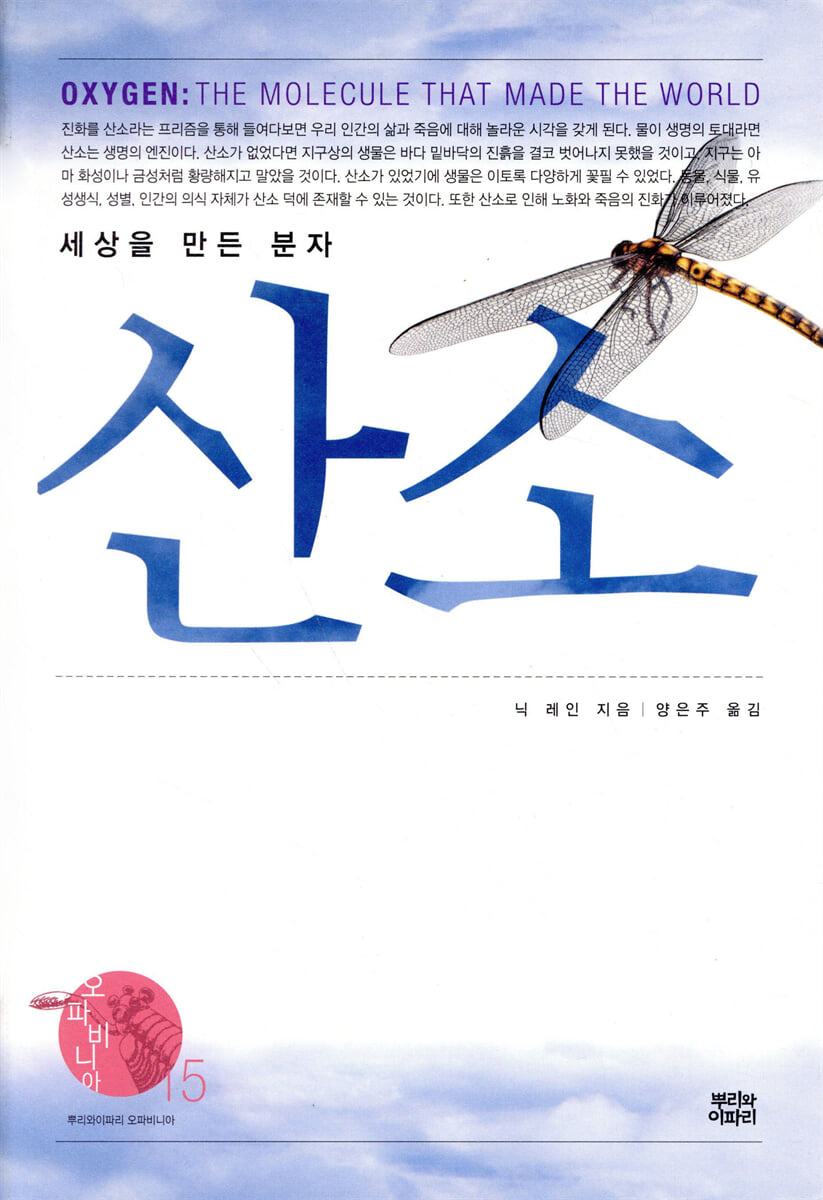
oxygen
 |
Description
Book Introduction
The evolution of life, and aging and death,
All this comes from oxygen!
Re-released in Korean after 12 years!
“I am proud of 『Oxygen』, which has endured so well for the past 15 years.”
- Nick Lane, in the foreword to the Korean edition
『Oxygen』 has been re-released in Korean after 12 years.
Nick Lane's "Oxygen," first published in 2002, is still loved by readers around the world, but it was introduced in Korea in 2004 and then went out of print, leaving Korean readers with some regret.
In April 2016, it was selected as the sixth book in Oxford University Press's modern science classic series, [Oxford Landmark Science], once again proving its authority as a 21st-century science classic.
This is no surprise, considering that many of the book's hypotheses and theories are still valid today and are gaining increasing support.
In this book, renowned biochemist Nick Lane, winner of the Royal Society Science Book Award, discusses how oxygen influenced the evolution of life on Earth, as well as aging and death.
Oxygen changed everything.
Without oxygen, life on Earth would have remained single-celled forever, and the Earth would likely have been a barren planet with evaporated oceans, like Mars or Venus.
Oxygen also brought aging and death to life.
There is perhaps no better book to explain how that simple molecule, O₂, both enables the world we know and love today and ultimately takes us away from it.
All this comes from oxygen!
Re-released in Korean after 12 years!
“I am proud of 『Oxygen』, which has endured so well for the past 15 years.”
- Nick Lane, in the foreword to the Korean edition
『Oxygen』 has been re-released in Korean after 12 years.
Nick Lane's "Oxygen," first published in 2002, is still loved by readers around the world, but it was introduced in Korea in 2004 and then went out of print, leaving Korean readers with some regret.
In April 2016, it was selected as the sixth book in Oxford University Press's modern science classic series, [Oxford Landmark Science], once again proving its authority as a 21st-century science classic.
This is no surprise, considering that many of the book's hypotheses and theories are still valid today and are gaining increasing support.
In this book, renowned biochemist Nick Lane, winner of the Royal Society Science Book Award, discusses how oxygen influenced the evolution of life on Earth, as well as aging and death.
Oxygen changed everything.
Without oxygen, life on Earth would have remained single-celled forever, and the Earth would likely have been a barren planet with evaporated oceans, like Mars or Venus.
Oxygen also brought aging and death to life.
There is perhaps no better book to explain how that simple molecule, O₂, both enables the world we know and love today and ultimately takes us away from it.
- You can preview some of the book's contents.
Preview
index
Preface to the Korean edition
1.
Entering - The Elixir of Life and Death
2.
In the Beginning - The Origin and Importance of Oxygen
3.
The Silent Age: 3 Billion Years of Microbial Evolution
4.
The Spark of the Cambrian Explosion: Snowball Earth and the First Animals
5.
Bolsover Sleeping Beauty - The Rise of Giant Creatures and Oxygen
6.
The Treachery of the Air: Common Mechanisms of Oxygen Toxicity and X-Ray Exposure
7.
Green Star - The Evolution of Photosynthesis and Radiation
8. In Search of LUCA - The Last Ancestor of the Pre-Oxygen Era
9.
Portrait of a Paradox: The Many Facets of Antioxidants and Vitamin C
10.
Antioxidant Devices - 101 Ways to Live with Oxygen
11.
Performance and Physical Maintenance—The Balance That Exists in the Evolution of Aging
12.
The Triangle of Food, Sex, and Longevity—If You Don't Eat, You'll Live Forever
13.
The Reason for the Existence of Male and Female: The Speed of Life and the Necessity of Gender
14.
Genes and Destiny: The Dual-Factor Theory of Aging and Disease
15.
Life, Death, and Oxygen—Lessons from Evolution About the Future of Aging
Acknowledgements
After moving
Read more
Glossary
Search
1.
Entering - The Elixir of Life and Death
2.
In the Beginning - The Origin and Importance of Oxygen
3.
The Silent Age: 3 Billion Years of Microbial Evolution
4.
The Spark of the Cambrian Explosion: Snowball Earth and the First Animals
5.
Bolsover Sleeping Beauty - The Rise of Giant Creatures and Oxygen
6.
The Treachery of the Air: Common Mechanisms of Oxygen Toxicity and X-Ray Exposure
7.
Green Star - The Evolution of Photosynthesis and Radiation
8. In Search of LUCA - The Last Ancestor of the Pre-Oxygen Era
9.
Portrait of a Paradox: The Many Facets of Antioxidants and Vitamin C
10.
Antioxidant Devices - 101 Ways to Live with Oxygen
11.
Performance and Physical Maintenance—The Balance That Exists in the Evolution of Aging
12.
The Triangle of Food, Sex, and Longevity—If You Don't Eat, You'll Live Forever
13.
The Reason for the Existence of Male and Female: The Speed of Life and the Necessity of Gender
14.
Genes and Destiny: The Dual-Factor Theory of Aging and Disease
15.
Life, Death, and Oxygen—Lessons from Evolution About the Future of Aging
Acknowledgements
After moving
Read more
Glossary
Search
Into the book
Whether it causes seizures, sudden death, progressive lung damage, or aging, the way oxygen works is always the same.
All forms of oxygen toxicity occur when free radicals are formed from oxygen.
As the great 16th century alchemist Paracelsus once said, all drugs are poisonous.
Seizures are caused by a large excess of free radicals acting on the brain, while lung damage is caused by a slightly lesser excess of free radicals acting on the lungs.
However, free radicals are not simply toxic.
Without free radicals, combustion does not occur.
They cannot photosynthesize or breathe.
If we want to use oxygen to get energy from food, we must produce free radicals as intermediate products.
--- p.29
It was life that saved Earth from becoming a barren land like Mars or Venus.
As organisms produced more oxygen through photosynthesis, there was less oxygen to react with on land and in the oceans, and eventually free oxygen accumulated in the atmosphere.
When free oxygen is present, water loss stops.
This is because most of the hydrogen released from the water reacts with this oxygen to form water again.
That's how the oceans were preserved on Earth.
According to estimates by James Lovelock, the founder of the Gaia theory, using the amount of oxygen in the air today, about 300,000 tons of hydrogen are released into space each year.
The story is that the Earth loses about 3 million tons of water every year.
Looking at the amount alone might sound unsettling, but according to Lovelock's calculations, it would take 4.5 billion years for the Earth's oceans to lose just 1 percent at this rate.
It's all thanks to photosynthesis.
--- pp.48-49
As oxygen concentration increased, cells tended to clump together, where the most efficient energy systems developed.
Countless mitochondria live within a single cell and provide energy to living organisms.
And the first multicellular organisms appeared.
If so, it could be said that the evolution of multicellular organisms was facilitated by cells clustering together to avoid the toxicity of oxygen.
Certainly, all multicellular organisms have mitochondria.
There are about 1,000 species of simple eukaryotes that lack mitochondria, and none of them are multicellular.
Therefore, humans are a community of cells gathered together and smaller cells gathered within those cells.
--- p.82
Respiration using oxygen has an energy metabolic efficiency of up to 40 percent.
So the food chain has to go through six levels to reach the 1 percent energy threshold.
The carnivorous food chain becomes profitable and thus predators emerge.
In modern ecosystems, predators dominate, but this would be impossible without oxygen.
It was no coincidence that Cambrian animals were Earth's first true predators.
Once the act of predation occurs, both the prey and the eaten become larger.
Predators hunt to get bigger prey, and prey hunt to avoid being eaten.
For a body to grow in size, it needs something to structurally support it.
The most important elements that support the bodies of plants and animals are lignin and collagen, respectively, and oxygen is required to synthesize these substances.
--- pp.108-109
According to Robert Dudley, a physiologist at the University of Texas, when the oxygen content of the air increases to 35 percent, the rate of oxygen diffusion increases by approximately 67 percent.
This allows oxygen to diffuse over longer distances.
In other words, in air with more oxygen, insects breathe less, allowing oxygen to penetrate deeper into the trachea.
This allows the muscles used for flight to get more oxygen, thickening the tissues and increasing the insect's body size.
While other selective pressures, such as predation, actually drive the trend toward larger bodies, higher oxygen concentrations physiologically raise the limits on how large a body can grow.
--- pp.141-142
The mechanism by which radioactivity affects living organisms is very similar to the effects of oxygen poisoning.
There are several invisible reactions that occur in sequence between oxygen and water, and the mechanism is based on this reaction.
In this reaction, both radiation poisoning and oxygen poisoning pass through the very same intermediate products.
These intermediates can be formed from either oxygen or water ([Figure 7]).
In radiation poisoning, intermediate products are formed from water, and in oxygen poisoning, they are formed from oxygen.
However, even in normal respiration, equally reactive intermediate products are produced from oxygen.
Therefore, breathing can be seen as a very slow form of oxygen intoxication.
As we'll discuss later, both aging and geriatric diseases are essentially caused by slow oxygen toxicity.
--- p.159
Oxidative stress drives our body's resistance to infection.
This resistance manifests as an active inflammatory attack (eliminating invaders) and a stress response (defending our cells against attack).
This mechanism greatly increases the chances of reproductive success in that it increases the chances of recovery and survival from infectious diseases in childhood, and although there are disadvantages, their effects are delayed until old age, so they have little effect on reproduction.
As we age, oxidative stress increases as free radicals leak from mitochondria into cells.
Our bodies perceive this as a threat and react accordingly.
But unlike infections, this new threat is not permanent.
Because there is no way to repair damaged mitochondria.
Chronic inflammation continues endlessly and ultimately leads to our physical and mental death.
--- p.443
Living things have learned to cope with oxygen through countless adaptations.
Everything from behavior to body size and reproduction is a result of adaptation.
When we consider how two sexes evolved and why eggs develop within follicles, we find unexpected validation of the evolutionary perspective.
The same goes for the failure of cloning experiments or the impact of malaria on geriatric diseases.
In this respect, oxygen is not only the engine of evolution and life, but also the most important and sole cause of aging and geriatric diseases.
This perspective helps us reflect on our human place in nature.
Considering that aging is neither predetermined nor inevitable, there is hope, even if it cannot be easily postponed.
All forms of oxygen toxicity occur when free radicals are formed from oxygen.
As the great 16th century alchemist Paracelsus once said, all drugs are poisonous.
Seizures are caused by a large excess of free radicals acting on the brain, while lung damage is caused by a slightly lesser excess of free radicals acting on the lungs.
However, free radicals are not simply toxic.
Without free radicals, combustion does not occur.
They cannot photosynthesize or breathe.
If we want to use oxygen to get energy from food, we must produce free radicals as intermediate products.
--- p.29
It was life that saved Earth from becoming a barren land like Mars or Venus.
As organisms produced more oxygen through photosynthesis, there was less oxygen to react with on land and in the oceans, and eventually free oxygen accumulated in the atmosphere.
When free oxygen is present, water loss stops.
This is because most of the hydrogen released from the water reacts with this oxygen to form water again.
That's how the oceans were preserved on Earth.
According to estimates by James Lovelock, the founder of the Gaia theory, using the amount of oxygen in the air today, about 300,000 tons of hydrogen are released into space each year.
The story is that the Earth loses about 3 million tons of water every year.
Looking at the amount alone might sound unsettling, but according to Lovelock's calculations, it would take 4.5 billion years for the Earth's oceans to lose just 1 percent at this rate.
It's all thanks to photosynthesis.
--- pp.48-49
As oxygen concentration increased, cells tended to clump together, where the most efficient energy systems developed.
Countless mitochondria live within a single cell and provide energy to living organisms.
And the first multicellular organisms appeared.
If so, it could be said that the evolution of multicellular organisms was facilitated by cells clustering together to avoid the toxicity of oxygen.
Certainly, all multicellular organisms have mitochondria.
There are about 1,000 species of simple eukaryotes that lack mitochondria, and none of them are multicellular.
Therefore, humans are a community of cells gathered together and smaller cells gathered within those cells.
--- p.82
Respiration using oxygen has an energy metabolic efficiency of up to 40 percent.
So the food chain has to go through six levels to reach the 1 percent energy threshold.
The carnivorous food chain becomes profitable and thus predators emerge.
In modern ecosystems, predators dominate, but this would be impossible without oxygen.
It was no coincidence that Cambrian animals were Earth's first true predators.
Once the act of predation occurs, both the prey and the eaten become larger.
Predators hunt to get bigger prey, and prey hunt to avoid being eaten.
For a body to grow in size, it needs something to structurally support it.
The most important elements that support the bodies of plants and animals are lignin and collagen, respectively, and oxygen is required to synthesize these substances.
--- pp.108-109
According to Robert Dudley, a physiologist at the University of Texas, when the oxygen content of the air increases to 35 percent, the rate of oxygen diffusion increases by approximately 67 percent.
This allows oxygen to diffuse over longer distances.
In other words, in air with more oxygen, insects breathe less, allowing oxygen to penetrate deeper into the trachea.
This allows the muscles used for flight to get more oxygen, thickening the tissues and increasing the insect's body size.
While other selective pressures, such as predation, actually drive the trend toward larger bodies, higher oxygen concentrations physiologically raise the limits on how large a body can grow.
--- pp.141-142
The mechanism by which radioactivity affects living organisms is very similar to the effects of oxygen poisoning.
There are several invisible reactions that occur in sequence between oxygen and water, and the mechanism is based on this reaction.
In this reaction, both radiation poisoning and oxygen poisoning pass through the very same intermediate products.
These intermediates can be formed from either oxygen or water ([Figure 7]).
In radiation poisoning, intermediate products are formed from water, and in oxygen poisoning, they are formed from oxygen.
However, even in normal respiration, equally reactive intermediate products are produced from oxygen.
Therefore, breathing can be seen as a very slow form of oxygen intoxication.
As we'll discuss later, both aging and geriatric diseases are essentially caused by slow oxygen toxicity.
--- p.159
Oxidative stress drives our body's resistance to infection.
This resistance manifests as an active inflammatory attack (eliminating invaders) and a stress response (defending our cells against attack).
This mechanism greatly increases the chances of reproductive success in that it increases the chances of recovery and survival from infectious diseases in childhood, and although there are disadvantages, their effects are delayed until old age, so they have little effect on reproduction.
As we age, oxidative stress increases as free radicals leak from mitochondria into cells.
Our bodies perceive this as a threat and react accordingly.
But unlike infections, this new threat is not permanent.
Because there is no way to repair damaged mitochondria.
Chronic inflammation continues endlessly and ultimately leads to our physical and mental death.
--- p.443
Living things have learned to cope with oxygen through countless adaptations.
Everything from behavior to body size and reproduction is a result of adaptation.
When we consider how two sexes evolved and why eggs develop within follicles, we find unexpected validation of the evolutionary perspective.
The same goes for the failure of cloning experiments or the impact of malaria on geriatric diseases.
In this respect, oxygen is not only the engine of evolution and life, but also the most important and sole cause of aging and geriatric diseases.
This perspective helps us reflect on our human place in nature.
Considering that aging is neither predetermined nor inevitable, there is hope, even if it cannot be easily postponed.
--- pp.463-464
Publisher's Review
From the origin of life to the development of animals, aging and death,
Oxygen created evolution and the world!
Almost all life on Earth cannot survive without oxygen.
But it is precisely because of that oxygen that we grow old and become sick.
Oxygen is sucked into the mitochondria in our bodies and turns into 'free radicals', and these free radicals are toxic.
Most free radicals are eliminated, but some escape the mitochondria and damage DNA or proteins.
When exposed to radiation, water molecules split and free radicals are created, which also indiscriminately attack DNA and proteins.
Therefore, breathing oxygen and exposure to radiation carry essentially the same risks.
However, from an evolutionary perspective, oxygen played a decisive role in determining the course of evolution.
There is no fossil record showing that oxygen causes organisms to age or become sick.
Rather, as oxygen levels in the atmosphere increased throughout Earth's history, life became more diverse and spread out, filling gaps in the ecosystem.
The first multicellular organisms evolved from swarms of cells that gathered together to survive as oxygen produced by photosynthesis increased in the atmosphere.
When oxygen increased during the Carboniferous period, giant insects appeared.
At that time, a giant dragonfly with a wingspan of up to 75 centimeters flew through the sky.
This is possible because as the oxygen concentration increases, the body size and the muscles that move the wings can grow larger while still being supplied with sufficient oxygen.
Conversely, some mass extinctions have been associated with periods of reduced oxygen.
The same was true of the mass extinction that occurred at the end of the Permian period.
Oxygen, Free Radicals—A 21st-Century Science Classic with New Insights into Life and Death
There are many reasons why oxygen promotes disease and aging.
In fact, free radicals, which are transformed from oxygen, are both essential signals and attack vehicles that enable us to respond to infections.
In other words, it becomes a weapon to attack invaders while activating genes that fight infection.
Tragedy strikes as we age and our mitochondria begin to leak out too many free radicals.
This is because our body mistakes this for an infection and continues to release free radicals.
Because there is no way to repair damaged mitochondria, free radicals continue to accumulate, eventually causing us to age, become sick, and die.
In other words, free radicals are an important means of fighting infections in childhood, but as time passes, they cause aging.
This is Nick Lane's 'two-factor theory of aging'.
According to this theory, what we need to do is to keep our mitochondria from being damaged as much as possible.
Could it be possible? - According to Nick Lane.
The answer lies in the genes that create mitochondria.
According to a 1998 study published in the medical journal The Lancet, a whopping 62 percent of hundreds of centenarians in Japan had a gene that creates altered mitochondria.
This gene was created by changing one base in the original gene that creates mitochondria.
As mitochondrial medicine advances, it may be possible to regulate genes to prevent mitochondria from becoming damaged.
Additionally, mitochondria are regulated by diet, exercise, and hormones.
Eating a balanced diet, avoiding overeating, and reducing stress can significantly slow down mitochondrial damage.
So, even though we can't easily postpone aging, we can still have hope.
『Oxygen』 is a painting on the vast canvas of evolution.
It offers a new perspective on life and death, while also explaining modern-day fatal diseases, why our bodies age, and how to deal with them.
This book covers a wide range of fields, from environmental science to molecular medicine, and presents new concepts that we had not previously considered through a series of evidences.
This extraordinary book, which reveals the author's fascinating insights into modern science and the place we humans have created in nature, will help us redefine our perspective on the world.
* Praise for this book
“Oxygen” is a story about how life came to exist on Earth.
Each chapter features special reports from the forefront of research on the history of Earth and life.
“It’s a book that will keep you glued to the end, and it’s a great pleasure that will reward the reader’s perseverance.” — [The Guardian]
“It presents a theory of how oxygen became the cornerstone of explosive evolution and how it is related to aging in a way that anyone with even a basic level of scientific knowledge can understand.
“It’s a wonderful book that serves as both a scholarly and easy-to-read introductory text.” — [Good Book Guide]
“This is a book about the history of how oxygen came to exist on the Earth we live on.
As you follow the author's detailed narrative, you'll find yourself caught in the fascinating paradox that oxygen, essential for life, can also be a cause of death." - [Natural History Magazine]
“Nick Lane effectively presents a compelling array of evidence, from the flight dynamics of insects to carbon isotope levels in rocks, to support the claim that the ancient Earth's atmosphere was indeed rich in oxygen.
Not only does it explain how the massive forests and animals of the Carboniferous period could have existed, it also forces readers to completely rethink how life evolved between 3.5 billion and 543 million years ago, and how that evolution relates to the diseases that plague us today.
The book itself is a highly ambitious and radical scientific argument.
“It’s the best science book ever written.” - [Financial Times]
“With public awareness of aging rapidly spreading, this book provides an interesting and compelling explanation of the impact of oxidative stress on aging.
It's a wonderful story about oxygen, an element that plays an important role in our lives.
“It is a widely read, entertaining and informative book.” - [Nature]
“This is a wonderful book that offers a surprisingly broad insight into the role of a single gas, oxygen, from the origin of life through the development of animals and their death.
“It’s full of fascinating stories about life and death.” - Peter Atkins, author of The Kingdom of the Elements
“A remarkable book on the dual role oxygen plays in life and death.
Nick Lane presents a scientific version of the heroic legend with characteristic passion, rivaling any creation myth.” - [Times Higher Supplement]
“No book has ever covered the history of oxygen so well.” - [Focus Magazine]
“It’s one of the most thought-provoking books I’ve ever read.” - John Emsley, author of The Chemistry Apology
“Author Nick Lane brings a wealth of scholarship and a broad historical perspective to vividly describe the role of oxygen in shaping the course of evolution.
“A delicate and ambitious work, with a broad yet dense argument.” - [Times Literary Supplement]
“A book that brilliantly integrates two very different scientific fields.
“It unravels the origins of life on Earth, connecting it to human disease, aging, and death, and at the end of the book, it tells us much we need to know about antioxidants and diet.” - [Sunday Times]
“A book that closely analyzes the role of free radicals in aging.
It is full of interesting information supported by a wide range of references, including the latest papers.
“It’s a masterpiece that delivers detailed information and fun along with a clear message.” - [American Scientist]
“An informative and entertaining book.” - [Science]
“An ambitious research book that reveals new facts to readers.” - [The Independent]
“It offers a provocative and unconventional discussion of evolutionary biology, geriatrics, and the role of oxygen in human life and death.
“This book, based on thorough research, addresses huge, real-world issues with a firm and sharp approach.” - [Ottawa Citizen]
“This book is a popular yet thought-provoking treatment of evolution and oxygen biochemistry.
It provides a variety of information and knowledge, while at the same time being light and easy to understand.
“Highly recommended.” - [New England Journal of Medicine]
“I dare say that this is the best popular science book.
It is accessible yet challenging, speculative yet rigorous.
“A masterful work that unfolds smoothly, encompassing both old concepts and very recent discoveries in many different scientific fields.” - Bernard Dickson, author of The Power of Microbes
“An excellent, captivating book.
I was completely absorbed in the experience throughout the seven-hour flight.
“I highly recommend it.” - [Free Radical Research]
Oxygen created evolution and the world!
Almost all life on Earth cannot survive without oxygen.
But it is precisely because of that oxygen that we grow old and become sick.
Oxygen is sucked into the mitochondria in our bodies and turns into 'free radicals', and these free radicals are toxic.
Most free radicals are eliminated, but some escape the mitochondria and damage DNA or proteins.
When exposed to radiation, water molecules split and free radicals are created, which also indiscriminately attack DNA and proteins.
Therefore, breathing oxygen and exposure to radiation carry essentially the same risks.
However, from an evolutionary perspective, oxygen played a decisive role in determining the course of evolution.
There is no fossil record showing that oxygen causes organisms to age or become sick.
Rather, as oxygen levels in the atmosphere increased throughout Earth's history, life became more diverse and spread out, filling gaps in the ecosystem.
The first multicellular organisms evolved from swarms of cells that gathered together to survive as oxygen produced by photosynthesis increased in the atmosphere.
When oxygen increased during the Carboniferous period, giant insects appeared.
At that time, a giant dragonfly with a wingspan of up to 75 centimeters flew through the sky.
This is possible because as the oxygen concentration increases, the body size and the muscles that move the wings can grow larger while still being supplied with sufficient oxygen.
Conversely, some mass extinctions have been associated with periods of reduced oxygen.
The same was true of the mass extinction that occurred at the end of the Permian period.
Oxygen, Free Radicals—A 21st-Century Science Classic with New Insights into Life and Death
There are many reasons why oxygen promotes disease and aging.
In fact, free radicals, which are transformed from oxygen, are both essential signals and attack vehicles that enable us to respond to infections.
In other words, it becomes a weapon to attack invaders while activating genes that fight infection.
Tragedy strikes as we age and our mitochondria begin to leak out too many free radicals.
This is because our body mistakes this for an infection and continues to release free radicals.
Because there is no way to repair damaged mitochondria, free radicals continue to accumulate, eventually causing us to age, become sick, and die.
In other words, free radicals are an important means of fighting infections in childhood, but as time passes, they cause aging.
This is Nick Lane's 'two-factor theory of aging'.
According to this theory, what we need to do is to keep our mitochondria from being damaged as much as possible.
Could it be possible? - According to Nick Lane.
The answer lies in the genes that create mitochondria.
According to a 1998 study published in the medical journal The Lancet, a whopping 62 percent of hundreds of centenarians in Japan had a gene that creates altered mitochondria.
This gene was created by changing one base in the original gene that creates mitochondria.
As mitochondrial medicine advances, it may be possible to regulate genes to prevent mitochondria from becoming damaged.
Additionally, mitochondria are regulated by diet, exercise, and hormones.
Eating a balanced diet, avoiding overeating, and reducing stress can significantly slow down mitochondrial damage.
So, even though we can't easily postpone aging, we can still have hope.
『Oxygen』 is a painting on the vast canvas of evolution.
It offers a new perspective on life and death, while also explaining modern-day fatal diseases, why our bodies age, and how to deal with them.
This book covers a wide range of fields, from environmental science to molecular medicine, and presents new concepts that we had not previously considered through a series of evidences.
This extraordinary book, which reveals the author's fascinating insights into modern science and the place we humans have created in nature, will help us redefine our perspective on the world.
* Praise for this book
“Oxygen” is a story about how life came to exist on Earth.
Each chapter features special reports from the forefront of research on the history of Earth and life.
“It’s a book that will keep you glued to the end, and it’s a great pleasure that will reward the reader’s perseverance.” — [The Guardian]
“It presents a theory of how oxygen became the cornerstone of explosive evolution and how it is related to aging in a way that anyone with even a basic level of scientific knowledge can understand.
“It’s a wonderful book that serves as both a scholarly and easy-to-read introductory text.” — [Good Book Guide]
“This is a book about the history of how oxygen came to exist on the Earth we live on.
As you follow the author's detailed narrative, you'll find yourself caught in the fascinating paradox that oxygen, essential for life, can also be a cause of death." - [Natural History Magazine]
“Nick Lane effectively presents a compelling array of evidence, from the flight dynamics of insects to carbon isotope levels in rocks, to support the claim that the ancient Earth's atmosphere was indeed rich in oxygen.
Not only does it explain how the massive forests and animals of the Carboniferous period could have existed, it also forces readers to completely rethink how life evolved between 3.5 billion and 543 million years ago, and how that evolution relates to the diseases that plague us today.
The book itself is a highly ambitious and radical scientific argument.
“It’s the best science book ever written.” - [Financial Times]
“With public awareness of aging rapidly spreading, this book provides an interesting and compelling explanation of the impact of oxidative stress on aging.
It's a wonderful story about oxygen, an element that plays an important role in our lives.
“It is a widely read, entertaining and informative book.” - [Nature]
“This is a wonderful book that offers a surprisingly broad insight into the role of a single gas, oxygen, from the origin of life through the development of animals and their death.
“It’s full of fascinating stories about life and death.” - Peter Atkins, author of The Kingdom of the Elements
“A remarkable book on the dual role oxygen plays in life and death.
Nick Lane presents a scientific version of the heroic legend with characteristic passion, rivaling any creation myth.” - [Times Higher Supplement]
“No book has ever covered the history of oxygen so well.” - [Focus Magazine]
“It’s one of the most thought-provoking books I’ve ever read.” - John Emsley, author of The Chemistry Apology
“Author Nick Lane brings a wealth of scholarship and a broad historical perspective to vividly describe the role of oxygen in shaping the course of evolution.
“A delicate and ambitious work, with a broad yet dense argument.” - [Times Literary Supplement]
“A book that brilliantly integrates two very different scientific fields.
“It unravels the origins of life on Earth, connecting it to human disease, aging, and death, and at the end of the book, it tells us much we need to know about antioxidants and diet.” - [Sunday Times]
“A book that closely analyzes the role of free radicals in aging.
It is full of interesting information supported by a wide range of references, including the latest papers.
“It’s a masterpiece that delivers detailed information and fun along with a clear message.” - [American Scientist]
“An informative and entertaining book.” - [Science]
“An ambitious research book that reveals new facts to readers.” - [The Independent]
“It offers a provocative and unconventional discussion of evolutionary biology, geriatrics, and the role of oxygen in human life and death.
“This book, based on thorough research, addresses huge, real-world issues with a firm and sharp approach.” - [Ottawa Citizen]
“This book is a popular yet thought-provoking treatment of evolution and oxygen biochemistry.
It provides a variety of information and knowledge, while at the same time being light and easy to understand.
“Highly recommended.” - [New England Journal of Medicine]
“I dare say that this is the best popular science book.
It is accessible yet challenging, speculative yet rigorous.
“A masterful work that unfolds smoothly, encompassing both old concepts and very recent discoveries in many different scientific fields.” - Bernard Dickson, author of The Power of Microbes
“An excellent, captivating book.
I was completely absorbed in the experience throughout the seven-hour flight.
“I highly recommend it.” - [Free Radical Research]
GOODS SPECIFICS
- Date of issue: October 31, 2016
- Format: Hardcover book binding method guide
- Page count, weight, size: 548 pages | 909g | 158*232*33mm
- ISBN13: 9788964620786
- ISBN10: 896462078X
You may also like
카테고리
korean


korean

![GQ KOREA Mark (Monthly): December [2025]](http://librairie.coreenne.fr/cdn/shop/files/8ef265dbbfbf186523ed75ba7319009d.jpg?v=1765340328&width=3840)


