

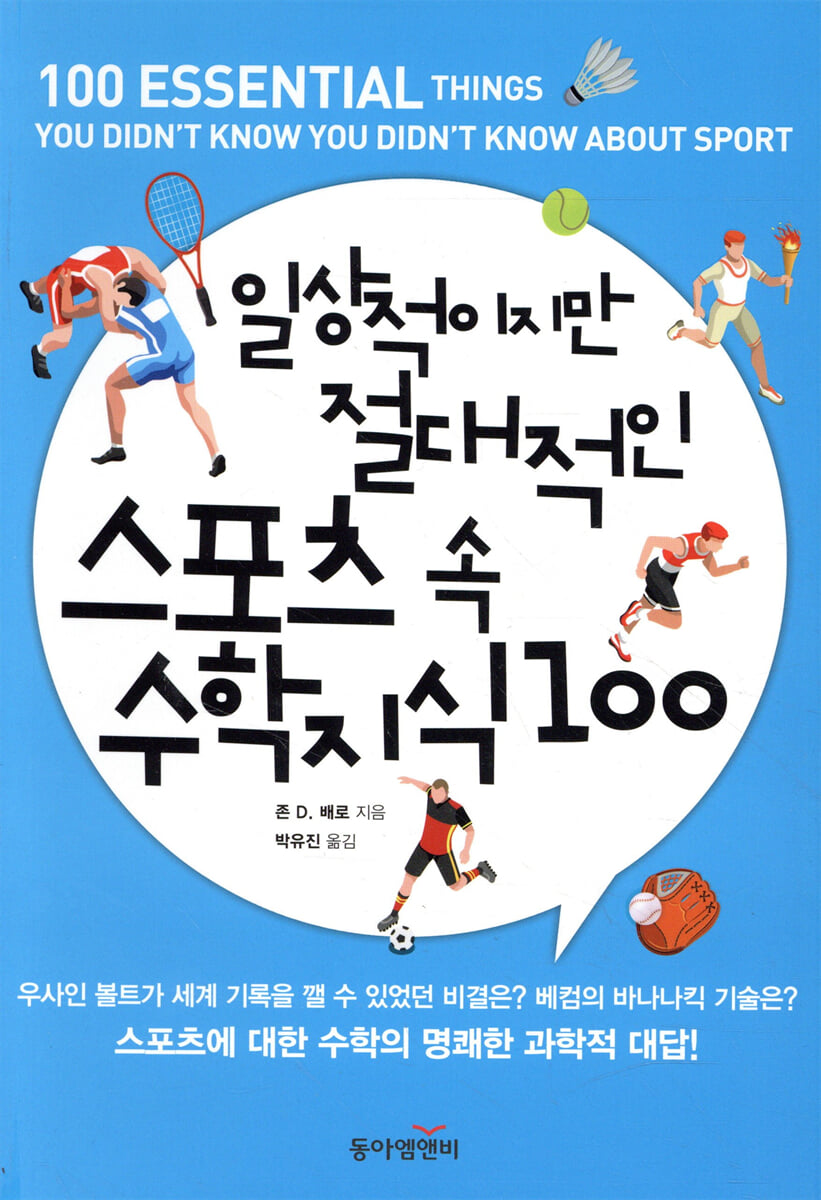
100 Everyday but Essential Math Facts from Sports
 |
Description
Book Introduction
Could knowing the principles of mathematics make the Olympics and World Cup games twice as enjoyable?
Archery, athletics, gymnastics, swimming, martial arts, soccer, cricket, weightlifting, etc.
The mathematical mysteries hidden in various sports are revealed!
Every four years, the Olympics and the World Cup, festivals for people all over the world, are held.
The entire nation will cheer on our athletes who have lost sleep and trained with sweat and blood.
"100 Everyday but Absolute Mathematical Knowledge in Sports" is a book in which the author, a professor of mathematical sciences at Cambridge University, tells interesting mathematical stories hidden in the sports we enjoy in an easy-to-understand way.
How does Usain Bolt break world records without much effort? What's the best penalty kick strategy in soccer? Why do they play third-round? How does wind affect records? What are the effects of banned full-body swimsuits? Why does the bouncing motion of the Super Bowl seem to defy Newton's laws of motion? This book contains answers to questions you've always wondered about but often overlooked.
After reading this book and watching a sporting event, you'll be amazed to find yourself exploring not only the mathematics behind it, but also the science behind human movement, scoring systems, record-breaking, strength testing, drug testing, diving, horseback riding, running, jumping, and throwing.
Archery, athletics, gymnastics, swimming, martial arts, soccer, cricket, weightlifting, etc.
The mathematical mysteries hidden in various sports are revealed!
Every four years, the Olympics and the World Cup, festivals for people all over the world, are held.
The entire nation will cheer on our athletes who have lost sleep and trained with sweat and blood.
"100 Everyday but Absolute Mathematical Knowledge in Sports" is a book in which the author, a professor of mathematical sciences at Cambridge University, tells interesting mathematical stories hidden in the sports we enjoy in an easy-to-understand way.
How does Usain Bolt break world records without much effort? What's the best penalty kick strategy in soccer? Why do they play third-round? How does wind affect records? What are the effects of banned full-body swimsuits? Why does the bouncing motion of the Super Bowl seem to defy Newton's laws of motion? This book contains answers to questions you've always wondered about but often overlooked.
After reading this book and watching a sporting event, you'll be amazed to find yourself exploring not only the mathematics behind it, but also the science behind human movement, scoring systems, record-breaking, strength testing, drug testing, diving, horseback riding, running, jumping, and throwing.
- You can preview some of the book's contents.
Preview
index
prolog
1 If Usain Bolt were to break his own world record without much effort,
2 Are humans all-rounders?
3 To shoot a bow like an archer
4 Is there a flaw in the average?
5 Which lane has the advantage in turning the curve?
6 To maintain good balance
7 Who wants to play baseball, tennis or cricket?
8 How do I know if I have taken any medication?
9 Why is it the third generation?
10 High Jump and Center of Gravity
11. Be born on time
12 How to increase your airtime?
13 How to win a kayak race?
14 Do you need a cox?
To collect 15 cards economically
16 Burning Wheel
17 If the scoring formula changes, will the rankings also change?
18 How to make diving great
19 Most Extreme Sports
20 It's slipping
21 Gender and Sports
22 Physics for Playground Managers
23 What goes up must come down
24 Left-handed vs. Right-handed
25 Best Pole Vaults
26 The Return of the Karate Kid
27 The Principle of the Lever
28 Reach out to the sky
29 What is the standard distance for a marathon?
30 All that glitters isn't gold
31 Don't blink first
32 Table Tennis is Coming Home
33 Walking the rough road
34 favorites and odds
35 What are the chances of being disqualified?
36 Moments of Adjustment
37 Rugby and Relativity
38 Cricket's scoring rate
39 A truly unique game: squash
40 Don't fall for the trick!
41 Weightlifters and Proportions
42. Shock Absorbing
43 How do breaststrokers overcome water drag?
44 That crucial point
45 Throw into the wind
46 Leagues that show reversals
47 Strange Rackets
48 Size matters
49 Really Strange Soccer Matches
50 Spinning Wheels
51 The capricious wind
52 How to become good at windsurfing?
53 How can I get a medal?
54 Why aren't there any world records in women's track and field?
55 Zigzag Run
56 Are there Cinderellas in sports too?
57 What is important in wheelchair racing?
58 Fairly Adjusted Triathlon
59 The Madness of the Crowd
60 Why hydrophobic polyurethane swimsuits?
61 Biathlon and Modern Pentathlon
62 Keeping your body cool
63 Wheelchair speed
64 War with Error
65 Defying Gravity
66 Google in the Caribbean
67 The Paradox of Ice Skating
68 What is the relationship between discus throwing and wind?
Is a 69 goal difference the best?
Is the 70 Premier League a random league?
71 Special training clothes, can they help?
72 Triangle in the water
73 The illusion of floating in the air
74 The rich get richer and the poor get poorer
75 Tournament Seeding
76 Manipulating Tournaments
77 Wind-assisted Marathon
78 Uphill Climb
79 Psychological inertia
80 goals, goals, goals
81 Who is the greatest contributor to improving the swimming world record?
82 Great Britain national football team
83 A strange but true story
84 Blade Runner
85 The number of pairs must be even
What if 86 ticket dealers merge?
87 A Skydiver Better Than Superman?
88 Which sport is more advantageous at higher altitudes?
89 The Archer's Paradox
Banana kick like Beckham in 90
91 Stop and go
92 Fun Diving Trains
93 Spring in the Air
94 Is coin tossing a panacea?
95 Which sport should be an Olympic event?
96 What do cats and high diving have in common?
97 Objects that fly through the air with great ease
98 I like it hot
99 Bouncy Super Bowl
Thinking in 100 boxes
Translator's Note
1 If Usain Bolt were to break his own world record without much effort,
2 Are humans all-rounders?
3 To shoot a bow like an archer
4 Is there a flaw in the average?
5 Which lane has the advantage in turning the curve?
6 To maintain good balance
7 Who wants to play baseball, tennis or cricket?
8 How do I know if I have taken any medication?
9 Why is it the third generation?
10 High Jump and Center of Gravity
11. Be born on time
12 How to increase your airtime?
13 How to win a kayak race?
14 Do you need a cox?
To collect 15 cards economically
16 Burning Wheel
17 If the scoring formula changes, will the rankings also change?
18 How to make diving great
19 Most Extreme Sports
20 It's slipping
21 Gender and Sports
22 Physics for Playground Managers
23 What goes up must come down
24 Left-handed vs. Right-handed
25 Best Pole Vaults
26 The Return of the Karate Kid
27 The Principle of the Lever
28 Reach out to the sky
29 What is the standard distance for a marathon?
30 All that glitters isn't gold
31 Don't blink first
32 Table Tennis is Coming Home
33 Walking the rough road
34 favorites and odds
35 What are the chances of being disqualified?
36 Moments of Adjustment
37 Rugby and Relativity
38 Cricket's scoring rate
39 A truly unique game: squash
40 Don't fall for the trick!
41 Weightlifters and Proportions
42. Shock Absorbing
43 How do breaststrokers overcome water drag?
44 That crucial point
45 Throw into the wind
46 Leagues that show reversals
47 Strange Rackets
48 Size matters
49 Really Strange Soccer Matches
50 Spinning Wheels
51 The capricious wind
52 How to become good at windsurfing?
53 How can I get a medal?
54 Why aren't there any world records in women's track and field?
55 Zigzag Run
56 Are there Cinderellas in sports too?
57 What is important in wheelchair racing?
58 Fairly Adjusted Triathlon
59 The Madness of the Crowd
60 Why hydrophobic polyurethane swimsuits?
61 Biathlon and Modern Pentathlon
62 Keeping your body cool
63 Wheelchair speed
64 War with Error
65 Defying Gravity
66 Google in the Caribbean
67 The Paradox of Ice Skating
68 What is the relationship between discus throwing and wind?
Is a 69 goal difference the best?
Is the 70 Premier League a random league?
71 Special training clothes, can they help?
72 Triangle in the water
73 The illusion of floating in the air
74 The rich get richer and the poor get poorer
75 Tournament Seeding
76 Manipulating Tournaments
77 Wind-assisted Marathon
78 Uphill Climb
79 Psychological inertia
80 goals, goals, goals
81 Who is the greatest contributor to improving the swimming world record?
82 Great Britain national football team
83 A strange but true story
84 Blade Runner
85 The number of pairs must be even
What if 86 ticket dealers merge?
87 A Skydiver Better Than Superman?
88 Which sport is more advantageous at higher altitudes?
89 The Archer's Paradox
Banana kick like Beckham in 90
91 Stop and go
92 Fun Diving Trains
93 Spring in the Air
94 Is coin tossing a panacea?
95 Which sport should be an Olympic event?
96 What do cats and high diving have in common?
97 Objects that fly through the air with great ease
98 I like it hot
99 Bouncy Super Bowl
Thinking in 100 boxes
Translator's Note
Into the book
If you're a coach or athlete, you'll probably have some idea of how a mathematical perspective can help you better understand your sport.
Whether you're a spectator or commentator, we hope you gain a deeper understanding of what's happening in the pool, indoor or outdoor stadium, on the track, or on the road.
If you're an educator, you'll find examples that spark interest when teaching aspects of math and science, and examples that broaden the perspectives of those who think math and physical education are just two opposing subjects.
If you're a mathematician, you'll be pleased to know how valuable your expertise is to other areas of human activity.
---From the "Prologue"
Let's assume that 90% of athletes are right-handed and 10% are left-handed, leaving aside the small number of mixed-handed and ambidextrous people.
What happens when right-handed and left-handed players face off in sports like boxing, baseball, cricket, fencing, or judo? Right-handed players will face right-handed opponents in 90% of their matches, a relatively unfamiliar experience, with left-handed opponents only 10% of the time.
On the other hand, left-handed players will face right-handed opponents in 90% of their matches, so they will learn a lot of tricks to beat right-handed players.
Right-handed people will never learn the skills necessary to beat left-handed people.
Left-handers will have the unfamiliar experience of competing against other left-handers in only 10% of their matches, but neither left-hander will be at a disadvantage compared to the other.
So overall, right-handed vs. right-handed matches and left-handed vs. left-handed matches are evenly matched, but left-handed vs. right-handed matches favor the left-hander, who has more experience in such matches.
---「024.
From "Left-handed vs. Right-handed"
Breaststroke is also unique in that swimmers do not move through the water at a constant speed.
Water resistance always acts to slow down the swimmer.
The reason water drag is so significant is because the force is proportional to the swimmer's speed, meaning that the faster the swimmer goes, the greater the force becomes.
The momentum that swimmers create by pushing water backwards throughout their stroke accelerates them, but is soon met with forces that cause them to slow down.
This deceleration occurs because swimmers bring their arms forward and pull their knees up to push the water forward in preparation for the next stroke.
---「043.
How do breaststroke swimmers overcome water resistance?
As the crowd density increases, they will slow down and try to move sideways.
Those who try to do so believe that doing so might speed up the overall pace of progress.
This is exactly the same psychology as drivers changing lanes in a traffic jam where the roads are clogged and cars are moving at a snail's pace.
In both cases, the ripples then spread throughout the crowded situation, causing some people to slow down and others to move aside to make way for someone else.
Such a series of disjointed waves spreads quickly through the crowd.
Such waves are not necessarily dangerous in themselves, but they do suggest the possibility that something very dangerous could happen suddenly.
---「059.
From "The Madness of the Crowd"
One of the skills that soccer players try to master from a young age is the 'banana kick'.
For those unfamiliar with soccer, it is a technique of kicking the ball so that it suddenly changes direction in the air.
This technique is useful for fooling opposing defenders and goalkeepers, and is particularly effective when taking a free kick near the edge of the opponent's penalty area.
Whether you're a spectator or commentator, we hope you gain a deeper understanding of what's happening in the pool, indoor or outdoor stadium, on the track, or on the road.
If you're an educator, you'll find examples that spark interest when teaching aspects of math and science, and examples that broaden the perspectives of those who think math and physical education are just two opposing subjects.
If you're a mathematician, you'll be pleased to know how valuable your expertise is to other areas of human activity.
---From the "Prologue"
Let's assume that 90% of athletes are right-handed and 10% are left-handed, leaving aside the small number of mixed-handed and ambidextrous people.
What happens when right-handed and left-handed players face off in sports like boxing, baseball, cricket, fencing, or judo? Right-handed players will face right-handed opponents in 90% of their matches, a relatively unfamiliar experience, with left-handed opponents only 10% of the time.
On the other hand, left-handed players will face right-handed opponents in 90% of their matches, so they will learn a lot of tricks to beat right-handed players.
Right-handed people will never learn the skills necessary to beat left-handed people.
Left-handers will have the unfamiliar experience of competing against other left-handers in only 10% of their matches, but neither left-hander will be at a disadvantage compared to the other.
So overall, right-handed vs. right-handed matches and left-handed vs. left-handed matches are evenly matched, but left-handed vs. right-handed matches favor the left-hander, who has more experience in such matches.
---「024.
From "Left-handed vs. Right-handed"
Breaststroke is also unique in that swimmers do not move through the water at a constant speed.
Water resistance always acts to slow down the swimmer.
The reason water drag is so significant is because the force is proportional to the swimmer's speed, meaning that the faster the swimmer goes, the greater the force becomes.
The momentum that swimmers create by pushing water backwards throughout their stroke accelerates them, but is soon met with forces that cause them to slow down.
This deceleration occurs because swimmers bring their arms forward and pull their knees up to push the water forward in preparation for the next stroke.
---「043.
How do breaststroke swimmers overcome water resistance?
As the crowd density increases, they will slow down and try to move sideways.
Those who try to do so believe that doing so might speed up the overall pace of progress.
This is exactly the same psychology as drivers changing lanes in a traffic jam where the roads are clogged and cars are moving at a snail's pace.
In both cases, the ripples then spread throughout the crowded situation, causing some people to slow down and others to move aside to make way for someone else.
Such a series of disjointed waves spreads quickly through the crowd.
Such waves are not necessarily dangerous in themselves, but they do suggest the possibility that something very dangerous could happen suddenly.
---「059.
From "The Madness of the Crowd"
One of the skills that soccer players try to master from a young age is the 'banana kick'.
For those unfamiliar with soccer, it is a technique of kicking the ball so that it suddenly changes direction in the air.
This technique is useful for fooling opposing defenders and goalkeepers, and is particularly effective when taking a free kick near the edge of the opponent's penalty area.
---「090.
From "Banana Kick Like Beckham"
From "Banana Kick Like Beckham"
Publisher's Review
Amazing Math in Sports You Never Knew You Knew
A math story that becomes visible when you know it, and becomes fun when you see it!
"100 Everyday but Absolute Math Knowledge in Sports" contains 100 stories that solve puzzles related to running, jumping, swimming, and scoring goals across the sports field using mathematics.
Whether you're an athlete striving to go faster or higher, or a fan eager to learn more about your favorite sport, this fascinating read will help anyone interested in sports and simple math understand sports better and make math more enjoyable.
The author of this book, John D.
Barrow is a bestselling author, professor at the University of Cambridge, fellow of the Royal Society, and director of the Millennium Mathematics Project.
He is also a research fellow at Clare Hall College, Cambridge, and a member of the Royal Society. He has received the Kelvin Medal from the Royal Glasgow Philosophical Society (1999) and the Michael Faraday Prize from the Royal Society (2008), and has built a reputation as a renowned mathematician through his diverse activities.
The author, who has extensively explored the development of physics, astronomy, and mathematics from historical, philosophical, and literary perspectives, explains in this book not only the mathematical laws encountered in various sports but also scientific principles in an easy and fun way.
Readers who have wondered why certain rules are applied and why scores are calculated in certain ways while watching sports will read this article that easily answers questions they had not known or seen before, and will come to a surprising realization that mathematical laws are hidden within the sports we commonly watch and enjoy.
How to shoot like an archer? What sport is better at high altitudes?
Clear mathematical answers to questions you may have while watching sports!
Did you know that Usain Bolt wasn't originally a sprinter? Bolt's coach had him run the 100m for a season to improve his sprinting speed, but he had no idea he would excel in the event.
Surely a kid that big would never become a 100m runner? But isn't it amazing that mathematical calculations show that Bolt can further improve his 100m time without even trying to run faster?
What's the strangest football match of all time? Probably the infamous match between Grenada and Barbados in the 1994 Shell Caribbean Cup.
Barbados, who needed to win by at least two goals to qualify for the finals, scored a goal on their own goal to level the score at 2-2 when the game appeared to be drawing 2-1.
This was due to the tournament rules that allowed a golden goal in overtime to be counted as two goals.
What was the outcome? Barbados advanced to the finals with a golden goal in overtime!
Could a coin flip solve all the problems in sports? A coin is considered completely random and fair, with an equal chance of landing on heads and tails.
But this is when the person flipping the coin doesn't know whether the coin will land on heads or tails.
The results differ depending on whether or not you spin the coin when flipping it.
In addition, this book contains various stories related to sports as well as athletics, such as how to find out if an athlete has taken drugs, why they do three-way races, the high jump and the center of gravity, how to increase airtime, how to collect cards economically, left-handedness vs. right-handedness, the best pole vaulters, favorites and odds, the probability of being disqualified, how breaststrokers overcome water drag, how to become good at windsurfing, why there are no world records in women's track and field, what is important in wheelchair racing, why hydrophobic polyurethane swimsuits were banned, the relationship between the discus throw and the wind, whether goal difference is best, a wind-assisted marathon, what happens when ticket scalpers merge, Beckham-like banana kicks, what cats and high diving have in common, and the bouncy Super Bowl.
As the saying goes, you see as much as you know, so you can expect two effects from this book: gaining more interesting sports knowledge the more you know, and also building your math knowledge.
A math story that becomes visible when you know it, and becomes fun when you see it!
"100 Everyday but Absolute Math Knowledge in Sports" contains 100 stories that solve puzzles related to running, jumping, swimming, and scoring goals across the sports field using mathematics.
Whether you're an athlete striving to go faster or higher, or a fan eager to learn more about your favorite sport, this fascinating read will help anyone interested in sports and simple math understand sports better and make math more enjoyable.
The author of this book, John D.
Barrow is a bestselling author, professor at the University of Cambridge, fellow of the Royal Society, and director of the Millennium Mathematics Project.
He is also a research fellow at Clare Hall College, Cambridge, and a member of the Royal Society. He has received the Kelvin Medal from the Royal Glasgow Philosophical Society (1999) and the Michael Faraday Prize from the Royal Society (2008), and has built a reputation as a renowned mathematician through his diverse activities.
The author, who has extensively explored the development of physics, astronomy, and mathematics from historical, philosophical, and literary perspectives, explains in this book not only the mathematical laws encountered in various sports but also scientific principles in an easy and fun way.
Readers who have wondered why certain rules are applied and why scores are calculated in certain ways while watching sports will read this article that easily answers questions they had not known or seen before, and will come to a surprising realization that mathematical laws are hidden within the sports we commonly watch and enjoy.
How to shoot like an archer? What sport is better at high altitudes?
Clear mathematical answers to questions you may have while watching sports!
Did you know that Usain Bolt wasn't originally a sprinter? Bolt's coach had him run the 100m for a season to improve his sprinting speed, but he had no idea he would excel in the event.
Surely a kid that big would never become a 100m runner? But isn't it amazing that mathematical calculations show that Bolt can further improve his 100m time without even trying to run faster?
What's the strangest football match of all time? Probably the infamous match between Grenada and Barbados in the 1994 Shell Caribbean Cup.
Barbados, who needed to win by at least two goals to qualify for the finals, scored a goal on their own goal to level the score at 2-2 when the game appeared to be drawing 2-1.
This was due to the tournament rules that allowed a golden goal in overtime to be counted as two goals.
What was the outcome? Barbados advanced to the finals with a golden goal in overtime!
Could a coin flip solve all the problems in sports? A coin is considered completely random and fair, with an equal chance of landing on heads and tails.
But this is when the person flipping the coin doesn't know whether the coin will land on heads or tails.
The results differ depending on whether or not you spin the coin when flipping it.
In addition, this book contains various stories related to sports as well as athletics, such as how to find out if an athlete has taken drugs, why they do three-way races, the high jump and the center of gravity, how to increase airtime, how to collect cards economically, left-handedness vs. right-handedness, the best pole vaulters, favorites and odds, the probability of being disqualified, how breaststrokers overcome water drag, how to become good at windsurfing, why there are no world records in women's track and field, what is important in wheelchair racing, why hydrophobic polyurethane swimsuits were banned, the relationship between the discus throw and the wind, whether goal difference is best, a wind-assisted marathon, what happens when ticket scalpers merge, Beckham-like banana kicks, what cats and high diving have in common, and the bouncy Super Bowl.
As the saying goes, you see as much as you know, so you can expect two effects from this book: gaining more interesting sports knowledge the more you know, and also building your math knowledge.
GOODS SPECIFICS
- Date of issue: July 20, 2016
- Page count, weight, size: 368 pages | 528g | 150*220*18mm
- ISBN13: 9791187336143
- ISBN10: 1187336149
You may also like
카테고리
korean


korean

![GQ KOREA Mark (Monthly): December [2025]](http://librairie.coreenne.fr/cdn/shop/files/8ef265dbbfbf186523ed75ba7319009d.jpg?v=1765340328&width=3840)


