

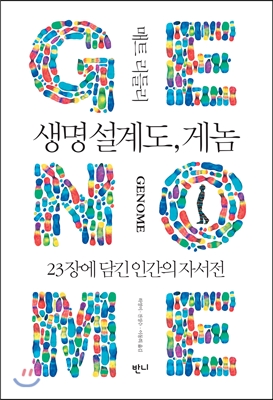
The blueprint of life, the genome
 |
Description
Book Introduction
23 pairs of genes contain everything about us!
World-renowned science writer and bestselling author
An exciting genomic journey with Matt Ridley!
Selected by the New York Times as one of the 10 Best Books of 2000, #1 in the nonfiction category!
A popular science humanities book written in an easy-to-understand manner for general readers.
Genes and the human genome have now become the stars of science.
Genome already has several fan science journals devoted solely to its work, and it has websites dedicated to its research and its findings, including those of the National Human Genome Research Institute and the private company Celera Genomics.
Even those outside the scientific community have come to anticipate new discoveries about the genome with the same fervor as Madonna's next album.
This is because I was fascinated by the unprecedented and destructive potential of the genome, such as conquering incurable diseases and extending life.
But where there is yang, yin will always follow.
As the codes of the genome, the book that holds the secrets of life's records, began to be deciphered one by one, humans became obsessed with fate and eugenics, and began to disregard life, discriminate against humans, and destroy the ecosystem, which led to serious economic and ethical debates.
That's why now is the time for all of us to re-evaluate our perspective on the genome.
Rather than looking at only one aspect of the genome and discussing its pros and cons, we should take a comprehensive look at the genome's self-portrait, and we should actively take the lead in expressing our personal opinions on how to utilize the genome, rather than leaving it to scientists, doctors, governments, and economic organizations.
At this time, popular and representative science writer Matt Ridley came out with the autobiography of the genome, “The Blueprint of Life: Genome.”
This book does not simply contain technical and analytical content that only scientists need and can understand, such as what a genome is, what its structure is, what its function is, and how to modify and utilize the genome.
To help us gain a better understanding of the genome as a whole, we've chosen one distinctive gene for each of the 23 chromosomes and challenged scientists to explain how it was discovered and what impact it has on humans.
Above all, unlike other existing science books that were difficult for the general public to access due to their technical terminology and difficult writing style, this book increases readers' understanding through a witty and flowing writing style, as if a competent tour guide were personally guiding them through the field.
In a word, it can be said to be a humanistic science book.
Thanks to this, it has been consistently selling well on Amazon for over 15 years since its publication.
World-renowned science writer and bestselling author
An exciting genomic journey with Matt Ridley!
Selected by the New York Times as one of the 10 Best Books of 2000, #1 in the nonfiction category!
A popular science humanities book written in an easy-to-understand manner for general readers.
Genes and the human genome have now become the stars of science.
Genome already has several fan science journals devoted solely to its work, and it has websites dedicated to its research and its findings, including those of the National Human Genome Research Institute and the private company Celera Genomics.
Even those outside the scientific community have come to anticipate new discoveries about the genome with the same fervor as Madonna's next album.
This is because I was fascinated by the unprecedented and destructive potential of the genome, such as conquering incurable diseases and extending life.
But where there is yang, yin will always follow.
As the codes of the genome, the book that holds the secrets of life's records, began to be deciphered one by one, humans became obsessed with fate and eugenics, and began to disregard life, discriminate against humans, and destroy the ecosystem, which led to serious economic and ethical debates.
That's why now is the time for all of us to re-evaluate our perspective on the genome.
Rather than looking at only one aspect of the genome and discussing its pros and cons, we should take a comprehensive look at the genome's self-portrait, and we should actively take the lead in expressing our personal opinions on how to utilize the genome, rather than leaving it to scientists, doctors, governments, and economic organizations.
At this time, popular and representative science writer Matt Ridley came out with the autobiography of the genome, “The Blueprint of Life: Genome.”
This book does not simply contain technical and analytical content that only scientists need and can understand, such as what a genome is, what its structure is, what its function is, and how to modify and utilize the genome.
To help us gain a better understanding of the genome as a whole, we've chosen one distinctive gene for each of the 23 chromosomes and challenged scientists to explain how it was discovered and what impact it has on humans.
Above all, unlike other existing science books that were difficult for the general public to access due to their technical terminology and difficult writing style, this book increases readers' understanding through a witty and flowing writing style, as if a competent tour guide were personally guiding them through the field.
In a word, it can be said to be a humanistic science book.
Thanks to this, it has been consistently selling well on Amazon for over 15 years since its publication.
- You can preview some of the book's contents.
Preview
index
introduction
Chromosome 1 - Life
Chromosome 2 - species
Chromosome 3 - History
Chromosome 4 - Destiny
Chromosome 5 - Environment
Chromosome 6 - Intelligence
Chromosome 7 - Instinct
X and Y chromosomes - conflict
Chromosome 8 - Selfishness
Chromosome 9 - Disease
Chromosome 10 - Stress
Chromosome 11 - personality
Chromosome 12 - self-assembly
Chromosome 13 - pseudo-transfer
Chromosome 14 - Immortality
Chromosome 15 - sex
Chromosome 16 - Memory
Chromosome 17 - Death
Chromosome 18 - Treatment
Chromosome 19 - Prevention
Chromosome 20 - Political Science
Chromosome 21 - Eugenics
Chromosome 22 - Free will
After moving | Note | Search
Chromosome 1 - Life
Chromosome 2 - species
Chromosome 3 - History
Chromosome 4 - Destiny
Chromosome 5 - Environment
Chromosome 6 - Intelligence
Chromosome 7 - Instinct
X and Y chromosomes - conflict
Chromosome 8 - Selfishness
Chromosome 9 - Disease
Chromosome 10 - Stress
Chromosome 11 - personality
Chromosome 12 - self-assembly
Chromosome 13 - pseudo-transfer
Chromosome 14 - Immortality
Chromosome 15 - sex
Chromosome 16 - Memory
Chromosome 17 - Death
Chromosome 18 - Treatment
Chromosome 19 - Prevention
Chromosome 20 - Political Science
Chromosome 21 - Eugenics
Chromosome 22 - Free will
After moving | Note | Search
Into the book
In the beginning there was a horse (here, horse can be interpreted as gene - translator).
The words repeatedly and endlessly copied themselves, making the sea a place imbued with the meaning of life.
Horses sustain life by extracting energy from the process of rearranging chemicals.
Those words transformed the dusty surface of this planet into a paradise filled with greenery.
He had created this wonderful, squishy device called the human brain, which could detect and recognize words themselves.
Every time I thought about this, my flabby body got excited.
It is a great fortune to be living in this era in the 4 billion years of Earth's history, and it is a great blessing to be born as a human being with consciousness among the 5 million species of living things.
I also consider it a personal honor to have been born in the country that discovered the secret of language among the 7 billion people on this planet.
In the long history of the Earth, among its diverse life forms, and on this landmass called Earth, two humans of the same species as me discovered a structure called DNA.
--- pp.17-18
We know these facts because they are written in our genes.
In the 1950s, the renowned anatomist Young wrote that it was unclear whether humans descended from a common ancestor with apes or from a separate lineage of primates more than 60 million years ago.
Some people still think that orangutans are our closest cousins.
But now we know that gorillas diverged first from the human family tree, followed by chimpanzees, and that the split between humans and chimpanzees may have been less than 5 million years ago, not 10 million years ago.
(…) The chromosomal differences between chimpanzees and humans are minimal or non-existent, except for the fusion of chromosome 2.
No noticeable differences were found among the 23 chromosomes.
If we were to randomly select a 'paragraph' of the chimpanzee genome and compare it to the same 'paragraph' of the human genome, it would be quite difficult to find any 'characters' that differ.
On average, there are only two or fewer differences in every 100 genes.
We are 98% chimpanzees, and chimpanzees are 98% humans.
If that doesn't hurt your pride, consider that chimpanzees are 97% similar to gorillas.
And humans are 97% similar to gorillas.
In other words, we can say that we are closer to chimpanzees than gorillas.
--- pp.38-40
Perhaps the most controversial genetic discovery was that made by Dean Hammer in 1993.
He announced that he had discovered a gene on the X chromosome that influences sexual orientation.
The media began to take interest in this gene and named it the 'gay gene'.
Around the same time as Hammer, several research papers were published, all concluding that homosexuality has a "biological" cause, not cultural pressure or conscious choice.
Some of these studies were conducted by homosexuals who were convinced that their condition was 'innate' and wanted to make this known to the public.
Simon Levay, a neuroscientist at the Salt Institute, is a prime example.
They thought that if people could explain that their way of life was due to innate tendencies rather than 'choices', then people would be less prejudiced.
--- p.150
Humans are very similar to monkeys.
Before it was discovered that monkeys lower in the hierarchy were more likely to have heart disease, it was discovered that the lower the rank of civil servants working in central government buildings in London, England, the higher the incidence of heart disease.
A large-scale, multi-year study of 17,000 government employees yielded a conclusion that was almost unbelievable.
A person's job title was more accurate in predicting their risk of having a heart attack than their weight, smoking, or high blood pressure.
People in low-status jobs, such as cleaners, were four times more likely to have a heart attack than high-status, formal secretaries.
Even if the secretary was fat, had high blood pressure, and smoked, she was less likely to have a heart attack than a cleaner of the same age, who was thin, non-smoking, and had low blood pressure.
This is consistent with the results of a study of one million employees at Bell Telephone Company in the 1960s.
(…) The idea that people with high positions and busy work or lives are more prone to stress and heart disease has become an outdated and unacceptable notion.
Of course, it is true that there are some reasons for this, but they are not that great.
Scientists are now increasingly pointing to external factors, such as location in the workplace, rather than physiological ones.
Your heart depends on your salary.
What on earth is going on? --- pp.198-199
If the genome is eternal, why does the physical body die? Even after four billion years of continuous replication, the messages contained in your genes remain intact, as they are digital codes. However, human skin gradually loses elasticity as we age.
(…) Part of the answer to that question comes from a gene called TEP1, located on chromosome 14. The product of TEP1 is a protein that forms part of a very strange little biochemical machine called telomerase.
Simply put, without telomerase, aging occurs.
Adding telomerase can make some cells live forever.
--- pp.248-249
The human genome is like a book.
A skilled professional could create a perfect human body by carefully reading from beginning to end, taking into account unusual features such as engravings.
Given the right techniques to properly read and interpret this book, a masterful modern-day Count Frankenstein could achieve feats.
What then? He merely created human flesh and injected it with the elixir of life, but to truly live, he must do something more than simply allow it to exist.
(…) the genome doesn't tell us when to beat our hearts, when to blink, or when to think.
Although genes determine personality, intelligence, and the very nature of human beings with remarkable precision, they only do so when they must.
Here on chromosome 16 are the genes that control learning and memory, which can be said to be one of the greatest representatives.
Although we humans are surprisingly determined by our genes, we are even more influenced by what we learn in life.
--- pp.277-278
As the new millennium dawns, we are at the point where we can, for the first time, compile a textbook on the genetic code.
The genetic code is no longer a precious manuscript, but the contents of a disk.
You can edit parts of the content, rearrange sentences, and overwrite new text.
This chapter is about how we can do this, whether we should actually do it, or why, when we try to do it, we feel so discouraged that we want to throw down our word processors (our computers) and declare that documents are sacrosanct.
It's about genetic engineering.
For most people, the ultimate destination, or if you will, ultimate gift of genetic research will be a human being created through genetic manipulation.
This means that one day, centuries from now, humans may emerge with completely new genes.
Currently, it refers to humans who have genes borrowed from other humans, plants or animals.
Is this possible? And if so, is it ethical?
The words repeatedly and endlessly copied themselves, making the sea a place imbued with the meaning of life.
Horses sustain life by extracting energy from the process of rearranging chemicals.
Those words transformed the dusty surface of this planet into a paradise filled with greenery.
He had created this wonderful, squishy device called the human brain, which could detect and recognize words themselves.
Every time I thought about this, my flabby body got excited.
It is a great fortune to be living in this era in the 4 billion years of Earth's history, and it is a great blessing to be born as a human being with consciousness among the 5 million species of living things.
I also consider it a personal honor to have been born in the country that discovered the secret of language among the 7 billion people on this planet.
In the long history of the Earth, among its diverse life forms, and on this landmass called Earth, two humans of the same species as me discovered a structure called DNA.
--- pp.17-18
We know these facts because they are written in our genes.
In the 1950s, the renowned anatomist Young wrote that it was unclear whether humans descended from a common ancestor with apes or from a separate lineage of primates more than 60 million years ago.
Some people still think that orangutans are our closest cousins.
But now we know that gorillas diverged first from the human family tree, followed by chimpanzees, and that the split between humans and chimpanzees may have been less than 5 million years ago, not 10 million years ago.
(…) The chromosomal differences between chimpanzees and humans are minimal or non-existent, except for the fusion of chromosome 2.
No noticeable differences were found among the 23 chromosomes.
If we were to randomly select a 'paragraph' of the chimpanzee genome and compare it to the same 'paragraph' of the human genome, it would be quite difficult to find any 'characters' that differ.
On average, there are only two or fewer differences in every 100 genes.
We are 98% chimpanzees, and chimpanzees are 98% humans.
If that doesn't hurt your pride, consider that chimpanzees are 97% similar to gorillas.
And humans are 97% similar to gorillas.
In other words, we can say that we are closer to chimpanzees than gorillas.
--- pp.38-40
Perhaps the most controversial genetic discovery was that made by Dean Hammer in 1993.
He announced that he had discovered a gene on the X chromosome that influences sexual orientation.
The media began to take interest in this gene and named it the 'gay gene'.
Around the same time as Hammer, several research papers were published, all concluding that homosexuality has a "biological" cause, not cultural pressure or conscious choice.
Some of these studies were conducted by homosexuals who were convinced that their condition was 'innate' and wanted to make this known to the public.
Simon Levay, a neuroscientist at the Salt Institute, is a prime example.
They thought that if people could explain that their way of life was due to innate tendencies rather than 'choices', then people would be less prejudiced.
--- p.150
Humans are very similar to monkeys.
Before it was discovered that monkeys lower in the hierarchy were more likely to have heart disease, it was discovered that the lower the rank of civil servants working in central government buildings in London, England, the higher the incidence of heart disease.
A large-scale, multi-year study of 17,000 government employees yielded a conclusion that was almost unbelievable.
A person's job title was more accurate in predicting their risk of having a heart attack than their weight, smoking, or high blood pressure.
People in low-status jobs, such as cleaners, were four times more likely to have a heart attack than high-status, formal secretaries.
Even if the secretary was fat, had high blood pressure, and smoked, she was less likely to have a heart attack than a cleaner of the same age, who was thin, non-smoking, and had low blood pressure.
This is consistent with the results of a study of one million employees at Bell Telephone Company in the 1960s.
(…) The idea that people with high positions and busy work or lives are more prone to stress and heart disease has become an outdated and unacceptable notion.
Of course, it is true that there are some reasons for this, but they are not that great.
Scientists are now increasingly pointing to external factors, such as location in the workplace, rather than physiological ones.
Your heart depends on your salary.
What on earth is going on? --- pp.198-199
If the genome is eternal, why does the physical body die? Even after four billion years of continuous replication, the messages contained in your genes remain intact, as they are digital codes. However, human skin gradually loses elasticity as we age.
(…) Part of the answer to that question comes from a gene called TEP1, located on chromosome 14. The product of TEP1 is a protein that forms part of a very strange little biochemical machine called telomerase.
Simply put, without telomerase, aging occurs.
Adding telomerase can make some cells live forever.
--- pp.248-249
The human genome is like a book.
A skilled professional could create a perfect human body by carefully reading from beginning to end, taking into account unusual features such as engravings.
Given the right techniques to properly read and interpret this book, a masterful modern-day Count Frankenstein could achieve feats.
What then? He merely created human flesh and injected it with the elixir of life, but to truly live, he must do something more than simply allow it to exist.
(…) the genome doesn't tell us when to beat our hearts, when to blink, or when to think.
Although genes determine personality, intelligence, and the very nature of human beings with remarkable precision, they only do so when they must.
Here on chromosome 16 are the genes that control learning and memory, which can be said to be one of the greatest representatives.
Although we humans are surprisingly determined by our genes, we are even more influenced by what we learn in life.
--- pp.277-278
As the new millennium dawns, we are at the point where we can, for the first time, compile a textbook on the genetic code.
The genetic code is no longer a precious manuscript, but the contents of a disk.
You can edit parts of the content, rearrange sentences, and overwrite new text.
This chapter is about how we can do this, whether we should actually do it, or why, when we try to do it, we feel so discouraged that we want to throw down our word processors (our computers) and declare that documents are sacrosanct.
It's about genetic engineering.
For most people, the ultimate destination, or if you will, ultimate gift of genetic research will be a human being created through genetic manipulation.
This means that one day, centuries from now, humans may emerge with completely new genes.
Currently, it refers to humans who have genes borrowed from other humans, plants or animals.
Is this possible? And if so, is it ethical?
--- pp.309-310
Publisher's Review
23 pairs of genes contain everything about us!
World-renowned science writer and bestselling author
An exciting genomic journey with Matt Ridley!
Selected by the New York Times as one of the 10 Best Books of 2000, #1 in the nonfiction category!
A remarkable work on the genetic history of our species.
This book will provide readers with a greater understanding of human genetic heritage.
It gives us an intuition about how far we have come and where we should be heading.
-《Library Journal》
A popular science humanities book written in an easy-to-understand manner for general readers.
Genes and the human genome have now become the stars of science.
Genome already has several fan science journals devoted solely to its work, and it has websites dedicated to its research and its findings, including those of the National Human Genome Research Institute and the private company Celera Genomics.
Even those outside the scientific community have come to anticipate new discoveries about the genome with the same fervor as Madonna's next album.
This is because I was fascinated by the unprecedented and destructive potential of the genome, such as conquering incurable diseases and extending lifespan.
But where there is yang, yin will always follow.
As the codes of the genome, the book that holds the secrets of life's records, began to be deciphered one by one, humans became obsessed with fate and eugenics, and began to disregard life, discriminate against humans, and destroy the ecosystem, which led to serious economic and ethical debates.
That's why now is the time for all of us to re-evaluate our perspective on the genome.
Rather than looking at only one aspect of the genome and discussing its pros and cons, we should take a comprehensive look at the genome's self-portrait, and we should actively take the lead in expressing our personal opinions on how to utilize the genome, rather than leaving it to scientists, doctors, governments, and economic organizations.
At this time, popular and representative science writer Matt Ridley came out with the autobiography of the genome, “The Blueprint of Life: Genome.”
This book does not simply contain technical and analytical content that only scientists need and can understand, such as what a genome is, what its structure is, what its function is, and how to modify and utilize the genome.
To help us gain a better understanding of the genome as a whole, we've chosen one distinctive gene for each of the 23 chromosomes and challenged scientists to explain how it was discovered and what impact it has on humans.
Above all, unlike other existing science books that were difficult for the general public to access due to their technical terminology and difficult writing style, this book increases readers' understanding through a witty and flowing writing style, as if a competent tour guide were personally guiding them through the field.
In a word, it can be said to be a humanistic science book.
Thanks to this, it has been consistently selling well on Amazon for over 15 years since its publication.
The genome, a book of codes that holds the mystery of the creation of life over 4 billion years.
Ridley, an ardent supporter of Darwinism, likens the genome to a book.
First, the genome itself is a compound word of gene and chromosome, and refers to the entire genetic information contained in a biological cell.
It is often called the 'blueprint of life' because it determines the phenomena of life.
It was thought that the history of 'genetic' inventions and changes that have occurred since the emergence of the human species is recorded autobiographically within that very genome.
Some genes have not changed much since they existed in single-celled life forms that proliferated in the primitive atmosphere.
Some genes were acquired as we evolved into insects, while others first appeared as we evolved into fish.
Ultimately, the genome can be said to be like an autobiography that records the important events that humanity has experienced from 4 billion years ago to the last hundred years or so.
This book, called Genome, is made up of 23 chapters called 'chromosomes', and each chapter contains thousands of stories called 'genes'.
In total, it contains about 1 billion words, which is equivalent to about 800 volumes of the Bible.
Ridley didn't just casually compare the genome to a book.
Because it is literally a book.
This book is a one-dimensional, long list of digital information, with codes that translate alphabetic symbols into other languages, and groups them by interpreting their meanings according to the codes.
This is the genome.
Ridley makes this mysterious book, called the Genome, accessible to the general public by listing the 23 pairs of chromosomes in order of size, and attaching genes next to each chromosome to explain topics related to human nature. The XY chromosomes are placed after chromosome 7, matching the size of the X chromosome.
This is why, although this book has 23 chapters in total, the last chapter ends at 22.
From Life to Free Will: Everything About the Human Genome
Ridley repeatedly emphasizes in this book that "the genome is not the cause of disease."
That's why this book doesn't contain a tedious list of which genomes cause which diseases, or which abnormalities appear when a genome mutates.
Instead, he selects one gene from each of the 23 chromosomes and, with free-spirited flexibility, wittily relates the achievements of modern molecular biology to humans.
In this book, we will learn how DNA, RNA, and the three-letter genetic code evolved to create the living organism known as human beings, how humans achieved their current genetic success after diverging from gorillas and chimpanzees through a long history of failure, and how homeogenes induce the development of the entire human body from a single cell.
It also introduces a gene called telomerase, focusing on aging and immortality.
Humans age as telomerase disappears.
Conversely, adding telomerase could allow some cells to live forever.
Genes can also reveal which ethnic groups are more prone to breast cancer, as well as where humans migrated in history and what relationship there is between language and genes.
It also reveals fascinating insights into how genes are involved in disease, intelligence, language, memory, personality, and free will.
Although genetic testing is now widely used in crime investigations and paternity tests, it is also worth noting that this technology has only been in practical use for about 30 years.
Finally, Ridley makes it clear that while genes can tell us a lot, they do not determine human life itself, and that the decision about how to use genes belongs to the individual, not to anyone else.
World-renowned science writer and bestselling author
An exciting genomic journey with Matt Ridley!
Selected by the New York Times as one of the 10 Best Books of 2000, #1 in the nonfiction category!
A remarkable work on the genetic history of our species.
This book will provide readers with a greater understanding of human genetic heritage.
It gives us an intuition about how far we have come and where we should be heading.
-《Library Journal》
A popular science humanities book written in an easy-to-understand manner for general readers.
Genes and the human genome have now become the stars of science.
Genome already has several fan science journals devoted solely to its work, and it has websites dedicated to its research and its findings, including those of the National Human Genome Research Institute and the private company Celera Genomics.
Even those outside the scientific community have come to anticipate new discoveries about the genome with the same fervor as Madonna's next album.
This is because I was fascinated by the unprecedented and destructive potential of the genome, such as conquering incurable diseases and extending lifespan.
But where there is yang, yin will always follow.
As the codes of the genome, the book that holds the secrets of life's records, began to be deciphered one by one, humans became obsessed with fate and eugenics, and began to disregard life, discriminate against humans, and destroy the ecosystem, which led to serious economic and ethical debates.
That's why now is the time for all of us to re-evaluate our perspective on the genome.
Rather than looking at only one aspect of the genome and discussing its pros and cons, we should take a comprehensive look at the genome's self-portrait, and we should actively take the lead in expressing our personal opinions on how to utilize the genome, rather than leaving it to scientists, doctors, governments, and economic organizations.
At this time, popular and representative science writer Matt Ridley came out with the autobiography of the genome, “The Blueprint of Life: Genome.”
This book does not simply contain technical and analytical content that only scientists need and can understand, such as what a genome is, what its structure is, what its function is, and how to modify and utilize the genome.
To help us gain a better understanding of the genome as a whole, we've chosen one distinctive gene for each of the 23 chromosomes and challenged scientists to explain how it was discovered and what impact it has on humans.
Above all, unlike other existing science books that were difficult for the general public to access due to their technical terminology and difficult writing style, this book increases readers' understanding through a witty and flowing writing style, as if a competent tour guide were personally guiding them through the field.
In a word, it can be said to be a humanistic science book.
Thanks to this, it has been consistently selling well on Amazon for over 15 years since its publication.
The genome, a book of codes that holds the mystery of the creation of life over 4 billion years.
Ridley, an ardent supporter of Darwinism, likens the genome to a book.
First, the genome itself is a compound word of gene and chromosome, and refers to the entire genetic information contained in a biological cell.
It is often called the 'blueprint of life' because it determines the phenomena of life.
It was thought that the history of 'genetic' inventions and changes that have occurred since the emergence of the human species is recorded autobiographically within that very genome.
Some genes have not changed much since they existed in single-celled life forms that proliferated in the primitive atmosphere.
Some genes were acquired as we evolved into insects, while others first appeared as we evolved into fish.
Ultimately, the genome can be said to be like an autobiography that records the important events that humanity has experienced from 4 billion years ago to the last hundred years or so.
This book, called Genome, is made up of 23 chapters called 'chromosomes', and each chapter contains thousands of stories called 'genes'.
In total, it contains about 1 billion words, which is equivalent to about 800 volumes of the Bible.
Ridley didn't just casually compare the genome to a book.
Because it is literally a book.
This book is a one-dimensional, long list of digital information, with codes that translate alphabetic symbols into other languages, and groups them by interpreting their meanings according to the codes.
This is the genome.
Ridley makes this mysterious book, called the Genome, accessible to the general public by listing the 23 pairs of chromosomes in order of size, and attaching genes next to each chromosome to explain topics related to human nature. The XY chromosomes are placed after chromosome 7, matching the size of the X chromosome.
This is why, although this book has 23 chapters in total, the last chapter ends at 22.
From Life to Free Will: Everything About the Human Genome
Ridley repeatedly emphasizes in this book that "the genome is not the cause of disease."
That's why this book doesn't contain a tedious list of which genomes cause which diseases, or which abnormalities appear when a genome mutates.
Instead, he selects one gene from each of the 23 chromosomes and, with free-spirited flexibility, wittily relates the achievements of modern molecular biology to humans.
In this book, we will learn how DNA, RNA, and the three-letter genetic code evolved to create the living organism known as human beings, how humans achieved their current genetic success after diverging from gorillas and chimpanzees through a long history of failure, and how homeogenes induce the development of the entire human body from a single cell.
It also introduces a gene called telomerase, focusing on aging and immortality.
Humans age as telomerase disappears.
Conversely, adding telomerase could allow some cells to live forever.
Genes can also reveal which ethnic groups are more prone to breast cancer, as well as where humans migrated in history and what relationship there is between language and genes.
It also reveals fascinating insights into how genes are involved in disease, intelligence, language, memory, personality, and free will.
Although genetic testing is now widely used in crime investigations and paternity tests, it is also worth noting that this technology has only been in practical use for about 30 years.
Finally, Ridley makes it clear that while genes can tell us a lot, they do not determine human life itself, and that the decision about how to use genes belongs to the individual, not to anyone else.
GOODS SPECIFICS
- Date of publication: February 28, 2016
- Page count, weight, size: 440 pages | 596g | 148*218*24mm
- ISBN13: 9791185435664
- ISBN10: 1185435662
You may also like
카테고리
korean


korean

![GQ KOREA Mark (Monthly): December [2025]](http://librairie.coreenne.fr/cdn/shop/files/8ef265dbbfbf186523ed75ba7319009d.jpg?v=1765340328&width=3840)


