

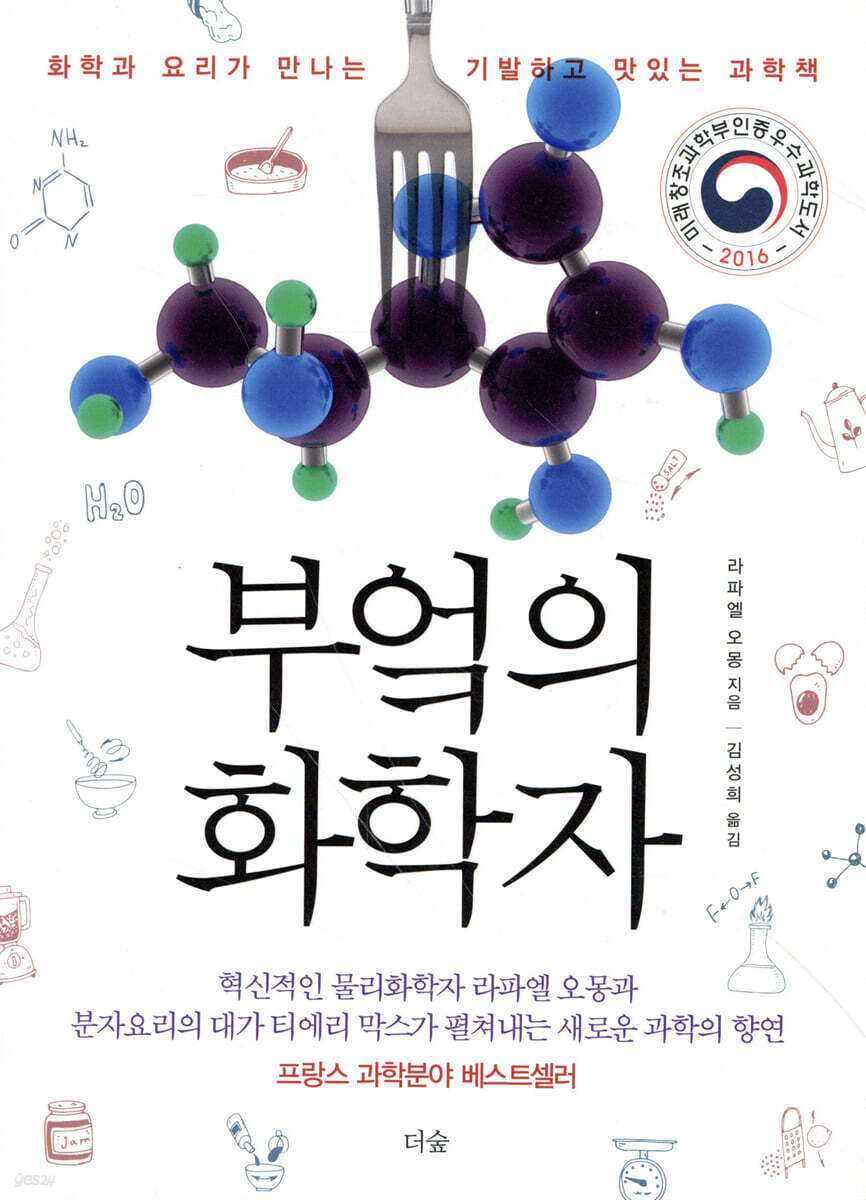
The Chemist in the Kitchen
 |
Description
Book Introduction
A series of rave reviews from leading French media outlets, including Le Monde and Le Figaro!
With the innovative physical chemist Raphaël Aumont
A new scientific feast presented by molecular gastronomy master Thierry Marx!
With interest in cooking at an all-time high thanks to the recent media boom, the book "The Kitchen Chemist" has been published, allowing readers to learn chemistry through cooking and discover the best cooking recipes through chemistry.
The meeting of the talented duo of young, experimental physical chemist Raphaël Aumont and molecular gastronomy master Thierry Marx transformed the kitchen into a science laboratory and cooking utensils into experimental tools, giving birth to an innovative art form.
Immediately after its publication in France, the country of gastronomy, this book received rave reviews from world-renowned French media outlets such as Le Monde, Le Figaro, Le Parisienne, Le Croix, and Ouest France, and created a new craze in the culinary and scientific communities with its unique and enjoyable content.
The author, Raphael Haumont, is a professor of materials physics at the University of Paris 11 and co-founder of the Centre Français d'Innovation Culinaire (CFIC). He is a young scientist who dreams of 'making science into art' based on innovative experiments.
In this book, the author introduces in an easy and fun way how ingredients and food follow the laws of physics as substances, and how scientific and rational food can be made through the 'chemical reaction called cooking'.
For example, why can the word "cook" in cooking be replaced with the word "coagulate"? How can we cook ingredients while preserving their flavor, aroma, color, and texture? How can we come up with ideas that turn existing recipes on their head? It is full of scientific knowledge and cooking secrets for understanding the properties of ingredients and creating unique dishes.
In addition, it provides friendly explanations of eco-friendly scientific research, such as the creation of edible packaging materials using seaweed gelling agents, an eco-friendly food additive, and food encapsulation, allowing readers to glimpse the process of scientific curiosity that began with cooking maturing further.
This book, which combines the scientific research and experiments that only a physical chemist can do with the top-notch recipes and culinary skills of research partner Thierry Marx, creates a synergy that will open up new horizons for readers in terms of taste and the pleasure of eating, and will introduce them to the fascinating world of culinary science.
With the innovative physical chemist Raphaël Aumont
A new scientific feast presented by molecular gastronomy master Thierry Marx!
With interest in cooking at an all-time high thanks to the recent media boom, the book "The Kitchen Chemist" has been published, allowing readers to learn chemistry through cooking and discover the best cooking recipes through chemistry.
The meeting of the talented duo of young, experimental physical chemist Raphaël Aumont and molecular gastronomy master Thierry Marx transformed the kitchen into a science laboratory and cooking utensils into experimental tools, giving birth to an innovative art form.
Immediately after its publication in France, the country of gastronomy, this book received rave reviews from world-renowned French media outlets such as Le Monde, Le Figaro, Le Parisienne, Le Croix, and Ouest France, and created a new craze in the culinary and scientific communities with its unique and enjoyable content.
The author, Raphael Haumont, is a professor of materials physics at the University of Paris 11 and co-founder of the Centre Français d'Innovation Culinaire (CFIC). He is a young scientist who dreams of 'making science into art' based on innovative experiments.
In this book, the author introduces in an easy and fun way how ingredients and food follow the laws of physics as substances, and how scientific and rational food can be made through the 'chemical reaction called cooking'.
For example, why can the word "cook" in cooking be replaced with the word "coagulate"? How can we cook ingredients while preserving their flavor, aroma, color, and texture? How can we come up with ideas that turn existing recipes on their head? It is full of scientific knowledge and cooking secrets for understanding the properties of ingredients and creating unique dishes.
In addition, it provides friendly explanations of eco-friendly scientific research, such as the creation of edible packaging materials using seaweed gelling agents, an eco-friendly food additive, and food encapsulation, allowing readers to glimpse the process of scientific curiosity that began with cooking maturing further.
This book, which combines the scientific research and experiments that only a physical chemist can do with the top-notch recipes and culinary skills of research partner Thierry Marx, creates a synergy that will open up new horizons for readers in terms of taste and the pleasure of eating, and will introduce them to the fascinating world of culinary science.
- You can preview some of the book's contents.
Preview
index
time
Recommended article_ Discover the science behind cooking, cooking using science
Preface: Science and Cooking Meet to Create New Innovations
1 Cooking is a chemical art
Cooking itself is already molecular.
Molecular gastronomy is a cuisine that impresses with its techniques.
Cooking is both an art and a science.
Scientific knowledge and tools are the power that stimulates the creativity of chefs.
The interesting properties of ingredients are expressed in cooking.
The flavorful impression that comes from the structure and texture of the dish
Basic cooking structures: mousse, emulsion, gel
Innovation that combines new culinary variables
2. 'Coagulate' rather than 'cook'
Boiling an egg perfectly is harder than you think.
Why and how do eggs cook?
Can you cook eggs at room temperature?
What makes an egg hard?
When eggs meet alcohol or lemon juice
Cooking time and cooking temperature are a compromise.
3 Cooking ingredients while preserving their flavor, aroma, color, and texture
Crispy on the outside, soft on the inside
The texture of meat depends on coagulation and hydrolysis.
To keep the juices that are the life of the steak
Changes in meat color are due to denaturation of myoglobin.
If you look inside the vegetables…
What does it mean to cook vegetables?
The right use of temperature and pressure can revolutionize cooking methods.
4 Cooking Recipes That Show Off Their Physical Chemistry
Gel is like having your hands and feet tied
If you remove the moisture contained in the bread flesh…
Creating a crispy texture in food
The boundary between soft and hard pies is
Understanding particle arrangement in solids and liquids
Why does jelly turn into a liquid when heated?
Scientifically proven cooking secrets of grandmothers
Do you know about jelly made from meat?
Benefits of Seaweed Gelatinizers
Agar makes for interesting dishes.
Seaweed, an eco-friendly version of food additives
The clear and transparent beads are called dishes.
A recipe that truly shines with culinary mechanics
Creating edible packaging through encapsulation
5 It can be a mousse, an emulsion, or a gel!
Finding the right balance between water and oil
You can even make mayonnaise with egg whites!
How far has mayonnaise changed?
What would happen if you made foam in emulsion?
From familiar textures to new textures
The world of delicious emulsions
Cut-and-eat French dressing made from emulsion in a gel state
Make a chewy mousse using only fruit juice
Super light sponge cake and airy Chantilly cream
Low-calorie chocolate mousse you can eat as much as you want
A chewy bavarois is possible even without gelatin.
If you put tomato juice in a centrifuge and spin it,
Conclusion: The World of Molecular Gastronomy: Exciting and Curious
Where art, science, and cooking meet
A dish that tastes different from the first bite to the last
There is no finish line in culinary research.
Search
Recommended article_ Discover the science behind cooking, cooking using science
Preface: Science and Cooking Meet to Create New Innovations
1 Cooking is a chemical art
Cooking itself is already molecular.
Molecular gastronomy is a cuisine that impresses with its techniques.
Cooking is both an art and a science.
Scientific knowledge and tools are the power that stimulates the creativity of chefs.
The interesting properties of ingredients are expressed in cooking.
The flavorful impression that comes from the structure and texture of the dish
Basic cooking structures: mousse, emulsion, gel
Innovation that combines new culinary variables
2. 'Coagulate' rather than 'cook'
Boiling an egg perfectly is harder than you think.
Why and how do eggs cook?
Can you cook eggs at room temperature?
What makes an egg hard?
When eggs meet alcohol or lemon juice
Cooking time and cooking temperature are a compromise.
3 Cooking ingredients while preserving their flavor, aroma, color, and texture
Crispy on the outside, soft on the inside
The texture of meat depends on coagulation and hydrolysis.
To keep the juices that are the life of the steak
Changes in meat color are due to denaturation of myoglobin.
If you look inside the vegetables…
What does it mean to cook vegetables?
The right use of temperature and pressure can revolutionize cooking methods.
4 Cooking Recipes That Show Off Their Physical Chemistry
Gel is like having your hands and feet tied
If you remove the moisture contained in the bread flesh…
Creating a crispy texture in food
The boundary between soft and hard pies is
Understanding particle arrangement in solids and liquids
Why does jelly turn into a liquid when heated?
Scientifically proven cooking secrets of grandmothers
Do you know about jelly made from meat?
Benefits of Seaweed Gelatinizers
Agar makes for interesting dishes.
Seaweed, an eco-friendly version of food additives
The clear and transparent beads are called dishes.
A recipe that truly shines with culinary mechanics
Creating edible packaging through encapsulation
5 It can be a mousse, an emulsion, or a gel!
Finding the right balance between water and oil
You can even make mayonnaise with egg whites!
How far has mayonnaise changed?
What would happen if you made foam in emulsion?
From familiar textures to new textures
The world of delicious emulsions
Cut-and-eat French dressing made from emulsion in a gel state
Make a chewy mousse using only fruit juice
Super light sponge cake and airy Chantilly cream
Low-calorie chocolate mousse you can eat as much as you want
A chewy bavarois is possible even without gelatin.
If you put tomato juice in a centrifuge and spin it,
Conclusion: The World of Molecular Gastronomy: Exciting and Curious
Where art, science, and cooking meet
A dish that tastes different from the first bite to the last
There is no finish line in culinary research.
Search
Detailed image
Into the book
As research from the French Center for Culinary Innovation confirms, molecular gastronomy can be both healthy and delicious, contrary to popular belief.
This is because it is food made by maximizing the properties of the raw ingredients.
Moreover, molecular gastronomy brings joy and satisfaction because it is a cuisine that eliminates unnecessary elements.
For example, from a molecular gastronomy perspective, flour is no longer an essential ingredient for biscuits, soufflés can be made without eggs, cakes can rise without baking powder, and sherbet can be made without sugar syrup.
That doesn't mean you have to use magic to make molecular gastronomy.
All you need is a minimal amount of knowledge and not be afraid to re-examine existing methods and use new technological tools.
It is about cooking based on accurate knowledge rather than cooking based on experience.
And it tastes good too! --- From "Science and Cooking Meet to Create New Innovations"
Egg white gelation occurs not only when the temperature is raised, that is, when heat energy is applied, but also under special chemical conditions that induce coagulation by unfolding the folded proteins.
Ethanol is a medium that creates just such conditions, and so is an acidic medium.
You may have seen scenes where raw fish is sprinkled with lemon juice or a sour marinade when stored in the refrigerator.
At this time, the fish is translucent and soft, but the surface where lemon juice or marinade is sprinkled becomes opaque and firm.
The same phenomenon occurs when an egg meets alcohol.
In short, ripening can be done not only with heat, but also with alcohol or acid.
If we look at the term 'ripe' in a broader sense.
Therefore, to be precise, it would be more correct to use the expression ‘coagulate’ rather than ‘cook, boil, or bake.’
---From "When Eggs Meet Alcohol or Lemon Juice"
Cooking is the process of transforming the properties of a given ingredient to make it edible or to enhance its flavor.
For example, cooking food softens its fibrous tissues (whether animal or vegetable), thus aiding digestion and absorption.
But these are not only advantages, there are also disadvantages.
This is because many minerals and vitamins are destroyed by heat or lost to water.
This is truly a dilemma.
In terms of texture, strawberries and radishes are best eaten raw, while artichokes and plantains (which are hard and starchy and are eaten as cooking vegetables) are best eaten cooked.
Some ingredients, like apples, bananas, tomatoes, and cabbage, can be eaten raw or cooked, but chefs use them to stimulate the taste buds by providing both raw and cooked textures.
---From “The texture of meat depends on coagulation and hydrolysis”
The synergy created by the meeting between me, a chemist, and Thierry Marx, a chef, has allowed us to go further.
To a world that cannot be reached naturally on one's own.
The connecting link in this collaborative work is the concept of material dynamics and change, and our current interest in 'food that changes in front of the guest' is also based on this concept.
In other words, it is the study of dishes in which the first and last bites differ in taste and texture.
Making these dishes requires not only knowledge of physicochemical reactions, but also consideration of the time it takes for the reaction to occur, the time it takes for the reaction to stop, the time it takes for the customer to taste it, and the time it takes for the dish to stabilize.
This is because it is food made by maximizing the properties of the raw ingredients.
Moreover, molecular gastronomy brings joy and satisfaction because it is a cuisine that eliminates unnecessary elements.
For example, from a molecular gastronomy perspective, flour is no longer an essential ingredient for biscuits, soufflés can be made without eggs, cakes can rise without baking powder, and sherbet can be made without sugar syrup.
That doesn't mean you have to use magic to make molecular gastronomy.
All you need is a minimal amount of knowledge and not be afraid to re-examine existing methods and use new technological tools.
It is about cooking based on accurate knowledge rather than cooking based on experience.
And it tastes good too! --- From "Science and Cooking Meet to Create New Innovations"
Egg white gelation occurs not only when the temperature is raised, that is, when heat energy is applied, but also under special chemical conditions that induce coagulation by unfolding the folded proteins.
Ethanol is a medium that creates just such conditions, and so is an acidic medium.
You may have seen scenes where raw fish is sprinkled with lemon juice or a sour marinade when stored in the refrigerator.
At this time, the fish is translucent and soft, but the surface where lemon juice or marinade is sprinkled becomes opaque and firm.
The same phenomenon occurs when an egg meets alcohol.
In short, ripening can be done not only with heat, but also with alcohol or acid.
If we look at the term 'ripe' in a broader sense.
Therefore, to be precise, it would be more correct to use the expression ‘coagulate’ rather than ‘cook, boil, or bake.’
---From "When Eggs Meet Alcohol or Lemon Juice"
Cooking is the process of transforming the properties of a given ingredient to make it edible or to enhance its flavor.
For example, cooking food softens its fibrous tissues (whether animal or vegetable), thus aiding digestion and absorption.
But these are not only advantages, there are also disadvantages.
This is because many minerals and vitamins are destroyed by heat or lost to water.
This is truly a dilemma.
In terms of texture, strawberries and radishes are best eaten raw, while artichokes and plantains (which are hard and starchy and are eaten as cooking vegetables) are best eaten cooked.
Some ingredients, like apples, bananas, tomatoes, and cabbage, can be eaten raw or cooked, but chefs use them to stimulate the taste buds by providing both raw and cooked textures.
---From “The texture of meat depends on coagulation and hydrolysis”
The synergy created by the meeting between me, a chemist, and Thierry Marx, a chef, has allowed us to go further.
To a world that cannot be reached naturally on one's own.
The connecting link in this collaborative work is the concept of material dynamics and change, and our current interest in 'food that changes in front of the guest' is also based on this concept.
In other words, it is the study of dishes in which the first and last bites differ in taste and texture.
Making these dishes requires not only knowledge of physicochemical reactions, but also consideration of the time it takes for the reaction to occur, the time it takes for the reaction to stop, the time it takes for the customer to taste it, and the time it takes for the dish to stabilize.
---From "A dish that tastes different from the first bite to the last"
Publisher's Review
Fun and entertaining experiments, groundbreaking and surprising foods…
Making scientific concepts, once perceived as difficult, more palatable.
How do you cook (coagulate) a boiled egg just right, without it becoming rubbery or stinky? How do you cook a steak so it's crispy on the outside and tender on the inside, while still retaining its juices? How should you cook vegetables?
Making delicious food requires more than just love and care.
To be able to 'cook accurately while respecting the properties of the ingredients as much as possible', you must understand various variables such as cooking time, cooking temperature, pressure, and the material structure of the ingredients.
The author calls this "rational cooking born from research," and says it could even create completely new foods from a molecular perspective.
To facilitate easy understanding, the author defines three basic cooking structures: 'mousse', where air bubbles are dispersed in a liquid; 'emulsion', where small droplets of fat are dispersed in another liquid; and 'gel', where a liquid is dispersed in a solid. By combining these in new ways, the author creates groundbreaking and surprising dishes that have never been seen before.
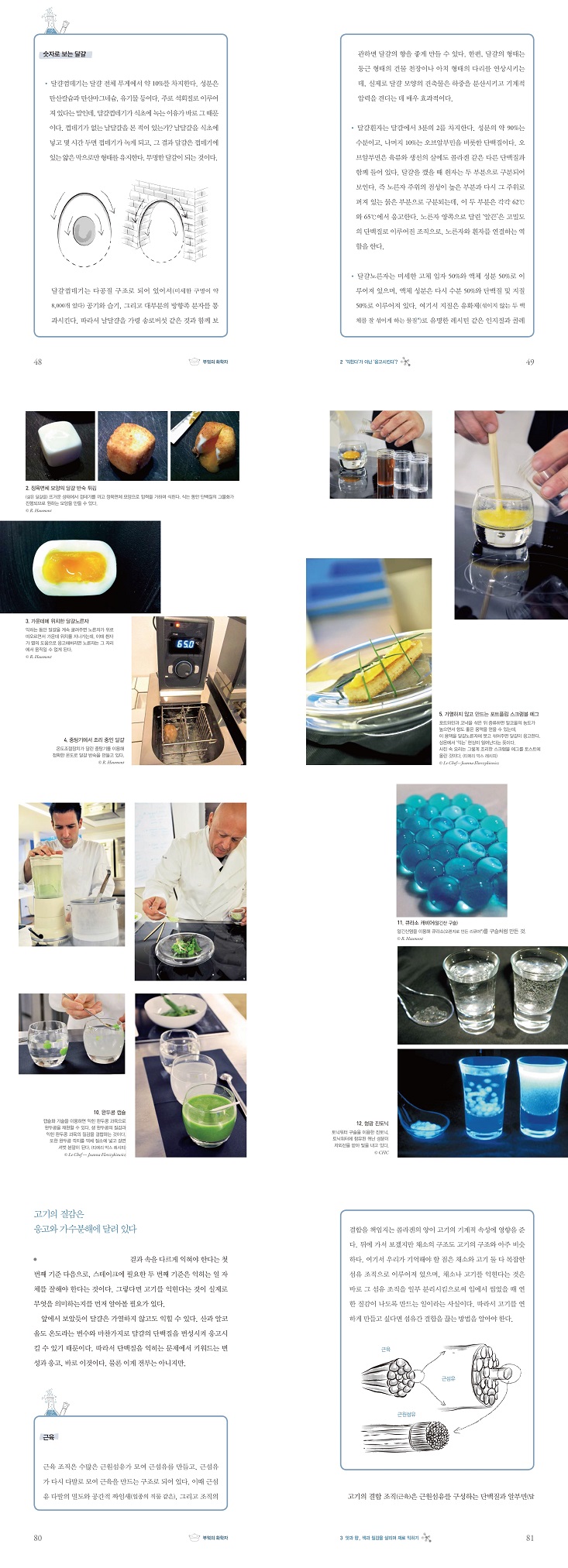
For example, there is 'Square Cut French Dressing', which uses a gelling agent and temperature to change French dressing from an emulsion state to a gel state, which changes the texture and creates a completely different shape and texture.
In addition, it is full of surprising recipes that combine science, such as mayonnaise made only with egg whites and no yolks, colorless tomato juice obtained through a centrifuge, soft-boiled eggs fried in cubes, chewy cube-shaped cocktails, super-light sponge cake made through vacuum cooling, and mint syrup beads.
As you read these unique and novel food recipes that will make your mouth water just by reading them, you'll find yourself getting closer to the knowledge of physics and chemistry that you've previously avoided because it was too difficult.
Free humanistic thinking and scientific knowledge,
A captivating textbook that harmoniously combines the finest recipes!
“Molecular cuisine can be seen as resembling the Eastern aesthetic of pursuing simplicity.
“Something simple yet powerful, like a painting painted with a single, precise brushstroke, or a short poem composed of just a few words.”
- From "Cooking is a Chemical Art"
With the growing popularity of chefs in recent years, people have begun to take an interest in the unique cooking methods of chefs, and at the same time, 'molecular cuisine' has emerged as a new concept.
Although this is a cooking method that has been in the spotlight overseas for several years, it is not known for long in Korea. Many restaurants that have been awarded stars by Michelin, France's representative restaurant guide, or are ranked high on the 'World's 50 Best Restaurants' selected by the British food magazine Restaurant magazine are promoting molecular gastronomy.
However, just as people are sensitive to the word 'chemical' used in food, there is still a persistent view that molecular gastronomy is artificial and unhealthy.
The author says about this bias, 'Cooking itself is already molecular.'
Even the simple act of boiling egg whites involves coagulating molecules called proteins, and adding salt to water to boil pasta involves complex chemical phenomena such as solvation, polarization, and electron clouds.
According to the author, dishes made with this method, which "returns to the essence of the recipe while maximizing the physical properties of the ingredients," can be both healthy and delicious, contrary to popular belief.
And at the same time, it goes beyond simple scientific experiments or recipes and becomes an art form that ‘impresses the public with technology.’
Chemist author and chef Thierry Marx continues his research based on a convergent mindset, not confined to a single field such as science or cuisine.
Their goal is to continue to innovate the art of molecular gastronomy by researching dishes that "change in front of the customer," that is, dishes that differ in taste and texture from the first to the last bite, based on the concepts of material dynamics and change.
Just as a chemist moves from the laboratory to the kitchen, and just as a chef applies scientific knowledge in the kitchen, this book, which freely crosses fields and awakens new values, will become an attractive educational resource for readers seeking convergent values, harmoniously blending liberal humanistic thinking, scientific knowledge, and top-notch recipes.
Recommendation
A series of rave reviews from leading French media outlets!
This book will help you look back on the physical chemistry books you've read so far, while also providing a clue for new innovations.
- Le Monde
With this book, Raphaël Aumont seeks to shatter the stereotypes surrounding molecular gastronomy.
- Ouest France
By introducing a fresh perspective on "molecular" cooking, we opened up new horizons of flavor.
- Sud Ouest
The science in this book is whetting our appetite!
- La Croix
A captivating essay filled with colorful photos of cube-shaped cocktails, puffed omelets, liquid tarte tatin, and fruit-powdered piña coladas.
- 7 Hebdo
Making scientific concepts, once perceived as difficult, more palatable.
How do you cook (coagulate) a boiled egg just right, without it becoming rubbery or stinky? How do you cook a steak so it's crispy on the outside and tender on the inside, while still retaining its juices? How should you cook vegetables?
Making delicious food requires more than just love and care.
To be able to 'cook accurately while respecting the properties of the ingredients as much as possible', you must understand various variables such as cooking time, cooking temperature, pressure, and the material structure of the ingredients.
The author calls this "rational cooking born from research," and says it could even create completely new foods from a molecular perspective.
To facilitate easy understanding, the author defines three basic cooking structures: 'mousse', where air bubbles are dispersed in a liquid; 'emulsion', where small droplets of fat are dispersed in another liquid; and 'gel', where a liquid is dispersed in a solid. By combining these in new ways, the author creates groundbreaking and surprising dishes that have never been seen before.
For example, there is 'Square Cut French Dressing', which uses a gelling agent and temperature to change French dressing from an emulsion state to a gel state, which changes the texture and creates a completely different shape and texture.
In addition, it is full of surprising recipes that combine science, such as mayonnaise made only with egg whites and no yolks, colorless tomato juice obtained through a centrifuge, soft-boiled eggs fried in cubes, chewy cube-shaped cocktails, super-light sponge cake made through vacuum cooling, and mint syrup beads.
As you read these unique and novel food recipes that will make your mouth water just by reading them, you'll find yourself getting closer to the knowledge of physics and chemistry that you've previously avoided because it was too difficult.
Free humanistic thinking and scientific knowledge,
A captivating textbook that harmoniously combines the finest recipes!
“Molecular cuisine can be seen as resembling the Eastern aesthetic of pursuing simplicity.
“Something simple yet powerful, like a painting painted with a single, precise brushstroke, or a short poem composed of just a few words.”
- From "Cooking is a Chemical Art"
With the growing popularity of chefs in recent years, people have begun to take an interest in the unique cooking methods of chefs, and at the same time, 'molecular cuisine' has emerged as a new concept.
Although this is a cooking method that has been in the spotlight overseas for several years, it is not known for long in Korea. Many restaurants that have been awarded stars by Michelin, France's representative restaurant guide, or are ranked high on the 'World's 50 Best Restaurants' selected by the British food magazine Restaurant magazine are promoting molecular gastronomy.
However, just as people are sensitive to the word 'chemical' used in food, there is still a persistent view that molecular gastronomy is artificial and unhealthy.
The author says about this bias, 'Cooking itself is already molecular.'
Even the simple act of boiling egg whites involves coagulating molecules called proteins, and adding salt to water to boil pasta involves complex chemical phenomena such as solvation, polarization, and electron clouds.
According to the author, dishes made with this method, which "returns to the essence of the recipe while maximizing the physical properties of the ingredients," can be both healthy and delicious, contrary to popular belief.
And at the same time, it goes beyond simple scientific experiments or recipes and becomes an art form that ‘impresses the public with technology.’
Chemist author and chef Thierry Marx continues his research based on a convergent mindset, not confined to a single field such as science or cuisine.
Their goal is to continue to innovate the art of molecular gastronomy by researching dishes that "change in front of the customer," that is, dishes that differ in taste and texture from the first to the last bite, based on the concepts of material dynamics and change.
Just as a chemist moves from the laboratory to the kitchen, and just as a chef applies scientific knowledge in the kitchen, this book, which freely crosses fields and awakens new values, will become an attractive educational resource for readers seeking convergent values, harmoniously blending liberal humanistic thinking, scientific knowledge, and top-notch recipes.
Recommendation
A series of rave reviews from leading French media outlets!
This book will help you look back on the physical chemistry books you've read so far, while also providing a clue for new innovations.
- Le Monde
With this book, Raphaël Aumont seeks to shatter the stereotypes surrounding molecular gastronomy.
- Ouest France
By introducing a fresh perspective on "molecular" cooking, we opened up new horizons of flavor.
- Sud Ouest
The science in this book is whetting our appetite!
- La Croix
A captivating essay filled with colorful photos of cube-shaped cocktails, puffed omelets, liquid tarte tatin, and fruit-powdered piña coladas.
- 7 Hebdo
GOODS SPECIFICS
- Date of publication: January 27, 2016
- Page count, weight, size: 236 pages | 398g | 152*210*14mm
- ISBN13: 9791186900024
- ISBN10: 1186900024
You may also like
카테고리
korean


korean

![GQ KOREA Mark (Monthly): December [2025]](http://librairie.coreenne.fr/cdn/shop/files/8ef265dbbfbf186523ed75ba7319009d.jpg?v=1765340328&width=3840)


