

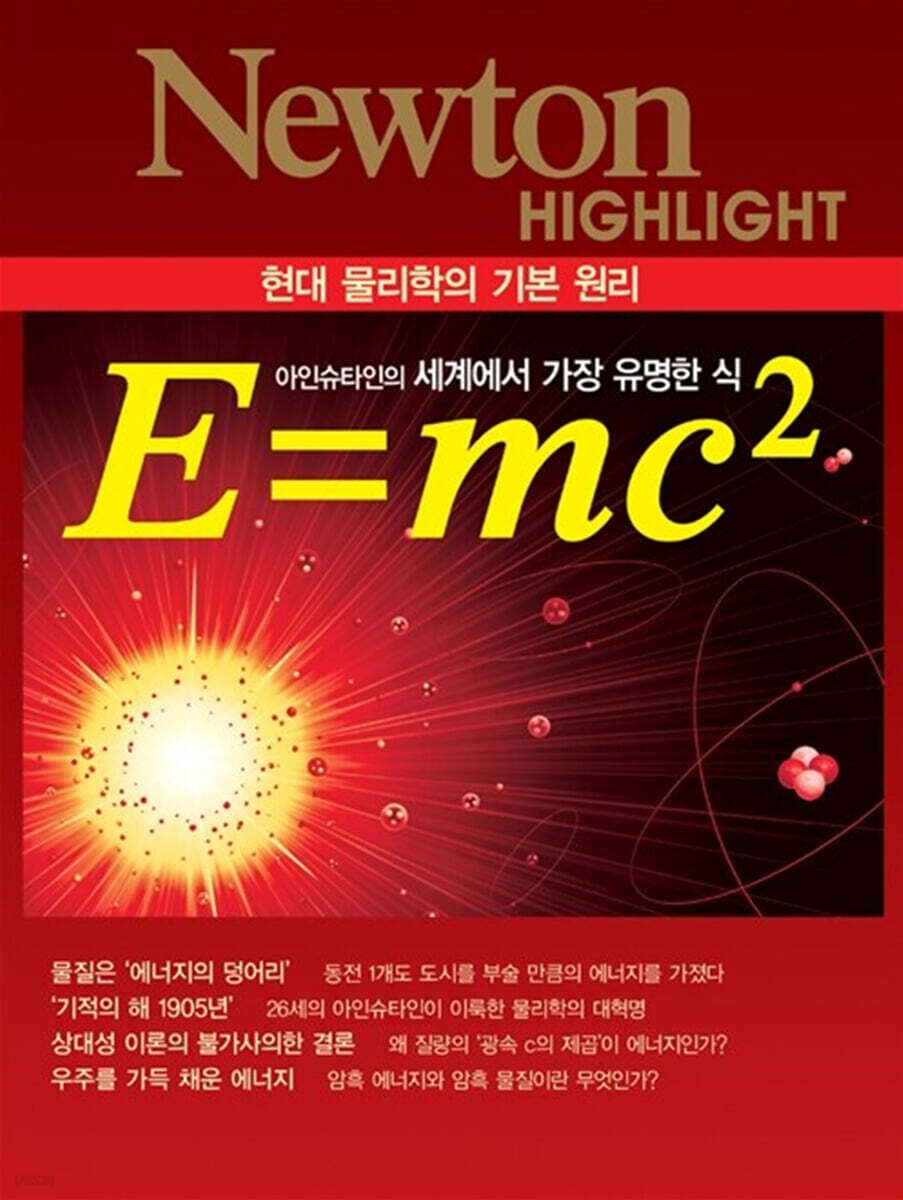
NEWTON HIGHLIGHT E=mc2
 |
Description
Book Introduction
Even a 10-won coin holds enormous energy.
"A 10-won coin (a substance weighing 1 gram) contains enough energy to fly from Seoul to Jeju Island 248 times." Is this true? The simple and clear equation proving this is none other than Einstein's famous E=mc2.
Moreover, this formula claims that the energy contained in a 1 gram coin can provide enough electricity to power 83,000 households, equivalent to a city, for a month, and boil water the size of a baseball field.
Why does this happen? How can such a tiny 1-gram coin hold so much energy, and how did Einstein discover its "secret"? Based on this background, "Newton Highlights: E=mc2" details the process leading up to E=mc2, as well as key concepts in modern physics closely related to E=mc^2, including energy, mass, special relativity, nuclear fission and fusion, nuclear power generation, elementary particles, and dark energy.
This book will provide a clear overview of everything about E=mc2, which is a pillar of physics along with Isaac Newton's F=ma.
"A 10-won coin (a substance weighing 1 gram) contains enough energy to fly from Seoul to Jeju Island 248 times." Is this true? The simple and clear equation proving this is none other than Einstein's famous E=mc2.
Moreover, this formula claims that the energy contained in a 1 gram coin can provide enough electricity to power 83,000 households, equivalent to a city, for a month, and boil water the size of a baseball field.
Why does this happen? How can such a tiny 1-gram coin hold so much energy, and how did Einstein discover its "secret"? Based on this background, "Newton Highlights: E=mc2" details the process leading up to E=mc2, as well as key concepts in modern physics closely related to E=mc^2, including energy, mass, special relativity, nuclear fission and fusion, nuclear power generation, elementary particles, and dark energy.
This book will provide a clear overview of everything about E=mc2, which is a pillar of physics along with Isaac Newton's F=ma.
index
Part 1 Energy, Mass, and the Speed of Light
Prologue: Matter is a lump of energy
Interview: Experts Explain E=mc2 (The Nature of Energy)
E - Energy / Types of energy / Kinetic energy and potential energy / Law of conservation of energy / m - Mass / Difference between 'mass' and 'weight' / c - Speed of light / Power of E=mc2
Part 2: The Birth of E=mc2
Prologue: 'E=mc2' - The Truth Reached After Deep Thought
Interview: E=mc2 from an Expert (How Did E=mc2 Come About?)
E=mc2 and the Year of Miracles / June 1905 paper 'Special Theory of Relativity' / September 1905 paper 'E=mc2' / Experimental Proof of E=mc2
Column: The Calculation Process for Deducing 'E=mc2'
Part 3 Nuclear Fission and Nuclear Fusion
Prologue: Manipulating the Nucleus to Convert Mass into Energy
Interview: E=mc2 (Nuclear Fission and Fusion) from an Expert
Nuclear fission and E=mc2 / Mechanism of nuclear power generation / Nuclear fusion and E=mc2 / Nuclear fusion power generation / Laser nuclear fusion
Column: How to achieve nuclear fusion?
Part 4 E=mc2 and the Origin of Matter
Prologue: E=mc2 Creates Matter
Interview: E=mc2 (What is Antimatter?) from an Expert
The Big Bang and E=mc2 / The source of matter: elementary particles / Electrons and quarks / Creating matter with accelerators / LHC / ILC / Antiparticles
Part 5: The Origins of Force and Mass
Prologue: Why is matter 'heavy?'
Interview: E=mc2: The Origin of Mass: Understanding the Cosmic Mechanism
Elementary particles that transmit force / Elementary particles and 'force' / The origin of mass / Superstring theory
Part 6 Dark Matter and Dark Energy
Prologue: We still don't know much about the universe.
Interview: E=mc2: The Keys to Solving the Mysteries of the Universe: Dark Matter and Dark Energy, According to Experts
Dark matter / Supersymmetric particles / XMASS / Expanding universe / Discovery of accelerating expansion of the universe / Dark energy
Prologue: Matter is a lump of energy
Interview: Experts Explain E=mc2 (The Nature of Energy)
E - Energy / Types of energy / Kinetic energy and potential energy / Law of conservation of energy / m - Mass / Difference between 'mass' and 'weight' / c - Speed of light / Power of E=mc2
Part 2: The Birth of E=mc2
Prologue: 'E=mc2' - The Truth Reached After Deep Thought
Interview: E=mc2 from an Expert (How Did E=mc2 Come About?)
E=mc2 and the Year of Miracles / June 1905 paper 'Special Theory of Relativity' / September 1905 paper 'E=mc2' / Experimental Proof of E=mc2
Column: The Calculation Process for Deducing 'E=mc2'
Part 3 Nuclear Fission and Nuclear Fusion
Prologue: Manipulating the Nucleus to Convert Mass into Energy
Interview: E=mc2 (Nuclear Fission and Fusion) from an Expert
Nuclear fission and E=mc2 / Mechanism of nuclear power generation / Nuclear fusion and E=mc2 / Nuclear fusion power generation / Laser nuclear fusion
Column: How to achieve nuclear fusion?
Part 4 E=mc2 and the Origin of Matter
Prologue: E=mc2 Creates Matter
Interview: E=mc2 (What is Antimatter?) from an Expert
The Big Bang and E=mc2 / The source of matter: elementary particles / Electrons and quarks / Creating matter with accelerators / LHC / ILC / Antiparticles
Part 5: The Origins of Force and Mass
Prologue: Why is matter 'heavy?'
Interview: E=mc2: The Origin of Mass: Understanding the Cosmic Mechanism
Elementary particles that transmit force / Elementary particles and 'force' / The origin of mass / Superstring theory
Part 6 Dark Matter and Dark Energy
Prologue: We still don't know much about the universe.
Interview: E=mc2: The Keys to Solving the Mysteries of the Universe: Dark Matter and Dark Energy, According to Experts
Dark matter / Supersymmetric particles / XMASS / Expanding universe / Discovery of accelerating expansion of the universe / Dark energy
Detailed image
Publisher's Review
● The concepts of energy, mass, and the speed of light and the process leading to E=mc2
In physics, energy refers to the ability to move something, and mass is a quantity that indicates how difficult it is to move something.
What's so special about the "speed of light"? This book first defines the concepts of "energy," "mass," and "speed of light," which appear in the equation E=mc2.
Meanwhile, Einstein derived the surprising result of E=mc2 from the 'special theory of relativity'.
How did Einstein derive E=mc2 from his theory? This detailed account explains the physical background that gave birth to this relationship, a symbol of modern science, as well as the process of its derivation.
● The structure of nuclear fission and nuclear fusion, which convert mass into energy by manipulating the atomic nucleus.
One of the dramatic cases where E=mc2 applies would be ‘nuclear fission’ and ‘nuclear fusion’.
'Nuclear fission' is a phenomenon in which the nucleus at the center of an atom breaks apart, and 'nuclear fusion' is a phenomenon in which nuclei collide and fuse into one nucleus.
In nuclear fission or nuclear fusion, there are cases where the total mass decreases after the reaction compared to before.
That reduced mass is converted into a huge amount of energy.
Explains in detail the mechanisms of nuclear fission and nuclear fusion.
● Elementary particles, the source of matter, and the relationship between force and E=mc2
When matter is broken down into molecules and atoms, it is ultimately divided into protons, neutrons, and electrons.
And protons and neutrons contain quarks.
So where did this matter come from? E=mc2 also implies that "matter is created from energy."
The energy that filled the universe at the time of its birth was converted into mass and became matter.
Learn about the origin and identity of matter.
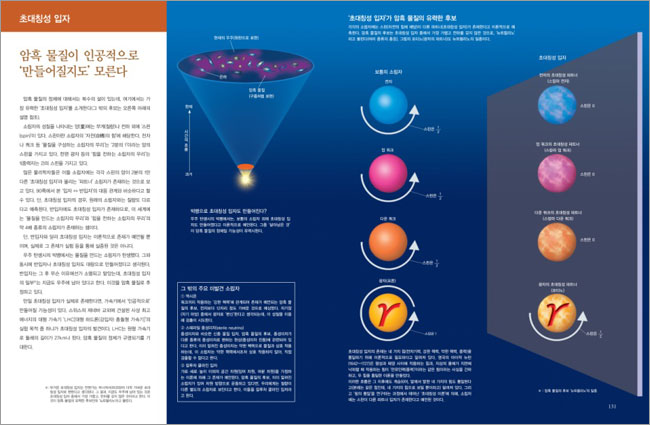
Dark energy and dark matter that fill the universe
According to the latest cosmology, most of the components of the universe are invisible, unidentified 'dark matter' and 'dark energy'.
There is not much of ordinary matter that we know.
Dark matter and dark energy have not been confirmed, but without them, the observed expansion of the universe and other phenomena cannot be explained.
It clearly explains what dark matter and dark energy are, which are also called the greatest mysteries of the universe.
● 'Newton Highlight Series' published one volume every month
This book is the 57th volume in the 'Newton Highlights Series', which selects and reorganizes only the articles that received favorable reviews from readers from the science magazine 'Newton'.
This series boasts a unique format that could be said to set a new standard for science books.
A variety of sister books in physics, chemistry, biology, earth science, and mathematics, such as 『Theory of Relativity』, 『Human Body - 21st Century Anatomy』, 『Periodic Table』, 『DNA』, and 『The Mysterious World of Mathematics』, are selling like hotcakes.
In physics, energy refers to the ability to move something, and mass is a quantity that indicates how difficult it is to move something.
What's so special about the "speed of light"? This book first defines the concepts of "energy," "mass," and "speed of light," which appear in the equation E=mc2.
Meanwhile, Einstein derived the surprising result of E=mc2 from the 'special theory of relativity'.
How did Einstein derive E=mc2 from his theory? This detailed account explains the physical background that gave birth to this relationship, a symbol of modern science, as well as the process of its derivation.
● The structure of nuclear fission and nuclear fusion, which convert mass into energy by manipulating the atomic nucleus.
One of the dramatic cases where E=mc2 applies would be ‘nuclear fission’ and ‘nuclear fusion’.
'Nuclear fission' is a phenomenon in which the nucleus at the center of an atom breaks apart, and 'nuclear fusion' is a phenomenon in which nuclei collide and fuse into one nucleus.
In nuclear fission or nuclear fusion, there are cases where the total mass decreases after the reaction compared to before.
That reduced mass is converted into a huge amount of energy.
Explains in detail the mechanisms of nuclear fission and nuclear fusion.
● Elementary particles, the source of matter, and the relationship between force and E=mc2
When matter is broken down into molecules and atoms, it is ultimately divided into protons, neutrons, and electrons.
And protons and neutrons contain quarks.
So where did this matter come from? E=mc2 also implies that "matter is created from energy."
The energy that filled the universe at the time of its birth was converted into mass and became matter.
Learn about the origin and identity of matter.
Dark energy and dark matter that fill the universe
According to the latest cosmology, most of the components of the universe are invisible, unidentified 'dark matter' and 'dark energy'.
There is not much of ordinary matter that we know.
Dark matter and dark energy have not been confirmed, but without them, the observed expansion of the universe and other phenomena cannot be explained.
It clearly explains what dark matter and dark energy are, which are also called the greatest mysteries of the universe.
● 'Newton Highlight Series' published one volume every month
This book is the 57th volume in the 'Newton Highlights Series', which selects and reorganizes only the articles that received favorable reviews from readers from the science magazine 'Newton'.
This series boasts a unique format that could be said to set a new standard for science books.
A variety of sister books in physics, chemistry, biology, earth science, and mathematics, such as 『Theory of Relativity』, 『Human Body - 21st Century Anatomy』, 『Periodic Table』, 『DNA』, and 『The Mysterious World of Mathematics』, are selling like hotcakes.
GOODS SPECIFICS
- Date of publication: December 10, 2011
- Page count, weight, size: 144 pages | 474g | 210*275*20mm
- ISBN13: 9788955378474
- ISBN10: 8955378475
You may also like
카테고리
korean


korean

![GQ KOREA Mark (Monthly): December [2025]](http://librairie.coreenne.fr/cdn/shop/files/8ef265dbbfbf186523ed75ba7319009d.jpg?v=1765340328&width=3840)


