

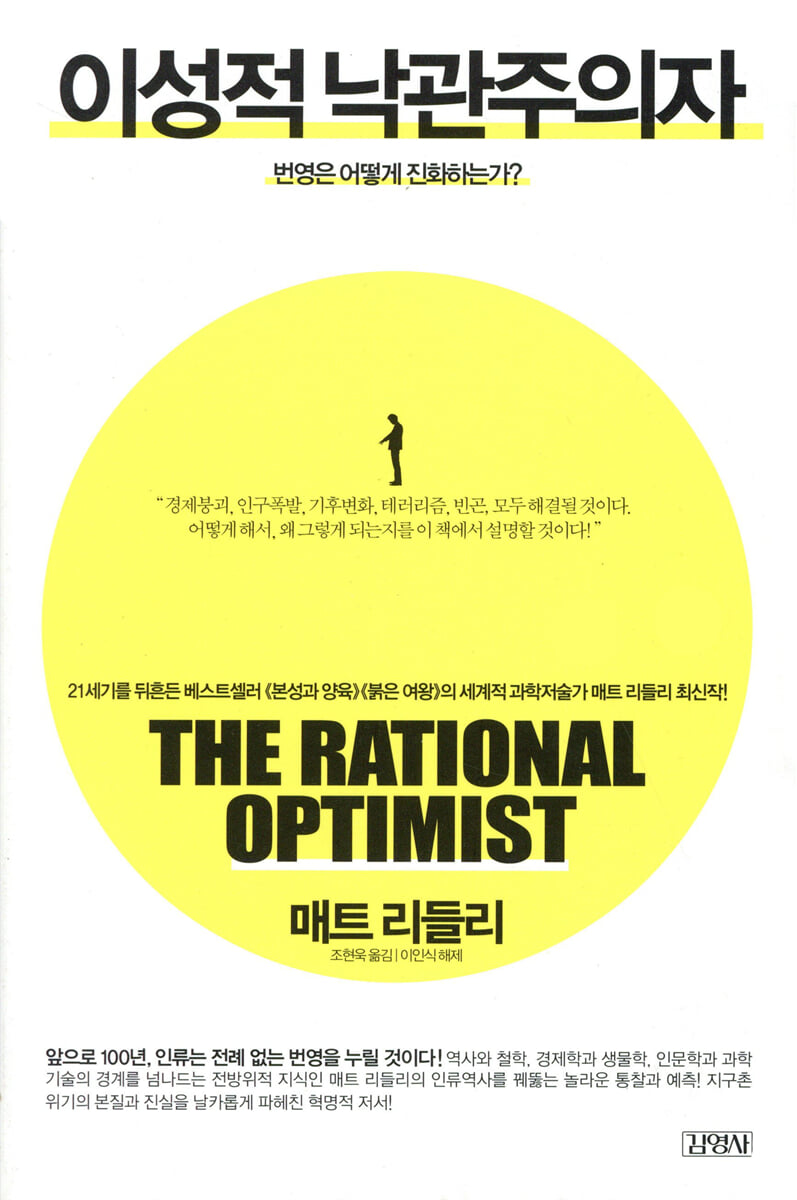
rational optimist
 |
Description
Book Introduction
The latest work from world-renowned science writer Matt Ridley, author of "Genome" and "The Red Queen"!
In the next 100 years, humanity will enjoy unprecedented prosperity!
"The Rational Optimist" is a revolutionary book that has been praised for its sharp analysis of the nature and truth of the global crisis.
Matt Ridley, a multifaceted intellectual who crosses the boundaries of history and philosophy, economics and biology, and the humanities and science and technology, presents astonishing insights and predictions that penetrate human history in this book.
He is confident that the end of nature will not come and that scientific reason has chosen an era of optimism.
To prove this, Ridley presents evidence of hope, clearly expressed through scientific rationality, in the face of the threats of climate change, resource depletion, and economic collapse.
Rising poverty, expanding deserts, virulent epidemics, water wars, oil depletion, declining sperm counts, a thinning ozone layer, acid rain, mad cow disease, global warming, asteroid impacts—these threats have been championed by cool-headed, serious elites, and propagandized by the media and mass media.
But Matt Ridley asks in this book:
Are we going to entrust our future to the warnings of Noam Chomsky, Al Gore, Michael Moore, Jared Diamond, and Rachel Carson, who have made such claims?
Ridley's unwavering and unflinching optimism stands tall against the pessimism of the times, refuting point by point the pessimism that dominates the intellectual world today with a broad historical perspective and extensive evidence.
He firmly diagnosed that humanity would enjoy unprecedented prosperity over the next 100 years, and he analyzed and summarized how wealth is created and spread, and why human life has improved so continuously, crossing over history, philosophy, economics, and biology.
At the end of the book, he shows his optimistic view of humanity as a "rational optimist" by concluding that the history of mankind, with its 100,000-year-long civilization, is a "history of prosperity."
In the next 100 years, humanity will enjoy unprecedented prosperity!
"The Rational Optimist" is a revolutionary book that has been praised for its sharp analysis of the nature and truth of the global crisis.
Matt Ridley, a multifaceted intellectual who crosses the boundaries of history and philosophy, economics and biology, and the humanities and science and technology, presents astonishing insights and predictions that penetrate human history in this book.
He is confident that the end of nature will not come and that scientific reason has chosen an era of optimism.
To prove this, Ridley presents evidence of hope, clearly expressed through scientific rationality, in the face of the threats of climate change, resource depletion, and economic collapse.
Rising poverty, expanding deserts, virulent epidemics, water wars, oil depletion, declining sperm counts, a thinning ozone layer, acid rain, mad cow disease, global warming, asteroid impacts—these threats have been championed by cool-headed, serious elites, and propagandized by the media and mass media.
But Matt Ridley asks in this book:
Are we going to entrust our future to the warnings of Noam Chomsky, Al Gore, Michael Moore, Jared Diamond, and Rachel Carson, who have made such claims?
Ridley's unwavering and unflinching optimism stands tall against the pessimism of the times, refuting point by point the pessimism that dominates the intellectual world today with a broad historical perspective and extensive evidence.
He firmly diagnosed that humanity would enjoy unprecedented prosperity over the next 100 years, and he analyzed and summarized how wealth is created and spread, and why human life has improved so continuously, crossing over history, philosophy, economics, and biology.
At the end of the book, he shows his optimistic view of humanity as a "rational optimist" by concluding that the history of mankind, with its 100,000-year-long civilization, is a "history of prosperity."
- You can preview some of the book's contents.
Preview
index
Release _ Dreaming of a truly wonderful future
Prologue _ When Ideas Have Sex
1.
A Better Present _ Unprecedented Prosperity
Prosperity for All | What Cheap Light Shines | Saving Time, the Fruit of Prosperity | The Correlation Between Economic Growth and Happiness | Is the World Economy Really Collapsed? | Interdependence and Wealth | Gentle Production, Diverse Consumption | Self-Sufficiency is Poverty | Paradise Rediscovered | The New Calls
2.
Collective Intelligence: Exchange and Specialization Since 200,000 Years Ago
The Emergence of Dynamic Humans | The Beginning of Barter | Hunting Assists Gathering, the Gendered Division of Labor | Drifters on the Eastern Shore | Shall We Trade? | Division of Labor Based on Comparative Advantage | Innovation Networks | Networking in the Middle East
3.
The Formation of Virtue - Barter, Trust, and Rules 50,000 Years Ago
Finding a trading partner | The human instinct to trust strangers | Current transactions with a shadow of the future | If trust drives markets, can markets create trust? | Coercion is the opposite of freedom | The monster called big business | Commerce and creativity | Rules and tools for creating trust
4.
Feeding 9 Billion People: Agriculture Since 10,000 Years Ago
There is no agriculture without trade | Capital and metal refining | The invention of agriculture: the worst mistake in human history? | The fertilizer revolution: turning air into fertilizer | Borlaug's dwarf wheat | Intensive farming protects nature | The fallacy of organic farming | The many ways to manipulate genes
5.
The Triumph of the City _ Trade Since 5,000 Years Ago
The world's first metropolis | Trading cotton and fish | Flags follow trade | The Phoenicians' maritime revolution | The virtues of weak government | From the Ganges to the Tiber | Camels, ships of the desert | The merchants of Pisa | A state of absolute regulation | Abolish the grain laws again | The golden age of cities
6.
Avoiding Malthus's Trap - Population after 1200
The Failure of Medieval Europe | Population Growth and Decline in 18th-Century Japan | British Exceptionalism | Demographic Transition | The Inexplicable
7.
Emancipation of Slaves - Energy after 1700
Growing Richer | Metal Industry in the English Midlands | Consume, They Will Supply | Coal, the King of Energy | The Magical World of Electricity | Heat is Work, Work is Heat | Biofuels, a Crazy World | Energy Efficiency and Demand
8.
The Invention of Inventions _ Harvest Stagnation After 1800
Innovation is like wildfire | Is it science that drives innovation? | Is it the power of capital? | If so, intellectual property rights? | Is it the government's contribution? | Then, exchange! | Infinite possibilities
9.
Turning Point Fuss: Pessimism After 1900
A Brief History of Bad News | The Never-ending Turning Point Crash | Are We Really Going From Bad to Worse? | Cancer Pandemic | Nuclear Armageddon | Global Famine | Resource Depletion | Air Pollution | Genes | Malignant Pandemic | Don't Be Fooled by False Alarms
10.
Today's Two Great Pessimists: Africa and Climate After 2010
Africa's poorest billion | Aid put to the test | Destined to fail? | Infinite opportunities await | The challenge of climate change | Will we warm and become richer, or cool and become poorer? | Saving ecosystems | Decarbonizing the economy
11.
Catalaxy _ Rational Optimism Looking to the Year 2100
Onward, upward! | How much better can it get?
Translator's Note _ Reason chose optimism.
References and Bibliography | Index
Prologue _ When Ideas Have Sex
1.
A Better Present _ Unprecedented Prosperity
Prosperity for All | What Cheap Light Shines | Saving Time, the Fruit of Prosperity | The Correlation Between Economic Growth and Happiness | Is the World Economy Really Collapsed? | Interdependence and Wealth | Gentle Production, Diverse Consumption | Self-Sufficiency is Poverty | Paradise Rediscovered | The New Calls
2.
Collective Intelligence: Exchange and Specialization Since 200,000 Years Ago
The Emergence of Dynamic Humans | The Beginning of Barter | Hunting Assists Gathering, the Gendered Division of Labor | Drifters on the Eastern Shore | Shall We Trade? | Division of Labor Based on Comparative Advantage | Innovation Networks | Networking in the Middle East
3.
The Formation of Virtue - Barter, Trust, and Rules 50,000 Years Ago
Finding a trading partner | The human instinct to trust strangers | Current transactions with a shadow of the future | If trust drives markets, can markets create trust? | Coercion is the opposite of freedom | The monster called big business | Commerce and creativity | Rules and tools for creating trust
4.
Feeding 9 Billion People: Agriculture Since 10,000 Years Ago
There is no agriculture without trade | Capital and metal refining | The invention of agriculture: the worst mistake in human history? | The fertilizer revolution: turning air into fertilizer | Borlaug's dwarf wheat | Intensive farming protects nature | The fallacy of organic farming | The many ways to manipulate genes
5.
The Triumph of the City _ Trade Since 5,000 Years Ago
The world's first metropolis | Trading cotton and fish | Flags follow trade | The Phoenicians' maritime revolution | The virtues of weak government | From the Ganges to the Tiber | Camels, ships of the desert | The merchants of Pisa | A state of absolute regulation | Abolish the grain laws again | The golden age of cities
6.
Avoiding Malthus's Trap - Population after 1200
The Failure of Medieval Europe | Population Growth and Decline in 18th-Century Japan | British Exceptionalism | Demographic Transition | The Inexplicable
7.
Emancipation of Slaves - Energy after 1700
Growing Richer | Metal Industry in the English Midlands | Consume, They Will Supply | Coal, the King of Energy | The Magical World of Electricity | Heat is Work, Work is Heat | Biofuels, a Crazy World | Energy Efficiency and Demand
8.
The Invention of Inventions _ Harvest Stagnation After 1800
Innovation is like wildfire | Is it science that drives innovation? | Is it the power of capital? | If so, intellectual property rights? | Is it the government's contribution? | Then, exchange! | Infinite possibilities
9.
Turning Point Fuss: Pessimism After 1900
A Brief History of Bad News | The Never-ending Turning Point Crash | Are We Really Going From Bad to Worse? | Cancer Pandemic | Nuclear Armageddon | Global Famine | Resource Depletion | Air Pollution | Genes | Malignant Pandemic | Don't Be Fooled by False Alarms
10.
Today's Two Great Pessimists: Africa and Climate After 2010
Africa's poorest billion | Aid put to the test | Destined to fail? | Infinite opportunities await | The challenge of climate change | Will we warm and become richer, or cool and become poorer? | Saving ecosystems | Decarbonizing the economy
11.
Catalaxy _ Rational Optimism Looking to the Year 2100
Onward, upward! | How much better can it get?
Translator's Note _ Reason chose optimism.
References and Bibliography | Index
Into the book
This book deals with the rapid, continuous, and uninterrupted changes in human society.
The societies of other animals do not change in this way.
For biologists, this is a phenomenon that requires explanation.
…even highly intelligent species such as chimpanzees, bottlenose dolphins, parrots, and octopuses are no exception.
They also sometimes use tools and occasionally change their ecological niche.
But there is no improvement in living standards or economic growth.
There is no such thing as poverty.
There is no progress in lifestyle, nor is there any lament about it.
There is no agricultural, urban, commercial, industrial, or information revolution.
Not to mention the Renaissance, the Reformation, the Great Depression, civil wars, civil wars, the Cold War, the culture wars, and the credit crunch. ---p.17
I am a rational optimist.
Being rational is not about temperament or instinct, but about arriving at optimism after examining the evidence.
It is my hope that readers will do the same in the pages that follow. ---p.26
What makes knowledge amazing and wonderful is that it truly has no limits.
It is impossible, even theoretically, to run out of ideas, inventions, and discoveries.
Herein lies the greatest basis for my optimism. ---p.416
If you say the world has been getting better, you might avoid being criticized as naive and insensitive.
But if I were to say that the world would continue to get better and better as it has in the past, I would be treated as a 'crazy person' to the point of embarrassment.
In fact, economist Julian Simon was widely criticized for saying this in the 1990s. ---p.419
If the world situation continues as it is now, it will end in disaster for all of humanity.
But the world will not continue in the same state as it is now.
This is the core of human progress, the most important message of cultural evolution, the essence of dynamic change, and the most important theme of this entire book.
The real danger comes from slowing down the pace of change.
The societies of other animals do not change in this way.
For biologists, this is a phenomenon that requires explanation.
…even highly intelligent species such as chimpanzees, bottlenose dolphins, parrots, and octopuses are no exception.
They also sometimes use tools and occasionally change their ecological niche.
But there is no improvement in living standards or economic growth.
There is no such thing as poverty.
There is no progress in lifestyle, nor is there any lament about it.
There is no agricultural, urban, commercial, industrial, or information revolution.
Not to mention the Renaissance, the Reformation, the Great Depression, civil wars, civil wars, the Cold War, the culture wars, and the credit crunch. ---p.17
I am a rational optimist.
Being rational is not about temperament or instinct, but about arriving at optimism after examining the evidence.
It is my hope that readers will do the same in the pages that follow. ---p.26
What makes knowledge amazing and wonderful is that it truly has no limits.
It is impossible, even theoretically, to run out of ideas, inventions, and discoveries.
Herein lies the greatest basis for my optimism. ---p.416
If you say the world has been getting better, you might avoid being criticized as naive and insensitive.
But if I were to say that the world would continue to get better and better as it has in the past, I would be treated as a 'crazy person' to the point of embarrassment.
In fact, economist Julian Simon was widely criticized for saying this in the 1990s. ---p.419
If the world situation continues as it is now, it will end in disaster for all of humanity.
But the world will not continue in the same state as it is now.
This is the core of human progress, the most important message of cultural evolution, the essence of dynamic change, and the most important theme of this entire book.
The real danger comes from slowing down the pace of change.
---p.421
Publisher's Review
“Economic collapse, population explosion, climate change, terrorism, poverty… all will be solved.
This book will explain how and why this happens!”
Matt Ridley, a world-renowned science writer who has written provocative books on evolution, genetics, and society, reminds us what good science writing should be and why science writing for the general public is important.
His vivid intellect, clear logic, extensive data collection, excellent analytical skills, and balanced and witty writing captivate the general reader, even on the most complex scientific topics.
Now, no one can claim to be educated in the 21st century scientific era without reading his books.
In 1993, The Red Queen, which explored human nature through the theory of sexual selection, became a classic in the field of evolutionary psychology.
It was revealed that phenomena previously understood only from a humanistic perspective, such as monogamy and polygamy, hypochondria and jealousy, and standards of beauty, all have evolutionary origins.
In 1996, the book "Genome", which provided a glimpse into the biotechnology era by excitingly deciphering the code contained in 23 chromosomes, became a sensational work that fully demonstrated the value of science writers by compiling the latest achievements in biotechnology and informing the general public in a timely manner.
And in 2003, Nature and Nurture presented a complete picture of humanity by reconciling the 'nature vs. nurture' debate that had lasted for 100 years throughout the 20th century with the question, 'Are humans born or made?'
In this book, unlike other science writers, he showed off his skills as a multidisciplinary intellectual who covers philosophy, psychology, linguistics, anthropology, and sociology.
In 2010, Ridley finally wrote The Rational Optimist, a book of civilization critique that mobilized all of his abilities with his comprehensive knowledge of all fields of science, technology, and the humanities, including evolutionary psychology, life sciences, anthropology, and sociology.
Amidst widespread pessimism about the future of humanity throughout modern history, Ridley championed optimism with his characteristic boldness and confidence.
The astonishing insights and foresight that spanned human civilization and history from the Stone Age to the year 2100 completely overturned pessimism.
Finally, the world-renowned intellectual Matt Ridley's masterpiece, a bold and sharp look into the future of civilization beyond the realms of genetics and life, has been born!
The end of nature is not imminent! Scientific reason has chosen an era of optimism! A revolutionary book that grasps the dynamic changes and trends of 100,000 years of human history at a glance and sharply exposes the essence and truth of the global crisis!
Matt Ridley asks in this book:
Will we entrust our future to the warnings of Noam Chomsky, Al Gore, Michael Moore, Jared Diamond, and Rachel Carson? Rising poverty, expanding deserts, virulent epidemics, water wars, depleting oil, declining sperm counts, a thinning ozone layer, acid rain, mad cow disease, global warming, asteroid impacts… These threats have been championed by sober, sober-minded elites, and the media and mass media have propagated them.
A pessimistic view has dominated modern discourse about the future of humanity.
In the 1960s, this was represented by the population explosion and global famine, in the 1970s by resource depletion, in the 1980s by acid rain, in the 1990s by global epidemics, and in the 2000s by global warming.
In the face of such pessimism, Ridley's optimism is unhindered and unstoppable.
It refutes point by point the pessimism that dominates the intellectual world today, with a broad historical perspective and extensive evidence.
He firmly predicts that humanity will enjoy unprecedented prosperity over the next 100 years.
It is argued that in 2100, humanity will live much better than today, and the ecological environment will have improved to the same extent.
It asserts that in the 21st century, even the world's poorest people will have the opportunity to fulfill all their cultural needs.
This is a conclusion based on scientific rationality, rational and comprehensive statistics, and meticulous research and analysis of everything from the Stone Age to the Internet Age, from the population explosion to climate change.
The British weekly economic magazine The Economist supported Ridley's argument, using the expression "Sophisticated and meticulous logic! He's definitely right!"
In this book, Ridley analyzes and compiles a 100,000-year history of civilization, crossing history, philosophy, economics, and biology to understand how wealth is created and spread, and why human life has improved so continuously.
And we conclude that the history of mankind is a 'history of prosperity.'
“Ridley’s dazzling insight and wit re-educate us about human history!” — The New York Post
How have division of labor, exchange, specialization, and collective intelligence prospered human history?
Ridley's optimism begins with the premise that humans are the only animals capable of innovation.
Why did prosperity emerge only in human society, something that cannot be found in other animal societies?
Ridley examines human history from the perspectives of exchange and specialization (Adam Smith) and evolution (Charles Darwin).
At some point in prehistoric times, the first exchanges took place, and through them, mankind discovered the 'division of labor'.
Division of labor fostered specialization, and specialization fostered innovation.
The so-called habit of exchange and specialization gave rise to 'collective intelligence', and as this accumulated, human civilization developed.
That is how prosperity came to be in human society.
This is not a change that occurred in the brain.
There's no use looking inside your head.
Something happened between the brain and the brain.
This is a collective phenomenon and has a cumulative nature.
That is, it evolves through the pairing of ideas and accumulates culturally.
Human culture has evolved in a manner similar to the process of natural selection in the theory of evolution.
“Look at the fist axe and the mouse again.
Both are man-made.
But the former was created by one person, the latter by hundreds, perhaps even millions.
“This is precisely what I mean by ‘collective intelligence’ (p. 19).”
Today, humanity's collective intelligence has reached unprecedented levels.
Almost every corner of the world is connected to the Internet, allowing ideas from anywhere to meet and network.
The pace of progress has accelerated once again.
This is not a reason for despair, but a reason for hope.
Ridley confidently asserts:
Thanks to humanity's relentless capacity for transformative change, and despite the inevitable catastrophes that will follow, humanity will prosper and nature's biodiversity will increase in the 21st century.
Covering history from prehistoric times to the present, it consistently examines how societies that fostered exchange and specialization achieved significant progress, and how societies that suppressed these developments fell into stagnation.
"Faced with the threats of climate change, resource depletion, and global warming, Ridley finally gives us reason to hope!"_The Wall Street Journal. Will we entrust our future to the warnings of ecology, the green movement, and environmentalists? Crisis can be overcome through innovation and character!
This book also mercilessly criticizes various ecological and green movements.
As they argue, can humanity survive only by abandoning the goal of economic growth? Maurice Strong, Executive Director of the United Nations Environment Programme, asks, "Isn't the only hope for the planet the collapse of industrial civilization?"
President Obama's science adviser, John Holdren, emphasized the need for "American reverse development."
However, he brilliantly refutes the warnings of ecology, the green movement, and environmentalists by thoroughly exposing the errors and loopholes in organic farming, biofuels, and renewable energy, claiming that they are the most certain way to destroy the environment.
Ridley's critique of concepts like "green," "clean," "renewable," and "sustainability" is based on science, economics, and humanitarianism.
Using fossil fuels is currently the best way to preserve the environment.
If the United States were to replace all of its transportation fuel with biofuels, it would require 1.3 times the amount of land currently used for food production.
This leaves the poor with less food to eat.
Renewable energy sources such as wind power and solar power are not alternatives either.
To meet the amount of energy typically used in the United States, you would need wind farms the size of Kazakhstan or solar panels the size of Spain.
Powering the world with renewable energy is the surest way to destroy nature.
Wind energy costs three times as much as coal.
He also points out that the organic movement is also flawed.
Organic farming depletes the soil of mineral nutrients.
To avoid this problem, organic farming uses crushed ore and mashed fish, which all have to be mined or caught with nets, destroying the environment and ecosystem.
They also argue that avoiding all synthetic fertilizers is unreasonable.
The same goes for the issue of 'climate change', which is emerging as a threat to the future of humanity.
It is the poor who are most affected by climate change.
Reducing carbon emissions means higher energy prices.
The likelihood of rapid and severe climate change is low.
They argue that humanity is more likely to create growth and innovation by choosing warming than it is to fail to adapt to climate change at all.
This book says:
If we predict the future under the assumption that there will be no technological advancement, we are bound to face catastrophe.
If inventions and discoveries do not continue, the future will be truly terrifying.
The real question is, 'How can we facilitate the change we need?'
Economic growth, innovation, and change are ways to improve the living standards of countless people.
The 21st century will be a wonderful time to live in.
Ridley encourages us to be unapologetically optimistic.
This book will explain how and why this happens!”
Matt Ridley, a world-renowned science writer who has written provocative books on evolution, genetics, and society, reminds us what good science writing should be and why science writing for the general public is important.
His vivid intellect, clear logic, extensive data collection, excellent analytical skills, and balanced and witty writing captivate the general reader, even on the most complex scientific topics.
Now, no one can claim to be educated in the 21st century scientific era without reading his books.
In 1993, The Red Queen, which explored human nature through the theory of sexual selection, became a classic in the field of evolutionary psychology.
It was revealed that phenomena previously understood only from a humanistic perspective, such as monogamy and polygamy, hypochondria and jealousy, and standards of beauty, all have evolutionary origins.
In 1996, the book "Genome", which provided a glimpse into the biotechnology era by excitingly deciphering the code contained in 23 chromosomes, became a sensational work that fully demonstrated the value of science writers by compiling the latest achievements in biotechnology and informing the general public in a timely manner.
And in 2003, Nature and Nurture presented a complete picture of humanity by reconciling the 'nature vs. nurture' debate that had lasted for 100 years throughout the 20th century with the question, 'Are humans born or made?'
In this book, unlike other science writers, he showed off his skills as a multidisciplinary intellectual who covers philosophy, psychology, linguistics, anthropology, and sociology.
In 2010, Ridley finally wrote The Rational Optimist, a book of civilization critique that mobilized all of his abilities with his comprehensive knowledge of all fields of science, technology, and the humanities, including evolutionary psychology, life sciences, anthropology, and sociology.
Amidst widespread pessimism about the future of humanity throughout modern history, Ridley championed optimism with his characteristic boldness and confidence.
The astonishing insights and foresight that spanned human civilization and history from the Stone Age to the year 2100 completely overturned pessimism.
Finally, the world-renowned intellectual Matt Ridley's masterpiece, a bold and sharp look into the future of civilization beyond the realms of genetics and life, has been born!
The end of nature is not imminent! Scientific reason has chosen an era of optimism! A revolutionary book that grasps the dynamic changes and trends of 100,000 years of human history at a glance and sharply exposes the essence and truth of the global crisis!
Matt Ridley asks in this book:
Will we entrust our future to the warnings of Noam Chomsky, Al Gore, Michael Moore, Jared Diamond, and Rachel Carson? Rising poverty, expanding deserts, virulent epidemics, water wars, depleting oil, declining sperm counts, a thinning ozone layer, acid rain, mad cow disease, global warming, asteroid impacts… These threats have been championed by sober, sober-minded elites, and the media and mass media have propagated them.
A pessimistic view has dominated modern discourse about the future of humanity.
In the 1960s, this was represented by the population explosion and global famine, in the 1970s by resource depletion, in the 1980s by acid rain, in the 1990s by global epidemics, and in the 2000s by global warming.
In the face of such pessimism, Ridley's optimism is unhindered and unstoppable.
It refutes point by point the pessimism that dominates the intellectual world today, with a broad historical perspective and extensive evidence.
He firmly predicts that humanity will enjoy unprecedented prosperity over the next 100 years.
It is argued that in 2100, humanity will live much better than today, and the ecological environment will have improved to the same extent.
It asserts that in the 21st century, even the world's poorest people will have the opportunity to fulfill all their cultural needs.
This is a conclusion based on scientific rationality, rational and comprehensive statistics, and meticulous research and analysis of everything from the Stone Age to the Internet Age, from the population explosion to climate change.
The British weekly economic magazine The Economist supported Ridley's argument, using the expression "Sophisticated and meticulous logic! He's definitely right!"
In this book, Ridley analyzes and compiles a 100,000-year history of civilization, crossing history, philosophy, economics, and biology to understand how wealth is created and spread, and why human life has improved so continuously.
And we conclude that the history of mankind is a 'history of prosperity.'
“Ridley’s dazzling insight and wit re-educate us about human history!” — The New York Post
How have division of labor, exchange, specialization, and collective intelligence prospered human history?
Ridley's optimism begins with the premise that humans are the only animals capable of innovation.
Why did prosperity emerge only in human society, something that cannot be found in other animal societies?
Ridley examines human history from the perspectives of exchange and specialization (Adam Smith) and evolution (Charles Darwin).
At some point in prehistoric times, the first exchanges took place, and through them, mankind discovered the 'division of labor'.
Division of labor fostered specialization, and specialization fostered innovation.
The so-called habit of exchange and specialization gave rise to 'collective intelligence', and as this accumulated, human civilization developed.
That is how prosperity came to be in human society.
This is not a change that occurred in the brain.
There's no use looking inside your head.
Something happened between the brain and the brain.
This is a collective phenomenon and has a cumulative nature.
That is, it evolves through the pairing of ideas and accumulates culturally.
Human culture has evolved in a manner similar to the process of natural selection in the theory of evolution.
“Look at the fist axe and the mouse again.
Both are man-made.
But the former was created by one person, the latter by hundreds, perhaps even millions.
“This is precisely what I mean by ‘collective intelligence’ (p. 19).”
Today, humanity's collective intelligence has reached unprecedented levels.
Almost every corner of the world is connected to the Internet, allowing ideas from anywhere to meet and network.
The pace of progress has accelerated once again.
This is not a reason for despair, but a reason for hope.
Ridley confidently asserts:
Thanks to humanity's relentless capacity for transformative change, and despite the inevitable catastrophes that will follow, humanity will prosper and nature's biodiversity will increase in the 21st century.
Covering history from prehistoric times to the present, it consistently examines how societies that fostered exchange and specialization achieved significant progress, and how societies that suppressed these developments fell into stagnation.
"Faced with the threats of climate change, resource depletion, and global warming, Ridley finally gives us reason to hope!"_The Wall Street Journal. Will we entrust our future to the warnings of ecology, the green movement, and environmentalists? Crisis can be overcome through innovation and character!
This book also mercilessly criticizes various ecological and green movements.
As they argue, can humanity survive only by abandoning the goal of economic growth? Maurice Strong, Executive Director of the United Nations Environment Programme, asks, "Isn't the only hope for the planet the collapse of industrial civilization?"
President Obama's science adviser, John Holdren, emphasized the need for "American reverse development."
However, he brilliantly refutes the warnings of ecology, the green movement, and environmentalists by thoroughly exposing the errors and loopholes in organic farming, biofuels, and renewable energy, claiming that they are the most certain way to destroy the environment.
Ridley's critique of concepts like "green," "clean," "renewable," and "sustainability" is based on science, economics, and humanitarianism.
Using fossil fuels is currently the best way to preserve the environment.
If the United States were to replace all of its transportation fuel with biofuels, it would require 1.3 times the amount of land currently used for food production.
This leaves the poor with less food to eat.
Renewable energy sources such as wind power and solar power are not alternatives either.
To meet the amount of energy typically used in the United States, you would need wind farms the size of Kazakhstan or solar panels the size of Spain.
Powering the world with renewable energy is the surest way to destroy nature.
Wind energy costs three times as much as coal.
He also points out that the organic movement is also flawed.
Organic farming depletes the soil of mineral nutrients.
To avoid this problem, organic farming uses crushed ore and mashed fish, which all have to be mined or caught with nets, destroying the environment and ecosystem.
They also argue that avoiding all synthetic fertilizers is unreasonable.
The same goes for the issue of 'climate change', which is emerging as a threat to the future of humanity.
It is the poor who are most affected by climate change.
Reducing carbon emissions means higher energy prices.
The likelihood of rapid and severe climate change is low.
They argue that humanity is more likely to create growth and innovation by choosing warming than it is to fail to adapt to climate change at all.
This book says:
If we predict the future under the assumption that there will be no technological advancement, we are bound to face catastrophe.
If inventions and discoveries do not continue, the future will be truly terrifying.
The real question is, 'How can we facilitate the change we need?'
Economic growth, innovation, and change are ways to improve the living standards of countless people.
The 21st century will be a wonderful time to live in.
Ridley encourages us to be unapologetically optimistic.
GOODS SPECIFICS
- Date of publication: August 19, 2010
- Format: Hardcover book binding method guide
- Page count, weight, size: 624 pages | 820g | 143*215*35mm
- ISBN13: 9788934940364
- ISBN10: 8934940360
You may also like
카테고리
korean


korean

![GQ KOREA Mark (Monthly): December [2025]](http://librairie.coreenne.fr/cdn/shop/files/8ef265dbbfbf186523ed75ba7319009d.jpg?v=1765340328&width=3840)


