

Sapiens for Teens
 |
Description
Book Introduction
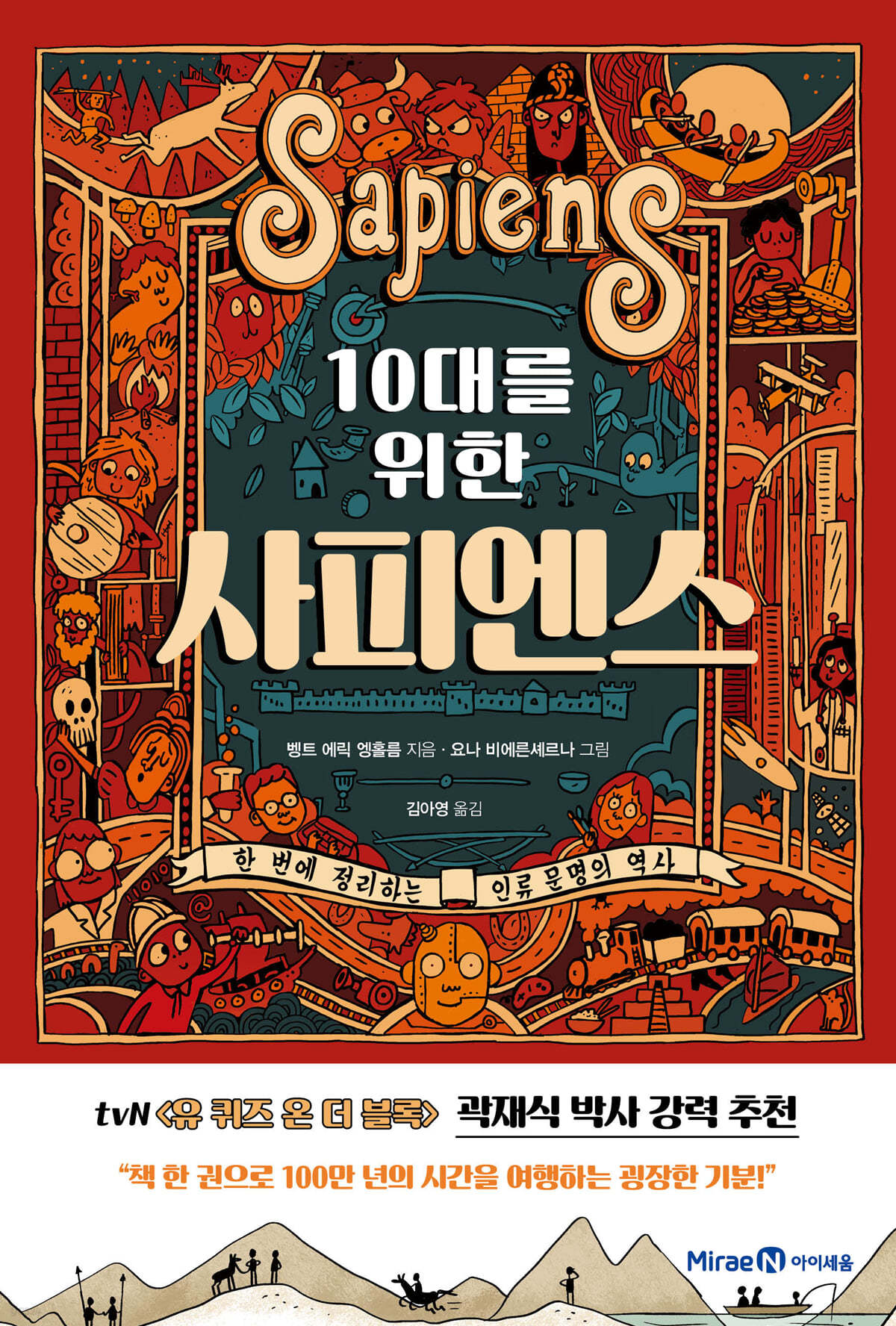
The Sapiens story that even teenagers should know!
Easy, fun, and friendly! A comprehensive overview of the history of human civilization.
Just 100,000 years ago, there were six species of humans living on Earth.
However, the only ones who survived to this day, numbering 7 billion, and flourishing in science and art are Homo sapiens, the current human race.
What on earth has happened in the meantime? How did a small species of human being, struggling to avoid being devoured by wild beasts, leap 300,000 years to become the dominant species on Earth?
From the distant birth of humanity to the age of artificial intelligence, the history of humanity's continuous evolution has been compiled in a way that even teenagers can easily and enjoyably read, "Sapiens for Teens."
Sapiens for Teens cites the Cognitive Revolution, the Agricultural Revolution, and the Scientific Revolution as the reasons why humans were able to occupy the top of the food chain, and humorously illuminates how they influenced the development of religion, politics, and capital.
If you think that this book, which contains the vast history of mankind, will be difficult and boring, you are mistaken.
It explains difficult concepts in a simple and concise manner, just like a middle school student explaining them to their younger sibling. It also includes humorous illustrations that are perfect for the occasion, making it impossible to get bored.
History is like a book, intertwined with the stories of each moment and the stories of the people who lived through it.
Through this book, I hope you will uncover the stories that have been piled up over hundreds of thousands of years, one by one, and slowly feel yourself as a distinctly historical story.
Easy, fun, and friendly! A comprehensive overview of the history of human civilization.
Just 100,000 years ago, there were six species of humans living on Earth.
However, the only ones who survived to this day, numbering 7 billion, and flourishing in science and art are Homo sapiens, the current human race.
What on earth has happened in the meantime? How did a small species of human being, struggling to avoid being devoured by wild beasts, leap 300,000 years to become the dominant species on Earth?
From the distant birth of humanity to the age of artificial intelligence, the history of humanity's continuous evolution has been compiled in a way that even teenagers can easily and enjoyably read, "Sapiens for Teens."
Sapiens for Teens cites the Cognitive Revolution, the Agricultural Revolution, and the Scientific Revolution as the reasons why humans were able to occupy the top of the food chain, and humorously illuminates how they influenced the development of religion, politics, and capital.
If you think that this book, which contains the vast history of mankind, will be difficult and boring, you are mistaken.
It explains difficult concepts in a simple and concise manner, just like a middle school student explaining them to their younger sibling. It also includes humorous illustrations that are perfect for the occasion, making it impossible to get bored.
History is like a book, intertwined with the stories of each moment and the stories of the people who lived through it.
Through this book, I hope you will uncover the stories that have been piled up over hundreds of thousands of years, one by one, and slowly feel yourself as a distinctly historical story.
- You can preview some of the book's contents.
Preview
Detailed image

Publisher's Review
Why Teenagers Should Learn Human History
The power to see a few steps ahead!
In fact, studying history doesn't teach us much about the distant future.
But we can see how the choices our ancestors made in the past have affected us today.
Yuval Harari, author of the international bestseller Sapiens, once said, “The goal of studying history is to free ourselves from the clutches of the past.”
By learning history, we can avoid repeating the mistakes and errors of our ancestors, and move forward with better choices, broader imagination, and bigger dreams.
This is precisely why teenagers need to learn about the long history of mankind, spanning 300,000 years.
Expanding your horizons through history can give you a fresh perspective on the present and empower you to see a few steps ahead.
Sapiens for Teens covers a wide range of history, from the birth of primates to the development of computers and artificial intelligence, seamlessly weaving together biology, history, anthropology, theology, and physics.
Popular scientist and science fiction writer Jae-sik Kwak recommended the book, saying that the intertwined stories of various fields help us develop a perspective on the world and that it is meaningful in that it helps us not forget and shed light on stories that might otherwise be ignored if we look at the world through a single ideology or historical perspective.
Sapiens for Teens is different from other history books that simply list knowledge and information.
As you read, you'll be struck by questions you've likely pondered at least once in your life: Why do we need to study relentlessly? Will humanity truly become happier as the world develops? Why is money so important? This book will be a journey to find the answers.
And the moment you close the last chapter, you will have grown into a more mature Sapiens, having cultivated the power to think for yourself by intersecting questions and imagination.
“It is by no means an easy task to go through the colorful history of mankind in an easy and fun way, but this book has accomplished that.
I devoured this book in one evening, and it felt like I was traveling a million years through time.
I hope you too will create wonderful memories by experiencing the stories of 7 billion people across 200 countries around the world.”
- Jae-sik Kwak, author of "Jae-sik Kwak's Future Store" and "How We Love Science"
Cognitive Revolution, Agricultural Revolution, Scientific Revolution, and… … ?
What is the future of Homo sapiens, the 'wise human'?
Thanks to the cognitive revolution, humanity has become the most powerful being on Earth.
This is because the ‘story’ was created with the power of imagination.
Stories have given birth to religion, politics, and ideology, and humanity has not hesitated to go to war based on whether or not they believe these stories.
The story that has accompanied humanity since its birth still influences our thoughts and actions.
Why is it important to protect democracy? Why do people love money? Why are lies, discrimination, and war bad? Through "Sapiens for Teens," you'll learn about the stories humanity has believed and the choices it has made throughout history, and the clues to these questions will gradually unravel.
As humans settled in one place, they began farming.
But the book argues that the agricultural revolution, which allowed us to harvest more food and live in comfort, has led to human suffering.
As agriculture developed and the concept of private property emerged, farmers had to work tirelessly to harvest more crops, and office workers who had to earn money suffered from back pain from sitting still for more than 40 hours a week.
Teenagers are so busy going to school and cram school all day long that they don't even have time to eat properly because they have to study hard to get a good job.
It goes without saying that since we started raising livestock, countless people have been dying from infectious diseases every year.
So, was the agricultural revolution undoubtedly a disaster for humanity? Was it merely a coincidence that cities and nations were founded, and civilization and science flourished thanks to agricultural life? The book's seamless interplay of questions and counterarguments keeps readers on edge until the very last page.
The scientific revolution, which began with Columbus's mistake just 500 years ago, not only shook up everything humanity had previously believed, but also poses fundamental questions to us today.
Now that we can implant prosthetic limbs and even befriend intelligent robots, what kind of future should we dream of? "Sapiens for Teens" reminds readers of the ultimate reason for learning history.
Our history has shown that the price we have paid for scientific advancement is too high: climate crisis, inequality, poverty, war, etc.
Have we truly become happier thanks to the knowledge and abilities we've acquired over thousands of years? What efforts should we, as "wise humans," Homo sapiens, make to dream of a future where everyone is happy? "Sapiens for Teens" traces the Cognitive Revolution, the Agricultural Revolution, and the Scientific Revolution as the major stages of how small and fragile humans became the world's rulers, prompting us to reflect deeply on what we must do to remain worthy beings.
The power to see a few steps ahead!
In fact, studying history doesn't teach us much about the distant future.
But we can see how the choices our ancestors made in the past have affected us today.
Yuval Harari, author of the international bestseller Sapiens, once said, “The goal of studying history is to free ourselves from the clutches of the past.”
By learning history, we can avoid repeating the mistakes and errors of our ancestors, and move forward with better choices, broader imagination, and bigger dreams.
This is precisely why teenagers need to learn about the long history of mankind, spanning 300,000 years.
Expanding your horizons through history can give you a fresh perspective on the present and empower you to see a few steps ahead.
Sapiens for Teens covers a wide range of history, from the birth of primates to the development of computers and artificial intelligence, seamlessly weaving together biology, history, anthropology, theology, and physics.
Popular scientist and science fiction writer Jae-sik Kwak recommended the book, saying that the intertwined stories of various fields help us develop a perspective on the world and that it is meaningful in that it helps us not forget and shed light on stories that might otherwise be ignored if we look at the world through a single ideology or historical perspective.
Sapiens for Teens is different from other history books that simply list knowledge and information.
As you read, you'll be struck by questions you've likely pondered at least once in your life: Why do we need to study relentlessly? Will humanity truly become happier as the world develops? Why is money so important? This book will be a journey to find the answers.
And the moment you close the last chapter, you will have grown into a more mature Sapiens, having cultivated the power to think for yourself by intersecting questions and imagination.
“It is by no means an easy task to go through the colorful history of mankind in an easy and fun way, but this book has accomplished that.
I devoured this book in one evening, and it felt like I was traveling a million years through time.
I hope you too will create wonderful memories by experiencing the stories of 7 billion people across 200 countries around the world.”
- Jae-sik Kwak, author of "Jae-sik Kwak's Future Store" and "How We Love Science"
Cognitive Revolution, Agricultural Revolution, Scientific Revolution, and… … ?
What is the future of Homo sapiens, the 'wise human'?
Thanks to the cognitive revolution, humanity has become the most powerful being on Earth.
This is because the ‘story’ was created with the power of imagination.
Stories have given birth to religion, politics, and ideology, and humanity has not hesitated to go to war based on whether or not they believe these stories.
The story that has accompanied humanity since its birth still influences our thoughts and actions.
Why is it important to protect democracy? Why do people love money? Why are lies, discrimination, and war bad? Through "Sapiens for Teens," you'll learn about the stories humanity has believed and the choices it has made throughout history, and the clues to these questions will gradually unravel.
As humans settled in one place, they began farming.
But the book argues that the agricultural revolution, which allowed us to harvest more food and live in comfort, has led to human suffering.
As agriculture developed and the concept of private property emerged, farmers had to work tirelessly to harvest more crops, and office workers who had to earn money suffered from back pain from sitting still for more than 40 hours a week.
Teenagers are so busy going to school and cram school all day long that they don't even have time to eat properly because they have to study hard to get a good job.
It goes without saying that since we started raising livestock, countless people have been dying from infectious diseases every year.
So, was the agricultural revolution undoubtedly a disaster for humanity? Was it merely a coincidence that cities and nations were founded, and civilization and science flourished thanks to agricultural life? The book's seamless interplay of questions and counterarguments keeps readers on edge until the very last page.
The scientific revolution, which began with Columbus's mistake just 500 years ago, not only shook up everything humanity had previously believed, but also poses fundamental questions to us today.
Now that we can implant prosthetic limbs and even befriend intelligent robots, what kind of future should we dream of? "Sapiens for Teens" reminds readers of the ultimate reason for learning history.
Our history has shown that the price we have paid for scientific advancement is too high: climate crisis, inequality, poverty, war, etc.
Have we truly become happier thanks to the knowledge and abilities we've acquired over thousands of years? What efforts should we, as "wise humans," Homo sapiens, make to dream of a future where everyone is happy? "Sapiens for Teens" traces the Cognitive Revolution, the Agricultural Revolution, and the Scientific Revolution as the major stages of how small and fragile humans became the world's rulers, prompting us to reflect deeply on what we must do to remain worthy beings.
GOODS SPECIFICS
- Publication date: April 29, 2021
- Page count, weight, size: 176 pages | 410g | 152*225*14mm
- ISBN13: 9791164135653
- ISBN10: 1164135651
- KC Certification: Certification Type: Conformity Confirmation
You may also like
카테고리
korean


korean

![GQ KOREA Mark (Monthly): December [2025]](http://librairie.coreenne.fr/cdn/shop/files/8ef265dbbfbf186523ed75ba7319009d.jpg?v=1765340328&width=3840)


