

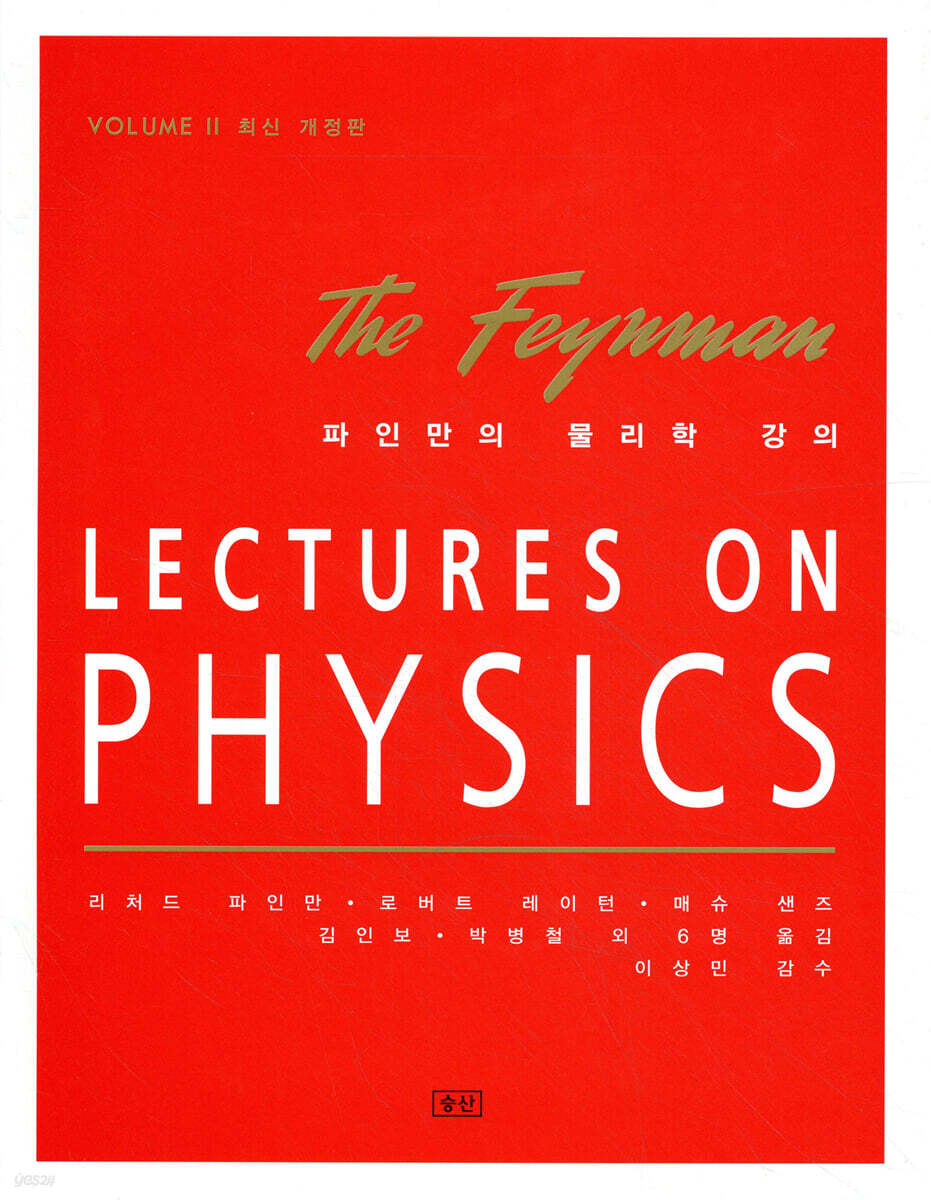
Feynman's Physics Lectures 2
 |
Description
Book Introduction
"Feynman's Lectures on Physics" is a book compiled from lectures Richard Feynman gave to undergraduates over a two-year period starting in 1961.
More than 40 years have passed since Feynman's legendary lectures were published as a book, and our understanding of the physical world has changed significantly, but "Feynman's Lectures on Physics" has withstood those changes.
It is no exaggeration to say that the true nature of physicist Feynman is revealed in these lecture notes.
This book finally shines with the power of solid reasoning that penetrates the principles of things and an ingenious problem-solving method that no one can imitate.
Feynman's unique physical insights and teaching style make his lectures as powerful today as they were when they were first published.
Perhaps no other physics book has had such a wide-ranging influence over such a long period of time.
This is the first complete translation of Feynman's lectures on physics to be introduced in Korea, following Volume 1.
It consists of a total of 42 chapters, and mainly contains content related to electromagnetism and physical properties.
More than 40 years have passed since Feynman's legendary lectures were published as a book, and our understanding of the physical world has changed significantly, but "Feynman's Lectures on Physics" has withstood those changes.
It is no exaggeration to say that the true nature of physicist Feynman is revealed in these lecture notes.
This book finally shines with the power of solid reasoning that penetrates the principles of things and an ingenious problem-solving method that no one can imitate.
Feynman's unique physical insights and teaching style make his lectures as powerful today as they were when they were first published.
Perhaps no other physics book has had such a wide-ranging influence over such a long period of time.
This is the first complete translation of Feynman's lectures on physics to be introduced in Korea, following Volume 1.
It consists of a total of 42 chapters, and mainly contains content related to electromagnetism and physical properties.
index
About Richard Feynman
Preface to the Revised Edition
Special Preface
Foreword by Richard Feynman
introduction
CHAPTER 1.
Electromagnetic
1-1 Electric force
1-2 Electric and magnetic fields
1-3 Characteristics of vector fields
1-4 Laws of Electromagnetism
1-5 What is a 'Chapter'?
1-6 The Role of Electromagnetism in Science and Technology
CHAPTER 2.
Differentiation of vector fields
2-1 Understanding Physics
2-2 Scalar field and vector field - T, h
Chapter 2-3 Derivatives-Gradients
2-4 ∇ operator
Application of 2-5 ∇
2-6 Differential equation of heat flow
2-7 Second-order derivatives of vector fields
2-8 Things to watch out for
CHAPTER 3.
Integral of a vector field
3-1 Vector Integral: Line Integral of ∇Ψ
3-2 Flux of vector field
3-3 Flux from a cube: Gauss's theorem
3-4 Heat Conduction: Diffusion Equation
Circulation of 3-5 vector fields
Circulation around a square: Stokes' theorem
3-7 A chapter with 0 curl and 0 divergence
3-8 Summary
CHAPTER 4.
electrostatics
4-1 Statics
4-2 Coulomb's Law: Superposition
4-3 Electric potential
4-4 E =-∇φ
Flux of 4-5 E
4-6 Gauss's Law and the Divergence of E
4-7 Electric field due to spherical charge
4-8 Long lines and equipotential (equipotential) surfaces
CHAPTER 5.
Applications of Gauss's law
5-1 Electrostatics = Gauss's Law + ...
5-2 Equilibrium in an electrostatic field
5-3 Equilibrium in conductors
5-4 Stability of atoms
5-5 Electric field due to distribution of electric current
5-6 Flat plate charge distribution: Two plates
5-7 Spherical charge distribution: spherical shell
5-8 Is the electric field of a point charge exactly proportional to 1/r²?
5-9 Electric field of a conductor
Electric field inside a 5-10 conductor cavity
CHAPTER 6.
Electric fields in various situations
6-1 Electrostatic potential equation
6-2 Electric dipole
6-3 A word about vector equations
6-4 Dipole potential expressed as a gradient
6-5 Dipole approximation for arbitrary charge distributions
6-6 Electric field of a charged conductor
6-7 How to use mirror images
6-8 Point charge near an infinite conducting plane
6-9 Point charge near the conducting sphere
6-10 parallel plate capacitor
6-11 High voltage insulation breakdown
Chapter 6-12 Emission Microscopy
CHAPTER 7.
Electric fields in various situations (continued)
7-1 Calculation of electrostatic field
7-2 Two-Dimensional Electric Field: Function of Complex Variables
7-3 Plasma vibration
7-4 Colloidal particles in electrolyte solution
Electrostatic field of the 7-5 grid
CHAPTER 8.
electrostatic energy
8-1 Electrostatic energy of a uniform spherical charge distribution
8-2 Energy of the capacitor.
Force acting on a charged conductor
8-3 Electrostatic energy of ionic crystals
8-4 Electrostatic energy inside the nucleus
8-5 Energy of the electrostatic field
Energy of 8-6 point charge
CHAPTER 9.
Electricity in the air
9-1 Electric potential gradient in the atmosphere
9-2 Current in the atmosphere
9-3 Source of standby current
9-4 Thunderstorm
9-5 Mechanism of charge separation
9-6 Lightning
CHAPTER 10.
dielectric
10-1 dielectric constant
10-2 Polarization vector P
10-3 polarization charge
Electrostatic equations of 10-4 dielectrics
Electric field and force in 10-5 dielectric
CHAPTER 11.
Inside the genome
11-1 Molecular Dipole
11-2 Electron polarization
11-3 Polar Molecules: Orientation Polarization
11-4 Electric field in a dielectric cavity
11-5 Dielectric Constant of Liquids: Clausius-Mosotti Equation
11-6 Solid dielectric
11-7 Ferroelectricity: BaTiO₃
CHAPTER 12.
Physics similar to electrostatics
12-1 If the equations are the same, then the solution is the same.
12-2 Heat Flow: Point Heat Source Near an Infinite Plane Boundary
12-3 Tightly pulled membrane
12-4 Neutron Diffusion: A spherical neutron source evenly distributed in a homogeneous medium.
12-5 Flow of Irrotational Fluids: Fluid Flowing Around a Sphere
12-6 Illumination: Uniform illumination in the form of a plane wave
12-7 Unity inherent in nature
CHAPTER 13.
Magnetostatics
13-1 Magnetic field
13-2 Current: Conservation of Charge
13-3 Magnetic force acting on current
13-4 Magnetic field due to steady current: Ampere's law
13-5 Magnetic fields due to straight wires and solenoids: Atomic currents
13-6 Relativity of Electric and Magnetic Fields
13-7 Conversion of current and charge
13-8 Principle of Superposition: Right-Hand Rule
CHAPTER 14.
Magnetic fields in various situations
14-1 Vector Potential
14-2 Vector potential due to a current already known
14-3 Straight wire
14-4 Long Solenoid
14-5 Magnetic field due to a small current loop: magnetic dipole
Vector potential of the 14-6 circuit
14-7 Biot-Savart's Law
CHAPTER 15.
Vector potential
15-1 Forces Acting on a Current Loop: Energy of a Magnetic Dipole
15-2 Mechanical Energy and Electrical Energy
15-3 Energy of steady current
15-4 B and A
15-5 Vector Potentials and Quantum Mechanics
15-6 Correct in statics, but incorrect in dynamics
CHAPTER 16.
induced current
16-1 Motor and Generator
16-2 Transformers and Inductance
16-3 Force acting on induced current
16-4 Electrical Engineering
CHAPTER 17.
Law of electromagnetic induction
17-1 Physics of Electromagnetic Induction
17-2 Exceptions to the “Flux Law”
17-3 Acceleration of particles by an induced electric field: Betatron
17-4 Paradoxical Problem
17-5 AC power
17-6 Mutual inductance
17-7 Self-inductance
17-8 Inductance and Magnetic Energy
CHAPTER 18.
Maxwell's equations
18-1 Maxwell's Equations
18-2 New protest effect
18-3 All About Classical Physics
18-4 Progressive electromagnetic field
18-5 Speed of light
18-6 Solutions to Maxwell's Equations: Potential and Wave Equations
CHAPTER 19.
Principle of least action
Special lecture - almost like an actual lecture
Comments added after the lecture
CHAPTER 20.
Solution of Maxwell's equations in free space
20-1 Waves in Free Space: Plane Waves
20-2 3D Wave
20-3 Scientific Imagination
20-4 spherical wave
CHAPTER 21.
Solutions to Maxwell's equations including charge and current
21-1 Light and Electromagnetic Waves
21-2 Spherical waves generated by point charges
21-3 General solution to Maxwell's equations
21-4 Field due to an oscillating dipole
21-5 Potential due to moving charge: Linard-Wiechert general solution
21-6 Potential due to a charge moving at constant velocity: Lorentz formula
CHAPTER 22.
AC circuit
22-1 Impedance
22-2 Power
22-3 Circuits composed of ideal elements: Kirchhoff's laws
22-4 Equivalent circuit
22-5 Energy
22-6 Ladder network
22-7 filter
22-8 Other circuit elements
CHAPTER 23.
cavity resonator
23-1 Actual circuit components
23-2 Capacitors in the high-frequency range
23-3 Resonance cavity
23-4 Joint Mode
23-5 Cavity and Resonant Circuits
CHAPTER 24.
wave-guide
24-1 Transmission Line
24-2 Rectangular waveguide
24-3 cutoff frequency
24-4 Speed of guided waves
24-5 Observation of guided waves
24-6 waveguide piping
24-7 waveguide mode
Another perspective on the 24-8 guided wave
CHAPTER 25.
Relativistic representation of electrodynamics
25-1 Four-dimensional vector
25-2 Scalar product (inner product)
25-3 Four-dimensional gradient
25-4 Electrodynamics described in four-dimensional notation
25-5 Four-dimensional potential of moving charges
25-6 Invariance of the electrodynamic equations
CHAPTER 26.
Lorentz transformation of electromagnetic fields
26-1 Four-dimensional potential of moving charges
26-2 Field due to a point charge moving at a constant speed
Relativistic transformations in Chapter 26-3
26-4 Equations of motion expressed in relativistic notation
CHAPTER 27.
Energy and momentum of electromagnetic fields
27-1 Local preservation
27-2 Conservation of Energy and Electromagnetism
27-3 Energy density and energy flow in electromagnetic fields
Chapter 27-4 The Ambiguity of Energy
27-5 Example of energy flow
Chapter 27-6 Momentum
CHAPTER 28.
electromagnetic mass
28-1 Field energy of a point charge
28-2 Field momentum of a moving charge
28-3 Electromagnetic mass
28-4 The force an electron exerts on itself
28-5 Attempts to Modify Maxwell's Theory
28-6 Nuclear force field
CHAPTER 29.
Movement of charges in electric and magnetic fields
29-1 Motion in Uniform Electric and Magnetic Fields
29-2 Momentum Analysis
29-3 Electrostatic Lens
29-4 Magnetic Lens
29-5 Electron Microscope
Chapter 29-6 Accelerator Guide
29-7 Alternate Gradient Focusing
29-8 Motion in Intersecting Electric and Magnetic Fields
CHAPTER 30.
Geometric structure of the decision
Geometry inside the 30-1 decision
30-2 Chemical bonding of the decision
30-3 Growth of the decision
30-4 crystal lattice
30-5 Two-dimensional symmetry
30-6 Three-dimensional symmetry
30-7 Strength of metal
30-8 Growth of dislocations and crystals
30-9 Bragg-Age Determination Model
CHAPTER 31.
tensor
31-1 Polarizability tensor
31-2 Transformation of tensor components
31-3 Energy ellipsoid
31-4 Other Tensors: Inertia Tensor
31-5 Cross product (outer product)
31-6 Stress Tensor
31-7 High-rank tensors
31-8 Four-dimensional tensor of electromagnetic momentum
CHAPTER 32.
Refractive index of dense substances
32-1 Polarization of matter
32-2 Maxwell's equations in a dielectric
32-3 Waves in the dielectric
32-4 Complex refractive index
32-5 Refractive index of the mixture
32-6 Waves in metal
32-7 Low- and high-frequency approximations: penetration depth and plasma frequency
CHAPTER 33.
Reflection from a surface
33-1 Reflection and refraction of light
33-2 Waves in dense matter
33-3 Boundary conditions
33-4 Reflected and transmitted waves
33-5 Reflection from metal
33-6 Total internal reflection
CHAPTER 34.
Magnetism of matter
34-1 Diamagnetism and paramagnetism
34-2 Magnetic Moment and Angular Momentum
34-3 Precession of Atomic Magnets
34-4 Diamagnetism
34-5 Larmore's Theorem
34-6 Why diamagnetism and paramagnetism cannot be explained by classical mechanics
34-7 Angular momentum in quantum mechanics
34-8 Magnetic energy of atoms
CHAPTER 35.
Paramagnetic and magnetic resonance
35-1 Quantized magnetic states
35-2 Stern-Gerlach experiment
35-3 Rabi's molecular beam method
35-4 Paramagnetism of bulk materials
35-5 Insulated element cooling
35-6 Nuclear Magnetic Resonance
CHAPTER 36.
ferromagnetism
36-1 Magnetizing current
Chapter 36-2 H
36-3 Magnetization curve
36-4 Core Inductance
36-5 Electromagnet
36-6 Spontaneous magnetization
CHAPTER 37.
magnetic material
37-1 Understanding Ferromagnetism
37-2 Thermodynamic properties
37-3 History Curve
37-4 Ferromagnetic material
37-5 Unusual magnetic material
CHAPTER 38.
Elasticity
38-1 Hooke's Law
38-2 Uniform deformation
38-3 Torsion Bar: Layer Shear Wave
38-4 Curved beam
38-5 Sudden bending phenomenon (buckling phenomenon)
CHAPTER 39.
elastic body
39-1 Strain Tensor
39-2 Elasticity Tensor
39-3 Movement within an elastic body
39-4 Inelastic behavior
39-5 Calculation of elastic constants
CHAPTER 40.
dry water flow
40-1 Fluid Statics
40-2 Equations of Motion
40-3 Normal Flow - Bernoulli's Principle
40-4 Circulation Flow
40-5 vortex line
CHAPTER 41.
wet water flow
41-1 Astrology
41-2 Viscous flow
41-3 Reynolds number
41-4 Flow through a cylinder
41-5 The limit of viscosity → 0
41-6 Couet flow
CHAPTER 42.
curved space
42-1 Curved two-dimensional space
42-2 Curvature of three-dimensional space
42-3 The space we live in is curved
42-4 Geometry of Space and Time
42-5 Gravity and the Equivalence Principle
42-6 A clock in a gravitational field
42-7 Curvature of spacetime
42-8 Motion in Curved Spacetime
42-9 Einstein's theory of gravity
Translator's Note
Search
Preface to the Revised Edition
Special Preface
Foreword by Richard Feynman
introduction
CHAPTER 1.
Electromagnetic
1-1 Electric force
1-2 Electric and magnetic fields
1-3 Characteristics of vector fields
1-4 Laws of Electromagnetism
1-5 What is a 'Chapter'?
1-6 The Role of Electromagnetism in Science and Technology
CHAPTER 2.
Differentiation of vector fields
2-1 Understanding Physics
2-2 Scalar field and vector field - T, h
Chapter 2-3 Derivatives-Gradients
2-4 ∇ operator
Application of 2-5 ∇
2-6 Differential equation of heat flow
2-7 Second-order derivatives of vector fields
2-8 Things to watch out for
CHAPTER 3.
Integral of a vector field
3-1 Vector Integral: Line Integral of ∇Ψ
3-2 Flux of vector field
3-3 Flux from a cube: Gauss's theorem
3-4 Heat Conduction: Diffusion Equation
Circulation of 3-5 vector fields
Circulation around a square: Stokes' theorem
3-7 A chapter with 0 curl and 0 divergence
3-8 Summary
CHAPTER 4.
electrostatics
4-1 Statics
4-2 Coulomb's Law: Superposition
4-3 Electric potential
4-4 E =-∇φ
Flux of 4-5 E
4-6 Gauss's Law and the Divergence of E
4-7 Electric field due to spherical charge
4-8 Long lines and equipotential (equipotential) surfaces
CHAPTER 5.
Applications of Gauss's law
5-1 Electrostatics = Gauss's Law + ...
5-2 Equilibrium in an electrostatic field
5-3 Equilibrium in conductors
5-4 Stability of atoms
5-5 Electric field due to distribution of electric current
5-6 Flat plate charge distribution: Two plates
5-7 Spherical charge distribution: spherical shell
5-8 Is the electric field of a point charge exactly proportional to 1/r²?
5-9 Electric field of a conductor
Electric field inside a 5-10 conductor cavity
CHAPTER 6.
Electric fields in various situations
6-1 Electrostatic potential equation
6-2 Electric dipole
6-3 A word about vector equations
6-4 Dipole potential expressed as a gradient
6-5 Dipole approximation for arbitrary charge distributions
6-6 Electric field of a charged conductor
6-7 How to use mirror images
6-8 Point charge near an infinite conducting plane
6-9 Point charge near the conducting sphere
6-10 parallel plate capacitor
6-11 High voltage insulation breakdown
Chapter 6-12 Emission Microscopy
CHAPTER 7.
Electric fields in various situations (continued)
7-1 Calculation of electrostatic field
7-2 Two-Dimensional Electric Field: Function of Complex Variables
7-3 Plasma vibration
7-4 Colloidal particles in electrolyte solution
Electrostatic field of the 7-5 grid
CHAPTER 8.
electrostatic energy
8-1 Electrostatic energy of a uniform spherical charge distribution
8-2 Energy of the capacitor.
Force acting on a charged conductor
8-3 Electrostatic energy of ionic crystals
8-4 Electrostatic energy inside the nucleus
8-5 Energy of the electrostatic field
Energy of 8-6 point charge
CHAPTER 9.
Electricity in the air
9-1 Electric potential gradient in the atmosphere
9-2 Current in the atmosphere
9-3 Source of standby current
9-4 Thunderstorm
9-5 Mechanism of charge separation
9-6 Lightning
CHAPTER 10.
dielectric
10-1 dielectric constant
10-2 Polarization vector P
10-3 polarization charge
Electrostatic equations of 10-4 dielectrics
Electric field and force in 10-5 dielectric
CHAPTER 11.
Inside the genome
11-1 Molecular Dipole
11-2 Electron polarization
11-3 Polar Molecules: Orientation Polarization
11-4 Electric field in a dielectric cavity
11-5 Dielectric Constant of Liquids: Clausius-Mosotti Equation
11-6 Solid dielectric
11-7 Ferroelectricity: BaTiO₃
CHAPTER 12.
Physics similar to electrostatics
12-1 If the equations are the same, then the solution is the same.
12-2 Heat Flow: Point Heat Source Near an Infinite Plane Boundary
12-3 Tightly pulled membrane
12-4 Neutron Diffusion: A spherical neutron source evenly distributed in a homogeneous medium.
12-5 Flow of Irrotational Fluids: Fluid Flowing Around a Sphere
12-6 Illumination: Uniform illumination in the form of a plane wave
12-7 Unity inherent in nature
CHAPTER 13.
Magnetostatics
13-1 Magnetic field
13-2 Current: Conservation of Charge
13-3 Magnetic force acting on current
13-4 Magnetic field due to steady current: Ampere's law
13-5 Magnetic fields due to straight wires and solenoids: Atomic currents
13-6 Relativity of Electric and Magnetic Fields
13-7 Conversion of current and charge
13-8 Principle of Superposition: Right-Hand Rule
CHAPTER 14.
Magnetic fields in various situations
14-1 Vector Potential
14-2 Vector potential due to a current already known
14-3 Straight wire
14-4 Long Solenoid
14-5 Magnetic field due to a small current loop: magnetic dipole
Vector potential of the 14-6 circuit
14-7 Biot-Savart's Law
CHAPTER 15.
Vector potential
15-1 Forces Acting on a Current Loop: Energy of a Magnetic Dipole
15-2 Mechanical Energy and Electrical Energy
15-3 Energy of steady current
15-4 B and A
15-5 Vector Potentials and Quantum Mechanics
15-6 Correct in statics, but incorrect in dynamics
CHAPTER 16.
induced current
16-1 Motor and Generator
16-2 Transformers and Inductance
16-3 Force acting on induced current
16-4 Electrical Engineering
CHAPTER 17.
Law of electromagnetic induction
17-1 Physics of Electromagnetic Induction
17-2 Exceptions to the “Flux Law”
17-3 Acceleration of particles by an induced electric field: Betatron
17-4 Paradoxical Problem
17-5 AC power
17-6 Mutual inductance
17-7 Self-inductance
17-8 Inductance and Magnetic Energy
CHAPTER 18.
Maxwell's equations
18-1 Maxwell's Equations
18-2 New protest effect
18-3 All About Classical Physics
18-4 Progressive electromagnetic field
18-5 Speed of light
18-6 Solutions to Maxwell's Equations: Potential and Wave Equations
CHAPTER 19.
Principle of least action
Special lecture - almost like an actual lecture
Comments added after the lecture
CHAPTER 20.
Solution of Maxwell's equations in free space
20-1 Waves in Free Space: Plane Waves
20-2 3D Wave
20-3 Scientific Imagination
20-4 spherical wave
CHAPTER 21.
Solutions to Maxwell's equations including charge and current
21-1 Light and Electromagnetic Waves
21-2 Spherical waves generated by point charges
21-3 General solution to Maxwell's equations
21-4 Field due to an oscillating dipole
21-5 Potential due to moving charge: Linard-Wiechert general solution
21-6 Potential due to a charge moving at constant velocity: Lorentz formula
CHAPTER 22.
AC circuit
22-1 Impedance
22-2 Power
22-3 Circuits composed of ideal elements: Kirchhoff's laws
22-4 Equivalent circuit
22-5 Energy
22-6 Ladder network
22-7 filter
22-8 Other circuit elements
CHAPTER 23.
cavity resonator
23-1 Actual circuit components
23-2 Capacitors in the high-frequency range
23-3 Resonance cavity
23-4 Joint Mode
23-5 Cavity and Resonant Circuits
CHAPTER 24.
wave-guide
24-1 Transmission Line
24-2 Rectangular waveguide
24-3 cutoff frequency
24-4 Speed of guided waves
24-5 Observation of guided waves
24-6 waveguide piping
24-7 waveguide mode
Another perspective on the 24-8 guided wave
CHAPTER 25.
Relativistic representation of electrodynamics
25-1 Four-dimensional vector
25-2 Scalar product (inner product)
25-3 Four-dimensional gradient
25-4 Electrodynamics described in four-dimensional notation
25-5 Four-dimensional potential of moving charges
25-6 Invariance of the electrodynamic equations
CHAPTER 26.
Lorentz transformation of electromagnetic fields
26-1 Four-dimensional potential of moving charges
26-2 Field due to a point charge moving at a constant speed
Relativistic transformations in Chapter 26-3
26-4 Equations of motion expressed in relativistic notation
CHAPTER 27.
Energy and momentum of electromagnetic fields
27-1 Local preservation
27-2 Conservation of Energy and Electromagnetism
27-3 Energy density and energy flow in electromagnetic fields
Chapter 27-4 The Ambiguity of Energy
27-5 Example of energy flow
Chapter 27-6 Momentum
CHAPTER 28.
electromagnetic mass
28-1 Field energy of a point charge
28-2 Field momentum of a moving charge
28-3 Electromagnetic mass
28-4 The force an electron exerts on itself
28-5 Attempts to Modify Maxwell's Theory
28-6 Nuclear force field
CHAPTER 29.
Movement of charges in electric and magnetic fields
29-1 Motion in Uniform Electric and Magnetic Fields
29-2 Momentum Analysis
29-3 Electrostatic Lens
29-4 Magnetic Lens
29-5 Electron Microscope
Chapter 29-6 Accelerator Guide
29-7 Alternate Gradient Focusing
29-8 Motion in Intersecting Electric and Magnetic Fields
CHAPTER 30.
Geometric structure of the decision
Geometry inside the 30-1 decision
30-2 Chemical bonding of the decision
30-3 Growth of the decision
30-4 crystal lattice
30-5 Two-dimensional symmetry
30-6 Three-dimensional symmetry
30-7 Strength of metal
30-8 Growth of dislocations and crystals
30-9 Bragg-Age Determination Model
CHAPTER 31.
tensor
31-1 Polarizability tensor
31-2 Transformation of tensor components
31-3 Energy ellipsoid
31-4 Other Tensors: Inertia Tensor
31-5 Cross product (outer product)
31-6 Stress Tensor
31-7 High-rank tensors
31-8 Four-dimensional tensor of electromagnetic momentum
CHAPTER 32.
Refractive index of dense substances
32-1 Polarization of matter
32-2 Maxwell's equations in a dielectric
32-3 Waves in the dielectric
32-4 Complex refractive index
32-5 Refractive index of the mixture
32-6 Waves in metal
32-7 Low- and high-frequency approximations: penetration depth and plasma frequency
CHAPTER 33.
Reflection from a surface
33-1 Reflection and refraction of light
33-2 Waves in dense matter
33-3 Boundary conditions
33-4 Reflected and transmitted waves
33-5 Reflection from metal
33-6 Total internal reflection
CHAPTER 34.
Magnetism of matter
34-1 Diamagnetism and paramagnetism
34-2 Magnetic Moment and Angular Momentum
34-3 Precession of Atomic Magnets
34-4 Diamagnetism
34-5 Larmore's Theorem
34-6 Why diamagnetism and paramagnetism cannot be explained by classical mechanics
34-7 Angular momentum in quantum mechanics
34-8 Magnetic energy of atoms
CHAPTER 35.
Paramagnetic and magnetic resonance
35-1 Quantized magnetic states
35-2 Stern-Gerlach experiment
35-3 Rabi's molecular beam method
35-4 Paramagnetism of bulk materials
35-5 Insulated element cooling
35-6 Nuclear Magnetic Resonance
CHAPTER 36.
ferromagnetism
36-1 Magnetizing current
Chapter 36-2 H
36-3 Magnetization curve
36-4 Core Inductance
36-5 Electromagnet
36-6 Spontaneous magnetization
CHAPTER 37.
magnetic material
37-1 Understanding Ferromagnetism
37-2 Thermodynamic properties
37-3 History Curve
37-4 Ferromagnetic material
37-5 Unusual magnetic material
CHAPTER 38.
Elasticity
38-1 Hooke's Law
38-2 Uniform deformation
38-3 Torsion Bar: Layer Shear Wave
38-4 Curved beam
38-5 Sudden bending phenomenon (buckling phenomenon)
CHAPTER 39.
elastic body
39-1 Strain Tensor
39-2 Elasticity Tensor
39-3 Movement within an elastic body
39-4 Inelastic behavior
39-5 Calculation of elastic constants
CHAPTER 40.
dry water flow
40-1 Fluid Statics
40-2 Equations of Motion
40-3 Normal Flow - Bernoulli's Principle
40-4 Circulation Flow
40-5 vortex line
CHAPTER 41.
wet water flow
41-1 Astrology
41-2 Viscous flow
41-3 Reynolds number
41-4 Flow through a cylinder
41-5 The limit of viscosity → 0
41-6 Couet flow
CHAPTER 42.
curved space
42-1 Curved two-dimensional space
42-2 Curvature of three-dimensional space
42-3 The space we live in is curved
42-4 Geometry of Space and Time
42-5 Gravity and the Equivalence Principle
42-6 A clock in a gravitational field
42-7 Curvature of spacetime
42-8 Motion in Curved Spacetime
42-9 Einstein's theory of gravity
Translator's Note
Search
Into the book
The general public does not fully understand the meaning of scientific imagination.
They try to test the imagination of scientists by asking questions like:
“Here is a picture of a person in a specific situation.
Look at this picture and imagine what will happen in a moment.” But if I answer, “I can’t imagine it just from this,” they will think that our imagination is poor.
They overlook the fact that scientific imagination is “allowed only to the extent that it does not conflict with the established laws of physics.”
Electric fields and electromagnetic waves are not concepts that can be created by arbitrary imagination.
The hypothesis must not contradict other known laws of physics.
If it goes against the established laws of nature, no matter how much you push yourself to “imagine it scientifically,” it’s useless.
The imagination of physicists is quite different in nature from what is commonly called imagination.
They have to imagine things they have never heard of or seen.
Moreover, scientific imagination must undergo very rigorous verification.
No matter how wonderful and plausible an imaginary world may be, it is of no use if it does not conform to the known laws of nature.
Creating something new while harmonizing with so many rules is never easy.
In addressing this topic, I wanted to raise the question, “Is it possible to imagine the ‘beauty’ of something invisible?”
When a rainbow appears after the rain, people are captivated by its beauty and exclaim, “Wow, it’s a rainbow!” (As you may have guessed, I am a very scientific person.
I try not to use the word 'beautiful' to describe objects that cannot be experimentally defined.
But if we were blind, how could we possibly describe the beauty of a rainbow? When it comes to measuring the infrared reflectivity of salt or analyzing the frequencies of electromagnetic waves emanating from outer space, we're effectively blind.
So, we have no choice but to draw pictures or graphs to help us understand indirectly.
They try to test the imagination of scientists by asking questions like:
“Here is a picture of a person in a specific situation.
Look at this picture and imagine what will happen in a moment.” But if I answer, “I can’t imagine it just from this,” they will think that our imagination is poor.
They overlook the fact that scientific imagination is “allowed only to the extent that it does not conflict with the established laws of physics.”
Electric fields and electromagnetic waves are not concepts that can be created by arbitrary imagination.
The hypothesis must not contradict other known laws of physics.
If it goes against the established laws of nature, no matter how much you push yourself to “imagine it scientifically,” it’s useless.
The imagination of physicists is quite different in nature from what is commonly called imagination.
They have to imagine things they have never heard of or seen.
Moreover, scientific imagination must undergo very rigorous verification.
No matter how wonderful and plausible an imaginary world may be, it is of no use if it does not conform to the known laws of nature.
Creating something new while harmonizing with so many rules is never easy.
In addressing this topic, I wanted to raise the question, “Is it possible to imagine the ‘beauty’ of something invisible?”
When a rainbow appears after the rain, people are captivated by its beauty and exclaim, “Wow, it’s a rainbow!” (As you may have guessed, I am a very scientific person.
I try not to use the word 'beautiful' to describe objects that cannot be experimentally defined.
But if we were blind, how could we possibly describe the beauty of a rainbow? When it comes to measuring the infrared reflectivity of salt or analyzing the frequencies of electromagnetic waves emanating from outer space, we're effectively blind.
So, we have no choice but to draw pictures or graphs to help us understand indirectly.
--- From the text
Publisher's Review
The introductory physics course Feynman taught to undergraduates at Caltech in 1961 became the first two volumes of his "Feynman Lectures on Physics."
Towards the end of this course, in May 1963, Feynman took the risk of teaching advanced quantum theory to second-year students.
This became Volume 3, adding two chapters from Volume 1 and additional material from 1964 (as mentioned earlier, Volume 4 was published in 2005, which included Feynman's lectures on problem solving and inertial derivation).
Feynman himself evaluated the lectures, saying that Volume 1 was a fairly good lecture, Volume 2 was an average lecture, and Volume 3 was a lecture that should not be repeated for undergraduates.
However, it should be noted that Feynman's somewhat negative evaluation is somewhat different from the public's evaluation.
Considering that the main content of volumes 2 and 3 is electromagnetism and quantum mechanics, which form the foundation of quantum electrodynamics, which can be said to be Feynman's specialty, it is difficult to take Feynman's self-evaluation at face value.
In fact, Volume 2 is a highly complete lecture on electromagnetism that stands out with its in-depth content that cannot be found in other electromagnetism books, and Feynman himself expresses considerable pride in the lecture notes throughout.
Let me briefly mention the systematic features of Volume 2. Chapter 1 presents the complete laws of electromagnetism, so from the very beginning of the lecture, you feel as if you are holding the entirety of electromagnetism in your hand.
The remainder of Volume 2 is also carefully designed to ensure enjoyable study under the guidance of our seasoned guide, Feynman.
Towards the end of this course, in May 1963, Feynman took the risk of teaching advanced quantum theory to second-year students.
This became Volume 3, adding two chapters from Volume 1 and additional material from 1964 (as mentioned earlier, Volume 4 was published in 2005, which included Feynman's lectures on problem solving and inertial derivation).
Feynman himself evaluated the lectures, saying that Volume 1 was a fairly good lecture, Volume 2 was an average lecture, and Volume 3 was a lecture that should not be repeated for undergraduates.
However, it should be noted that Feynman's somewhat negative evaluation is somewhat different from the public's evaluation.
Considering that the main content of volumes 2 and 3 is electromagnetism and quantum mechanics, which form the foundation of quantum electrodynamics, which can be said to be Feynman's specialty, it is difficult to take Feynman's self-evaluation at face value.
In fact, Volume 2 is a highly complete lecture on electromagnetism that stands out with its in-depth content that cannot be found in other electromagnetism books, and Feynman himself expresses considerable pride in the lecture notes throughout.
Let me briefly mention the systematic features of Volume 2. Chapter 1 presents the complete laws of electromagnetism, so from the very beginning of the lecture, you feel as if you are holding the entirety of electromagnetism in your hand.
The remainder of Volume 2 is also carefully designed to ensure enjoyable study under the guidance of our seasoned guide, Feynman.
GOODS SPECIFICS
- Date of issue: September 1, 2006
- Format: Hardcover book binding method guide
- Page count, weight, size: 800 pages | 2,169g | 210*270*40mm
- ISBN13: 9788988907849
- ISBN10: 8988907841
You may also like
카테고리
korean


korean

![GQ KOREA Mark (Monthly): December [2025]](http://librairie.coreenne.fr/cdn/shop/files/8ef265dbbfbf186523ed75ba7319009d.jpg?v=1765340328&width=3840)


