

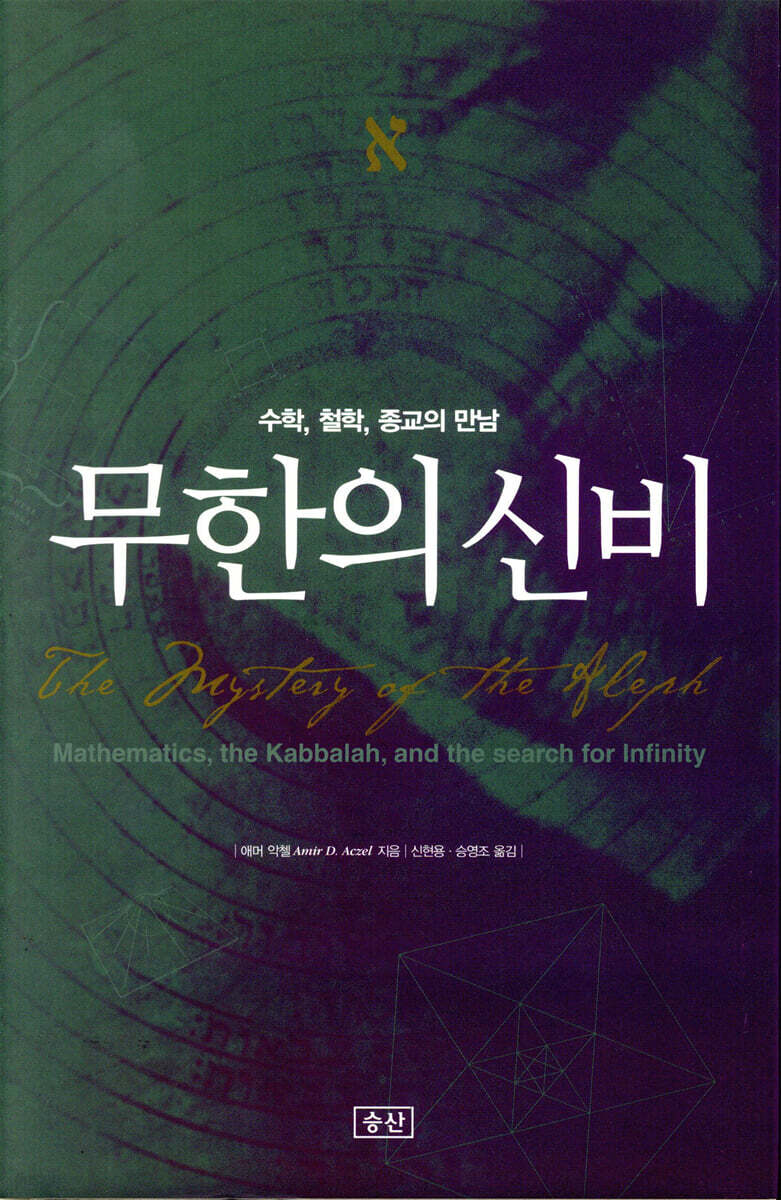
The mystery of infinity
 |
Description
Book Introduction
A book discussing the theory and concept of infinity based on the story of Cantor, who died a lonely death in a mental hospital in 1918.
It does not simply elucidate the mathematical research of one individual, but discusses the profoundly secret and esoteric nature of infinity, reaching all the way to ancient Kabbalah and numerology.
Those who tried to lift the hem of the infinite based on historical circumstances and facts, such as the ancient Kabbalists, Kandor, and Gödel, all became insane or met death.
Until the Middle Ages, infinity was considered the realm of God, and challenging it was considered to be tantamount to challenging the work of God.
Were they punished for challenging God's work?
Questions still persist about how Cantor developed his theory of infinity, and how the impact and consequences of his pioneering work will shape the future of our world.
When he first wanted to present this theory, he hesitated for ten years.
And even after this theory was published, it was constantly criticized by teachers and colleagues.
The inspiration that sparked Cantor's genius had its roots in mathematics, but its meaning remains to be fully understood.
However, Kurt Gödel, who died in 1947, proved that Cantor's continuum hypothesis was independent of other mathematics, thereby shaking the very foundations of mathematics.
Cantor's infinity theory is famous for its apparent contradictions.
For example, we can prove that the number of points on a line one inch long is the same as the number of points on a line one mile long.
We can also prove that there are as many years as there are days.
As Cantor proved, infinite sets have the same size.
Cantor's philosophical study of mathematics has its roots in ancient Greek mathematics and Jewish numerology.
Jewish numerology can be found in the mystical study known as Kabbalah.
Cantor used the symbol Aleph, the first letter of the Hebrew alphabet, to represent infinity.
Aleph, which incidentally has a meaning reminiscent of God, can be said to be a mystical number that is the sum of all positive integers.
However, Aleph is not the last positive integer.
Because there is no such thing as an end.
Aleph is the ultimate number that is always being approached—just as there is no final fraction before the number 1.
It does not simply elucidate the mathematical research of one individual, but discusses the profoundly secret and esoteric nature of infinity, reaching all the way to ancient Kabbalah and numerology.
Those who tried to lift the hem of the infinite based on historical circumstances and facts, such as the ancient Kabbalists, Kandor, and Gödel, all became insane or met death.
Until the Middle Ages, infinity was considered the realm of God, and challenging it was considered to be tantamount to challenging the work of God.
Were they punished for challenging God's work?
Questions still persist about how Cantor developed his theory of infinity, and how the impact and consequences of his pioneering work will shape the future of our world.
When he first wanted to present this theory, he hesitated for ten years.
And even after this theory was published, it was constantly criticized by teachers and colleagues.
The inspiration that sparked Cantor's genius had its roots in mathematics, but its meaning remains to be fully understood.
However, Kurt Gödel, who died in 1947, proved that Cantor's continuum hypothesis was independent of other mathematics, thereby shaking the very foundations of mathematics.
Cantor's infinity theory is famous for its apparent contradictions.
For example, we can prove that the number of points on a line one inch long is the same as the number of points on a line one mile long.
We can also prove that there are as many years as there are days.
As Cantor proved, infinite sets have the same size.
Cantor's philosophical study of mathematics has its roots in ancient Greek mathematics and Jewish numerology.
Jewish numerology can be found in the mystical study known as Kabbalah.
Cantor used the symbol Aleph, the first letter of the Hebrew alphabet, to represent infinity.
Aleph, which incidentally has a meaning reminiscent of God, can be said to be a mystical number that is the sum of all positive integers.
However, Aleph is not the last positive integer.
Because there is no such thing as an end.
Aleph is the ultimate number that is always being approached—just as there is no final fraction before the number 1.
- You can preview some of the book's contents.
Preview
index
0.
Halle
1.
The Origin of Ancient Infinity
2.
Kabbalah
3.
Galileo Galilei and Bolzano
4.
Berlin
5.
Make a circle into a square
6.
student days
7.
The Birth of Set Theory
8.
The first circle...129
9.
"I know it, but I don't believe it."
10.
malicious opposition
11.
Superlimit
12.
continuum hypothesis
13.
Shakespeare and Mental Illness
14.
Axiom of choice
15.
Russell's Paradox
16.
Marienbad Thermal Baths
17.
Cafe in Vienna, Austria
18.
The night of June 14th and 15th, 1937
19.
Leibniz, Relativity, and the U.S. Constitution
20.
Cohen's Proof and the Future of Set Theory
21.
Haluk's Infinite Radiance
Appendix: Several axioms of set theory
Halle
1.
The Origin of Ancient Infinity
2.
Kabbalah
3.
Galileo Galilei and Bolzano
4.
Berlin
5.
Make a circle into a square
6.
student days
7.
The Birth of Set Theory
8.
The first circle...129
9.
"I know it, but I don't believe it."
10.
malicious opposition
11.
Superlimit
12.
continuum hypothesis
13.
Shakespeare and Mental Illness
14.
Axiom of choice
15.
Russell's Paradox
16.
Marienbad Thermal Baths
17.
Cafe in Vienna, Austria
18.
The night of June 14th and 15th, 1937
19.
Leibniz, Relativity, and the U.S. Constitution
20.
Cohen's Proof and the Future of Set Theory
21.
Haluk's Infinite Radiance
Appendix: Several axioms of set theory
Into the book
Numbers have an order.
Given two arbitrary disjoint numbers, a and b, either a>b or b>a.
But there is a puzzling property here.
That is, for any given number, there is no next number.
If b is greater than a, there is some distance between them.
If we divide that distance by 2 and add it to a, we can get a new number between a and b.
For example, there is a number called 5.005 between 5.01 and 5. From here, we can obtain a new number between 5 and 5.005, and so on.
Therefore, there is no "next" number to 5.
Numbers are infinitely dense, so there is always a number larger than another, but there is no next number that goes from one number to another larger.
Given two arbitrary disjoint numbers, a and b, either a>b or b>a.
But there is a puzzling property here.
That is, for any given number, there is no next number.
If b is greater than a, there is some distance between them.
If we divide that distance by 2 and add it to a, we can get a new number between a and b.
For example, there is a number called 5.005 between 5.01 and 5. From here, we can obtain a new number between 5 and 5.005, and so on.
Therefore, there is no "next" number to 5.
Numbers are infinitely dense, so there is always a number larger than another, but there is no next number that goes from one number to another larger.
--- From the text
GOODS SPECIFICS
- Date of issue: June 30, 2002
- Page count, weight, size: 301 pages | 547g | 148*210*30mm
- ISBN13: 9788988907344
- ISBN10: 8988907345
You may also like
카테고리
korean


korean

![GQ KOREA Mark (Monthly): December [2025]](http://librairie.coreenne.fr/cdn/shop/files/8ef265dbbfbf186523ed75ba7319009d.jpg?v=1765340328&width=3840)


