

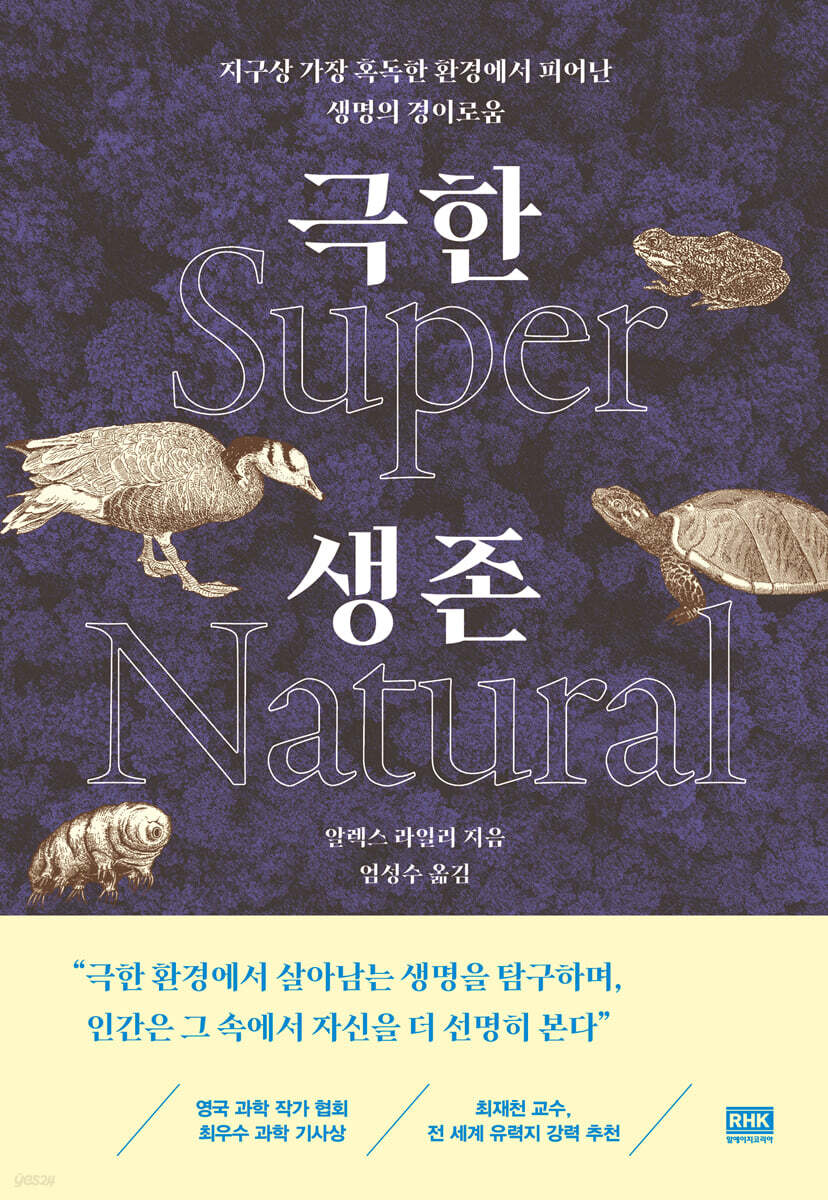
Extreme Survival Super Natural
 |
Description
Book Introduction
“Hope blossoms in the most extreme circumstances.”
In an era of "extreme survival," animals in extreme environments offer a signal of hope.
Professor Choi Jae-cheon strongly recommends the book to influential publications such as The Guardian.
Winner of the British Science Writers' Association Award for Best Article
Meet the animals that survive the harshest environments on Earth, including turtles that don't breathe underwater for six months, frogs that freeze and resurrect in the winter, Saharan silver ants that run one meter per second in the hot desert, microorganisms that survive by eating radiation in the Chernobyl exclusion zone, and even tardigrades that traveled into space.
"Extreme Survival" is a record of Alex Riley, a science writer who won the UK's Best Science Writer Award, meeting and exploring life in extreme environments around the world.
[The Guardian], the world-renowned book review magazine [Times Literary Supplement], and many science media outlets have taken note, calling it “excellent.”
Also, Professor Emeritus Choi Jae-cheon of the Department of Ecological Science at Ewha Womans University left a recommendation, saying, “It makes us unable to give up hope that life will continue in Chernobyl and that unknown life forms may exist somewhere in outer space beyond Earth.”
This book is not just a collection of 'amazing animals'; it is a hymn to life that teaches us, who live in an age of extreme survival.
In the natural world, it contains survival strategies that only animals know, and humans can obtain answers that they would never have expected.
Lifeforms that have overcome extreme conditions make us imagine a future where humanity can still live and breathe.
Seeing how life continues to exist even in the face of great disaster and change, we will feel a sense of wonder and hope as one life form, transcending species.
In an era of "extreme survival," animals in extreme environments offer a signal of hope.
Professor Choi Jae-cheon strongly recommends the book to influential publications such as The Guardian.
Winner of the British Science Writers' Association Award for Best Article
Meet the animals that survive the harshest environments on Earth, including turtles that don't breathe underwater for six months, frogs that freeze and resurrect in the winter, Saharan silver ants that run one meter per second in the hot desert, microorganisms that survive by eating radiation in the Chernobyl exclusion zone, and even tardigrades that traveled into space.
"Extreme Survival" is a record of Alex Riley, a science writer who won the UK's Best Science Writer Award, meeting and exploring life in extreme environments around the world.
[The Guardian], the world-renowned book review magazine [Times Literary Supplement], and many science media outlets have taken note, calling it “excellent.”
Also, Professor Emeritus Choi Jae-cheon of the Department of Ecological Science at Ewha Womans University left a recommendation, saying, “It makes us unable to give up hope that life will continue in Chernobyl and that unknown life forms may exist somewhere in outer space beyond Earth.”
This book is not just a collection of 'amazing animals'; it is a hymn to life that teaches us, who live in an age of extreme survival.
In the natural world, it contains survival strategies that only animals know, and humans can obtain answers that they would never have expected.
Lifeforms that have overcome extreme conditions make us imagine a future where humanity can still live and breathe.
Seeing how life continues to exist even in the face of great disaster and change, we will feel a sense of wonder and hope as one life form, transcending species.
- You can preview some of the book's contents.
Preview
index
Recommendation
prolog
Part 1.
The Secret of Survival
: If there are no three conditions for life,
Chapter 1.
A Dry World - Surviving Without Water
Chapter 2.
Breathtaking Survival - Surviving Without Oxygen
Chapter 3.
Fasting Masters - Surviving Without Food
Part 2.
Extreme Environments and Evolution
: Animals that survived anyway
Chapter 4.
You have to freeze to survive - cryogenics
Chapter 5.
Highest, deepest - extreme high and low pressure
Chapter 6.
What you need after a sprint - extreme heat
Part 3.
Light and radiation
: Testing the limits of life
Chapter 7.
A House Without Light - An Ecosystem Blossomed in the Dark
Chapter 8.
A Poisonous Paradise - Creatures That Live on Radiation
Epilogue
Acknowledgements
Translator's Note
main
prolog
Part 1.
The Secret of Survival
: If there are no three conditions for life,
Chapter 1.
A Dry World - Surviving Without Water
Chapter 2.
Breathtaking Survival - Surviving Without Oxygen
Chapter 3.
Fasting Masters - Surviving Without Food
Part 2.
Extreme Environments and Evolution
: Animals that survived anyway
Chapter 4.
You have to freeze to survive - cryogenics
Chapter 5.
Highest, deepest - extreme high and low pressure
Chapter 6.
What you need after a sprint - extreme heat
Part 3.
Light and radiation
: Testing the limits of life
Chapter 7.
A House Without Light - An Ecosystem Blossomed in the Dark
Chapter 8.
A Poisonous Paradise - Creatures That Live on Radiation
Epilogue
Acknowledgements
Translator's Note
main
Detailed image

Into the book
Our life journey is about overcoming extreme environments where there is either no or too much of the elements essential for life, such as water, oxygen, food, cold, pressure, heat, darkness, and radiation.
These extreme environments on Earth are like gateways to distant planets and satellites.
Places once thought to be lifeless now intrigue astrobiologists searching for life beyond Earth.
Furthermore, the way animals adapt to environmental stress provides us with insights needed to treat human diseases and preserve cells and organs.
But when faced with a variety of stressful situations, it is resilience and creativity, the central themes of this book, that enable us to move forward.
--- p.20~21
There is no scientific term to describe the tendency of organisms to gravitate toward extreme environments.
In her 1957 book The Immense Journey, anthropologist and science writer Loren Eisley attempted to explain this tendency as an emotional pull of "the eternal dissatisfaction of life with reality."
He wrote that living things can adapt to even the most unrealistic situations thanks to their "endless tendency to move toward new environments."
Evolution is necessarily adventure-oriented.
Or, as Dr. Ian Malcolm said in the movie Jurassic Park, “Life finds a way.” --- p.22
I was still amazed at the flexibility of this animal, half its body in its shell and half out.
It is solid but can also shrink.
Like amphibians, they can live both on land and in water.
We breathe in and out air, but we can live almost half a year, or half our life in the long run, without air.
--- p.75
The hopeful thing is that discoveries come from the most unexpected places.
For example, the naked mole rat's resistance to cancer stems from a protein that prevents cells from sticking together.
The protein is produced in large quantities in the skin of these wrinkled mammals, which helps them avoid getting caught or stuck in their labyrinthine burrows.
Leaning back into his desk chair, Parmenter summarizes:
“Ultimately, the skin that grows for underground living leads to resistance to cancer and also helps with longevity.
Who would have expected that?" --- p.103
The frog doesn't have to worry about frostbite.
They build hibernation chambers under piles of fallen leaves near the pool where they were born.
They also pack a lot of glucose into their cells, so that even if water leaks out through the ice crystals that form between the cells, the cells do not burst.
--- p.157
The thin air of high altitudes is a particularly difficult obstacle to overcome.
We can breathe more frequently or increase the volume of our breath, but there is always a moment (just before exhalation) when the air in our lungs is not replenished.
However, birds do not experience shortness of breath like mammals.
Regardless of altitude, birds do not appear to suffer from high-altitude pulmonary edema.
When humans breathe in and out, their lungs expand and contract, but birds breathe by continuously circulating their air in one direction.
--- p.185
Running at full speed during the hottest part of the day reduces competition and the risk of being eaten by predators, but it doesn't last long.
Once you find food, you need to return quickly before your body overheats.
To do this, they memorize landmarks to identify their nests, count their steps, and carefully observe the polarization of light from the sun.
Putting all of this together gives us the coordinates.
Even though desert ants don't know where their next food source will come from, they know very well where they are.
--- p.227
Before the digging equipment was withdrawn, the newly discovered cave was investigated by Romanian speleologist Christian Lascu.
At the time, he had no idea that he was entering a world that had not been touched by human footsteps or any outside influence for over two million years.
(...) Of the 57 species of animals that live in this cave, 37 exist nowhere else on Earth, and they live entirely in a small number of places with oxygen-poor air and sulfur-rich water.
At just 21 meters long, this cave is a tiny speck of dust in the Earth's biosphere, a miniature safari where the 10-centimeter-long civet is the top predator.
--- p.282~284
In fact, mold has been found in even the most radioactive environments long before Chernobyl.
It has long been known that fungi exist in high-radiation environments, from the Bikini Atoll nuclear test site to wastewater samples from other nuclear power plants.
Therefore, Chernobyl, or even Chernobyl itself, was an environment that was sufficiently habitable for these resilient creatures.
--- p.315
Because melanin-rich fungi are good at handling radiation, we need to find ways to utilize them effectively.
In this regard, Casadevall and Dadachova proposed an interesting idea in discussions with NASA engineers.
The idea is to use melanized fungi to protect astronauts from radiation.
Instead of encasing the spacecraft in lead or thick metal, the method involves placing colonies of fungal spores in the hollow spaces inside the spacecraft's outer walls.
This allows the fungi to survive by feeding on the astronauts' feces and growing in a cocoon-like space outside the spacecraft.
These fungi could act as a biological shield in case of radiation attack from outside the spacecraft.
--- p.321
When all hope seems lost, I often turn my gaze back to life itself.
What the animals, plants, and fungi we looked at in the previous chapter taught me is simple.
Life has an amazing ability to recover from any disaster.
Tardigrades will not die out unless the oceans boil and evaporate, and foraminifera still thrive in man-made dead zones.
Even polar bears, often seen as a symbol of impending disaster, are finding ways to adapt and survive by finding new habitats as the ice melts.
--- p.342
One thing is certain.
Once life begins on a planet, it is very difficult for it to completely disappear.
I often imagine Earth millions of years from now.
I wonder if one day the ecosystem will revolve around cooperation and harmony rather than competition and predation, providing a natural counterbalance to the overly destructive actions of humans.
These extreme environments on Earth are like gateways to distant planets and satellites.
Places once thought to be lifeless now intrigue astrobiologists searching for life beyond Earth.
Furthermore, the way animals adapt to environmental stress provides us with insights needed to treat human diseases and preserve cells and organs.
But when faced with a variety of stressful situations, it is resilience and creativity, the central themes of this book, that enable us to move forward.
--- p.20~21
There is no scientific term to describe the tendency of organisms to gravitate toward extreme environments.
In her 1957 book The Immense Journey, anthropologist and science writer Loren Eisley attempted to explain this tendency as an emotional pull of "the eternal dissatisfaction of life with reality."
He wrote that living things can adapt to even the most unrealistic situations thanks to their "endless tendency to move toward new environments."
Evolution is necessarily adventure-oriented.
Or, as Dr. Ian Malcolm said in the movie Jurassic Park, “Life finds a way.” --- p.22
I was still amazed at the flexibility of this animal, half its body in its shell and half out.
It is solid but can also shrink.
Like amphibians, they can live both on land and in water.
We breathe in and out air, but we can live almost half a year, or half our life in the long run, without air.
--- p.75
The hopeful thing is that discoveries come from the most unexpected places.
For example, the naked mole rat's resistance to cancer stems from a protein that prevents cells from sticking together.
The protein is produced in large quantities in the skin of these wrinkled mammals, which helps them avoid getting caught or stuck in their labyrinthine burrows.
Leaning back into his desk chair, Parmenter summarizes:
“Ultimately, the skin that grows for underground living leads to resistance to cancer and also helps with longevity.
Who would have expected that?" --- p.103
The frog doesn't have to worry about frostbite.
They build hibernation chambers under piles of fallen leaves near the pool where they were born.
They also pack a lot of glucose into their cells, so that even if water leaks out through the ice crystals that form between the cells, the cells do not burst.
--- p.157
The thin air of high altitudes is a particularly difficult obstacle to overcome.
We can breathe more frequently or increase the volume of our breath, but there is always a moment (just before exhalation) when the air in our lungs is not replenished.
However, birds do not experience shortness of breath like mammals.
Regardless of altitude, birds do not appear to suffer from high-altitude pulmonary edema.
When humans breathe in and out, their lungs expand and contract, but birds breathe by continuously circulating their air in one direction.
--- p.185
Running at full speed during the hottest part of the day reduces competition and the risk of being eaten by predators, but it doesn't last long.
Once you find food, you need to return quickly before your body overheats.
To do this, they memorize landmarks to identify their nests, count their steps, and carefully observe the polarization of light from the sun.
Putting all of this together gives us the coordinates.
Even though desert ants don't know where their next food source will come from, they know very well where they are.
--- p.227
Before the digging equipment was withdrawn, the newly discovered cave was investigated by Romanian speleologist Christian Lascu.
At the time, he had no idea that he was entering a world that had not been touched by human footsteps or any outside influence for over two million years.
(...) Of the 57 species of animals that live in this cave, 37 exist nowhere else on Earth, and they live entirely in a small number of places with oxygen-poor air and sulfur-rich water.
At just 21 meters long, this cave is a tiny speck of dust in the Earth's biosphere, a miniature safari where the 10-centimeter-long civet is the top predator.
--- p.282~284
In fact, mold has been found in even the most radioactive environments long before Chernobyl.
It has long been known that fungi exist in high-radiation environments, from the Bikini Atoll nuclear test site to wastewater samples from other nuclear power plants.
Therefore, Chernobyl, or even Chernobyl itself, was an environment that was sufficiently habitable for these resilient creatures.
--- p.315
Because melanin-rich fungi are good at handling radiation, we need to find ways to utilize them effectively.
In this regard, Casadevall and Dadachova proposed an interesting idea in discussions with NASA engineers.
The idea is to use melanized fungi to protect astronauts from radiation.
Instead of encasing the spacecraft in lead or thick metal, the method involves placing colonies of fungal spores in the hollow spaces inside the spacecraft's outer walls.
This allows the fungi to survive by feeding on the astronauts' feces and growing in a cocoon-like space outside the spacecraft.
These fungi could act as a biological shield in case of radiation attack from outside the spacecraft.
--- p.321
When all hope seems lost, I often turn my gaze back to life itself.
What the animals, plants, and fungi we looked at in the previous chapter taught me is simple.
Life has an amazing ability to recover from any disaster.
Tardigrades will not die out unless the oceans boil and evaporate, and foraminifera still thrive in man-made dead zones.
Even polar bears, often seen as a symbol of impending disaster, are finding ways to adapt and survive by finding new habitats as the ice melts.
--- p.342
One thing is certain.
Once life begins on a planet, it is very difficult for it to completely disappear.
I often imagine Earth millions of years from now.
I wonder if one day the ecosystem will revolve around cooperation and harmony rather than competition and predation, providing a natural counterbalance to the overly destructive actions of humans.
--- p.343
Publisher's Review
Beyond Science: Finding Hope in Nature
A wondrous world of life in extreme environments, explored from the corner of your room.
There are animals that can survive in boiling water for 30 minutes, in liquid helium at -200 degrees Celsius for 7 months, and in 1,000 atmospheres of pressure, strong radiation, and various toxic gases.
This is the story of a creature that survived even space travel: the 'tardigrade'.
This animal, also known as a 'water bear' due to its surprisingly cute appearance and slow movements, is known to be a supernatural creature that is almost impossible to take life without.
Like the tardigrades, the animals in "Extreme Survival" display remarkable resilience and creativity.
They survive even in environments without 'water, oxygen, and food', which are considered natural conditions for survival from a human perspective (Part 1 'Secret of Survival').
The key to survival is being different.
Extreme animals live in harsh environments, but that's why they seek out niche habitats where there is no competition.
And they use extraordinary methods to adapt to that environment.
For example, in winter, when sunlight is scarce, carp, which can survive for months without oxygen in water, deliberately damage their brain cells to keep their metabolism as low as possible.
For carp, which are often considered symbols of animals with poor memory, brain cell damage and resulting memory loss are actually 'minor' problems.
When faced with a major problem, the carp uses all available resources to the fullest extent.
The surprising thing is that carp can regenerate brain cells.
The memories of last winter may have faded, but we can once again be reborn as animals.
Survival in nature is often perceived as a 'competition', but in reality, survival is also a journey to find a place where you can belong.
There is a reason why an animal exists in that place and in that form.
This book shatters human-centered preconceptions and astonishes us with the adaptability and creativity of animals bred over long periods of time through evolution, providing a delightful "readable science documentary" for anyone interested in nature, life, and existence.
A creative narrative of nature more dramatic than a novel
Survival Strategies and Wisdom Learned from Animals in Extreme Environments
Beyond fun and wonder, "Extreme Survival" teaches life lessons through plants and animals that live in extreme environments.
How do animals survive in the hottest and coldest places on Earth, and the highest and lowest elevations, where humans would be unable to survive? They must equip their bodies with the necessary functions to survive in these extreme environments (Part 2, "Extreme Environments and Evolution").
Saharan silver ants can run at a speed of one meter per second in the extremely hot desert.
When you run, your body briefly rises above the ground, which reduces the amount of heat you generate.
Even if the temperature at the ground is almost 60 degrees Celsius, just one centimeter above it can be 20 degrees cooler.
The secret of these ants is surprisingly regular 'rest'.
Up to three-quarters of their foraging time is spent resting.
Meanwhile, the great-tailed godwit pushes itself to its limits, flying nonstop for nearly ten days in the low-pressure, high-altitude skies towards warmer temperatures.
This animal also sleeps almost as if dead after a flight.
In this way, nature's amazing ability can be said to be its ability to adapt and know how to use the energy it has to survive.
As you follow the ecosystem in the book, you will realize how systematic and creative the natural world is for survival.
It is also surprising that the secrets of survival for many plants and animals remain mysterious and unknown.
Life finds a way
The meaning of life learned from life beyond limits
Life transcends seemingly impossible limits.
At the end of the book, there are small creatures from the underworld where there is no light, and moths that can distinguish not only shapes but also colors in the dark.
There is also a story about microorganisms growing in the Chernobyl exclusion zone using radiation as energy (Part 3, 'Light and Radiation').
As always, life finds a way.
About 2 billion years ago, an event occurred that has been called "the greatest pollution crisis the Earth has ever faced."
The discovery of the power of photosynthesis by cyanobacteria transformed Earth from a place with little oxygen to one where we breathe oxygen.
The anaerobic organisms that lived on Earth at that time suffocated, and the life forms we see today took their place.
In this way, no matter what environment the Earth is in, ‘life’ itself finds a way.
Human life is also unpredictable, but sometimes it may be meaningful to just endure for survival.
Like the animals facing the climate crisis in "Extreme Survival," enduring an increasingly harsh environment may already be the best possible state.
“While the survival strategies of living things are rooted in scientific facts, what we learn from them goes beyond scientific facts.
This book makes us rethink how we live.
“Just ‘holding on’ is already a great achievement.” _From the ‘Translator’s Note’
A brilliant account of how life survives in the face of radiation, extreme drought, Saharan heat and polar cold, complete darkness and famine, oxygen deprivation and the pressures of the deep sea.
The author tells this extreme story with humor and restrained insight.
The Guardian
An excellent, authoritative and accessible account of life.
It reminds us how evolution has created countless ecological niches on Earth.
The Times Literary Supplement
It features impressive stories and vivid descriptions of creatures that survived with amazing resilience.
A fascinating book that balances science and emotion.
Publisher's Weekly
A delightful exploration of the fringes of life, a hymn showcasing its resilience and ingenious strategies.
NHBS, the UK's leading natural history and ecology review body
A wondrous world of life in extreme environments, explored from the corner of your room.
There are animals that can survive in boiling water for 30 minutes, in liquid helium at -200 degrees Celsius for 7 months, and in 1,000 atmospheres of pressure, strong radiation, and various toxic gases.
This is the story of a creature that survived even space travel: the 'tardigrade'.
This animal, also known as a 'water bear' due to its surprisingly cute appearance and slow movements, is known to be a supernatural creature that is almost impossible to take life without.
Like the tardigrades, the animals in "Extreme Survival" display remarkable resilience and creativity.
They survive even in environments without 'water, oxygen, and food', which are considered natural conditions for survival from a human perspective (Part 1 'Secret of Survival').
The key to survival is being different.
Extreme animals live in harsh environments, but that's why they seek out niche habitats where there is no competition.
And they use extraordinary methods to adapt to that environment.
For example, in winter, when sunlight is scarce, carp, which can survive for months without oxygen in water, deliberately damage their brain cells to keep their metabolism as low as possible.
For carp, which are often considered symbols of animals with poor memory, brain cell damage and resulting memory loss are actually 'minor' problems.
When faced with a major problem, the carp uses all available resources to the fullest extent.
The surprising thing is that carp can regenerate brain cells.
The memories of last winter may have faded, but we can once again be reborn as animals.
Survival in nature is often perceived as a 'competition', but in reality, survival is also a journey to find a place where you can belong.
There is a reason why an animal exists in that place and in that form.
This book shatters human-centered preconceptions and astonishes us with the adaptability and creativity of animals bred over long periods of time through evolution, providing a delightful "readable science documentary" for anyone interested in nature, life, and existence.
A creative narrative of nature more dramatic than a novel
Survival Strategies and Wisdom Learned from Animals in Extreme Environments
Beyond fun and wonder, "Extreme Survival" teaches life lessons through plants and animals that live in extreme environments.
How do animals survive in the hottest and coldest places on Earth, and the highest and lowest elevations, where humans would be unable to survive? They must equip their bodies with the necessary functions to survive in these extreme environments (Part 2, "Extreme Environments and Evolution").
Saharan silver ants can run at a speed of one meter per second in the extremely hot desert.
When you run, your body briefly rises above the ground, which reduces the amount of heat you generate.
Even if the temperature at the ground is almost 60 degrees Celsius, just one centimeter above it can be 20 degrees cooler.
The secret of these ants is surprisingly regular 'rest'.
Up to three-quarters of their foraging time is spent resting.
Meanwhile, the great-tailed godwit pushes itself to its limits, flying nonstop for nearly ten days in the low-pressure, high-altitude skies towards warmer temperatures.
This animal also sleeps almost as if dead after a flight.
In this way, nature's amazing ability can be said to be its ability to adapt and know how to use the energy it has to survive.
As you follow the ecosystem in the book, you will realize how systematic and creative the natural world is for survival.
It is also surprising that the secrets of survival for many plants and animals remain mysterious and unknown.
Life finds a way
The meaning of life learned from life beyond limits
Life transcends seemingly impossible limits.
At the end of the book, there are small creatures from the underworld where there is no light, and moths that can distinguish not only shapes but also colors in the dark.
There is also a story about microorganisms growing in the Chernobyl exclusion zone using radiation as energy (Part 3, 'Light and Radiation').
As always, life finds a way.
About 2 billion years ago, an event occurred that has been called "the greatest pollution crisis the Earth has ever faced."
The discovery of the power of photosynthesis by cyanobacteria transformed Earth from a place with little oxygen to one where we breathe oxygen.
The anaerobic organisms that lived on Earth at that time suffocated, and the life forms we see today took their place.
In this way, no matter what environment the Earth is in, ‘life’ itself finds a way.
Human life is also unpredictable, but sometimes it may be meaningful to just endure for survival.
Like the animals facing the climate crisis in "Extreme Survival," enduring an increasingly harsh environment may already be the best possible state.
“While the survival strategies of living things are rooted in scientific facts, what we learn from them goes beyond scientific facts.
This book makes us rethink how we live.
“Just ‘holding on’ is already a great achievement.” _From the ‘Translator’s Note’
A brilliant account of how life survives in the face of radiation, extreme drought, Saharan heat and polar cold, complete darkness and famine, oxygen deprivation and the pressures of the deep sea.
The author tells this extreme story with humor and restrained insight.
The Guardian
An excellent, authoritative and accessible account of life.
It reminds us how evolution has created countless ecological niches on Earth.
The Times Literary Supplement
It features impressive stories and vivid descriptions of creatures that survived with amazing resilience.
A fascinating book that balances science and emotion.
Publisher's Weekly
A delightful exploration of the fringes of life, a hymn showcasing its resilience and ingenious strategies.
NHBS, the UK's leading natural history and ecology review body
GOODS SPECIFICS
- Date of issue: December 3, 2025
- Page count, weight, size: 376 pages | 496g | 145*210*23mm
- ISBN13: 9788925572963
- ISBN10: 8925572966
You may also like
카테고리
korean


korean

![ELLE 엘르 스페셜 에디션 A형 : 12월 [2025]](http://librairie.coreenne.fr/cdn/shop/files/b8e27a3de6c9538896439686c6b0e8fb.jpg?v=1766436872&width=3840)


