

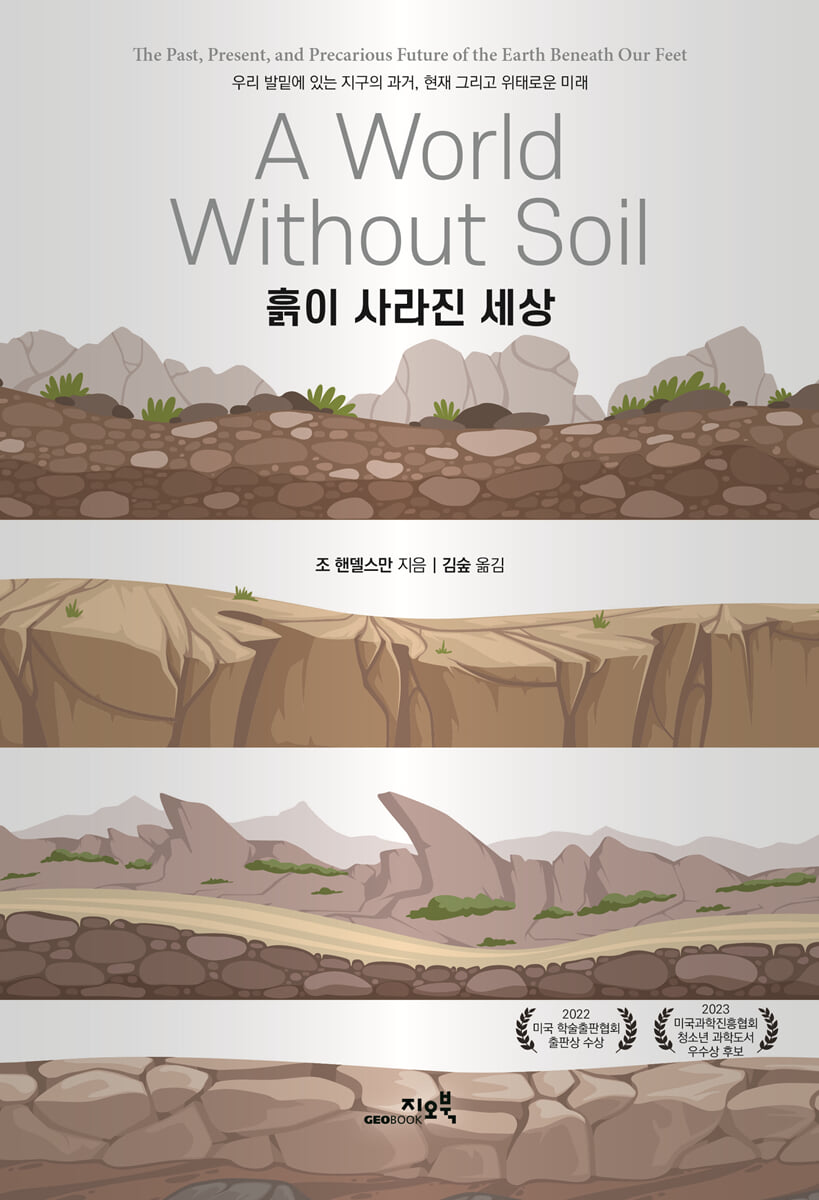
A world without soil
 |
Description
Book Introduction
Soil is disappearing 10 to 100 times faster than it is being created.
Soil is the planet's largest water filter and largest carbon storage.
Soils around the world are facing an invisible crisis.
People don't realize that the very land we walk on is disappearing at an alarming rate.
Soil is disappearing 10 to 100 times faster than it is being created.
Soil is the planet's largest water filter and largest carbon reservoir.
When soil erodes, food production and the environment as a whole become unstable.
There is still time to save this precious resource.
We have enough knowledge to reduce or even stop soil erosion.
The regenerative power of the soil and human ingenuity, when combined, can save us from a precarious future.
Soil is the planet's largest water filter and largest carbon storage.
Soils around the world are facing an invisible crisis.
People don't realize that the very land we walk on is disappearing at an alarming rate.
Soil is disappearing 10 to 100 times faster than it is being created.
Soil is the planet's largest water filter and largest carbon reservoir.
When soil erodes, food production and the environment as a whole become unstable.
There is still time to save this precious resource.
We have enough knowledge to reduce or even stop soil erosion.
The regenerative power of the soil and human ingenuity, when combined, can save us from a precarious future.
- You can preview some of the book's contents.
Preview
index
Recommended articles… 4
Translator's Note … 7
Header … 10
Prologue … 14
1.
Dawn - The Invisible Crisis… 18
2.
Earth's dark matter… 26
3.
What the Soil Does… 42
4.
There are twelve kinds of soil on Earth… 64
5.
Disappearing Soil… 86
6.
What if all the soil disappeared from Earth? … 122
7.
The Duet of Soil and the Climate Crisis… 152
8.
Learning Farming from Indigenous Peoples… 176
9.
Let's change the way we farm! … 202
10.
A future with soil… 230
Acknowledgments … 254
Abbreviation … 258
Week … 259
References … 296
Search … 308
Translator's Note … 7
Header … 10
Prologue … 14
1.
Dawn - The Invisible Crisis… 18
2.
Earth's dark matter… 26
3.
What the Soil Does… 42
4.
There are twelve kinds of soil on Earth… 64
5.
Disappearing Soil… 86
6.
What if all the soil disappeared from Earth? … 122
7.
The Duet of Soil and the Climate Crisis… 152
8.
Learning Farming from Indigenous Peoples… 176
9.
Let's change the way we farm! … 202
10.
A future with soil… 230
Acknowledgments … 254
Abbreviation … 258
Week … 259
References … 296
Search … 308
Publisher's Review
Have you ever imagined a world without soil?
Soil is disappearing 10 to 100 times faster than it is being created.
A book that presents problems and solutions for the collapse of the soil system, the world beneath our feet.
Billions of tons of soil disappear around the world every year.
95% of the food we eat comes from the soil.
The amount of carbon in the soil is three times that of the Earth's atmosphere.
The Earth's soil is a much thinner layer than we think and is a treasure trove of biodiversity, home to 25% of all known life forms today.
What is even more surprising is that the soil was formed after life appeared on Earth, a billion years after its birth.
This soil system, created by the Earth's weathered rocks, living organisms, organic matter, and atmosphere, is collapsing due to erosion and loss.
The collapse of soil systems, accelerated by modern agriculture and climate change, is a major issue that poses a global food production and environmental crisis.
This book, "A World Without Soil," is a new compilation of a report on soil conservation policy prepared by Dr. Joe Handelsman, former President Barack Obama's science advisor and a soil scientist with 35 years of experience.
This book diagnoses the serious soil crisis from various angles and suggests solutions.
The solution wasn't far away.
It is a recovery strategy that combines traditional farming methods and soil-friendly farming methods with modern agriculture.
The book also systematically organizes stories about the origin of soil and soil science, soil classification, soil and world civilization, traditional soil management methods, soil policy, and urban agriculture.
The soil that covered the Earth's surface is disappearing: Soil erosion and loss.
Soil depth is determined by the balance between formation, deposition, and erosion.
Natural topsoil production is about 0.5 to 1 tonne/ha per year, but the global average erosion is 13.5 tonnes/ha, which is 10 to 30 times faster.
In Iowa in 2007, a single storm caused annual losses of 4 million hectares, with some areas losing up to 220 tons/ha.
Erosion is primarily caused by wind and water, with water erosion being particularly severe in sub-Saharan Africa and Papua New Guinea.
India has increased production through expanded irrigation, but has also become more vulnerable to salt accumulation.
Parts of Africa and South America with shallow topsoils also suffered significant damage.
Farming and logging accelerated this, and Jefferson's shovel plow caused historically large-scale soil loss.
Erosion has significant social costs, including reduced yields, declining land values, and biodiversity loss, as well as downstream sedimentation, flooding, water purification costs, food prices, and climate change.
Climate and soil have been close companions for thousands of years: The climate crisis and the carbon storage potential of soil.
Climate and soil interact and influence each other.
The 2019 IPCC report, “Climate Change and Land,” addressed the link between desertification and soil degradation.
Soils store about 2.5 trillion tons of carbon, three times more than the atmosphere and four times more than vegetation, making them the largest carbon reservoir on land.
When the balance is broken, erosion releases carbon, accelerating climate change, which in turn exacerbates erosion, creating a vicious cycle.
Rice fields emit tens of millions of tons of methane annually, but this can be mitigated with varieties that send more oxygen to the roots, helping methane-consuming microbes.
Global warming melts permafrost, increasing methane production, triggering disasters such as heavy rains due to increased evaporation, and posing new threats to crop production due to changes in the distribution of pests and pathogens.
Even Earth's dark matter, the soil, has a secret to its birth: The origin of soil.
4.55 billion years ago, the Earth was formed, and 150 million years later, the two axes of the soil, rock and water, existed first.
Life emerged between 3.95 and 3.48 billion years ago, evolving into self-sufficient chemical systems and microbial communities.
Soil is a product of thermal, mechanical, and chemical weathering of rocks and long-term microbial activity, which are controlled by weather and climate.
The core ingredient, sand, is mainly composed of SiO₂, and its large particles create pores that help water and air flow.
The smallest clays are silicate minerals, while silt is a medium-sized particle based on feldspar and quartz.
In just one teaspoon of soil, billions of bacteria live and provide nutrients to plants, and the plants return photosynthetic carbon to the soil.
The author calls soil "dark matter," the most complex yet difficult-to-study substance on Earth.
Soil also comes in many different types and colors: Soil classification
Soil may seem chaotic, but its history and origins can be traced and classified using clues like scent, texture, grain, taste, and color.
The first classifiers were farmers about 12,000 years ago, who passed down traditional knowledge.
Later, ancient officials developed a system for taxation, and during the reign of Emperor Yao of China, a nine-grade system based on production was introduced.
In the late 19th century, Russia's Dokuchayev established a classification based on soil origin, and after World War II, each country refined its own system. While the FAO established a global standard, widespread adoption has been limited, and the USDA's new soil classification is widely used in many regions.
Korea operates separate forest and agricultural land systems.
The book maps 12 of the USDA's soil types, including Mollisol (Chernozem), a fertile black topsoil found in the grasslands of Ukraine and the Midwestern United States, a result of the collaboration of perennial roots, herbivores, and microorganisms.
The more you know about the Earth's gift of soil, the more important it becomes: The functions and value of soil.
Soil is a place where biological, chemical, and physical processes intersect and provides diverse ecosystem services.
Biologically, it supports the production of food, fuel, feed, fiber, and medicine; chemically, it acts as a filter that absorbs and releases substances; and physically, it is responsible for the movement of water and the support structure for plants.
The scriptures of Judaism, Christianity, and Islam also trace the origin of humanity to the earth.
Soil is the habitat for approximately 25% of all living species and the production base for 95% of food.
Groundwater accounts for a large proportion of freshwater, providing water for 2.5 billion people, and soil filters this water, though not completely.
Author Handelsmann continues his research with students, analyzing thousands of soil bacteria to find antibiotics that pharmaceutical companies ignore.
Soil is disappearing 10 to 100 times faster than it is being created.
A book that presents problems and solutions for the collapse of the soil system, the world beneath our feet.
Billions of tons of soil disappear around the world every year.
95% of the food we eat comes from the soil.
The amount of carbon in the soil is three times that of the Earth's atmosphere.
The Earth's soil is a much thinner layer than we think and is a treasure trove of biodiversity, home to 25% of all known life forms today.
What is even more surprising is that the soil was formed after life appeared on Earth, a billion years after its birth.
This soil system, created by the Earth's weathered rocks, living organisms, organic matter, and atmosphere, is collapsing due to erosion and loss.
The collapse of soil systems, accelerated by modern agriculture and climate change, is a major issue that poses a global food production and environmental crisis.
This book, "A World Without Soil," is a new compilation of a report on soil conservation policy prepared by Dr. Joe Handelsman, former President Barack Obama's science advisor and a soil scientist with 35 years of experience.
This book diagnoses the serious soil crisis from various angles and suggests solutions.
The solution wasn't far away.
It is a recovery strategy that combines traditional farming methods and soil-friendly farming methods with modern agriculture.
The book also systematically organizes stories about the origin of soil and soil science, soil classification, soil and world civilization, traditional soil management methods, soil policy, and urban agriculture.
The soil that covered the Earth's surface is disappearing: Soil erosion and loss.
Soil depth is determined by the balance between formation, deposition, and erosion.
Natural topsoil production is about 0.5 to 1 tonne/ha per year, but the global average erosion is 13.5 tonnes/ha, which is 10 to 30 times faster.
In Iowa in 2007, a single storm caused annual losses of 4 million hectares, with some areas losing up to 220 tons/ha.
Erosion is primarily caused by wind and water, with water erosion being particularly severe in sub-Saharan Africa and Papua New Guinea.
India has increased production through expanded irrigation, but has also become more vulnerable to salt accumulation.
Parts of Africa and South America with shallow topsoils also suffered significant damage.
Farming and logging accelerated this, and Jefferson's shovel plow caused historically large-scale soil loss.
Erosion has significant social costs, including reduced yields, declining land values, and biodiversity loss, as well as downstream sedimentation, flooding, water purification costs, food prices, and climate change.
Climate and soil have been close companions for thousands of years: The climate crisis and the carbon storage potential of soil.
Climate and soil interact and influence each other.
The 2019 IPCC report, “Climate Change and Land,” addressed the link between desertification and soil degradation.
Soils store about 2.5 trillion tons of carbon, three times more than the atmosphere and four times more than vegetation, making them the largest carbon reservoir on land.
When the balance is broken, erosion releases carbon, accelerating climate change, which in turn exacerbates erosion, creating a vicious cycle.
Rice fields emit tens of millions of tons of methane annually, but this can be mitigated with varieties that send more oxygen to the roots, helping methane-consuming microbes.
Global warming melts permafrost, increasing methane production, triggering disasters such as heavy rains due to increased evaporation, and posing new threats to crop production due to changes in the distribution of pests and pathogens.
Even Earth's dark matter, the soil, has a secret to its birth: The origin of soil.
4.55 billion years ago, the Earth was formed, and 150 million years later, the two axes of the soil, rock and water, existed first.
Life emerged between 3.95 and 3.48 billion years ago, evolving into self-sufficient chemical systems and microbial communities.
Soil is a product of thermal, mechanical, and chemical weathering of rocks and long-term microbial activity, which are controlled by weather and climate.
The core ingredient, sand, is mainly composed of SiO₂, and its large particles create pores that help water and air flow.
The smallest clays are silicate minerals, while silt is a medium-sized particle based on feldspar and quartz.
In just one teaspoon of soil, billions of bacteria live and provide nutrients to plants, and the plants return photosynthetic carbon to the soil.
The author calls soil "dark matter," the most complex yet difficult-to-study substance on Earth.
Soil also comes in many different types and colors: Soil classification
Soil may seem chaotic, but its history and origins can be traced and classified using clues like scent, texture, grain, taste, and color.
The first classifiers were farmers about 12,000 years ago, who passed down traditional knowledge.
Later, ancient officials developed a system for taxation, and during the reign of Emperor Yao of China, a nine-grade system based on production was introduced.
In the late 19th century, Russia's Dokuchayev established a classification based on soil origin, and after World War II, each country refined its own system. While the FAO established a global standard, widespread adoption has been limited, and the USDA's new soil classification is widely used in many regions.
Korea operates separate forest and agricultural land systems.
The book maps 12 of the USDA's soil types, including Mollisol (Chernozem), a fertile black topsoil found in the grasslands of Ukraine and the Midwestern United States, a result of the collaboration of perennial roots, herbivores, and microorganisms.
The more you know about the Earth's gift of soil, the more important it becomes: The functions and value of soil.
Soil is a place where biological, chemical, and physical processes intersect and provides diverse ecosystem services.
Biologically, it supports the production of food, fuel, feed, fiber, and medicine; chemically, it acts as a filter that absorbs and releases substances; and physically, it is responsible for the movement of water and the support structure for plants.
The scriptures of Judaism, Christianity, and Islam also trace the origin of humanity to the earth.
Soil is the habitat for approximately 25% of all living species and the production base for 95% of food.
Groundwater accounts for a large proportion of freshwater, providing water for 2.5 billion people, and soil filters this water, though not completely.
Author Handelsmann continues his research with students, analyzing thousands of soil bacteria to find antibiotics that pharmaceutical companies ignore.
GOODS SPECIFICS
- Date of issue: September 30, 2025
- Page count, weight, size: 328 pages | 153*224*30mm
- ISBN13: 9788994242927
- ISBN10: 8994242929
You may also like
카테고리
korean


korean

![ELLE 엘르 스페셜 에디션 A형 : 12월 [2025]](http://librairie.coreenne.fr/cdn/shop/files/b8e27a3de6c9538896439686c6b0e8fb.jpg?v=1766436872&width=3840)


