

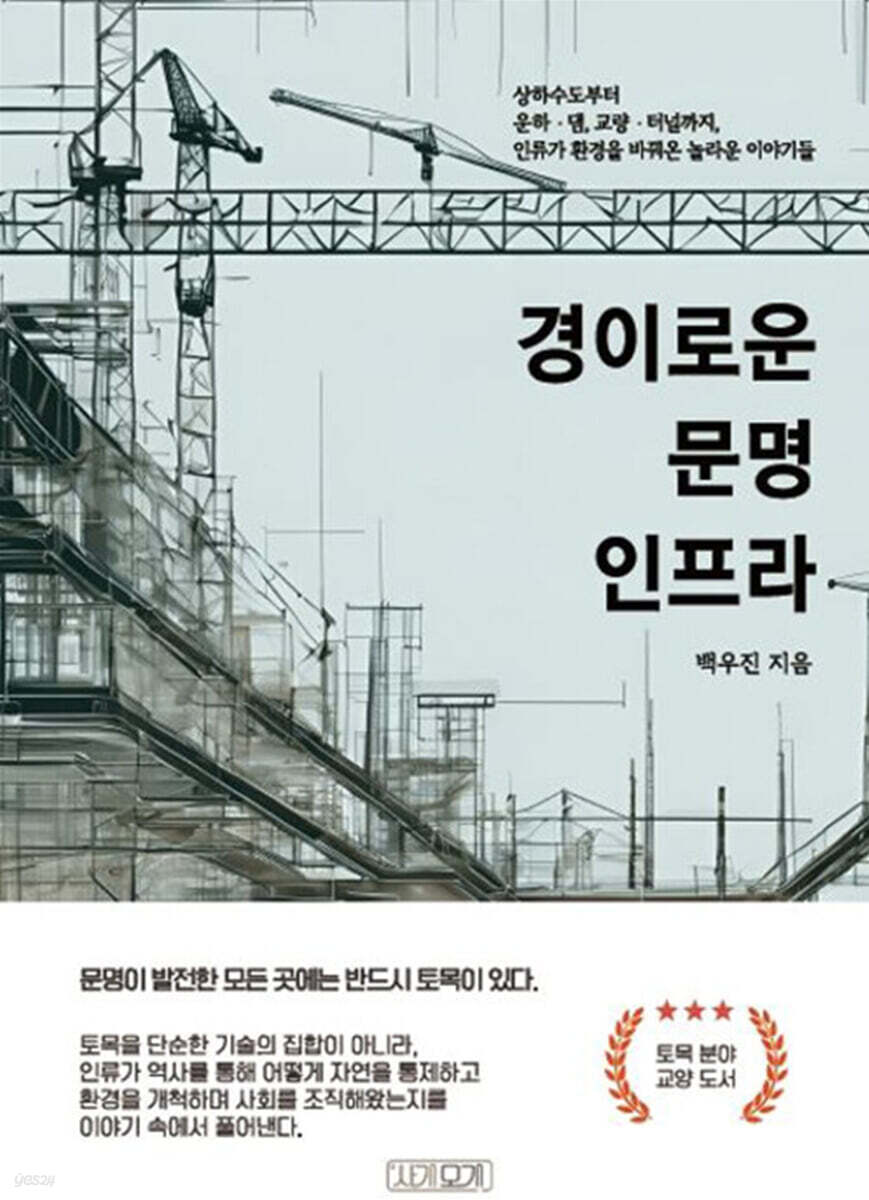
Amazing civilization infrastructure
 |
Description
Book Introduction
Rome's extensive and closely connected roads and aqueducts symbolize a powerfully organized empire.
The Hoover Dam in the United States and the Soyang River Dam in Korea symbolize the greatness of humanity in maximizing water resources while controlling nature.
Civil engineering, which builds the infrastructure of human civilization, is not simply a collection of technologies.
Each civil engineering project contains a rich story of how humanity has controlled nature, developed the environment, and governed society.
Against the backdrop of history, society, economy, politics, and international affairs, the author goes beyond simply listing the structures and technologies of infrastructure such as roads, bridges, tunnels, canals, and dams, and unravels the activities of the people who created each structure.
It also weaves together in a three-dimensional way how the world has changed because of it.
For example, it shows how the two tasks of building sewer systems and combating infectious diseases that have claimed countless lives in large cities for decades have intertwined and come to fruition.
The Hoover Dam in the United States and the Soyang River Dam in Korea symbolize the greatness of humanity in maximizing water resources while controlling nature.
Civil engineering, which builds the infrastructure of human civilization, is not simply a collection of technologies.
Each civil engineering project contains a rich story of how humanity has controlled nature, developed the environment, and governed society.
Against the backdrop of history, society, economy, politics, and international affairs, the author goes beyond simply listing the structures and technologies of infrastructure such as roads, bridges, tunnels, canals, and dams, and unravels the activities of the people who created each structure.
It also weaves together in a three-dimensional way how the world has changed because of it.
For example, it shows how the two tasks of building sewer systems and combating infectious diseases that have claimed countless lives in large cities for decades have intertwined and come to fruition.
index
[Recommendation] A Guide to a Journey to Civilization
[Introduction] “Why?” and “How?” surrounding civil engineering.
Part 1 Water and Sewerage
Chapter 1: Paris and the Sewers as Seen Through Les Misérables
Chapter 2: Civil Engineers Fight Cholera in London
Chapter 3: Why Did the Chicago River Flow Backward?
Chapter 4: Underground Waterways: The Foundation of the Persian Empire
Part 2 Canals and Dams
Chapter 5: The Mediterranean and Red Seas: Connected in Just 10 Years
Chapter 6: Dividing the Land but Uniting the World
Chapter 7: The Hidden Heroes Who Built the Panama Canal
Chapter 8: I Came, I Saw, I Was Overwhelmed
Chapter 9: Representative Dams of Korea, China, and Japan: The Three Kingdoms and Three Colors
Chapter 10: Tokyo's Floods Are Stopped by an Underground Temple
Part 3 Roads, Bridges, and Tunnels
Chapter 11: All the Knowledge About the 'Road' to Rome
Chapter 12: Competition and Cooperation between Cable-stayed and Suspension Bridges
Chapter 13: Why Seoul 7017 is Different from New York's High Line
Chapter 14 We Don't Know the Tunnel
Chapter 15: The World Became More Beautiful Through Arches
Part 4 Space Expansion
Chapter 16 The Roman Empire Expanded Underground
Chapter 17: The Underground, Where the Impossible Becomes Possible
Chapter 18: How Edo Developed into Tokyo
Chapter 19: How Edo Became the World's Largest City
Part 5 material
Chapter 20: Reinforced Concrete is Great
Chapter 21: The Colosseum Would Have Collapsed Without This
Chapter 22: The many 'irons' invented since the Iron Age
Chapter 23: A Tower of Thought, a Tower of Earth… Even the Earth is Soft
[Epilogue] Writing in the Content-Rich AI Era
[Introduction] “Why?” and “How?” surrounding civil engineering.
Part 1 Water and Sewerage
Chapter 1: Paris and the Sewers as Seen Through Les Misérables
Chapter 2: Civil Engineers Fight Cholera in London
Chapter 3: Why Did the Chicago River Flow Backward?
Chapter 4: Underground Waterways: The Foundation of the Persian Empire
Part 2 Canals and Dams
Chapter 5: The Mediterranean and Red Seas: Connected in Just 10 Years
Chapter 6: Dividing the Land but Uniting the World
Chapter 7: The Hidden Heroes Who Built the Panama Canal
Chapter 8: I Came, I Saw, I Was Overwhelmed
Chapter 9: Representative Dams of Korea, China, and Japan: The Three Kingdoms and Three Colors
Chapter 10: Tokyo's Floods Are Stopped by an Underground Temple
Part 3 Roads, Bridges, and Tunnels
Chapter 11: All the Knowledge About the 'Road' to Rome
Chapter 12: Competition and Cooperation between Cable-stayed and Suspension Bridges
Chapter 13: Why Seoul 7017 is Different from New York's High Line
Chapter 14 We Don't Know the Tunnel
Chapter 15: The World Became More Beautiful Through Arches
Part 4 Space Expansion
Chapter 16 The Roman Empire Expanded Underground
Chapter 17: The Underground, Where the Impossible Becomes Possible
Chapter 18: How Edo Developed into Tokyo
Chapter 19: How Edo Became the World's Largest City
Part 5 material
Chapter 20: Reinforced Concrete is Great
Chapter 21: The Colosseum Would Have Collapsed Without This
Chapter 22: The many 'irons' invented since the Iron Age
Chapter 23: A Tower of Thought, a Tower of Earth… Even the Earth is Soft
[Epilogue] Writing in the Content-Rich AI Era
Publisher's Review
A treasure trove of stories that keep coming out
-Is infrastructure a field with such a rich story?
- A drama about the construction of civilization set against the backdrop of a different era and society.
-Civil engineering series serialized to rave reviews in the Journal of the Korean Society of Civil Engineers
Rome's extensive and closely connected roads and aqueducts symbolize a powerfully organized empire.
The Hoover Dam in the United States and the Soyang River Dam in Korea symbolize the greatness of humanity in maximizing water resources while controlling nature.
Civil engineering, which builds the infrastructure of human civilization, is not simply a collection of technologies.
Each civil engineering project contains a rich story of how humanity has controlled nature, developed the environment, and governed society.
Against the backdrop of history, society, economy, politics, and international affairs, the author goes beyond simply listing the structures and technologies of infrastructure such as roads, bridges, tunnels, canals, and dams, and unravels the activities of the people who created each structure.
It also weaves together in a three-dimensional way how the world has changed because of it.
For example, it shows how the two tasks of building sewer systems and combating infectious diseases that have claimed countless lives in large cities for decades have intertwined and come to fruition.
One of the strengths and fun of this book is that it weaves together scattered facts and knowledge in a coherent and concise manner.
For example, the history of the liberation of Jews from slavery in ancient Babylon is recorded in the Old Testament and also sung as the 'Chorus of the Hebrew Slaves' in Giuseppe Verdi's opera "Nabucco". However, the liberation of the Jews was achieved by Cyrus II of the Persian Empire, who has been praised as a great ruler in the West. Persia, which Cyrus II laid the foundation for, later attacked Greece and fought battles such as the Battle of Marathon and the Battle of Thermopylae depicted in the movie "300", but was defeated and retreated. Although they lost, Persia was strong enough to mobilize large armies on several expeditions. The story is told along with the story of how the underground aqueducts, which are widely used even today in arid regions such as Iran and western China, were built, and the process of their construction is explained.
This power of weaving together comes from the questions the author poses.
The author asks questions such as, “All ancient civilizations were formed along large rivers, so how did the Persian Empire become a powerful nation in an arid plateau region?” and “Ancient Egypt carried out civil engineering projects on a scale that would be daunting even today, so why didn’t they connect the Mediterranean and Red Seas with a canal?” and “How was it possible for Tokugawa Ieyasu not to directly participate in the Imjin and Byeongja Wars or to not send troops?”
In the process of finding the answer, facts and knowledge are woven into the story one by one, and a pattern appears.
This book serves as a 'bridge' for the general public to enter the field of civil engineering.
It provides civil engineering researchers and professionals with materials to use in communicating with the general public.
This book will be of great interest to anyone with strong intellectual curiosity or who wants to cultivate a curious perspective, regardless of their field.
Almost every field is connected to civil engineering.
The Paris sewers that became the stage for literature.
One of the settings for the musical version of Les Miserables is the Parisian sewers.
French author Victor Hugo (1802-1885) devotes a significant portion of this voluminous work, which is 2,556 pages long in the Korean edition, to the Parisian sewers.
“Paris has another Paris beneath it,” “The sewers themselves form a wonderfully dark web beneath both sides of the Seine, (omitted) and there, in the damp fog, appear rats, the offspring of Paris.”
The route that Jean Valjean took to escape, carrying the injured young man Marius, was through the sewers.
The Parisian sewers flowed along with politics.
The last king of the French royal family was Louis Philippe, who ascended the throne in 1830.
After the French Revolution of 1789, the monarchy was restored in 1814, and Louis XVIII was succeeded by his younger brother Charles X.
Charles X attempts to turn back the clock and return France to an absolute monarchy.
The nobles and upper bourgeoisie rebel and drive Charles X from the throne.
The July Revolution of 1830.
Taking advantage of this, the upper bourgeoisie, who wanted a constitutional monarchy, elected Louis Philippe, who was from a different royal family, as king.
But Philip also cannot accept the changing times.
He was ousted by a popular movement and opposition within parliament, and the Second Republic was established.
The February Revolution of 1848.
The person who became president through this was Napoleon's nephew, Charles Louis Napoleon Bonaparte.
He later dissolved the parliament in a coup of his own and ascended to the throne as Napoleon III in 1852.
Louis Philippe reigned for 18 years, but faced opposition from angry republicans from the beginning.
Students and workers rose up in June 1832, which Hugo used as the main setting for Les Misérables.
Cosette's lover, Marius, leads this uprising.
Political leanings and civil engineering achievements are separate.
Victor Hugo became inclined towards liberalism and humanitarianism around the time of the July Revolution of 1830.
After the February Revolution of 1848, he became a republican.
Hugo went into exile in 1851 after opposing Louis Napoleon's coup d'état and lived in England, Belgium, and other countries.
In 1870, he returned home after the Second Empire of Napoleon III fell after losing the war with Prussia.
(The Last Lesson, another work by French author Alphonse Daudet, who wrote the short story “The Star,” takes place in a school in the Alsace-Lorraine region, which was ceded to Prussia by defeated France.)
Therefore, much of Les Misérables, written in 1845, was written in exile until its publication in 1862.
Although Hugo wrote this work as a republican, he approved of, and even praised, the renovation of Paris's sewers during the emperor's reign.
The first Paris sewer renovation was carried out during the reign of Napoleon I.
The second phase was carried out during the reign of Napoleon III, along with the improvement of the road network.
Hugo described the first renovation as “a revolution more than progress,” describing it as “a straight Alexandrian classical beauty that seems to be mixed in every stone of those long, dark and whitish vaults, and an arcade in every drain.”
The Paris sewers have undergone a second renovation and have been reborn as a tourist attraction.
Civil engineering is a melting pot of geography, politics, international politics, and economics.
The process of building infrastructure is a drama in its own right.
The content so far is a background explanation that will help you read and understand the epic novel "Les Miserables" as well as Chapter 1 of this book, "The Paris Sewers as Seen Through "Les Miserables," in a more interesting and broader way.
Civil engineering is a melting pot where many fields of human culture melt together.
So far, I have introduced some of the literature and some of the politics covered in this book.
Let's look at other areas as well.
Geography is the basis of civil engineering.
The Battle of Thermopylae, depicted in the movie 300, took place when Xerxes I of Persia attacked Greece.
Some sources describe the terrain of Thermopylae, which was chosen as a defensive position by Leonidas I of Sparta, as a 'valley' or 'gorge', but in reality it was a narrow path formed where the slope of a mountain meets the sea.
So it was a 'narrow road'.
Cherxes I was the son of Darius I.
Darius I attempted to conquer Greece twice, but both times failed.
The second defeat came at the Battle of Marathon in 490 BC.
Xerxes I claimed that the Greeks had incited a rebellion by Persian slaves, but in reality he waged war to 'avenge his father'.
Darius I brought the Persian Empire to its peak.
The person who laid the foundation for this was Cyrus II.
He is also considered a great emperor in the West.
Cyrus II conquered Neo-Babylonia and returned the Jews who were being forced into slavery there to Israel.
This was also conveyed in the Old Testament.
(The Jewish slave life was depicted in Giuseppe Verdi's opera Nabucco, famous for its 'Chorus of the Hebrew Slaves'.)
As the author examines the history of the reign of Cyrus II, he begins to wonder:
Persia, now Iran, was situated on a dry plateau.
All major ancient civilizations based on agriculture developed and flourished along rivers.
Persia seems to be almost the only exception.
How on earth did Persia manage to farm and increase its population in such a barren land?'
In the process of finding an answer to this question, the author re-studies the topography called fan-shaped land.
Readers may have encountered the term "fan" in geography class, which is defined as "a landform formed by gravel and sand carried by a river and deposited in a fan shape toward a flat surface."
This book will fully reveal the mysterious civil engineering story that delves into the relationship between the Sunshine Coast and the Persian Empire.
The book also covers other geographic knowledge, such as the isthmus that formed the site of the canal.
Large-scale construction is only possible if it passes international politics.
The main countries participating in the Panama Canal were the United States, France, Colombia, Panama, and Nicaragua.
The United States took over the baton of construction that France had abandoned.
At that time, the Isthmus of Panama was Colombian territory.
Panama had to become independent before construction could begin.
Meanwhile, France and Britain were at odds over the Suez Canal in Egypt.
Britain later became involved after France finally opened the Suez Canal.
Even after its opening, the canal remained at the crossroads of international politics.
When Egypt nationalized the Suez Canal in 1956 ahead of the contract, France and Britain were furious.
Invoke Israel to attack Egypt.
The Suez War ended within a few days due to strong protests from the United States.
In recent years, the United States has been at odds with the Panama Canal.
The Chinese company CK Hutchison took issue with the operation of the Panama Canal port. CK Hutchison ultimately withdrew from the operation, handing it over to the American asset management firm BlackRock.
Before the United States, China had attempted to open the Nicaragua Canal as an alternative to using the Panama Canal, where the United States exerts significant influence, to open up logistics with Central and South America.
Politics is a fundamental variable in civil engineering.
It is common sense that large-scale infrastructure projects are promoted through domestic political processes.
London's sewers were like that, and Korea's Soyang River Dam was like that.
Edo, a small coastal town that had been neglected throughout Japanese history, developed into a large city through a creative reaction to political influence.
In the process, a political system that weakened the power of the daimyo after unification was implemented in conjunction with civil engineering projects.
The economy is the driver and driver of infrastructure.
It goes without saying that infrastructure is required to promote economic activity, and that infrastructure can only be built if the economy supports it.
The economy becomes more vibrant as people travel shorter roads and the time and cost of transporting text are dramatically reduced.
Bridges and tunnels are essential components of short roads.
Infrastructure requires materials.
The invention of combining steel and concrete made it possible for structures, including buildings and bridges, to become taller and larger.
The extraordinary vision and unwavering commitment of the project's key players
It also has abundant civil engineering content, including comparisons between suspension bridges and cable-stayed bridges.
Characters and dramas flicker in the civil engineering works.
The Agrippa who appeared in the art drawing class is the Roman general and politician Marcus Vipsanius Agrippa (62 BC - 12 BC).
He contributed greatly to the political advancement and military and diplomatic success of Augustus, who later became emperor.
He built the Pantheon, aqueducts, and baths in Rome.
The road he paved in the Gaelic region is called the 'Via Agripa'.
The person who acted as the 'matchmaker' and 'midwife' of the Panama Canal was the French engineer Philippe Buenovarilla (1859-1940).
Vinobaria commented on his performance as follows:
“I have revived the great French cause.
France expelled the child she had borne, but I succeeded in having that child adopted by an ally.”
The rise and fall of Ferdinand de Lesseps (1805-94), who rose to fame as a French icon by successfully completing the Suez Canal, but then fell to ruin due to the Panama Canal, is more dramatic than a drama.
This book also tells the story of Joseph Bazalgette (1819-1891), who freed London from cholera by reforming its sewers, and his wounded pride.
We also introduce British engineers, including Henry Bessemer (1813-1898), who further advanced the Iron Age.
The story of civil engineering itself is basic.
This slim book is filled with stories of civil engineering that may be overlooked but become fascinating topics once you learn about them, including cable-stayed and suspension bridges, the water and sewer systems of modern and contemporary London and Chicago, the use of underground space today, tunnel construction, and arches, all from a competitive perspective.
-Is infrastructure a field with such a rich story?
- A drama about the construction of civilization set against the backdrop of a different era and society.
-Civil engineering series serialized to rave reviews in the Journal of the Korean Society of Civil Engineers
Rome's extensive and closely connected roads and aqueducts symbolize a powerfully organized empire.
The Hoover Dam in the United States and the Soyang River Dam in Korea symbolize the greatness of humanity in maximizing water resources while controlling nature.
Civil engineering, which builds the infrastructure of human civilization, is not simply a collection of technologies.
Each civil engineering project contains a rich story of how humanity has controlled nature, developed the environment, and governed society.
Against the backdrop of history, society, economy, politics, and international affairs, the author goes beyond simply listing the structures and technologies of infrastructure such as roads, bridges, tunnels, canals, and dams, and unravels the activities of the people who created each structure.
It also weaves together in a three-dimensional way how the world has changed because of it.
For example, it shows how the two tasks of building sewer systems and combating infectious diseases that have claimed countless lives in large cities for decades have intertwined and come to fruition.
One of the strengths and fun of this book is that it weaves together scattered facts and knowledge in a coherent and concise manner.
For example, the history of the liberation of Jews from slavery in ancient Babylon is recorded in the Old Testament and also sung as the 'Chorus of the Hebrew Slaves' in Giuseppe Verdi's opera "Nabucco". However, the liberation of the Jews was achieved by Cyrus II of the Persian Empire, who has been praised as a great ruler in the West. Persia, which Cyrus II laid the foundation for, later attacked Greece and fought battles such as the Battle of Marathon and the Battle of Thermopylae depicted in the movie "300", but was defeated and retreated. Although they lost, Persia was strong enough to mobilize large armies on several expeditions. The story is told along with the story of how the underground aqueducts, which are widely used even today in arid regions such as Iran and western China, were built, and the process of their construction is explained.
This power of weaving together comes from the questions the author poses.
The author asks questions such as, “All ancient civilizations were formed along large rivers, so how did the Persian Empire become a powerful nation in an arid plateau region?” and “Ancient Egypt carried out civil engineering projects on a scale that would be daunting even today, so why didn’t they connect the Mediterranean and Red Seas with a canal?” and “How was it possible for Tokugawa Ieyasu not to directly participate in the Imjin and Byeongja Wars or to not send troops?”
In the process of finding the answer, facts and knowledge are woven into the story one by one, and a pattern appears.
This book serves as a 'bridge' for the general public to enter the field of civil engineering.
It provides civil engineering researchers and professionals with materials to use in communicating with the general public.
This book will be of great interest to anyone with strong intellectual curiosity or who wants to cultivate a curious perspective, regardless of their field.
Almost every field is connected to civil engineering.
The Paris sewers that became the stage for literature.
One of the settings for the musical version of Les Miserables is the Parisian sewers.
French author Victor Hugo (1802-1885) devotes a significant portion of this voluminous work, which is 2,556 pages long in the Korean edition, to the Parisian sewers.
“Paris has another Paris beneath it,” “The sewers themselves form a wonderfully dark web beneath both sides of the Seine, (omitted) and there, in the damp fog, appear rats, the offspring of Paris.”
The route that Jean Valjean took to escape, carrying the injured young man Marius, was through the sewers.
The Parisian sewers flowed along with politics.
The last king of the French royal family was Louis Philippe, who ascended the throne in 1830.
After the French Revolution of 1789, the monarchy was restored in 1814, and Louis XVIII was succeeded by his younger brother Charles X.
Charles X attempts to turn back the clock and return France to an absolute monarchy.
The nobles and upper bourgeoisie rebel and drive Charles X from the throne.
The July Revolution of 1830.
Taking advantage of this, the upper bourgeoisie, who wanted a constitutional monarchy, elected Louis Philippe, who was from a different royal family, as king.
But Philip also cannot accept the changing times.
He was ousted by a popular movement and opposition within parliament, and the Second Republic was established.
The February Revolution of 1848.
The person who became president through this was Napoleon's nephew, Charles Louis Napoleon Bonaparte.
He later dissolved the parliament in a coup of his own and ascended to the throne as Napoleon III in 1852.
Louis Philippe reigned for 18 years, but faced opposition from angry republicans from the beginning.
Students and workers rose up in June 1832, which Hugo used as the main setting for Les Misérables.
Cosette's lover, Marius, leads this uprising.
Political leanings and civil engineering achievements are separate.
Victor Hugo became inclined towards liberalism and humanitarianism around the time of the July Revolution of 1830.
After the February Revolution of 1848, he became a republican.
Hugo went into exile in 1851 after opposing Louis Napoleon's coup d'état and lived in England, Belgium, and other countries.
In 1870, he returned home after the Second Empire of Napoleon III fell after losing the war with Prussia.
(The Last Lesson, another work by French author Alphonse Daudet, who wrote the short story “The Star,” takes place in a school in the Alsace-Lorraine region, which was ceded to Prussia by defeated France.)
Therefore, much of Les Misérables, written in 1845, was written in exile until its publication in 1862.
Although Hugo wrote this work as a republican, he approved of, and even praised, the renovation of Paris's sewers during the emperor's reign.
The first Paris sewer renovation was carried out during the reign of Napoleon I.
The second phase was carried out during the reign of Napoleon III, along with the improvement of the road network.
Hugo described the first renovation as “a revolution more than progress,” describing it as “a straight Alexandrian classical beauty that seems to be mixed in every stone of those long, dark and whitish vaults, and an arcade in every drain.”
The Paris sewers have undergone a second renovation and have been reborn as a tourist attraction.
Civil engineering is a melting pot of geography, politics, international politics, and economics.
The process of building infrastructure is a drama in its own right.
The content so far is a background explanation that will help you read and understand the epic novel "Les Miserables" as well as Chapter 1 of this book, "The Paris Sewers as Seen Through "Les Miserables," in a more interesting and broader way.
Civil engineering is a melting pot where many fields of human culture melt together.
So far, I have introduced some of the literature and some of the politics covered in this book.
Let's look at other areas as well.
Geography is the basis of civil engineering.
The Battle of Thermopylae, depicted in the movie 300, took place when Xerxes I of Persia attacked Greece.
Some sources describe the terrain of Thermopylae, which was chosen as a defensive position by Leonidas I of Sparta, as a 'valley' or 'gorge', but in reality it was a narrow path formed where the slope of a mountain meets the sea.
So it was a 'narrow road'.
Cherxes I was the son of Darius I.
Darius I attempted to conquer Greece twice, but both times failed.
The second defeat came at the Battle of Marathon in 490 BC.
Xerxes I claimed that the Greeks had incited a rebellion by Persian slaves, but in reality he waged war to 'avenge his father'.
Darius I brought the Persian Empire to its peak.
The person who laid the foundation for this was Cyrus II.
He is also considered a great emperor in the West.
Cyrus II conquered Neo-Babylonia and returned the Jews who were being forced into slavery there to Israel.
This was also conveyed in the Old Testament.
(The Jewish slave life was depicted in Giuseppe Verdi's opera Nabucco, famous for its 'Chorus of the Hebrew Slaves'.)
As the author examines the history of the reign of Cyrus II, he begins to wonder:
Persia, now Iran, was situated on a dry plateau.
All major ancient civilizations based on agriculture developed and flourished along rivers.
Persia seems to be almost the only exception.
How on earth did Persia manage to farm and increase its population in such a barren land?'
In the process of finding an answer to this question, the author re-studies the topography called fan-shaped land.
Readers may have encountered the term "fan" in geography class, which is defined as "a landform formed by gravel and sand carried by a river and deposited in a fan shape toward a flat surface."
This book will fully reveal the mysterious civil engineering story that delves into the relationship between the Sunshine Coast and the Persian Empire.
The book also covers other geographic knowledge, such as the isthmus that formed the site of the canal.
Large-scale construction is only possible if it passes international politics.
The main countries participating in the Panama Canal were the United States, France, Colombia, Panama, and Nicaragua.
The United States took over the baton of construction that France had abandoned.
At that time, the Isthmus of Panama was Colombian territory.
Panama had to become independent before construction could begin.
Meanwhile, France and Britain were at odds over the Suez Canal in Egypt.
Britain later became involved after France finally opened the Suez Canal.
Even after its opening, the canal remained at the crossroads of international politics.
When Egypt nationalized the Suez Canal in 1956 ahead of the contract, France and Britain were furious.
Invoke Israel to attack Egypt.
The Suez War ended within a few days due to strong protests from the United States.
In recent years, the United States has been at odds with the Panama Canal.
The Chinese company CK Hutchison took issue with the operation of the Panama Canal port. CK Hutchison ultimately withdrew from the operation, handing it over to the American asset management firm BlackRock.
Before the United States, China had attempted to open the Nicaragua Canal as an alternative to using the Panama Canal, where the United States exerts significant influence, to open up logistics with Central and South America.
Politics is a fundamental variable in civil engineering.
It is common sense that large-scale infrastructure projects are promoted through domestic political processes.
London's sewers were like that, and Korea's Soyang River Dam was like that.
Edo, a small coastal town that had been neglected throughout Japanese history, developed into a large city through a creative reaction to political influence.
In the process, a political system that weakened the power of the daimyo after unification was implemented in conjunction with civil engineering projects.
The economy is the driver and driver of infrastructure.
It goes without saying that infrastructure is required to promote economic activity, and that infrastructure can only be built if the economy supports it.
The economy becomes more vibrant as people travel shorter roads and the time and cost of transporting text are dramatically reduced.
Bridges and tunnels are essential components of short roads.
Infrastructure requires materials.
The invention of combining steel and concrete made it possible for structures, including buildings and bridges, to become taller and larger.
The extraordinary vision and unwavering commitment of the project's key players
It also has abundant civil engineering content, including comparisons between suspension bridges and cable-stayed bridges.
Characters and dramas flicker in the civil engineering works.
The Agrippa who appeared in the art drawing class is the Roman general and politician Marcus Vipsanius Agrippa (62 BC - 12 BC).
He contributed greatly to the political advancement and military and diplomatic success of Augustus, who later became emperor.
He built the Pantheon, aqueducts, and baths in Rome.
The road he paved in the Gaelic region is called the 'Via Agripa'.
The person who acted as the 'matchmaker' and 'midwife' of the Panama Canal was the French engineer Philippe Buenovarilla (1859-1940).
Vinobaria commented on his performance as follows:
“I have revived the great French cause.
France expelled the child she had borne, but I succeeded in having that child adopted by an ally.”
The rise and fall of Ferdinand de Lesseps (1805-94), who rose to fame as a French icon by successfully completing the Suez Canal, but then fell to ruin due to the Panama Canal, is more dramatic than a drama.
This book also tells the story of Joseph Bazalgette (1819-1891), who freed London from cholera by reforming its sewers, and his wounded pride.
We also introduce British engineers, including Henry Bessemer (1813-1898), who further advanced the Iron Age.
The story of civil engineering itself is basic.
This slim book is filled with stories of civil engineering that may be overlooked but become fascinating topics once you learn about them, including cable-stayed and suspension bridges, the water and sewer systems of modern and contemporary London and Chicago, the use of underground space today, tunnel construction, and arches, all from a competitive perspective.
GOODS SPECIFICS
- Date of issue: April 5, 2025
- Page count, weight, size: 215 pages | 280g | 148*210*20mm
- ISBN13: 9791198202802
- ISBN10: 1198202807
You may also like
카테고리
korean


korean

![GQ KOREA Mark (Monthly): December [2025]](http://librairie.coreenne.fr/cdn/shop/files/8ef265dbbfbf186523ed75ba7319009d.jpg?v=1765340328&width=3840)


