

The small front lines of medicine
 |
Description
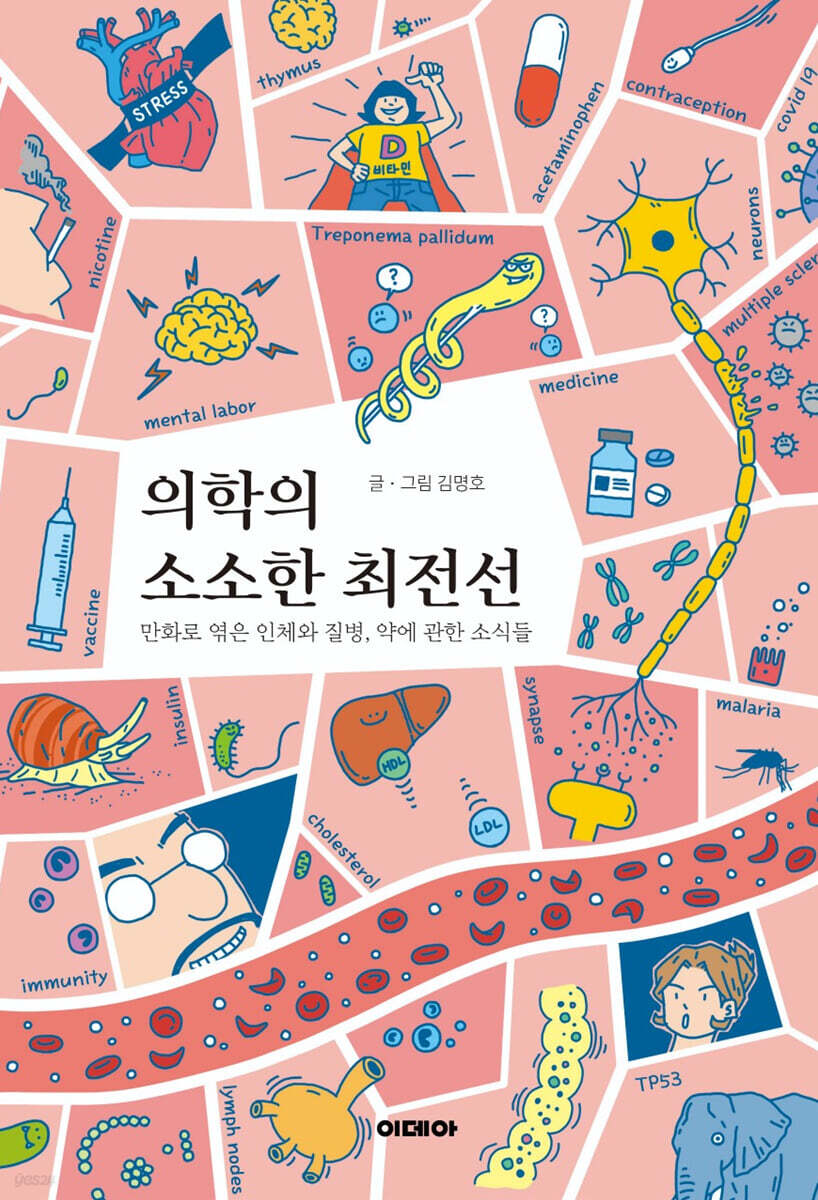
Book Introduction
28 latest medical issues depicted in science comics
Covering a wide range of medical knowledge, from acne, pain, and nicotine addiction to mental health and cancer.
It explains scientific knowledge, history, and human rights awareness related to medicine in an easy and fun way.
"In a world overflowing with bogus medical books written by medical professionals, this book is a blessing in disguise."
Is itching just pain? Why does mental work tire even our bodies? Is the myth of drinking two liters of water a day really true? And every time we turn on the TV, we're told to consume plenty of good cholesterol, but what exactly is good cholesterol? We thought sun exposure was all we needed, but do we need vitamin D as well? These are the small but crucial medical questions we face in our daily lives.
And there are still medical challenges, such as diabetes, aging, and cancer.
Mental and emotional problems such as mental work, broken heart syndrome, depression, and misophonia.
From the Black Death to syphilis, this book explores 28 of the latest medical issues in the form of science comics.
Covering a wide range of medical knowledge, from acne, pain, and nicotine addiction to mental health and cancer.
It explains scientific knowledge, history, and human rights awareness related to medicine in an easy and fun way.
"In a world overflowing with bogus medical books written by medical professionals, this book is a blessing in disguise."
Is itching just pain? Why does mental work tire even our bodies? Is the myth of drinking two liters of water a day really true? And every time we turn on the TV, we're told to consume plenty of good cholesterol, but what exactly is good cholesterol? We thought sun exposure was all we needed, but do we need vitamin D as well? These are the small but crucial medical questions we face in our daily lives.
And there are still medical challenges, such as diabetes, aging, and cancer.
Mental and emotional problems such as mental work, broken heart syndrome, depression, and misophonia.
From the Black Death to syphilis, this book explores 28 of the latest medical issues in the form of science comics.
- You can preview some of the book's contents.
Preview
index
Reviewer's note
Author's Note
01_Insulin: Finding Fast Insulin in Slow-Moving Snails
02_Acne: The Mystery Hidden in the Hair Follicle
03_Mental Labor: Why Does Mental Labor Tire Us?
04_Cancer: The Elephant's Paradox
05_The Black Death: Understanding the Present Through Ancient DNA
06_Nicotine Addiction: Regulating Tobacco
07_Pain: The pain felt by men and women is different.
08_Water Drinking Myth: You should only drink water when you're thirsty.
09_Male Birth Control Pills: Carrying It Together
10_Asian Flush: Alcohol Leaves a Trace on Your Genes
11_Good Cholesterol: Everything in Moderation
12_The Tumor Microbiome: A New Tool for Cancer Treatment
13_Anti-aging Research: Exploring the 21st Century's Elixir of Life
14_Vitamin D: Essential Nutrient or Unnecessary Supplement?
15_Epstein-Barr Virus: A Trouble Hidden in the Immune System
16_The Thymus: Its Importance in Adult Immunity Revealed
17_Itching: Is itching painful?
18_Male Depression: Overshadowed by Gender Bias
19_Sickle Cells: Repairing Natural Selection
20_Broken Heart Syndrome: A Broken Heart
21_Male Infertility: Are Sperm Counts Really Declining?
22_Catheter: Preventing bacterial invasion
23_Long-term COVID: Respiratory Disease Causes Neurological Problems
24_Antidepressants: How Often Do Withdrawal Symptoms Occur?
25_Sodium Channel Blockers: A New Pain Treatment Appears
26_Syphilis: A Tough Bond with Humanity
27_Alzheimer's Disease and the Brain Microbiome: Friend or Intruder?
28_Misophonia: The Sounds of Others Become Emotional Swords
References
Author's Note
01_Insulin: Finding Fast Insulin in Slow-Moving Snails
02_Acne: The Mystery Hidden in the Hair Follicle
03_Mental Labor: Why Does Mental Labor Tire Us?
04_Cancer: The Elephant's Paradox
05_The Black Death: Understanding the Present Through Ancient DNA
06_Nicotine Addiction: Regulating Tobacco
07_Pain: The pain felt by men and women is different.
08_Water Drinking Myth: You should only drink water when you're thirsty.
09_Male Birth Control Pills: Carrying It Together
10_Asian Flush: Alcohol Leaves a Trace on Your Genes
11_Good Cholesterol: Everything in Moderation
12_The Tumor Microbiome: A New Tool for Cancer Treatment
13_Anti-aging Research: Exploring the 21st Century's Elixir of Life
14_Vitamin D: Essential Nutrient or Unnecessary Supplement?
15_Epstein-Barr Virus: A Trouble Hidden in the Immune System
16_The Thymus: Its Importance in Adult Immunity Revealed
17_Itching: Is itching painful?
18_Male Depression: Overshadowed by Gender Bias
19_Sickle Cells: Repairing Natural Selection
20_Broken Heart Syndrome: A Broken Heart
21_Male Infertility: Are Sperm Counts Really Declining?
22_Catheter: Preventing bacterial invasion
23_Long-term COVID: Respiratory Disease Causes Neurological Problems
24_Antidepressants: How Often Do Withdrawal Symptoms Occur?
25_Sodium Channel Blockers: A New Pain Treatment Appears
26_Syphilis: A Tough Bond with Humanity
27_Alzheimer's Disease and the Brain Microbiome: Friend or Intruder?
28_Misophonia: The Sounds of Others Become Emotional Swords
References
Publisher's Review
Fake medical information
Not only TV, but also social media and video platforms are flooded with medical information that is difficult to discern under the guise of “common sense.”
It is now common for certain foods (over-the-counter drugs, health functional foods, etc.) to be promoted and marketed as if they are related to certain diseases or health, based on the authority of famous doctors.
For example, let's look at the case of vitamin D deficiency and supplementation.
Even now, if you search for 'vitamin D' on the Internet, you will find an overwhelming amount of information.
Without exception, there is a flood of information about vitamin D deficiency and its symptoms, the correct dosage of vitamin D for this, and recommended products(?).
Doctors familiar to us through various media outlets also appear, encouraging us as if something bad will happen if we don't take vitamin D supplements now.
Is this really true?
This is well covered in one chapter of the book, 'Vitamin D: Essential Nutrient or Unnecessary Supplement?'
Explains how vitamin D gained popularity as a “modern-day panacea”—not only for preventing rickets, a disease that causes bones to become brittle and deformed, and for bone health, but also for strengthening the immune system and being deeply linked to various chronic diseases such as asthma, diabetes, cancer, and heart disease.
In the United States alone, sales of vitamin D supplements soared more than tenfold, from $50 million in 2005 to a whopping $600 million in 2011.
Medical information has entered the market, and sales in the market have made medical information more reliable.
The Institute of Medicine (IOM), which issued guidelines on vitamin D at the request of the U.S. government in 2010, reviewed existing research and announced the following:
“There is insufficient evidence to support the effectiveness of vitamin D in preventing cancer, cardiovascular disease, diabetes, autoimmune diseases, and other conditions other than bone health,” the book says, adding that this has been confirmed by several recent large-scale clinical trials.
Unless you have a specific reason, such as severe nutritional deficiency or osteoporosis, vitamin D supplements do not provide additional health benefits.
You can get enough vitamin D from daily sunlight exposure and food alone, and even if your levels are low, the impact on your health is minimal.
The book adds, “The lines between belief and science surrounding health are blurred, and establishing causality and correlation is always challenging.”
A science book, not a medical common sense book
As such, this book is not a book of health or medical common sense, such as 'What should you eat in this situation?' or 'This is good for your health.'
As the author says, it is closer to a 'science book' that "aims to help people understand disease, the body, and treatment based on recent medical research results."
Professor Chi-Wook Park (Purdue University, USA), a biochemist who carefully read the manuscript before publication and provided advice, said the following about this book:
“The 28 stories included cover cutting-edge medical information that can be found in renowned scientific journals such as Nature or Science.
Over the years, the cartoonist himself has personally researched, studied, and digested the latest medical papers.
So, this book is full of up-to-date information that even medical students can enjoy learning from.”
Professor Hwang Seung-sik of Seoul National University Graduate School of Public Health also said in his review, “This is not a book that introduces common health knowledge and adds illustrations to it.
This book is closer to a medical textbook in that the author, who is not a medical professional, covers the latest medical research in such depth.
Compared to the reality where there are so many false medical books written by medical professionals on the market, it is a blessing that author Myung-ho Kim's hard work is being published in a book and delivered to the public.
The nearly twenty pages of chapter-by-chapter articles and papers listed in the reference materials at the end of the booklet only show a fraction of the effort the author put into completing each chapter.
“The listed papers and articles are not at a level that even medical school students can read fluently,” he explains.
That doesn't mean you have to assume the book will be difficult.
Like the author's previous work, it focuses on conveying science in an easy and fun way through comics.
“It is composed of easy explanations and clear pictures that even people who have not studied medicine can understand” (Professor Park Chi-wook), and “It selects only the core of the latest medical issues and contains scientific knowledge, history, and even human rights sensitivity, making it easy and fun to read and explain without exaggeration.
“It is an excellent popular medical book that can be confidently handed out to anyone.” (Professor Choi Kyu-jin, Inha University College of Medicine)
Not only TV, but also social media and video platforms are flooded with medical information that is difficult to discern under the guise of “common sense.”
It is now common for certain foods (over-the-counter drugs, health functional foods, etc.) to be promoted and marketed as if they are related to certain diseases or health, based on the authority of famous doctors.
For example, let's look at the case of vitamin D deficiency and supplementation.
Even now, if you search for 'vitamin D' on the Internet, you will find an overwhelming amount of information.
Without exception, there is a flood of information about vitamin D deficiency and its symptoms, the correct dosage of vitamin D for this, and recommended products(?).
Doctors familiar to us through various media outlets also appear, encouraging us as if something bad will happen if we don't take vitamin D supplements now.
Is this really true?
This is well covered in one chapter of the book, 'Vitamin D: Essential Nutrient or Unnecessary Supplement?'
Explains how vitamin D gained popularity as a “modern-day panacea”—not only for preventing rickets, a disease that causes bones to become brittle and deformed, and for bone health, but also for strengthening the immune system and being deeply linked to various chronic diseases such as asthma, diabetes, cancer, and heart disease.
In the United States alone, sales of vitamin D supplements soared more than tenfold, from $50 million in 2005 to a whopping $600 million in 2011.
Medical information has entered the market, and sales in the market have made medical information more reliable.
The Institute of Medicine (IOM), which issued guidelines on vitamin D at the request of the U.S. government in 2010, reviewed existing research and announced the following:
“There is insufficient evidence to support the effectiveness of vitamin D in preventing cancer, cardiovascular disease, diabetes, autoimmune diseases, and other conditions other than bone health,” the book says, adding that this has been confirmed by several recent large-scale clinical trials.
Unless you have a specific reason, such as severe nutritional deficiency or osteoporosis, vitamin D supplements do not provide additional health benefits.
You can get enough vitamin D from daily sunlight exposure and food alone, and even if your levels are low, the impact on your health is minimal.
The book adds, “The lines between belief and science surrounding health are blurred, and establishing causality and correlation is always challenging.”
A science book, not a medical common sense book
As such, this book is not a book of health or medical common sense, such as 'What should you eat in this situation?' or 'This is good for your health.'
As the author says, it is closer to a 'science book' that "aims to help people understand disease, the body, and treatment based on recent medical research results."
Professor Chi-Wook Park (Purdue University, USA), a biochemist who carefully read the manuscript before publication and provided advice, said the following about this book:
“The 28 stories included cover cutting-edge medical information that can be found in renowned scientific journals such as Nature or Science.
Over the years, the cartoonist himself has personally researched, studied, and digested the latest medical papers.
So, this book is full of up-to-date information that even medical students can enjoy learning from.”
Professor Hwang Seung-sik of Seoul National University Graduate School of Public Health also said in his review, “This is not a book that introduces common health knowledge and adds illustrations to it.
This book is closer to a medical textbook in that the author, who is not a medical professional, covers the latest medical research in such depth.
Compared to the reality where there are so many false medical books written by medical professionals on the market, it is a blessing that author Myung-ho Kim's hard work is being published in a book and delivered to the public.
The nearly twenty pages of chapter-by-chapter articles and papers listed in the reference materials at the end of the booklet only show a fraction of the effort the author put into completing each chapter.
“The listed papers and articles are not at a level that even medical school students can read fluently,” he explains.
That doesn't mean you have to assume the book will be difficult.
Like the author's previous work, it focuses on conveying science in an easy and fun way through comics.
“It is composed of easy explanations and clear pictures that even people who have not studied medicine can understand” (Professor Park Chi-wook), and “It selects only the core of the latest medical issues and contains scientific knowledge, history, and even human rights sensitivity, making it easy and fun to read and explain without exaggeration.
“It is an excellent popular medical book that can be confidently handed out to anyone.” (Professor Choi Kyu-jin, Inha University College of Medicine)
GOODS SPECIFICS
- Date of issue: September 8, 2025
- Format: Hardcover book binding method guide
- Page count, weight, size: 400 pages | 870g | 148*210*30mm
- ISBN13: 9791189143541
- ISBN10: 1189143542
You may also like
카테고리
korean


korean

![GQ KOREA Mark (Monthly): December [2025]](http://librairie.coreenne.fr/cdn/shop/files/8ef265dbbfbf186523ed75ba7319009d.jpg?v=1765340328&width=3840)


