

Knot theory
 |
Description
Book Introduction
Complex knots, proven mathematically through pictures!
Knots and loops in pictures solved with mathematical thinking
When we think of 'mathematics', we often think of complex calculations, but the knot theory covered in this book is different.
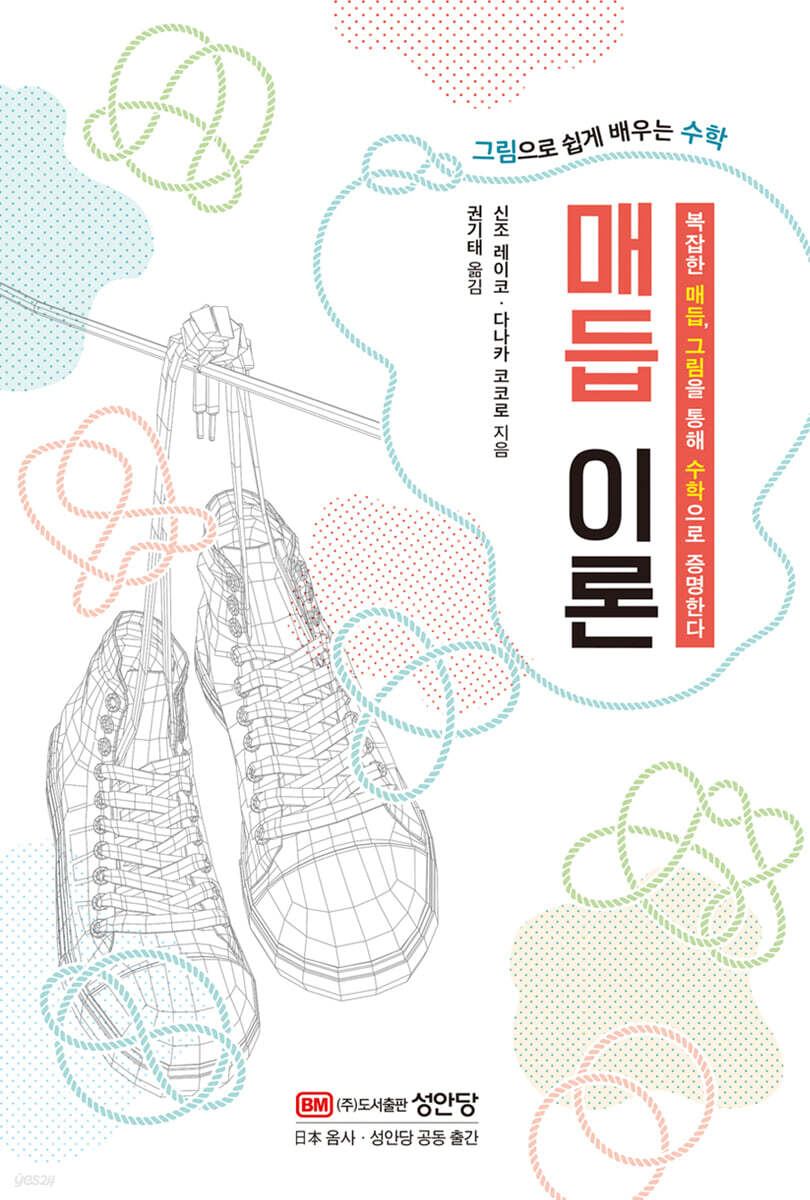
Knot theory is a branch of topology that studies knots and loops mathematically instead of numerically. It is a somewhat unfamiliar but fascinating world that is explored only with pictures, without formulas.
This book is designed to help even beginners in knot theory enjoy tying knots without feeling burdened, by explaining complex knots in an easy-to-understand manner through illustrations.
It is designed to help you understand step-by-step everything from common knots in everyday life to loop invariants, number of turns, and Reidemeister transformations, through rich illustrations, examples, and practice problems.
Additionally, by gradually increasing the difficulty level, as if unraveling a complex tangle of strings, you can learn until the end, so that even specialized content such as the concept of three-colorability, simple ring number, and invariant can be naturally accepted through visual analogies and practice problems.
An experience of seeing mathematics through knots and thinking about mathematics through pictures.
With this book, you will rediscover that mathematics is more than just a domain of simple calculations; it is a world of creative and intuitive thinking.
Knots and loops in pictures solved with mathematical thinking
When we think of 'mathematics', we often think of complex calculations, but the knot theory covered in this book is different.
Knot theory is a branch of topology that studies knots and loops mathematically instead of numerically. It is a somewhat unfamiliar but fascinating world that is explored only with pictures, without formulas.
This book is designed to help even beginners in knot theory enjoy tying knots without feeling burdened, by explaining complex knots in an easy-to-understand manner through illustrations.
It is designed to help you understand step-by-step everything from common knots in everyday life to loop invariants, number of turns, and Reidemeister transformations, through rich illustrations, examples, and practice problems.
Additionally, by gradually increasing the difficulty level, as if unraveling a complex tangle of strings, you can learn until the end, so that even specialized content such as the concept of three-colorability, simple ring number, and invariant can be naturally accepted through visual analogies and practice problems.
An experience of seeing mathematics through knots and thinking about mathematics through pictures.
With this book, you will rediscover that mathematics is more than just a domain of simple calculations; it is a world of creative and intuitive thinking.
index
preface
Chapter 1: Knots
1. Knots in everyday life
2 What does it mean to be tied up?
3 Explaining the knotting method
Chapter 2: What with Knot Theory?
1 Knots and Loops
2 Same knot · Different knot
To examine Chapter 3, the rings
1 Let's draw a ring on paper.
2 Ring Diagram - Reduced Diagram
3 Goals of Knot Theory
Chapter 4 Various Links
1. Knots obtained from knots in everyday life
- Shackle knot / Knot knot / Figure-of-eight knot / Dockside knot / Wing knot / Square knot / Surgeon's knot / Granny knot / Solomon's knot / Borromeo ring
2. Rings with mathematical meaning
- Ring series / detachable ring / mirrored ring / synthetic knot / prime knot
Chapter 5 Graphs and Knots
1 Planar graph
2 Euler's Formula - Extended Proof of Euler's Formula
3 Knot diagram and plane graph
Chapter 6: Transforming the Drawn Ring I
1 Same diagram · Different diagram
- What does 'same' mean? / 'Same' plane figures
2 Isotopic transformations of planes - What are the same figures?
3 Isotope transformations of the ring diagram
4 Another diagram showing the same ring
- Self-explanatory diagram / alternating knot
Chapter 7: Let's Make a Ring Table
1. Ring complexity criteria
2 To list the knots
- Minimum number of intersections of a knot / To determine the minimum number of intersections / Which knot is obtained from a diagram with 1 or 2 intersections?
3 Shift diagram and minimum number of intersections
4. Creating a knot table
Chapter 8: Transforming the Drawn Ring II
Diagram of the same ring that does not move with isotopic deformation in the 1st plane
2 What is the Reidemeister Variant?
Let's try using the 3rd Ridemeister variant
- Diagram that only allows for the Ridemeister transformation that increases the number of intersections
Chapter 9: Fingerprints of the Ring
1 What is an invariant?
- Invariants of people / Invariants of plane figures
2 Invariants of rings and diagrams
- Invariants of rings / Invariants of ring diagrams
Chapter 10: Is that link really entangled?
1 What is a simple ring?
2. Let's find the simple ring number
3 Examples of calculations and what they teach us
Chapter 11: Is the Knot Really Tied?
1 What are the three color possibilities of a ring?
- 3-coloring of the ring diagram
2 3 Let's find out if coloring is possible
- 3-colorability of the Hope Loop / 3-colorability of the figure-eight knot / Practice problems on 3-colorability
3 What can be known from the results of the judgment on whether coloring is possible?
Chapter 12 Proof of Invariance
1 Proof of the invariance of simple ring numbers
- Isotopic transformation of the plane / Reidemeister transformation I / Reidemeister transformation II / Reidemeister transformation III
2 Proof of the invariance of the three-colorability
- Isotopic transformation of the plane / Reidemeister transformation I / Reidemeister transformation II / Reidemeister transformation III
Chapter 13: Untie the Chain
1 Cross exchange and unknotting number
2-Ring Anomaly - Cross Exchange and Simple Ring Anomaly
Appendix / Table of Knots and Loops
Search
Chapter 1: Knots
1. Knots in everyday life
2 What does it mean to be tied up?
3 Explaining the knotting method
Chapter 2: What with Knot Theory?
1 Knots and Loops
2 Same knot · Different knot
To examine Chapter 3, the rings
1 Let's draw a ring on paper.
2 Ring Diagram - Reduced Diagram
3 Goals of Knot Theory
Chapter 4 Various Links
1. Knots obtained from knots in everyday life
- Shackle knot / Knot knot / Figure-of-eight knot / Dockside knot / Wing knot / Square knot / Surgeon's knot / Granny knot / Solomon's knot / Borromeo ring
2. Rings with mathematical meaning
- Ring series / detachable ring / mirrored ring / synthetic knot / prime knot
Chapter 5 Graphs and Knots
1 Planar graph
2 Euler's Formula - Extended Proof of Euler's Formula
3 Knot diagram and plane graph
Chapter 6: Transforming the Drawn Ring I
1 Same diagram · Different diagram
- What does 'same' mean? / 'Same' plane figures
2 Isotopic transformations of planes - What are the same figures?
3 Isotope transformations of the ring diagram
4 Another diagram showing the same ring
- Self-explanatory diagram / alternating knot
Chapter 7: Let's Make a Ring Table
1. Ring complexity criteria
2 To list the knots
- Minimum number of intersections of a knot / To determine the minimum number of intersections / Which knot is obtained from a diagram with 1 or 2 intersections?
3 Shift diagram and minimum number of intersections
4. Creating a knot table
Chapter 8: Transforming the Drawn Ring II
Diagram of the same ring that does not move with isotopic deformation in the 1st plane
2 What is the Reidemeister Variant?
Let's try using the 3rd Ridemeister variant
- Diagram that only allows for the Ridemeister transformation that increases the number of intersections
Chapter 9: Fingerprints of the Ring
1 What is an invariant?
- Invariants of people / Invariants of plane figures
2 Invariants of rings and diagrams
- Invariants of rings / Invariants of ring diagrams
Chapter 10: Is that link really entangled?
1 What is a simple ring?
2. Let's find the simple ring number
3 Examples of calculations and what they teach us
Chapter 11: Is the Knot Really Tied?
1 What are the three color possibilities of a ring?
- 3-coloring of the ring diagram
2 3 Let's find out if coloring is possible
- 3-colorability of the Hope Loop / 3-colorability of the figure-eight knot / Practice problems on 3-colorability
3 What can be known from the results of the judgment on whether coloring is possible?
Chapter 12 Proof of Invariance
1 Proof of the invariance of simple ring numbers
- Isotopic transformation of the plane / Reidemeister transformation I / Reidemeister transformation II / Reidemeister transformation III
2 Proof of the invariance of the three-colorability
- Isotopic transformation of the plane / Reidemeister transformation I / Reidemeister transformation II / Reidemeister transformation III
Chapter 13: Untie the Chain
1 Cross exchange and unknotting number
2-Ring Anomaly - Cross Exchange and Simple Ring Anomaly
Appendix / Table of Knots and Loops
Search
Detailed image

GOODS SPECIFICS
- Date of issue: September 10, 2025
- Page count, weight, size: 272 pages | 152*225*20mm
- ISBN13: 9788931585940
- ISBN10: 8931585942
You may also like
카테고리
korean


korean

![ELLE 엘르 스페셜 에디션 A형 : 12월 [2025]](http://librairie.coreenne.fr/cdn/shop/files/b8e27a3de6c9538896439686c6b0e8fb.jpg?v=1766436872&width=3840)


