

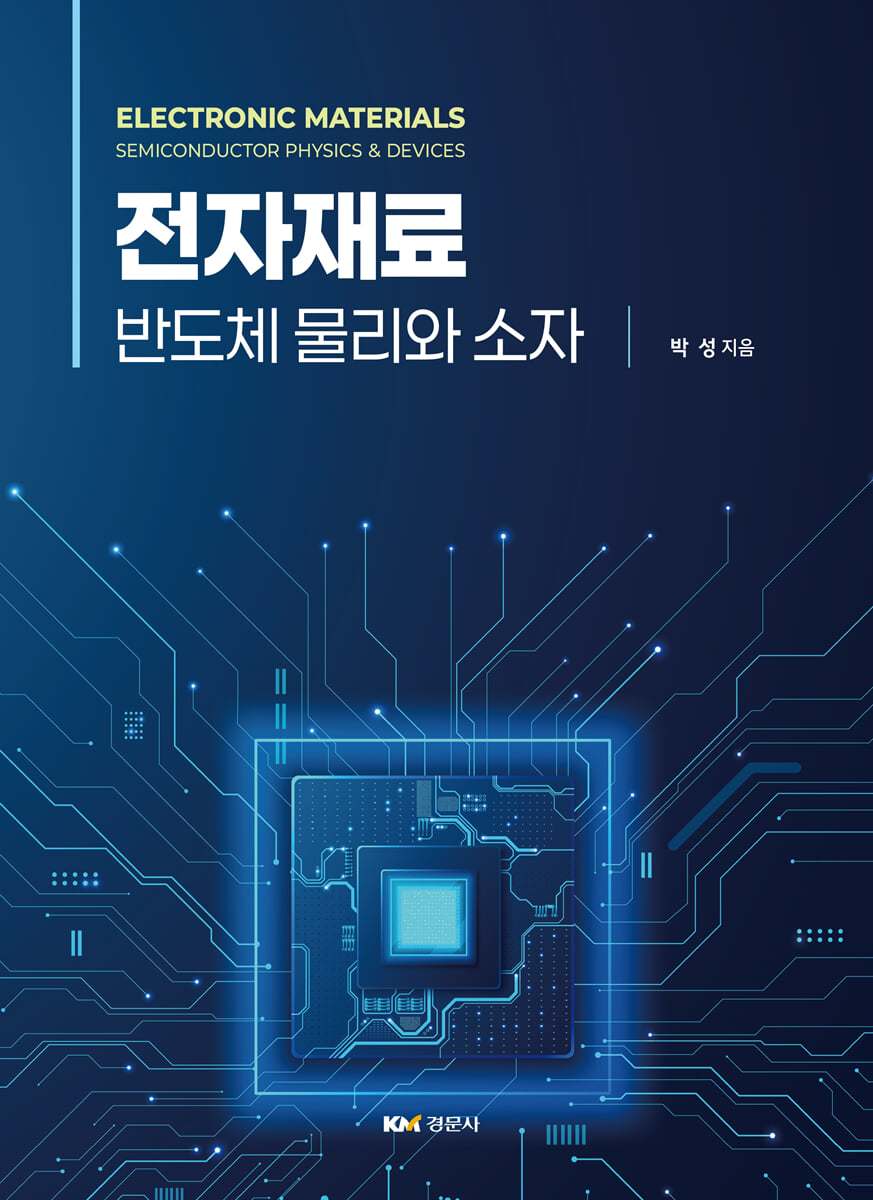
electronic materials
 |
Description
Book Introduction
The author has been teaching courses such as 'Electronic Materials' and 'Special Topics in Electronic Materials Engineering' at a university for over 32 years, and wrote this book based on his research experience in 'Development of New Optoelectronic Devices and Their Applications.'
This book was written with the aim of providing practical assistance to undergraduate and graduate students interested in electronic materials by providing easy and systematic physical knowledge of semiconductor materials and devices.
This book was written with the aim of providing practical assistance to undergraduate and graduate students interested in electronic materials by providing easy and systematic physical knowledge of semiconductor materials and devices.
- You can preview some of the book's contents.
Preview
index
CHAPTER 1 Introduction
1.1 What are electronic materials?
1.2 How to measure electrical resistance and the scientific elements that make up electrical resistance
ㆍPractice problems
CHAPTER 2 Crystal Structure of Solids
2.1 Introduction
2.2 Semiconductor Materials
2.3 Scientifically Understanding Semiconductor Properties through the Properties of a Single Atom (Atomic Structure)
2.4 Scientifically Understanding the Properties of Electronic Materials through Atomic Bonding
2.5 Understanding the properties of electronic materials scientifically using the unit concept
2.6 Crystal planes and crystal directions
Practice Problems /60
CHAPTER 3 Defects and Impurities in Semiconductor Materials
3.1 Types of defects that can occur in semiconductor materials
3.2 Point defects in semiconductor materials
3.3 Dislocations as one-dimensional defects
3.4 Boundary defects in semiconductor materials
3.5 Manufacturing of high-purity semiconductor materials and growth of semiconductor materials
ㆍPractice problems
CHAPTER 4: Introduction to Quantum Mechanics for Semiconductor Materials
4.1 Electrical conduction phenomena in semiconductor materials
4.2 Scientific understanding of the valence states that can be present in an atom depending on external conditions and the energy band model structure using these states.
4.3 Allowed and Forbidden Energy Bands
ㆍPractice problems
CHAPTER 5: The Infinite Potential Well Model and the Newly Designed Carrier Concentration
5.1 Electrical Conductivity
5.2 Finding the number of carriers that move directly in a solid: Infinite potential well model
5.3 Newly designed carrier concentration
ㆍPractice problems
CHAPTER 6 The Effect of Carrier Concentration on Electronic Properties of Semiconductors in Thermal Equilibrium
6.1 Introduction
6.2 Charge carriers in semiconductors
6.3 Intrinsic semiconductors
6.4 Dopant atoms and energy levels in foreign semiconductors
6.5 Carrier distribution in foreign semiconductors
6.6 The law of mass action in foreign semiconductors
6.7 Relationship between carrier concentration and permium level in foreign semiconductors
6.8 Finding the temperature range in which a semiconductor operates normally by examining the change in carrier concentration with temperature in a foreign semiconductor.
6.9 Classification of semiconductors by doping amount in foreign semiconductors
6.10 Charge Neutral
ㆍPractice problems
CHAPTER 7 The Effect of Semiconductor Mobility Values on Semiconductor Electronic Properties
7.1 Introduction
7.2 Carrier Drift
7.3 Mobility Effect
7.4 Proliferation of carriers
7.5 Total current density flowing in semiconductor materials
7.6 Slope impurity distribution
7.7 Hall effect
ㆍPractice problems
CHAPTER 8 Excess (excess) carriers generated in semiconductors in non-equilibrium state
8.1 Introduction
8.2 Generation, recombination, and carrier injection
8.3 Recombination mechanism
8.4 Temporary Reunion Response
8.5 Quasi-Permian Level or Semi-Permian Level
ㆍPractice problems
CHAPTER 9 Bonding
9.1 Introduction
9.2 Electrical properties of junctions
9.3 Properties of various joints
9.4 Other pn junction semiconductor devices
ㆍPractice problems
1.1 What are electronic materials?
1.2 How to measure electrical resistance and the scientific elements that make up electrical resistance
ㆍPractice problems
CHAPTER 2 Crystal Structure of Solids
2.1 Introduction
2.2 Semiconductor Materials
2.3 Scientifically Understanding Semiconductor Properties through the Properties of a Single Atom (Atomic Structure)
2.4 Scientifically Understanding the Properties of Electronic Materials through Atomic Bonding
2.5 Understanding the properties of electronic materials scientifically using the unit concept
2.6 Crystal planes and crystal directions
Practice Problems /60
CHAPTER 3 Defects and Impurities in Semiconductor Materials
3.1 Types of defects that can occur in semiconductor materials
3.2 Point defects in semiconductor materials
3.3 Dislocations as one-dimensional defects
3.4 Boundary defects in semiconductor materials
3.5 Manufacturing of high-purity semiconductor materials and growth of semiconductor materials
ㆍPractice problems
CHAPTER 4: Introduction to Quantum Mechanics for Semiconductor Materials
4.1 Electrical conduction phenomena in semiconductor materials
4.2 Scientific understanding of the valence states that can be present in an atom depending on external conditions and the energy band model structure using these states.
4.3 Allowed and Forbidden Energy Bands
ㆍPractice problems
CHAPTER 5: The Infinite Potential Well Model and the Newly Designed Carrier Concentration
5.1 Electrical Conductivity
5.2 Finding the number of carriers that move directly in a solid: Infinite potential well model
5.3 Newly designed carrier concentration
ㆍPractice problems
CHAPTER 6 The Effect of Carrier Concentration on Electronic Properties of Semiconductors in Thermal Equilibrium
6.1 Introduction
6.2 Charge carriers in semiconductors
6.3 Intrinsic semiconductors
6.4 Dopant atoms and energy levels in foreign semiconductors
6.5 Carrier distribution in foreign semiconductors
6.6 The law of mass action in foreign semiconductors
6.7 Relationship between carrier concentration and permium level in foreign semiconductors
6.8 Finding the temperature range in which a semiconductor operates normally by examining the change in carrier concentration with temperature in a foreign semiconductor.
6.9 Classification of semiconductors by doping amount in foreign semiconductors
6.10 Charge Neutral
ㆍPractice problems
CHAPTER 7 The Effect of Semiconductor Mobility Values on Semiconductor Electronic Properties
7.1 Introduction
7.2 Carrier Drift
7.3 Mobility Effect
7.4 Proliferation of carriers
7.5 Total current density flowing in semiconductor materials
7.6 Slope impurity distribution
7.7 Hall effect
ㆍPractice problems
CHAPTER 8 Excess (excess) carriers generated in semiconductors in non-equilibrium state
8.1 Introduction
8.2 Generation, recombination, and carrier injection
8.3 Recombination mechanism
8.4 Temporary Reunion Response
8.5 Quasi-Permian Level or Semi-Permian Level
ㆍPractice problems
CHAPTER 9 Bonding
9.1 Introduction
9.2 Electrical properties of junctions
9.3 Properties of various joints
9.4 Other pn junction semiconductor devices
ㆍPractice problems
Publisher's Review
How to use this book
In particular, in terms of content, it is largely divided into three parts.
The first part, Chapter 1, covers a general overview of electronic materials, including their definition and classification. The second part, Chapters 2 through 8, covers semiconductor physics, which scientifically understands the properties of semiconductors. The last third part, Chapter 9, focuses on scientifically understanding the operating principles of semiconductor devices through the structure of junctions and their electrical characteristics.
A brief overview of the contents of each chapter is as follows.
First, Chapter 1, 'Overview', covers the basic concepts of current, voltage, and resistance along with the definition of electronic materials, and learns how electronic materials are classified through the concept of electrical conductivity (or electrical resistivity).
Second, Chapter 2 will begin with the definition and types of semiconductors and examine the scientific reasons why semiconductors cannot help but have electrical conductivity (or electrical resistivity) values between those of conductors and insulators.
To this end, we analyzed the atomic structure of solids, atomic bonds, and three-dimensional microscopic regions called unit cells within the material, and scientifically explained in which cases a material inevitably exhibits semiconductor properties.
Third, in Chapter 3, you will learn about defects and impurities that can exist in semiconductor materials. In particular, you will study how pn junction diodes are made using planar technology that utilizes point defects, how the widely used exotic semiconductors were created by adding impurities to intrinsic semiconductors, and you will also learn about undesirable one-dimensional and two-dimensional defects that exist in semiconductor devices.
Fourth, in Chapter 4, we will introduce two models that explain the properties of semiconductors: the valence electron bond model and the energy band model. Among them, we will study how the concepts of bands and band gaps are born through quantum mechanical theory when free electrons in a solid move in a wave motion in the energy band model.
Fifth, from Chapters 5 to 7, we will scientifically analyze and understand the properties of semiconductors, focusing on the concept of electrical conductivity.
?In Chapter 5, we learn that the carrier concentration can be obtained as the product of the density of states and the Fermi-Dirac distribution function.
Chapter 6 examines the influence of the carrier concentration obtained in this way on the semiconductor properties, and furthermore, the expression method of carrier concentration in intrinsic and extrinsic semiconductors and the location of the perm energy.
In Chapter 7, we will also learn how the concept of mobility affects the electrical properties of semiconductors.
Sixth, in Chapter 8, we will study the generation and recombination of excess carriers in a non-equilibrium semiconductor, the injection process, the recombination mechanism, and the mechanism that affects the lifetime of the semiconductor.
Seventh, Chapter 9 will provide a scientific understanding of the operating principles of semiconductor devices through the electrical characteristics of junctions.
Since most semiconductor devices are composed of junctions between different materials, you will learn scientifically and systematically how various junctions change the energy band diagram, starting from the initial metal-metal junction characteristics to the characteristics of pn junction diodes, and how these changes affect the operation of the device.
In particular, in terms of content, it is largely divided into three parts.
The first part, Chapter 1, covers a general overview of electronic materials, including their definition and classification. The second part, Chapters 2 through 8, covers semiconductor physics, which scientifically understands the properties of semiconductors. The last third part, Chapter 9, focuses on scientifically understanding the operating principles of semiconductor devices through the structure of junctions and their electrical characteristics.
A brief overview of the contents of each chapter is as follows.
First, Chapter 1, 'Overview', covers the basic concepts of current, voltage, and resistance along with the definition of electronic materials, and learns how electronic materials are classified through the concept of electrical conductivity (or electrical resistivity).
Second, Chapter 2 will begin with the definition and types of semiconductors and examine the scientific reasons why semiconductors cannot help but have electrical conductivity (or electrical resistivity) values between those of conductors and insulators.
To this end, we analyzed the atomic structure of solids, atomic bonds, and three-dimensional microscopic regions called unit cells within the material, and scientifically explained in which cases a material inevitably exhibits semiconductor properties.
Third, in Chapter 3, you will learn about defects and impurities that can exist in semiconductor materials. In particular, you will study how pn junction diodes are made using planar technology that utilizes point defects, how the widely used exotic semiconductors were created by adding impurities to intrinsic semiconductors, and you will also learn about undesirable one-dimensional and two-dimensional defects that exist in semiconductor devices.
Fourth, in Chapter 4, we will introduce two models that explain the properties of semiconductors: the valence electron bond model and the energy band model. Among them, we will study how the concepts of bands and band gaps are born through quantum mechanical theory when free electrons in a solid move in a wave motion in the energy band model.
Fifth, from Chapters 5 to 7, we will scientifically analyze and understand the properties of semiconductors, focusing on the concept of electrical conductivity.
?In Chapter 5, we learn that the carrier concentration can be obtained as the product of the density of states and the Fermi-Dirac distribution function.
Chapter 6 examines the influence of the carrier concentration obtained in this way on the semiconductor properties, and furthermore, the expression method of carrier concentration in intrinsic and extrinsic semiconductors and the location of the perm energy.
In Chapter 7, we will also learn how the concept of mobility affects the electrical properties of semiconductors.
Sixth, in Chapter 8, we will study the generation and recombination of excess carriers in a non-equilibrium semiconductor, the injection process, the recombination mechanism, and the mechanism that affects the lifetime of the semiconductor.
Seventh, Chapter 9 will provide a scientific understanding of the operating principles of semiconductor devices through the electrical characteristics of junctions.
Since most semiconductor devices are composed of junctions between different materials, you will learn scientifically and systematically how various junctions change the energy band diagram, starting from the initial metal-metal junction characteristics to the characteristics of pn junction diodes, and how these changes affect the operation of the device.
GOODS SPECIFICS
- Date of issue: August 18, 2025
- Page count, weight, size: 380 pages | 153*225*30mm
- ISBN13: 9791160737936
- ISBN10: 1160737932
You may also like
카테고리
korean


korean

![GQ KOREA Mark (Monthly): December [2025]](http://librairie.coreenne.fr/cdn/shop/files/8ef265dbbfbf186523ed75ba7319009d.jpg?v=1765340328&width=3840)


