

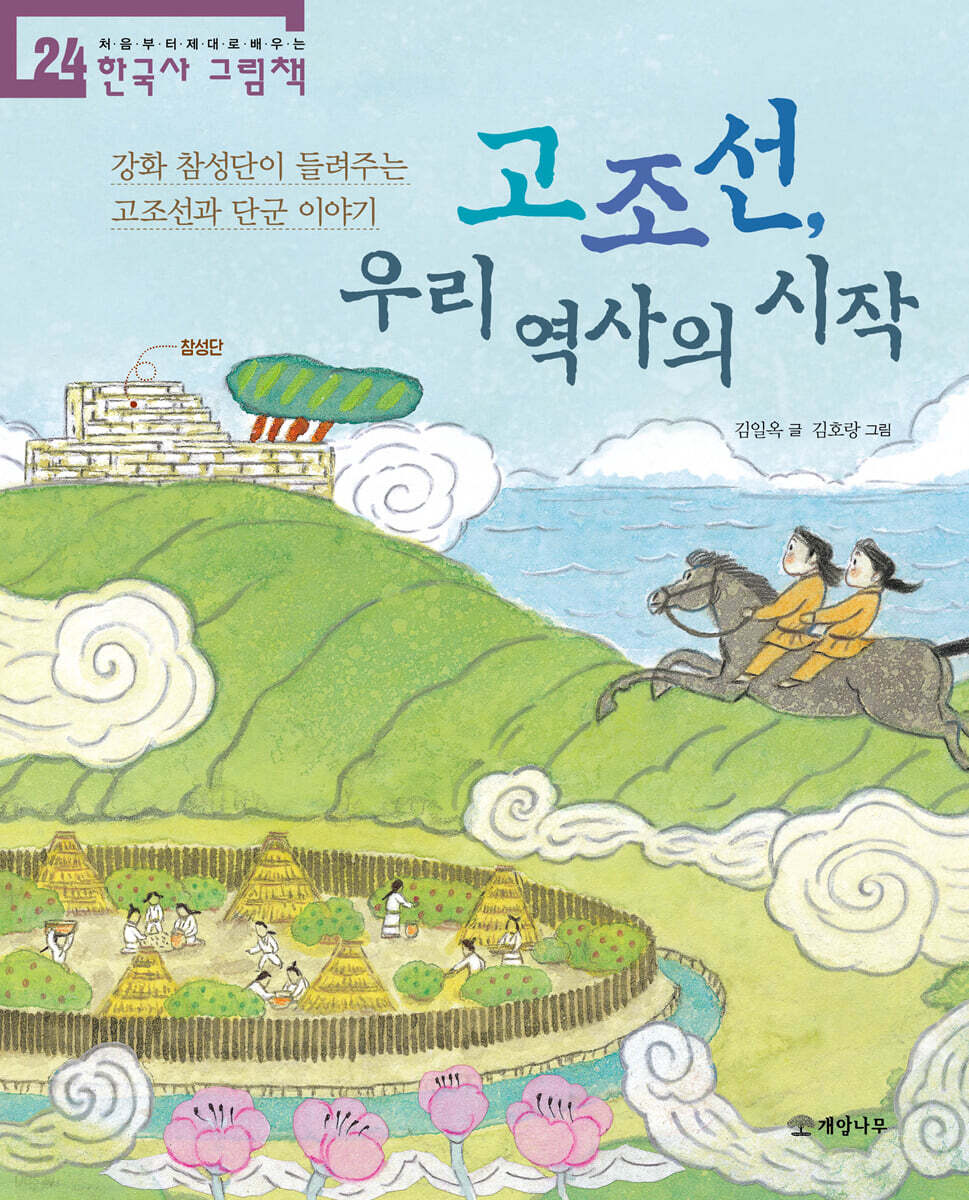
Gojoseon, the beginning of our history
 |
Description
Book Introduction
Ganghwa Chamseongdan, located at the crossroads of the Korean Peninsula,
Talking about the history of our people!
"Gojoseon, the Beginning of Our History" tells the story of Gojoseon and Dangun Wanggeom, the first nation on the Korean Peninsula and a kingdom that existed during the transition from the Bronze Age to the Iron Age.
In addition, through the founding myth of Gojoseon, the meaning and value of the founding myth are conveyed in depth.
Ganghwa Island is the gateway to the Korean Peninsula.
It served as a place to protect the country and a refuge when the country was in crisis.
During the Goryeo Dynasty, it was invaded by the Mongols, and during the Japanese invasions and the Manchu invasions of the Joseon Dynasty, it was also an important military stronghold.
Ganghwa Island was also a stronghold during the French invasion of Byeong-in Yangyo and the American invasion of Shinmi Yangyo.
Ganghwa Island is not just a simple military stronghold.
Looking at the dolmens scattered throughout Ganghwa Island, we can see that Ganghwa Island has been a major residential area for people since the Bronze Age.
In that Ganghwa Island, there is Samrangseong Fortress, which was built by Ganghwa Chamseongdan and his three sons.
"Gojoseon, the Beginning of Our History" begins with Ganghwa Chamseongdan telling the story of Bau and Gangdol, fictional characters who lived during the Gojoseon era.
Through the story of two children of similar age but different social status, it shows the social system and lifestyle of Gojoseon, which had a system of laws and class, and engaged in intermediary trade.
Furthermore, you can even get a glimpse of the characteristics of the Bronze Age and the Iron Age.
The founding myth is an important source of information about a country's culture, customs, and history.
This book naturally tells the founding myth of Gojoseon through the story of Bau and Gangdol.
Kangdol tells Bau that Hwanung is the god of clouds in the sky.
There is a story about a bear and a tiger who came down with Hwanung, who controls the wind, and a tiger who controls the rain, who wanted to become humans, and who ate mugwort and garlic in a cave.
And it explains the hidden meaning of this story.
In this process, children naturally learn the importance of the founding myth and the meaning contained within it.
Additionally, you can learn what role Dangun Wanggeom played in Gojoseon.
Talking about the history of our people!
"Gojoseon, the Beginning of Our History" tells the story of Gojoseon and Dangun Wanggeom, the first nation on the Korean Peninsula and a kingdom that existed during the transition from the Bronze Age to the Iron Age.
In addition, through the founding myth of Gojoseon, the meaning and value of the founding myth are conveyed in depth.
Ganghwa Island is the gateway to the Korean Peninsula.
It served as a place to protect the country and a refuge when the country was in crisis.
During the Goryeo Dynasty, it was invaded by the Mongols, and during the Japanese invasions and the Manchu invasions of the Joseon Dynasty, it was also an important military stronghold.
Ganghwa Island was also a stronghold during the French invasion of Byeong-in Yangyo and the American invasion of Shinmi Yangyo.
Ganghwa Island is not just a simple military stronghold.
Looking at the dolmens scattered throughout Ganghwa Island, we can see that Ganghwa Island has been a major residential area for people since the Bronze Age.
In that Ganghwa Island, there is Samrangseong Fortress, which was built by Ganghwa Chamseongdan and his three sons.
"Gojoseon, the Beginning of Our History" begins with Ganghwa Chamseongdan telling the story of Bau and Gangdol, fictional characters who lived during the Gojoseon era.
Through the story of two children of similar age but different social status, it shows the social system and lifestyle of Gojoseon, which had a system of laws and class, and engaged in intermediary trade.
Furthermore, you can even get a glimpse of the characteristics of the Bronze Age and the Iron Age.
The founding myth is an important source of information about a country's culture, customs, and history.
This book naturally tells the founding myth of Gojoseon through the story of Bau and Gangdol.
Kangdol tells Bau that Hwanung is the god of clouds in the sky.
There is a story about a bear and a tiger who came down with Hwanung, who controls the wind, and a tiger who controls the rain, who wanted to become humans, and who ate mugwort and garlic in a cave.
And it explains the hidden meaning of this story.
In this process, children naturally learn the importance of the founding myth and the meaning contained within it.
Additionally, you can learn what role Dangun Wanggeom played in Gojoseon.
- You can preview some of the book's contents.
Preview
Detailed image

Publisher's Review
Curriculum linkage
2nd grade, 1st semester, Korean language-B8.
I can guess your feelings
3rd grade, 2nd semester, Korean language-B6.
The heart contained in the writing
4th grade, 1st semester Korean language-A 1.
Into the story
5th grade, 1st semester Korean language-A 1.
The character's words and actions
3rd year, 2nd semester, Social Studies 3.
Changing family appearance and roles
5th grade, 2nd semester, Social Studies 1.
Life and culture of the old people
Ganghwa Chamseongdan, located at the crossroads of the Korean Peninsula,
Talking about the history of our people!
《The Beginning of Our History, Gojoseon》 tells the story of Gojoseon and Dangun Wanggeom, the first nation on the Korean Peninsula and a kingdom that existed during the transition from the Bronze Age to the Iron Age.
In addition, through the founding myth of Gojoseon, the meaning and value of the founding myth are conveyed in depth.
Ganghwa Island is the gateway to the Korean Peninsula.
It served as a place to protect the country and a refuge when the country was in crisis.
During the Goryeo Dynasty, it was invaded by the Mongols, and during the Japanese invasions and the Manchu invasions of the Joseon Dynasty, it was also an important military stronghold.
Ganghwa Island was also a stronghold during the French invasion of Byeong-in Yangyo and the American invasion of Shinmi Yangyo.
Ganghwa Island is not just a simple military stronghold.
Looking at the dolmens scattered throughout Ganghwa Island, we can see that Ganghwa Island has been a major residential area for people since the Bronze Age.
In that Ganghwa Island, there is Samrangseong Fortress, which was built by Ganghwa Chamseongdan and his three sons.
《Gojoseon, the Beginning of Our History》 begins with Ganghwa Chamseongdan telling the story of Bau and Gangdol, fictional characters who lived during the Gojoseon era.
Through the story of two children of similar age but different social status, it shows the social system and lifestyle of Gojoseon, which had a system of laws and class, and engaged in intermediary trade.
Furthermore, you can even get a glimpse of the characteristics of the Bronze Age and the Iron Age.
The founding myth is an important source of information about a country's culture, customs, and history.
This book naturally tells the founding myth of Gojoseon through the story of Bau and Gangdol.
Kangdol tells Bau that Hwanung is the god of clouds in the sky.
There is a story about a bear and a tiger who came down with Hwanung, who controls the wind, and a tiger who controls the rain, who wanted to become humans, and who ate mugwort and garlic in a cave.
And it explains the hidden meaning of this story.
In this process, children naturally learn the importance of the founding myth and the meaning contained within it.
Additionally, you can learn what role Dangun Wanggeom played in Gojoseon.
Gojoseon, which was in a transitional period between the Bronze Age and the Iron Age, experienced frequent wars.
Bau and Kangdol discover a Han spy disguised as a merchant and prepare for an invasion.
In recognition of his achievements, he also participates in the Jecheon ceremony held at Ganghwa Chamseongdan.
The latter part of the book explains the confederation states of the Iron Age that led the Iron Age after Gojoseon, and details the flow of our history and how they developed later.
Advances in various technologies, including Chat GPT, are changing the daily lives of not only adults but also children.
Author Kim Il-ok, who wrote this book, says that the emergence of AI could be a turning point in history.
They say that we can learn how to live in an era of rapid change from the Bronze Age to the Iron Age through history, which marked a major turning point.
I hope this book will provide children with an opportunity to think about how to best navigate this era of change.
Also, I hope that you will guide us to think about the roots of our nation through our primordial history and to develop pride in ourselves.
◆ A picture book that teaches Korean history properly from the beginning
This series is designed to help children who are encountering our history for the first time learn about it and take an interest in it.
By carefully following the stories told by our historical symbols, such as relics and ruins, we can understand the major flow of history from the past to the present.
2nd grade, 1st semester, Korean language-B8.
I can guess your feelings
3rd grade, 2nd semester, Korean language-B6.
The heart contained in the writing
4th grade, 1st semester Korean language-A 1.
Into the story
5th grade, 1st semester Korean language-A 1.
The character's words and actions
3rd year, 2nd semester, Social Studies 3.
Changing family appearance and roles
5th grade, 2nd semester, Social Studies 1.
Life and culture of the old people
Ganghwa Chamseongdan, located at the crossroads of the Korean Peninsula,
Talking about the history of our people!
《The Beginning of Our History, Gojoseon》 tells the story of Gojoseon and Dangun Wanggeom, the first nation on the Korean Peninsula and a kingdom that existed during the transition from the Bronze Age to the Iron Age.
In addition, through the founding myth of Gojoseon, the meaning and value of the founding myth are conveyed in depth.
Ganghwa Island is the gateway to the Korean Peninsula.
It served as a place to protect the country and a refuge when the country was in crisis.
During the Goryeo Dynasty, it was invaded by the Mongols, and during the Japanese invasions and the Manchu invasions of the Joseon Dynasty, it was also an important military stronghold.
Ganghwa Island was also a stronghold during the French invasion of Byeong-in Yangyo and the American invasion of Shinmi Yangyo.
Ganghwa Island is not just a simple military stronghold.
Looking at the dolmens scattered throughout Ganghwa Island, we can see that Ganghwa Island has been a major residential area for people since the Bronze Age.
In that Ganghwa Island, there is Samrangseong Fortress, which was built by Ganghwa Chamseongdan and his three sons.
《Gojoseon, the Beginning of Our History》 begins with Ganghwa Chamseongdan telling the story of Bau and Gangdol, fictional characters who lived during the Gojoseon era.
Through the story of two children of similar age but different social status, it shows the social system and lifestyle of Gojoseon, which had a system of laws and class, and engaged in intermediary trade.
Furthermore, you can even get a glimpse of the characteristics of the Bronze Age and the Iron Age.
The founding myth is an important source of information about a country's culture, customs, and history.
This book naturally tells the founding myth of Gojoseon through the story of Bau and Gangdol.
Kangdol tells Bau that Hwanung is the god of clouds in the sky.
There is a story about a bear and a tiger who came down with Hwanung, who controls the wind, and a tiger who controls the rain, who wanted to become humans, and who ate mugwort and garlic in a cave.
And it explains the hidden meaning of this story.
In this process, children naturally learn the importance of the founding myth and the meaning contained within it.
Additionally, you can learn what role Dangun Wanggeom played in Gojoseon.
Gojoseon, which was in a transitional period between the Bronze Age and the Iron Age, experienced frequent wars.
Bau and Kangdol discover a Han spy disguised as a merchant and prepare for an invasion.
In recognition of his achievements, he also participates in the Jecheon ceremony held at Ganghwa Chamseongdan.
The latter part of the book explains the confederation states of the Iron Age that led the Iron Age after Gojoseon, and details the flow of our history and how they developed later.
Advances in various technologies, including Chat GPT, are changing the daily lives of not only adults but also children.
Author Kim Il-ok, who wrote this book, says that the emergence of AI could be a turning point in history.
They say that we can learn how to live in an era of rapid change from the Bronze Age to the Iron Age through history, which marked a major turning point.
I hope this book will provide children with an opportunity to think about how to best navigate this era of change.
Also, I hope that you will guide us to think about the roots of our nation through our primordial history and to develop pride in ourselves.
◆ A picture book that teaches Korean history properly from the beginning
This series is designed to help children who are encountering our history for the first time learn about it and take an interest in it.
By carefully following the stories told by our historical symbols, such as relics and ruins, we can understand the major flow of history from the past to the present.
GOODS SPECIFICS
- Date of issue: July 9, 2024
- Page count, weight, size: 96 pages | 380g | 210*260*7mm
- ISBN13: 9788968308239
- ISBN10: 8968308233
- KC Certification: Certification Type: Conformity Confirmation
You may also like
카테고리
korean


korean

![GQ KOREA Mark (Monthly): December [2025]](http://librairie.coreenne.fr/cdn/shop/files/8ef265dbbfbf186523ed75ba7319009d.jpg?v=1765340328&width=3840)


