

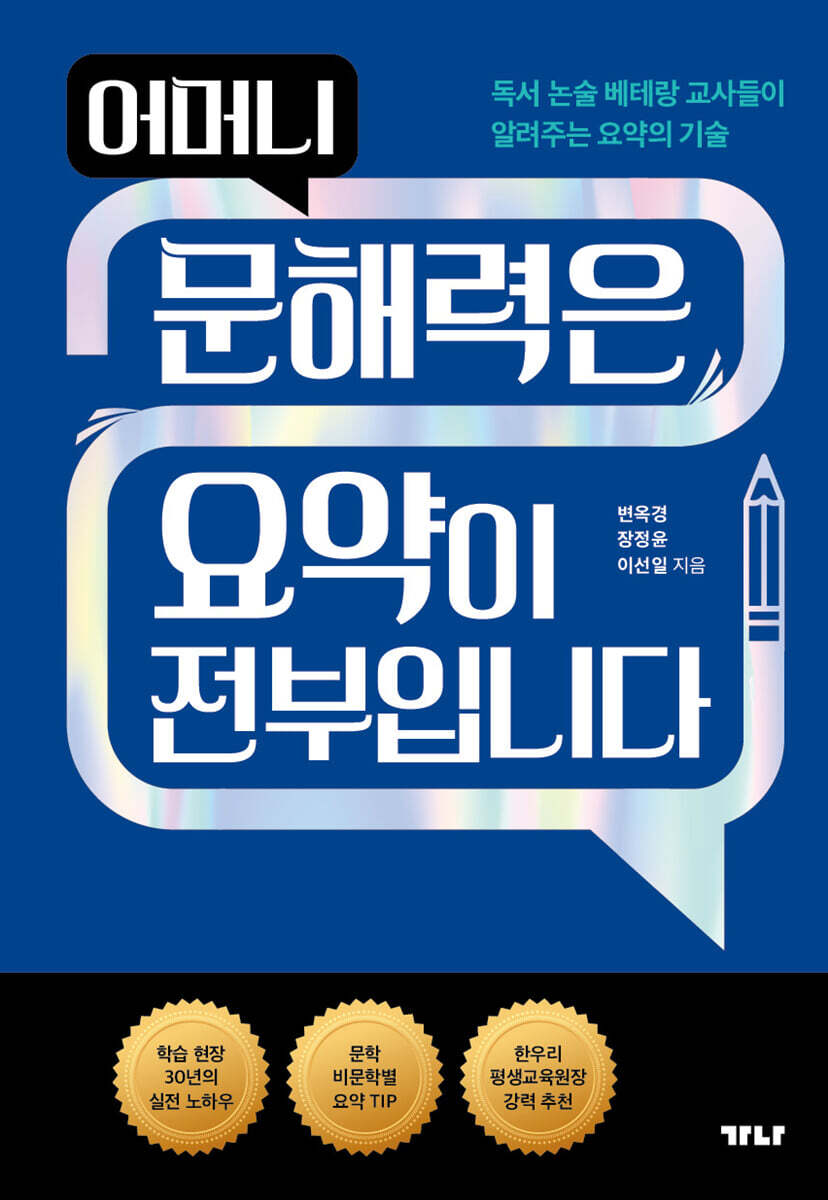
Maternal literacy is all about summarizing
 |
Description
Book Introduction
Whether you have 'read' or 'seen' a book is determined by whether or not you can summarize it!
Reading? Summarizing: The Art of Writing, Taught by Teachers with 30 Years of Writing Experience
“Did you read the book? What was it about?” This is the question parents ask when their children say they have read a book.
Unfortunately, few children can answer this question with complete clarity.
They just roll their eyes, talk about funny scenes that have nothing to do with the content, or even get angry and ask why I don't believe them when I say I read it all.
Is this what happens when you're asked to tell what was in the book you just read?
The reason children cannot read a book and properly tell the plot is because they do not have a good grasp of the summary.
If you develop the habit of summarizing not only when reading text but also when taking in any content such as audio, video, or images, you can clearly grasp the main points.
To grasp the core means to be literate.
In other words, summarizing must come first in order to develop literacy.
The problem is that neither parents nor children have ever properly learned this method of summarizing.
Until now, there were only summaries in Korea, but there was no book that taught how to summarize the content.
Now, this book can help you resolve this regret.
This book introduces practical methods for systematic summarization by experienced writing experts.
If you want to hear your child read a book and tell a proper story, open this book right now.
Reading? Summarizing: The Art of Writing, Taught by Teachers with 30 Years of Writing Experience
“Did you read the book? What was it about?” This is the question parents ask when their children say they have read a book.
Unfortunately, few children can answer this question with complete clarity.
They just roll their eyes, talk about funny scenes that have nothing to do with the content, or even get angry and ask why I don't believe them when I say I read it all.
Is this what happens when you're asked to tell what was in the book you just read?
The reason children cannot read a book and properly tell the plot is because they do not have a good grasp of the summary.
If you develop the habit of summarizing not only when reading text but also when taking in any content such as audio, video, or images, you can clearly grasp the main points.
To grasp the core means to be literate.
In other words, summarizing must come first in order to develop literacy.
The problem is that neither parents nor children have ever properly learned this method of summarizing.
Until now, there were only summaries in Korea, but there was no book that taught how to summarize the content.
Now, this book can help you resolve this regret.
This book introduces practical methods for systematic summarization by experienced writing experts.
If you want to hear your child read a book and tell a proper story, open this book right now.
- You can preview some of the book's contents.
Preview
index
Recommendation
A book worth keeping by your side and using
prolog
How can I improve my Korean language skills by reading better?
Chapter 1: Mother, if you just summarize well, literacy will follow.
Books should be read, not just looked at.
First, you have to start by reading properly.
Literacy depends on the ability to summarize.
The reason why the speech lacks a core message is because the summary is weak.
Getting mistakes on questions you know is because of summarization.
If you can't summarize, you can't study.
I already learned how to summarize in school
Chapter 2: Mother, There's a Skill in Summary
Creating a 'summary brain' that helps you study well
When writing is difficult, speak first
5 Absolute Rules for Summary Writing
Summary principles applicable to any text
-Read the article for a summary
-Find keywords
-Finding the central sentence and central idea
-Distinguish between facts and quotes or opinions
Preparation for a good summary 1: Vocabulary
Preparation for a good summary 2: Concentration
Preparation for a good summary 3: Reading method
Chapter 3: Mother, Understanding Literary Themes is Solved with a Summary
Understand the structure of the text
-Find the three elements of story composition
- Break the story down into 5 stages.
-Follow the introduction, development, climax, and conclusion
Drawing a character relationship chart
Summary game to learn while having fun
-Let's figure out the plot with Bingo
- Six Harmony Principles Question Relay
-Collecting keywords with SWBST
Easy summary using pictures
-If this is your first time summarizing, start with a picture book.
-The picture book I make
Find the author's intention
Developing your summary skills through diary writing
Developing your summary skills through reading reviews
Summary techniques for fluently reading literary texts
Chapter 4: Mother, the Key to Non-Fiction Analysis is Summary
Summarize with image frame
- A text listing information
- Text with a chronological order or flow
-An article comparing two pieces of information
- An article containing multiple details within a single topic
Use the table of contents
Summarize in five fingers
Summarizing with 2W1H
Thought Net × Six Harmonies
Create a 3-step summary
Summarize according to the structure of the text
-The structure of cause and effect
-Structure of problems and solutions
-Listing structure by order
Assess importance
Developing your summary skills through article writing
Developing your summarizing skills through essay writing
A summary technique for neatly organizing non-literary reading passages
Chapter 5: Mother, if you summarize well, you can achieve multimedia literacy.
Using video
-Summary of a short video
- Summarizing long videos
Other activities online
- Add a comment and title to the video
- Create a thumbnail for your video
You only get one chance to watch the video
Write a caption after viewing the image
Epilogue
Literacy is power in summary
A book worth keeping by your side and using
prolog
How can I improve my Korean language skills by reading better?
Chapter 1: Mother, if you just summarize well, literacy will follow.
Books should be read, not just looked at.
First, you have to start by reading properly.
Literacy depends on the ability to summarize.
The reason why the speech lacks a core message is because the summary is weak.
Getting mistakes on questions you know is because of summarization.
If you can't summarize, you can't study.
I already learned how to summarize in school
Chapter 2: Mother, There's a Skill in Summary
Creating a 'summary brain' that helps you study well
When writing is difficult, speak first
5 Absolute Rules for Summary Writing
Summary principles applicable to any text
-Read the article for a summary
-Find keywords
-Finding the central sentence and central idea
-Distinguish between facts and quotes or opinions
Preparation for a good summary 1: Vocabulary
Preparation for a good summary 2: Concentration
Preparation for a good summary 3: Reading method
Chapter 3: Mother, Understanding Literary Themes is Solved with a Summary
Understand the structure of the text
-Find the three elements of story composition
- Break the story down into 5 stages.
-Follow the introduction, development, climax, and conclusion
Drawing a character relationship chart
Summary game to learn while having fun
-Let's figure out the plot with Bingo
- Six Harmony Principles Question Relay
-Collecting keywords with SWBST
Easy summary using pictures
-If this is your first time summarizing, start with a picture book.
-The picture book I make
Find the author's intention
Developing your summary skills through diary writing
Developing your summary skills through reading reviews
Summary techniques for fluently reading literary texts
Chapter 4: Mother, the Key to Non-Fiction Analysis is Summary
Summarize with image frame
- A text listing information
- Text with a chronological order or flow
-An article comparing two pieces of information
- An article containing multiple details within a single topic
Use the table of contents
Summarize in five fingers
Summarizing with 2W1H
Thought Net × Six Harmonies
Create a 3-step summary
Summarize according to the structure of the text
-The structure of cause and effect
-Structure of problems and solutions
-Listing structure by order
Assess importance
Developing your summary skills through article writing
Developing your summarizing skills through essay writing
A summary technique for neatly organizing non-literary reading passages
Chapter 5: Mother, if you summarize well, you can achieve multimedia literacy.
Using video
-Summary of a short video
- Summarizing long videos
Other activities online
- Add a comment and title to the video
- Create a thumbnail for your video
You only get one chance to watch the video
Write a caption after viewing the image
Epilogue
Literacy is power in summary
Detailed image

Into the book
First, find the word that appears most frequently in the entire presentation.
If it is a fairy tale, words related to the theme will appear frequently.
You must see this without missing the title.
This is a tip.
Usually, children are so busy looking for words that appear frequently in the text that they often miss the title of the text. However, the words in the title usually appear most frequently in the entire text.
---From "Chapter 2 Mother, There is also a skill in summarizing"
Look at the table of contents of a long book and make sure you understand that it is divided into chapters.
And if the title is organized by chapter, make sure to read the title carefully before reading the corresponding chapter.
After reading everything, go back and divide the chapters into groups according to each of the five stages.
Instruct students to summarize the content according to the criteria divided in this way.
---From "Chapter 3: Mother, Understanding Literary Themes is Solved with a Summary"
Ultimately, asking whether you know the given content means asking you to organize what you have just read.
In order to answer the question of what the passage contains, you must read the long passage and summarize its content in a short amount of time.
Although you do not write down the summary, you must demonstrate the skill of summarizing only the key parts by reading the given passage within a limited time.
---From "Chapter 3: Mother, Understanding Literary Themes is Solved with a Summary"
The image frame requires reading the entire text and internalizing it so that you can decide for yourself what type of image frame to use, what the most important central content should be, and how the surrounding information should be arranged.
Therefore, it requires a high-level summary ability, and it may be unfamiliar to children who are encountering it for the first time, so some practice is needed.
However, if you summarize the material using an image frame, even the most difficult text will appear as if it were a bird's eye view, which is useful for understanding the entire text, and your reading comprehension and summary skills will improve during the process.
---From "Chapter 4 Mother, the Key to Non-Fiction Analysis is Summary"
Hyena drew a basic idea net.
The preceding text explains the process of founding Goryeo, and summarizes the stories of the three countries that formed the framework of the process in the form of a thought network.
Now that even the minor incidents have been sorted out, we can organize the detailed information of the three countries into six principles.
For example, in the small incident of 'Later Baekje, the military power of the strongest', the who is 'Gyeon Hwon', the when is '900 years', the where is 'Wansanju', the what is 'Later Baekje', the how is 'founded a country and actively engaged in foreign activities', and the why is 'to succeed Baekje'.
---From "Chapter 4 Mother, the Key to Non-Fiction Analysis is Summary"
It is clear that we will live in an era where diverse reading comprehension skills are needed, not only now but also in the future.
In particular, we are entering an era where the ability to properly read media materials is becoming the core of reading comprehension.
I dare to predict that activities like creating thumbnails or summarizing videos will be great tools and methods for developing these new reading skills.
If it is a fairy tale, words related to the theme will appear frequently.
You must see this without missing the title.
This is a tip.
Usually, children are so busy looking for words that appear frequently in the text that they often miss the title of the text. However, the words in the title usually appear most frequently in the entire text.
---From "Chapter 2 Mother, There is also a skill in summarizing"
Look at the table of contents of a long book and make sure you understand that it is divided into chapters.
And if the title is organized by chapter, make sure to read the title carefully before reading the corresponding chapter.
After reading everything, go back and divide the chapters into groups according to each of the five stages.
Instruct students to summarize the content according to the criteria divided in this way.
---From "Chapter 3: Mother, Understanding Literary Themes is Solved with a Summary"
Ultimately, asking whether you know the given content means asking you to organize what you have just read.
In order to answer the question of what the passage contains, you must read the long passage and summarize its content in a short amount of time.
Although you do not write down the summary, you must demonstrate the skill of summarizing only the key parts by reading the given passage within a limited time.
---From "Chapter 3: Mother, Understanding Literary Themes is Solved with a Summary"
The image frame requires reading the entire text and internalizing it so that you can decide for yourself what type of image frame to use, what the most important central content should be, and how the surrounding information should be arranged.
Therefore, it requires a high-level summary ability, and it may be unfamiliar to children who are encountering it for the first time, so some practice is needed.
However, if you summarize the material using an image frame, even the most difficult text will appear as if it were a bird's eye view, which is useful for understanding the entire text, and your reading comprehension and summary skills will improve during the process.
---From "Chapter 4 Mother, the Key to Non-Fiction Analysis is Summary"
Hyena drew a basic idea net.
The preceding text explains the process of founding Goryeo, and summarizes the stories of the three countries that formed the framework of the process in the form of a thought network.
Now that even the minor incidents have been sorted out, we can organize the detailed information of the three countries into six principles.
For example, in the small incident of 'Later Baekje, the military power of the strongest', the who is 'Gyeon Hwon', the when is '900 years', the where is 'Wansanju', the what is 'Later Baekje', the how is 'founded a country and actively engaged in foreign activities', and the why is 'to succeed Baekje'.
---From "Chapter 4 Mother, the Key to Non-Fiction Analysis is Summary"
It is clear that we will live in an era where diverse reading comprehension skills are needed, not only now but also in the future.
In particular, we are entering an era where the ability to properly read media materials is becoming the core of reading comprehension.
I dare to predict that activities like creating thumbnails or summarizing videos will be great tools and methods for developing these new reading skills.
---From "Chapter 5 Mother, Multimedia Literacy is Possible if You Summarize Well"
Publisher's Review
Long text warning for children!
Studying head starts from summary head
We live in an era where we watch dramas in summary form.
So the writing is in an even more serious situation.
Any title that is even slightly long on the Internet is accompanied by a warning saying, "Caution, long post," and a comment saying, "Please summarize in three lines."
People don't want to read long texts.
However, the ability to read and summarize text is very important.
Being able to summarize means you have a good understanding of the content.
That is why, regardless of whether it is literature or non-literature, the CSAT basically includes questions that require summarizing the content of a text and identifying the topic.
The ability to summarize is not just a problem with Korean language grades.
All questions presented in the 'descriptive' format can be solved only if you understand the core of what is being asked.
In fact, summarizing is not just a problem for students.
Even in social life, you need to understand what the other person is saying and the main point of the email.
To effectively convey my thoughts to others, I need the ability to summarize.
Developing children's ability to summarize can be said to teach them how to live well not only in school but also after college.
Now everyone agrees that literacy is important.
The hidden card to develop literacy is summarizing.
The habit of reading and summarizing books will develop the habit of reading seriously, and this will soon be applied to all subjects.
If you have a summary head, it will naturally lead to a study head.
30 years of experience in the field of learning, reading? Created by essay experts
A 100% customized summary method that reflects the educational field
There is one situation that any parent with children has probably experienced at least once.
This is the nonsense that comes out when you ask a child about something he or she has experienced.
Whether you're reading a book, watching a movie, or traveling, the moment you ask, "What was the content like?" you'll sigh deeply at the absurd answer.
‘Why doesn’t my child understand the core?’
'Why can't I speak logically?'
Parents are clearly aware that their child has poor summarization skills, but addressing them is not easy.
The three authors of "Mother's Literacy is All About Summary" are all writing experts active in the learning field, and are instructors in the Hanuri Reading Instructor Course and the Writing Coach Training Course.
As a teacher of teachers and a teacher who teaches reading and writing to children, I have encountered many cases.
Although they took the same classes and read the same books, each child's comprehension ability varied.
Their school grades and the level of the English and math academies they attended were similar, but their ability to digest books was different.
And once they reached middle school and above, the difference was evident in their grades.
What's different?
After much thought, I realized that the difference was in the ability to summarize.
Children needed to develop the habit of summarizing.
So the three authors created a summary roadmap while teaching children.
When reading a literary book, first check the table of contents and divide it into 'introduction, development, climax, and conclusion'. In short texts, look for keywords such as repeated words or words in the title, and play games like bingo with them to learn them.
In non-fiction, we look for keywords to find the cause and effect of the text.
I organized the content by drawing a network of thoughts and using the six principles to clearly see the major keywords and their flow.
In addition, we have developed over 30 different methods to help children find the main points and summarize the content while reading.
"Mother's Literacy is All About Summary" contains this field know-how and summary method.
Chapter 2 introduces a comprehensive summary method based on detailed explanations and vivid examples, as if you were receiving direct coaching from three teachers. Chapter 3 introduces a summary method for literature, Chapter 4 introduces a summary method for non-literature, and Chapter 5 introduces a summary method using multiple media.
Stop worrying about the videos your kids watch a lot and start summarizing them!
A practical, one-volume summary guide covering everything from literature to non-fiction and multimedia.
The biggest reason parents haven't been able to teach their children how to summarize is because they themselves have never learned a systematic way to summarize.
In the past, students naturally learned how to read and summarize books on their own by reading various books, magazines, and textbooks.
So maybe I didn't need to tell you specifically how to summarize.
But these days, things are different.
First of all, children do not read books.
There's no time, and there's a lot to do.
Above all, there is a fun cell phone other than books.
There is no time to master the unique summarizing method that you naturally acquired in the past.
Even if each person's summary ability is lost, it is inevitable that they must understand and accept the content through summarization.
That's why the value of this book is even higher.
This book introduces a new method of summarizing using multimedia media such as videos and images that children are familiar with, rather than just developing summarizing skills through text alone.
Activities such as watching a video and summarizing it in 10 lines or changing the title are easy to follow in daily life, making them even more useful.
Additionally, choosing videos on topics that interest children will help them develop their summarizing skills more easily by engaging them and engaging them.
Studying head starts from summary head
We live in an era where we watch dramas in summary form.
So the writing is in an even more serious situation.
Any title that is even slightly long on the Internet is accompanied by a warning saying, "Caution, long post," and a comment saying, "Please summarize in three lines."
People don't want to read long texts.
However, the ability to read and summarize text is very important.
Being able to summarize means you have a good understanding of the content.
That is why, regardless of whether it is literature or non-literature, the CSAT basically includes questions that require summarizing the content of a text and identifying the topic.
The ability to summarize is not just a problem with Korean language grades.
All questions presented in the 'descriptive' format can be solved only if you understand the core of what is being asked.
In fact, summarizing is not just a problem for students.
Even in social life, you need to understand what the other person is saying and the main point of the email.
To effectively convey my thoughts to others, I need the ability to summarize.
Developing children's ability to summarize can be said to teach them how to live well not only in school but also after college.
Now everyone agrees that literacy is important.
The hidden card to develop literacy is summarizing.
The habit of reading and summarizing books will develop the habit of reading seriously, and this will soon be applied to all subjects.
If you have a summary head, it will naturally lead to a study head.
30 years of experience in the field of learning, reading? Created by essay experts
A 100% customized summary method that reflects the educational field
There is one situation that any parent with children has probably experienced at least once.
This is the nonsense that comes out when you ask a child about something he or she has experienced.
Whether you're reading a book, watching a movie, or traveling, the moment you ask, "What was the content like?" you'll sigh deeply at the absurd answer.
‘Why doesn’t my child understand the core?’
'Why can't I speak logically?'
Parents are clearly aware that their child has poor summarization skills, but addressing them is not easy.
The three authors of "Mother's Literacy is All About Summary" are all writing experts active in the learning field, and are instructors in the Hanuri Reading Instructor Course and the Writing Coach Training Course.
As a teacher of teachers and a teacher who teaches reading and writing to children, I have encountered many cases.
Although they took the same classes and read the same books, each child's comprehension ability varied.
Their school grades and the level of the English and math academies they attended were similar, but their ability to digest books was different.
And once they reached middle school and above, the difference was evident in their grades.
What's different?
After much thought, I realized that the difference was in the ability to summarize.
Children needed to develop the habit of summarizing.
So the three authors created a summary roadmap while teaching children.
When reading a literary book, first check the table of contents and divide it into 'introduction, development, climax, and conclusion'. In short texts, look for keywords such as repeated words or words in the title, and play games like bingo with them to learn them.
In non-fiction, we look for keywords to find the cause and effect of the text.
I organized the content by drawing a network of thoughts and using the six principles to clearly see the major keywords and their flow.
In addition, we have developed over 30 different methods to help children find the main points and summarize the content while reading.
"Mother's Literacy is All About Summary" contains this field know-how and summary method.
Chapter 2 introduces a comprehensive summary method based on detailed explanations and vivid examples, as if you were receiving direct coaching from three teachers. Chapter 3 introduces a summary method for literature, Chapter 4 introduces a summary method for non-literature, and Chapter 5 introduces a summary method using multiple media.
Stop worrying about the videos your kids watch a lot and start summarizing them!
A practical, one-volume summary guide covering everything from literature to non-fiction and multimedia.
The biggest reason parents haven't been able to teach their children how to summarize is because they themselves have never learned a systematic way to summarize.
In the past, students naturally learned how to read and summarize books on their own by reading various books, magazines, and textbooks.
So maybe I didn't need to tell you specifically how to summarize.
But these days, things are different.
First of all, children do not read books.
There's no time, and there's a lot to do.
Above all, there is a fun cell phone other than books.
There is no time to master the unique summarizing method that you naturally acquired in the past.
Even if each person's summary ability is lost, it is inevitable that they must understand and accept the content through summarization.
That's why the value of this book is even higher.
This book introduces a new method of summarizing using multimedia media such as videos and images that children are familiar with, rather than just developing summarizing skills through text alone.
Activities such as watching a video and summarizing it in 10 lines or changing the title are easy to follow in daily life, making them even more useful.
Additionally, choosing videos on topics that interest children will help them develop their summarizing skills more easily by engaging them and engaging them.
GOODS SPECIFICS
- Date of issue: July 10, 2023
- Page count, weight, size: 288 pages | 410g | 145*210*18mm
- ISBN13: 9791168091016
- ISBN10: 1168091012
You may also like
카테고리
korean


korean

![GQ KOREA Mark (Monthly): December [2025]](http://librairie.coreenne.fr/cdn/shop/files/8ef265dbbfbf186523ed75ba7319009d.jpg?v=1765340328&width=3840)


