

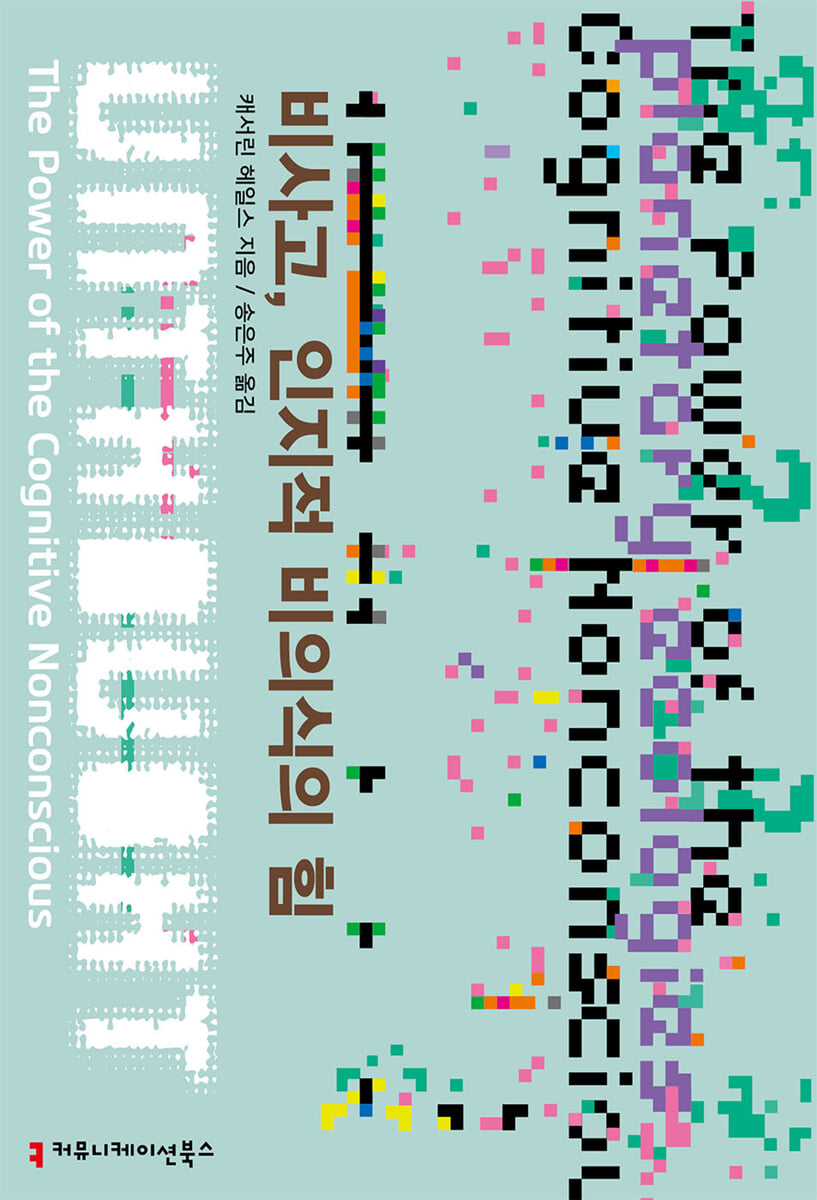
The power of non-thinking, cognitive non-consciousness
 |
Description
Book Introduction
There is an old question.
Can machines think like humans? Now that AI can answer my questions and even offer empathy and comfort, the question is fundamentally turned upside down.
Why have we so far taken for granted that only humans can think? Catherine Hayles, a world-renowned posthumanist theorist who has transcended the "human vs. machine" dichotomy and explored their intertwined and coevolutionary relationships, proposes a holistic framework that transcends the anthropocentric perspective on thought and allows us to consider both human consciousness and machine operations.
It provides a new perspective on cognition, leading us toward a more sustainable, enduring, and thriving environment for all living beings and nonhuman others.
Can machines think like humans? Now that AI can answer my questions and even offer empathy and comfort, the question is fundamentally turned upside down.
Why have we so far taken for granted that only humans can think? Catherine Hayles, a world-renowned posthumanist theorist who has transcended the "human vs. machine" dichotomy and explored their intertwined and coevolutionary relationships, proposes a holistic framework that transcends the anthropocentric perspective on thought and allows us to consider both human consciousness and machine operations.
It provides a new perspective on cognition, leading us toward a more sustainable, enduring, and thriving environment for all living beings and nonhuman others.
- You can preview some of the book's contents.
Preview
index
Prologue: Changing the Way You See the World
Part 1: Cognitive Unconsciousness and the Price of Consciousness
01 Non-conscious Cognition: Humans and Others
Thinking and Cognition / Plant Signals and Claims of Plant Intelligence / Technological Cognition / Analyzing Cognition / The Three-Pronged Framework of (Human) Cognition / Agents and Mediators / Why Computational Media Are Not Just Another Technology / Technological Cognition and Ethics
02 Interaction between unconscious cognition and consciousness
The Cost of Consciousness / Neural Correlates of Consciousness and Cognitive Unconsciousness / Simulation and Representation in Consciousness / The Importance of Information Processing in Cognitive Unconsciousness / The Interplay between Unconscious Cognition and Consciousness / Unconscious Cognition as a Humanistic Concept: The McDowell-Dreyfuss Debate / Analogues to Unconscious Cognition in Other Traditions
03 Cognitive Unconsciousness and New Materialism
Ontology / Evolution / Survival / Power / Transformation
04 The Price of Consciousness: Tom McCarthy's "The Dregs" and Peter Watts' "Blindsight"
《The Remnants》: The Tenacious Power of Consciousness vs. Matter / (Re)presenting the Dysfunctions of Consciousness / Negotiating with Temporality / Addicted to Trauma / Real Simulations / 《Blindsight》 and Neuroscience / Modifying Human (and Non-Human) Consciousness / Interpreting the Rorschach / 《Blindsight》 and the Masters of Consciousness / Advanced Technologies Without Consciousness / 'Normal' Consciousness and Technological Cognition
Part 2 Cognitive Set
05 Cognitive Sets: Technological Agency and Human Interaction
Infrastructure and Technological Cognition / Digital Assistants and Information Portals / Social Signals and Physical Surveillance / Distributed Agency and Technological Autonomy / Human Emotions and Technological Cognition
06 Temporality and Cognitive Aggregation: Financial Capital, Derivatives, and High-Speed Trading
Complex temporality and derivatives / Trauma, oppression, and markets / Feedback loops: The critical weakness of probability / Globalization, 'excessive privilege,' and the 2007-2008 financial crisis / High-frequency trading algorithms and the stock market crash of May 2010 / The complex ecosystem of human-algorithm interaction / Systemic reengineering: IEX and concentrated trading / Financial capital and the humanities / Meaning, interpretation, and value
07 Intuition, Cognitive Aggregates, and Political and Historical Affects: Colson Whitehead's The Intuitionist
Why unconscious cognition is not enough / The worst failure: the meaning of the message / The liberating potential of error / Cognitive collectives and the unknowable / Aesthetic strategies and speculative realism / The historical present and cognitive collectives / Cognitive collectives and novel forms
08 The Utopian Potential of Cognitive Aggregation
Expanding the Spirit of the Humanities / Interpretation and Description / Performing Cognitive Unconsciousness in the Theater of Consciousness / Two Paths in the Humanities
Acknowledgements
Translator's Note
Americas
References
Part 1: Cognitive Unconsciousness and the Price of Consciousness
01 Non-conscious Cognition: Humans and Others
Thinking and Cognition / Plant Signals and Claims of Plant Intelligence / Technological Cognition / Analyzing Cognition / The Three-Pronged Framework of (Human) Cognition / Agents and Mediators / Why Computational Media Are Not Just Another Technology / Technological Cognition and Ethics
02 Interaction between unconscious cognition and consciousness
The Cost of Consciousness / Neural Correlates of Consciousness and Cognitive Unconsciousness / Simulation and Representation in Consciousness / The Importance of Information Processing in Cognitive Unconsciousness / The Interplay between Unconscious Cognition and Consciousness / Unconscious Cognition as a Humanistic Concept: The McDowell-Dreyfuss Debate / Analogues to Unconscious Cognition in Other Traditions
03 Cognitive Unconsciousness and New Materialism
Ontology / Evolution / Survival / Power / Transformation
04 The Price of Consciousness: Tom McCarthy's "The Dregs" and Peter Watts' "Blindsight"
《The Remnants》: The Tenacious Power of Consciousness vs. Matter / (Re)presenting the Dysfunctions of Consciousness / Negotiating with Temporality / Addicted to Trauma / Real Simulations / 《Blindsight》 and Neuroscience / Modifying Human (and Non-Human) Consciousness / Interpreting the Rorschach / 《Blindsight》 and the Masters of Consciousness / Advanced Technologies Without Consciousness / 'Normal' Consciousness and Technological Cognition
Part 2 Cognitive Set
05 Cognitive Sets: Technological Agency and Human Interaction
Infrastructure and Technological Cognition / Digital Assistants and Information Portals / Social Signals and Physical Surveillance / Distributed Agency and Technological Autonomy / Human Emotions and Technological Cognition
06 Temporality and Cognitive Aggregation: Financial Capital, Derivatives, and High-Speed Trading
Complex temporality and derivatives / Trauma, oppression, and markets / Feedback loops: The critical weakness of probability / Globalization, 'excessive privilege,' and the 2007-2008 financial crisis / High-frequency trading algorithms and the stock market crash of May 2010 / The complex ecosystem of human-algorithm interaction / Systemic reengineering: IEX and concentrated trading / Financial capital and the humanities / Meaning, interpretation, and value
07 Intuition, Cognitive Aggregates, and Political and Historical Affects: Colson Whitehead's The Intuitionist
Why unconscious cognition is not enough / The worst failure: the meaning of the message / The liberating potential of error / Cognitive collectives and the unknowable / Aesthetic strategies and speculative realism / The historical present and cognitive collectives / Cognitive collectives and novel forms
08 The Utopian Potential of Cognitive Aggregation
Expanding the Spirit of the Humanities / Interpretation and Description / Performing Cognitive Unconsciousness in the Theater of Consciousness / Two Paths in the Humanities
Acknowledgements
Translator's Note
Americas
References
Into the book
Non-thinking can also be captured in recent findings in neuroscience that confirm the existence of non-conscious cognitive processes that are inaccessible to conscious introspection but are essential for consciousness to function.
To fully understand the power of unconscious cognitive processes, we must fundamentally rethink cognition.
Moreover, since the very existence of nonconscious cognitive processes is not well known in the humanities, non-thinking suggests an unknown territory that beckons beyond widely accepted notions of how consciousness operates.
While non-thinking points to the rich possibilities that open up when considering non-conscious cognition, it also points to a powerful force for conceptualizing the interaction between humans and technological systems.
This helps us to understand more clearly the political, cultural, and ethical pillars of life in modern, advanced societies.
--- From the "Prologue"
The notion that consciousness and advanced thinking are necessarily parallel has been a tradition for hundreds, if not thousands, of years, based on anthropocentric predictions.
However, as the limits of consciousness have been widely reassessed in recent years, so too have the functions performed by other cognitive abilities and the crucial roles they play in human neurological processes.
Consciousness occupies a central place in our thinking, not because it is the sum total of cognition, but because it creates the (sometimes fictional) narratives that make sense of our lives and support our basic assumptions about the coherence of the world.
Cognition, on the other hand, is a much broader ability that extends far beyond consciousness to include other neurological brain processes.
Cognition also extends to other living organisms and complex technological systems.
Cognitive abilities that exist beyond consciousness have many names, but I will call them 'non-conscious cognition'.
--- From "01 Unconscious Cognition"
Without consciousness, the anthropocentric biases that have made humans infamous would not be possible, at least not in that sense.
The impression of the embodied self created by higher consciousness goes without saying.
The very function that allows us to perceive ourselves as selves also blinds us, in part, to the complexity of the biological, social, and technological systems in which we are embedded, and easily leads us to believe that we are the most important actors and can control the outcomes of our actions and those of other agents.
But with climate change, ocean acidification, and the greenhouse effect all coming to light, this is becoming increasingly less true.
--- From "02 Interaction between unconscious cognition and consciousness"
New materialists might argue that there are already many discourses, past and present, that emphasize the role of consciousness and cognition, and that it is not their place to repeat or modify these discourses to emphasize materiality in particular.
However, separating materiality from cognition does not make the defense of materiality any stronger.
Rather, it weakens the argument because it erases the crucial role that materiality plays in creating the structures and organizations from which consciousness and cognition emerge.
Creating these structures and organizations is by no means all that the 'liveliness' of materiality can do, but it is a particularly full and important form of material agency.
If we ignore this, we get a very biased and incomplete picture.
Moreover, this erasure leads to overgeneralized analyses, which fail to recognize the core differences between types of material agency.
Perhaps including that difference would weaken the decentralization plan.
From this perspective, it can be said that new materialism confuses the decentralization of humans with the complete erasure of humans.
Given that any decentralized project requires, above all, convincing people why it is beneficial, this confusion is unrealistic and ultimately self-defeating.
--- From "03 Cognitive Unconsciousness and New Materialism"
Tom McCarthy's "The Dregs" and Peter Watts' "Blindsight."
"The Remnants" centers on an unnamed narrator who loses the functions of non-conscious cognition after an accident for which the work is not clearly explained, while "Blindsight" explores the broader context of anomalous forms of consciousness, exploring the stakes involved in the evolutionary path that Homo sapiens (and other life forms on Earth) have taken since they acquired consciousness.
Both novels are heavily influenced by recent neuroscientific research, but they don't simply follow the path that science leads.
Both novels explore the consequences of consciousness far beyond what science has revealed, particularly its phenomenological and cultural dimensions.
"The Remnants" highlights the central importance of unconscious cognition through the loss of unconscious cognition, while "Blindsight" highlights the central importance of unconscious cognition through the portrayal of an alien species that lacks conscious thought entirely but has developed technology far superior to that of Earth.
Both novels show how widely accepted assumptions in traditional Western culture are undermined, even denied, when the supreme status of higher consciousness is called into question.
--- From "04 The Price of Consciousness"
I will use the term 'cognitive aggregate' to describe the ability to mobilize action and material power.
Latour and Deleuze and Guattari (1987) also refer to 'assemblages', but cognitive assemblages have specific characteristics that differ from the way they use them.
In cognitive systems, in particular, the flow of information through the system and the choices and decisions that create, coordinate, and interpret that flow are prominent.
Cognitive ensembles may (and almost always do) include material agents and forces, but it is the perceivers within the ensembles who mobilize these affordances and direct their power to act in complex situations.
--- From "05 Cognitive Set"
High-frequency trading, combined with faster processor speeds, massive increases in computer memory, and fiber-optic cables that allow information to flow at near the speed of light, has created a temporal gap between human and technological cognition, creating a realm of autonomy for technological agency.
Within this space of "punctuated agency," algorithms reason, analyze context, and make decisions in milliseconds.
Ultra-short-term trading emerged when derivatives had already begun to dominate financial trading.
The complex temporality inherent in derivatives interacts with the altered temporality of high-frequency trading, exacerbating the fragility, feedback loops, and self-amplifying dynamics of financial markets.
Analyzing these effects allows us to see how the interpenetration of technological and human cognition redefines the landscape in which human actors move.
--- From "06 Temporality and Cognitive Set"
Cognitive collectives are inherently political.
Cognitive ensembles are composed of human-technology interfaces, multiple levels of interpretation of related choices, and multiple types of information flows, and are influenced by social, technological, cultural, and economic practices that instantiate and negotiate different types of power, stakeholders, and cognitive modes.
In Chapters 5 and 6, we explored how such negotiations take place in urban infrastructure and financial capital, respectively.
Chapter 6 focused on the technological cognition of algorithms and the potential for global change by changing the types of temporality associated with them.
In contrast, this chapter will primarily focus on affective forces within aggregates.
As we will see, this emotional force goes beyond human responses to the supposed reactions of technological artifacts.
This chapter will use African-American writer Colson Whitehead's The Intuitionist (1999) as a textbook to examine how this novel creates a richly woven affective, embodied, and interpretive context.
--- From “07 Intuition, Cognitive Collectives, and Political and Historical Affects”
I have always urged the humanities to play a central role in thinking about cognitive ensembles.
Interpretation, meaning, and value are not limited to the humanities.
However, they have always been important areas of exploration within the humanities, including art, literature, philosophy, religious studies, and qualitative history.
You can't add ethics to a system once it's been formed and is in motion.
There is an unfortunate tendency in corporate practice to treat 'ethics' in that way.
Too often, the focus is solely on how to satisfy legal requirements so that no one is sued.
In contrast, effective ethical interventions must be inherent in the functioning of the system itself.
In cognitive ensembles, this means understanding how the interpenetration of human and technological cognition occurs in specific places, and how such analyses can be used to identify inflection points.
Rather than existing in advance as objective realities, inflection points emerge from the interactions/interactions of previous commitments to create new trajectories for collectives, offering a more open, equitable, and sustainable future for humans, non-human life, and technological cognitors (i.e., planetary cognitive ecologies).
To fully understand the power of unconscious cognitive processes, we must fundamentally rethink cognition.
Moreover, since the very existence of nonconscious cognitive processes is not well known in the humanities, non-thinking suggests an unknown territory that beckons beyond widely accepted notions of how consciousness operates.
While non-thinking points to the rich possibilities that open up when considering non-conscious cognition, it also points to a powerful force for conceptualizing the interaction between humans and technological systems.
This helps us to understand more clearly the political, cultural, and ethical pillars of life in modern, advanced societies.
--- From the "Prologue"
The notion that consciousness and advanced thinking are necessarily parallel has been a tradition for hundreds, if not thousands, of years, based on anthropocentric predictions.
However, as the limits of consciousness have been widely reassessed in recent years, so too have the functions performed by other cognitive abilities and the crucial roles they play in human neurological processes.
Consciousness occupies a central place in our thinking, not because it is the sum total of cognition, but because it creates the (sometimes fictional) narratives that make sense of our lives and support our basic assumptions about the coherence of the world.
Cognition, on the other hand, is a much broader ability that extends far beyond consciousness to include other neurological brain processes.
Cognition also extends to other living organisms and complex technological systems.
Cognitive abilities that exist beyond consciousness have many names, but I will call them 'non-conscious cognition'.
--- From "01 Unconscious Cognition"
Without consciousness, the anthropocentric biases that have made humans infamous would not be possible, at least not in that sense.
The impression of the embodied self created by higher consciousness goes without saying.
The very function that allows us to perceive ourselves as selves also blinds us, in part, to the complexity of the biological, social, and technological systems in which we are embedded, and easily leads us to believe that we are the most important actors and can control the outcomes of our actions and those of other agents.
But with climate change, ocean acidification, and the greenhouse effect all coming to light, this is becoming increasingly less true.
--- From "02 Interaction between unconscious cognition and consciousness"
New materialists might argue that there are already many discourses, past and present, that emphasize the role of consciousness and cognition, and that it is not their place to repeat or modify these discourses to emphasize materiality in particular.
However, separating materiality from cognition does not make the defense of materiality any stronger.
Rather, it weakens the argument because it erases the crucial role that materiality plays in creating the structures and organizations from which consciousness and cognition emerge.
Creating these structures and organizations is by no means all that the 'liveliness' of materiality can do, but it is a particularly full and important form of material agency.
If we ignore this, we get a very biased and incomplete picture.
Moreover, this erasure leads to overgeneralized analyses, which fail to recognize the core differences between types of material agency.
Perhaps including that difference would weaken the decentralization plan.
From this perspective, it can be said that new materialism confuses the decentralization of humans with the complete erasure of humans.
Given that any decentralized project requires, above all, convincing people why it is beneficial, this confusion is unrealistic and ultimately self-defeating.
--- From "03 Cognitive Unconsciousness and New Materialism"
Tom McCarthy's "The Dregs" and Peter Watts' "Blindsight."
"The Remnants" centers on an unnamed narrator who loses the functions of non-conscious cognition after an accident for which the work is not clearly explained, while "Blindsight" explores the broader context of anomalous forms of consciousness, exploring the stakes involved in the evolutionary path that Homo sapiens (and other life forms on Earth) have taken since they acquired consciousness.
Both novels are heavily influenced by recent neuroscientific research, but they don't simply follow the path that science leads.
Both novels explore the consequences of consciousness far beyond what science has revealed, particularly its phenomenological and cultural dimensions.
"The Remnants" highlights the central importance of unconscious cognition through the loss of unconscious cognition, while "Blindsight" highlights the central importance of unconscious cognition through the portrayal of an alien species that lacks conscious thought entirely but has developed technology far superior to that of Earth.
Both novels show how widely accepted assumptions in traditional Western culture are undermined, even denied, when the supreme status of higher consciousness is called into question.
--- From "04 The Price of Consciousness"
I will use the term 'cognitive aggregate' to describe the ability to mobilize action and material power.
Latour and Deleuze and Guattari (1987) also refer to 'assemblages', but cognitive assemblages have specific characteristics that differ from the way they use them.
In cognitive systems, in particular, the flow of information through the system and the choices and decisions that create, coordinate, and interpret that flow are prominent.
Cognitive ensembles may (and almost always do) include material agents and forces, but it is the perceivers within the ensembles who mobilize these affordances and direct their power to act in complex situations.
--- From "05 Cognitive Set"
High-frequency trading, combined with faster processor speeds, massive increases in computer memory, and fiber-optic cables that allow information to flow at near the speed of light, has created a temporal gap between human and technological cognition, creating a realm of autonomy for technological agency.
Within this space of "punctuated agency," algorithms reason, analyze context, and make decisions in milliseconds.
Ultra-short-term trading emerged when derivatives had already begun to dominate financial trading.
The complex temporality inherent in derivatives interacts with the altered temporality of high-frequency trading, exacerbating the fragility, feedback loops, and self-amplifying dynamics of financial markets.
Analyzing these effects allows us to see how the interpenetration of technological and human cognition redefines the landscape in which human actors move.
--- From "06 Temporality and Cognitive Set"
Cognitive collectives are inherently political.
Cognitive ensembles are composed of human-technology interfaces, multiple levels of interpretation of related choices, and multiple types of information flows, and are influenced by social, technological, cultural, and economic practices that instantiate and negotiate different types of power, stakeholders, and cognitive modes.
In Chapters 5 and 6, we explored how such negotiations take place in urban infrastructure and financial capital, respectively.
Chapter 6 focused on the technological cognition of algorithms and the potential for global change by changing the types of temporality associated with them.
In contrast, this chapter will primarily focus on affective forces within aggregates.
As we will see, this emotional force goes beyond human responses to the supposed reactions of technological artifacts.
This chapter will use African-American writer Colson Whitehead's The Intuitionist (1999) as a textbook to examine how this novel creates a richly woven affective, embodied, and interpretive context.
--- From “07 Intuition, Cognitive Collectives, and Political and Historical Affects”
I have always urged the humanities to play a central role in thinking about cognitive ensembles.
Interpretation, meaning, and value are not limited to the humanities.
However, they have always been important areas of exploration within the humanities, including art, literature, philosophy, religious studies, and qualitative history.
You can't add ethics to a system once it's been formed and is in motion.
There is an unfortunate tendency in corporate practice to treat 'ethics' in that way.
Too often, the focus is solely on how to satisfy legal requirements so that no one is sued.
In contrast, effective ethical interventions must be inherent in the functioning of the system itself.
In cognitive ensembles, this means understanding how the interpenetration of human and technological cognition occurs in specific places, and how such analyses can be used to identify inflection points.
Rather than existing in advance as objective realities, inflection points emerge from the interactions/interactions of previous commitments to create new trajectories for collectives, offering a more open, equitable, and sustainable future for humans, non-human life, and technological cognitors (i.e., planetary cognitive ecologies).
--- From "08 The Utopian Potential of Cognitive Aggregation"
Publisher's Review
“Before an accident, a non-accident is in operation.”
From human consciousness to plant physiology,
From transportation systems to combat drones and stock algorithms.
Uncovering the hidden forces that drive all living things and machines.
There is an old question.
Can machines think like humans? Now that AI can answer my questions and even offer empathy and comfort, the question is fundamentally turned upside down.
Why have we taken it for granted that only humans can think?
Catherine Hayles is a world-renowned posthumanist theorist who has gone beyond the dichotomy of 'human versus machine' to consider the entanglement and co-evolution of the two.
This book, "Non-Thought, the Power of Cognitive Non-Consciousness," is an extension of that thinking, and presents an integrated framework that allows us to think about both human consciousness and machine operation, moving beyond the human-centered perspective on thought.
The key word here is nonconscious cognition.
Nonconscious cognition operates at a level of neuronal processing that humans cannot grasp at the level of consciousness, but performs functions essential to consciousness.
Nonconscious cognition processes information much faster than conscious awareness, recognizes patterns too complex and subtle for conscious awareness to discern, and draws inferences that influence behavior and help us determine priorities.
Above all, non-conscious cognition plays a crucial role in preventing the consciousness, which has slow reactions and limited processing capacity, from being overwhelmed by the flood of internal and external information that flows into the brain every millisecond.
The operation of intelligent machines, including artificial intelligence, is often compared to the operation of human consciousness, but according to Hales, it is much more similar to the process of non-conscious cognition.
Intelligent machines also process information, identify patterns, and draw inferences faster than human consciousness.
Furthermore, these machines are designed to avoid overwhelming human consciousness with a vast stream of information that is so large, complex, and multifaceted that the human brain could never process it.
The reason Hales focuses on non-conscious cognition in this book is not simply to devalue conscious thought, which has been considered a characteristic of humans.
Hailes's goal is to arrive at a more balanced and accurate view of cognitive ecologies, including humans and non-humans, by starting with the concept of non-conscious cognition, which allows human cognition to be compared on the same level with the cognition of non-human creatures and technological systems.
Indeed, Hales cites the example of plants, which respond to their environment and communicate with other organisms, to demonstrate that plants, too, rely on their cognitive abilities to interact with, adapt to, and evolve within the world around them.
It also points out that technological artifacts such as artificial intelligence and drones also have cognitive abilities, and that these abilities are developing rapidly day by day.
If we can move beyond the (mis)perception that humans are the only significant or meaningful cognizers on Earth, we can begin to identify a host of new questions, problems, and ethical considerations.
In this context, Hales defines the distributed cognitive network in which human and non-human agents interact to process information in a meaningful way as the cognitive nonconscious or cognitive assemblage, and focuses on the cognitive assemblage that is rapidly growing worldwide.
The cognitive ensembles covered in this book range from traffic control systems to combat drones to stock trading algorithms.
These cognitive ensembles illustrate the reality that technological advancements are increasing connectivity and increasingly limiting human agency.
For example, the 2010 stock market crash analyzed by Hales is a prime example of humans failing to control the actions of technological agents that transcend human response capabilities.
As our interactions with technological cognition increase, so too will the instances of control failures.
Humans are merely part of a cognitive collective, and as the problems of the Anthropocene, such as climate change and environmental disasters, demonstrate, we have no power to control that collective.
But Hales urges us to consider the direction in which cognitive ensembles might take, not only for humans but also for non-humans, based on a new perspective on cognition, even if we cannot control or change the entire structure at our own will.
This book will spark conversation about cognition and its importance for understanding our current situation, and will contribute to moving us toward a more sustainable, enduring, and thriving environment for all living beings and nonhuman others.
The book consists of two parts and eight chapters.
Part 1 deals with the concept of non-conscious cognition.
Chapter 1 discusses the relationship between consciousness/unconsciousness and material processes.
Chapter 2 summarizes scientific research on nonconscious cognition and relates it to contemporary discussions of cognition.
Chapter 3 discusses new materialism and analyzes the benefits of including non-conscious cognition within the framework of new materialist projects.
Chapter 4 examines the costs of consciousness, rather than the benefits it brings, through an analysis of two contemporary novels, Tom McCarthy's Remainder (2007) and Peter Watts's Blindsight (2006).
Part 2 addresses the overall effects of human-technology cognitive ensembles.
Chapter 5 illustrates the dynamics of human-technology cognitive ensembles through representative examples ranging from traffic control centers to manned and autonomous drones.
Chapter 6 focuses on automated trading algorithms, examining the implications of cognitive ensembles whose operating speed far exceeds the timescales of human decision-making.
We further discuss the impact of these types of cognitive aggregates, particularly their overall destabilizing effect on the global economy.
Chapter 7 explores the ethical implications of cognitive collectives through a careful reading of Colson Whitehead's novel The Intuitionist.
Chapter 8 describes the utopian potential of cognitive collectives and extends this discussion to the digital humanities, suggesting that they too can be considered cognitive collectives.
Furthermore, we show how the framework of non-conscious cognition proposed here influences how we understand and evaluate digital humanities.
From human consciousness to plant physiology,
From transportation systems to combat drones and stock algorithms.
Uncovering the hidden forces that drive all living things and machines.
There is an old question.
Can machines think like humans? Now that AI can answer my questions and even offer empathy and comfort, the question is fundamentally turned upside down.
Why have we taken it for granted that only humans can think?
Catherine Hayles is a world-renowned posthumanist theorist who has gone beyond the dichotomy of 'human versus machine' to consider the entanglement and co-evolution of the two.
This book, "Non-Thought, the Power of Cognitive Non-Consciousness," is an extension of that thinking, and presents an integrated framework that allows us to think about both human consciousness and machine operation, moving beyond the human-centered perspective on thought.
The key word here is nonconscious cognition.
Nonconscious cognition operates at a level of neuronal processing that humans cannot grasp at the level of consciousness, but performs functions essential to consciousness.
Nonconscious cognition processes information much faster than conscious awareness, recognizes patterns too complex and subtle for conscious awareness to discern, and draws inferences that influence behavior and help us determine priorities.
Above all, non-conscious cognition plays a crucial role in preventing the consciousness, which has slow reactions and limited processing capacity, from being overwhelmed by the flood of internal and external information that flows into the brain every millisecond.
The operation of intelligent machines, including artificial intelligence, is often compared to the operation of human consciousness, but according to Hales, it is much more similar to the process of non-conscious cognition.
Intelligent machines also process information, identify patterns, and draw inferences faster than human consciousness.
Furthermore, these machines are designed to avoid overwhelming human consciousness with a vast stream of information that is so large, complex, and multifaceted that the human brain could never process it.
The reason Hales focuses on non-conscious cognition in this book is not simply to devalue conscious thought, which has been considered a characteristic of humans.
Hailes's goal is to arrive at a more balanced and accurate view of cognitive ecologies, including humans and non-humans, by starting with the concept of non-conscious cognition, which allows human cognition to be compared on the same level with the cognition of non-human creatures and technological systems.
Indeed, Hales cites the example of plants, which respond to their environment and communicate with other organisms, to demonstrate that plants, too, rely on their cognitive abilities to interact with, adapt to, and evolve within the world around them.
It also points out that technological artifacts such as artificial intelligence and drones also have cognitive abilities, and that these abilities are developing rapidly day by day.
If we can move beyond the (mis)perception that humans are the only significant or meaningful cognizers on Earth, we can begin to identify a host of new questions, problems, and ethical considerations.
In this context, Hales defines the distributed cognitive network in which human and non-human agents interact to process information in a meaningful way as the cognitive nonconscious or cognitive assemblage, and focuses on the cognitive assemblage that is rapidly growing worldwide.
The cognitive ensembles covered in this book range from traffic control systems to combat drones to stock trading algorithms.
These cognitive ensembles illustrate the reality that technological advancements are increasing connectivity and increasingly limiting human agency.
For example, the 2010 stock market crash analyzed by Hales is a prime example of humans failing to control the actions of technological agents that transcend human response capabilities.
As our interactions with technological cognition increase, so too will the instances of control failures.
Humans are merely part of a cognitive collective, and as the problems of the Anthropocene, such as climate change and environmental disasters, demonstrate, we have no power to control that collective.
But Hales urges us to consider the direction in which cognitive ensembles might take, not only for humans but also for non-humans, based on a new perspective on cognition, even if we cannot control or change the entire structure at our own will.
This book will spark conversation about cognition and its importance for understanding our current situation, and will contribute to moving us toward a more sustainable, enduring, and thriving environment for all living beings and nonhuman others.
The book consists of two parts and eight chapters.
Part 1 deals with the concept of non-conscious cognition.
Chapter 1 discusses the relationship between consciousness/unconsciousness and material processes.
Chapter 2 summarizes scientific research on nonconscious cognition and relates it to contemporary discussions of cognition.
Chapter 3 discusses new materialism and analyzes the benefits of including non-conscious cognition within the framework of new materialist projects.
Chapter 4 examines the costs of consciousness, rather than the benefits it brings, through an analysis of two contemporary novels, Tom McCarthy's Remainder (2007) and Peter Watts's Blindsight (2006).
Part 2 addresses the overall effects of human-technology cognitive ensembles.
Chapter 5 illustrates the dynamics of human-technology cognitive ensembles through representative examples ranging from traffic control centers to manned and autonomous drones.
Chapter 6 focuses on automated trading algorithms, examining the implications of cognitive ensembles whose operating speed far exceeds the timescales of human decision-making.
We further discuss the impact of these types of cognitive aggregates, particularly their overall destabilizing effect on the global economy.
Chapter 7 explores the ethical implications of cognitive collectives through a careful reading of Colson Whitehead's novel The Intuitionist.
Chapter 8 describes the utopian potential of cognitive collectives and extends this discussion to the digital humanities, suggesting that they too can be considered cognitive collectives.
Furthermore, we show how the framework of non-conscious cognition proposed here influences how we understand and evaluate digital humanities.
GOODS SPECIFICS
- Date of issue: August 6, 2025
- Page count, weight, size: 426 pages | 128*188*20mm
- ISBN13: 9791143007100
You may also like
카테고리
korean


korean

![ELLE 엘르 스페셜 에디션 A형 : 12월 [2025]](http://librairie.coreenne.fr/cdn/shop/files/b8e27a3de6c9538896439686c6b0e8fb.jpg?v=1766436872&width=3840)


