

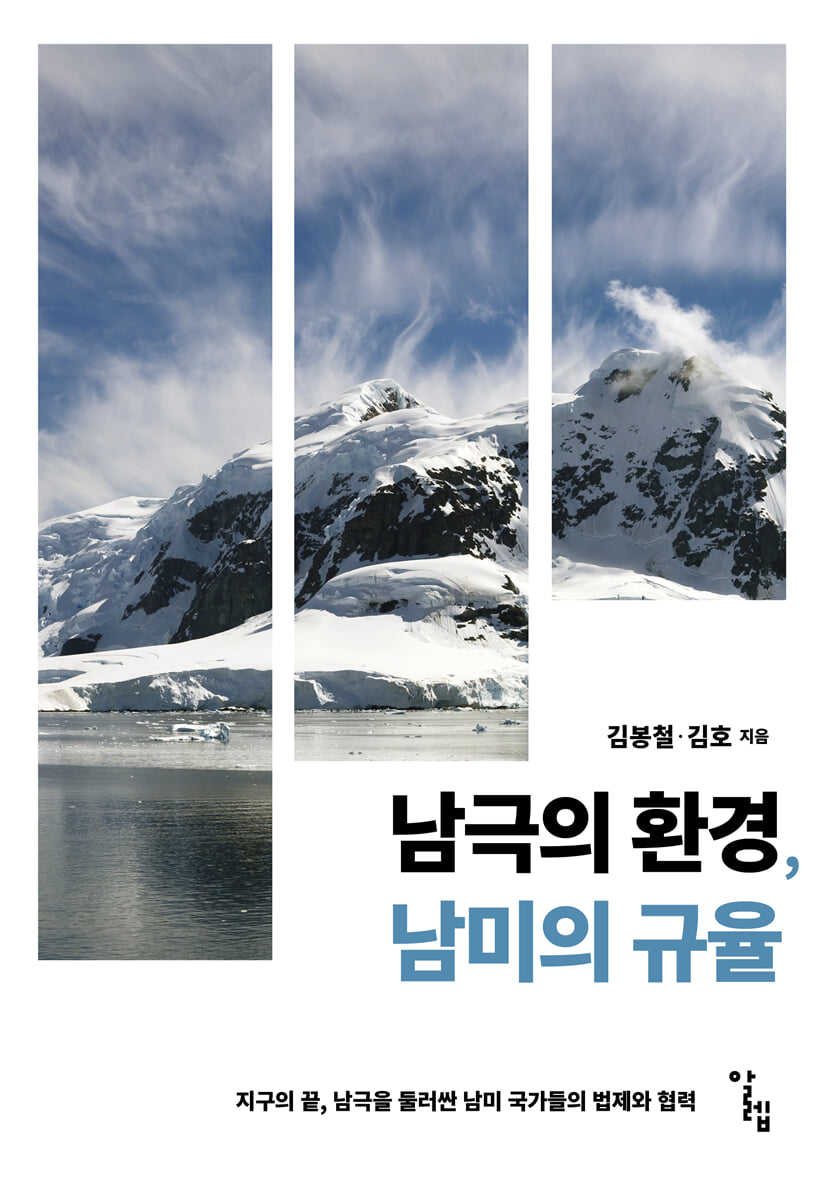
Antarctic environment, South American discipline
 |
Description
Book Introduction
A New Experiment in Environment and Law Begins in Antarctica
A Story of Norms and Cooperation Connecting Antarctica and South America
"Environment of Antarctica, Discipline of South America" is a book that examines the legal imagination and responses of South American countries, geographically close to Antarctica, in the complex regulatory arena surrounding Antarctica.
Humanity's interest in the polar regions dates back a long time, but their distance from civilization and harsh natural environments have long prevented human access.
However, advancements in science and technology and in navigation finally led humans to this unfamiliar space.
Among them, Antarctica is the last unknown space reached by mankind.
Since the 19th century, Antarctica has been a major target of exploration for explorers and scientists, and the world's attention was focused on the Norwegian explorer Roald Amundsen, who became the first human to reach the South Pole in 1911.
The climate crisis has become a global challenge that can no longer be addressed by the policies of a single country or the efforts of a single continent.
In this context, Antarctica is once again receiving attention as a regulator of the Earth's ecosystem and an environmental asset for future generations.
Accordingly, several countries are moving to reflect their own interests and positions on the legal status and disciplinary methods of Antarctica, and Antarctica has become an ecological space and a central stage for international negotiations where diplomacy and politics intersect.
Co-authors Bong-Cheol Kim, a professor in the Department of International Studies at Hankuk University of Foreign Studies, is an international law expert covering Europe, Southeast Asia, Central and South America, and the Polar Regions. Ho Kim, an associate professor in the Department of International Trade at Keimyung University, is a scholar who has studied trade, trade contracts, and polar law. The two authors focus on the movement of South America, which is creating norms from the periphery of the international order to the center.
"Antarctic Environment, South American Discipline" closely examines how South American countries, such as Argentina and Chile, have regulated the Antarctic environment and resources at various levels, including the Antarctic Treaty system, domestic law development, and policymaking.
These countries have not simply accepted international norms; they have also developed their own unique normative systems based on their historical experiences and ecological interconnectedness.
The authors examine these normative formations and institutional practices at the intersection of international and domestic law, raising the fundamental question of how to define and preserve the "common space" of Antarctica.
How can we precisely interpret the intersections of international and domestic law surrounding the polar regions? And how can we legally coordinate areas where diverse interests intersect, including those related to the environment, resources, diplomacy, and trade? These are the weighty questions this book poses.
A Story of Norms and Cooperation Connecting Antarctica and South America
"Environment of Antarctica, Discipline of South America" is a book that examines the legal imagination and responses of South American countries, geographically close to Antarctica, in the complex regulatory arena surrounding Antarctica.
Humanity's interest in the polar regions dates back a long time, but their distance from civilization and harsh natural environments have long prevented human access.
However, advancements in science and technology and in navigation finally led humans to this unfamiliar space.
Among them, Antarctica is the last unknown space reached by mankind.
Since the 19th century, Antarctica has been a major target of exploration for explorers and scientists, and the world's attention was focused on the Norwegian explorer Roald Amundsen, who became the first human to reach the South Pole in 1911.
The climate crisis has become a global challenge that can no longer be addressed by the policies of a single country or the efforts of a single continent.
In this context, Antarctica is once again receiving attention as a regulator of the Earth's ecosystem and an environmental asset for future generations.
Accordingly, several countries are moving to reflect their own interests and positions on the legal status and disciplinary methods of Antarctica, and Antarctica has become an ecological space and a central stage for international negotiations where diplomacy and politics intersect.
Co-authors Bong-Cheol Kim, a professor in the Department of International Studies at Hankuk University of Foreign Studies, is an international law expert covering Europe, Southeast Asia, Central and South America, and the Polar Regions. Ho Kim, an associate professor in the Department of International Trade at Keimyung University, is a scholar who has studied trade, trade contracts, and polar law. The two authors focus on the movement of South America, which is creating norms from the periphery of the international order to the center.
"Antarctic Environment, South American Discipline" closely examines how South American countries, such as Argentina and Chile, have regulated the Antarctic environment and resources at various levels, including the Antarctic Treaty system, domestic law development, and policymaking.
These countries have not simply accepted international norms; they have also developed their own unique normative systems based on their historical experiences and ecological interconnectedness.
The authors examine these normative formations and institutional practices at the intersection of international and domestic law, raising the fundamental question of how to define and preserve the "common space" of Antarctica.
How can we precisely interpret the intersections of international and domestic law surrounding the polar regions? And how can we legally coordinate areas where diverse interests intersect, including those related to the environment, resources, diplomacy, and trade? These are the weighty questions this book poses.
- You can preview some of the book's contents.
Preview
index
Entering
Chapter 1: Polar and Antarctic: International Discipline
Chapter 2: Discipline Regarding Antarctica: The Antarctic Treaty System
Chapter 3: South America's Interests and Challenges in Antarctica
Chapter 4 South American Regulations Regarding the Antarctic Environment
Chapter 5: International and Korean Interests in Antarctica: Potential for Cooperation with South America
References
Chapter 1: Polar and Antarctic: International Discipline
Chapter 2: Discipline Regarding Antarctica: The Antarctic Treaty System
Chapter 3: South America's Interests and Challenges in Antarctica
Chapter 4 South American Regulations Regarding the Antarctic Environment
Chapter 5: International and Korean Interests in Antarctica: Potential for Cooperation with South America
References
Detailed image
Into the book
Antarctica is the last unknown space to be approached by humanity, and its environmental issues pose a challenge to the international community, serving as a new testing ground for management and regulation.
The geographical proximity of Antarctica to South America, where they are influenced by each other's climate and environment, suggests that a South American approach to environmental issues could be attempted.
Seeing many South American countries experimenting with fairly novel legislation and policies regarding nature and the environment, it led to the idea that South America's interest in Antarctica and its legislation could be a subject of study.
--- p.5-6 From “Introduction”
The polar regions play a vital role in the Earth's environment and human survival, and the international community is cooperating to protect them and manage them sustainably.
Continued efforts and cooperation by the international community are essential to ensuring the protection and sustainable management of the polar regions, and are a matter of significant concern to the international community.
Both the Arctic and Antarctica have unique historical and environmental characteristics, and international management and governance systems have been established to effectively manage them.
These governance systems are comprised of international cooperative bodies and norms, and primarily address environmental protection, resource management, scientific research, and the protection of indigenous peoples' rights.
--- p.25 From “Chapter 1 Polar and Antarctic: Disciplines of the International Community”
Climate change has serious implications for polar ecosystems and human activities, requiring an international response.
Environmental protection and sustainable development in polar regions are important tasks for the international community.
The ecosystems of the Arctic and Antarctic are highly sensitive to human activity, and resource development and expansion of the tourism industry can have a significant impact on the environment.
It is necessary to strengthen environmental protection regulations and introduce sustainable development models through international cooperation.
It plays a vital role in protecting polar ecosystems and responding to climate change.
--- p.33 From “Chapter 1 Polar and Antarctic: Disciplines of the International Community”
The conclusion of the Antarctic Treaty in 1959 can be seen as the fruition of international efforts to maintain Antarctica as a space for peace and scientific research even during the Cold War.
The Antarctic Treaty is a very important treaty in the international community, as it provides stable protection for Antarctica as a public good for all of humanity, protects the global environment through peaceful international cooperation, and establishes the legal basis and standards for the disciplines necessary for scientific progress.
--- p.69 From “Chapter 2 Disciplines Regarding Antarctica: The Antarctic Treaty System”
However, in reality, the Antarctic Treaty System operated for a long time without a permanent administrative entity.
Since September 2004, the Antarctic Treaty Secretariat has been established in Buenos Aires, Argentina, and has officially begun operation as the permanent administrative body of the Antarctic Treaty System.
The Secretariat provides administrative support for the Antarctic Treaty Consultative Meetings and meetings related to the Antarctic Treaty, monitors the implementation of the Convention and its Protocols, and shares information and data with Member States.
--- p.82 Chapter 2 Disciplines Regarding Antarctica: The Antarctic Treaty System
The geographical proximity of Antarctica to South America makes Antarctica a key issue in South American foreign and domestic policy, and Antarctic issues are emerging as a major concern for South American countries.
In particular, the Patagonia region of Chile and Argentina is close to Antarctica and serves as a major gateway for Antarctic research and exploration.
Due to these geographical characteristics, South American countries have a direct stake in Antarctic issues, and many of them have joined the Antarctic Treaty and are actively participating.
--- p.103 From “Chapter 3: South America’s Interests and Challenges in Antarctica”
Cooperation among South American countries on Antarctic issues has developed based on several factors and contexts.
Argentina and Chile, which have held important positions since the Antarctic Treaty was first concluded, played a leading role, and their activities played a role in strengthening South America's scientific research and diplomatic cooperation in Antarctica.
(……) Since the 1970s, more South American countries, including Brazil, have joined the Antarctic Treaty System, influencing scientific research in general across the international community.
--- p.133 From “Chapter 3 South America’s Interests and Challenges in Antarctica”
Chile has further systematized its policy toward Antarctica by revising its domestic legislation.
In particular, Law No. 21255, also known as the Chilean Antarctic Law (Ley Antartica Chilena), enacted in 2020 and entered into force in 2021, is a comprehensive and integrated legislation related to Antarctica, providing legal support for national Antarctic activities.
The law prioritizes environmental protection as a fundamental principle and codifies waste management, environmental impact assessment, emergency response, legal liability for environmental damage, and criminal regulations for environmental crimes.
This system has a similar structure to the Madrid Protocol on Environmental Protection adopted in 1991, demonstrating that Chile is faithfully incorporating international environmental standards into its domestic laws.
--- p.120 From “Chapter 4 South American Regulations Regarding the Antarctic Environment”
Argentina was the first signatory to the Antarctic Treaty and strongly supports the principles of international law prohibiting military use of Antarctica and promoting peaceful use.
In particular, in 2004, the Antarctic Treaty's status was strengthened by establishing the Antarctic Treaty Secretariat in Buenos Aires in accordance with the decision of the Antarctic Treaty Consultative Conference.
The Secretariat is a legal entity, and in 2003, the Argentine government signed a Headquarters Agreement with the Antarctic Treaty Consultative Conference to support the operation of the Secretariat.
This Agreement establishes the legal status, financial resources, and operational modalities of the Secretariat, and clarifies the relationship between the Government of Argentina and the Antarctic Treaty Council.
These measures demonstrate that Argentina is functioning as an institutional center of the Antarctic Treaty System, beyond being a mere treaty party.
--- p.126 From “Chapter 4 South American Regulations Regarding the Antarctic Environment”
Since joining the Antarctic Treaty in 1986, Korea has recognized the scientific value and international responsibility of Antarctica and has established a foundation for continuous research.
South Korea operates scientific research stations and conducts research in a variety of fields, including atmospheric, biological, geological, and marine research. This contributes to detecting changes in the Antarctic environment and strengthening international capacity to respond to climate change.
Recently, Korea enacted the Antarctic Activities Act and the Polar Activities Promotion Act, strengthening the overall institutional framework for scientific exploration, environmental protection, international cooperation, and policy consistency.
Now, Korea has reached a point where it must pursue policies that balance qualitative advancements in scientific research with environmental conservation and international cooperation.
--- p.173 From “Chapter 5: International Community and Korea’s Interest in Antarctica: Possibility of Cooperation with South America”
In the long term, Korea must re-establish its activities in Antarctica beyond simple exploration and scientific research, to activities that contribute to the shared values pursued by the international community.
Antarctica is at the forefront of the climate crisis and holds significant value as an environmental legacy for future generations.
Therefore, Korea must establish its identity as an ‘environmentally responsible nation.’
Collaboration with South America is a strategic choice to accelerate this process, and legal enforcement, science-based policymaking, and international solidarity will play a key role in shaping global governance for Antarctic protection.
This is ultimately closely linked to the development of international law surrounding Antarctica, and is also a way to strengthen Korea's global standing.
The geographical proximity of Antarctica to South America, where they are influenced by each other's climate and environment, suggests that a South American approach to environmental issues could be attempted.
Seeing many South American countries experimenting with fairly novel legislation and policies regarding nature and the environment, it led to the idea that South America's interest in Antarctica and its legislation could be a subject of study.
--- p.5-6 From “Introduction”
The polar regions play a vital role in the Earth's environment and human survival, and the international community is cooperating to protect them and manage them sustainably.
Continued efforts and cooperation by the international community are essential to ensuring the protection and sustainable management of the polar regions, and are a matter of significant concern to the international community.
Both the Arctic and Antarctica have unique historical and environmental characteristics, and international management and governance systems have been established to effectively manage them.
These governance systems are comprised of international cooperative bodies and norms, and primarily address environmental protection, resource management, scientific research, and the protection of indigenous peoples' rights.
--- p.25 From “Chapter 1 Polar and Antarctic: Disciplines of the International Community”
Climate change has serious implications for polar ecosystems and human activities, requiring an international response.
Environmental protection and sustainable development in polar regions are important tasks for the international community.
The ecosystems of the Arctic and Antarctic are highly sensitive to human activity, and resource development and expansion of the tourism industry can have a significant impact on the environment.
It is necessary to strengthen environmental protection regulations and introduce sustainable development models through international cooperation.
It plays a vital role in protecting polar ecosystems and responding to climate change.
--- p.33 From “Chapter 1 Polar and Antarctic: Disciplines of the International Community”
The conclusion of the Antarctic Treaty in 1959 can be seen as the fruition of international efforts to maintain Antarctica as a space for peace and scientific research even during the Cold War.
The Antarctic Treaty is a very important treaty in the international community, as it provides stable protection for Antarctica as a public good for all of humanity, protects the global environment through peaceful international cooperation, and establishes the legal basis and standards for the disciplines necessary for scientific progress.
--- p.69 From “Chapter 2 Disciplines Regarding Antarctica: The Antarctic Treaty System”
However, in reality, the Antarctic Treaty System operated for a long time without a permanent administrative entity.
Since September 2004, the Antarctic Treaty Secretariat has been established in Buenos Aires, Argentina, and has officially begun operation as the permanent administrative body of the Antarctic Treaty System.
The Secretariat provides administrative support for the Antarctic Treaty Consultative Meetings and meetings related to the Antarctic Treaty, monitors the implementation of the Convention and its Protocols, and shares information and data with Member States.
--- p.82 Chapter 2 Disciplines Regarding Antarctica: The Antarctic Treaty System
The geographical proximity of Antarctica to South America makes Antarctica a key issue in South American foreign and domestic policy, and Antarctic issues are emerging as a major concern for South American countries.
In particular, the Patagonia region of Chile and Argentina is close to Antarctica and serves as a major gateway for Antarctic research and exploration.
Due to these geographical characteristics, South American countries have a direct stake in Antarctic issues, and many of them have joined the Antarctic Treaty and are actively participating.
--- p.103 From “Chapter 3: South America’s Interests and Challenges in Antarctica”
Cooperation among South American countries on Antarctic issues has developed based on several factors and contexts.
Argentina and Chile, which have held important positions since the Antarctic Treaty was first concluded, played a leading role, and their activities played a role in strengthening South America's scientific research and diplomatic cooperation in Antarctica.
(……) Since the 1970s, more South American countries, including Brazil, have joined the Antarctic Treaty System, influencing scientific research in general across the international community.
--- p.133 From “Chapter 3 South America’s Interests and Challenges in Antarctica”
Chile has further systematized its policy toward Antarctica by revising its domestic legislation.
In particular, Law No. 21255, also known as the Chilean Antarctic Law (Ley Antartica Chilena), enacted in 2020 and entered into force in 2021, is a comprehensive and integrated legislation related to Antarctica, providing legal support for national Antarctic activities.
The law prioritizes environmental protection as a fundamental principle and codifies waste management, environmental impact assessment, emergency response, legal liability for environmental damage, and criminal regulations for environmental crimes.
This system has a similar structure to the Madrid Protocol on Environmental Protection adopted in 1991, demonstrating that Chile is faithfully incorporating international environmental standards into its domestic laws.
--- p.120 From “Chapter 4 South American Regulations Regarding the Antarctic Environment”
Argentina was the first signatory to the Antarctic Treaty and strongly supports the principles of international law prohibiting military use of Antarctica and promoting peaceful use.
In particular, in 2004, the Antarctic Treaty's status was strengthened by establishing the Antarctic Treaty Secretariat in Buenos Aires in accordance with the decision of the Antarctic Treaty Consultative Conference.
The Secretariat is a legal entity, and in 2003, the Argentine government signed a Headquarters Agreement with the Antarctic Treaty Consultative Conference to support the operation of the Secretariat.
This Agreement establishes the legal status, financial resources, and operational modalities of the Secretariat, and clarifies the relationship between the Government of Argentina and the Antarctic Treaty Council.
These measures demonstrate that Argentina is functioning as an institutional center of the Antarctic Treaty System, beyond being a mere treaty party.
--- p.126 From “Chapter 4 South American Regulations Regarding the Antarctic Environment”
Since joining the Antarctic Treaty in 1986, Korea has recognized the scientific value and international responsibility of Antarctica and has established a foundation for continuous research.
South Korea operates scientific research stations and conducts research in a variety of fields, including atmospheric, biological, geological, and marine research. This contributes to detecting changes in the Antarctic environment and strengthening international capacity to respond to climate change.
Recently, Korea enacted the Antarctic Activities Act and the Polar Activities Promotion Act, strengthening the overall institutional framework for scientific exploration, environmental protection, international cooperation, and policy consistency.
Now, Korea has reached a point where it must pursue policies that balance qualitative advancements in scientific research with environmental conservation and international cooperation.
--- p.173 From “Chapter 5: International Community and Korea’s Interest in Antarctica: Possibility of Cooperation with South America”
In the long term, Korea must re-establish its activities in Antarctica beyond simple exploration and scientific research, to activities that contribute to the shared values pursued by the international community.
Antarctica is at the forefront of the climate crisis and holds significant value as an environmental legacy for future generations.
Therefore, Korea must establish its identity as an ‘environmentally responsible nation.’
Collaboration with South America is a strategic choice to accelerate this process, and legal enforcement, science-based policymaking, and international solidarity will play a key role in shaping global governance for Antarctic protection.
This is ultimately closely linked to the development of international law surrounding Antarctica, and is also a way to strengthen Korea's global standing.
--- p.177 From “Chapter 5: International Community and Korea’s Interest in Antarctica: Possibility of Cooperation with South America”
Publisher's Review
The Birth of Discipline Surrounding the Polar Regions
The Arctic and Antarctic: A Testing Ground for Global Cooperation
The North and South Poles are collectively called the 'polar regions'.
The authors define the concept of this 'polar region' and explain how this space has become subject to international regulation.
The Arctic and Antarctic regions share harsh climates, isolation, resource potential, and ecological vulnerability.
It is a space where exploration, scientific activities, resource acquisition, and military tensions of various countries intersect.
How has the international community transformed the polar regions into "manageable spaces"? In Chapter 1, "The Polar Regions and Antarctica: Disciplines of the International Community," the authors examine this within the context of international norms and agreements.
If there is the Arctic Council in the North Pole, there is the Antarctic Treaty System in the South Pole.
The Arctic Council pursues the values of indigenous peoples' rights, environmental protection, and sustainable development, and has established a relatively flexible consultative structure.
However, the Antarctic Treaty system is a more explicit and binding normative system.
The Antarctic Treaty prohibited military activity, established scientific research and environmental protection as core values, and enabled international cooperation under the principle of joint management.
Along with this, subsidiary agreements such as the Convention on the Conservation of Antarctic Marine Living Resources were concluded, establishing a legal framework encompassing the marine ecosystem of Antarctica.
This chapter emphasizes that the formation of international norms surrounding the polar regions was not simply a result of the political calculations of major powers, but rather a result of the combined efforts of the accumulation of scientific information, the need for environmental conservation, and institutional imagination.
The Antarctic Treaty: Establishing the Law of Peace
A model of international cooperation that was possible even during the Cold War
The Antarctic Treaty was concluded in 1959 during the Cold War, stipulating the values of scientific cooperation and peaceful use, and was the first full-fledged legal agreement of the international community to protect Antarctica as a common space for humanity.
In Chapter 2, “Government of Antarctica: The Antarctic Treaty System,” the authors present a detailed account of the formation and key principles of the international legal system governing Antarctica, namely the “Antarctic Treaty System,” and its subsequent development.
The treaty banned all military activity, guaranteed freedom of scientific research and information sharing, and suspended existing territorial claims.
Nuclear testing and radioactive waste dumping were also explicitly prohibited, and Antarctica was declared a "demilitarized, non-territorial, and nuclear-free" space.
In addition, it sought to increase the transparency and effectiveness of the treaty by mutually opening research bases of each country and stipulating the authority for on-site inspections.
Afterwards, various subsidiary agreements were concluded, such as the Agreement on the Conservation of Antarctic Flora and Fauna, the Convention on the Conservation of Antarctic Marine Living Resources, and the Protocol to the Antarctic Treaty on Environmental Protection, and the legal framework surrounding Antarctica gradually expanded in sophistication.
Challenge to Antarctica
Diplomacy among South American countries surrounding Antarctica
South America, which is close to Antarctica, has shown a deep interest in Antarctica from early on.
In Chapter 3, "South America's Interests and Challenges in Antarctica," the authors examine how South American countries have positioned themselves as key stakeholders in Antarctic issues, focusing on their historical interest in and diplomatic approach to Antarctica.
Argentina and Chile have claimed sovereignty over Antarctica due to their close geographic proximity to the continent and their long history of navigation and exploration.
Even before the launch of the Antarctic Treaty System, both countries have sought to secure legitimacy for their participation in Antarctica through legal and diplomatic means, and have also continued to attempt to integrate Antarctica into their national identities and diplomatic strategies.
In the late 1970s, Chile and Argentina came close to military conflict over sovereignty over the Strait of Magellan and surrounding waters.
Fortunately, a diplomatic solution was chosen through the mediation of the Vatican, and this incident remains a prime example of how armed conflict was transformed into diplomacy and cooperation.
Since then, the two countries have further strengthened their cooperation in Antarctica through joint scientific research, development of port and transportation infrastructure, and policy coordination.
These changes demonstrate that South American countries are not simply accepting the Antarctic Treaty system, but are actively participating in norm formation and implementation.
Discipline of South American countries surrounding Antarctica
Beyond the treaty, Antarctic discipline implemented through national legal systems
Chapter 4, "South American Regulations Regarding the Antarctic Environment," examines how major South American countries have established laws and institutions to protect the Antarctic environment while also securing their own strategic interests.
Argentina, Brazil, and Chile have established their own legal and administrative systems within the framework of the Antarctic Treaty System, reflecting their respective historical experiences and political needs. These regulations extend beyond mere environmental conservation and are linked to diverse objectives, including national security, diplomatic strategy, and the operation of scientific bases.
Chile has enacted the Chilean Antarctic Law, which covers all Antarctic activities, establishing a sophisticated legal framework that encompasses waste management, environmental impact assessments, emergency response, and the prosecution of environmental crimes.
For example, the Economic and Environmental Crimes Act defines environmental violations in the Antarctic as serious crimes and designates them under the jurisdiction of special prosecutors, thereby establishing a criminal response system.
Argentina has maintained a robust scientific exploration and environmental monitoring system centered around the world's first Antarctic station, Orcadas Station, while Brazil is gradually building an interagency cooperation platform linking science, diplomacy, and the environment through the Navy-led PROANTAR and the National Commission on Antarctic Affairs (CONANTAR).
These countries have developed a system that preserves the Antarctic ecosystem while also considering military and strategic uses for scientific bases and transportation infrastructure. Various ministries, including the Ministry of Foreign Affairs, the Ministry of National Defense, and the Ministry of Environment, are working closely together in policy design and legislation.
The Potential for Polar Cooperation: Korea and South America
Cooperation between Korea and South America in the Age of Climate Crisis
What has Korea's interest and involvement in Antarctica been like? Since joining the Antarctic Treaty in 1986, Korea has steadily strengthened its institutional foundation and infrastructure through the establishment of the King Sejong Station and the Jang Bogo Station, the operation of the icebreaker research vessel Araon, and the enactment of the Antarctic Activities Act and the Polar Activities Promotion Act.
The international community's interest in Antarctica extends beyond simple scientific exploration to a complex issue intertwined with global environmental change, resource competition, and diplomatic strategy.
Chapter 5, "International Community and Korea's Interest in Antarctica: Potential for Cooperation with South America," examines the international community's approach to Antarctica within this context, focusing particularly on the potential for cooperation between Korea and South American countries.
Territorial disputes in Antarctica, the designation of marine protected areas, and the invasion of invasive alien species have already emerged as issues requiring a global response.
In this process, the need for cooperation from the international community is further emphasized.
Korea has broadened the foundation of cooperation, particularly with South American countries, by concluding bilateral and multilateral agreements on joint research, technological cooperation, and the establishment of distribution systems.
The Korea-Chile Antarctic Cooperation Center established in Punta Arenas, Chile, is considered a representative achievement.
Although Korea is geographically far from Antarctica, it possesses strengths in science and technology, including remote sensing and climate modeling.
On the other hand, South American countries have advantageous conditions in terms of on-site accessibility and logistics infrastructure, so cooperation between the two sides can form a mutually complementary relationship.
What about the 'Buen Vivir Collection'?
The HK+ Project Group of the Institute of Latin American Studies at Hankuk University of Foreign Studies is carrying out a project titled "Latin America, a Platform for the Transition of 21st Century Civilization: From Industrial Civilization to Ecological Civilization."
This division researches the alternative worldviews and lifestyles pursued by Latin Americans, as well as various efforts being made to shift the paradigm toward an ecological civilization not only in Latin America but also around the world.
To share the research results related to this with the public, we are planning and publishing the 'Buen Vivir Series'.
'Buen vivir' is a word that expresses the life pursued by the Andean indigenous people, and its core content is harmony and coexistence within the community.
The Buen Vivir series contains the results of a fusion of humanities, social sciences, and natural sciences that explores the ecological civilization of Latin America.
The Arctic and Antarctic: A Testing Ground for Global Cooperation
The North and South Poles are collectively called the 'polar regions'.
The authors define the concept of this 'polar region' and explain how this space has become subject to international regulation.
The Arctic and Antarctic regions share harsh climates, isolation, resource potential, and ecological vulnerability.
It is a space where exploration, scientific activities, resource acquisition, and military tensions of various countries intersect.
How has the international community transformed the polar regions into "manageable spaces"? In Chapter 1, "The Polar Regions and Antarctica: Disciplines of the International Community," the authors examine this within the context of international norms and agreements.
If there is the Arctic Council in the North Pole, there is the Antarctic Treaty System in the South Pole.
The Arctic Council pursues the values of indigenous peoples' rights, environmental protection, and sustainable development, and has established a relatively flexible consultative structure.
However, the Antarctic Treaty system is a more explicit and binding normative system.
The Antarctic Treaty prohibited military activity, established scientific research and environmental protection as core values, and enabled international cooperation under the principle of joint management.
Along with this, subsidiary agreements such as the Convention on the Conservation of Antarctic Marine Living Resources were concluded, establishing a legal framework encompassing the marine ecosystem of Antarctica.
This chapter emphasizes that the formation of international norms surrounding the polar regions was not simply a result of the political calculations of major powers, but rather a result of the combined efforts of the accumulation of scientific information, the need for environmental conservation, and institutional imagination.
The Antarctic Treaty: Establishing the Law of Peace
A model of international cooperation that was possible even during the Cold War
The Antarctic Treaty was concluded in 1959 during the Cold War, stipulating the values of scientific cooperation and peaceful use, and was the first full-fledged legal agreement of the international community to protect Antarctica as a common space for humanity.
In Chapter 2, “Government of Antarctica: The Antarctic Treaty System,” the authors present a detailed account of the formation and key principles of the international legal system governing Antarctica, namely the “Antarctic Treaty System,” and its subsequent development.
The treaty banned all military activity, guaranteed freedom of scientific research and information sharing, and suspended existing territorial claims.
Nuclear testing and radioactive waste dumping were also explicitly prohibited, and Antarctica was declared a "demilitarized, non-territorial, and nuclear-free" space.
In addition, it sought to increase the transparency and effectiveness of the treaty by mutually opening research bases of each country and stipulating the authority for on-site inspections.
Afterwards, various subsidiary agreements were concluded, such as the Agreement on the Conservation of Antarctic Flora and Fauna, the Convention on the Conservation of Antarctic Marine Living Resources, and the Protocol to the Antarctic Treaty on Environmental Protection, and the legal framework surrounding Antarctica gradually expanded in sophistication.
Challenge to Antarctica
Diplomacy among South American countries surrounding Antarctica
South America, which is close to Antarctica, has shown a deep interest in Antarctica from early on.
In Chapter 3, "South America's Interests and Challenges in Antarctica," the authors examine how South American countries have positioned themselves as key stakeholders in Antarctic issues, focusing on their historical interest in and diplomatic approach to Antarctica.
Argentina and Chile have claimed sovereignty over Antarctica due to their close geographic proximity to the continent and their long history of navigation and exploration.
Even before the launch of the Antarctic Treaty System, both countries have sought to secure legitimacy for their participation in Antarctica through legal and diplomatic means, and have also continued to attempt to integrate Antarctica into their national identities and diplomatic strategies.
In the late 1970s, Chile and Argentina came close to military conflict over sovereignty over the Strait of Magellan and surrounding waters.
Fortunately, a diplomatic solution was chosen through the mediation of the Vatican, and this incident remains a prime example of how armed conflict was transformed into diplomacy and cooperation.
Since then, the two countries have further strengthened their cooperation in Antarctica through joint scientific research, development of port and transportation infrastructure, and policy coordination.
These changes demonstrate that South American countries are not simply accepting the Antarctic Treaty system, but are actively participating in norm formation and implementation.
Discipline of South American countries surrounding Antarctica
Beyond the treaty, Antarctic discipline implemented through national legal systems
Chapter 4, "South American Regulations Regarding the Antarctic Environment," examines how major South American countries have established laws and institutions to protect the Antarctic environment while also securing their own strategic interests.
Argentina, Brazil, and Chile have established their own legal and administrative systems within the framework of the Antarctic Treaty System, reflecting their respective historical experiences and political needs. These regulations extend beyond mere environmental conservation and are linked to diverse objectives, including national security, diplomatic strategy, and the operation of scientific bases.
Chile has enacted the Chilean Antarctic Law, which covers all Antarctic activities, establishing a sophisticated legal framework that encompasses waste management, environmental impact assessments, emergency response, and the prosecution of environmental crimes.
For example, the Economic and Environmental Crimes Act defines environmental violations in the Antarctic as serious crimes and designates them under the jurisdiction of special prosecutors, thereby establishing a criminal response system.
Argentina has maintained a robust scientific exploration and environmental monitoring system centered around the world's first Antarctic station, Orcadas Station, while Brazil is gradually building an interagency cooperation platform linking science, diplomacy, and the environment through the Navy-led PROANTAR and the National Commission on Antarctic Affairs (CONANTAR).
These countries have developed a system that preserves the Antarctic ecosystem while also considering military and strategic uses for scientific bases and transportation infrastructure. Various ministries, including the Ministry of Foreign Affairs, the Ministry of National Defense, and the Ministry of Environment, are working closely together in policy design and legislation.
The Potential for Polar Cooperation: Korea and South America
Cooperation between Korea and South America in the Age of Climate Crisis
What has Korea's interest and involvement in Antarctica been like? Since joining the Antarctic Treaty in 1986, Korea has steadily strengthened its institutional foundation and infrastructure through the establishment of the King Sejong Station and the Jang Bogo Station, the operation of the icebreaker research vessel Araon, and the enactment of the Antarctic Activities Act and the Polar Activities Promotion Act.
The international community's interest in Antarctica extends beyond simple scientific exploration to a complex issue intertwined with global environmental change, resource competition, and diplomatic strategy.
Chapter 5, "International Community and Korea's Interest in Antarctica: Potential for Cooperation with South America," examines the international community's approach to Antarctica within this context, focusing particularly on the potential for cooperation between Korea and South American countries.
Territorial disputes in Antarctica, the designation of marine protected areas, and the invasion of invasive alien species have already emerged as issues requiring a global response.
In this process, the need for cooperation from the international community is further emphasized.
Korea has broadened the foundation of cooperation, particularly with South American countries, by concluding bilateral and multilateral agreements on joint research, technological cooperation, and the establishment of distribution systems.
The Korea-Chile Antarctic Cooperation Center established in Punta Arenas, Chile, is considered a representative achievement.
Although Korea is geographically far from Antarctica, it possesses strengths in science and technology, including remote sensing and climate modeling.
On the other hand, South American countries have advantageous conditions in terms of on-site accessibility and logistics infrastructure, so cooperation between the two sides can form a mutually complementary relationship.
What about the 'Buen Vivir Collection'?
The HK+ Project Group of the Institute of Latin American Studies at Hankuk University of Foreign Studies is carrying out a project titled "Latin America, a Platform for the Transition of 21st Century Civilization: From Industrial Civilization to Ecological Civilization."
This division researches the alternative worldviews and lifestyles pursued by Latin Americans, as well as various efforts being made to shift the paradigm toward an ecological civilization not only in Latin America but also around the world.
To share the research results related to this with the public, we are planning and publishing the 'Buen Vivir Series'.
'Buen vivir' is a word that expresses the life pursued by the Andean indigenous people, and its core content is harmony and coexistence within the community.
The Buen Vivir series contains the results of a fusion of humanities, social sciences, and natural sciences that explores the ecological civilization of Latin America.
GOODS SPECIFICS
- Date of issue: July 31, 2025
- Page count, weight, size: 192 pages | 200g | 140*205*16mm
- ISBN13: 9791189333980
You may also like
카테고리
korean


korean

![ELLE 엘르 스페셜 에디션 A형 : 12월 [2025]](http://librairie.coreenne.fr/cdn/shop/files/b8e27a3de6c9538896439686c6b0e8fb.jpg?v=1766436872&width=3840)


