

Mindfulness Workbook for Kids
 |
Description
Book Introduction
Why do public elementary schools in the UK and the US teach 'mindfulness'?
The mindfulness craze in the West is well known.
According to the Harvard Business Review published in 2015, the mindfulness industry in the United States has already surpassed $4 billion (KRW 4.76 trillion) and has been growing rapidly every year since.
Given the current situation, there are warnings about the commercialization of meditation.
In the early days, hospitals were the largest base for the spread of mindfulness in the West.
Strengthening immune function.
As mindfulness has proven to be effective in reducing pain and other issues, the use of mindfulness as an adjunct to medical care has begun to increase.
The growth in the field of psychotherapy is even more remarkable. A field called Mindfulness-Based Psychotherapy (MBSR) has now become a mainstream practice.
There are even statistics showing that mindfulness currently accounts for approximately 60% of psychological treatments in the United States.
In addition to these circumstances, the expansion into various fields, not just medicine, has been noteworthy over the past decade.
Major companies like Google and Apple have adopted mindfulness to improve not only the psychological well-being of their employees but also sales, and professional sports teams and the military are increasingly adopting mindfulness based on their individual needs.
But the place where it spread most widely and effectively was ‘school.’
In mid-2010, a bill passed by Parliament in the UK mandating the introduction of mindfulness education in public schools, and it was recently reported that 4,500 teachers were being prepared to provide 'one-on-one intensive mindfulness' to one million children over the next five years.
The United States is no different.
Although there are differences from state to state, a growing number of public schools are already implementing mindfulness meditation programs.
Introducing mindfulness meditation for children and adolescents has already become a national initiative.
So why is mindfulness meditation so popular in schools?
There are numerous studies, but they generally agree that mindfulness meditation not only improves children's concentration, but is also very effective in treating children's 'mental illnesses' such as anger management disorder and ADHD, which are emerging as recent problems.
Recently, a flood of papers has been published claiming that it is also remarkably effective in fostering compassion and a sense of community.
The mindfulness craze in the West is well known.
According to the Harvard Business Review published in 2015, the mindfulness industry in the United States has already surpassed $4 billion (KRW 4.76 trillion) and has been growing rapidly every year since.
Given the current situation, there are warnings about the commercialization of meditation.
In the early days, hospitals were the largest base for the spread of mindfulness in the West.
Strengthening immune function.
As mindfulness has proven to be effective in reducing pain and other issues, the use of mindfulness as an adjunct to medical care has begun to increase.
The growth in the field of psychotherapy is even more remarkable. A field called Mindfulness-Based Psychotherapy (MBSR) has now become a mainstream practice.
There are even statistics showing that mindfulness currently accounts for approximately 60% of psychological treatments in the United States.
In addition to these circumstances, the expansion into various fields, not just medicine, has been noteworthy over the past decade.
Major companies like Google and Apple have adopted mindfulness to improve not only the psychological well-being of their employees but also sales, and professional sports teams and the military are increasingly adopting mindfulness based on their individual needs.
But the place where it spread most widely and effectively was ‘school.’
In mid-2010, a bill passed by Parliament in the UK mandating the introduction of mindfulness education in public schools, and it was recently reported that 4,500 teachers were being prepared to provide 'one-on-one intensive mindfulness' to one million children over the next five years.
The United States is no different.
Although there are differences from state to state, a growing number of public schools are already implementing mindfulness meditation programs.
Introducing mindfulness meditation for children and adolescents has already become a national initiative.
So why is mindfulness meditation so popular in schools?
There are numerous studies, but they generally agree that mindfulness meditation not only improves children's concentration, but is also very effective in treating children's 'mental illnesses' such as anger management disorder and ADHD, which are emerging as recent problems.
Recently, a flood of papers has been published claiming that it is also remarkably effective in fostering compassion and a sense of community.
- You can preview some of the book's contents.
Preview
index
Chapter 1: Preparation for Mindfulness
Connect with practice mindfulness!
Practice rough waves, gentle waves
Feel the practice breathing
How does my body feel when I practice?
Exercise 3-2-1: Tune into your senses
My Mindfulness Toolbox for Practice
Chapter 2: Preparing for a New Day
Log in with a practice mindset!
Practice What do I want to achieve?
Practice Curiosity Warehouse
Maintaining confidence through practice
Practice, my body, wake up!
Practice I am grateful…
A message to yourself through practice
Chapter 3: Focus Your Mind
Feeling focused on practice
Follow the practice song
Practice mirror, mirror on the wall
Practice Sensational Steps
Poke around every corner of the practice room
Breathing like a mountain of practice
Look at the practice glitter
Chapter 4: Getting to Know Your Mood
Practice Why do I feel this way?
Face the practice mood
Practice What color are you feeling today?
Practice Mood Explorer
Practice breathing with your belly
Practice and recharge your emotions!
Practice mood cloud
Chapter 5: Dealing with Worry
The starting point of practice stress
The worries that filled my body as I practiced
The bubble of practice worries
Let go of your worries about practice
Practice holding and releasing
Practice song sketch
Let's give practice anxiety a name.
Chapter 6: Staying Calm in Difficult Situations
What part of my body is this that I'm practicing on?
Shake it up and practice!
Spin the practice pinwheel!
Practice is a place that gives me happiness
Practice turning negativity into positivity
Colors that calm the mind during practice
Practice Life Lessons
Chapter 7: How to Make the Wiseest Decision
Practice: Reacting arbitrarily or responding cautiously?
Signs of a Practice Storm
Practice your breathing wisely!
Practice making a fist and opening your hand
Practice step by step
Affirmation of Practice Anger
Choosing at the practice fork
Chapter 8: Expressing Kindness, Compassion, and Empathy
Practice Embrace the World
Sending you a friendly greeting from the practice
Let's fill the practice heart
Practice Letter to My Most Precious Friend
A hand extended to me who was hurt during practice
Let's hear some words of practice care
Send a practice thank you note
Chapter 9: Ending the Day Powerfully
Breath of Comfort from Practice
Practice Moon Mantra
Practice twisting and straightening
Practice the flow of thought
When you surround yourself with the practice moonlight
Meditation on the Practice of Emotions
Practice today, this moment, and tomorrow
Connect with practice mindfulness!
Practice rough waves, gentle waves
Feel the practice breathing
How does my body feel when I practice?
Exercise 3-2-1: Tune into your senses
My Mindfulness Toolbox for Practice
Chapter 2: Preparing for a New Day
Log in with a practice mindset!
Practice What do I want to achieve?
Practice Curiosity Warehouse
Maintaining confidence through practice
Practice, my body, wake up!
Practice I am grateful…
A message to yourself through practice
Chapter 3: Focus Your Mind
Feeling focused on practice
Follow the practice song
Practice mirror, mirror on the wall
Practice Sensational Steps
Poke around every corner of the practice room
Breathing like a mountain of practice
Look at the practice glitter
Chapter 4: Getting to Know Your Mood
Practice Why do I feel this way?
Face the practice mood
Practice What color are you feeling today?
Practice Mood Explorer
Practice breathing with your belly
Practice and recharge your emotions!
Practice mood cloud
Chapter 5: Dealing with Worry
The starting point of practice stress
The worries that filled my body as I practiced
The bubble of practice worries
Let go of your worries about practice
Practice holding and releasing
Practice song sketch
Let's give practice anxiety a name.
Chapter 6: Staying Calm in Difficult Situations
What part of my body is this that I'm practicing on?
Shake it up and practice!
Spin the practice pinwheel!
Practice is a place that gives me happiness
Practice turning negativity into positivity
Colors that calm the mind during practice
Practice Life Lessons
Chapter 7: How to Make the Wiseest Decision
Practice: Reacting arbitrarily or responding cautiously?
Signs of a Practice Storm
Practice your breathing wisely!
Practice making a fist and opening your hand
Practice step by step
Affirmation of Practice Anger
Choosing at the practice fork
Chapter 8: Expressing Kindness, Compassion, and Empathy
Practice Embrace the World
Sending you a friendly greeting from the practice
Let's fill the practice heart
Practice Letter to My Most Precious Friend
A hand extended to me who was hurt during practice
Let's hear some words of practice care
Send a practice thank you note
Chapter 9: Ending the Day Powerfully
Breath of Comfort from Practice
Practice Moon Mantra
Practice twisting and straightening
Practice the flow of thought
When you surround yourself with the practice moonlight
Meditation on the Practice of Emotions
Practice today, this moment, and tomorrow
Detailed image
Publisher's Review
Training to enhance empathy and concentration in our children who are growing well.
As awareness grows of the profound benefits of mindfulness training for children, and the support needed to implement it grows, the number of books published on the subject is also increasing.
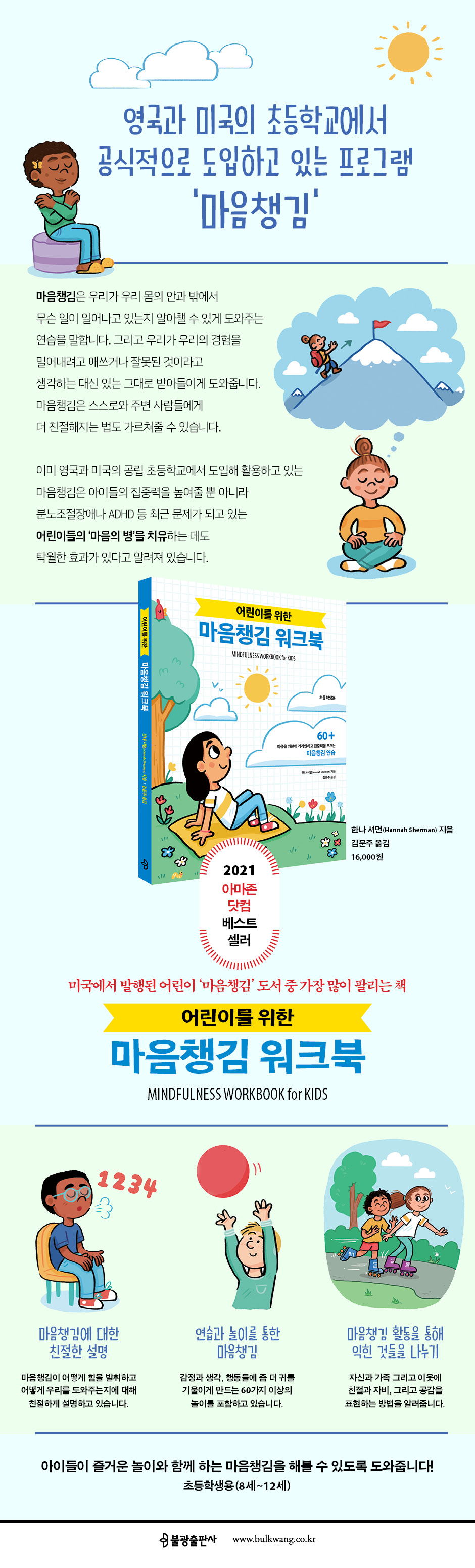
This book is the best-selling children's mindfulness book in the United States as of 2021.
The author has shared all the know-how he has accumulated over his many years of experience as a mindfulness meditation instructor for children and adolescents.
The contents of the book are largely divided into three parts.
- It is explained in an easy way so that children can understand what ‘mindfulness’ is.
- Over 60 'exercises' help you become more attentive to your emotions, thoughts, and actions.
- It also provides detailed information on how to share what you have learned through mindfulness activities.
The 62 activities included in the book are designed to accommodate children's attention spans, with most lasting no longer than 1 to 10 minutes. They are designed as a variety of programs that can be practiced anywhere, from school to home, and from morning to evening, to suit children's schedules and activities.
There are also programs that allow you to mark up or draw directly in the book, as well as programs that allow you to practice while you're resting, before or after meals, or before going to bed with the book closed.
There are over 1,200 opinions on Amazon from parents and teachers who have actually purchased and used the book, and the evaluations are approaching a perfect score of five stars, which is rare for a workbook.
If possible, it is recommended that parents or teachers read the book first and provide brief guidance, and then allow children to use it through the book or even after the book is closed.
As awareness grows of the profound benefits of mindfulness training for children, and the support needed to implement it grows, the number of books published on the subject is also increasing.
This book is the best-selling children's mindfulness book in the United States as of 2021.
The author has shared all the know-how he has accumulated over his many years of experience as a mindfulness meditation instructor for children and adolescents.
The contents of the book are largely divided into three parts.
- It is explained in an easy way so that children can understand what ‘mindfulness’ is.
- Over 60 'exercises' help you become more attentive to your emotions, thoughts, and actions.
- It also provides detailed information on how to share what you have learned through mindfulness activities.
The 62 activities included in the book are designed to accommodate children's attention spans, with most lasting no longer than 1 to 10 minutes. They are designed as a variety of programs that can be practiced anywhere, from school to home, and from morning to evening, to suit children's schedules and activities.
There are also programs that allow you to mark up or draw directly in the book, as well as programs that allow you to practice while you're resting, before or after meals, or before going to bed with the book closed.
There are over 1,200 opinions on Amazon from parents and teachers who have actually purchased and used the book, and the evaluations are approaching a perfect score of five stars, which is rare for a workbook.
If possible, it is recommended that parents or teachers read the book first and provide brief guidance, and then allow children to use it through the book or even after the book is closed.
GOODS SPECIFICS
- Publication date: December 6, 2021
- Page count, weight, size: 136 pages | 456g | 203*254*10mm
- ISBN13: 9788974799588
- ISBN10: 8974799588
You may also like
카테고리
korean


korean

![GQ KOREA Mark (Monthly): December [2025]](http://librairie.coreenne.fr/cdn/shop/files/8ef265dbbfbf186523ed75ba7319009d.jpg?v=1765340328&width=3840)


