

If every moment of our daily lives were filled with chemistry
 |
Description
Book Introduction
The intersection of color and light, metal and particle, sense and atom,
A story rewritten by a chemist there
#From Yves Klein's blue velvet to Monet's colors and Klimt's gold
#Knowing chemistry means seeing the world at the atomic level.
“There is beauty that becomes more beautiful through knowledge.
“The feeling of longing becomes clearer when you understand the reason for the object, its creation, and the principles behind it.” - Lee Ok-to (photographer)
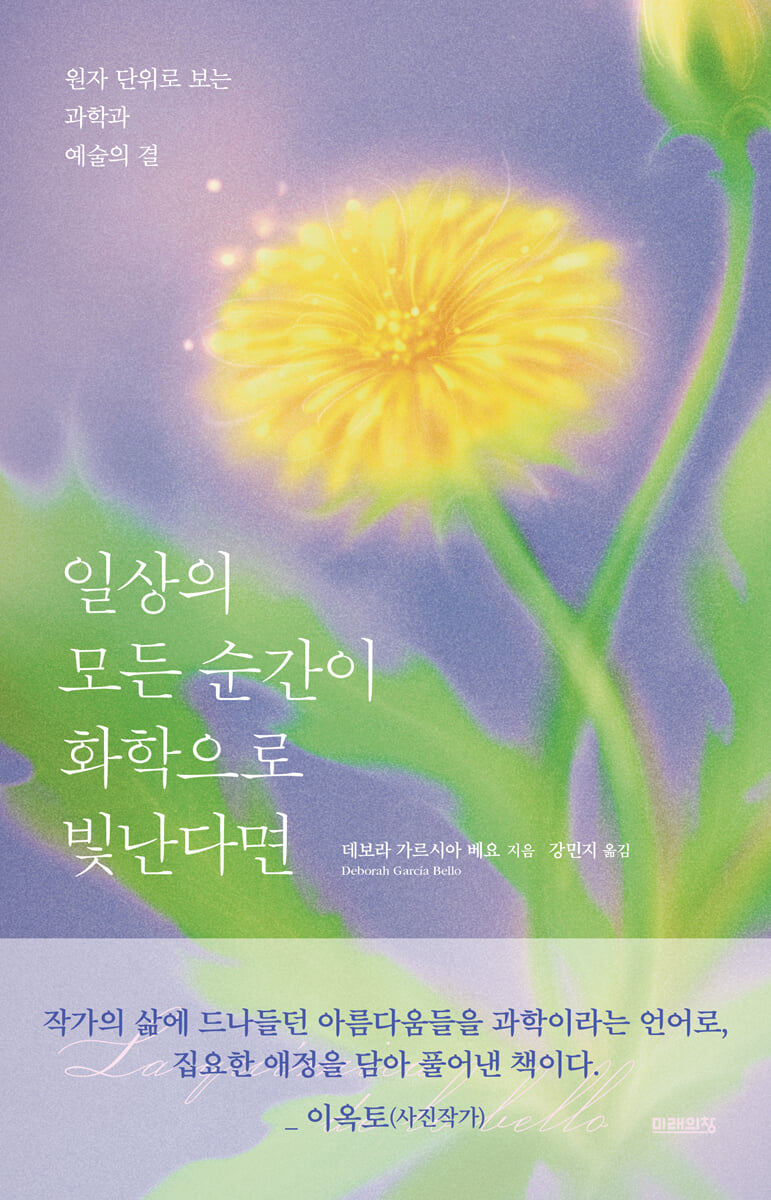
A dandelion blooming in a crack in the concrete, the sound of a train station loudspeaker, the smell of the sea, the cobalt blue of a coffee cup.
We call all of this 'sensation,' but behind it all are the intricate movements of atoms and molecules.
Deborah García Bello, a chemist who teaches materials science at the Guggenheim Museum, delicately maps out these astonishing layers of sensation in twenty-five lyrical essays in If Every Moment Were Chemistry.
As we follow the journey that begins with 'Blue Velvet' and ends with 'Red Velvet,' the boundaries between art and science, emotion and structure, and object and existence are broken down.
You will discover the vibration of molecules in the sound of seagulls, the waves of light in a sunset, and the magic of silver particles in old black-and-white photographs.
Knowing chemistry means looking at the world at the atomic level.
After reading the book, things you had passed by without a second thought will begin to take on a completely different face, bathed in a quiet light.
A story rewritten by a chemist there
#From Yves Klein's blue velvet to Monet's colors and Klimt's gold
#Knowing chemistry means seeing the world at the atomic level.
“There is beauty that becomes more beautiful through knowledge.
“The feeling of longing becomes clearer when you understand the reason for the object, its creation, and the principles behind it.” - Lee Ok-to (photographer)
A dandelion blooming in a crack in the concrete, the sound of a train station loudspeaker, the smell of the sea, the cobalt blue of a coffee cup.
We call all of this 'sensation,' but behind it all are the intricate movements of atoms and molecules.
Deborah García Bello, a chemist who teaches materials science at the Guggenheim Museum, delicately maps out these astonishing layers of sensation in twenty-five lyrical essays in If Every Moment Were Chemistry.
As we follow the journey that begins with 'Blue Velvet' and ends with 'Red Velvet,' the boundaries between art and science, emotion and structure, and object and existence are broken down.
You will discover the vibration of molecules in the sound of seagulls, the waves of light in a sunset, and the magic of silver particles in old black-and-white photographs.
Knowing chemistry means looking at the world at the atomic level.
After reading the book, things you had passed by without a second thought will begin to take on a completely different face, bathed in a quiet light.
- You can preview some of the book's contents.
Preview
index
1.
blue velvet
2.
Old paper fades
3.
Good things, beautiful things, true things
4.
Photos of grandparents
5.
There are memories in the neighborhood
6.
The Golden Wonder
7.
Jacket with lobster embroidery
8.
Sunday afternoons are a good time for drawing.
9.
My name on the wooden desk
10.
60s fashion magazines
11.
Giant dog made of flowers
12.
Mom applying lipstick
13.
A rosy sky is a harbinger of a brighter day.
14.
Whiter than light
15.
Darker than the abyss
16.
Shelter against the sea
17.
What is time made of?
18.
rubber dust floating in the air
19.
felt hat
20.
peeled wall
21.
It's raining stars in our neighborhood.
22.
Coffee cups in the village
23.
Grandma and the Turnip Sprouts
24.
My mom is a spider
25.
red velvet
blue velvet
2.
Old paper fades
3.
Good things, beautiful things, true things
4.
Photos of grandparents
5.
There are memories in the neighborhood
6.
The Golden Wonder
7.
Jacket with lobster embroidery
8.
Sunday afternoons are a good time for drawing.
9.
My name on the wooden desk
10.
60s fashion magazines
11.
Giant dog made of flowers
12.
Mom applying lipstick
13.
A rosy sky is a harbinger of a brighter day.
14.
Whiter than light
15.
Darker than the abyss
16.
Shelter against the sea
17.
What is time made of?
18.
rubber dust floating in the air
19.
felt hat
20.
peeled wall
21.
It's raining stars in our neighborhood.
22.
Coffee cups in the village
23.
Grandma and the Turnip Sprouts
24.
My mom is a spider
25.
red velvet
Detailed image

Into the book
We admired the sculpture S41 by Yves Klein (1928, Nice, France – 1962, Paris, France), better known as 'Blue Venus'.
(...) Venus's intense blue color, her velvety soft texture, and above all, her shining appearance made everything else around her invisible.
It was more sparkling than any other work.
The blue light of the statue accentuated the light and shade while softening the outlines.
“It’s like blue velvet.
A sea covered with very deep blue fur comes to mind.
But it's not velvet, it's pigment.
"How on earth did you do that?" --- p.13~14
I discovered in chemistry values that we can aspire to.
It is beauty, truth, and goodness.
The good, the beautiful, and the true are inseparable.
Knowledge has an aesthetic pleasure, and it is a pleasure of the most exquisite kind.
More precisely, in science, beauty is the criterion of truth.
Theories, laws, and hypotheses are evaluated based on their order and elegance. --- p.44-45
Old black and white photographs resemble poetry.
It feels somewhat weighty and more precious.
It's not just because it feels like a long time.
It is also because of the value of the materials used in the photo.
The black pigment used in analog photography is made of precious materials such as silver.
--- p.54
It's a fun spectacle, but it's gold.
It has a frivolous quality, but it's still gold.
However, it is an idealistic work that depicts the debauchery of power simply and directly.
Cattelan said:
“Laughter and humor are the Trojan horse without violence, connecting directly with the unconscious, stimulating the imagination, and triggering instinctive responses.” Few materials have as seemingly contradictory meanings as gold.
--- p.96
The lobster is a plaster cast and the telephone is a rotary dial telephone made of Bakelite.
Gypsum is calcium sulfate, CaSO₄, the most widely used material in construction sites.
Bakelite is a synthetic polymer, a type of thermosetting plastic.
Once it solidifies and takes shape, it cannot be softened again even if heat is applied.
Because of its thermal resistance, Bakelite is used to make cases for devices such as telephones and radios.
In the 1930s, both lobsters and telephones were symbols of luxury.
Luxury at the time was a concept that was both evolving and easily recognizable and relatively clearly accessible.
Telephones were only found in wealthy homes, and lobster was reserved as a luxury food for parties.
For Dali, the pleasure of luxury was similar to conquest or sexual pleasure in its exclusivity.
--- p.105
This method is what Mondrian called “realization through elimination.”
Mondrian tried to eliminate visual noise by using only simple lines and colors.
What we can glimpse through his work is the absolute universe he pursued.
Mondrian believed that reality was hidden behind a veil of appearances, and that a true artist must remove that veil to reveal the essence.
--- p.150
First of all, it is a sculpture designed to be displayed outdoors, so it is made of stainless steel.
Steel is an alloy of iron and carbon that naturally oxidizes over time.
To prevent this, Koons added chromium.
Chromium, Cr, oxidizes before iron and becomes the martyr of oxidation that protects iron.
In the process, a thin oxidized surface layer called 'passivation' is formed.
This layer acts like a primer to prepare the surface, allowing the lacquer to adhere smoothly.
〈Tulip〉 is finished with a translucent colored lacquer, so its surface shines like a mirror.
Everyone who saw this work took a picture of themselves reflected on the surface of the balloon.
That's exactly what Koons wanted.
The people and background reflected in “Tulip” are dyed in color, and every surface of “Tulip” changes into a scene from a party.
Koons's works can be considered modern trophies.
--- p.160
You can see this by looking at the works of Caravaggio, Rembrandt, Goya, and Manet.
By the time Impressionism emerged, black was no longer included in the palette.
Because, as Monet said, there is no black in nature.
The avant-garde movement focused on shape and, above all, color.
Black and white are not colors.
It is light and abyss.
Kazimir Malevich's 1915 painting "Black Square" opened the door to monochrome, an art form we continue to explore today.
--- p.217
The definition of time is complex and not as intuitive as it might seem.
How can you explain time to a child without resorting to equations or mathematical formulas?
Even we adults pretend to understand time.
Time began after the Big Bang.
What does this mean? We cannot comprehend the absence of time.
We even have difficulty understanding that time is distorted by the action of gravity.
It can be explained by general relativity, but it is not something that can be intuitively understood.
If we think rationally, time flows continuously.
But it often flows slowly or quickly.
There's a box on top of my closet that can travel through time.
Above all, I still have the part that I cut out from my textbook when I was around seven years old.
--- p.252
So, the beautiful world is everywhere.
To know how to see the world is to put a red velvet string on every part of the bright everyday life.
I am fascinated by the constant perception of perspective and the constant discovery of new aspects, not only in planets and stars, but also in ordinary objects.
Ultimately, this costumbrismo story was a proposal to wrap our memories in red velvet.
(...) Venus's intense blue color, her velvety soft texture, and above all, her shining appearance made everything else around her invisible.
It was more sparkling than any other work.
The blue light of the statue accentuated the light and shade while softening the outlines.
“It’s like blue velvet.
A sea covered with very deep blue fur comes to mind.
But it's not velvet, it's pigment.
"How on earth did you do that?" --- p.13~14
I discovered in chemistry values that we can aspire to.
It is beauty, truth, and goodness.
The good, the beautiful, and the true are inseparable.
Knowledge has an aesthetic pleasure, and it is a pleasure of the most exquisite kind.
More precisely, in science, beauty is the criterion of truth.
Theories, laws, and hypotheses are evaluated based on their order and elegance. --- p.44-45
Old black and white photographs resemble poetry.
It feels somewhat weighty and more precious.
It's not just because it feels like a long time.
It is also because of the value of the materials used in the photo.
The black pigment used in analog photography is made of precious materials such as silver.
--- p.54
It's a fun spectacle, but it's gold.
It has a frivolous quality, but it's still gold.
However, it is an idealistic work that depicts the debauchery of power simply and directly.
Cattelan said:
“Laughter and humor are the Trojan horse without violence, connecting directly with the unconscious, stimulating the imagination, and triggering instinctive responses.” Few materials have as seemingly contradictory meanings as gold.
--- p.96
The lobster is a plaster cast and the telephone is a rotary dial telephone made of Bakelite.
Gypsum is calcium sulfate, CaSO₄, the most widely used material in construction sites.
Bakelite is a synthetic polymer, a type of thermosetting plastic.
Once it solidifies and takes shape, it cannot be softened again even if heat is applied.
Because of its thermal resistance, Bakelite is used to make cases for devices such as telephones and radios.
In the 1930s, both lobsters and telephones were symbols of luxury.
Luxury at the time was a concept that was both evolving and easily recognizable and relatively clearly accessible.
Telephones were only found in wealthy homes, and lobster was reserved as a luxury food for parties.
For Dali, the pleasure of luxury was similar to conquest or sexual pleasure in its exclusivity.
--- p.105
This method is what Mondrian called “realization through elimination.”
Mondrian tried to eliminate visual noise by using only simple lines and colors.
What we can glimpse through his work is the absolute universe he pursued.
Mondrian believed that reality was hidden behind a veil of appearances, and that a true artist must remove that veil to reveal the essence.
--- p.150
First of all, it is a sculpture designed to be displayed outdoors, so it is made of stainless steel.
Steel is an alloy of iron and carbon that naturally oxidizes over time.
To prevent this, Koons added chromium.
Chromium, Cr, oxidizes before iron and becomes the martyr of oxidation that protects iron.
In the process, a thin oxidized surface layer called 'passivation' is formed.
This layer acts like a primer to prepare the surface, allowing the lacquer to adhere smoothly.
〈Tulip〉 is finished with a translucent colored lacquer, so its surface shines like a mirror.
Everyone who saw this work took a picture of themselves reflected on the surface of the balloon.
That's exactly what Koons wanted.
The people and background reflected in “Tulip” are dyed in color, and every surface of “Tulip” changes into a scene from a party.
Koons's works can be considered modern trophies.
--- p.160
You can see this by looking at the works of Caravaggio, Rembrandt, Goya, and Manet.
By the time Impressionism emerged, black was no longer included in the palette.
Because, as Monet said, there is no black in nature.
The avant-garde movement focused on shape and, above all, color.
Black and white are not colors.
It is light and abyss.
Kazimir Malevich's 1915 painting "Black Square" opened the door to monochrome, an art form we continue to explore today.
--- p.217
The definition of time is complex and not as intuitive as it might seem.
How can you explain time to a child without resorting to equations or mathematical formulas?
Even we adults pretend to understand time.
Time began after the Big Bang.
What does this mean? We cannot comprehend the absence of time.
We even have difficulty understanding that time is distorted by the action of gravity.
It can be explained by general relativity, but it is not something that can be intuitively understood.
If we think rationally, time flows continuously.
But it often flows slowly or quickly.
There's a box on top of my closet that can travel through time.
Above all, I still have the part that I cut out from my textbook when I was around seven years old.
--- p.252
So, the beautiful world is everywhere.
To know how to see the world is to put a red velvet string on every part of the bright everyday life.
I am fascinated by the constant perception of perspective and the constant discovery of new aspects, not only in planets and stars, but also in ordinary objects.
Ultimately, this costumbrismo story was a proposal to wrap our memories in red velvet.
--- p.348
Publisher's Review
From 'Blue Velvet' to 'Red Velvet',
Twenty-five sensory records following the trajectory of color and material.
《If Every Moment of Everyday Life Shined with Chemistry》 illuminates the science quietly permeating beneath the surface of art.
Author Deborah García Bello teaches materials science at the Guggenheim Bilbao Museum in Spain and is a scientist who delves into the relationship between art and materials.
As we follow her gaze, the colors and materials in art begin to be read as physical language rather than as mere objects of aesthetics.
The book's journey begins with Yves Klein's velvety blue pigments, passes through Jeff Koons' metal sculptures, and concludes with the iconic "Red Velvet."
For Deborah García Bello, the materials of her work are not simply substances.
Materials are a sense of the times, a shell of emotions, and a language that contains a person's choices and worldview.
Therefore, the author naturally takes us beyond simple sensations and into the world of science hidden within.
As the author says, “Scientific knowledge illuminates places that might otherwise have remained dark, or where only mismatched light might exist.” This book is a collection of sentences that demonstrate how science enriches the world of the senses.
“There is a poem contained within the material.”
The science hidden beneath the surface of art, the senses layered within everyday objects.
The emotional scenes in the book are filled with the oxidation of silver particles, the color changes of metal oxides, and the microscopic structures of pigments, as if they were poetry.
This exploration extends beyond the walls of the art museum and into our daily lives.
The essence of material things we have passed by without a second thought begins to be revealed, from famous paintings to trivial and familiar objects like lipstick, black-and-white photographs, and coffee cups.
Literally, “the materials used in a work are codes with hidden meaning.
“There is a poem contained within the material.”
At the end of “If Every Moment of Everyday Life Shined with Chemistry,” she says:
“So, the beautiful world is everywhere.
To know how to see the world is to put a red velvet string on every part of the bright everyday life.
I am fascinated by the constant perception of perspective and the discovery of new facets not only in planets and stars, but also in ordinary objects.
Ultimately, this costumbrismo story was a proposal to wrap our memories in red velvet.”
Twenty-five sensory records following the trajectory of color and material.
《If Every Moment of Everyday Life Shined with Chemistry》 illuminates the science quietly permeating beneath the surface of art.
Author Deborah García Bello teaches materials science at the Guggenheim Bilbao Museum in Spain and is a scientist who delves into the relationship between art and materials.
As we follow her gaze, the colors and materials in art begin to be read as physical language rather than as mere objects of aesthetics.
The book's journey begins with Yves Klein's velvety blue pigments, passes through Jeff Koons' metal sculptures, and concludes with the iconic "Red Velvet."
For Deborah García Bello, the materials of her work are not simply substances.
Materials are a sense of the times, a shell of emotions, and a language that contains a person's choices and worldview.
Therefore, the author naturally takes us beyond simple sensations and into the world of science hidden within.
As the author says, “Scientific knowledge illuminates places that might otherwise have remained dark, or where only mismatched light might exist.” This book is a collection of sentences that demonstrate how science enriches the world of the senses.
“There is a poem contained within the material.”
The science hidden beneath the surface of art, the senses layered within everyday objects.
The emotional scenes in the book are filled with the oxidation of silver particles, the color changes of metal oxides, and the microscopic structures of pigments, as if they were poetry.
This exploration extends beyond the walls of the art museum and into our daily lives.
The essence of material things we have passed by without a second thought begins to be revealed, from famous paintings to trivial and familiar objects like lipstick, black-and-white photographs, and coffee cups.
Literally, “the materials used in a work are codes with hidden meaning.
“There is a poem contained within the material.”
At the end of “If Every Moment of Everyday Life Shined with Chemistry,” she says:
“So, the beautiful world is everywhere.
To know how to see the world is to put a red velvet string on every part of the bright everyday life.
I am fascinated by the constant perception of perspective and the discovery of new facets not only in planets and stars, but also in ordinary objects.
Ultimately, this costumbrismo story was a proposal to wrap our memories in red velvet.”
GOODS SPECIFICS
- Date of issue: July 28, 2025
- Page count, weight, size: 368 pages | 135*210*30mm
- ISBN13: 9791193638743
- ISBN10: 1193638747
You may also like
카테고리
korean


korean

![GQ KOREA Mark (Monthly): December [2025]](http://librairie.coreenne.fr/cdn/shop/files/8ef265dbbfbf186523ed75ba7319009d.jpg?v=1765340328&width=3840)


