

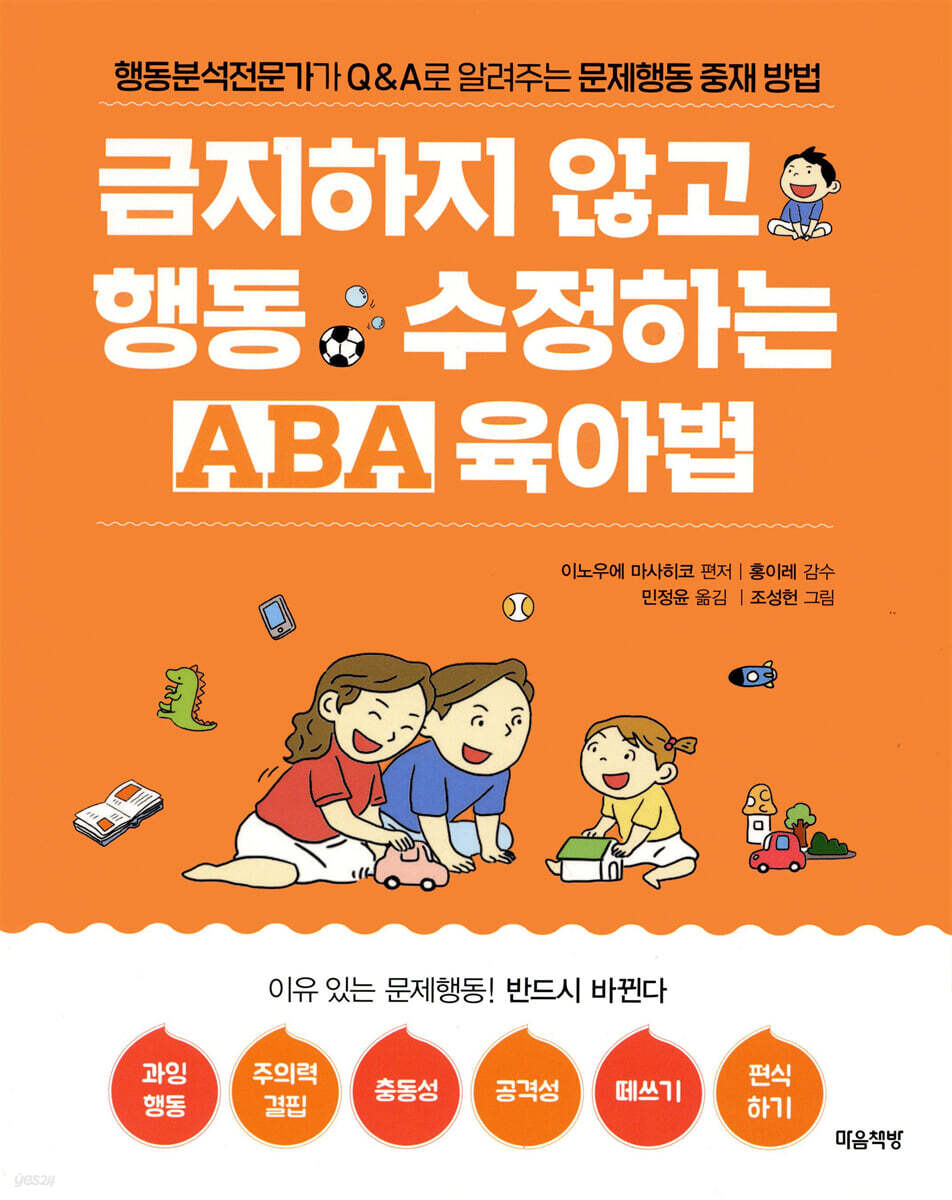
ABA Parenting Method for Problem Behavior: Modifying Behavior Without Forbidding
 |
Description
Book Introduction
“I won’t do it. How should we deal with a child's 'dislike' disease, such as "I don't like it"? Do you give your child what he or she wants even though you say, "This doesn't seem right"? ― There is no right answer to parenting, but there are solutions to problem behaviors. This book is for parents who constantly have to say “no” or “don’t” to their children because of their “problem” behavior. Masahiko Inoue, author of 『ABA Therapy Program at Home』, is well known in Korea and now teaches us how to mediate children's problem behaviors. This book, which explains in a Q&A format using real-life examples, begins with the questions, "Problem behaviors definitely change" and "Is that behavior really a problem?" This is because problem behaviors have been learned primarily as a means of communication for 'attracting attention from others', 'avoiding unpleasant stimuli or activities', and 'obtaining desirable objects or activities'. Therefore, simply prohibiting or suppressing problem behavior by saying “no” will only lead to the same problem repeating itself. To improve problem behavior, you need to change the environment or implement appropriate intervention methods. At this time, the basic principle of an appropriate intervention method is to understand the real meaning and function of the behavior that causes the child's problem behavior, then change the surrounding environment that causes the problem, replace the problem behavior with desirable behavior, and increase the desirable behavior. Eun-Jeong Heo, director of the ABA Research Institute of Kids World and a board-certified international behavioral analyst (BCBA-D), said, “On the surface, children’s demands or forms of communication may appear to be problem behaviors, but these may actually be their own survival strategies. It is the parents' role to change these problem behaviors into desirable ones, but it is often difficult to do so and it is often difficult to know where to start. In that respect, I recommend this book, saying, “It teaches parents the process of identifying the cause of problem behavior and how to solve it in an easy-to-understand way.” |
- You can preview some of the book's contents.
Preview
index
Recommendation
Why? Applied Behavior Analysis (ABA)
Must-read! Essential Terms to Know
Reviewer's note
Starting the article
PART Ⅰ.
Understanding Problem Behavior - ABC Analysis and Behavioral Functions
Problem behaviors must change.
Is that behavior really a 'problem'?
When behavior matters and when it doesn't
Problem Behavior Learning Process (ABC Analysis)
ABA Basic Principles for Changing Behavior
A fundamental solution to changing problem behavior
Reasons for problem behavior
Function of behavior ① When it is communication
Function of behavior ② When it is automatic reinforcement
Function of action ③ When it is a complex function
Emergency response measures to be implemented immediately
How to keep promises
PART Ⅱ.
Preparing for Behavioral Intervention - Prioritization and Documentation Methods
Creating common interests among family members
Clearly define the problem behavior to be mediated
Record the 'ABC analysis' specifically
How to Keep Records for Behavioral Intervention
Set a time to record
PART Ⅲ.
Analyzing Problem Behavior - How to Use a Strategy Sheet
Developing an Arbitration Plan with a Strategy Sheet
Write in negative form NO, positive form
Fill out the strategy sheet 'B: Action'
Fill out the strategy sheet 'A: Antecedent Events'
Fill out the strategy sheet 'C: Results'
Developing a Mediation Plan
Teaching alternative behaviors to problem behaviors
Reorganizing the 'Preemptive Countermeasures Research'
How to strengthen correctly
Response when problem behavior occurs
Things to keep in mind when practicing at home
The End of Moon Jae-in's Mediation and Step-Up
PART IV.
Intervening with Problem Behavior - Q&A Practical Strategies 39
[Self-harm/perpetrator]
Q 01.
Become verbally abusive or violent
Q 02.
The brothers keep fighting
Q 03.
Hit your own head
Q 04.
He hits his mother while making persistent demands.
Hyperactivity/Impulsivity
Q 05.
Run out of the house without permission
Q 06.
I can't wait and I'm running around
Q 07.
If I let go of your hand, I don't know where you'll go.
[hypersensitivity]
Q 08.
I hate brushing my teeth
Q 09.
I can't go out because I'm afraid of thunder and lightning.
Q 10.
I'm extremely afraid of hospitals.
Q 11.
If your clothes get even a little wet, change them all.
[Stubbornness/Obsession]
Q 12.
I'm obsessed with a specific order when moving.
Q 13.
Whenever I go to the mart, they always ask me to buy it for them.
Q 14.
I'm obsessed with pressing elevator buttons.
Q 15.
I keep ringing the doorbell of other houses.
[Meal Problem]
Q 16.
I don't eat rice
Q 17.
Eat quickly, barely chewing
Q 18.
I'm trying not to eat well because of the wrong idea.
Q 19.
I'm very obsessed with food and I'm a picky eater.
[Bow problems]
Q 20.
Instead of going to the bathroom, I wear a diaper and pee on purpose.
Q 21.
Even though it looks like you need to go to the bathroom urgently, you hold it in.
Q 22.
When I pee, I stick my butt out.
[Group activities]
Q 23.
I'm always late because I don't wake up at a set time.
Q 24.
I have a very hard time walking in a single line according to the rules.
Q 25.
People often say, "I was bullied."
Q 26.
I get angry and refuse to do homework for difficult subjects.
Q 27.
Separation from my mother is difficult.
Q 28.
I lose things a lot and make a fuss when I find out.
Q 29.
I keep asking the same question
[Family Life]
Q 30.
I can't adjust the volume of my voice
Q 31.
I hate getting into the bathtub and I hate washing.
Q 32.
He just can't seem to stop playing and go to sleep.
Q 33.
I can't stop sucking my thumb because it's become a habit.
Q 34.
I play too many internet games
Q 35.
I'm having a hard time because I'm obsessed with many things.
Q 36.
I have an excessive hoarding habit, so my room is overflowing with stuff.
Q 37.
I can't organize it
[Sexual Issues]
Q 38.
Touching your genitals in front of people
Q 39.
I'm concerned about my child's excessive physical contact.
In closing
Translator's Note
Column
- Is echolalia a problem behavior?
- Time-out misunderstood
- When you hate getting your hair cut
- Responding to hypersensitivity
- Teach your child how to correct their behavior
- Find a way to calm down
- Understanding difficult situations at school
Why? Applied Behavior Analysis (ABA)
Must-read! Essential Terms to Know
Reviewer's note
Starting the article
PART Ⅰ.
Understanding Problem Behavior - ABC Analysis and Behavioral Functions
Problem behaviors must change.
Is that behavior really a 'problem'?
When behavior matters and when it doesn't
Problem Behavior Learning Process (ABC Analysis)
ABA Basic Principles for Changing Behavior
A fundamental solution to changing problem behavior
Reasons for problem behavior
Function of behavior ① When it is communication
Function of behavior ② When it is automatic reinforcement
Function of action ③ When it is a complex function
Emergency response measures to be implemented immediately
How to keep promises
PART Ⅱ.
Preparing for Behavioral Intervention - Prioritization and Documentation Methods
Creating common interests among family members
Clearly define the problem behavior to be mediated
Record the 'ABC analysis' specifically
How to Keep Records for Behavioral Intervention
Set a time to record
PART Ⅲ.
Analyzing Problem Behavior - How to Use a Strategy Sheet
Developing an Arbitration Plan with a Strategy Sheet
Write in negative form NO, positive form
Fill out the strategy sheet 'B: Action'
Fill out the strategy sheet 'A: Antecedent Events'
Fill out the strategy sheet 'C: Results'
Developing a Mediation Plan
Teaching alternative behaviors to problem behaviors
Reorganizing the 'Preemptive Countermeasures Research'
How to strengthen correctly
Response when problem behavior occurs
Things to keep in mind when practicing at home
The End of Moon Jae-in's Mediation and Step-Up
PART IV.
Intervening with Problem Behavior - Q&A Practical Strategies 39
[Self-harm/perpetrator]
Q 01.
Become verbally abusive or violent
Q 02.
The brothers keep fighting
Q 03.
Hit your own head
Q 04.
He hits his mother while making persistent demands.
Hyperactivity/Impulsivity
Q 05.
Run out of the house without permission
Q 06.
I can't wait and I'm running around
Q 07.
If I let go of your hand, I don't know where you'll go.
[hypersensitivity]
Q 08.
I hate brushing my teeth
Q 09.
I can't go out because I'm afraid of thunder and lightning.
Q 10.
I'm extremely afraid of hospitals.
Q 11.
If your clothes get even a little wet, change them all.
[Stubbornness/Obsession]
Q 12.
I'm obsessed with a specific order when moving.
Q 13.
Whenever I go to the mart, they always ask me to buy it for them.
Q 14.
I'm obsessed with pressing elevator buttons.
Q 15.
I keep ringing the doorbell of other houses.
[Meal Problem]
Q 16.
I don't eat rice
Q 17.
Eat quickly, barely chewing
Q 18.
I'm trying not to eat well because of the wrong idea.
Q 19.
I'm very obsessed with food and I'm a picky eater.
[Bow problems]
Q 20.
Instead of going to the bathroom, I wear a diaper and pee on purpose.
Q 21.
Even though it looks like you need to go to the bathroom urgently, you hold it in.
Q 22.
When I pee, I stick my butt out.
[Group activities]
Q 23.
I'm always late because I don't wake up at a set time.
Q 24.
I have a very hard time walking in a single line according to the rules.
Q 25.
People often say, "I was bullied."
Q 26.
I get angry and refuse to do homework for difficult subjects.
Q 27.
Separation from my mother is difficult.
Q 28.
I lose things a lot and make a fuss when I find out.
Q 29.
I keep asking the same question
[Family Life]
Q 30.
I can't adjust the volume of my voice
Q 31.
I hate getting into the bathtub and I hate washing.
Q 32.
He just can't seem to stop playing and go to sleep.
Q 33.
I can't stop sucking my thumb because it's become a habit.
Q 34.
I play too many internet games
Q 35.
I'm having a hard time because I'm obsessed with many things.
Q 36.
I have an excessive hoarding habit, so my room is overflowing with stuff.
Q 37.
I can't organize it
[Sexual Issues]
Q 38.
Touching your genitals in front of people
Q 39.
I'm concerned about my child's excessive physical contact.
In closing
Translator's Note
Column
- Is echolalia a problem behavior?
- Time-out misunderstood
- When you hate getting your hair cut
- Responding to hypersensitivity
- Teach your child how to correct their behavior
- Find a way to calm down
- Understanding difficult situations at school
Detailed image

Into the book
ABA is a comprehensive program that teaches skills in all areas, from language and cognition to social skills and even daily life tasks like getting dressed and brushing teeth.
--- p.19, from "Why? ABA (Applied Behavior Analysis)"
As parents who have to care for their children every day, a wide range of problem behaviors can be a huge stressor for the family and can even negatively impact the quality of life for the entire family.
In that sense, the various intervention methods presented in this book will be of great help to many parents who are struggling with their children's behavior.
Starting with the question, “Is problem behavior really a ‘problem’?”, it helps children evaluate and understand their problem behavior from various angles, thereby serving as a faithful guide that guides them to replace it with desirable behavior rather than correcting it.
--- p.23, from “The Supervisor’s Note”
This book introduces 'how parents can easily change their children's problem behaviors into desirable behaviors at home', under the premise that professional help is not available.
Of course, there are many different processes and methods for changing problem behavior, not just one or two.
However, among them, the method of simply prohibiting and suppressing the child's behavior was not addressed.
--- p.24~25, from “Starting Writing”
To improve problem behavior, you need to change the environment or think of an appropriate intervention method.
The basic principle of an appropriate intervention method is to identify the true meaning or function of the child's problem behavior, change the surrounding environment that causes the problem, replace the problem behavior with desirable behavior, and increase the desirable behavior.
--- p.28, from “Problem Behavior Must Change”
A behavior becomes a problem behavior not simply because it is a 'unique behavior or habit that is different from others', but when it 'causes harm or damage to others or oneself', 'limits the actions of others or oneself', or 'interferes with participation in learning or social activities'.
Therefore, whether a behavior is a 'problem behavior' or not must be reviewed and judged according to each situation, such as the child's age, the place where the behavior is being done, or the target.
--- p.33, from “When Actions Matter and When They Don’t”
The greatest advantage of ABC analysis is that it shows the function of invisible behaviors at a glance.
--- p.45, from “Function of Behavior ① When it is Communication”
If you use strategy sheets at home, we recommend that you complete them together as a couple or with another adult family member, if possible.
This is to ensure that the entire family has a common interest in the child's problem behavior and responds consistently.
--- p.59, from “Creating Common Interests Among Family Members”
When you record behavior observation sheets, you often see various 'problem behaviors' that you were not aware of before.
However, it is more effective to focus on and support one high-priority problem behavior rather than trying to intervene on multiple problem behaviors at once.
--- p.63, from “Recording ‘ABC Analysis’ in Detail”
Even if a desirable behavior is substituted for the problem behavior, if that behavior is not reinforced, the problem behavior will eventually return.
--- p.99, from “How to Strengthen Correctly”
When introducing a time-out or during the time-out period, yelling or aggressive behavior may occur. If you do not pay attention to the time-out or speak to it (e.g., "Stop it!"), the problem behavior will only get worse.
If the problem behavior worsens during time-out and parents give up, that is also counterproductive.
--- p.19, from "Why? ABA (Applied Behavior Analysis)"
As parents who have to care for their children every day, a wide range of problem behaviors can be a huge stressor for the family and can even negatively impact the quality of life for the entire family.
In that sense, the various intervention methods presented in this book will be of great help to many parents who are struggling with their children's behavior.
Starting with the question, “Is problem behavior really a ‘problem’?”, it helps children evaluate and understand their problem behavior from various angles, thereby serving as a faithful guide that guides them to replace it with desirable behavior rather than correcting it.
--- p.23, from “The Supervisor’s Note”
This book introduces 'how parents can easily change their children's problem behaviors into desirable behaviors at home', under the premise that professional help is not available.
Of course, there are many different processes and methods for changing problem behavior, not just one or two.
However, among them, the method of simply prohibiting and suppressing the child's behavior was not addressed.
--- p.24~25, from “Starting Writing”
To improve problem behavior, you need to change the environment or think of an appropriate intervention method.
The basic principle of an appropriate intervention method is to identify the true meaning or function of the child's problem behavior, change the surrounding environment that causes the problem, replace the problem behavior with desirable behavior, and increase the desirable behavior.
--- p.28, from “Problem Behavior Must Change”
A behavior becomes a problem behavior not simply because it is a 'unique behavior or habit that is different from others', but when it 'causes harm or damage to others or oneself', 'limits the actions of others or oneself', or 'interferes with participation in learning or social activities'.
Therefore, whether a behavior is a 'problem behavior' or not must be reviewed and judged according to each situation, such as the child's age, the place where the behavior is being done, or the target.
--- p.33, from “When Actions Matter and When They Don’t”
The greatest advantage of ABC analysis is that it shows the function of invisible behaviors at a glance.
--- p.45, from “Function of Behavior ① When it is Communication”
If you use strategy sheets at home, we recommend that you complete them together as a couple or with another adult family member, if possible.
This is to ensure that the entire family has a common interest in the child's problem behavior and responds consistently.
--- p.59, from “Creating Common Interests Among Family Members”
When you record behavior observation sheets, you often see various 'problem behaviors' that you were not aware of before.
However, it is more effective to focus on and support one high-priority problem behavior rather than trying to intervene on multiple problem behaviors at once.
--- p.63, from “Recording ‘ABC Analysis’ in Detail”
Even if a desirable behavior is substituted for the problem behavior, if that behavior is not reinforced, the problem behavior will eventually return.
--- p.99, from “How to Strengthen Correctly”
When introducing a time-out or during the time-out period, yelling or aggressive behavior may occur. If you do not pay attention to the time-out or speak to it (e.g., "Stop it!"), the problem behavior will only get worse.
If the problem behavior worsens during time-out and parents give up, that is also counterproductive.
--- p.129, from the column 'Time-out Misunderstood'
Publisher's Review
Modifying 'problem' behaviors with ABA techniques that can be applied to all humans.
It is widely used in the treatment of developmental disorders such as autism due to its excellent effectiveness.
- The number of times ABA techniques are applied to typical children and children with developmental disabilities differs.
ABA techniques have several ways to reduce or eliminate behavior.
This book introduces methods that parents can implement at home to change the environment as easily as possible and change problem behaviors into desirable behaviors.
Of course, there are limits to responding to problem behaviors at home alone.
Even if you implement the basic coping methods introduced in this book, there may be times when there is no change in your child's problem behavior, or you may not know how to respond.
In such cases, you should not force yourself at home, but seek out a professional institution.
It is never in the child's best interest for parents or family members to shoulder all of the child's problem behavior.
ABA (Applied Behavior Analysis) is, in a word, the science of learning and behavior.
It is a discipline that seeks to elucidate the principles by which learning occurs and the reasons for which human behavior occurs, and to apply these principles to increase useful and desirable behaviors and reduce harmful or disruptive behaviors.
These ABA techniques can be applied to all humans.
Its effectiveness is so outstanding that it is widely used in the treatment of developmental disorders such as autism.
It is so powerful that it can be applied dozens of times to children with developmental disabilities, but only once or twice to typical children, and can change all the problem behaviors that are bothering you.
This book helps parents correct their child's problematic behavior at home without forbidding it, using ABC analysis, a part of the ABA technique.
What behaviors constitute 'problem' behavior?
To whom, where, when, and in what way will that behavior be problematic?
- Is the behavior you think is a 'problem' really a 'problem'?
In everyday parenting, you tend to worry about things like what is and isn't a problem with your child's behavior, how far you should leave them alone and how far you should teach them, and whether they are naturally stubborn, have a disability, or simply have a strong personality.
ABA techniques can be a great help in parenting, but if used incorrectly, they can become a nuisance that restricts a child's freedom.
This is because some of the problem behaviors that are concerning are beneficial to a child's learning or development.
In other words, children learn through trial and error, and this should not be considered a problem behavior and should not be stopped.
Therefore, you must carefully consider which of your child's behaviors are problematic before proceeding.
For example, a behavior is not simply a 'unique behavior or habit that is different from others', but it becomes a problem behavior when it 'causes harm or damage to others or oneself', 'limits the actions of others or oneself', or 'interferes with participation in learning or social activities'.
Therefore, whether a behavior is a 'problem behavior' or not must be reviewed and judged according to each situation, such as the child's age, the place where the behavior is being done, or the target.
Kim Soo-jung, a Board Certified Behavior Analyst (BCBA) and director of the Paran Behavioral Development Research Institute, said in her expert recommendation, “ABA’s perspective of solving so-called ‘problem behaviors’ not as a problem of the child’s will or noncompliance, but rather as a connection with the environment, feels delicate and excellent.”
Find the right situation for your child and apply it as if using an encyclopedia.
First, look into the child's mind and help them understand their behavior.
- Solutions presented in a Q&A format with strategy sheets and various real-world examples.
This book is largely divided into four parts.
The first part, 'Understanding Problem Behavior', determines whether the behavior you want to change is truly a problem, and then uses ABC analysis to identify the hidden intentions behind the problem behavior.
At this time, we will find out the cause of the behavior through the function of the behavior and then provide the basic method of coping measures to fundamentally resolve it.
The second part, 'Preparing for Behavior Intervention', checks the things that must be prepared before seriously correcting problem behaviors and informs parents of what they must do.
The third part, 'Analyzing Problem Behavior', teaches you how to do ABC analysis more systematically, and this is where the 'Strategy Sheet' comes into play.
This strategy sheet, designed by the author himself, helps you record and implement problem behaviors and coping strategies at a glance.
The fourth and final part, 'Intervening Problem Behavior', is the core of this book, and the author provides solutions to various real-life cases he has experienced in clinical practice in a Q&A format.
It introduces methods for dealing with common problem behaviors that occur in everyday life by classifying 39 cases into self-harm and harm, hyperactivity and impulsivity, hypersensitivity, stubbornness and obsession, eating problems, bowel problems, group activities, family life, and sexual problems.
A reader who read this book first (a mother of a 6-year-old) said that there are three main good points about this book.
“First, the causes of problem behaviors are analyzed from various perspectives, and response methods and behavior modification methods for each situation are organized step by step and introduced clearly with cute pictures.
Second, by introducing response methods for various problem behavior cases in an easy-to-understand Q&A format, you can find the situation that suits your child and apply the cause and correction method as if using an encyclopedia.
Third and last, many of the behavior modification methods introduced in the book apply positive reinforcement rather than suppressing or punishing the child.” He then recommends, “Above all, this book is beneficial not only in terms of studying and utilizing it to correct problem behavior, but also in helping children look into and understand their minds and behaviors.”
Parental recommendation
This practical parenting book, which helps children actively intervene in problem behaviors, is likely to be frequently referred to in this era when homeschooling is increasingly emphasized.
- Yang So-hee (pseudonym): Mother of a 2-year-old child
This book will be of great help to many parents, like me, who are struggling to deal with their children's behavioral problems while raising them with developmental disabilities.
- Woo Ga-young (pseudonym): Mother of a 6-year-old child
Above all, this book is beneficial not only in terms of studying and using it to correct problem behaviors, but also in helping us look into and understand our children's minds and behaviors.
- Ok Hee-won (pseudonym): Mother of a 6-year-old child
It is widely used in the treatment of developmental disorders such as autism due to its excellent effectiveness.
- The number of times ABA techniques are applied to typical children and children with developmental disabilities differs.
ABA techniques have several ways to reduce or eliminate behavior.
This book introduces methods that parents can implement at home to change the environment as easily as possible and change problem behaviors into desirable behaviors.
Of course, there are limits to responding to problem behaviors at home alone.
Even if you implement the basic coping methods introduced in this book, there may be times when there is no change in your child's problem behavior, or you may not know how to respond.
In such cases, you should not force yourself at home, but seek out a professional institution.
It is never in the child's best interest for parents or family members to shoulder all of the child's problem behavior.
ABA (Applied Behavior Analysis) is, in a word, the science of learning and behavior.
It is a discipline that seeks to elucidate the principles by which learning occurs and the reasons for which human behavior occurs, and to apply these principles to increase useful and desirable behaviors and reduce harmful or disruptive behaviors.
These ABA techniques can be applied to all humans.
Its effectiveness is so outstanding that it is widely used in the treatment of developmental disorders such as autism.
It is so powerful that it can be applied dozens of times to children with developmental disabilities, but only once or twice to typical children, and can change all the problem behaviors that are bothering you.
This book helps parents correct their child's problematic behavior at home without forbidding it, using ABC analysis, a part of the ABA technique.
What behaviors constitute 'problem' behavior?
To whom, where, when, and in what way will that behavior be problematic?
- Is the behavior you think is a 'problem' really a 'problem'?
In everyday parenting, you tend to worry about things like what is and isn't a problem with your child's behavior, how far you should leave them alone and how far you should teach them, and whether they are naturally stubborn, have a disability, or simply have a strong personality.
ABA techniques can be a great help in parenting, but if used incorrectly, they can become a nuisance that restricts a child's freedom.
This is because some of the problem behaviors that are concerning are beneficial to a child's learning or development.
In other words, children learn through trial and error, and this should not be considered a problem behavior and should not be stopped.
Therefore, you must carefully consider which of your child's behaviors are problematic before proceeding.
For example, a behavior is not simply a 'unique behavior or habit that is different from others', but it becomes a problem behavior when it 'causes harm or damage to others or oneself', 'limits the actions of others or oneself', or 'interferes with participation in learning or social activities'.
Therefore, whether a behavior is a 'problem behavior' or not must be reviewed and judged according to each situation, such as the child's age, the place where the behavior is being done, or the target.
Kim Soo-jung, a Board Certified Behavior Analyst (BCBA) and director of the Paran Behavioral Development Research Institute, said in her expert recommendation, “ABA’s perspective of solving so-called ‘problem behaviors’ not as a problem of the child’s will or noncompliance, but rather as a connection with the environment, feels delicate and excellent.”
Find the right situation for your child and apply it as if using an encyclopedia.
First, look into the child's mind and help them understand their behavior.
- Solutions presented in a Q&A format with strategy sheets and various real-world examples.
This book is largely divided into four parts.
The first part, 'Understanding Problem Behavior', determines whether the behavior you want to change is truly a problem, and then uses ABC analysis to identify the hidden intentions behind the problem behavior.
At this time, we will find out the cause of the behavior through the function of the behavior and then provide the basic method of coping measures to fundamentally resolve it.
The second part, 'Preparing for Behavior Intervention', checks the things that must be prepared before seriously correcting problem behaviors and informs parents of what they must do.
The third part, 'Analyzing Problem Behavior', teaches you how to do ABC analysis more systematically, and this is where the 'Strategy Sheet' comes into play.
This strategy sheet, designed by the author himself, helps you record and implement problem behaviors and coping strategies at a glance.
The fourth and final part, 'Intervening Problem Behavior', is the core of this book, and the author provides solutions to various real-life cases he has experienced in clinical practice in a Q&A format.
It introduces methods for dealing with common problem behaviors that occur in everyday life by classifying 39 cases into self-harm and harm, hyperactivity and impulsivity, hypersensitivity, stubbornness and obsession, eating problems, bowel problems, group activities, family life, and sexual problems.
A reader who read this book first (a mother of a 6-year-old) said that there are three main good points about this book.
“First, the causes of problem behaviors are analyzed from various perspectives, and response methods and behavior modification methods for each situation are organized step by step and introduced clearly with cute pictures.
Second, by introducing response methods for various problem behavior cases in an easy-to-understand Q&A format, you can find the situation that suits your child and apply the cause and correction method as if using an encyclopedia.
Third and last, many of the behavior modification methods introduced in the book apply positive reinforcement rather than suppressing or punishing the child.” He then recommends, “Above all, this book is beneficial not only in terms of studying and utilizing it to correct problem behavior, but also in helping children look into and understand their minds and behaviors.”
Parental recommendation
This practical parenting book, which helps children actively intervene in problem behaviors, is likely to be frequently referred to in this era when homeschooling is increasingly emphasized.
- Yang So-hee (pseudonym): Mother of a 2-year-old child
This book will be of great help to many parents, like me, who are struggling to deal with their children's behavioral problems while raising them with developmental disabilities.
- Woo Ga-young (pseudonym): Mother of a 6-year-old child
Above all, this book is beneficial not only in terms of studying and using it to correct problem behaviors, but also in helping us look into and understand our children's minds and behaviors.
- Ok Hee-won (pseudonym): Mother of a 6-year-old child
GOODS SPECIFICS
- Publication date: December 10, 2020
- Page count, weight, size: 264 pages | 514g | 183*230*18mm
- ISBN13: 9791190888127
- ISBN10: 1190888122
You may also like
카테고리
korean


korean

![GQ KOREA Mark (Monthly): December [2025]](http://librairie.coreenne.fr/cdn/shop/files/8ef265dbbfbf186523ed75ba7319009d.jpg?v=1765340328&width=3840)


