

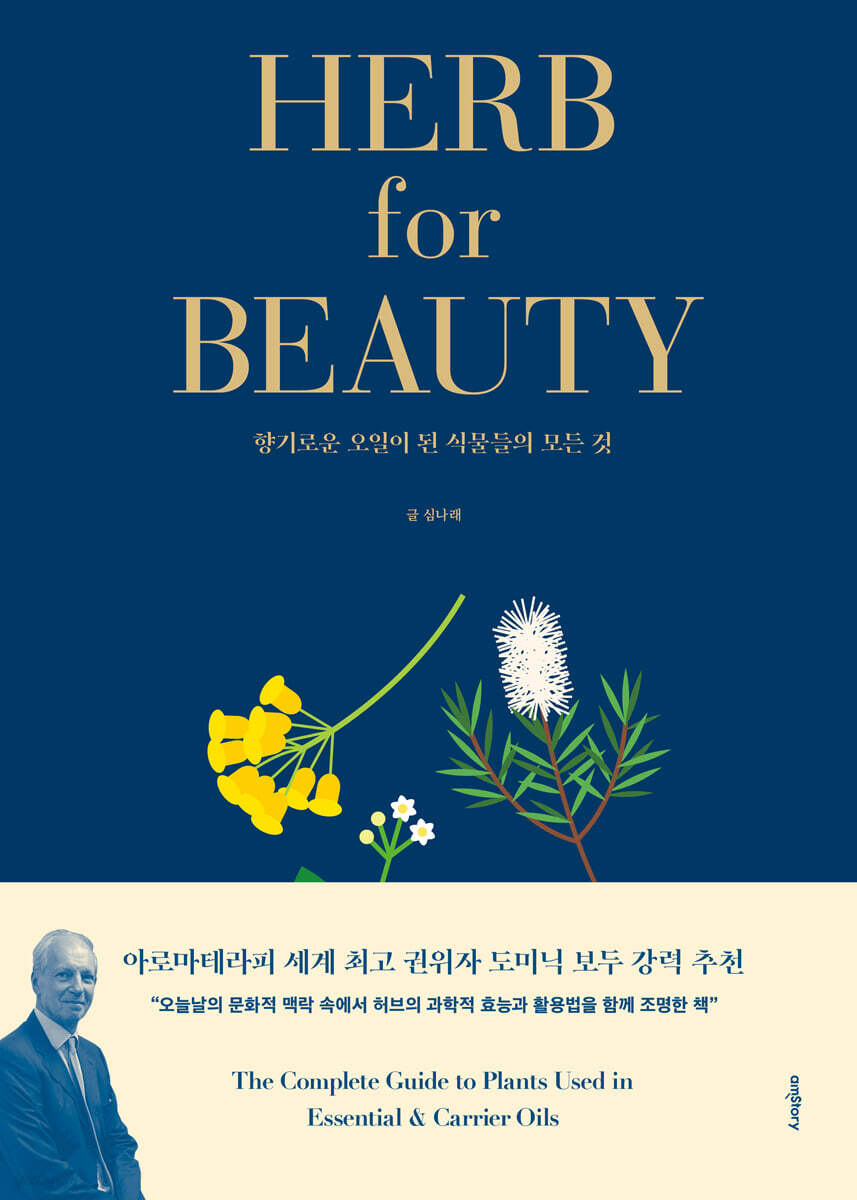
Herb for Beauty
 |
Description
Book Introduction
“How can a fragrant plant be made into a single drop of oil?”
Explore the strong vitality and cultural significance of 76 herbs.
All about herbs used as ingredients for the beauty of body and mind!
Herbs have been with humanity for a long time, connecting humans and gods and healing the body and mind. However, recently, they have been consumed as mere fragrant plants and raw materials for incense.
The author, who has obtained international certifications from prestigious aromatherapy organizations such as the British IFA and the American NAHA, as well as from France and Belgium, and has been providing related education and consulting for 11 years, comprehensively introduces the history and healing properties of each plant, focusing on 76 herbs that are widely used in the field, and even scientific efficacy discovered today and methods of utilizing oils based on them.
The author, who is also a full-time lecturer at Dominic Bowdoin College, which values scientific aromatherapy, systematically explains the chemical composition and application methods based on extensive research and extensive references.
By thoroughly examining even the methods of use that previously lacked logical basis, it helps readers gain a practical understanding of herbs and guides readers to look deeply at herbs as living beings that produce essential oils, rather than simply as raw materials for oils.
Dominic Bodou, an authority in the field of medical aromatherapy, praised the book, saying, “It illuminates both the scientific efficacy and practical applications of herbs in today’s cultural context.”
Covering a wide range of herbs, from botany to cultural history and chemistry, and containing the efficacy and modern uses of herbs as revealed by 21st-century science, this book will establish itself as a practical 'aromatherapy guide' that readers can trust and utilize to care for their body and mind.
Explore the strong vitality and cultural significance of 76 herbs.
All about herbs used as ingredients for the beauty of body and mind!
Herbs have been with humanity for a long time, connecting humans and gods and healing the body and mind. However, recently, they have been consumed as mere fragrant plants and raw materials for incense.
The author, who has obtained international certifications from prestigious aromatherapy organizations such as the British IFA and the American NAHA, as well as from France and Belgium, and has been providing related education and consulting for 11 years, comprehensively introduces the history and healing properties of each plant, focusing on 76 herbs that are widely used in the field, and even scientific efficacy discovered today and methods of utilizing oils based on them.
The author, who is also a full-time lecturer at Dominic Bowdoin College, which values scientific aromatherapy, systematically explains the chemical composition and application methods based on extensive research and extensive references.
By thoroughly examining even the methods of use that previously lacked logical basis, it helps readers gain a practical understanding of herbs and guides readers to look deeply at herbs as living beings that produce essential oils, rather than simply as raw materials for oils.
Dominic Bodou, an authority in the field of medical aromatherapy, praised the book, saying, “It illuminates both the scientific efficacy and practical applications of herbs in today’s cultural context.”
Covering a wide range of herbs, from botany to cultural history and chemistry, and containing the efficacy and modern uses of herbs as revealed by 21st-century science, this book will establish itself as a practical 'aromatherapy guide' that readers can trust and utilize to care for their body and mind.
- You can preview some of the book's contents.
Preview
index
Prologue l Why We Need Herbs in Our Lives
From Plants to Oil
History of herbs
The fragrance classification of this book
Essential Oils - Carrier Oils
Major herb origins
Essential oil extraction method
Extracted parts by herbs
Chemical Components of Essential Oils You Should Know
How to select a good product
Using hubs according to situation
Essential Oil
Aromatic
Basil, clary sage, hyssop, lavandin, lavender, oregano
Peppermint, Rosemary, Sage, Spike Lavender, Sweet Marjoram
time
Camphor
Bay Laurel, Eucalyptus, Kunzea, Manuka, and Niaouli
Ravintsara Tea Tree
Earthy
Angelica, Carrot, Lovelyz, Vetiver
Floral
Geranium, jasmine, neroli, rosewood, ylang-ylang
Fresh
Bergamot, grapefruit, lemon, lemon verbena, lime, mandarin
May Chang, Petitgrain, Sweet Orange, Yuzu
Medicinal
Celery, cistus, everlasting, German chamomile, lemongrass, mastic
Palmarosa, Patchouli, Roman Chamomile, Wintergreen
Spicy
Anise, black pepper, cardamom, cinnamon, clove, coriander
Ginger, Juniper, Sweet Fennel, Tarragon
Woody & Balsam
Atlas cedarwood, cypress, fir, and frankincense
Hinoki (cypress), Katharpay, Mir, Pine, Sandalwood, Spruce
Carrier Oil
Almond, Apricot, Argan, Arnica, Calendula, Jojoba, Rosehip
References
From Plants to Oil
History of herbs
The fragrance classification of this book
Essential Oils - Carrier Oils
Major herb origins
Essential oil extraction method
Extracted parts by herbs
Chemical Components of Essential Oils You Should Know
How to select a good product
Using hubs according to situation
Essential Oil
Aromatic
Basil, clary sage, hyssop, lavandin, lavender, oregano
Peppermint, Rosemary, Sage, Spike Lavender, Sweet Marjoram
time
Camphor
Bay Laurel, Eucalyptus, Kunzea, Manuka, and Niaouli
Ravintsara Tea Tree
Earthy
Angelica, Carrot, Lovelyz, Vetiver
Floral
Geranium, jasmine, neroli, rosewood, ylang-ylang
Fresh
Bergamot, grapefruit, lemon, lemon verbena, lime, mandarin
May Chang, Petitgrain, Sweet Orange, Yuzu
Medicinal
Celery, cistus, everlasting, German chamomile, lemongrass, mastic
Palmarosa, Patchouli, Roman Chamomile, Wintergreen
Spicy
Anise, black pepper, cardamom, cinnamon, clove, coriander
Ginger, Juniper, Sweet Fennel, Tarragon
Woody & Balsam
Atlas cedarwood, cypress, fir, and frankincense
Hinoki (cypress), Katharpay, Mir, Pine, Sandalwood, Spruce
Carrier Oil
Almond, Apricot, Argan, Arnica, Calendula, Jojoba, Rosehip
References
Detailed image

Into the book
· Basil has established itself as a fairly important herb in the field of essential oils.
The basil used in basil oil is divided into two types, sweet basil and exotic basil, depending on their origin, and each has completely different fragrances and chemical compositions.
· In ancient Greece and Rome, oregano leaves were used to treat skin wounds and relieve muscle pain.
The first person to record oregano as a medicinal plant was the ancient Greek physician Hippocrates, who is said to have used it for skin infections.
· At that time, camphor, the resin of the camphor tree, was not only used as a medicinal herb, but was also a valuable resource used for various purposes, such as making preservatives and explosives.
Rather than being a simple conflict over commercial interests, this war can be seen as an extension of the conflict between the two countries that had persisted since the First Opium War.
· Bay laurel has been used in traditional Iranian medicine to relieve digestive ailments such as abdominal bloating and flatulence, and has also been used to treat epilepsy and neuralgia.
In Turkey, it was used in folk medicine as an antidote for snake bites.
Bay laurel has also been used in soap making for thousands of years, a prime example being Aleppo soap from Syria.
· Berber women have traditionally used argan oil to protect their skin and hair, a practice that continues today.
In fact, argan oil contains about 8% vitamin E, which has excellent antioxidant properties, which helps prevent skin aging and protect the skin from the hot sun.
The basil used in basil oil is divided into two types, sweet basil and exotic basil, depending on their origin, and each has completely different fragrances and chemical compositions.
· In ancient Greece and Rome, oregano leaves were used to treat skin wounds and relieve muscle pain.
The first person to record oregano as a medicinal plant was the ancient Greek physician Hippocrates, who is said to have used it for skin infections.
· At that time, camphor, the resin of the camphor tree, was not only used as a medicinal herb, but was also a valuable resource used for various purposes, such as making preservatives and explosives.
Rather than being a simple conflict over commercial interests, this war can be seen as an extension of the conflict between the two countries that had persisted since the First Opium War.
· Bay laurel has been used in traditional Iranian medicine to relieve digestive ailments such as abdominal bloating and flatulence, and has also been used to treat epilepsy and neuralgia.
In Turkey, it was used in folk medicine as an antidote for snake bites.
Bay laurel has also been used in soap making for thousands of years, a prime example being Aleppo soap from Syria.
· Berber women have traditionally used argan oil to protect their skin and hair, a practice that continues today.
In fact, argan oil contains about 8% vitamin E, which has excellent antioxidant properties, which helps prevent skin aging and protect the skin from the hot sun.
--- From the text
Publisher's Review
☆★Recommended by aromatherapy authority Dominic Bodou☆★
☆★Recommended by Kim Jin-ah, CEO of Pranarom Importers☆★
☆★Praise from famous aromatherapists at home and abroad☆★
"A valuable guide to understanding aromatherapy through a scientific approach."
Herbs have been with us for a long time and have played various roles, including medicinal, perfume, and religious symbolism.
Today, as scientific research increasingly demonstrates the efficacy of herbs, their value is once again being recognized.
This book covers a wide range of topics, including the ecology, culture, history, and science of herbs, which have been with us since before the dawn of human history.
Furthermore, it includes practical information such as the extraction method and usage of essential oils and carrier oils extracted from these plants.
The author, who holds international certifications from the UK IFA, the US NAHA, France, and Belgium, and has been teaching and consulting aromatherapy for 11 years, feels saddened by the reality that herbs are consumed simply as raw materials for oil.
Accordingly, in order to deeply understand aromatherapy, we considered it a priority to understand the essence of the plant itself, and attempted an in-depth approach to the plant itself.
Chapter 1, 'From Plants to Oil,' covers the historical flow of herbs, the fragrance classification system used in this book, the concept and composition of oils, and how to select products.
Chapter 2, 'Essential Oil', systematically introduces 69 essential oils that are central to aromatherapy, divided into 8 fragrance families, under subheadings such as 'Plants', 'Classification', 'History', and 'Aromatherapy'. Chapter 3, 'Carrier Oil', summarizes the characteristics and uses of major carrier oils used with essential oils.
This book will serve as a reliable guide for those seeking to understand aromatherapy as a healing tool beyond the senses.
The difficult but curious world of herbs,
Discover a new world through intuitive scent differentiation.
Dominic Bodou, a pharmacist-turned-aromalogist and founder of Pranarom, a leading European essential oil brand, often uses the phrase “trust your sense of smell.”
This emphasizes that scent is a subjective sensation that varies depending on an individual's emotional state or physical condition.
In reality, the same scent can be perceived differently by different people and can leave a completely different impression at different times.
Despite these characteristics, European perfumers, perfume associations, and educational institutions have created a system called 'fragrance series' to classify fragrances according to their mood or character.
However, the European classification of fragrances was far from Korean cultural sensibilities, making it difficult to build consensus.
Accordingly, based on his extensive educational experience, the author has reconstructed eight criteria for the fragrances found in essential oils so that domestic readers can more easily relate to them.
Aromatic is a group of herbs that have a natural freshness and coolness, while Camphor is a group of herbs that have a cool yet strong scent.
The earthy herbs have a deep scent with an earthy and smoky feel, the floral herbs have a rich and soft floral scent, the fresh herbs have a refreshing scent that bursts with juice, the medicinal herbs have a unique scent from herbs and medicines, and the spicy herbs have a warm and stimulating spicy scent.
Finally, woody and balsamic are two slightly different families of woody scents that are stable and come from wood, grouped together into one category.
This classification of scents allows readers to discover new herbs in the same family as their favorite herbs, or to experience familiar scents with new eyes.
Therefore, this book serves as a starting point for broadening one's perception of fragrance and guides readers one step further into the deep and wide world of herbs.
The names of fragrant plants and their struggles contained in history
A human story utilizing this
Adding sensory illustrations to the herb story, the first in Korea to include scientific definitions.
Beyond the sense of smell, the effects of aromatherapy are based on a deeper scientific foundation.
Now we need to expand our perspective to understand its composition and structure.
Essential oils are made up of over 75 different biochemical compounds that work together to produce healing properties such as soothing, relaxing, wound healing, digestive, and tonic properties.
These ingredients are generally safe, but because they are highly concentrated substances, caution is needed in dosage and combination.
However, because aromatherapy is generally consumed with a focus on 'scent', awareness of its chemical components and structure is relatively lacking.
The author, who is a full-time lecturer at Dominic Bodou College Seoul, clearly presents the efficacy and usage methods based on the chemical components of herbs, drawing on a wealth of literature and field experience.
In this way, herbs are established as scientific and practical entities that heal the body and mind, rather than simply being raw materials for fragrance.
This book also traces the struggles of herbs to survive in nature and the wisdom of humans who have utilized them.
It introduces examples of herbal use in various fields, including medicine, food, alcohol, and fragrance, enabling a more three-dimensional understanding.
Another appealing aspect of this book is its sensory visual elements.
The illustrations, patterned with intense colors, are simple yet dynamic and convey a sensual impression.
This book, produced in hardcover through special post-processing, will be a true introduction to aromatherapy, boasting depth of content, a sensuous composition, practicality, and collectible value.
☆★Recommended by Kim Jin-ah, CEO of Pranarom Importers☆★
☆★Praise from famous aromatherapists at home and abroad☆★
"A valuable guide to understanding aromatherapy through a scientific approach."
Herbs have been with us for a long time and have played various roles, including medicinal, perfume, and religious symbolism.
Today, as scientific research increasingly demonstrates the efficacy of herbs, their value is once again being recognized.
This book covers a wide range of topics, including the ecology, culture, history, and science of herbs, which have been with us since before the dawn of human history.
Furthermore, it includes practical information such as the extraction method and usage of essential oils and carrier oils extracted from these plants.
The author, who holds international certifications from the UK IFA, the US NAHA, France, and Belgium, and has been teaching and consulting aromatherapy for 11 years, feels saddened by the reality that herbs are consumed simply as raw materials for oil.
Accordingly, in order to deeply understand aromatherapy, we considered it a priority to understand the essence of the plant itself, and attempted an in-depth approach to the plant itself.
Chapter 1, 'From Plants to Oil,' covers the historical flow of herbs, the fragrance classification system used in this book, the concept and composition of oils, and how to select products.
Chapter 2, 'Essential Oil', systematically introduces 69 essential oils that are central to aromatherapy, divided into 8 fragrance families, under subheadings such as 'Plants', 'Classification', 'History', and 'Aromatherapy'. Chapter 3, 'Carrier Oil', summarizes the characteristics and uses of major carrier oils used with essential oils.
This book will serve as a reliable guide for those seeking to understand aromatherapy as a healing tool beyond the senses.
The difficult but curious world of herbs,
Discover a new world through intuitive scent differentiation.
Dominic Bodou, a pharmacist-turned-aromalogist and founder of Pranarom, a leading European essential oil brand, often uses the phrase “trust your sense of smell.”
This emphasizes that scent is a subjective sensation that varies depending on an individual's emotional state or physical condition.
In reality, the same scent can be perceived differently by different people and can leave a completely different impression at different times.
Despite these characteristics, European perfumers, perfume associations, and educational institutions have created a system called 'fragrance series' to classify fragrances according to their mood or character.
However, the European classification of fragrances was far from Korean cultural sensibilities, making it difficult to build consensus.
Accordingly, based on his extensive educational experience, the author has reconstructed eight criteria for the fragrances found in essential oils so that domestic readers can more easily relate to them.
Aromatic is a group of herbs that have a natural freshness and coolness, while Camphor is a group of herbs that have a cool yet strong scent.
The earthy herbs have a deep scent with an earthy and smoky feel, the floral herbs have a rich and soft floral scent, the fresh herbs have a refreshing scent that bursts with juice, the medicinal herbs have a unique scent from herbs and medicines, and the spicy herbs have a warm and stimulating spicy scent.
Finally, woody and balsamic are two slightly different families of woody scents that are stable and come from wood, grouped together into one category.
This classification of scents allows readers to discover new herbs in the same family as their favorite herbs, or to experience familiar scents with new eyes.
Therefore, this book serves as a starting point for broadening one's perception of fragrance and guides readers one step further into the deep and wide world of herbs.
The names of fragrant plants and their struggles contained in history
A human story utilizing this
Adding sensory illustrations to the herb story, the first in Korea to include scientific definitions.
Beyond the sense of smell, the effects of aromatherapy are based on a deeper scientific foundation.
Now we need to expand our perspective to understand its composition and structure.
Essential oils are made up of over 75 different biochemical compounds that work together to produce healing properties such as soothing, relaxing, wound healing, digestive, and tonic properties.
These ingredients are generally safe, but because they are highly concentrated substances, caution is needed in dosage and combination.
However, because aromatherapy is generally consumed with a focus on 'scent', awareness of its chemical components and structure is relatively lacking.
The author, who is a full-time lecturer at Dominic Bodou College Seoul, clearly presents the efficacy and usage methods based on the chemical components of herbs, drawing on a wealth of literature and field experience.
In this way, herbs are established as scientific and practical entities that heal the body and mind, rather than simply being raw materials for fragrance.
This book also traces the struggles of herbs to survive in nature and the wisdom of humans who have utilized them.
It introduces examples of herbal use in various fields, including medicine, food, alcohol, and fragrance, enabling a more three-dimensional understanding.
Another appealing aspect of this book is its sensory visual elements.
The illustrations, patterned with intense colors, are simple yet dynamic and convey a sensual impression.
This book, produced in hardcover through special post-processing, will be a true introduction to aromatherapy, boasting depth of content, a sensuous composition, practicality, and collectible value.
GOODS SPECIFICS
- Date of issue: July 1, 2025
- Format: Hardcover book binding method guide
- Page count, weight, size: 383 pages | 1,078g | 184*256*27mm
- ISBN13: 9791185469287
- ISBN10: 1185469281
You may also like
카테고리
korean


korean

![GQ KOREA Mark (Monthly): December [2025]](http://librairie.coreenne.fr/cdn/shop/files/8ef265dbbfbf186523ed75ba7319009d.jpg?v=1765340328&width=3840)


