

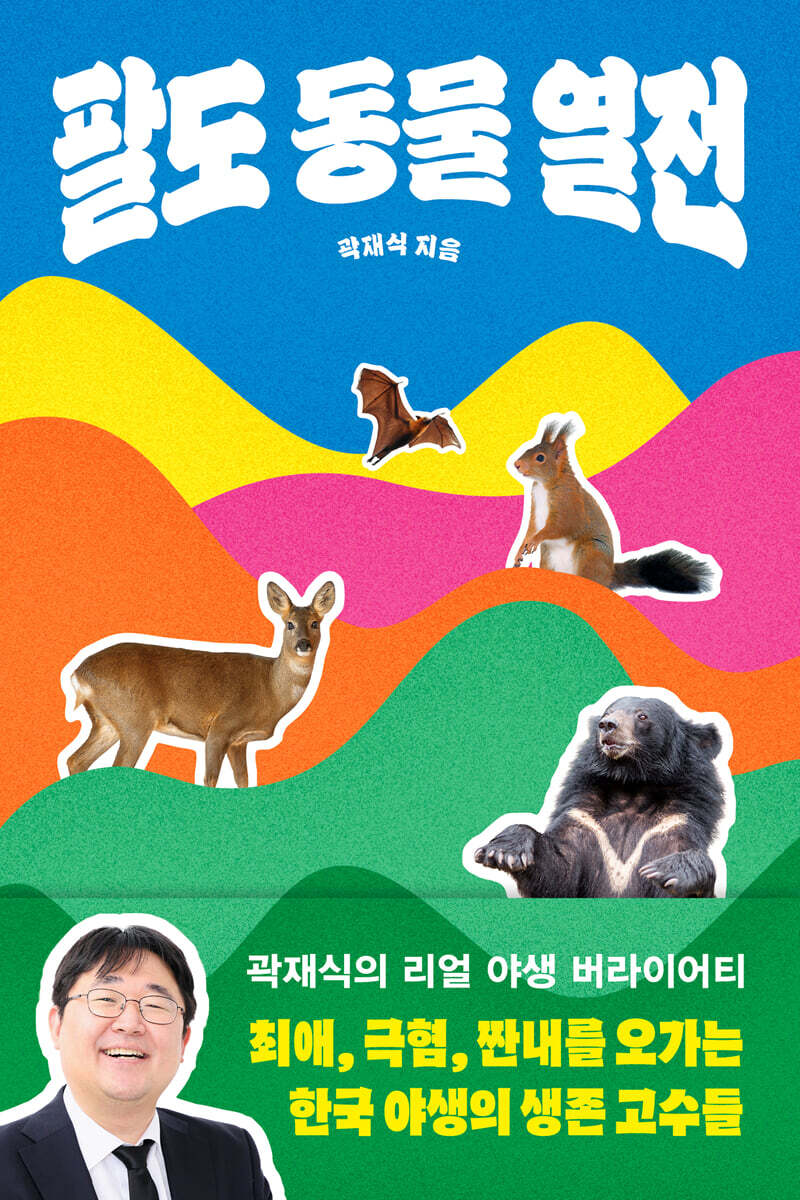
Eight Provinces Animal Chronicles
 |
Description
Book Introduction
Korean patch complete! Survival at max level!
A real wild variety show by novelist and scientist Kwak Jae-sik
K-wildlife stories that were familiar but unknown
Korea is a country richer in nature than you might think.
About 70% of the country is covered with forests, the fourth highest forest ratio among OECD countries.
This shows that despite high population density and rapid urbanization, a variety of wild animals still live and breathe among us.
That's why it's not uncommon to see deer crossing the highway and wild boars coming down to houses.
But how much do we really know about these familiar animals? Perhaps we've only encountered them by chance on a walk or glimpsed them briefly on the news? In reality, they are survivors who have lived and thrived on this land for thousands of years, coexisting with nature and humanity.
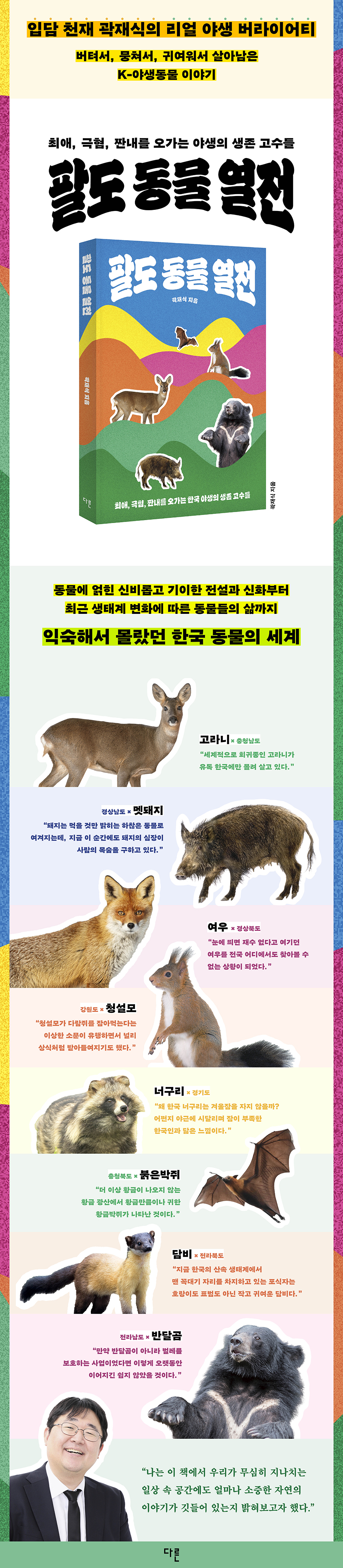
『Animal Chronicles of the Eight Provinces』 is a book written by Kwak Jae-sik, a scientist and novelist, that unfolds the hidden stories of wild animals across Korea.
It covers the unique habits and ecology of each animal, its symbolism in folktales, and its socio-cultural significance.
It tells stories that blend science and imagination, including the identity of the monster that predicted the fall of Baekje in the Samguk Sagi, why the hated fox suddenly became endangered, the misunderstandings surrounding squirrels and chipmunks, how raccoons became rabies spreaders, and the Dracula-like life of bats.
The author says, “I wanted to reveal how precious stories of nature are embedded in the everyday spaces we pass by without a second thought.”
Through this book, you will discover a new side of nature that you have never seen before.
A real wild variety show by novelist and scientist Kwak Jae-sik
K-wildlife stories that were familiar but unknown
Korea is a country richer in nature than you might think.
About 70% of the country is covered with forests, the fourth highest forest ratio among OECD countries.
This shows that despite high population density and rapid urbanization, a variety of wild animals still live and breathe among us.
That's why it's not uncommon to see deer crossing the highway and wild boars coming down to houses.
But how much do we really know about these familiar animals? Perhaps we've only encountered them by chance on a walk or glimpsed them briefly on the news? In reality, they are survivors who have lived and thrived on this land for thousands of years, coexisting with nature and humanity.
『Animal Chronicles of the Eight Provinces』 is a book written by Kwak Jae-sik, a scientist and novelist, that unfolds the hidden stories of wild animals across Korea.
It covers the unique habits and ecology of each animal, its symbolism in folktales, and its socio-cultural significance.
It tells stories that blend science and imagination, including the identity of the monster that predicted the fall of Baekje in the Samguk Sagi, why the hated fox suddenly became endangered, the misunderstandings surrounding squirrels and chipmunks, how raccoons became rabies spreaders, and the Dracula-like life of bats.
The author says, “I wanted to reveal how precious stories of nature are embedded in the everyday spaces we pass by without a second thought.”
Through this book, you will discover a new side of nature that you have never seen before.
- You can preview some of the book's contents.
Preview
index
Introduction: The Stories of Korea's Wilderness We Missed
Chapter 1 Gorani × Chungcheongnam-do
A rare species widely distributed in Korea
- The monster that predicted the fall of Baekje
- As precious as a panda, but ranked first in roadkill
- When you see a goral, you see Korea.
- We don't know the goral
- How to prepare for climate change
Chapter 2 Wild Boar × Gyeongsangnam-do
The ruler of the wild who most resembles humans
- The golden boar in Silla legend
- Are wild boars and domestic pigs the same species?
-An animal more human than a monkey
- Hidden powerhouse in the mountains
- Is there a problem with too many?
Chapter 3 Fox × Gyeongsangbuk-do
Hated, disappeared, now precious
A 'bad' beast that bewitches people
Why are foxes hated?
Going extinct at an unusually rapid rate
Fox Restoration Project
How to live like a fox
Chapter 4 Cheongseolmo × Gangwon-do
Guardian of the forest, compared to a squirrel
- The story of how he became a villain unjustly
- Usefulness becomes a name
- Squirrel vs. Chipmunk
- Reasons for the sudden decline in popularity
- As the forest changed, the squirrels flocked in.
Chapter 5 Raccoon × Gyeonggi-do
Survival tips for surviving in the city
- The identity of the mysterious voice
- Is Korea a raccoon paradise?
- Wild animals encountered while walking
- Hidden rabies spreaders
Chapter 6 Red Bat × Chungcheongbuk-do
Avoiding disease and defying death
- Batman who swept Joseon
- In search of the secret to longevity
- The life of a bat without illness
- Is the legendary golden bat alive?
Chapter 7: Sable × Jeollabuk-do
Becoming a king in a tiger-less mountain
- Animals of Goguryeo and Korea
- From an evil monster to a symbol of good luck
- A teacher of Goguryeo, which succeeded in becoming a multicultural society
- Small but strong survival king
Chapter 8: Half-moon Bear × Jeollanam-do
From a chased animal to a protector
- The tragedy of the Asiatic black bear in Seoraksan Mountain
- I survived because I was cute
- History of bear spirit worship
- What would be good if it were restored?
- The future of the Asiatic black bear changed by KM-53
References
Chapter 1 Gorani × Chungcheongnam-do
A rare species widely distributed in Korea
- The monster that predicted the fall of Baekje
- As precious as a panda, but ranked first in roadkill
- When you see a goral, you see Korea.
- We don't know the goral
- How to prepare for climate change
Chapter 2 Wild Boar × Gyeongsangnam-do
The ruler of the wild who most resembles humans
- The golden boar in Silla legend
- Are wild boars and domestic pigs the same species?
-An animal more human than a monkey
- Hidden powerhouse in the mountains
- Is there a problem with too many?
Chapter 3 Fox × Gyeongsangbuk-do
Hated, disappeared, now precious
A 'bad' beast that bewitches people
Why are foxes hated?
Going extinct at an unusually rapid rate
Fox Restoration Project
How to live like a fox
Chapter 4 Cheongseolmo × Gangwon-do
Guardian of the forest, compared to a squirrel
- The story of how he became a villain unjustly
- Usefulness becomes a name
- Squirrel vs. Chipmunk
- Reasons for the sudden decline in popularity
- As the forest changed, the squirrels flocked in.
Chapter 5 Raccoon × Gyeonggi-do
Survival tips for surviving in the city
- The identity of the mysterious voice
- Is Korea a raccoon paradise?
- Wild animals encountered while walking
- Hidden rabies spreaders
Chapter 6 Red Bat × Chungcheongbuk-do
Avoiding disease and defying death
- Batman who swept Joseon
- In search of the secret to longevity
- The life of a bat without illness
- Is the legendary golden bat alive?
Chapter 7: Sable × Jeollabuk-do
Becoming a king in a tiger-less mountain
- Animals of Goguryeo and Korea
- From an evil monster to a symbol of good luck
- A teacher of Goguryeo, which succeeded in becoming a multicultural society
- Small but strong survival king
Chapter 8: Half-moon Bear × Jeollanam-do
From a chased animal to a protector
- The tragedy of the Asiatic black bear in Seoraksan Mountain
- I survived because I was cute
- History of bear spirit worship
- What would be good if it were restored?
- The future of the Asiatic black bear changed by KM-53
References
Detailed image
Into the book
When people think of an animal that symbolizes Korea, they usually think of the tiger.
The mascot of the 1988 Seoul Olympics was also a tiger.
However, the last recorded sighting of tigers in South Korea was in the 1920s, and since then, there have been no tigers around us for nearly 100 years.
Nowadays, tigers live in much greater numbers in Russia, China, India, and other places.
In that respect, I believe that the most prosperous goral in Korea is fully qualified to represent Korea today.
--- pp.24~25
Depending on how you look at it, pigs are seen as insignificant animals that only care about food, but in fact, at this very moment, a pig's heart is saving human lives.
As it happens, the Chinese character '심心' in the word '심심' means 'heart', and the English word 'heart' also means 'heart' and 'mind' at the same time.
If you think about it this way, it wouldn't be an exaggeration to say that pigs are the animals that most scientifically connect with humans.
--- p.48
Foxes were once very common, but their numbers plummeted in just 20 years, from the 1960s to the 1970s.
In the meantime, few people cared about the fox.
This may be because foxes are not considered very cute in Korea.
By 1980, foxes, which had been considered unlucky to be seen just a generation before, were nowhere to be found in the country.
--- pp.74~75
The blue squirrel builds an even more wonderful house.
The blue squirrel builds its nest not underground, but high in the middle of a tree, which is what we would call the royal floor in Korean.
They gather branches together to make a nest-like house, and gently align the inside with leaves or their own fur.
It feels like a house built entirely of wood with a fur carpet as the interior.
In addition, the structure of the Cheongseolmo house is different from that of the new house, so it has a separate entrance.
The entrance is usually made facing south, which also provides good real estate conditions.
Even American ecologist David R.
Patton (David R.
According to Patton's research, squirrels build two to six nests and use them alternately.
The story is that Cheongseolmo is not a household that owns one house, but rather a multi-homeowner who owns up to six houses per household.
--- pp.101~102
Although raccoons are known to hibernate, Korean scholars now report that Korean raccoons rarely fall into deep hibernation.
If raccoons are supposed to hibernate, why don't Korean raccoons hibernate? This also somehow reminds me of Koreans, who suffer from sleep deprivation due to overtime work.
--- p.139
In January 2007, Mr. Pi Jin-ho, the village head of a village in Jincheon, North Chungcheong Province, discovered a flock of golden bats in an abandoned old mine near the village, raising hopes that golden bats might still be present in various parts of Korea.
What is even more impressive is that the place where these bats were discovered happened to be an abandoned gold mine.
In a gold mine that no longer produces gold, a golden bat, as precious as gold, appears.
This is also a wonderful coincidence worthy of the name Golden Bat.
--- p.181
What's interesting is that among the weasels and other animals that mostly live alone and hunt, only the yellow-necked marten, a common civet found in Korea, shows signs of cooperation.
Doesn't this marten, which can be considered the animal of Goguryeo, seem to fit in well with the people of Goguryeo, a multi-ethnic nation where people of various ethnicities coexisted and achieved success?
--- p.198
In a democratic society, everything the government pursues can only be sustained if it receives the interest and support of the people.
Even if it is a business that protects the ecosystem, it is no exception.
So, when an animal with public appeal and symbolism like a bear becomes a protected species, it is inevitable that more resources and attention will be focused on it in terms of policy.
If this had been a business protecting bugs rather than moon bears, it would not have been easy to continue for this long.
The mascot of the 1988 Seoul Olympics was also a tiger.
However, the last recorded sighting of tigers in South Korea was in the 1920s, and since then, there have been no tigers around us for nearly 100 years.
Nowadays, tigers live in much greater numbers in Russia, China, India, and other places.
In that respect, I believe that the most prosperous goral in Korea is fully qualified to represent Korea today.
--- pp.24~25
Depending on how you look at it, pigs are seen as insignificant animals that only care about food, but in fact, at this very moment, a pig's heart is saving human lives.
As it happens, the Chinese character '심心' in the word '심심' means 'heart', and the English word 'heart' also means 'heart' and 'mind' at the same time.
If you think about it this way, it wouldn't be an exaggeration to say that pigs are the animals that most scientifically connect with humans.
--- p.48
Foxes were once very common, but their numbers plummeted in just 20 years, from the 1960s to the 1970s.
In the meantime, few people cared about the fox.
This may be because foxes are not considered very cute in Korea.
By 1980, foxes, which had been considered unlucky to be seen just a generation before, were nowhere to be found in the country.
--- pp.74~75
The blue squirrel builds an even more wonderful house.
The blue squirrel builds its nest not underground, but high in the middle of a tree, which is what we would call the royal floor in Korean.
They gather branches together to make a nest-like house, and gently align the inside with leaves or their own fur.
It feels like a house built entirely of wood with a fur carpet as the interior.
In addition, the structure of the Cheongseolmo house is different from that of the new house, so it has a separate entrance.
The entrance is usually made facing south, which also provides good real estate conditions.
Even American ecologist David R.
Patton (David R.
According to Patton's research, squirrels build two to six nests and use them alternately.
The story is that Cheongseolmo is not a household that owns one house, but rather a multi-homeowner who owns up to six houses per household.
--- pp.101~102
Although raccoons are known to hibernate, Korean scholars now report that Korean raccoons rarely fall into deep hibernation.
If raccoons are supposed to hibernate, why don't Korean raccoons hibernate? This also somehow reminds me of Koreans, who suffer from sleep deprivation due to overtime work.
--- p.139
In January 2007, Mr. Pi Jin-ho, the village head of a village in Jincheon, North Chungcheong Province, discovered a flock of golden bats in an abandoned old mine near the village, raising hopes that golden bats might still be present in various parts of Korea.
What is even more impressive is that the place where these bats were discovered happened to be an abandoned gold mine.
In a gold mine that no longer produces gold, a golden bat, as precious as gold, appears.
This is also a wonderful coincidence worthy of the name Golden Bat.
--- p.181
What's interesting is that among the weasels and other animals that mostly live alone and hunt, only the yellow-necked marten, a common civet found in Korea, shows signs of cooperation.
Doesn't this marten, which can be considered the animal of Goguryeo, seem to fit in well with the people of Goguryeo, a multi-ethnic nation where people of various ethnicities coexisted and achieved success?
--- p.198
In a democratic society, everything the government pursues can only be sustained if it receives the interest and support of the people.
Even if it is a business that protects the ecosystem, it is no exception.
So, when an animal with public appeal and symbolism like a bear becomes a protected species, it is inevitable that more resources and attention will be focused on it in terms of policy.
If this had been a business protecting bugs rather than moon bears, it would not have been easy to continue for this long.
--- p.225
Publisher's Review
From the lawless deer on the road
Even the cute crescent moon bear survived
The world of wild animals shaking up Korean society and ecosystem
We survived by holding on, sticking together, and being cute!
A fierce survival story that endured change and crisis
Today, Korea's wild animals have each survived in their own way in a rapidly changing environment.
Among them, the animal that has most agilely adapted to living close to humans is definitely the raccoon dog.
Raccoons, nocturnal and omnivorous, infiltrate the outskirts of cities and even residential areas, where they live by rummaging through trash cans.
It has emerged as a powerhouse in the urban ecosystem with its remarkable adaptability.
On the other hand, the raccoon overcame the crisis in a completely different way.
They have become the top predators in today's mountain ecosystems, where tigers have disappeared, by working together to hunt large prey and through cooperative strategies.
The crescent bear made another choice.
It wasn't a nimble strategy or agile adaptability.
Rather, he used people's favor as a weapon.
Its cute and friendly image caught the public's attention, and it gained the status of a symbol of ecological conservation.
Ultimately, the Asiatic black bear was designated as an umbrella species and a flagship species, and was able to survive the threat of extinction.
This book illuminates the unfamiliar survival strategies of familiar animals.
As we follow the fierce struggles of those who move between the city and the forest, we are reminded of the diversity and resilience of life.
The 'hurry hurry' Gorani, the 'will' Red Bat, the 'multi-home owner' Cheongseolmo…
When you look at Korean animals, you see Korean society.
What makes this book special is that it doesn't simply introduce animals based on their appearance or habits.
The author delicately weaves animal behavior into the fabric of Korean society, yielding sharp and engaging insights.
For example, the impatient nature of the goral resembles the tendency of Koreans to shout "hurry, hurry".
The sight of them adapting to their environment in search of food during the cold winter brings to mind Korean society's sensitivity to change.
The blue squirrel has another symbolism.
It is interpreted as a metaphor for multi-homeowners in the real estate market, as they build as many as six houses on the 'royal level' of the tree.
The sight of red bats, which mainly live in warm regions, surviving tenaciously in the cold winters of Korea is reminiscent of the 'Korean spirit of determination.'
In this way, the animals in the book go beyond being a part of nature and become mirrors that reflect our lives, giving us a strange resonance.
Even the cute crescent moon bear survived
The world of wild animals shaking up Korean society and ecosystem
We survived by holding on, sticking together, and being cute!
A fierce survival story that endured change and crisis
Today, Korea's wild animals have each survived in their own way in a rapidly changing environment.
Among them, the animal that has most agilely adapted to living close to humans is definitely the raccoon dog.
Raccoons, nocturnal and omnivorous, infiltrate the outskirts of cities and even residential areas, where they live by rummaging through trash cans.
It has emerged as a powerhouse in the urban ecosystem with its remarkable adaptability.
On the other hand, the raccoon overcame the crisis in a completely different way.
They have become the top predators in today's mountain ecosystems, where tigers have disappeared, by working together to hunt large prey and through cooperative strategies.
The crescent bear made another choice.
It wasn't a nimble strategy or agile adaptability.
Rather, he used people's favor as a weapon.
Its cute and friendly image caught the public's attention, and it gained the status of a symbol of ecological conservation.
Ultimately, the Asiatic black bear was designated as an umbrella species and a flagship species, and was able to survive the threat of extinction.
This book illuminates the unfamiliar survival strategies of familiar animals.
As we follow the fierce struggles of those who move between the city and the forest, we are reminded of the diversity and resilience of life.
The 'hurry hurry' Gorani, the 'will' Red Bat, the 'multi-home owner' Cheongseolmo…
When you look at Korean animals, you see Korean society.
What makes this book special is that it doesn't simply introduce animals based on their appearance or habits.
The author delicately weaves animal behavior into the fabric of Korean society, yielding sharp and engaging insights.
For example, the impatient nature of the goral resembles the tendency of Koreans to shout "hurry, hurry".
The sight of them adapting to their environment in search of food during the cold winter brings to mind Korean society's sensitivity to change.
The blue squirrel has another symbolism.
It is interpreted as a metaphor for multi-homeowners in the real estate market, as they build as many as six houses on the 'royal level' of the tree.
The sight of red bats, which mainly live in warm regions, surviving tenaciously in the cold winters of Korea is reminiscent of the 'Korean spirit of determination.'
In this way, the animals in the book go beyond being a part of nature and become mirrors that reflect our lives, giving us a strange resonance.
GOODS SPECIFICS
- Date of issue: June 20, 2025
- Page count, weight, size: 260 pages | 404g | 140*210*16mm
- ISBN13: 9791156336945
- ISBN10: 1156336945
You may also like
카테고리
korean


korean

![ELLE 엘르 스페셜 에디션 A형 : 12월 [2025]](http://librairie.coreenne.fr/cdn/shop/files/b8e27a3de6c9538896439686c6b0e8fb.jpg?v=1766436872&width=3840)


