

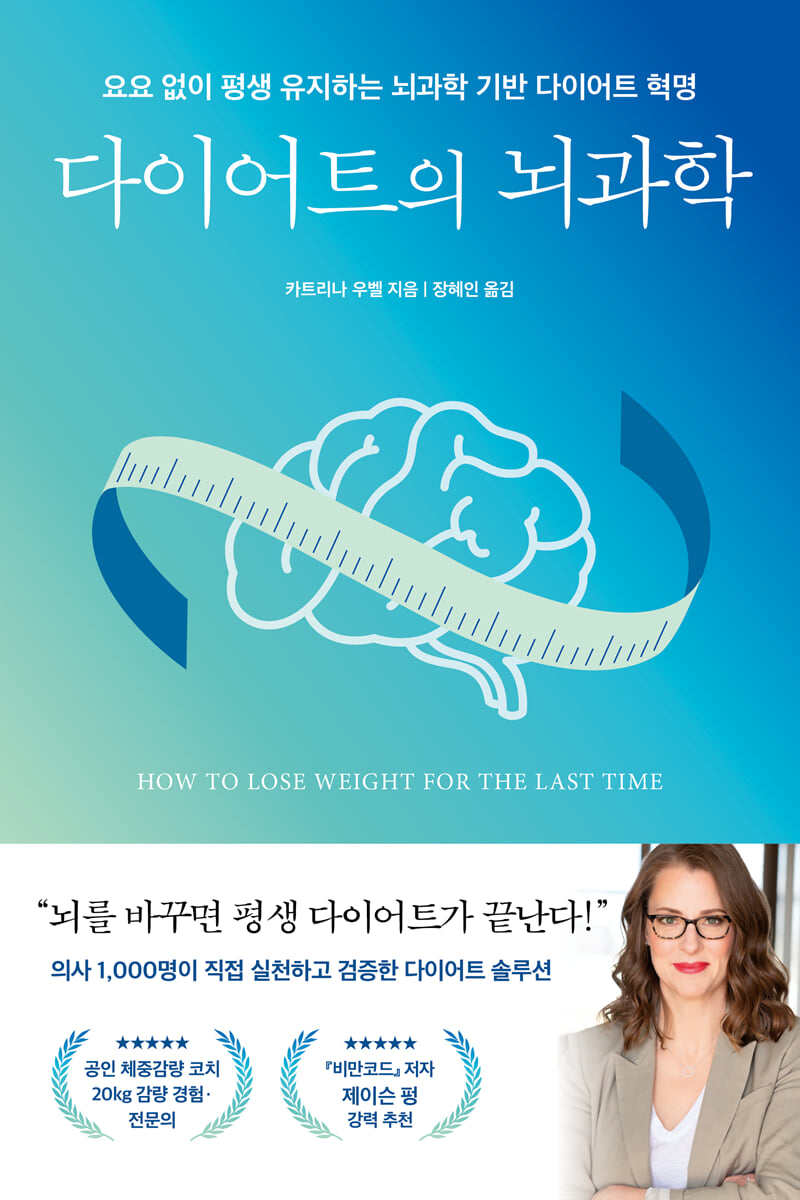
The Brain Science of Dieting
 |
Description
Book Introduction
A doctor who successfully helped 1,000 people lose weight says:
“We designed the brain before the diet.”
“Even I, an obesity specialist who lost 70kg, found completely new answers in this book.”
― Jen Kearns, MD, American Society for Obesity Medicine
It is possible without willpower,
A Lifelong Diet Perfected with Brain Science
“I hated myself the most when I regretted eating something.”
"The Brain Science of Diet" is a prescription for recovery for everyone who has been so disappointed in themselves.
This book, personally practiced and verified by thousands of doctors, guides you through the cycle of yo-yo dieting and binge eating, and helps you regain a healthy body and mind.
The author reveals that the real cause of diet failure is not a lack of willpower, but the way the brain works, and presents a fundamental solution to control appetite and emotions through brain science and behavioral design instead of willpower.
This book is not just a collection of diet tips or dietary advice.
▶ Why do you keep eating even when you are full?
▶ Why diets only last three days
▶ Why do we binge eat when our emotions are fluctuating?
This is the first practical guide to explain all the 'whys' through brain science.
For those who want to break the cycle of self-loathing, which leads to regrets after eating and to the collapse of a diet after starting, this book will serve as a practical guide to the last diet of their lives.
“We designed the brain before the diet.”
“Even I, an obesity specialist who lost 70kg, found completely new answers in this book.”
― Jen Kearns, MD, American Society for Obesity Medicine
It is possible without willpower,
A Lifelong Diet Perfected with Brain Science
“I hated myself the most when I regretted eating something.”
"The Brain Science of Diet" is a prescription for recovery for everyone who has been so disappointed in themselves.
This book, personally practiced and verified by thousands of doctors, guides you through the cycle of yo-yo dieting and binge eating, and helps you regain a healthy body and mind.
The author reveals that the real cause of diet failure is not a lack of willpower, but the way the brain works, and presents a fundamental solution to control appetite and emotions through brain science and behavioral design instead of willpower.
This book is not just a collection of diet tips or dietary advice.
▶ Why do you keep eating even when you are full?
▶ Why diets only last three days
▶ Why do we binge eat when our emotions are fluctuating?
This is the first practical guide to explain all the 'whys' through brain science.
For those who want to break the cycle of self-loathing, which leads to regrets after eating and to the collapse of a diet after starting, this book will serve as a practical guide to the last diet of their lives.
- You can preview some of the book's contents.
Preview
index
Recommendation
Entering
Chapter 1 Why Do We Keep Eating Even When We Are Full?
Chapter 2: Food that Your Emotions Want, Not Your Body
Chapter 3: A Starting Point for Escape from Emotional Appetite
Chapter 4: When to Eat and When to Stop: Reading Your Body's Signals
Chapter 5: Planning Your Own Meal
Chapter 6: A Scientific Method for Checking Diet Results
Chapter 7: The Most Common Reasons Why You Can't Lose Weight
Chapter 8: When Emotions Sway: The Mechanism of Binge Eating
Chapter 9: How to Feel Better Without Eating: Emotion Regulation Tips
Chapter 10: Lifelong Sustainable Diet Strategies
Chapter 11: A Bright Future
Acknowledgements
References
Recommended Resources
Appendix | 'Diet Program for Doctors'
Entering
Chapter 1 Why Do We Keep Eating Even When We Are Full?
Chapter 2: Food that Your Emotions Want, Not Your Body
Chapter 3: A Starting Point for Escape from Emotional Appetite
Chapter 4: When to Eat and When to Stop: Reading Your Body's Signals
Chapter 5: Planning Your Own Meal
Chapter 6: A Scientific Method for Checking Diet Results
Chapter 7: The Most Common Reasons Why You Can't Lose Weight
Chapter 8: When Emotions Sway: The Mechanism of Binge Eating
Chapter 9: How to Feel Better Without Eating: Emotion Regulation Tips
Chapter 10: Lifelong Sustainable Diet Strategies
Chapter 11: A Bright Future
Acknowledgements
References
Recommended Resources
Appendix | 'Diet Program for Doctors'
Detailed image

Into the book
"An overweight doctor"? Isn't that really embarrassing?
I think that doctors would take good care of their own bodies.
But there is a truth hidden here that many people do not know.
In fact, medical schools rarely teach “healthy weight management” or nutrition.
After meeting with over 1,000 doctors, I realized that very few truly understand healthy eating.
Doctors may be experts at treating diseases, but they often fail to properly manage their own eating habits.
According to the 2017 Medical Professional Health Survey, 63 percent of American doctors were overweight or obese.
A 2012 survey also found that 55 percent of nurses had weight issues.
This result is not much different from the statistic that 69 percent of Americans are overweight or clinically obese.
I, too, have experienced the yo-yo effect of gaining and losing 40 pounds while working as a pediatrician.
Yet, in the crowded clinic, he gave advice to the patient's parents on diet management as if he knew all the answers.
But the diet I recommended was so different from my actual eating habits.
The shame and confusion deepened.
--- p.8-9, from “Introduction”
I learned how to soothe negative emotions and nurture positive ones with food.
Food was my refuge, my mood-altering tool, and my means of communicating with others.
On my days off, I would spend time in the kitchen cooking and baking.
Looking back now, I was a very introverted person, so I think I treated the lonely time I spent in the kitchen as my own time.
It was because I believed that to be a good mother, I had to do something productive for my family rather than just sit around.
…
But I realized something important.
That means you don't have to change the lives of those around you to eat healthy.
Through coaching, I discovered that I had the power within me to shift my perspective, examine my thoughts, and consciously choose differently.
The realization that I could look at food and hunger in a new way completely changed my life.
I came to understand that I have the power to decide how I feel in every moment.
--- p.13-14, from “Introduction”
How do foods in their natural state work? Chewing wholesome, unprocessed, natural foods thoroughly releases the right amount of dopamine, providing a pleasant sensation.
It's a reward for a healthy diet, with added benefits like smooth digestion, better sleep, increased energy, and mental clarity.
This experience will help you seek out similarly nutritious foods the next time you're hungry.
But humanity has gone one step further.
I discovered a way to concentrate this very pleasure.
Around the first century AD, humans refined sugarcane to create the white sugar we know today.
Technological advancements have made sugar
As production costs fell, sugar, once the preserve of the upper class, gradually became a popular food item, and by the 1700s, demand had exploded.
In Britain in particular, sugar consumption skyrocketed with the spread of tea culture.
Refined wheat flour was also a valuable food ingredient until the Industrial Revolution.
However, the invention of the roller mill made it possible to easily remove the bitter-tasting bran and germ, mass-producing fine-particle flour, and extending its shelf life.
Finely ground wheat flour is easy to digest and tastes good, so it's easy to overeat, and you end up consuming much more of it compared to whole wheat.
When sugar and flour meet, a huge amount of dopamine is secreted in the brain.
Imagine a baby tasting cake for the first time.
The expression of a baby filled with joy with whipped cream on his face shows the dopamine overflowing in ecstasy.
Dopamine, which is secreted explosively like this, gives the human brain an intense sense of pleasure.
And once we experience this extreme pleasure, we instinctively want to feel it again quickly.
Unfortunately, in modern society, these desires can be met all too easily.
In the United States, 74 percent of products distributed in the food supply chain contain sweeteners (such as sugar or high-fructose corn syrup).
Since most of the foods we eat on a daily basis contain flour or sugar, we now have difficulty feeling hungry unless the food is sweet enough.
--- p.30-31, from “Chapter 1 | Why Do We Keep Eating Even When We Are Full?”
“I just enjoy food.” “When I travel, eating at great restaurants and savoring special dishes is one of the joys of life!” “Wine is my escape.
I'm so stressed out at work….
“I need a glass of wine to end the day and unwind.”
When I first heard the term "emotional eating," I thought it had nothing to do with me.
Emotional eaters were thought to be people who couldn't cope with life's difficulties and would empty ice cream containers in tears.
My life wasn't that miserable.
Overall, I had a happy family and a stable job, and there was no reason to complain.
There were countless people who lived much more difficult lives than I did.
So I couldn't admit that I was an emotional eater and thought I just loved food.
So I was trying hard to deny the fundamental reason for overeating.
But it wasn't until my nutrition counselor started recommending books about emotional eating that I finally realized what was wrong.
Emotional eating isn't just about binge eating because you can't control your emotions.
Any act of eating for reasons other than its original purpose of providing energy to the body was emotional eating.
I remembered countless times when I had picked up something and eaten it even though I wasn't hungry, and I immediately changed my mind.
That day I admitted that I was actually an emotional eater.
And gradually I realized that almost everyone was like that.
--- p.53-54, from “Chapter 2 | Food that Your Emotions Want, Not Your Body”
Many clients are surprised to find that they actually feel better when they don't overeat.
Even those who were hesitant to stop at +4 will find that their overall condition improves significantly once they actually try it.
I often hear people say, “You’re so energetic!”
The reason your body feels sluggish after overeating is because it uses too much energy to digest.
So most people feel drowsy after overeating and want to take a nap or just zone out after lunch.
Even after a long time of eating, I can't even think about doing anything active or exercising.
The quality of sleep also worsens.
This is because digestion takes energy away from the body at night, when it should be restoring and regenerating the brain.
According to a study in the Journal of Clinical Sleep Medicine, eating a meal before bed (especially a high-fat meal) can decrease sleep efficiency, take longer to fall asleep, cause frequent awakenings, and reduce REM sleep, all of which can negatively impact sleep quality.
If you stop at +4, there is no need for a 'recovery' period after eating.
Rather, I feel more energetic and my head becomes clearer.
I feel like my body is functioning properly.
However, consistently experimenting and adjusting to accurately match a specific number on the hunger index to your actual sensations requires constant experimentation.
This trial and error process is well worth it until the ability to check your own condition and accurately read your hunger index becomes second nature.
--- p.120-121, from “Chapter 4 | When to Eat and When to Stop: How to Read Your Body’s Signals”
Even if you follow a good protocol faithfully, weight loss may not proceed at a consistent rate.
You may experience a plateau or even weight gain, which is common.
Some people stay for ten days
Even though I kept my weight well, there was no change, and then suddenly I lost 2 kilograms in two days.
It's as if the body has been holding onto the weight for a while and has finally decided to let it go.
The human body is a very complex system, so it is difficult to explain the exact cause of this phenomenon.
One thing is certain, however: these irregular patterns are normal.
Therefore, when such a situation arises, it is important to have a mindset about how to accept and deal with it.
Don't give up too soon or beat yourself up if you don't see any change on the scale.
If progress isn't immediately visible, many people give up on the protocol, saying, "This isn't going to work!"
Some people even conclude that dieting is impossible, blaming it on genes or a slow metabolism.
But in reality, the results of your efforts only appear a little later.
Today's weight reflects your eating patterns over the past 1-2 weeks.
This is not a short-term gamble, but a long-term investment.
Even if there is no immediate reward, consistent effort will definitely bear fruit.
Keeping a food and weight diary can help you better understand your body's reactions.
You can identify patterns and plan for the future based on facts and data, not emotions.
I think that doctors would take good care of their own bodies.
But there is a truth hidden here that many people do not know.
In fact, medical schools rarely teach “healthy weight management” or nutrition.
After meeting with over 1,000 doctors, I realized that very few truly understand healthy eating.
Doctors may be experts at treating diseases, but they often fail to properly manage their own eating habits.
According to the 2017 Medical Professional Health Survey, 63 percent of American doctors were overweight or obese.
A 2012 survey also found that 55 percent of nurses had weight issues.
This result is not much different from the statistic that 69 percent of Americans are overweight or clinically obese.
I, too, have experienced the yo-yo effect of gaining and losing 40 pounds while working as a pediatrician.
Yet, in the crowded clinic, he gave advice to the patient's parents on diet management as if he knew all the answers.
But the diet I recommended was so different from my actual eating habits.
The shame and confusion deepened.
--- p.8-9, from “Introduction”
I learned how to soothe negative emotions and nurture positive ones with food.
Food was my refuge, my mood-altering tool, and my means of communicating with others.
On my days off, I would spend time in the kitchen cooking and baking.
Looking back now, I was a very introverted person, so I think I treated the lonely time I spent in the kitchen as my own time.
It was because I believed that to be a good mother, I had to do something productive for my family rather than just sit around.
…
But I realized something important.
That means you don't have to change the lives of those around you to eat healthy.
Through coaching, I discovered that I had the power within me to shift my perspective, examine my thoughts, and consciously choose differently.
The realization that I could look at food and hunger in a new way completely changed my life.
I came to understand that I have the power to decide how I feel in every moment.
--- p.13-14, from “Introduction”
How do foods in their natural state work? Chewing wholesome, unprocessed, natural foods thoroughly releases the right amount of dopamine, providing a pleasant sensation.
It's a reward for a healthy diet, with added benefits like smooth digestion, better sleep, increased energy, and mental clarity.
This experience will help you seek out similarly nutritious foods the next time you're hungry.
But humanity has gone one step further.
I discovered a way to concentrate this very pleasure.
Around the first century AD, humans refined sugarcane to create the white sugar we know today.
Technological advancements have made sugar
As production costs fell, sugar, once the preserve of the upper class, gradually became a popular food item, and by the 1700s, demand had exploded.
In Britain in particular, sugar consumption skyrocketed with the spread of tea culture.
Refined wheat flour was also a valuable food ingredient until the Industrial Revolution.
However, the invention of the roller mill made it possible to easily remove the bitter-tasting bran and germ, mass-producing fine-particle flour, and extending its shelf life.
Finely ground wheat flour is easy to digest and tastes good, so it's easy to overeat, and you end up consuming much more of it compared to whole wheat.
When sugar and flour meet, a huge amount of dopamine is secreted in the brain.
Imagine a baby tasting cake for the first time.
The expression of a baby filled with joy with whipped cream on his face shows the dopamine overflowing in ecstasy.
Dopamine, which is secreted explosively like this, gives the human brain an intense sense of pleasure.
And once we experience this extreme pleasure, we instinctively want to feel it again quickly.
Unfortunately, in modern society, these desires can be met all too easily.
In the United States, 74 percent of products distributed in the food supply chain contain sweeteners (such as sugar or high-fructose corn syrup).
Since most of the foods we eat on a daily basis contain flour or sugar, we now have difficulty feeling hungry unless the food is sweet enough.
--- p.30-31, from “Chapter 1 | Why Do We Keep Eating Even When We Are Full?”
“I just enjoy food.” “When I travel, eating at great restaurants and savoring special dishes is one of the joys of life!” “Wine is my escape.
I'm so stressed out at work….
“I need a glass of wine to end the day and unwind.”
When I first heard the term "emotional eating," I thought it had nothing to do with me.
Emotional eaters were thought to be people who couldn't cope with life's difficulties and would empty ice cream containers in tears.
My life wasn't that miserable.
Overall, I had a happy family and a stable job, and there was no reason to complain.
There were countless people who lived much more difficult lives than I did.
So I couldn't admit that I was an emotional eater and thought I just loved food.
So I was trying hard to deny the fundamental reason for overeating.
But it wasn't until my nutrition counselor started recommending books about emotional eating that I finally realized what was wrong.
Emotional eating isn't just about binge eating because you can't control your emotions.
Any act of eating for reasons other than its original purpose of providing energy to the body was emotional eating.
I remembered countless times when I had picked up something and eaten it even though I wasn't hungry, and I immediately changed my mind.
That day I admitted that I was actually an emotional eater.
And gradually I realized that almost everyone was like that.
--- p.53-54, from “Chapter 2 | Food that Your Emotions Want, Not Your Body”
Many clients are surprised to find that they actually feel better when they don't overeat.
Even those who were hesitant to stop at +4 will find that their overall condition improves significantly once they actually try it.
I often hear people say, “You’re so energetic!”
The reason your body feels sluggish after overeating is because it uses too much energy to digest.
So most people feel drowsy after overeating and want to take a nap or just zone out after lunch.
Even after a long time of eating, I can't even think about doing anything active or exercising.
The quality of sleep also worsens.
This is because digestion takes energy away from the body at night, when it should be restoring and regenerating the brain.
According to a study in the Journal of Clinical Sleep Medicine, eating a meal before bed (especially a high-fat meal) can decrease sleep efficiency, take longer to fall asleep, cause frequent awakenings, and reduce REM sleep, all of which can negatively impact sleep quality.
If you stop at +4, there is no need for a 'recovery' period after eating.
Rather, I feel more energetic and my head becomes clearer.
I feel like my body is functioning properly.
However, consistently experimenting and adjusting to accurately match a specific number on the hunger index to your actual sensations requires constant experimentation.
This trial and error process is well worth it until the ability to check your own condition and accurately read your hunger index becomes second nature.
--- p.120-121, from “Chapter 4 | When to Eat and When to Stop: How to Read Your Body’s Signals”
Even if you follow a good protocol faithfully, weight loss may not proceed at a consistent rate.
You may experience a plateau or even weight gain, which is common.
Some people stay for ten days
Even though I kept my weight well, there was no change, and then suddenly I lost 2 kilograms in two days.
It's as if the body has been holding onto the weight for a while and has finally decided to let it go.
The human body is a very complex system, so it is difficult to explain the exact cause of this phenomenon.
One thing is certain, however: these irregular patterns are normal.
Therefore, when such a situation arises, it is important to have a mindset about how to accept and deal with it.
Don't give up too soon or beat yourself up if you don't see any change on the scale.
If progress isn't immediately visible, many people give up on the protocol, saying, "This isn't going to work!"
Some people even conclude that dieting is impossible, blaming it on genes or a slow metabolism.
But in reality, the results of your efforts only appear a little later.
Today's weight reflects your eating patterns over the past 1-2 weeks.
This is not a short-term gamble, but a long-term investment.
Even if there is no immediate reward, consistent effort will definitely bear fruit.
Keeping a food and weight diary can help you better understand your body's reactions.
You can identify patterns and plan for the future based on facts and data, not emotions.
--- p.171, from “Chapter 6 | Scientific Methods for Understanding Diet Results”
Publisher's Review
7 Brain Science Solutions You Can Get from This Book
1.
Breaking the Willpower Trap: How to Rewire Your Brain Without Relying on Willpower
2.
Emotional Overeating Blocking Techniques: Strategies for Breaking the Link Between Stress and Food
3.
How to Recover from Your Body's Signals: How to Distinguish Real Hunger from Fake Hunger
4.
Replacing Toxic Beliefs: Replacing False Eating Beliefs with Healthy Beliefs
5.
Rewiring Your Brain: Creating Sustainable Change Without Guilt
6.
Personalized Lifetime Action Plan: Designing a Personalized Diet Without Yo-Yoing
7.
Developing Dopamine Alternatives: Finding Healthy Dopamine Sources Beyond Food
1.
Breaking the Willpower Trap: How to Rewire Your Brain Without Relying on Willpower
2.
Emotional Overeating Blocking Techniques: Strategies for Breaking the Link Between Stress and Food
3.
How to Recover from Your Body's Signals: How to Distinguish Real Hunger from Fake Hunger
4.
Replacing Toxic Beliefs: Replacing False Eating Beliefs with Healthy Beliefs
5.
Rewiring Your Brain: Creating Sustainable Change Without Guilt
6.
Personalized Lifetime Action Plan: Designing a Personalized Diet Without Yo-Yoing
7.
Developing Dopamine Alternatives: Finding Healthy Dopamine Sources Beyond Food
Diet is decided in the brain
─ The problem wasn't willpower, it was brain circuitry.
"The Brain Science of Dieting" offers an innovative approach that turns the tired diet advice of "eat less, move more" on its head.
The author, who personally experienced the 18kg yo-yo effect several times since his medical school days, developed a diet program based on brain science based on this painful experience.
As a result, more than 1,000 doctors successfully lost an average of 9.6% of their body weight in just six months without medication, and surprisingly, their stress levels also improved significantly.
The cause of diet failure was not lack of willpower, but brain circuitry.
The formula “food = comfort/reward” is ingrained in us from childhood, leading to emotional overeating even in adulthood.
An internist confessed:
“I couldn’t understand why I would reach for chocolate whenever I was stressed, even though I was dieting for 20 years.
Through this book, I learned that it was due to the brain circuits formed during childhood, and I was finally able to break that cycle.”
Since childhood, whenever we feel boredom, loneliness, stress, or anxiety, we have been soothing ourselves with food, and this pattern leads to unconscious overeating, which leads to repeated failed diets.
Therefore, rather than controlling your food intake or counting calories, the starting point is to recognize your emotions and reactions and ask yourself why you eat.
The reason traditional diets fail is because they confront bad habits head-on.
Instead, the author proposes a strategy to build new healthy habit circuits by leveraging 'neuroplasticity'.
“When you want to eat candy, don’t force yourself to endure it by saying, ‘I have to hold back.’
Instead, if you repeat a new behavior, such as drinking water or taking a five-minute walk, the new habit circuit will gradually be strengthened and the existing craving itself will weaken.” This book provides a detailed step-by-step methodology, from identifying trigger situations to designing healthy alternative behaviors and rewiring brain circuits through consistent repetition.
Design your brain before your diet
This book clearly explains the scientific reasons why existing diets are bound to fail.
The root of diet failure is not a lack of willpower, but rather “how the brain uses energy.”
The key is to change the body from a 'sugar burning state' due to a diet centered on processed foods to a 'fat adaptation state'.
“If we use a refrigerator as an analogy, until now, we have only been taking out and eating food from the refrigerator (blood sugar) and have not been able to use the food that is full in the freezer (body fat).
“By adjusting your eating habits, your body will naturally start using stored fat as a source of energy.”
The appetite we feel is not simply hunger, but is due to special circuits engraved in our brain.
Our brains, like a computer program, store patterns like “I feel bad → I eat chocolate → I feel better.”
These accumulated patterns are established in a place called the 'basal ganglia' deep in the brain and become solidified into automatic behavior without us even knowing it.
Dr. Katrina Ubel says that rather than forcing these patterns to endure, we need to "redesign" them.
So how can we do this? This book presents practical methods that anyone can easily follow.
Here are some of them:
- Emotional Freedom Technique (EFT): A method of releasing emotions by gently tapping specific points.
- Keep a new food diary: Instead of saying, “I ate two slices of pizza for lunch today,” write down why you ate, such as, “I ate pizza because I was stressed after the meeting.”
- 90-second emotional flow observation: Don't hold back, just watch the emotion pass by for 90 seconds.
Emotions come and go like waves.
- Knowing Your Body's True Signals: How to Distinguish Between Real and Emotional Hunger
“In fact, what matters is not what you eat, but why you eat it.
Were you truly hungry, or was it due to loneliness or stress? If you were eating due to stress, find another way to deal with it.
“The moment you notice those patterns, your behavior naturally begins to change.” All of these methods focus not on fighting appetites, but on rewiring our emotions and brain circuits.
The journey to listening more closely to our body's hunger signals and building healthy relationships free from emotional sway begins here.
For you who regret eating
The last diet of my life
Doctors who participated in the author's program experienced amazing results.
Over six months, they lost an average of 9.6% of their body weight without medication or extreme diet restrictions.
But there was a more important change than numbers.
My constant thoughts about food have decreased and my concentration on work and life has greatly improved.
“What surprised the participants most wasn’t the weight loss.
The experience of my appetite being naturally controlled was shocking in itself.
“Before, I would spend all day thinking about ‘what should I eat next?’ Now, my brain can focus on other important things.”
One emergency medicine physician described his experience this way:
“I didn’t know my body could function so well without food.
I don't fight my appetite anymore.
“It feels like I’ve rewired my brain.”
Katrina Ubel says the secret to her ability to maintain weight loss without yo-yoing, despite the medical world's irregular schedule, is that she developed a "protocol" (action plan) optimized for her personal lifestyle, physical condition, and emotional state.
This protocol consists of eight core elements:
Keep a food diary, limit sugar and flour, eat only at mealtimes (limit snacking), create personalized eating habits, practice intermittent fasting, plan ahead, have flexible exceptions, and monitor your weight daily.
In particular, by limiting flour and sugar, you suppress the brain's excessive dopamine secretion, allowing your body to detect true hunger signals and use fat as an efficient energy source.
Rather than requiring superhuman willpower, this method is a process that helps your body function naturally as it was designed to.
No more being stuck in the 'eat and regret' routine.
This book asks us one last question:
"The real question is, are you hungry or are you hungry?" Diet decisions are made in the brain.
─ The problem wasn't willpower, it was brain circuitry.
"The Brain Science of Dieting" offers an innovative approach that turns the tired diet advice of "eat less, move more" on its head.
The author, who personally experienced the 18kg yo-yo effect several times since his medical school days, developed a diet program based on brain science based on this painful experience.
As a result, more than 1,000 doctors successfully lost an average of 9.6% of their body weight in just six months without medication, and surprisingly, their stress levels also improved significantly.
The cause of diet failure was not lack of willpower, but brain circuitry.
The formula “food = comfort/reward” is ingrained in us from childhood, leading to emotional overeating even in adulthood.
An internist confessed:
“I couldn’t understand why I would reach for chocolate whenever I was stressed, even though I was dieting for 20 years.
Through this book, I learned that it was due to the brain circuits formed during childhood, and I was finally able to break that cycle.”
Since childhood, whenever we feel boredom, loneliness, stress, or anxiety, we have been soothing ourselves with food, and this pattern leads to unconscious overeating, which leads to repeated failed diets.
Therefore, rather than controlling your food intake or counting calories, the starting point is to recognize your emotions and reactions and ask yourself why you eat.
The reason traditional diets fail is because they confront bad habits head-on.
Instead, the author proposes a strategy to build new healthy habit circuits by leveraging 'neuroplasticity'.
“When you want to eat candy, don’t force yourself to endure it by saying, ‘I have to hold back.’
Instead, if you repeat a new behavior, such as drinking water or taking a five-minute walk, the new habit circuit will gradually be strengthened and the existing craving itself will weaken.” This book provides a detailed step-by-step methodology, from identifying trigger situations to designing healthy alternative behaviors and rewiring brain circuits through consistent repetition.
Design your brain before your diet
This book clearly explains the scientific reasons why existing diets are bound to fail.
The root of diet failure is not a lack of willpower, but rather “how the brain uses energy.”
The key is to change the body from a 'sugar burning state' due to a diet centered on processed foods to a 'fat adaptation state'.
“If we use a refrigerator as an analogy, until now, we have only been taking out and eating food from the refrigerator (blood sugar) and have not been able to use the food that is full in the freezer (body fat).
“By adjusting your eating habits, your body will naturally start using stored fat as a source of energy.”
The appetite we feel is not simply hunger, but is due to special circuits engraved in our brain.
Our brains, like a computer program, store patterns like “I feel bad → I eat chocolate → I feel better.”
These accumulated patterns are established in a place called the 'basal ganglia' deep in the brain and become solidified into automatic behavior without us even knowing it.
Dr. Katrina Ubel says that rather than forcing these patterns to endure, we need to "redesign" them.
So how can we do this? This book presents practical methods that anyone can easily follow.
Here are some of them:
- Emotional Freedom Technique (EFT): A method of releasing emotions by gently tapping specific points.
- Keep a new food diary: Instead of saying, “I ate two slices of pizza for lunch today,” write down why you ate, such as, “I ate pizza because I was stressed after the meeting.”
- 90-second emotional flow observation: Don't hold back, just watch the emotion pass by for 90 seconds.
Emotions come and go like waves.
- Knowing Your Body's True Signals: How to Distinguish Between Real and Emotional Hunger
“In fact, what matters is not what you eat, but why you eat it.
Were you truly hungry, or was it due to loneliness or stress? If you were eating due to stress, find another way to deal with it.
“The moment you notice those patterns, your behavior naturally begins to change.” All of these methods focus not on fighting appetites, but on rewiring our emotions and brain circuits.
The journey to listening more closely to our body's hunger signals and building healthy relationships free from emotional sway begins here.
For you who regret eating
The last diet of my life
Doctors who participated in the author's program experienced amazing results.
Over six months, they lost an average of 9.6% of their body weight without medication or extreme diet restrictions.
But there was a more important change than numbers.
My constant thoughts about food have decreased and my concentration on work and life has greatly improved.
“What surprised the participants most wasn’t the weight loss.
The experience of my appetite being naturally controlled was shocking in itself.
“Before, I would spend all day thinking about ‘what should I eat next?’ Now, my brain can focus on other important things.”
One emergency medicine physician described his experience this way:
“I didn’t know my body could function so well without food.
I don't fight my appetite anymore.
“It feels like I’ve rewired my brain.”
Katrina Ubel says the secret to her ability to maintain weight loss without yo-yoing, despite the medical world's irregular schedule, is that she developed a "protocol" (action plan) optimized for her personal lifestyle, physical condition, and emotional state.
This protocol consists of eight core elements:
Keep a food diary, limit sugar and flour, eat only at mealtimes (limit snacking), create personalized eating habits, practice intermittent fasting, plan ahead, have flexible exceptions, and monitor your weight daily.
In particular, by limiting flour and sugar, you suppress the brain's excessive dopamine secretion, allowing your body to detect true hunger signals and use fat as an efficient energy source.
Rather than requiring superhuman willpower, this method is a process that helps your body function naturally as it was designed to.
No more being stuck in the 'eat and regret' routine.
This book asks us one last question:
“The real question is, are you hungry or are you hungry?”
─ The problem wasn't willpower, it was brain circuitry.
"The Brain Science of Dieting" offers an innovative approach that turns the tired diet advice of "eat less, move more" on its head.
The author, who personally experienced the 18kg yo-yo effect several times since his medical school days, developed a diet program based on brain science based on this painful experience.
As a result, more than 1,000 doctors successfully lost an average of 9.6% of their body weight in just six months without medication, and surprisingly, their stress levels also improved significantly.
The cause of diet failure was not lack of willpower, but brain circuitry.
The formula “food = comfort/reward” is ingrained in us from childhood, leading to emotional overeating even in adulthood.
An internist confessed:
“I couldn’t understand why I would reach for chocolate whenever I was stressed, even though I was dieting for 20 years.
Through this book, I learned that it was due to the brain circuits formed during childhood, and I was finally able to break that cycle.”
Since childhood, whenever we feel boredom, loneliness, stress, or anxiety, we have been soothing ourselves with food, and this pattern leads to unconscious overeating, which leads to repeated failed diets.
Therefore, rather than controlling your food intake or counting calories, the starting point is to recognize your emotions and reactions and ask yourself why you eat.
The reason traditional diets fail is because they confront bad habits head-on.
Instead, the author proposes a strategy to build new healthy habit circuits by leveraging 'neuroplasticity'.
“When you want to eat candy, don’t force yourself to endure it by saying, ‘I have to hold back.’
Instead, if you repeat a new behavior, such as drinking water or taking a five-minute walk, the new habit circuit will gradually be strengthened and the existing craving itself will weaken.” This book provides a detailed step-by-step methodology, from identifying trigger situations to designing healthy alternative behaviors and rewiring brain circuits through consistent repetition.
Design your brain before your diet
This book clearly explains the scientific reasons why existing diets are bound to fail.
The root of diet failure is not a lack of willpower, but rather “how the brain uses energy.”
The key is to change the body from a 'sugar burning state' due to a diet centered on processed foods to a 'fat adaptation state'.
“If we use a refrigerator as an analogy, until now, we have only been taking out and eating food from the refrigerator (blood sugar) and have not been able to use the food that is full in the freezer (body fat).
“By adjusting your eating habits, your body will naturally start using stored fat as a source of energy.”
The appetite we feel is not simply hunger, but is due to special circuits engraved in our brain.
Our brains, like a computer program, store patterns like “I feel bad → I eat chocolate → I feel better.”
These accumulated patterns are established in a place called the 'basal ganglia' deep in the brain and become solidified into automatic behavior without us even knowing it.
Dr. Katrina Ubel says that rather than forcing these patterns to endure, we need to "redesign" them.
So how can we do this? This book presents practical methods that anyone can easily follow.
Here are some of them:
- Emotional Freedom Technique (EFT): A method of releasing emotions by gently tapping specific points.
- Keep a new food diary: Instead of saying, “I ate two slices of pizza for lunch today,” write down why you ate, such as, “I ate pizza because I was stressed after the meeting.”
- 90-second emotional flow observation: Don't hold back, just watch the emotion pass by for 90 seconds.
Emotions come and go like waves.
- Knowing Your Body's True Signals: How to Distinguish Between Real and Emotional Hunger
“In fact, what matters is not what you eat, but why you eat it.
Were you truly hungry, or was it due to loneliness or stress? If you were eating due to stress, find another way to deal with it.
“The moment you notice those patterns, your behavior naturally begins to change.” All of these methods focus not on fighting appetites, but on rewiring our emotions and brain circuits.
The journey to listening more closely to our body's hunger signals and building healthy relationships free from emotional sway begins here.
For you who regret eating
The last diet of my life
Doctors who participated in the author's program experienced amazing results.
Over six months, they lost an average of 9.6% of their body weight without medication or extreme diet restrictions.
But there was a more important change than numbers.
My constant thoughts about food have decreased and my concentration on work and life has greatly improved.
“What surprised the participants most wasn’t the weight loss.
The experience of my appetite being naturally controlled was shocking in itself.
“Before, I would spend all day thinking about ‘what should I eat next?’ Now, my brain can focus on other important things.”
One emergency medicine physician described his experience this way:
“I didn’t know my body could function so well without food.
I don't fight my appetite anymore.
“It feels like I’ve rewired my brain.”
Katrina Ubel says the secret to her ability to maintain weight loss without yo-yoing, despite the medical world's irregular schedule, is that she developed a "protocol" (action plan) optimized for her personal lifestyle, physical condition, and emotional state.
This protocol consists of eight core elements:
Keep a food diary, limit sugar and flour, eat only at mealtimes (limit snacking), create personalized eating habits, practice intermittent fasting, plan ahead, have flexible exceptions, and monitor your weight daily.
In particular, by limiting flour and sugar, you suppress the brain's excessive dopamine secretion, allowing your body to detect true hunger signals and use fat as an efficient energy source.
Rather than requiring superhuman willpower, this method is a process that helps your body function naturally as it was designed to.
No more being stuck in the 'eat and regret' routine.
This book asks us one last question:
"The real question is, are you hungry or are you hungry?" Diet decisions are made in the brain.
─ The problem wasn't willpower, it was brain circuitry.
"The Brain Science of Dieting" offers an innovative approach that turns the tired diet advice of "eat less, move more" on its head.
The author, who personally experienced the 18kg yo-yo effect several times since his medical school days, developed a diet program based on brain science based on this painful experience.
As a result, more than 1,000 doctors successfully lost an average of 9.6% of their body weight in just six months without medication, and surprisingly, their stress levels also improved significantly.
The cause of diet failure was not lack of willpower, but brain circuitry.
The formula “food = comfort/reward” is ingrained in us from childhood, leading to emotional overeating even in adulthood.
An internist confessed:
“I couldn’t understand why I would reach for chocolate whenever I was stressed, even though I was dieting for 20 years.
Through this book, I learned that it was due to the brain circuits formed during childhood, and I was finally able to break that cycle.”
Since childhood, whenever we feel boredom, loneliness, stress, or anxiety, we have been soothing ourselves with food, and this pattern leads to unconscious overeating, which leads to repeated failed diets.
Therefore, rather than controlling your food intake or counting calories, the starting point is to recognize your emotions and reactions and ask yourself why you eat.
The reason traditional diets fail is because they confront bad habits head-on.
Instead, the author proposes a strategy to build new healthy habit circuits by leveraging 'neuroplasticity'.
“When you want to eat candy, don’t force yourself to endure it by saying, ‘I have to hold back.’
Instead, if you repeat a new behavior, such as drinking water or taking a five-minute walk, the new habit circuit will gradually be strengthened and the existing craving itself will weaken.” This book provides a detailed step-by-step methodology, from identifying trigger situations to designing healthy alternative behaviors and rewiring brain circuits through consistent repetition.
Design your brain before your diet
This book clearly explains the scientific reasons why existing diets are bound to fail.
The root of diet failure is not a lack of willpower, but rather “how the brain uses energy.”
The key is to change the body from a 'sugar burning state' due to a diet centered on processed foods to a 'fat adaptation state'.
“If we use a refrigerator as an analogy, until now, we have only been taking out and eating food from the refrigerator (blood sugar) and have not been able to use the food that is full in the freezer (body fat).
“By adjusting your eating habits, your body will naturally start using stored fat as a source of energy.”
The appetite we feel is not simply hunger, but is due to special circuits engraved in our brain.
Our brains, like a computer program, store patterns like “I feel bad → I eat chocolate → I feel better.”
These accumulated patterns are established in a place called the 'basal ganglia' deep in the brain and become solidified into automatic behavior without us even knowing it.
Dr. Katrina Ubel says that rather than forcing these patterns to endure, we need to "redesign" them.
So how can we do this? This book presents practical methods that anyone can easily follow.
Here are some of them:
- Emotional Freedom Technique (EFT): A method of releasing emotions by gently tapping specific points.
- Keep a new food diary: Instead of saying, “I ate two slices of pizza for lunch today,” write down why you ate, such as, “I ate pizza because I was stressed after the meeting.”
- 90-second emotional flow observation: Don't hold back, just watch the emotion pass by for 90 seconds.
Emotions come and go like waves.
- Knowing Your Body's True Signals: How to Distinguish Between Real and Emotional Hunger
“In fact, what matters is not what you eat, but why you eat it.
Were you truly hungry, or was it due to loneliness or stress? If you were eating due to stress, find another way to deal with it.
“The moment you notice those patterns, your behavior naturally begins to change.” All of these methods focus not on fighting appetites, but on rewiring our emotions and brain circuits.
The journey to listening more closely to our body's hunger signals and building healthy relationships free from emotional sway begins here.
For you who regret eating
The last diet of my life
Doctors who participated in the author's program experienced amazing results.
Over six months, they lost an average of 9.6% of their body weight without medication or extreme diet restrictions.
But there was a more important change than numbers.
My constant thoughts about food have decreased and my concentration on work and life has greatly improved.
“What surprised the participants most wasn’t the weight loss.
The experience of my appetite being naturally controlled was shocking in itself.
“Before, I would spend all day thinking about ‘what should I eat next?’ Now, my brain can focus on other important things.”
One emergency medicine physician described his experience this way:
“I didn’t know my body could function so well without food.
I don't fight my appetite anymore.
“It feels like I’ve rewired my brain.”
Katrina Ubel says the secret to her ability to maintain weight loss without yo-yoing, despite the medical world's irregular schedule, is that she developed a "protocol" (action plan) optimized for her personal lifestyle, physical condition, and emotional state.
This protocol consists of eight core elements:
Keep a food diary, limit sugar and flour, eat only at mealtimes (limit snacking), create personalized eating habits, practice intermittent fasting, plan ahead, have flexible exceptions, and monitor your weight daily.
In particular, by limiting flour and sugar, you suppress the brain's excessive dopamine secretion, allowing your body to detect true hunger signals and use fat as an efficient energy source.
Rather than requiring superhuman willpower, this method is a process that helps your body function naturally as it was designed to.
No more being stuck in the 'eat and regret' routine.
This book asks us one last question:
“The real question is, are you hungry or are you hungry?”
GOODS SPECIFICS
- Date of issue: June 26, 2025
- Page count, weight, size: 280 pages | 432g | 150*225*18mm
- ISBN13: 9791139724967
- ISBN10: 1139724967
You may also like
카테고리
korean


korean

![GQ KOREA Mark (Monthly): December [2025]](http://librairie.coreenne.fr/cdn/shop/files/8ef265dbbfbf186523ed75ba7319009d.jpg?v=1765340328&width=3840)


